
Jonathan turned the lamp’s little brass wheel, lowering the flame until the room fell into a soft amber darkness.
Evelyn watched the light retreat from the photograph.
He had not asked her to leave.
Yet she understood that she had reached a part of his life he was not ready to share.
“I’ll remember about the shelf,” she said.
Jonathan nodded.
Then he went to his room without another word.
Evelyn remained beside the table.
Six plates sat in the dishpan.
Six cups waited to be washed.
For the first time in months, her sons had eaten enough without her secretly reducing her own portion.
She ought to have felt entirely relieved.
Instead, she found herself wondering whether she had brought five noisy lives into a home that had been grieving for years.
The next morning, she was downstairs before sunrise.
Jonathan was already outside tending the livestock.
Evelyn made breakfast, then called the boys.
Thomas came down first, determined to begin earning his keep.
Samuel followed, arguing cheerfully with Henry over which of them would be given the more difficult work.
James appeared last, still rubbing sleep from his eyes.
At the table, Jonathan explained the day’s chores.
Thomas would accompany him to the cattle.
Samuel and Henry could help with a damaged section of fence, after he showed them what needed doing.
James would begin with lighter tasks near the house.
“I can do what they do,” James protested.
Jonathan shook his head.
“Not every job suits every pair of hands.”
“I don’t want to be useless.”
The farmer studied him.
“Then learn to do a smaller job well.”
James looked toward his mother.
Evelyn nodded.
“That’s worth learning.”
By midday, the boys were busy.
Thomas showed an instinctive calm around the cattle that Jonathan had not expected.
Samuel and Henry turned carrying fence rails into a competition until Jonathan reminded them that careful work mattered more than speed.
James helped Evelyn bring supplies from the pantry and performed his assigned tasks with fierce concentration.
That afternoon, Jonathan discovered him struggling to move a feed sack that was far too heavy.
“Put that down, son.”
James froze.
“I was only trying—”
“I know.”
Jonathan lifted the sack himself.
“You don’t need to prove your worth by hurting yourself.”
James’s face reddened.
“Thomas says everybody has to earn what he eats.”
Jonathan glanced toward the barn.
“Your brother is trying to look after you. But a boy shouldn’t have to carry more than he’s able. There’ll be work enough when you’re older.”
James nodded.
For the first time since arriving, he looked as though he believed he could simply be eleven.
That evening, Evelyn found Thomas washing dirt from his hands.
“You’ve been pushing yourself.”
“We need this place, Mama.”
“I know.”
“If Mr. Reed decides we’re not worth keeping—”
She turned toward him.
“We have an agreement, Thomas. And I intend to make certain it’s a fair one.”
“But what if he changes his mind?”
Evelyn could not promise that he never would.
She had learned what promises were worth when the bank sold their farm.
Instead, she squeezed her son’s shoulder.
“Then we will face it together. But you don’t have to carry that worry alone.”
At supper, Jonathan noticed how carefully the boys waited for him to speak.
He set down his fork.
“You’ve all done good work today.”
Four young faces lifted.
“And we’ll decide tomorrow’s chores tomorrow. Nobody needs to work himself sick trying to earn a month’s keep in a day.”
Samuel grinned.
“Does that mean Henry loses our fence-building contest?”
Henry immediately protested.
For the second evening in a row, laughter filled the kitchen.
Jonathan looked around the table.
Then his gaze settled on Evelyn.
She was smiling, but he noticed the weariness she could no longer completely hide.
After the boys went upstairs, he found her counting the supplies remaining in the pantry.
“Is there a problem?”
“No. I only want to make sure we’re using things wisely.”
He pulled out a chair.
“You can tell me when something’s needed.”
Evelyn closed the cupboard.
“I will. And I would like us to keep a clear understanding of the work we’re doing.”
Jonathan nodded.
“That’s reasonable.”
She hesitated.
“Because my boys have already lost one home. I cannot let them believe this one is theirs unless we know what that means.”
Jonathan looked toward the ceiling.
He had been thinking about empty rooms for six years.
Now four boys slept in them.
And the woman standing before him was asking for something he had never considered carefully enough.
Not simply shelter.
Something secure enough to trust.
He drew a chair away from the table and said, “Sit with me, Evelyn. We ought to settle that properly.”
Evelyn sat in the chair Jonathan had drawn out.
He remained standing for a moment, then took his place across from her.
Between them lay the table that had served one man for six years and six people for only two evenings.
“What would make this arrangement clearer?” he asked.
Evelyn appreciated the question.
She had expected him to remind her that it was his house.
Instead, he had invited her to explain what she needed.
“I want to know what work you’ll expect of us and what we’ll receive for it. The boys are willing, but I want them to have time to learn without being treated as hired men twice their age.”
“Agreed.”
“And if something changes, I need time to make other arrangements. I cannot have them sent away without warning.”
Jonathan considered that.
“I have no intention of putting you out.”
“I understand. But intentions weren’t enough to save our farm.”
He did not argue.
After a moment, they agreed that Evelyn and her sons could use the two upstairs rooms while the arrangement continued, with meals and necessities supplied from the farm.
The boys would help with suitable chores, and Jonathan would teach them what they did not know.
Evelyn would manage meals and much of the household work, with help from the boys, while contributing to the other tasks she could reasonably handle.
They would review the arrangement as the farm’s seasons changed.
Most importantly, Jonathan promised that if the arrangement ended, he would give Evelyn time to find another place.
“Would you want anything more?” he asked.
Evelyn looked at him.
“For tonight, that’s enough.”
He nodded.
“Then we’ll begin there.”
Neither mentioned affection.
Neither imagined marriage.
They were two adults trying to make an honest arrangement out of circumstances neither had chosen.
Yet when Evelyn went upstairs that night, she felt something unfamiliar.
Not certainty.
But the beginnings of trust.
***
The weeks that followed changed the rhythm of Reed Farm.
Thomas became Jonathan’s closest helper with the livestock.
The boy possessed a steadiness around nervous animals that surprised the older man.
He could recognize when a cow was unsettled before it began to kick or pull away, and he followed instructions without needing to be reminded twice.
One afternoon, Jonathan watched him quiet a restless young cow.
“You notice things quickly.”
Thomas shrugged.
“My father used to say that.”
“He was right.”
The boy looked down, but Jonathan saw his pleased expression.
From then on, he taught Thomas not merely what to do, but why.
How to judge a change in weather from the morning sky.
How to recognize when an animal needed closer attention.
How to approach livestock without frightening it.
Thomas listened intently.
But Jonathan was careful to remind him that learning the farm did not require forgetting he was still a boy.
Samuel proved happiest when he could turn a dull job into a challenge.
Henry, meanwhile, seemed determined to understand every field, fence, and tool on the property.
He asked questions about soil and planting until Jonathan sometimes had to stop what he was doing and consider the answer.
“Does your mind ever grow tired?” he asked Henry one afternoon.
“Not when there’s something worth knowing.”
Samuel laughed.
“That means never.”
James followed Jonathan whenever permitted.
He was too young for many demanding chores, but he learned to fetch suitable tools, gather small supplies, and watch carefully.
The boy’s confidence grew each time Jonathan trusted him with a task he could finish.
Inside the farmhouse, Evelyn found work of her own.
The kitchen had everything necessary for a household, yet little evidence that anyone had taken pleasure in it for years.
The shelves were orderly.
The cookware was clean.
But Jonathan had preserved the old arrangement so carefully that Evelyn suspected he was afraid to disturb it.
She changed nothing without asking.
Instead, she organized the provisions, made better use of what the farm produced, repaired worn clothing, and prepared food that could sustain six people through long working days.
The boys helped with the household tasks as well.
Within a few weeks, there was a predictable rhythm to meals, washing, mending, and farm chores.
Jonathan had not realized how much time he had wasted attending to everything alone.
Evelyn had not realized how much strength she still possessed until she began making decisions that mattered again.
One evening, she placed six settings around the table.
Jonathan looked at the chairs.
“You’ve made a habit of filling every place.”
“Would you rather we stood?”
He almost smiled.
“That isn’t what I meant.”
“I know.”
She set down the bread.
“There’s no sense leaving people standing when there’s room at the table.”
Samuel made some ridiculous observation about a stubborn goat.
Henry corrected him.
James laughed so hard that he nearly upset his cup.
And Jonathan, to his own surprise, laughed with them.
Evelyn watched him.
For a moment, the sternness disappeared from his face.
He looked younger.
Not because his grief had vanished, but because something besides grief had briefly claimed his attention.
***
It was after the boys had gone to bed one evening that Evelyn finally asked about his wife.
They had been speaking about the farm’s routines when Jonathan grew quiet at the mention of an old household arrangement.
“You don’t often speak of her,” Evelyn said gently.
Jonathan stared into his coffee.
“Margaret.”
Evelyn waited.
“That was her name.”
He rubbed a thumb along the cup’s handle.
“She was a good woman.”
“I’m sure she was.”
“We had a daughter.”
Evelyn felt her heart tighten.
Jonathan continued before he could lose his courage.
“Fever took them both. Same week. Six years ago.”
For a long moment, the only sound was the faint settling of the stove.
“I stayed because this was their home,” he said. “Leaving would have felt like walking away from the last place we belonged together.”
Evelyn understood.
After William died, she had continued setting aside little things that belonged to him, even when money was desperately short.
She knew how objects could become a person’s last way of keeping faith with someone who was gone.
“William died of fever too,” she said quietly.
Jonathan looked up.
“Eight months before we came here. He’d borrowed against our farm after two bad harvests. When he died, I couldn’t keep up the payments.”
She drew a breath.
“I watched them sell the land. Then I had to tell four boys that the place where they’d grown up was no longer ours.”
Jonathan’s face changed.
He had known she was widowed.
He had not understood the full cost.
“That’s a hard thing to ask a mother to do.”
“It was.”
Evelyn looked toward the staircase.
“Thomas has been trying to replace his father ever since.”
Jonathan nodded slowly.
“I’ve noticed.”
“I don’t want him to lose his boyhood along with everything else.”
“He shouldn’t have to.”
They sat together in silence.
Then Evelyn glanced toward the shelf Jonathan had warned her not to disturb.
“I won’t ever ask you to put Margaret away.”
He followed her gaze.
For the first time, he did not look uncomfortable that she had noticed.
“Thank you.”
Evelyn folded her hands.
“I don’t think remembering people makes it harder to care about the living.”
Jonathan stared into his cup.
He did not answer.
But he remained at the table long after their conversation had ended.
***
Early summer brought a violent prairie storm.
The weather turned quickly, with heavy wind driving rain across the fields and making the barn doors strain against their fastenings.
Jonathan saw the darkening sky and began securing what he could.
Thomas worked beside him at the barn.
Samuel and Henry helped move frightened livestock toward shelter, following Jonathan’s instructions.
Evelyn kept James near the house, where he could carry lanterns and supplies without being exposed to the worst danger.
As darkness settled, a section of fence failed beneath the force of the wind.
Jonathan and Thomas worked in the rain to prevent the opening from growing larger.
“Hold that rail!” Jonathan called.
Thomas braced it as instructed.
His arms shook with effort.
Jonathan fixed the temporary support, then guided him back from the damaged section.
“That’s enough. Get under cover.”
Thomas started to protest.
“You’ve done your share,” Jonathan said firmly. “Now move.”
The boy obeyed.
By the time the worst of the storm had passed, everyone was exhausted.
The rain had soaked their clothing.
Mud covered their boots.
Several hours of repair would be needed after daylight.
But the livestock had been brought to safety, and the barn remained standing.
Jonathan found Evelyn sitting beneath the porch roof with James asleep against her shoulder.
He lowered himself beside them.
For a while, they watched the last of the rain.
“Your boys did well,” he said.
“They’ve had to grow up faster than I wanted.”
“Thomas has a good head for the work.”
“He learned much of that from William.”
“Then his father gave him a fine beginning.”
Evelyn looked at Jonathan.
She had never heard him speak of her husband with jealousy or discomfort.
He seemed content to recognize that another man had loved these children before him.
“Thank you,” she said.
Jonathan glanced at her.
“For what?”
“For making room for us.”
He shook his head.
“We agreed to help each other.”
“I know.”
She looked out toward the fields.
“But this has begun to feel different from an ordinary agreement.”
Jonathan was quiet.
Then he said, “It has.”
Their eyes met.
Neither reached for the other.
There was too much still unspoken.
Yet Evelyn felt that something had crossed between them more meaningful than gratitude.
An acknowledgment that their lives were changing.
***
In the weeks after the storm, James began following Jonathan during evening chores more often than necessary.
One afternoon, he heard the farmer whistling softly while working on a piece of tack.
James attempted to imitate the tune.
The result was dreadful.
Jonathan looked up.
“What was that supposed to be?”
“A whistle.”
“Well, it wants some practice.”
James tried again.
And again.
Jonathan showed him how to shape his lips and control his breath.
At last, a single clear note emerged.
“I did it!”
“You certainly did.”
James grinned.
Then his expression grew thoughtful.
“My papa used to whistle.”
Jonathan set down the tack.
“Did he?”
“Thomas remembers better than I do. I wish I remembered more.”
Jonathan understood the sadness beneath those words.
“You can ask your brothers what they remember.”
“I do.”
James tried another whistle.
“I’m glad you can teach me.”
Jonathan looked at the boy.
It was such a small sentence.
Yet it entered a part of him that had remained closed for six years.
He had believed that all the tenderness he possessed had been buried with Margaret and their daughter.
Now an eleven-year-old boy was standing beside him, trusting him with a task too small to be called important by anyone who did not understand childhood.
Jonathan smiled.
“Let’s try that tune again.”
***
By late summer, Reed Farm had begun to operate more smoothly than it had in years.
The repairs were no longer always behind schedule.
The animals received more regular attention.
The boys had learned their responsibilities, though Evelyn insisted on adequate rest and would not allow them to take on dangerous work merely to prove themselves.
Jonathan also began recognizing that her judgment mattered outside the kitchen.
She helped plan the household provisions and suggested ways to reduce waste during the demanding months ahead.
When decisions affected the entire family, he increasingly asked her opinion.
The change pleased him.
It frightened her too.
One evening, after the boys went upstairs, Evelyn sat beside Jonathan on the porch.
“I promised myself something after William died.”
Jonathan turned toward her.
“What was that?”
“That I would never again let my children’s future depend entirely on the goodwill of one man.”
He listened without interrupting.
“Our old farm was our home. Or so I believed. But when William was gone, the debt was still there, and the bank wanted its payment.”
Her hands tightened in her lap.
“Being a good wife didn’t save the land. Having four good sons didn’t save it. We lost everything just the same.”
Jonathan’s expression grew serious.
“Evelyn—”
“I’m grateful for what we’ve found here. But we’re still living under your roof.”
He nodded.
“Yes.”
“If something happened to you, or if you decided you no longer wanted us here, I don’t know what position we’d be in.”
“I wouldn’t put you out.”
“I believe that you mean it.”
She looked at him.
“But I believed many things before William died.”
Jonathan fell silent.
He had imagined that kindness and continued work might eventually convince her she was safe.
Now he understood that she needed more than a man’s assurances.
She needed something she could rely upon even when circumstances changed.
“What would help?” he asked.
Evelyn shook her head.
“I haven’t worked that out yet.”
“Then we’ll keep talking.”
She looked surprised.
“You’re not offended?”
“No. You’re responsible for four boys. It would trouble me more if you stopped thinking about their future.”
Evelyn’s eyes filled.
Jonathan reached toward her hand, then paused.
She turned her palm upward.
He took it.
For a long while, they sat together in the evening light.
Neither offered a promise that could settle everything.
But neither withdrew.
***
Autumn brought demanding weeks of harvest work.
Every capable hand had responsibilities, and the days were planned carefully.
Thomas worked alongside Jonathan through the most difficult hours, learning to anticipate what needed doing.
Samuel and Henry handled lighter assignments, competing good-naturedly until exhaustion silenced their jokes.
James helped with tasks suited to his age, discovering that doing something properly could be more satisfying than struggling with work beyond his strength.
Evelyn coordinated meals, supplies, clothing repairs, and the many practical necessities that kept the household functioning.
She also helped with farm work whenever her other responsibilities allowed.
No one escaped the season without aching muscles or tired hands.
But this time, the labor produced something substantial.
The harvest was the best Jonathan had brought in since Margaret’s death.
When they finished storing the final portion, he stood with Evelyn near the barn.
“I couldn’t have managed half of this alone.”
Evelyn looked at the results of their work.
“Then we must have earned considerably more than our keep.”
Jonathan turned toward her.
“You have.”
She smiled.
But he did not.
“I’ve been thinking about that.”
Evelyn waited.
“When you came here, I told myself I needed help with the farm. And I did.”
He glanced toward the house, where the boys were washing before supper.
“But somewhere along the way, I stopped thinking of you as people helping me run it.”
Evelyn’s heart quickened.
“What do you think of us now?”
Jonathan met her eyes.
“My family.”
The word struck her with unexpected force.
She wanted it to be true.
More than anything, she wanted the home behind them to be the place where her sons could grow up without wondering when they would have to leave.
But she had once believed that about another farmhouse.
And she remembered how it had felt to watch strangers take possession.
“Jonathan,” she whispered, “I think the boys and I may need to find a place of our own.”
He went perfectly still.
Then he looked toward the house and back at her.
“After everything we’ve built here?”
Evelyn swallowed.
“Because of everything we’ve built.”
He waited as she struggled to continue.
“I’ve begun thinking of this farm as home. The boys already do. And that frightens me more than arriving here with nothing.”
“Why?”
“Because I cannot bear to let them belong somewhere again without knowing whether that belonging can last.”
Jonathan turned toward the farmhouse.
For six years, he had believed the greatest danger was loving people he might lose.
Now the woman he loved was telling him that her greatest fear was almost the same.
He drew a slow breath.
“Evelyn, before you make arrangements to leave, there’s something I need to say about what I want this place to become.”
She looked up at him, afraid of how much she hoped his next words might mean.
Evelyn waited beside the barn as Jonathan struggled to find the words.
The harvested fields lay quiet behind them.
From the house came the distant sound of Samuel laughing at something one of his brothers had said.
It was a sound Jonathan had grown accustomed to hearing.
And now he faced the possibility of losing it.
“Six years ago,” he began, “I buried Margaret and our little girl.”
Evelyn said nothing.
“I thought the rest of my life had already been decided. I had this farm, the work that came with it, and enough memories to make leaving seem impossible.”
He glanced toward the farmhouse.
“I convinced myself that was all I had left.”
Evelyn watched him carefully.
“Then you came up my road with those four boys.”
A small smile crossed his face.
“I thought you needed a place to sleep and I needed help with the work. It seemed simple enough.”
“It did.”
“But it hasn’t stayed simple.”
He looked at her.
“Thomas has learned more about livestock in a season than some grown men learn in years. Samuel can make a joke of just about anything. Henry asks questions I sometimes have to think half a day to answer.”
Evelyn smiled through gathering tears.
“And James?”
Jonathan’s voice softened.
“James reminds me that there’s still pleasure in teaching a boy to whistle.”
For a moment, he looked away.
Then he spoke more quietly.
“I spent six years believing that losing my family meant I had no right to hope for another.”
Evelyn felt her heart tighten.
“Jonathan…”
“But you’re not asking me whether I want you here. You’re asking whether you and the boys would have a place in this home if life turned hard again.”
She nodded.
“Yes.”
“And I haven’t given you a proper answer.”
He moved toward the barn door and rested his hand against its weathered wood.
“This land is mine, Evelyn. I won’t pretend that isn’t true. I’ve made the decisions here for years because there was nobody else to consider.”
He looked back at her.
“But there are six people living in that house now. And I’ve come to see how wrong it would be to keep deciding everything as though I were the only one who mattered.”
Evelyn studied him.
“What are you saying?”
“I’m saying I want you and the boys to stay. Not merely until the next harvest. Not merely because the work needs doing.”
He stepped closer.
“I want to make a family with you.”
For several seconds, Evelyn could not speak.
She had imagined hearing those words.
She had also feared hearing them.
Because wanting to belong somewhere was not the same as knowing she could safely build a future there.
“And if I agree?” she asked.
“Then we make the decisions together.”
“All of them?”
“All the ones that concern our lives together. The farm’s work, the household, what the boys need, what we can save.”
Jonathan hesitated.
“And if there are arrangements needed to make your place here more secure, we’ll seek proper advice and settle them. I don’t want you depending on a promise nobody else knows about.”
Evelyn stared at him.
He had understood the heart of her fear.
Not every uncertainty could be removed.
But he was offering to face it with her, rather than asking her to stop being afraid.
“I don’t want another roof that can disappear over our heads,” she said.
“I know.”
“And I don’t want the boys thinking they must work themselves to exhaustion to deserve a home.”
“They won’t.”
“Thomas especially.”
Jonathan nodded.
“He’s a fine worker. But he’s still fifteen. I haven’t forgotten.”
Evelyn looked toward the fields.
“What if I decide I need to earn money of my own?”
“Then we’ll find a way for you to do it. You’ve already shown what you can manage.”
She took a slow breath.
“You’re making this sound very reasonable.”
“I’ve been told I can be reasonable now and again.”
Evelyn laughed softly.
The tension between them eased.
Then Jonathan said something that changed the conversation entirely.
“I love you, Evelyn.”
She stopped breathing for an instant.
He continued before fear could silence him.
“I didn’t expect to. I wasn’t looking for anyone to take Margaret’s place. I never believed there could be a place for anyone else.”
His eyes shone.
“But there is. And you’re standing in it.”
Evelyn felt tears run down her cheeks.
She did not hide them.
“I’ve been frightened of that very thing,” she whispered.
“Of loving me?”
“Of loving anyone enough to make another home.”
Jonathan reached toward her hand but did not take it until she offered it.
“Then don’t decide because I asked you to stay,” he said. “Decide when you know what you want.”
Evelyn looked at their joined hands.
For months, she had been trying to find a way to protect her boys from another loss.
Now she understood that protecting them did not require shutting every possibility of love out of their lives.
She had already lost William.
That truth could not be undone.
But she could honor the years they had shared without condemning herself and her sons to spend the rest of their lives fearing happiness.
“I love you too, Jonathan.”
He closed his eyes briefly.
When he opened them, she was smiling.
“But I still intend to have a say in how this farm is run.”
Jonathan gave a quiet laugh.
“I’d be disappointed if you didn’t.”
“And the boys?”
“They’ll have their own say about their lives as they grow. They’ll know they’re wanted here, not simply useful.”
Evelyn stepped closer.
“Then I think we should discuss what building a family would mean.”
Jonathan nodded.
“I’d like that.”
***
They did not settle everything beside the barn.
That evening, after supper, Evelyn and Jonathan returned to the table with the accounts and their plans for the coming months.
They discussed the farm’s income, the boys’ needs, the provision of clothing and supplies, and how money could be set aside rather than spent whenever a little extra came in.
Evelyn wanted to understand the farm’s finances.
Jonathan agreed to show her.
He had managed the place alone so long that some of his habits were difficult to explain, even to himself.
Evelyn discovered that he could remember exactly which fence needed repair but was less careful about keeping his household expenditures written down.
She began helping with the records.
Jonathan listened when she pointed out expenses that could be planned more carefully.
He also explained which repairs could not safely be postponed and why certain farm supplies had to be purchased before they were urgently needed.
They did not agree about everything.
But disagreement no longer felt like a threat.
It became another part of learning how to share responsibility.
One afternoon, Evelyn asked whether Jonathan had considered what would happen to the farm if he became unable to work.
He was quiet for a long time.
Then he admitted he had not given the matter the attention it deserved.
For six years, he had lived with little thought beyond his own future.
Now there were five other people to consider.
They agreed to seek appropriate advice about their future household and property arrangements rather than relying on assumptions.
Evelyn felt no need to pretend that one conversation could undo the insecurity she had experienced.
But she could see Jonathan making room for her concerns in the practical decisions of his life.
That mattered.
And as autumn deepened, her certainty grew.
***
The boys noticed the change before their mother told them anything.
Thomas saw Jonathan asking Evelyn’s opinion about work that would affect the whole farm.
Samuel noticed that Jonathan no longer seemed embarrassed when Evelyn teased him.
Henry began including both adults in his questions about the next planting season.
James simply followed Jonathan more closely than ever.
One evening, the youngest boy found him repairing a piece of harness near the barn.
“Mr. Reed?”
Jonathan looked up.
“Yes?”
“Are we going to stay here?”
The question was so direct that Jonathan stopped working.
“Your mother and I have been talking about that.”
“She says this is our home now.”
Jonathan felt something move painfully in his chest.
“Does she?”
James nodded.
“But I wanted to ask you.”
Jonathan set down his tools.
“Would you like to stay?”
“Oh, yes.”
“Then I want you to know something.”
James waited.
“You don’t have to keep proving how useful you are to make me want you here.”
The boy looked down.
“I like helping.”
“And I like having your help. But I’d like having you around even if all you did today was tell me about your brothers and whistle badly.”
James grinned.
“I whistle better now.”
“You certainly do.”
He demonstrated.
The tune still wandered away from its intended notes, but Jonathan listened with great seriousness.
Then James grew thoughtful.
“My papa used to whistle.”
“I remember you telling me.”
“Would you mind if I talked about him sometimes?”
Jonathan shook his head.
“Never.”
The boy hesitated.
“You knew your little girl when she was a baby, didn’t you?”
Jonathan’s breath caught.
“Yes.”
“Do you remember her?”
“Every day.”
James considered that answer.
“Then I suppose you understand.”
Jonathan looked at him for a long moment.
“I believe I do.”
There was no need to say more.
James returned to whistling.
And Jonathan resumed his work with the strange, overwhelming feeling that something once broken inside him was slowly finding a way to live alongside the hurt.
***
As winter approached, Evelyn became more certain of what she wanted.
She had come to Jonathan’s farm because she needed shelter and work.
She had remained because the arrangement was fair and the boys were thriving.
Now she wanted to stay for a different reason.
She loved the man who had made room for them.
And she loved the life they had built together through months of patient effort.
One evening, she found Jonathan alone at the table.
He was looking toward the shelf where Margaret’s belongings remained.
Evelyn sat beside him.
“Do you think she would have minded?” she asked softly.
Jonathan understood whom she meant.
He thought for a long time.
“I can’t know what Margaret would say about all this,” he answered. “But I remember the kind of home we wanted. We hoped to fill it with children and laughter.”
His voice grew rough.
“For years, I thought that hope had died with her.”
Evelyn reached for his hand.
“Perhaps it changed.”
He looked at her.
“Perhaps it did.”
She glanced toward the upstairs rooms.
“William would have liked seeing the boys settled. He worried so much about providing for them.”
Jonathan nodded.
“You’ve done right by them, Evelyn.”
“I’ve tried.”
“You’ve done more than tried.”
She smiled.
“And you’ve given them things I couldn’t teach alone.”
“They’ve taught me quite a bit too.”
For a while, they sat quietly.
Then Jonathan turned toward her.
“Evelyn, I want to ask you something.”
She smiled.
“You sound nervous.”
“I am.”
“Then perhaps you’d better say it plainly.”
Jonathan took her hand.
“I would like you to become my wife.”
Evelyn’s eyes filled.
He continued.
“Not because you need my name, my land, or a roof over your head. We’ve spoken about those things, and we’ll keep settling them properly.”
He drew a breath.
“I want to marry you because I love you. I want to share the good years and the difficult ones, and I want you beside me when we decide what those years require.”
Evelyn looked at him.
“And the boys?”
“I’ve come to love them as well. I’ll never ask them to forget their father, and I won’t pretend to replace him.”
A tear slipped down her cheek.
“But if you’ll have me, I’d be honored to help raise them.”
Evelyn had imagined many futures during the desperate weeks after William died.
Most involved nothing more than finding enough food, enough work, and a safe place for her sons to sleep.
She had not dared imagine being loved again.
Yet here was Jonathan, asking her to build something neither of them could have made alone.
“Yes,” she whispered.
Jonathan held still.
“Yes?”
She laughed through her tears.
“Yes, Jonathan. I’ll marry you.”
He rose from his chair, and she stood with him.
When she stepped into his arms, he held her as though he understood both the gift of her answer and the courage it had taken to give it.
***
They told the boys the next morning.
Thomas listened gravely.
Samuel grinned before either adult had finished speaking.
Henry asked whether this meant there would be changes to the farm’s arrangements.
James burst into tears.
Samuel immediately laughed.
“What’s wrong with you?”
“Nothing!” James protested, wiping his face. “I’m happy.”
Jonathan knelt beside him.
“You’re allowed to be.”
James threw his arms around him.
Thomas remained near the table, watching.
After the others had begun talking about the wedding, he approached Jonathan.
“Mr. Reed?”
“Yes, Thomas?”
The boy offered his hand.
Jonathan shook it.
“My father would have liked you,” Thomas said quietly.
Jonathan’s expression changed.
He looked at the young man who had spent so many months trying to bear responsibilities far beyond his years.
“That means a great deal to me.”
Thomas swallowed.
“You’ve been good to Mama.”
“Your mother has been very good to all of us.”
“And to my brothers.”
Jonathan nodded.
“I intend to keep being so.”
Thomas’s eyes shone.
Then he stepped away before his younger brothers could notice.
Evelyn had seen the exchange.
She did not interrupt.
Some things belonged between a boy and the man he had chosen to trust.
***
The wedding took place at Reed Farm that winter.
It was a small ceremony attended by neighbors who had watched Jonathan live alone for six years and had scarcely believed they would see him marry again.
The house was warm.
The long table had been prepared for a shared meal.
Neighbors brought pies, preserves, and other dishes to contribute to the celebration.
Evelyn wore a carefully tended dress.
Jonathan wore his best coat.
The boys stood together, each displaying a different kind of happiness.
Thomas remained solemn until the vows were complete.
Samuel and Henry exchanged amused glances whenever James wiped his eyes.
James insisted that the room was dusty.
Nobody believed him.
When Jonathan and Evelyn promised to share their lives, there was no grand speech about forgetting the past.
Margaret and the little girl Jonathan had lost remained part of his story.
William remained the father of Evelyn’s sons.
The wedding did not erase them.
It simply marked the beginning of another chapter for the people still living.
After the ceremony, everyone gathered around the table.
One neighbor looked at the six occupied places and smiled.
“Well, Jonathan, it appears it took a widow and four boys to get those fences back into proper shape.”
Samuel laughed.
Henry began explaining exactly which fences had required the most work.
The neighbor raised his hands in surrender.
Jonathan smiled.
“It took the right family.”
Evelyn looked at him across the table.
She knew how much he meant by those words.
And when he reached for her hand, she took it without hesitation.
***
The years that followed were not free of hardship.
No working farm could promise easy seasons.
There were fences to mend, livestock to tend, crops to bring in, and long days when everyone went to bed exhausted.
But the work no longer rested on Jonathan’s shoulders alone.
Evelyn continued managing the household while taking a fuller role in the farm’s planning and finances.
She maintained the accounts and helped decide how provisions and earnings should be used.
The boys grew into their abilities.
Thomas became increasingly skilled with livestock.
Samuel’s humor remained a familiar feature of even the hardest workdays.
Henry continued asking questions about the land, the crops, and anything else that interested him.
James grew stronger and more capable, but he never entirely lost his habit of following Jonathan during evening chores.
Jonathan learned that a farm could be better tended when its owner listened as well as directed.
He also learned to leave unfinished work for another day when someone he loved needed his attention.
Evelyn learned that accepting help did not mean surrendering her judgment.
She had a voice in their shared life.
She knew the work that sustained them.
And her children no longer lived with the constant fear of being sent down another unfamiliar road.
The farmhouse changed gradually.
Not through fine furnishings or expensive improvements.
Through use.
Coats hung beside the door.
Schoolwork and household accounts sometimes occupied the same table.
Bread cooled in the kitchen while someone argued about a fence or the price of feed.
Six chairs were filled at supper whenever everyone was home.
The old silence did not disappear completely.
Sometimes Jonathan still thought about Margaret and their daughter when the house grew quiet.
Sometimes Evelyn remembered William with a sudden ache that no happiness could entirely remove.
But they learned that grief could remain without governing every hour of the day.
They could remember the people they had lost while giving their hearts to the people still beside them.
One evening, years after Evelyn first arrived, Jonathan sat at the table listening to James attempt an old familiar whistle.
The tune had improved considerably.
Samuel made an exaggerated show of covering his ears.
Henry told him to be quiet.
Thomas laughed.
Evelyn carried a dish to the table and shook her head at all four of them.
Jonathan watched her.
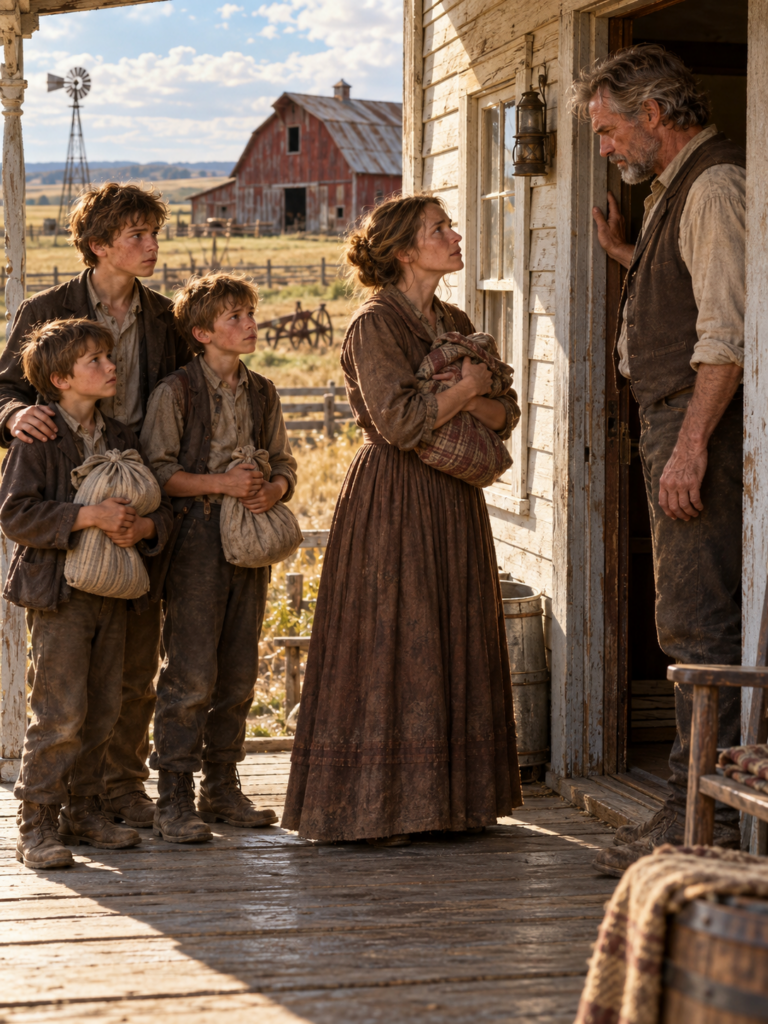
He remembered a dusty woman standing on his porch with four exhausted boys behind her.
He remembered her trying to hold herself straight when her strength was nearly gone.
And he remembered the first words she had spoken.
Four children.
Nowhere to go.
He had answered with a farm he could not manage alone.
At the time, it had seemed like a practical exchange.
She needed shelter.
He needed help.
Neither had understood how much more the other was offering.
Evelyn noticed him watching.
“What are you thinking about?”
Jonathan smiled.
“The day you came here.”
She looked toward the front door.
“I remember wondering whether you would send us away.”
“I nearly believed you were only asking for directions.”
She laughed softly.
“And instead I told you everything in one sentence.”
“You did.”
“You answered rather strangely.”
“I suppose I did.”
She sat beside him.
“You said you couldn’t manage the farm alone.”
Jonathan looked around the table.
Thomas was explaining something to Henry.
Samuel had begun another ridiculous story.
James was whistling again.
Six chairs.
Six places.
A room that had once held only one man’s supper.
“I couldn’t,” Jonathan said.
Evelyn rested her hand over his.
“Neither could I.”
He turned toward her.
She smiled.
“But we managed together.”
Jonathan squeezed her hand.
He had once believed his remaining years would contain nothing beyond work and the quiet endurance of loss.
Evelyn had once believed that all she could offer the world was four hungry boys and the determination to keep them alive.
Both had been mistaken.
She had brought courage, judgment, skill, and the love of a mother who refused to give up.
He had brought work, patience, a willingness to share what he possessed, and the strength to open a door he had kept closed against the world.
The farm had needed more hands.
The family had needed a home.
But what made their lives whole was not simply that one possessed what the other lacked.
It was that both had chosen to build something together.
Later that evening, when the meal was finished and the boys had gone about their tasks, Evelyn stood on the porch beside Jonathan.
The old red barn rested in the fading light.
Beyond it lay the fields they had worked through so many seasons.
The same road that had carried her toward the farmhouse in fear now led back to a place where she belonged.
Jonathan looked at her.
“Do you ever wish you’d turned toward another farm that day?”
Evelyn considered the question.
“No.”
“Not even when Samuel complains about the chores?”
She smiled.
“Especially not then.”
Jonathan laughed.
She slipped her hand into his.
Eight months after losing William, she had arrived at that door believing she had reached the end of every good possibility.
Six years after losing Margaret and their daughter, Jonathan had opened it believing that his life would never change.
What followed had required more than kindness on one afternoon.
It had required work, honesty, patience, and the courage to trust someone again.
Most of all, it had required making room for love without asking either person to abandon the life or memories they carried.
When the evening grew cooler, Jonathan opened the farmhouse door.
Warm lamplight fell across the porch.
From inside came the voices of four boys, louder than any house had a right to be.
Evelyn laughed and stepped through.
Jonathan followed, closing the door gently behind them.
The road had once brought five weary strangers to a lonely farmer’s home.
Now, whatever hardships might come, all six knew they had built a place worth returning to.
And at the table that had stood nearly empty for six long years, no one had to wonder whether there was room for them anymore.


