
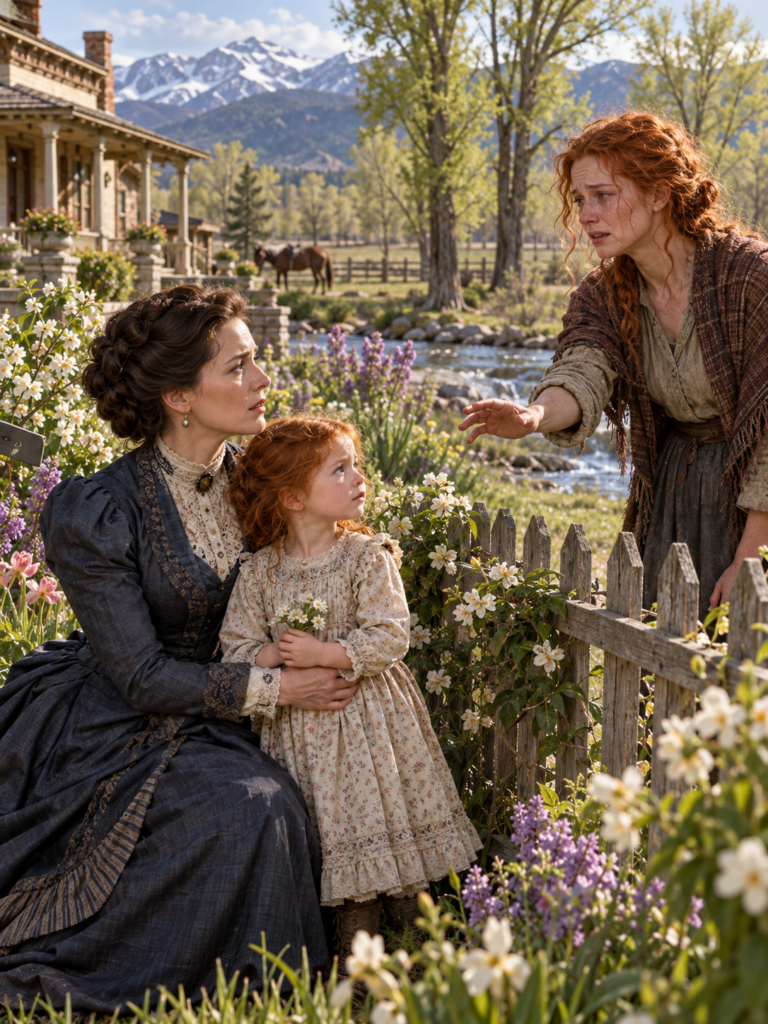
Beatrice kept herself between Emmy and the stranger while the young woman struggled to answer.
“Your name,” Beatrice said. “Tell me your name.”
“Maeve Donahue.”
The woman remained outside the fence.
Up close, Beatrice could see how worn her clothes were. Her shoes had split near the seams, and her hands were roughened by work.
But it was the resemblance that frightened her most.
Those red curls.
The same pale complexion.
The shape of her eyes.
Emmy tugged at Beatrice’s skirt.
“Mama, why is she crying?”
Beatrice knelt briefly.
“Stay close to me, sweetheart.”
Then she faced Maeve again.
“How do you know my daughter?”
Maeve’s expression crumpled.
“I know what you’re thinking. I haven’t come to take her.”
“Then why are you here?”
“Because I wanted one more look.”
Beatrice stared.
“One more?”
Maeve lowered her eyes.
“I’ve seen her before. From the road.”
“How often?”
The woman hesitated.
“Several times.”
“Over how long?”
Maeve’s hands shook.
“Nearly four years.”
Beatrice felt a wave of anger.
“You’ve been watching my child for four years?”
“I never came onto your land. I never spoke to her.”
“That doesn’t answer me.”
“No, ma’am.”
Maeve looked toward the creek.
“I was here when she was learning to walk. I saw her chasing a chicken near the yard. You caught her before she fell.”
Beatrice remembered that afternoon.
It had seemed an ordinary day.
Emmy had laughed until she could hardly stand.
Someone had been watching.
“You should have come to us,” Beatrice said.
“I tried once.”
“When?”
“Before I left her.”
The words seemed to empty the afternoon of sound.
Beatrice heard the creek running behind them.
She heard Emmy humming to herself.
Then Maeve continued.
“I had nowhere to live properly. I took laundry, cleaned rooms, did sewing. Some nights I had a roof. Some nights I didn’t.”
Beatrice’s grip on the fence tightened.
“The child’s father?”
“He went west before she was born. I haven’t heard from him since.”
Maeve swallowed.
“I thought I could manage. I thought if I worked hard enough, there would always be something.”
She looked at Emmy.
“But there were days when I couldn’t feed her.”
Beatrice felt her anger struggling against another feeling.
Recognition.
The expression on Maeve’s face was the same desperate longing Beatrice remembered from the years when the nursery stood empty.
“Did you leave her on our porch?” Beatrice asked.
Maeve nodded.
Emmy began picking flowers beside her mother’s skirt.
Beatrice lowered her voice.
“Why this house?”
Maeve looked toward the great windows beyond the garden.
“I knew Mr. Harroway paid his workers fairly. I’d seen you carry food to a family who’d been ill.”
She drew a careful breath.
“I came asking for work. I was turned away before I could speak to either of you.”
“Who turned you away?”
“The housekeeper.”
“Mrs. Kimball?”
Maeve nodded.
“She said there was no place for someone like me.”
Beatrice went still.
Four years earlier, in those first difficult weeks, she had believed the abandoned child had come without warning.
Now she was hearing that the mother had stood at their door seeking work before ever leaving her baby behind.
“What happened afterward?”
Maeve stared at the ground.
“I spent the night near the creek. I tried to think of somewhere else I could go.”
Her voice became unsteady.
“In the morning, I came back.”
Beatrice looked at Emmy.
The little girl had found a yellow flower and was holding it up proudly.
“Mama, look!”
“It’s beautiful, darling.”
Beatrice’s voice nearly failed her.
Maeve wiped at her eyes.
“I’m not asking for money. I’m not asking you to give her to me today. I know she doesn’t know me.”
Beatrice heard the word today, and fear returned.
“What exactly are you asking?”
“Only to know she’s well. And then I’ll leave, if that’s what you want.”
Beatrice watched the young woman standing beyond the fence.
She could order her away.
She could take Emmy home and never mention this encounter again.
For an instant, that seemed the simplest way to protect the life she loved.
But the truth would still exist.
And Emmy would one day be old enough to ask questions.
Beatrice gathered the child into her arms.
“Maeve, I cannot decide anything about this alone. Julian needs to hear what you’ve told me. We must also consider what is right for Emmy.”
Maeve’s eyes widened.
“I don’t want to frighten her.”
“Neither do I.”
“Will you let me explain to your husband?”
Beatrice hesitated.
Then she opened the garden gate.
“Come to the house this evening. We’ll speak privately.”
Maeve looked at the open gate but did not move.
“Mrs. Harroway, are you certain?”
“No,” Beatrice answered.
Her heart was pounding.
“But you have already told me something I cannot pretend not to know.”
She stepped aside, keeping Emmy safely in her arms, and held the gate open for the woman who might change their family forever.
Maeve looked through the open gate toward the great house on the hill.
For four years, she had stood beyond this fence, never daring to cross it.
Now Beatrice Harroway was holding it open.
Yet Maeve could not make her feet move.
“I should come back this evening,” she said at last.
Beatrice looked at Emmy, who had begun to grow impatient in her arms.
“Yes. We can speak after Julian returns from the ranch.”
Maeve nodded.
“Thank you.”
Beatrice closed the gate gently after she stepped back.
The young woman turned toward the road.
Then she stopped.
“Mrs. Harroway?”
“Yes?”
“Does she laugh often?”
Beatrice felt tears rising unexpectedly.
“Every day.”
Maeve pressed her lips together.
“I’m glad.”
She turned away before Beatrice could answer.
As she walked toward town, her shoulders shook.
Beatrice stood beside the gate holding Emmy.
The little girl touched her mother’s cheek.
“Are you sad?”
Beatrice kissed her forehead.
“A little troubled, darling.”
“Because of the lady?”
“Yes.”
Emmy considered this.
“She looked sad too.”
“She did.”
The child wrapped both arms around Beatrice’s neck.
“Maybe you could give her a flower.”
Beatrice held her closer.
How simple kindness seemed when one was four years old.
How difficult it became when fear had something precious to lose.
That afternoon, Beatrice could scarcely attend to her usual household affairs.
She sat with Emmy in the nursery, listening as the girl arranged her wooden animals along the windowsill.
The little horse Julian had made occupied the place of honor.
Beatrice remembered the morning the basket arrived.
The empty porch.
The absence of a letter.
The pendant wrapped in worn cloth.
Someone had loved the baby enough to wash her clothes carefully.
Someone had also been unable to keep her.
For four years, Beatrice had tried not to imagine that person too clearly.
Now she knew her name.
Maeve Donahue.
And she had stood at their gate.
Julian arrived home before supper.
One look at his wife told him something was wrong.
“Beatrice?”
She sent Emmy upstairs with her nurse, then led him into the parlor.
“We had a visitor today.”
She told him everything.
The stranger near the creek.
The red hair.
The years of watching from the road.
The claim that Maeve had left their daughter on the porch.
Julian listened without interrupting.
But his expression grew guarded.
“She says she’s Emmy’s mother?”
“Yes.”
“And you invited her here?”
“To speak with us.”
He turned toward the window.
“Beatrice, we must be careful.”
“I know.”
“Emmy is legally our daughter.”
“I know that too.”
“What if this woman wants to challenge the adoption?”
“She says she doesn’t.”
Julian looked back at her.
“Then why has she come?”
Beatrice took a breath.
“Because she misses the child she gave up.”
He said nothing.
“Julian, she told me something else.”
She repeated Maeve’s account of coming to the house seeking employment and being turned away by Mrs. Kimball.
Julian frowned.
“Mrs. Kimball never mentioned it.”
“Perhaps she believed it wasn’t important.”
“An exhausted mother carrying a baby came asking for work, and no one thought we ought to know?”
Beatrice had no answer.
Julian walked to the mantel.
His house had always been managed efficiently.
Visitors were announced.
Workers were screened.
The household staff made decisions before many small matters reached him.
He had thought that a sign of good order.
Now, for the first time, he wondered what else had been kept from his notice.
“She’ll be here this evening?” he asked.
“Yes.”
“Then we’ll hear her.”
Beatrice approached him.
“You’re angry.”
“I’m frightened.”
The admission surprised them both.
Julian lowered his voice.
“I love that little girl more than I knew it was possible to love anyone. The thought of losing her…”
He stopped.
Beatrice touched his arm.
“I feel the same.”
“Then why invite this woman into our home?”
“Because if she’s telling the truth, we’ve been raising a child whose mother has been grieving outside our fence.”
Julian looked toward the staircase.
From above came Emmy’s laughter.
He closed his eyes briefly.
“We’ll listen,” he said.
“And we’ll protect her.”
“Yes.”
When Maeve arrived that evening, she wore the same plain dress, carefully brushed, with her red hair pinned back.
Mrs. Kimball opened the door.
For one startled instant, the two women stared at each other.
Maeve recognized her.
Mrs. Kimball’s face went pale.
Before either could speak, Beatrice appeared in the hallway.
“Please show Miss Donahue into the parlor.”
Mrs. Kimball stepped aside.
Maeve entered.
The room’s polished furniture and fine carpet seemed to make her even more conscious of her worn shoes.
She stopped near the doorway.
Julian rose.
“Miss Donahue.”
“Mr. Harroway.”
“Please sit.”
She sat at the edge of an upholstered chair.
Beatrice took the chair opposite her.
Julian remained standing for a moment, then sat beside his wife.
“Mrs. Harroway has told me what you said this afternoon,” he began.
Maeve folded her hands.
“Yes, sir.”
“I need to understand why you left the child without telling us who she was.”
Maeve looked down.
“Because I was afraid that if I saw her once more, I wouldn’t be able to go through with it.”
Her voice trembled.
“I knew she needed food and a safe place. I couldn’t give her enough of either.”
“You could have spoken to us.”
“I tried.”
Julian’s expression changed.
Maeve continued.
“When I came asking for work, I carried her with me. Your housekeeper looked at my clothes and said you had no position for me.”
“Did she ask what work you could do?”
“No, sir.”
“What happened then?”
“I went away.”
Maeve gripped her hands so tightly that her knuckles whitened.
“I spent that night near the creek. She cried for food. I had so little to give her.”
Beatrice pressed a hand to her mouth.
“The next morning,” Maeve whispered, “I wrapped her in the warmest blanket I owned. I put her clothes in the basket. And I left the pendant my mother had given me.”
“The pendant?” Beatrice asked.
Maeve nodded.
“I thought perhaps she might keep something that came from my family, even if she never knew whose it was.”
Beatrice remembered the cheap metal ornament.
It had been placed carefully among Emmy’s keepsakes.
“We still have it,” she said.
Maeve began to cry.
Julian looked away for a moment.
The anger he had carried into the conversation was changing shape.
He still feared what Maeve’s arrival might mean.
But he could no longer imagine her as merely a stranger threatening his family.
She was a young woman who had made a desperate decision and lived with its consequences every day.
“Why didn’t you return sooner?” he asked.
“I did return.”
Maeve glanced toward Beatrice.
“Not to the door. I watched her sometimes from the road.”
“Four years?”
Maeve nodded.
“I told myself I only wanted to know she was happy.”
She wiped her face.
“But sometimes I wanted her to look toward me. Just once.”
Beatrice’s tears fell silently.
“She has been happy,” she said.
Maeve looked at her.
“I know.”
“She has been loved.”
“I know that too.”
For a while, no one spoke.
Then Julian asked, “What do you want now?”
Maeve straightened.
“I don’t want money for leaving her. I don’t want to take her away from you. I know you are the only parents she remembers.”
Her voice broke.
“I wanted to see her again. I thought afterward I could keep away.”
Beatrice looked at Julian.
She recognized the tension in his face.
He feared any arrangement that might unsettle Emmy’s home.
So did she.
But neither could ignore what had happened.
Finally Beatrice asked, “Maeve, are you still looking for work?”
Maeve seemed startled.
“Yes, ma’am.”
“What can you do?”
“Laundry. Sewing. Cleaning. Some gardening.”
“Gardening?”
“My mother taught me about seedlings. I worked with plants before I came west.”
Beatrice leaned forward.
“I’ve been wanting more help in the greenhouse. Our gardener manages the grounds, but there are flowers and young plants needing regular attention.”
Maeve stared.
“Mrs. Harroway, I haven’t come expecting a reward.”
“I’m not offering you money for a child.”
Beatrice’s voice was gentle but firm.
“I’m asking whether you’d like paid employment.”
Maeve glanced toward Julian.
He considered the proposal.
Then he said, “If you work here, you’ll receive wages according to the work. The arrangement will be written in my books, just as it is for every other employee.”
Maeve swallowed.
“And Emmy?”
Beatrice answered carefully.
“We must decide what is right for her. She’s too young to understand everything at once. We cannot begin by confusing or frightening her.”
Maeve nodded immediately.
“I wouldn’t want that.”
“And there must be honesty between us.”
“Yes, ma’am.”
Julian leaned forward.
“Whatever happens, we won’t ask you to pretend your history doesn’t exist. But we must proceed with care, and we’ll seek proper advice where necessary.”
For the first time that evening, Maeve seemed able to breathe.
“I understand.”
There was an unused cottage on the property, once occupied by an elderly groundskeeper.
It had two rooms, a sound stove, and a window overlooking the creek.
Julian offered Maeve the cottage while she worked and saved her wages.
She accepted only after they explained the terms plainly.
The following week, she began in the greenhouse.
Beatrice showed her the seed trays and young plants.
Maeve listened attentively.
Soon Beatrice discovered that the young woman possessed a skill no one had expected.
She understood plants.
She could judge moisture in the soil, recognize struggling seedlings, and handle delicate roots without damaging them.
Within a month, she coaxed a stubborn rose cutting into new growth after others had given it up.
She also repaired torn work clothes and mended a delicate seam in one of Beatrice’s dresses so neatly that the damage could scarcely be found.
Julian paid her regularly.
Her wages were recorded like those of any other worker.
Maeve began saving money.
And gradually, Emmy became acquainted with the new woman in the greenhouse.
Their first meeting was ordinary.
Emmy appeared beside Beatrice carrying her wooden horse.
“Do you know about horses?” the little girl asked.
Maeve smiled nervously.
“A little.”
“Papa knows everything about them.”
“Does he?”
“Almost.”
Maeve laughed.
Emmy held out the wooden horse.
“This one’s called Captain.”
Maeve accepted it carefully.
“He’s a fine animal.”
“He doesn’t eat hay.”
“That must make him inexpensive to keep.”
Emmy burst into delighted laughter.
Beatrice watched from beside the potting bench.
For a moment she saw not a threat to her family, but two people beginning to know each other.
A daughter.
And the woman who had given her life.
Yet Beatrice also knew the arrangement could not rest forever on things left unsaid.
One evening, after Emmy had gone upstairs, she asked Julian and Maeve to join her.
“There’s something we must agree upon,” she began.
Both looked at her.
“We will not lie to Emmy about where she came from.”
Maeve went still.
Julian nodded slowly.
“She’s young.”
“Yes. We must tell her in a way she can understand, at the proper time.”
Beatrice looked at Maeve.
“And when she is ready, she should know who you are.”
Maeve pressed her hands together.
“Are you certain?”
“She is our daughter,” Beatrice said. “But that does not make your place in her history disappear.”
Julian reached for his wife’s hand.
Maeve lowered her face and wept quietly.
For four years, she had believed the best she could hope for was a glimpse through the fence.
Now she had been given work, a place to live, and the possibility of knowing her daughter openly.
But one difficult question remained.
How would Emmy respond when she was old enough to understand that the woman tending the roses had once carried her in a basket to the Harroway door?
And would Beatrice, who had waited so long to become a mother, find the courage to let her daughter love them both?
Beatrice looked from Julian to Maeve across the parlor.
The decision they had made felt both right and frightening.
“We must be patient,” she said. “Emmy deserves to learn her story without being made responsible for our fears.”
Julian squeezed her hand.
“Then that’s what we’ll do.”
Maeve nodded.
“I won’t ask her to feel anything for me that she doesn’t feel.”
And with that, the three adults began the difficult work of making room for the truth.
It did not happen quickly.
During the first weeks, Beatrice sometimes felt an unexpected ache when Emmy hurried toward Maeve in the greenhouse.
She would hear her daughter’s bright voice and remember the years she herself had spent longing to hold a child.
Part of her wanted to keep every moment.
Every question.
Every embrace.
Every small discovery.
Then she would see Maeve kneeling beside Emmy, patiently explaining why a young plant needed more light, and recognize that her own fear did not make the friendship wrong.
One afternoon Emmy came running into the parlor carrying a small pot.
“Look, Mama! Maeve helped me grow this!”
A tiny green shoot rose from the soil.
Beatrice examined it solemnly.
“It’s beautiful.”
“She says I mustn’t give it too much water.”
“Then we’d better remember.”
Emmy set the pot beside the window.
“Can we put it in the garden when it gets bigger?”
“Of course.”
After the girl ran away, Beatrice remained beside the window.
She touched the edge of the little clay pot.
Maeve had taught her daughter something useful.
The child was proud of it.
Nothing had been taken from Beatrice.
Yet something had been added to Emmy’s life.
That evening Julian found his wife still looking at the seedling.
“Troubled?”
“A little.”
He waited.
“I never thought motherhood would ask this of me.”
“What?”
“To love someone enough to share the parts of her life I cannot fill myself.”
Julian moved beside her.
“You’ve given Emmy a home. That won’t become less true because another person cares for her.”
Beatrice rested against his shoulder.
“I know it here.”
She touched her heart.
“I’m learning to know it everywhere else.”
Julian understood.
He too had feared that Maeve’s presence might change Emmy’s affection for him.
But the child’s love had proved remarkably untroubled by the adults’ complicated feelings.
She still demanded that Julian tell her stories about the ranch.
She still fell asleep against his shoulder.
She still believed he could answer every question about horses, even when he sometimes had to admit otherwise.
And she still called Beatrice whenever she wanted comfort.
Maeve became another familiar presence in that world.
Not a replacement.
Not a secret visitor.
A woman who answered questions about flowers, repaired torn ribbons, and sometimes brought wild blossoms to the kitchen.
Julian also began changing the way his household was managed.
He spoke privately with Mrs. Kimball about the day Maeve had been turned away.
The housekeeper did not deny it.
“She looked desperate, sir. I believed you wouldn’t want strangers troubling the family.”
Julian listened.
Then he answered quietly, “A woman asking for honest work is not a disturbance simply because she’s poor.”
Mrs. Kimball lowered her eyes.
“I thought I was protecting the household.”
“I understand that. But I never intended our door to be closed to everyone whose need was inconvenient.”
He instructed her that people seeking work were to be heard fairly and that requests for assistance should be brought to the family’s attention rather than dismissed solely by appearance.
The change was not a grand public announcement.
It was a practical correction.
But it mattered.
For Maeve, the ranch cottage became the first place in years where she could sleep without wondering whether she would be asked to leave the following morning.
She kept it carefully.
A few books stood on a shelf.
Her sewing tools rested in a wooden box.
A pot of flowers brightened the window overlooking the creek.
She saved part of every wage.
And when the workday ended, she had a door she could close and a future she could begin planning.
Months passed.
Emmy grew taller.
Her questions became more complicated.
She wanted to know why some plants survived winter and others did not.
Why horses had different colors.
Why Julian kept certain old ledgers tied with string.
Why Beatrice sometimes became quiet when they passed the nursery cradle, which now stood among the belongings of Emmy’s earliest years.
The adults did not yet give her the entire story, but they began speaking naturally about the different ways families came together.
Beatrice explained that some children were born into the homes where they grew up, while others joined families after birth.
Emmy considered this with her usual seriousness.
“Was I always here?”
“No, darling,” Beatrice answered. “You came to us when you were a tiny baby.”
“Where was I before?”
Beatrice looked at Julian.
“With the woman who gave birth to you.”
Emmy thought about it.
“Did she love me?”
Beatrice held her daughter closer.
“Yes. I believe she did very much.”
Emmy rested against her and asked no more that evening.
But the question remained part of their lives.
As she grew older, Julian and Beatrice sought advice from those responsible for her records and care, wanting to ensure that her history was handled truthfully and with regard for her security.
They did not want to build peace upon a falsehood.
Nor did they want to treat Maeve as though her feelings alone should determine Emmy’s future.
The child’s welfare came first.
Her adoptive parents remained responsible for her home, education, and daily care.
Maeve understood and respected that.
By the time Emmy reached seven, she was old enough for a fuller explanation.
One Sunday afternoon, Beatrice and Julian sat with her in the parlor.
The wooden horse stood on the mantel.
Outside, spring sunlight lay across the garden.
Beatrice held the small pendant found in the basket years before.
“There’s something about when you were a baby that we want to tell you.”
Emmy sat very still.
Julian leaned forward.
“You know that your mother and I adopted you when you were little.”
“Yes.”
“And you know that another woman gave birth to you.”
Emmy nodded.
Beatrice opened her hand.
“This pendant belonged to that woman. She put it in your basket so you’d have something from her family.”
Emmy touched the metal gently.
“Do you know who she is?”
Beatrice took a breath.
“Yes, sweetheart. It’s Maeve.”
Emmy stared at her.
“Maeve from the greenhouse?”
“Yes.”
The little girl looked toward the window.
For several moments, she said nothing.
Then she asked, “Why didn’t she keep me?”
Beatrice felt the old sorrow return.
Julian took her hand.
“Maeve was alone and very poor,” he explained. “She didn’t have enough food or a safe home for you. She made a difficult decision because she wanted you to live somewhere secure.”
Emmy frowned.
“Couldn’t she have worked?”
“She tried,” Beatrice said softly. “But she couldn’t find enough work then.”
The child studied the pendant.
“Does she still love me?”
“She does,” Beatrice answered.
“And you?”
Beatrice drew her close.
“Nothing about this changes how much we love you.”
“Or Papa?”
Julian moved beside them.
“Or me.”
Emmy sat between them for a long time.
Then she asked to see Maeve.
They arranged a quiet conversation the following afternoon in the greenhouse.
Maeve was working with young rose plants when Emmy arrived with Beatrice.
She looked up and saw the pendant in the child’s hand.
Her face changed.
“Maeve?”
“Yes, Emmy?”
“Mama and Papa told me.”
Maeve set down her tool.
She knelt so they could speak face-to-face.
Emmy held up the pendant.
“Was this yours?”
“It was my mother’s.”
“Why did you put it with me?”
Maeve’s eyes filled.
“Because I wanted you to have something that belonged to the people you came from.”
Emmy looked thoughtful.
“Did you want to leave me?”
Maeve shook her head.
“No, sweetheart.”
“Then why did you?”
For a moment, Maeve could scarcely speak.
Beatrice remained nearby, allowing her the chance to answer.
“I loved you,” Maeve said. “But I couldn’t give you the food and shelter a baby needed. I believed this house was a place where you would be safe.”
Emmy looked at the flowers.
“Did you miss me?”
“Every day.”
“Even when you worked here?”
“Yes.”
The child considered this with the seriousness she brought to everything.
Then she placed her small hand over Maeve’s.
“I’m glad you know me now.”
Maeve bowed her head.
Tears fell onto the greenhouse floor.
Emmy looked alarmed.
“Did I say something bad?”
“No,” Maeve whispered. “You said something very kind.”
Beatrice came closer.
She rested one hand gently against Emmy’s shoulder.
The three remained together among the rose seedlings until the child began asking ordinary questions again.
Whether the flowers would bloom soon.
Whether the yellow rose would survive.
Whether Maeve had remembered to water her favorite pot.
Life, Beatrice realized, would not be made entirely of difficult conversations.
There would also be these simple afternoons.
That evening Emmy asked whether she ought to call Maeve by another name.
“She’s my mother too, isn’t she?”
Beatrice considered her words.
“She is the woman who gave birth to you. You may decide what you’d like to call her.”
“Would you mind?”
“I wouldn’t want you to choose a name merely to spare my feelings.”
Emmy looked relieved.
For more than a week, she thought about it.
Then she continued calling the young woman Maeve.
It was the name she knew.
And Maeve accepted it gladly.
As the years passed, the relationship deepened.
Maeve taught Emmy to sew a straight seam.
At first, the little girl’s stitches leaned in every direction.
Maeve patiently helped her pull them out and begin again.
When Emmy finally made a neat line, she ran to show Beatrice.
“Mama! Look what Maeve taught me!”
Beatrice admired it.
Then she helped Emmy choose a place in her sewing box to keep the finished piece.
Julian taught Emmy to recognize sound horses and read the ranch’s accounts.
Beatrice shared her knowledge of the gardens and the responsibilities of running a household.
No one insisted that the child divide her affections into separate portions.
Her life grew richer because the adults stopped treating love as something that had to be defended against every new attachment.
Maeve continued saving money.
After several years, she began speaking of opening a small sewing business in town.
The work at the ranch had strengthened her skills, and customers had begun asking for her directly.
Julian offered to help with the cost of establishing the shop.
Maeve accepted a modest loan only after insisting that the terms be written plainly.
“I want to repay it,” she said.
“You shall,” Julian answered.
Beatrice smiled.
She understood exactly why Maeve needed that agreement.
The young woman had once possessed so little that she believed leaving her baby was the only way to keep the child alive.
Now she wanted to build something that belonged to her.
Her shop was modest.
A narrow room with a worktable near the window.
Shelves held thread, buttons, and folded cloth.
She took in alterations and repairs, gradually earning a steady living.
Her name hung above the door.
Every payment was recorded carefully.
When Julian offered to forgive the final portion of the loan, Maeve declined.
“You trusted me to repay it.”
“I did.”
“Then let me keep my word.”
He accepted the last payment with a smile.
“You’ve done fine work, Miss Donahue.”
Maeve looked around the shop.
For once, her pride did not feel like something she needed to hide.
She had a livelihood.
She had a home of her own.
And she could visit Emmy without standing unseen among the trees.
Mrs. Kimball changed too.
Over the years, she became one of the first people to welcome Maeve into the Harroway house.
Sometimes she sent her home with a piece of cake wrapped in cloth.
Neither woman frequently mentioned their first encounter.
But both remembered it.
And the older housekeeper took care never again to dismiss someone merely because their clothing was worn or their circumstances difficult.
As Emmy grew into a young woman, she came to understand her family story more fully.
She understood why Maeve had suffered.
Why Beatrice had been afraid.
Why Julian had insisted upon protecting the security of the home they had given her.
She also understood that every adult involved had been required to change.
Maeve had learned to accept help without surrendering her dignity.
Beatrice had learned that being a mother did not require possessing every part of her daughter’s heart.
Julian had learned that a well-run ranch was not necessarily a welcoming place unless the people who needed its doors opened could actually be heard.
And Emmy had learned that love could be complicated without being false.
One spring Sunday, many years after the basket appeared on the porch, the Harroway house was filled with preparations for an evening gathering.
Emmy descended the staircase wearing a dress Maeve had made for her.
The fabric fell gracefully.
Its seams were so fine that even Beatrice had difficulty finding the joins.
Emmy’s vivid red hair was pinned elegantly.
She was no longer the little girl who had chased chickens through the yard.
Julian stood beside Beatrice in the hall.
For a moment he stared.
“Well,” he said softly.
Emmy laughed.
“Papa, you’ve seen me wearing dresses before.”
“Not one quite like that.”
Beatrice adjusted a small fold at her daughter’s shoulder.
“Maeve has outdone herself.”
“She says the fitting took longer because I wouldn’t stand still.”
“That sounds familiar,” Julian said.
A carriage approached along the drive.
Through the window, they saw Maeve arriving for her usual Sunday visit.
She stepped down and waved toward the house.
Emmy hurried outside to meet her.
Beatrice followed with Julian.
Years earlier, Maeve had stood beyond the fence and hidden among the cottonwood trees.
Now the gate stood open.
She walked toward the family without fear.
Emmy reached her first and embraced her warmly.
Then she turned and drew Beatrice close too.
For a moment, the three women stood together in the spring sunlight.
Julian watched them.
His wife caught his eye over Emmy’s shoulder.
He remembered the morning he had found Beatrice on the porch holding a basket.
He remembered the nursery door opening after years of silence.
He remembered fearing that the arrival of Maeve would somehow take away the family they had built.
But looking at the women before him, he understood something the younger man he had been could never have imagined.
The child had not been the only person who needed a home.
Maeve had needed a chance to build one for herself.
Beatrice had needed freedom from the fear that her love could be replaced.
And Julian had needed to discover that protecting one’s family sometimes meant making room for a difficult truth rather than shutting it outside.
Emmy stepped back and looked at them all.
“Are we going inside? Everyone will wonder where we’ve gone.”
Maeve laughed.
Beatrice offered her an arm.
“Come along, then.”
They walked toward the house together.
At the threshold, Beatrice paused.
The porch looked much as it had that spring morning in 1888.
The steps had been repaired.
The garden had grown fuller.
But she could still remember exactly where the wicker basket had rested.
She could still remember the weight of the child in her arms.
And the tiny fingers closing around her hand.
For years, Beatrice had believed that the emptiness in their nursery was proof of something missing from their lives.
Then a little girl had arrived, and the room had filled with laughter.
Later, the child’s first mother had appeared, bringing a truth that frightened them all.
What remained, after fear and uncertainty had been met with honesty, was a family larger than the one any of them had imagined.
Emmy called from the hallway.
“Mama?”
Beatrice looked up.
“Coming, darling.”
Julian offered his hand.
She took it.
Together they crossed the threshold, following their daughter and Maeve into the bright, familiar rooms.
The door closed gently behind them.
Not to keep anyone out.
But because everyone they were expecting had finally come home.


