
Part 1
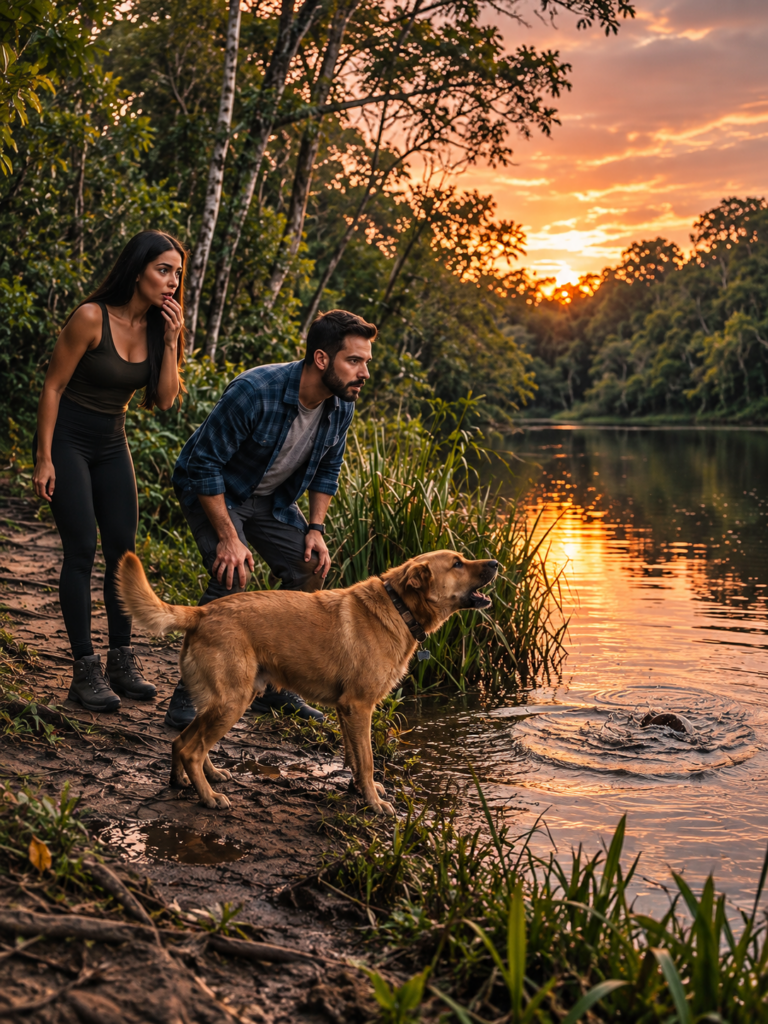
Every afternoon, just before the sun disappeared behind the trees, Nilo would abandon whatever he was doing, run out of Té’s house, and head straight toward the pond.
It didn’t matter whether he had been sleeping on the porch, chewing on a stick, or lying beside his owner’s chair. At almost the same time each day, the dog would suddenly lift his head, turn toward the narrow trail behind the house, and hurry away.
At first, Té thought nothing of it.
Dogs had their habits. Some waited beside the kitchen door when they knew dinner was coming. Others chased passing cars or barked at squirrels in the yard.
Nilo, however, had developed a habit that Té couldn’t explain.
He ran to the pond.
And he barked.
Not once or twice, the way he might bark at a passing bird.
He barked repeatedly, urgently, always facing the water.
The first afternoon, Té assumed the dog had spotted something moving beneath the surface.
The pond was surrounded by thick vegetation and old trees whose roots twisted through the damp earth. Birds nested in the branches, frogs hid among the reeds, and insects skimmed across the water whenever the afternoon heat began to fade.
There were plenty of things that could catch a dog’s attention.
But when Té followed Nilo to the bank, he saw nothing unusual.
The pond lay almost perfectly still.
A few leaves floated near the shoreline. Reflections of the surrounding trees stretched across the darkening surface.
Nilo stood rigidly near the water.
His ears were raised.
His eyes were fixed on something Té couldn’t see.
And he wouldn’t stop barking.
“What is it, boy?”
Té stepped beside him.
Nilo didn’t turn.
“See something out there?”
Still nothing.
Té bent down and placed a hand on the dog’s back. He felt the muscles beneath the fur tighten as Nilo leaned forward.
The dog wasn’t frightened.
At least, he didn’t seem frightened in the ordinary way.
He wasn’t backing away or trying to hide behind his owner.
Instead, he appeared determined to make Té look at the water.
Té followed the direction of his gaze.
A patch of reeds stood near the opposite edge of the shallow bank. Beyond them, darker water reflected the overhanging branches.
Nothing moved.
“Come on,” Té said.
He picked up a stick and threw it along the path.
Normally, Nilo would have chased it before it touched the ground.
This time, he didn’t even glance toward it.
The stick landed among the fallen leaves.
Nilo kept barking.
Té tried calling him again.
Then he tried walking away.
The dog remained where he was.
Finally, after several minutes, Nilo quieted. He watched the water a little longer, turned toward Té, and followed him home.
By the time they reached the house, the dog seemed entirely normal.
He drank from his water bowl, settled near the porch, and fell asleep.
Té decided the whole thing had probably been nothing.
Until it happened again the next afternoon.
And the afternoon after that.
By the fourth day, Té had begun watching the clock.
The pattern was too precise to ignore.
The dog always became restless shortly before sunset. He always followed the same narrow trail, weaving between the trees until the pond appeared through the foliage.
And he always stopped near the same section of shoreline.
Té tried several explanations.
Perhaps an animal lived in the reeds.
Perhaps fish were gathering near the surface.
Perhaps Nilo could smell something in the muddy water.
One afternoon, Té walked around the bank, searching for tracks.
He found ordinary signs of wildlife: small impressions in the damp soil, broken stems, and places where birds had disturbed the vegetation.
Nothing explained the barking.
Another afternoon, he took Nilo to a different path, hoping a longer walk would distract him.
Nilo enjoyed the walk.
But as soon as they returned home, he turned toward the pond.
Within minutes, the barking started again.
Té stood in his yard listening.
The sound carried through the trees in short, insistent bursts.
There was something strangely uncomfortable about hearing the dog call out like that.
It wasn’t merely the noise.
It was the feeling that Nilo wanted something from him and that he kept failing to understand what it was.
Té had known the dog long enough to recognize his ordinary moods.
He knew when Nilo wanted food, when he wanted attention, and when he was only pretending to be interested in something so that Té would follow him outside.
This behavior felt different.
Nilo wasn’t seeking entertainment.
He was insisting.
At the end of the first week, Té decided to try another approach.
Instead of following directly behind the dog, he would observe him from a distance.
That afternoon, he waited near the house.
Nilo lay quietly beside the porch steps, his eyes half-closed.
As the sun began dropping behind the tree line, his ears suddenly moved.
He lifted his head.
For several seconds, he sat motionless.
Then he got up and hurried down the trail.
Té followed slowly, keeping enough distance that the dog wouldn’t become distracted by his presence.
Through the trees, he watched Nilo reach the pond.
The dog stopped.
Turned slightly toward the left.
And began barking.
Té remained hidden behind a tree.
For the first time, he paid attention not to the barking itself, but to the direction of Nilo’s gaze.
And that was when he noticed something he had overlooked all week.
Nilo wasn’t looking randomly across the pond.
He was staring at one particular place.
Not the deepest water.
Not the reeds nearest the path.
A small, partially obscured section of shoreline where thick plants grew close together.
Whenever Nilo moved along the bank, he turned his head back toward that precise spot.
Té stepped out from behind the tree.
The dog heard him and glanced over.
“All right, boy,” Té murmured. “Let’s see what you’re looking at.”
He approached the vegetation.
Nilo’s barking became louder.
Té stopped at the edge of the water.
The plants grew thickly there, their stems emerging from shallow mud. Beneath the surface, the water looked darker than it did a few feet away.
He crouched and peered between the leaves.
Still, he could see nothing that clearly explained the dog’s behavior.
But now there was a difference.
He knew where to look.
And for the first time, he began to suspect that whatever interested Nilo might not be visible from the bank.
Té didn’t want to enter the water alone.
The pond had been part of the surrounding landscape for as long as he could remember, but that didn’t mean he understood every section of it.
The bottom was uneven, and roots and submerged debris could be hidden beneath the vegetation.
He needed another pair of eyes.
Someone familiar with the area.
He immediately thought of Iara.
Iara was twenty-seven and lived nearby. She knew the trails, the trees, and the changes in the pond through different seasons. She had spent enough time around the area to notice when something looked out of place.
Té called her.
“I need you to come look at something.”
“What happened?”
“It’s Nilo.”
There was a pause.
“Is he hurt?”
“No. That’s the strange part. He’s perfectly fine, except he keeps barking at the pond.”
Iara gave a small laugh.
“At the pond?”
“Every afternoon. Same time. Same place.”
“Maybe he sees an animal.”
“That’s what I thought. But I’ve watched him for a week. He’s looking at one exact spot, and I can’t figure out why.”
“Have you checked the water?”
“Not yet.”
“Then maybe that’s where you should start.”
Té looked toward the trail.
Nilo was still barking in the distance.
“Can you come over?”
“I’ll be there.”
When Iara arrived, the sunlight was already filtering through the branches at a low angle.
Té met her near the trail.
Nilo recognized her and hurried toward them, wagging his tail.
For a moment, he appeared delighted by the visitor.
Then he turned and ran back toward the pond.
Iara watched him disappear between the trees.
“Well, he certainly wants us to follow.”
“That’s exactly what he’s been doing.”
They walked together down the narrow path.
The air became cooler beneath the canopy. Dry leaves shifted under their shoes, and the faint smell of damp earth grew stronger as they approached the shoreline.
Nilo was already waiting.
He stood near the vegetation, barking toward the water.
Iara stopped several feet away.
She didn’t immediately speak.
Instead, she watched the dog.
Nilo barked, paused, listened, and barked again.
His attention remained fixed on the same location.
After a minute, Iara moved a few steps to the side.
Nilo followed her with his eyes only briefly.
Then he turned back toward the pond.
“You’re right,” she said.
Té folded his arms.
“About what?”
“He’s not just barking at the water. He’s looking at something specific.”
“I told you.”
She studied the bank.
“Have you gone in?”
“No.”
“Why not?”
“Because I didn’t want to step into something I couldn’t see.”
Iara nodded.
“Fair enough.”
She pointed toward a small opening between the reeds.
“Maybe it’s over there.”
Té followed her finger.
From that angle, he could see that the vegetation formed a loose barrier around a small area of shallow water.
The plants appeared thicker than elsewhere along the bank.
As they approached, Nilo began barking harder.
Té looked at Iara.
“That has to mean something.”
“Or he thinks it does.”
“Either way, I want to know.”
He tested the edge of the pond with one foot.
The ground was soft but held his weight.
He stepped into the shallow water.
Coldness seeped around his footwear as he moved carefully forward.
Behind him, Iara remained on the bank.
“Watch where you’re stepping,” she warned.
“I am.”
Nilo paced along the shoreline.
Té pushed aside a cluster of reeds.
The water became slightly clearer.
A few feet ahead, something straight interrupted the irregular shapes of roots and stones beneath the surface.
Té leaned forward.
He reached down.
His fingers touched a firm edge.
It didn’t feel like a rock.
He moved his hand along it.
The surface was rough, softened by years of moisture, but unmistakably shaped.
Wood.
He pushed the surrounding plants away.
A dark, weathered structure emerged beneath the shallow water.
It consisted of several old wooden pieces, partly buried in mud and tangled vegetation.
Té stepped back in surprise.
“Iara!”
She moved closer to the edge.
“What?”
“There’s something down here.”
“What kind of something?”
“I’m not sure.”
He bent again and cleared more leaves from the surface.
The outline became easier to recognize.
It resembled part of an old wooden platform.
Not a fallen tree.
Not a random pile of branches.
Something built by human hands.
Iara crouched near the bank and examined it.
“That’s strange.”
“You recognize it?”
She shook her head.
“No. And I’ve been around this pond plenty of times.”
Té ran his hand along a weathered board.
“Maybe it’s been here longer than either of us realized.”
“Hidden under all this vegetation?”
“Looks that way.”
For several moments, neither spoke.
The discovery was small, but it changed the entire question.
Until that afternoon, they had been wondering what animal or movement might have caught Nilo’s attention.
Now there was evidence of an old structure beneath the water.
Something belonging to the pond’s forgotten past.
Té stood upright.
He looked back at Nilo.
The dog was still barking.
But then, unexpectedly, Nilo moved.
He hurried away from the water and followed the bank toward a large tree.
“Where’s he going now?” Iara asked.
Té stepped out of the pond.
“I don’t know.”
Nilo stopped beside the tree.
He lowered his head, sniffed among the exposed roots, and began pawing at the ground.
Damp leaves scattered behind him.
Iara exchanged a puzzled glance with Té.
“Now he’s digging.”
They followed.
Nilo continued working at a patch of earth between two thick roots.
At first, there appeared to be nothing unusual there.
Just mud, leaves, and small plants.
Then Té noticed a dark opening beneath the vegetation.
He crouched.
“Hold on.”
He moved several leaves aside.
The opening became clearer.
It was small, but it didn’t look like an ordinary hollow made by an animal.
There were signs of an old built structure beneath the roots.
Iara leaned forward.
“That almost looks like a passage.”
Té examined its edges.
“Not one big enough for a person.”
“No. But look at the shape.”
The opening led toward a concealed section of material that didn’t match the surrounding earth.
Part of something had been buried and gradually covered by roots and vegetation.
The old platform in the water suddenly seemed less mysterious.
Perhaps the two discoveries were connected.
Té sat back on his heels.
“Someone built something here.”
Iara looked toward the pond.
“A long time ago, apparently.”
Nilo stopped digging.
He stood between them, breathing rapidly, watching as though he expected them to continue.
Té gently touched the dog’s head.
“All right. We found it.”
But even as he said the words, he knew they hadn’t found the whole answer.
They had uncovered an opening.
They still had no idea what it belonged to.
Back at the house, Té began searching on his phone.
He tried the name of the area, the pond, and references to old construction near the water.
Most results offered little useful information.
But after several searches, he found records referring to a former water-control system in the region.
Decades earlier, parts of the area had been used to manage water levels during periods of heavy rain.
The system included channels and control structures designed to regulate the movement of water.
Té read the description twice.
Then he called Iara over.
“Look at this.”
She leaned beside him.
“Water-level control?”
“That’s what it says.”
“Here?”
“Apparently.”
Iara looked at the old references on the screen.
“That might explain the platform.”
“And the opening under the tree.”
“Maybe.”
Té continued reading.
Then his expression changed.
“What?” Iara asked.
He pointed to a line in the record.
“The system was deactivated.”
“How long ago?”
“Decades.”
Iara sat back.
“So whatever we found should be abandoned.”
“That’s what the records suggest.”
She turned toward the window.
Beyond the house, the woods were growing dark.
Somewhere along the trail, the pond lay still beneath the trees.
And hidden beneath its vegetation were remains of a system neither of them had known existed.
Iara spoke quietly.
“Then why is Nilo so interested in it now?”
Té looked down at the phone.
He had an answer for what the structure might be.
He had no answer for what the dog was hearing, smelling, or sensing.
And that bothered him more than the strange discovery itself.
Because the system was supposed to be inactive.
Yet Nilo had been trying to lead them toward it every single afternoon.
Part 2
The following afternoon, Té was ready before Nilo began moving.
He had slept poorly.
Not because he was frightened by what they had discovered, but because the pieces didn’t fit together.
An old platform hidden beneath shallow water.
A small opening concealed among tree roots.
Records of a water-control system abandoned decades earlier.
And a dog that apparently knew exactly where to look.
There had to be some connection.
Té had spent part of the morning reviewing the information on his phone. He found references to channels, drainage routes, and older infrastructure intended to protect the surrounding area during rainy seasons.
The records weren’t enough to explain the precise layout of the structures.
They certainly didn’t say anything about why a dog would suddenly become interested in them.
Still, Té was convinced the investigation shouldn’t end with the wooden platform.
When Iara arrived, he showed her the information he had collected.
“It seems the pond wasn’t always managed the way it is now,” he said.
Iara studied the screen.
“So the water could have been directed through underground channels?”
“That’s what I’m thinking.”
“Do you know where those channels are?”
“No. The descriptions aren’t very specific.”
She handed back the phone.
“Then maybe Nilo knows more than the records.”
Té smiled faintly.
“At this point, I wouldn’t be surprised.”
They walked toward the pond together.
Nilo ran ahead.
But this time, something different happened.
Instead of stopping at the familiar section of shoreline, the dog continued past it.
He moved along the bank, then turned toward a cluster of trees.
Té stopped.
“That’s new.”
Iara looked in the same direction.
“Where’s he going?”
Nilo disappeared briefly behind the vegetation.
Then his barking began again.
It sounded slightly different from the bank, more enclosed, as though something around him was reflecting the noise.
Té and Iara followed the sound.
The ground rose gently away from the water. Low plants crowded the spaces between the trees, and old leaves had accumulated in uneven layers.
At first, the area looked like any other neglected part of the woods.
Then Iara noticed an edge that was too straight to belong to the natural landscape.
“Wait,” she said.
Té stopped beside her.
Partly hidden behind overgrown plants stood a small building.
Its exterior was weathered, and the surrounding vegetation made it easy to miss from the main trail.
Branches reached across parts of its walls. Dirt and fallen leaves had gathered near the entrance.
It looked like a structure the woods had slowly swallowed.
Té approached cautiously.
Nilo waited near the door.
For a moment, the dog stopped barking and looked back at him.
Then he barked again.
Iara stepped beside Té.
“You’ve never noticed this before?”
“No.”
“I knew there were old structures around the pond, but I didn’t know this one was here.”
Té examined the building.
“If the records are right, it could be part of the system.”
He reached for the door.
It resisted at first.
Years of dirt and disuse had left it difficult to move.
Té shifted his footing and tried again.
The door finally opened enough for him to look inside.
A stale, damp smell drifted outward.
Light entered through the doorway, revealing a cramped interior crowded with old mechanical equipment.
There were pipes.
Heavy fittings.
Metal components darkened by age.
And near one wall stood a large valve covered with dirt.
Iara leaned forward.
“Well, that answers one question.”
Té stepped inside.
“What question?”
“Whether this building had something to do with the pond.”
He looked around.
The equipment was too specialized to have been placed there casually.
This wasn’t a storage shed someone had forgotten.
It was part of the old water-control facility.
Té moved his eyes across the pipes, trying to understand how the different pieces might have worked together.
Some disappeared into the walls.
Others ran toward the floor.
The large valve looked as though it had once been used to control the flow through one of those connections.
Iara stood near the doorway.
“Could any of this still work?”
Té looked at the old mechanism.
“I don’t know.”
“Wouldn’t it have been shut down?”
“According to the records.”
She stepped farther inside.
“But you’re not sure.”
“No.”
Neither of them touched the valve.
It was old, and there was no way to know whether the equipment remained under pressure or connected to anything beyond the walls.
Té had no intention of forcing an unfamiliar mechanism just to satisfy his curiosity.
Then Nilo barked.
The sudden noise made them both turn.
The dog stood in front of a wall near the back of the building.
He stared at a dark patch partly concealed by dirt and dead leaves.
Té sighed.
“He’s found something else.”
Iara followed him.
Nilo moved aside just enough to let Té approach.
Té took out his flashlight and directed the beam toward the wall.
A narrow opening appeared behind the accumulated debris.
At first glance, it looked like a damaged section of the structure.
But the edges were too deliberate.
Té crouched and cleared away some of the loose leaves.
Iara held the light while he examined the surrounding surface.
Then he noticed an old inscription.
Part of it was obscured, but enough remained to identify its purpose.
It referred to a second underground outlet associated with the pond.
Té read it aloud.
Iara stared.
“A second outlet?”
“That’s what it says.”
“Then where does it go?”
He directed the flashlight toward the opening.
“I think we’re looking at the answer.”
Iara stepped closer.
There was a section of the structure that appeared to cover or conceal access beyond the wall.
It had become stuck over time.
“So there’s something behind it,” she said.
“Probably another part of the system.”
“Can we see?”
Té studied the obstruction.
“We can try to move the covering. Carefully.”
He checked the edges, looking for a way to shift it without damaging the surrounding structure.
At first, it refused to move.
He adjusted his grip and tried again.
Iara helped clear away loose debris while he worked.
Gradually, they managed to loosen the obstruction enough to create an opening.
Cool air seemed to settle around them.
Té raised the flashlight.
Beyond the wall was a narrow tunnel.
Its surfaces were darkened by age and moisture.
The passage extended farther than the light initially reached.
Iara stared into it.
“I wasn’t expecting that.”
“Neither was I.”
Nilo began barking rapidly.
Té looked down.
“Easy, boy.”
But the dog continued.
His attention was fixed on the passage.
Then Té heard something.
At first, he thought it was the movement of leaves outside.
He turned toward the doorway.
The sound remained.
He listened again.
A low, continuous murmur came from somewhere beyond the tunnel.
“Iara.”
“What?”
“Be quiet for a second.”
She stopped moving.
The three of them stood still.
Under the faint noises of the forest, another sound became recognizable.
A soft, steady rushing.
Not wind.
Not footsteps.
Water.
“Do you hear that?” Té whispered.
Iara nodded.
“It sounds like running water.”
He raised the flashlight again.
The beam illuminated the passage walls.
There were stains and mineral marks on parts of the surface, signs of prolonged exposure to moisture.
Té remembered the records.
The abandoned channels.
The old control facility.
The second underground outlet.
If water was still moving somewhere beyond this wall, then perhaps the system wasn’t entirely inactive after all.
Iara reached for his arm.
“Are you thinking what I’m thinking?”
“That there’s still water circulating down there?”
“Yes.”
Té looked toward the tunnel.
“There’s only one way to understand what we’re hearing.”
They proceeded cautiously, mindful that an old underground structure could be unstable.
Té kept the flashlight pointed ahead.
Iara remained close behind.
Nilo followed them, restless but alert.
The sound became clearer as they approached the far end of the passage.
It was no longer possible to mistake it for wind.
Water was moving through something nearby.
Té paused.
The tunnel opened toward a larger underground space.
He raised the flashlight and swept the beam across the room.
Old mechanical components emerged from the darkness.
Pipes ran along the walls.
A channel crossed part of the floor.
And near the center stood another section of the old control system.
But something here was different from the equipment they had seen near the entrance.
This part was not completely silent.
A small amount of water moved continuously through the underground channel.
Iara stepped beside him and stared.
“That’s unbelievable.”
Té slowly directed the light along the channel.
The water was flowing.
Not quickly.
Not in a powerful stream.
But steadily enough to make the sound they had heard from the tunnel.
The old structure was still connected to moving water.
Iara crouched near a safe, dry section of the floor.
“Does that mean the pond is still connected to a spring?”
Té examined the route of the channel.
“It looks that way.”
He followed the visible water flow with his flashlight.
The underground passage appeared to carry water through part of the old system, suggesting a connection to a continuing source.
But there was something wrong.
The water wasn’t moving freely through every section.
In one area, material had accumulated near an outlet.
Té stepped closer to look.
The opening was almost completely blocked.
Debris and sediment restricted the passage, leaving only a narrow route for water to move through.
He frowned.
“Iara, look at this.”
She joined him.
“Is that supposed to be covered?”
“I don’t think so.”
“Could that be what’s causing the problem?”
Té examined the flow.
He couldn’t judge the whole system from one room, but the obstruction was obvious.
If the remaining opening closed, water circulation could be affected.
Depending on how the channels were connected, that might have consequences for the pond above.
Iara watched the thin movement of water.
“So the system is still working, but barely.”
“At least part of it is.”
“Even though the records say it was deactivated.”
Té nodded.
“Apparently, deactivated didn’t mean every connection stopped carrying water.”
For a long moment, they watched the channel.
The water moved quietly past the obstruction.
It seemed strange that something so important might have remained hidden beneath the landscape for decades.
Above them, people could walk around the pond and see nothing unusual.
Trees would grow.
Leaves would fall.
Seasons would pass.
And beneath the ground, water could continue moving through forgotten channels.
Iara glanced toward Nilo.
The dog had finally stopped barking.
He stood near Té, looking toward the flowing water.
She smiled.
“Do you think this is what he’s been trying to show us?”
Té didn’t answer immediately.
He remembered the first afternoon.
Nilo standing at the bank.
The fixed gaze.
The barking that wouldn’t stop.
The way he ignored the thrown stick.
The way he led them from the shallow water to the roots of the tree, and finally toward this concealed building.
Té looked at the channel.
Dogs could detect sounds and odors humans often missed.
If water was moving beneath the ground, Nilo might have heard or smelled something associated with the flow.
Perhaps the obstruction had altered the sounds around the underground system.
Perhaps the movement of water through the restricted passage created vibrations or noises that reached the surface.
Té couldn’t know precisely what Nilo had detected.
But the dog’s persistence had brought them to the only place where they could see the problem.
“I think he noticed something we couldn’t,” he said.
Iara looked at Nilo.
“And it took us a week to understand.”
Té gave a quiet laugh.
“A whole week.”
He knelt beside the dog.
Nilo leaned toward him, accepting the affection without taking his eyes entirely off the channel.
“You’ve been trying to tell me, haven’t you?”
Té rubbed behind his ears.
“I wish you’d found an easier way.”
Iara laughed.
“Maybe he thought barking was pretty clear.”
Té stood.
Then his expression became serious.
They had discovered the possible cause of Nilo’s behavior.
But they hadn’t solved the problem.
The blocked outlet remained blocked.
And neither of them knew enough about the facility to interfere safely with the equipment.
“We shouldn’t try to clear that ourselves,” Té said.
Iara nodded.
“No. This needs someone who understands these systems.”
“I’ll find out who can inspect it.”
He took another look at the channel.
The narrow stream continued moving.
The soft sound echoed through the underground room.
Té thought about the pond above.
Its familiar shoreline.
The frogs among the reeds.
The surrounding vegetation.
The paths people used without knowing what lay underneath them.
If this system still mattered to the pond’s balance, then the obstruction might be more than an interesting remnant of local history.
It could be a problem that had been developing out of sight.
Iara looked at him.
“What happens if nobody fixes it?”
Té shook his head.
“I don’t know exactly. But if the outlet closes completely, that can’t be good.”
He switched the flashlight toward the tunnel entrance.
“Let’s get some help before we make anything worse.”
They returned through the passage without disturbing the blocked outlet.
Once outside, the late-afternoon air felt unexpectedly fresh.
Sunlight still touched the upper branches of the trees.
Nilo walked ahead of them toward the pond.
This time, he paused at the shoreline.
For several seconds, he watched the familiar patch of water.
Then he turned back toward Té.
There was no way to know what the dog understood about their discovery.
But Té felt as though the strange behavior of the past week had finally begun to make sense.
He looked at Iara.
“Imagine if I’d kept throwing that stick.”
She glanced at Nilo.
“He probably would’ve kept ignoring it.”
Té nodded.
“You’re probably right.”
As they walked home, neither spoke much.
The discovery had been fascinating.
But there was an uncomfortable realization beneath their excitement.
The pond had been quietly supported by a system almost nobody remembered.
And that system had developed a problem hidden from ordinary sight.
The next step was no longer simply an investigation.
It was a responsibility.
Part 3
The following morning, Té began making calls.
He explained that he and Iara had discovered an old water-control structure near the pond and had found evidence that part of its underground system was still carrying water.
He described the blocked outlet, the hidden building, and the records indicating that the facility had been deactivated decades earlier.
He was careful not to exaggerate what they knew.
They hadn’t measured the flow.
They hadn’t inspected the entire underground network.
They didn’t know whether the obstruction had already affected the pond.
What they did know was that water was still moving through the structure and that one outlet was close to being blocked.
That was enough to justify a proper inspection.
Technicians were called to assess the old facility.
When they arrived, Té and Iara met them near the pond.
Nilo came too.
The dog seemed interested in the visitors, circling briefly before returning to Té’s side.
One of the technicians looked toward the wooded bank.
“This is where you found the old structure?”
Té nodded.
“There’s a wooden section under the shallow water, and another opening near a tree. Then we found the building farther back.”
“How did you know where to look?”
Té glanced down.
“Actually, he showed us.”
The technician followed his gaze to Nilo.
“The dog?”
“He’s been barking at the same spot every afternoon.”
Iara smiled.
“We thought he was watching an animal.”
“And instead?”
Té gestured toward the trees.
“We found part of a forgotten water system.”
The technicians listened while Té described the order of their discoveries.
First the barking.
Then the submerged platform.
Then the opening near the roots.
Then the small building.
Finally, the underground channel and the obstruction.
The technicians began their inspection.
They examined the visible sections of the old structure, studied the equipment, and assessed the connection between the underground channels and the pond.
Té and Iara remained nearby, answering questions when asked.
For the first time since the investigation had begun, Té felt some of the pressure lift.
They were no longer relying on guesses.
People with the appropriate knowledge were examining the system.
Several hours passed.
The technicians worked methodically, checking the old components and the movement of water.
Nilo spent much of the time close to Té, occasionally looking toward the building.
At one point, Iara sat on a fallen log near the trail.
Té joined her.
“Still think this started because of a frog?” she asked.
He smiled.
“I’d be pretty embarrassed if all this turned out to be about a frog.”
She laughed.
Then she looked toward the pond.
“It’s strange, isn’t it?”
“What is?”
“How many times we’ve walked around here without knowing any of that existed.”
Té nodded.
The pond had always seemed like a simple part of the landscape.
It was familiar enough that he rarely gave much thought to what lay beneath the surface.
The water reflected the trees.
The bank changed with the seasons.
Birds visited, insects hovered, and the surrounding plants grew without anyone deliberately arranging them.
It was easy to assume that everything important was visible.
Yet a hidden structure had been functioning beneath their feet.
And without Nilo’s insistence, they might never have noticed it.
Eventually, one of the technicians approached them.
“We’ve completed the initial assessment.”
Té stood.
“What did you find?”
“The underground system is still contributing to the pond’s water circulation.”
Iara glanced at Té.
“So it wasn’t completely inactive?”
“The facility may have been formally deactivated, but part of the old connection remained functional.”
Té looked toward the concealed building.
“And the blockage?”
“It’s significant. The outlet needs to be cleared carefully.”
“Could it affect the pond?”
“Yes. Restrictions in a system like this can interfere with normal water movement.”
Té let out a slow breath.
For the first time, they had confirmation.
The problem was real.
And Nilo had led them straight toward it.
Iara folded her arms.
“So we were right to call.”
“Absolutely,” the technician replied. “This isn’t something you should try to repair without proper assessment.”
Té looked at the dog.
Nilo stood quietly beside him, unaware of the conversation happening above his head.
Or at least unaware of its human meaning.
Té reached down and scratched his neck.
“Good work, boy.”
The blocked section was addressed carefully.
The technicians removed the accumulated material that had restricted the outlet, taking care not to damage the old structure.
Té watched from a safe distance as the obstruction was cleared.
Piece by piece, the narrow passage opened.
The movement of water gradually became less restricted.
What had been a confined flow through a small gap was once again able to circulate more freely through the channel.
The technicians continued checking the system to ensure that the restored movement was functioning as intended.
By the end of the work, the immediate blockage had been removed.
The underground circulation had returned to normal.
Té felt an unexpected sense of relief.
He had begun the week frustrated by a dog that wouldn’t stop barking.
Now he stood beside a restored section of an old water-control system, looking at the same dog with a different understanding.
Nilo hadn’t been misbehaving.
He had been responding to something unusual in his environment.
And through sheer persistence, he had convinced his owner to pay attention.
Over the following days, the pond began showing signs of recovery.
With the water moving more normally through the underground system, the surrounding environment gradually regained a healthier balance.
The work also brought attention to the neglected areas around the old facility.
Vegetation that had concealed important access points was managed carefully.
Accumulated debris was removed where appropriate.
The area was cleaned and preserved with greater care.
For nearby residents, the discovery became a source of fascination.
Many had known the pond for years.
Some had walked past it regularly.
Others remembered visiting it during childhood.
Yet very few knew anything about the old water-control system.
Té and Iara found themselves answering the same questions repeatedly.
Where had they discovered the building?
How long had the structure been there?
Why had nobody noticed it earlier?
And, inevitably, how had a dog found it?
That last question always made Té smile.
“He didn’t exactly explain it to me,” he would say. “He just kept barking until I followed him.”
People laughed when they heard the story.
But they were also curious.
It was one thing to imagine a dog finding a hidden object.
It was another to learn that the animal’s attention had led people to an underground system that still mattered to the pond.
Nilo became a familiar subject of conversation.
People who hadn’t paid much attention to him before began greeting him along the trail.
Some bent down to pet him.
Others asked Té whether the dog had discovered anything else.
Té always answered the same way.
“Not that I know of.”
Then he would look at Nilo.
“But I’m listening now.”
As the initial repair work ended, attention turned toward the future of the old facility.
The discovery had revealed more than a technical problem.
It had uncovered a forgotten chapter of the region’s environmental history.
The pond had once been part of a managed water system designed to respond to changing water levels.
The machinery and channels had served a practical purpose.
Even after their formal deactivation, part of the infrastructure remained connected to the natural movement of water.
The structure represented a connection between the area’s past and its present.
Allowing it to disappear beneath vegetation again would mean losing that story.
The decision was made to restore the old facility and develop it into a small environmental preservation center.
The work did not transform the pond into an entirely different place.
Instead, the aim was to protect what was already there.
The hidden structure could be preserved.
The area’s environmental history could be explained.
And visitors could learn how water, land, and old human engineering had interacted over time.
Iara helped organize the space.
She took an active interest in making the information accessible to people who might otherwise walk past without realizing the importance of the site.
The transformation happened gradually.
Areas around the old structure were cleaned.
The facility was made suitable for its new educational purpose.
Information about the former water-control system became part of the center’s story.
Visitors could learn why such systems had been built, how they managed water levels during rainy periods, and why continued attention to the pond’s environment mattered.
Té often visited while the work was taking place.
Nilo accompanied him.
The dog seemed content to wander familiar paths, sniff the vegetation, and sit near the bank.
Sometimes he looked toward the place where the old platform remained partially submerged.
But the frantic daily barking began to fade.
At first, Té almost missed it.
For more than a week, the sound had become part of his afternoons.
He had learned to expect it.
He would hear Nilo leave the porch, then the distant barking through the trees.
Now there were afternoons when the dog simply walked to the pond, watched the water, and returned.
One evening, Iara found Té sitting near the bank.
Nilo rested beside him.
The sun was beginning its slow descent behind the trees.
The pond reflected patches of orange light between the shadows of the branches.
Iara approached quietly.
“Well,” she said, “this looks peaceful.”
Té looked up.
“It is.”
She nodded toward Nilo.
“And now? Does he still bark at the water?”
Té smiled.
“Sometimes.”
“Sometimes?”
“Just not the way he used to.”
Iara sat beside him.
“And do you still investigate?”
“Of course.”
She laughed.
“Good. I’d hate to think you learned nothing from all this.”
Té shook his head.
“I learned that ignoring him is usually a bad idea.”
Nilo lifted his head at the sound of their voices.
For a moment, he looked from one person to the other.
Then he settled again.
Iara watched the water.
“Do you remember the first day you called me?”
“Of course.”
“You sounded convinced something was wrong with him.”
“I was convinced something was strange.”
“You asked me to look at a dog barking at a pond.”
Té laughed.
“When you say it like that, I can understand why it sounded ridiculous.”
“It didn’t sound ridiculous. Just unusual.”
She glanced toward the old facility.
“And you were right to pay attention.”
Té followed her gaze.
It was difficult to believe how much had happened because of a few afternoons of persistent barking.
They had uncovered an old platform.
Found a concealed opening.
Located an abandoned building.
Discovered a tunnel.
Heard water flowing underground.
And helped bring attention to a blockage that specialists confirmed needed repair.
All of it had begun with Nilo refusing to look away from one spot.
Té reached down and stroked the dog’s back.
“I think everything’s fine now,” he said.
Iara watched a small ripple move across the surface.
Then she spoke more thoughtfully.
“Did you notice something?”
“What?”
“If you’d ignored his barking, maybe nobody would have discovered that system.”
Té didn’t answer immediately.
It was a simple observation.
But it carried more weight than he expected.
He thought back to his first attempts to distract Nilo.
The stick he had thrown.
The repeated commands.
The irritation of calling the dog and getting no response.
He had spent days assuming the barking was a problem to stop.
He hadn’t considered that it might be a warning worth investigating.
“That’s true,” he finally said.
Iara nodded.
“We probably would’ve kept walking past the pond like we always did.”
“And the blockage might have gotten worse.”
“Maybe.”
They sat quietly.
Across the water, a bird moved between the reeds.
The trees swayed gently in the evening breeze.
Nothing about the pond appeared extraordinary.
That was part of what made the discovery so memorable.
The important thing hadn’t announced itself with a dramatic change in the landscape.
There had been no obvious collapse or sudden disappearance of water.
No sign large enough for an ordinary passerby to recognize.
Instead, the clue had come from an animal paying attention to something outside the range of human perception.
Nilo might have heard subtle sounds from the underground circulation.
He might have detected odors associated with the damp channels or the obstructed flow.
Perhaps several signals had caught his attention at once.
Nobody could know for certain.
But the result was undeniable.
His behavior had led Té and Iara to the hidden system.
Té looked at the dog.
“Sometimes,” he said softly, “those who can’t speak are the ones trying hardest to show us something.”
Iara turned toward him.
“That’s a good way to put it.”
Té smiled.
“I just wish I’d understood him sooner.”
Nilo shifted closer and rested near his feet.
The conversation ended there.
For a while, they simply watched the water.
As the weeks passed, the preservation effort continued.
More people learned about the history of the pond.
The old facility, once forgotten beneath decades of dirt and vegetation, became a place where visitors could understand how the landscape had been managed in the past.
The restored site encouraged a different kind of attention.
People no longer saw only the surface of the water.
They began noticing the relationship between the pond, the surrounding trees, the channels below the ground, and the movement of water through the area.
Children visiting the site were especially curious about the dog.
They wanted to know how Nilo had found the underground system.
Some imagined that he had somehow understood the old machinery.
Others wondered whether he had heard the water moving through the pipes.
Té never claimed to know exactly what Nilo had sensed.
He explained only what he had witnessed.
The dog had barked repeatedly at a specific place.
He had resisted every attempt to distract him.
Then, when Té finally investigated, Nilo had guided him toward a sequence of hidden structures.
The rest had been discovered through observation, research, and professional inspection.
That was the story.
And it was remarkable enough without adding anything to it.
Months later, the pond had recovered.
The surrounding area had new trails, preserved sections, and spaces where adults could learn about the environmental history of the region.
The preservation center offered a reminder that places people consider ordinary may have complicated histories beneath the surface.
The forgotten facility no longer stood as a neglected remnant hidden in the woods.
It had become part of the community’s understanding of the pond.
And Nilo had become part of that history too.
People referred to him as the dog that discovered the pond’s secret.
Té occasionally heard the phrase while walking along the trail.
It made him smile every time.
Not because he thought Nilo understood what people were saying.
But because he remembered how close he had come to dismissing the dog’s behavior altogether.
One afternoon, long after the repairs and restoration, Té followed Nilo down the familiar path.
The weather was pleasant.
Sunlight filtered between the leaves.
The earth was dry in some places and cool and damp in others.
Nilo walked ahead with the comfortable confidence of an animal who knew every turn.
When they reached the pond, the dog slowed.
Té watched him closely.
For an instant, it seemed as though the old routine might begin again.
Nilo approached the same part of the bank where he had stood during those strange afternoons.
He looked across the water.
He raised his ears.
Then he sat down.
No frantic barking.
No urgent pacing.
No desperate attempts to lead Té into the vegetation.
He simply watched.
Té stood beside him.
The pond looked peaceful.
Small ripples moved across the surface, catching the late light.
The vegetation near the bank shifted gently.
Beyond the trees, the restored facility remained part of the landscape, no longer forgotten but carefully preserved.
Té lowered himself beside the dog.
“Remember this place, boy?”
Nilo turned his head.
Té smiled.
“Of course you do.”
He rested a hand on the dog’s shoulder.
“I certainly do.”
For a while, he thought about the first afternoon.
How ordinary everything had seemed.
A dog running down a trail.
A familiar pond.
An annoying burst of barking that interrupted the quiet.
Té had looked for an animal.
He had thrown a stick.
He had called Nilo away.
And when none of those things worked, he had assumed the dog was simply being stubborn.
Now he understood that the persistence itself had been the most important clue.
Nilo had returned again and again because whatever caught his attention had remained there.
The location hadn’t changed.
The strange signals he perceived apparently hadn’t disappeared.
And the dog had continued trying to direct his owner’s attention toward them.
Té looked across the pond.
He thought about how easily the discovery might never have happened.
He could have kept Nilo away from the water.
He could have accepted the barking as a harmless habit.
He could have decided that investigating an apparently ordinary patch of reeds wasn’t worth the trouble.
Instead, one afternoon, he had chosen to watch more carefully.
Then he had asked Iara for help.
Together, they had followed the clues without knowing where they would lead.
That simple decision had uncovered an old water-control system, revealed a nearly blocked outlet, and helped preserve an important part of the community’s environmental history.
Té reached down and scratched Nilo behind the ears.
“Good boy.”
Nilo leaned against his hand.
The two remained beside the pond as the sun lowered toward the trees.
To anyone passing by, they might have looked like nothing more than a man spending a quiet afternoon with his dog.
There was no visible sign of the strange week that had changed the place.
No urgent barking.
No hurried investigation.
No mystery waiting beneath the reeds.
Only a peaceful stretch of water and a dog resting beside the person he trusted.
But Té knew that the calm surface concealed a story worth remembering.
Nilo had never been barking at the entire pond.
He had been trying to draw attention to something hidden beneath it.
And when Té finally listened, that persistence helped reveal a forgotten system, restore the movement of water, and protect a place connected to the community’s past.
The lesson stayed with him long after the investigation ended.
Not every warning arrives in words.
Sometimes it comes as a repeated sound, an unusual habit, or a familiar companion refusing to be distracted.
And sometimes the difference between overlooking a problem and discovering the truth is simply the decision to pay attention.
That afternoon, Nilo remained quiet.
He watched the pond.
Té watched him.
And neither needed to say another word.


