
Part 1
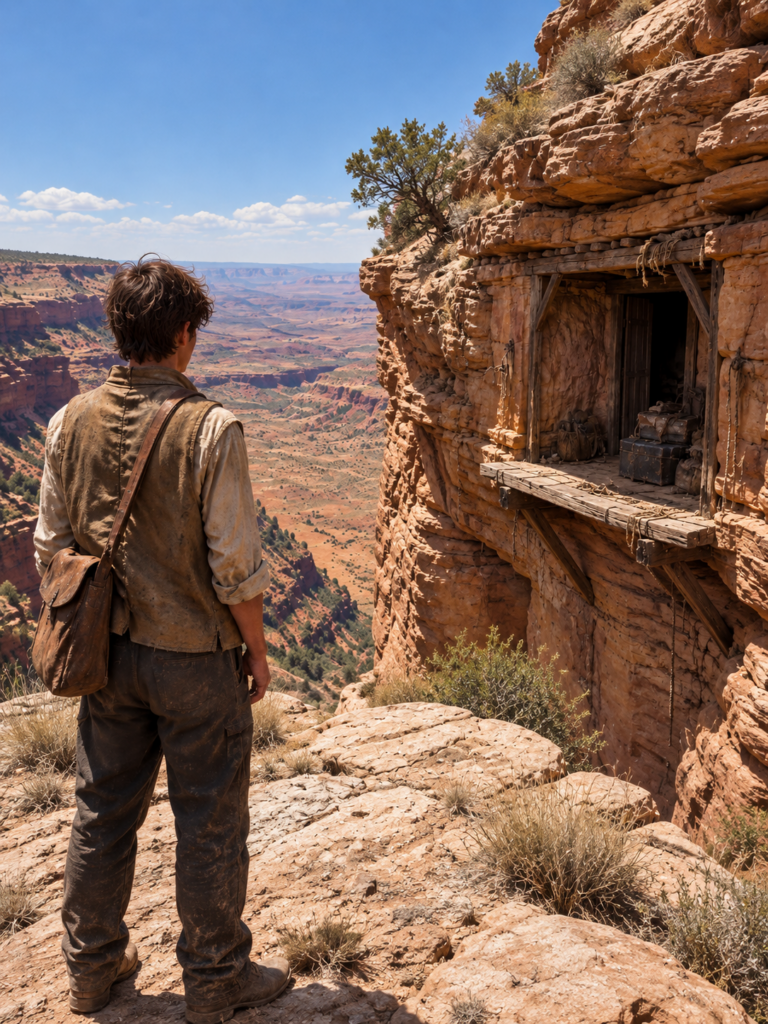
James Foster was eighteen years old when two men took his horse, his rifle, and his last reasonable chance of getting home, then left him on a narrow sandstone shelf in a canyon two days’ ride from Dry Creek.
They did not strike him. They did not tie him to a tree or put a bullet through his chest. Merle Hoyt simply took the reins from his hand, removed the rifle from the saddle scabbard, and told him that Dutch Reamer no longer required a third man.
James stood there in the afternoon heat, looking from Merle to the second rider, a wiry Kansan everyone called Pike.
Pike was winding a catch rope into an orderly coil. He had not looked James in the face since they stopped.
“What about my wages?” James asked.
Merle gave him the kind of look a man might give a dog that had wandered into his yard.
“You’ve eaten more than you’ve earned. Dutch figures that makes us square.”
James had worked for nearly a month. He knew what was owed him. He also knew that arguing would not put a rifle back into his hands.
“Are you fixing to shoot me?”
Merle glanced toward the canyon wall.
“Wouldn’t be much sense in that. A shot carries a long way out here.”
He looked over the ledge.
“Country’ll take care of you.”
Then he climbed into his saddle.
James watched the two horses turn along the narrow trail. Pike kept his head lowered. Merle did not look back.
For several minutes, the sound of iron horseshoes striking loose stone traveled along the canyon wall. Then the hoofbeats faded, leaving only the wind.
James remained standing until he could no longer hear them.
He had forty-two cents in a leather pouch beneath his shirt, a folding knife with a worn bone handle, a spare shirt tied at his belt, and a cracked canteen that had been leaking since morning.
He was barefoot in the sense that mattered most to a man in cattle country: he had no horse.
And he was standing in a place where a single wrong step would kill him faster than thirst.
Yet the most important thing James possessed was something neither Merle nor Pike had thought worth taking.
An old man’s lessons.
James sat carefully on the sandstone and began to count what he had.
He counted twice.
Years earlier, Ori Bement had taught him that panic was expensive. A frightened man could spend strength, water, and daylight without moving himself one inch closer to safety.
“When something bad’s already happened,” Ori used to say, “quit wasting time wishing it hadn’t. Find out what’s left.”
James could almost hear the old man’s dry voice.
He took the canteen from his belt and tipped it gently. A little water shifted inside. He did not drink.
Then he looked toward the descending canyon, where dark shadows had already gathered beneath the eastern wall.
There might be water below.
There would almost certainly be colder air.
But the lower country offered one thing the exposed rim did not.
Shelter.
James pushed himself to his feet and started down.
He had been born in a little two-room house on the northern edge of Dry Creek. His mother, Naomi Foster, liked to say he arrived in the spring of the year the town well went dry twice.
His father, Whit Foster, worked wherever a man could earn money from horses or cattle. Mostly he rode fences for the Halloran outfit. Sometimes he drove stock. Sometimes he returned home with a few dollars and promises of more work.
There was never quite enough money.
James remembered his mother sitting beneath the kitchen window with a shirt spread across her lap, stitching by the last daylight because lamp oil cost money.
She washed clothing for railroad section hands and mended whatever people brought her. Her fingers were rough from soap and cold water, but when James was small she could still straighten his hair with a touch that felt softer than anything else in the world.
He was nine when a lung fever took her.
He remembered the sound of her breathing during the last night. He remembered his father standing helplessly beside the bed. Most of all, he remembered the terrible silence the following morning.
After the funeral, Whit became a different kind of father.
He was never deliberately cruel. He simply carried more disappointment than he knew what to do with, and whiskey offered temporary relief.
James learned to make beans before he was ten. He could mend a torn shirt, sweep a stable, repair a section of fencing, and guide his father home from the saloon without attracting too many watching eyes.
Their dog, Bud, followed him everywhere in those years.
Some evenings, when his father slept in his chair and the dishes were finished, James sat on the porch with Bud’s head resting across his boot.
He would look over the empty road and wonder whether every grown man’s life eventually narrowed to work, debt, and exhaustion.
The person who showed him another possibility was Ori Bement.
Ori lived alone in a sod-roofed cabin east of town. He had been a horse breaker, a wagon hand, and several other things he seldom discussed. By the time James met him, he was past seventy, broad through the shoulders despite his age, and content to spend an entire afternoon without speaking unless he had something useful to say.
James first began helping him when he was eleven.
Sometimes the work was ordinary: stacking firewood, carrying water, repairing harness, or cleaning the little stable behind the cabin.
Other days, Ori took him into the surrounding country.
He taught James to recognize deer tracks and distinguish them from the marks of wandering cattle. He showed him how grass changed color above damp ground, how willow roots followed water, and how certain breaks in rock could hold shade long after the surrounding earth had become hot enough to blister skin.
James learned to make a small fire in wind, find his direction when landmarks disappeared, and wait beside a trail without moving.
“Most fellows want to conquer the country,” Ori once told him. “Better learn to read it.”
When James turned fourteen, Ori gave him a folding knife.
The handle was smooth bone, yellowed by years of use. The blade had been sharpened so many times that it was slightly narrower than it must once have been.
“Belonged to my father,” Ori said.
James turned it carefully in his hand.
“You sure you want me to have it?”
“Wouldn’t have handed it over otherwise.”
That was all.
But James understood the size of the gift.
Ori did not own many things, and he did not part with them lightly.
When the old man died two winters later, James found him sitting beside his stove, his hand near a coffee cup that had gone cold.
There was no wife to send for and no living family James knew of.
The county would not pay to open a proper grave in frozen ground.
So James borrowed a mattock and dug one himself.
It took most of two days.
He buried Ori on a rise east of the cabin, where the old man had liked to sit in the evenings.
For months afterward, whenever James encountered a difficult choice, his thumb went instinctively to the knife in his pocket.
Whit Foster died eleven months after Ori.
He began coughing blood on a Tuesday and was buried before the following Sunday.
A bank officer came shortly afterward carrying papers James had never seen. Whit had borrowed against the house, and the debts were larger than the property was worth.
James tried to explain that he could work.
The man listened politely and said the notes were overdue.
Within weeks, the only home James had known belonged to the bank.
He took his clothing, his saddle, Ori’s knife, and the few coins he had saved.
A saddle without a horse was a poor measure of prosperity, but it was better than nothing.
Around Dry Creek, people knew James as a quiet boy who worked hard and charged little. That reputation found him employment with Dutch Reamer, who operated a small cattle-hunting outfit north of town.
Dutch had a thick neck, pale eyes, and a habit of promising payment when the next cattle sale came through.
He could appear almost friendly when he wanted work done.
“You’ll learn the country with us,” he told James. “Keep your head down, do what you’re told, and you’ll make yourself useful.”
James accepted.
He was hungry, nearly penniless, and tired of being reminded that he had no family left to speak for him.
He had no reason to imagine Dutch had already decided that the easiest employee to cheat was the one nobody would come looking for.
The job began with fence riding and gathering scattered cattle. James repaired broken gear, rode borrowed horses, and worked until his arms shook.
Then Dutch assigned him to accompany Merle Hoyt and Pike into the broken country beyond Beeler’s Draw.
Merle claimed that several Halloran strays had wandered into a distant side canyon and remained there for years.
James knew the Halloran brand. His father had worked for that outfit most of his adult life.
The explanation sounded reasonable enough.
They rode out on a Wednesday.
For four days, the men traveled through increasingly unfamiliar country. Merle spoke only when necessary. Pike rarely spoke at all.
James assumed they were simply men who preferred silence.
By the second afternoon beyond their last reliable water, however, he began noticing things he could not explain.
There were no fresh cattle tracks.
The narrow approach Merle selected looked wrong for a herd.
And neither man seemed interested in searching for animals.
James remembered Ori’s warning that a man should pay attention whenever the story he had been told no longer matched the ground beneath his feet.
But turning back alone was dangerous.
So he followed.
The canyon grew narrower. Loose shale slid beneath the horses’ hooves. High above them, the rim cut a thin irregular line against the bright sky.
Finally, Merle stopped beside a shelf of sandstone.
And James learned why they had brought him there.
Now, abandoned on that shelf, he understood that whatever had been planned, it had not been a misunderstanding.
His employer had decided he was disposable.
The thought should have made him furious.
Instead, it left him feeling strangely hollow.
He had spent most of his childhood trying to be useful enough that people would keep him around. He had worked without complaint, taken whatever wages were offered, and swallowed indignities because he believed a man with no money could not afford pride.
And still, he had ended up alone in a canyon.
James moved downward until the path became a jumble of broken rock.
He used his hands as often as his feet, testing each stone before trusting it. At one steep descent, his right boot slipped across shale. He twisted sideways, caught himself against the wall, and struck his knee hard enough to send pain through his entire leg.
He remained motionless until the dizziness passed.
Then he continued.
By late afternoon, the shadows had swallowed the lower canyon.
He found a hollow beneath a leaning sandstone slab, just large enough to keep the worst of the wind off his body.
He buttoned his father’s wool vest to his throat and drew his knees toward his chest.
There was no wood close enough to gather safely in the dark.
He did not make a fire.
Above him, the wind moved across the rim with a steady sound like water breaking against a distant bank.
James thought of the little house on the edge of Dry Creek, the cabin where Ori had lived, and the men who would be sleeping somewhere warm that night.
He wondered whether Dutch would tell anyone he had run away.
He wondered whether Merle and Pike would feel any regret.
Eventually, he stopped wondering.
Cold demanded his full attention.
Through the night, he shifted position whenever his legs began to lose feeling. He held the broken canteen against his chest to keep its remaining water from freezing.
When morning finally reached the rocks, he stood slowly and almost fell.
His knee had swollen.
The heels of his hands were raw and his lips had begun to split.
He drank only a little from the canteen.
Then he started moving.
There were moments when the canyon seemed to lead nowhere, when every route ended in another ledge or a wall too steep to climb.
At one narrow chimney of rock, he stopped for a long time.
He could attempt a difficult descent or spend hours searching for another passage.
James took the bone-handled knife from his pocket, turned it over once, and remembered Ori’s advice about conserving strength in bad country.
He chose the descent.
The stone scraped his shoulders and tore a strip from his sleeve. Twice he had to lower himself without seeing where his boots would land.
But the passage opened below.
He kept moving.
By the following morning, James could no longer walk normally.
He crawled across stretches of loose shale, dragging his injured leg whenever necessary.
His tongue felt too large for his mouth.
His head ached with every movement.
He had begun to imagine the taste of cold water so vividly that it seemed almost real.
Then, as he rounded a bend, he saw a narrow line of dark green below him.
Willow.
James stopped.
He blinked several times, afraid the color might vanish.
But the trees remained.
And willow, Ori had taught him, rarely grew in country that had forgotten water completely.
James stared at that green line for a long time.
Then he began making his way toward it.
He reached the trees on his hands and one good knee.
Beneath a dark shelf of rock, cold water emerged from a shallow opening and traveled perhaps twenty feet through a gravel bed before disappearing underground.
James lowered himself beside it.
He drank carefully, taking small swallows and resting between them.
The water tasted of iron and decaying leaves.
It was the finest thing he had ever tasted.
He washed dust from his face. He wet his torn hands and rested his swollen knee in the cool shade.
For the first time since Merle took his horse, he allowed himself to believe he might survive.
When his head stopped pounding, he studied the ground around the seep.
There were deer tracks in the damp sand. Smaller animals had visited too.
Then he noticed something different.
A horseshoe print.
It was old, softened by seasons of weather, but unmistakable.
A shod horse had been here.
James lifted his head and looked beyond the water.
The willow branches hung thick against the canyon wall.
Behind them, almost completely concealed, stood a door.
It was built from split cedar planks that had weathered silver. Rust covered the heavy iron hinges, and a wooden peg held the latch closed.
Above the entrance, old lodgepoles and sod formed a roof that blended into the hillside. Yellow flowers grew along its edge.
A low stone chimney rose against the rock.
Beside the doorway stood a rough bench and a small anvil resting on a rotting section of oak.
James stared.
Someone had lived here.
And whoever built this place had gone to extraordinary trouble to make certain passing travelers would never know it existed.
He approached slowly.
The door was not locked.
James pulled the wooden peg from the hasp.
For an instant, nothing happened.
Then he drew the door toward him, and the old hinges answered with a long, dry creak.
Cool darkness waited beyond the threshold.
James stood looking inside, his hand resting on Ori’s knife.
He had followed the promise of water into a place the world seemed to have forgotten.
What he did not yet know was that the person who had built this refuge had once been abandoned in the same canyon by men whose secrets were still buried nearby.
And beneath the stones of that old shelter lay something far more dangerous than forgotten gold.
Part 2
The smell inside the dugout was unlike anything James remembered from an occupied home.
There was cold stone, dry timber, ancient wood smoke, and the faint mineral scent of earth that had been shut away for years.
Three flat stone steps descended from the doorway.
James eased himself down them, favoring his injured knee.
The room measured roughly twelve feet across and fifteen feet deep. Its floor consisted of split logs laid flat and secured with wooden pegs. A broad stone hearth occupied the eastern wall.
At the back stood a narrow bunk made from peeled poles. Beneath a small square window, a plank table rested on thick wooden legs.
The paper that had once covered the window had torn away, admitting a thin shaft of daylight.
A three-legged stool stood beside the table.
On wall pegs hung a stiff bullwhip, a broken bridle, and an old canvas coat.
There was also a Sharps rifle.
James reached up carefully and lifted it down.
The hammer was missing, and the stock had split badly. Whatever use the rifle might once have served, it could not defend anyone now.
He returned it to its peg.
On the table lay a tin plate, a cup, a horn-handled spoon, and the remains of a candle melted into a hardened amber-colored pool of tallow.
James touched the table.
Dust shifted beneath his fingertips.
No one had lived here for a long time.
Yet the dugout had not been ransacked. Whoever left it had either departed in a peculiar hurry or had never intended to return.
James lowered himself onto the stool.
He had spent the past two days thinking about food, water, and shelter.
Now he had water and shelter.
Food remained a problem.
Still, the room changed his circumstances so completely that for several minutes he could do nothing except look around.
A man had built this place with his own hands.
The stonework was rough but sound. The dugout had been positioned where the willow concealed the entrance and the sandstone protected it from wind.
Whoever lived here had known the country intimately.
James wondered whether the builder had been a prospector, a trapper, or someone hiding from the law.
The old anvil outside suggested a blacksmith.
The hidden entrance suggested a man who did not welcome visitors.
James examined the floor, the bunk, and the corners near the hearth.
There were no fresh supplies.
A few pieces of rotten cloth lay beneath the bunk, and the canvas coat on the wall had pockets stiff with dust.
He searched them anyway.
One contained a small strip of dried apple, hard as leather but still recognizable.
James set it aside for morning.
By late afternoon, his strength had begun to return, although his knee remained painfully swollen.
He sat in the doorway with his back against the frame and his legs stretched into the last warm sunlight.
The seep murmured softly nearby.
He could not remember the last time he had felt so grateful to be sitting still.
He thought of taking the old canvas coat, sleeping until morning, then attempting to follow the watercourse toward open country.
That would have been the sensible course.
But something about the dugout troubled him.
Ori once told him that a man who built a shelter specifically to escape notice would rarely leave everything valuable where a stranger could see it.
“Folks hide themselves for reasons,” he had said. “And a fellow willing to hide himself usually knows how to hide other things.”
James looked over his shoulder toward the dark hearth.
He had no particular reason to believe there was anything worth finding.
Still, he had daylight left.
He took his knife from his pocket and went inside.
The hearth had seven flat stones arranged before the firebox.
Most were deeply settled into their beds, held fast by years of packed dust and clay.
James worked the knife blade along the first seam.
Nothing moved.
He tried another.
Then another.
At the smallest stone, near the left corner of the hearth, he felt the blade slip into a narrow opening.
He pressed gently.
The stone shifted.
James stopped.
He tried again, this time supporting the knife with both hands.
The edge lifted perhaps a quarter of an inch.
He did not want to snap the blade Ori had given him. He found a thin piece of broken pine near the bunk and worked it beneath the stone.
With patient pressure, he raised it free.
Beneath lay a carefully cut cavity in the sandstone.
Inside the cavity was a folded square of oiled canvas.
James moved the cloth.
A tin box appeared.
It was about the size of a family Bible, its surface darkened by age, with a hinged lid secured by a simple wire hasp.
Beside it lay a small leather packet tied with rawhide.
James remained crouched beside the hearth.
The dust in that opening had not been disturbed in years.
Whatever rested inside had been placed there deliberately and concealed with care.
He carried the box and packet to the table.
The tin was heavier than he expected.
He sat on the stool, opened the hasp, and raised the lid.
Inside was a bundle wrapped in faded blue calico.
He unfolded the cloth.
Gold coins caught the thin window light.
James did not move.
He had seen gold before, but seldom at close range and never in such quantity.
There were forty-one double eagles.
He counted them twice, laying them in short stacks on the table.
Each coin bore a twenty-dollar denomination.
Eight hundred and twenty dollars.
James stared at the amount, trying to comprehend it.
He had arrived in the canyon with forty-two cents.
The coins before him represented more money than he could expect to earn in years of ordinary cattle work.
Beneath the gold lay a small buckskin sack containing eleven silver dollars and an assortment of half dollars and quarters.
There was also an old bank draft, issued from a Denver banking house for two hundred and twelve dollars, never presented for payment.
At the very bottom of the box rested a woman’s thin gold wedding ring.
James picked it up.
The inside had been worn smooth by years against someone’s finger. There were no initials he could clearly read.
The ring looked almost insignificant beside the coins.
Yet it had been placed carefully at the bottom, where it would remain protected.
For some reason, James found himself handling it more gently than the gold.
He returned it to the box.
Then he opened the leather packet.
Inside were a small ledger, a folded map, and a letter sealed with a smear of candle wax.
The ledger contained dates, initials, amounts, and entries reaching back twenty-three years.
One column, written in darker ink, bore a single heading.
Owed.
James turned several pages.
Some entries recorded supplies, payments, and portions of money assigned to names or initials. Others were less clear.
He recognized no complete explanation for what he was seeing.
The second document was a map drawn in pencil on the reverse of a feed-store bill.
It showed the canyon, several side draws, the seep, and a trail leading toward the upper country.
Two miles above the dugout, an X marked a place labeled Cache.
James looked back at the tin box.
Someone had hidden a small fortune beneath the hearth.
And the map suggested there was more.
He unfolded the last paper.
On the outside, in the same cramped handwriting as the ledger, someone had written:
For whoever finds this and has need of it.
James broke the wax seal with the tip of his knife.
The letter had been folded so long that the creases were nearly white.
He carried it toward the window, where the remaining daylight was strongest, and began to read.
The writer’s name was Josiah Pell.
He described himself as a former blacksmith and wagon hand who had once worked for a criminal outfit. He had been left for dead on the shale above the canyon, much as James himself had been abandoned.
After surviving, Josiah had lived alone in the dugout for twelve years.
He was seventy-one when he wrote the letter.
His heart was failing, and he did not expect to survive another spring.
James paused.
The words had been written by a man who knew death was coming and wanted a stranger to understand what remained behind.
He continued.
Josiah explained that the money in the tin box was honestly earned. After leaving the gang, he had supported himself by shoeing horses and working for the mail road.
The wedding ring had belonged to his wife.
He had no children and no living family willing to claim him.
The money marked on the map was different.
It had been stolen.
Josiah did not consider himself entitled to give it away.
He had maintained the ledger so someone might one day identify the rightful claimants and return what could be returned.
James read that passage again.
The gold in the tin was a gift.
The money on the map was a responsibility.
That distinction mattered enormously to the dying man who had written the letter.
Then James reached the final paragraph.
Josiah asked that whoever found his remains bury him beneath the cottonwood near the seep.
And he asked one more favor.
He wanted the finder to remember a young horse breaker named Ori Bement, who had once fed Josiah when he was hungry and asked no questions.
If Ori still lived, Josiah hoped someone might tell him that the kindness had never been forgotten.
James stopped reading.
For a long while, the only sound in the room was water moving outside.
He looked down at Ori’s folding knife.
The worn bone handle lay near the letter.
He read Ori’s name again.
Then he began the letter from the beginning.
When he finished, he read it a third time.
There was no mistaking the name.
The same man who had taught James to survive in the wilderness had once helped the old blacksmith who built this hidden shelter.
Josiah had carried that memory through twelve years of solitude.
And now James, saved by Ori’s lessons, had stumbled upon the one place where that forgotten kindness still lived in another man’s handwriting.
He tried to imagine Ori as a young horse breaker.
It was difficult.
James had only known him as an old man who drank black coffee, disliked wasted words, and expected work to be done properly.
Had Ori ever spoken of Josiah Pell?
James searched his memory.
There had been stories of wagon roads, winter storms, dishonest trail bosses, and horses that learned to bite.
But no Josiah.
Perhaps Ori had forgotten the encounter.
Perhaps he had remembered it and considered it too ordinary to mention.
Giving a hungry man something to eat was exactly the sort of thing Ori might have done without believing it worth a story.
James placed the knife across the unfolded letter to hold it against the draft.
Something inside him eased.
He had been abandoned because three men considered his life worth less than the wages they owed him.
Yet here was evidence of another kind of accounting, one that had survived long after the people involved were gone.
An old man had fed a stranger.
That stranger had remembered.
And years later, the memory had found its way back to the boy the old man had raised in everything but name.
James sat there until the light faded.
He did not weep.
He had spent too many years learning to keep grief private.
But he touched Ori’s knife and spoke softly into the empty room.
“I found him.”
That night, James slept on the wooden floor with Josiah’s old canvas coat drawn over him.
He kept the tin box beside his hip.
When he woke, the pale morning light lay across the table.
His knee ached less than before, although he still could not put his full weight upon it.
He drank from the seep, washed his injured hands, and ate three small handfuls of watercress growing near the spring.
He also ate the dried apple from the coat pocket, chewing it slowly.
Then he set about making himself fit to travel.
He cut a dry cedar branch into a walking staff and stripped it smooth with Ori’s knife.
He tore his spare shirt into long strips and wrapped the injured knee tightly enough to support it without cutting off circulation.
He studied Josiah’s map, which showed an old game trail on its reverse side.
It appeared to offer a way out of the canyon without climbing the nearly vertical walls James had descended.
For the first time, he possessed a route home.
But before leaving, he had something to do.
He went to the cottonwood near the head of the seep.
The tree stood apart from the smaller willow growth, its roots gripping a shelf of earth above the water.
Beneath it lay a shallow mound covered with loose stones.
James knelt.
He moved the stones carefully.
There, inside the grave Josiah had evidently prepared for himself, lay the old blacksmith’s remains.
James removed enough earth to lay the bones properly. Then he covered them again, using more soil and stones to protect the resting place.
He worked slowly because of his knee.
Sometimes he had to stop and rest his back against the cottonwood.
He did not resent the labor.
He remembered the grave he had dug for Ori in frozen ground, and he wondered whether some duties passed from one man to another without either understanding why.
When he finished, he cut a strip of cedar bark and heated the tip of his knife in a small fire.
With patient movements, he burned Josiah Pell’s name into the bark.
He set the marker between two flat stones at the head of the grave.
Then he stepped back.
There was no minister, no congregation, and no bell tolling in Dry Creek.
Only the sound of water.
James removed his hatless head from the sunlight by lowering it for a moment.
“Thank you,” he said.
He left the dugout later that morning, carrying the tin box wrapped in Josiah’s canvas coat.
The leather packet rested against his skin beneath his shirt.
He followed the game trail cautiously.
There were stretches where it disappeared among stones or divided into several faint tracks. Each time, James stopped and compared the ground with Josiah’s penciled map.
He made no attempt to find the cache marked by the X.
His knee was not strong enough, and the letter had made clear that the hidden money belonged to other people.
More importantly, James understood that if those old crimes involved living men, a boy carrying stolen treasure through the wilderness might find himself in greater danger than he had already survived.
The first day was painfully slow.
The second brought him into more open country, where he found rabbit tracks and a sheltered hollow in which to sleep.
On the third, he saw distant grazing land.
By the fourth, he recognized the shape of the hills north of Dry Creek.
He reached town at dusk on the fifth day.
His clothing was torn, his face burned dark by sun and wind, and his knee had swollen again from the walking.
He passed the mercantile.
A man on the boardwalk glanced at him and then looked again.
James kept moving.
He passed the yard where Dutch Reamer usually kept his horses.
He did not stop.
Nor did he go to the bank.
Instead, he walked directly to the county sheriff’s office.
Amos Beeler was fifty-eight, tall and spare, with a graying mustache and a habit of listening before he spoke.
He had known Ori Bement for decades.
He had also helped carry Naomi Foster’s coffin to her grave when James was nine.
When James entered, Amos looked up from his desk.
For a moment, the sheriff seemed unable to place him beneath the dirt and bruises.
“James?”
“Evening, Sheriff.”
Amos rose.
“Good Lord, boy. What happened to you?”
James placed the bundle on the desk.
“I need to tell you something.”
The sheriff examined his face, then his swollen knee.
“Sit down first.”
James sat.
Amos brought him water and waited while he drank.
Then James told him everything.
He began with Dutch Reamer’s assignment and the ride beyond Beeler’s Draw.
He described Merle Hoyt taking the horse and rifle, Pike standing with his rope, and the long descent into the canyon.
When he reached the discovery of the dugout, he laid the map on the desk.
He showed Amos the ledger.
Finally, he unfolded Josiah Pell’s letter.
Amos read it once.
Then again.
At the mention of Ori Bement, his expression changed.
He set the letter down carefully.
“I knew Ori worked the wagon roads when he was younger,” he said. “Never knew this fellow.”
“Neither did I.”
Amos turned several pages of the ledger.
His finger stopped beside an entry marked with the initials D. R.
Then he examined another entry mentioning a young wagon hand named Merle.
He looked toward the office window.
“James, who else knows you found this?”
“Nobody.”
“Good.”
“Is Dutch in trouble?”
Amos closed the ledger.
“That depends on what we can prove.”
He paused.
“But there’s one thing we don’t need to wait on.”
He opened a drawer, removed a sheet of paper, and reached for his pen.
“We’ll send for Merle Hoyt and Pike tonight.”
James watched the sheriff begin writing.
He had brought the documents because Ori had taught him that important matters belonged in responsible hands.
Until that moment, he had not fully understood what those documents might mean.
The ledger did not merely record money.
It preserved the names of men who believed their old crimes had been forgotten.
And one of those men was the employer who had just tried to leave James Foster to die.
Part 3
By morning, Merle Hoyt and Pike were locked in separate cells behind the sheriff’s office.
The deputies had found Pike at a card table in the Blue Antler saloon. He had been holding a hand of cards when they approached and apparently believed they had come about an unpaid debt.
Merle was discovered in the loft of Dutch Reamer’s barn.
Dutch himself was arrested shortly afterward.
All three men were in custody by noon.
James heard the news while sitting in the little back room above Hattie Renfrow’s kitchen, where the widow had insisted he stay until his knee healed.
Hattie was forty-six and ran a boarding house at the south end of town.
Twenty years earlier, she had washed clothing alongside Naomi Foster. She remembered James as a small, solemn child who followed his mother with a bundle of clean linen nearly as large as himself.
When Amos brought James to her door, she took one look at him and stepped aside.
“Upstairs,” she said.
“Hattie, I can’t pay for a room yet.”
“You can discuss money when you can walk without leaning on the wall.”
She fed him stew, cleaned his scraped hands, and gave him a bed with a proper mattress.
The following morning, she appeared carrying coffee and a plate of biscuits.
James tried once more to explain that he had money hidden away but did not yet know what he could use.
Hattie placed the plate on the bedside table.
“James Foster, your mother would haunt me clean out of this house if I charged you rent while you looked like that.”
He smiled despite himself.
Hattie sat beside the bed.
“Amos says they found the men.”
“Yes, ma’am.”
“Did they truly leave you out there with no horse?”
James nodded.
She pressed her lips together.
For a moment, the woman who had washed his mother’s clothing seemed unable to find words strong enough for what she thought.
Finally, she adjusted the quilt over his leg.
“Eat those biscuits before they’re cold.”
That was the end of the conversation.
But when she went downstairs, James heard her moving pots around the kitchen with considerably more force than usual.
At the sheriff’s office, Amos began comparing Josiah’s ledger with the documents and money taken from the men.
The old accounts named a number of individuals, including several who had lost money or property more than two decades earlier.
One entry showed the initials D. R. beside a sum of eleven hundred and forty dollars, described as a share taken and never divided.
Another referred to a young wagon hand named Merle.
At first, James struggled to connect the man who had stood above him on the sandstone shelf with events that had occurred before James was born.
Merle seemed like a man whose entire life consisted of cattle work, cards, and grudges.
Yet the ledger placed him near the people who had operated with Josiah Pell’s former outfit.
Amos was cautious.
A name in a book was not proof of every crime recorded there, and a man could not be convicted merely because a dead blacksmith had written down his initials.
But the map, the accounts, and the circumstances surrounding James’s abandonment gave the sheriff grounds to investigate.
Two deputies accompanied Amos into the canyon.
They followed the route James had described, using Josiah’s map to locate the dugout and then the marked cache two miles above it.
The hiding place was not obvious.
It lay among broken rock where a narrow side draw turned sharply beneath the upper wall.
Without the map, a traveler could have passed within yards and seen nothing unusual.
The deputies uncovered the buried money.
There were coins, paper currency, and a small metal ingot bearing a Denver assay stamp.
Together, the contents were valued at three thousand eight hundred and sixty dollars.
Amos brought the money to town under careful guard.
He issued a receipt, entered it into the county record, and placed it in the safe pending investigation of the claims recorded in Josiah’s ledger.
When James saw the contents laid out for counting, he felt none of the astonishment that had overtaken him at the discovery of the gold beneath the hearthstone.
This money had a different weight.
Josiah had spent his final years believing that someone, somewhere, had suffered because it was taken.
There were names beside those losses.
Some might belong to people who were now dead.
Others might still have families who remembered debts never repaid.
James thought of his father arguing with the bank, of the notes that had cost him his home, and of how little mercy a man received when he owed even a few dollars.
He understood why Josiah had refused to call stolen money his own.
A thousand dollars could be a comfortable sum to a man who had earned it.
It could also be years of labor stolen from another.
As the investigation continued, James visited the sheriff’s office whenever his knee allowed.
He did not try to direct the proceedings.
Mostly he answered questions.
Where had Merle taken his horse?
What exactly had Dutch told him before the trip?
Had Pike threatened him?
What direction had the men ridden when they left?
James gave the same account each time.
He did not embellish it.
There was no need.
One afternoon, Amos asked whether he wanted to see Merle.
James considered the question.
“What for?”
“Sometimes a man wants to hear an explanation.”
James looked toward the cells.
He could still remember Merle’s hand closing over the borrowed horse’s reins.
He could remember the flat voice telling him the country would finish the job.
“I know what he did,” James said. “Don’t reckon hearing him talk would improve it.”
Amos nodded.
“Fair enough.”
James returned to Hattie’s boarding house without looking toward the back of the office.
The town gradually learned what had happened.
At first the story traveled in fragments.
A boy had been left out in the canyon.
A hidden shack had been discovered.
There was gold.
There was a dead outlaw.
There were old records, arrests, and a cache of money.
As often happens in small towns, the rumors grew more elaborate with each retelling.
James heard one man claim he had found a cave stacked with gold bars.
Another insisted there had been a skeleton chained to the wall.
A third said James had fought off three armed men.
None of it was true.
Whenever someone asked him directly, he explained the facts as simply as he could.
He had been abandoned.
He had found water and a dugout.
An old man had left a letter.
The sheriff was handling the money.
That was all he wanted people to know.
Yet he soon discovered that his neighbors looked at him differently.
Men who had once barely acknowledged him began touching their hats when he passed.
Children followed him along the boardwalk, staring at the boy who had supposedly returned from the dead.
At the mercantile, the clerk addressed him as Mr. Foster.
James nearly looked over his shoulder to see whom the man meant.
The attention made him uncomfortable.
He had not gone into the canyon looking for an adventure.
He had been trying to earn enough money to live.
And although everyone admired the gold, few seemed to understand that he still woke some nights remembering the long descent over the shale.
He could feel the canyon beneath his hands.
He could hear the wind above the rim.
Sometimes he dreamed that he had reached the willow and found no water.
On those mornings, Hattie’s coffee and the ordinary sounds of people moving downstairs were more comforting than the treasure.
Still, the discovery had opened possibilities James had never expected.
Once he could travel comfortably, he asked Ned Avery for help returning to the dugout.
Ned was sixty-three and operated the livery stable.
He had known Whit Foster for years, although he spoke more kindly of James’s father than most men did.
When James explained what he wanted, Ned led a mule from the back stall.
Her name was Prue.
She was sturdy, patient, and entirely unimpressed by human foolishness.
“She’ll carry a pack saddle,” Ned said. “And she won’t get excited about rough country.”
“What’ll you charge?”
“Bring her back in one piece.”
James waited.
Ned adjusted the mule’s halter.
“That’s the price.”
James did not argue further.
On the first trip, he carried tools, food, blankets, and enough supplies to spend several days working.
He wanted to see whether the dugout could become a permanent home.
It was an unusual ambition.
Most men who possessed any prospect of money wanted to leave a lonely place behind.
James had spent much of his life trying to escape poverty and isolation.
Yet the canyon no longer seemed like a prison.
He knew where the water ran.
He knew how morning light reached the doorway.
He knew that a man had once lived there for twelve years, working quietly and carrying the memory of another man’s kindness.
The land offered something James had never been able to purchase in Dry Creek.
A place where his presence did not depend upon someone else’s permission.
He began by clearing debris from the floor and inspecting the timbers.
The roof was sound in some places and badly weathered in others.
The cedar door had sagged on its hinges.
The chimney cap was broken.
But the dugout had survived many winters, and James believed it could survive more.
On his third trip, he brought Wills Overbey.
Wills was a forty-one-year-old carpenter with strong hands, a practical temperament, and enough experience with ironwork to make and repair his own hardware.
He examined the dugout without speaking for several minutes.
Then he pressed his palm against one of the roof timbers.
“Whoever made this knew what he was about,” he said.
“Can it be fixed?”
“Certainly.”
Wills looked toward the doorway.
“Question is whether you want to live this far from everyone.”
James considered the small room.
He thought of Hattie’s crowded boarding house and the stable where men sometimes slept between jobs.
He thought of the bank’s claim against his father’s house.
“I’d like something that’s mine,” he said.
Wills nodded.
“Then we’d best see about giving you a door that closes properly.”
They worked for several days.
Wills replaced the worn hinges with new iron straps he had forged. They re-chinked the doorframe using fresh red clay from the creek bank.
They installed a proper lock.
James helped cut new sod from a flat above the rim and laid it in courses over the aging roof.
They repaired the chimney cap with mortar and fitted a small pane of glass into the window.
It was no larger than a book, but it transformed the room.
Sunlight entered cleanly in the mornings, falling across the wooden floor in a bright square.
James built a plank bunk over the old pole frame and stuffed a mattress tick with dry grass.
He repaired the table and placed a shelf above the hearth.
On it he arranged Josiah’s tin plate, the horn-handled spoon, and three new candles purchased in town.
The room still looked plain.
But it no longer looked abandoned.
James made a sheath from the upper leather of an old boot and hung Ori’s knife beside the door, where he could reach it as he came in from work.
He kept Josiah’s letter in the tin box, protected from dust and damp.
The wedding ring remained with it.
James had decided almost immediately that he would never sell the ring.
The gold might pay for repairs, tools, animals, and years of modest security.
But the ring belonged to a part of Josiah’s life that money could not measure.
He had preserved it through twelve years of solitude.
James intended to preserve it too.
Meanwhile, Amos helped determine whether James could legally claim the ground around the dugout.
The land appeared to be unclaimed public land, and the hidden seep had made a previously overlooked parcel worth considering.
Amos brought the county clerk, Otis Vandermeer, to inspect the location and witness the necessary filing.
Otis was twenty-four, wore steel-rimmed spectacles, and possessed the careful handwriting of a man who trusted ink more than memory.
James filed a homestead entry covering one hundred and sixty acres around the dugout, the seep, and the bench above it.
The filing was recorded in Dry Creek, and Otis gave him a stamped receipt.
James examined the paper.
His name stood plainly across the top.
James Foster.
For a long time, he did nothing but hold it.
The property was not yet a life of comfort. There would be requirements to meet, improvements to maintain, and winters to endure.
The paper itself did not build fences or put hay in a shed.
But it meant he had taken the first formal step toward establishing a home no employer could take away simply by refusing wages.
When James returned to the canyon, he placed the receipt safely with his other papers.
Then he went back outside and cut firewood.
There was still work to do.
In September, the circuit judge arrived in Dry Creek.
The courtroom filled early.
Men stood along the back wall. Women occupied nearly every bench. Even people who seldom attended county proceedings came to hear the charges involving Dutch Reamer, Merle Hoyt, and Pike.
James sat in the second row.
He wore a clean shirt Hattie had pressed for him and kept Ori’s folding knife in his pocket.
He testified when called.
He told the judge what had happened above the shale, described the route into the canyon, and explained how he found Josiah’s dugout.
The recovered ledger and stolen money were examined as part of the proceedings.
The court considered the old thefts alongside the more recent crime against James.
Dutch Reamer received a sentence of twelve years.
Merle Hoyt and Pike were sentenced to five years each for their conduct in abandoning James.
James listened without satisfaction or triumph.
He had imagined many things during the first bitter hours on the sandstone shelf.
He had imagined reaching town and demanding the wages Dutch owed him.
He had imagined finding a horse and riding far enough away that he would never have to look at those men again.
But he had not imagined standing in a courtroom while the law answered for what had happened.
When the proceedings ended, people gathered in the aisle.
Several shook his hand.
A few spoke about justice.
James thanked them politely.
Then he found Amos outside.
The sheriff stood beneath the shade of the courthouse awning.
“How do you feel?” Amos asked.
James looked toward the street.
“Tired.”
Amos nodded.
“That’ll happen.”
After a moment, James added, “I kept thinking they’d get away with it.”
“They might have, if you’d never come home.”
James watched a wagon roll past.
“Josiah’s book did more than I did.”
“The book helped,” Amos said. “But you had to bring it.”
James put his hands into his pockets.
For the first time, he understood that surviving the canyon had only been the beginning of what was required of him.
He had also chosen what to do with the thing he found.
And that choice had brought three men to account.
As autumn deepened, Amos wrote to the surviving relatives of people named in Josiah’s ledger.
Some trails had gone cold.
Others could still be followed through family records and addresses.
Two claims were established clearly enough for payment.
A woman in Sterling, Colorado, received a bank draft.
So did a man in North Platte, Nebraska.
Their families had been owed money for years.
Neither had expected it to return.
The letters of acknowledgment came back to the sheriff’s office before the first snow.
Amos showed them to James one evening beside the stove.
James read the letters slowly.
There were no grand speeches in them.
Both writers simply expressed surprise, gratitude, and relief that an old wrong had finally been recognized.
James returned the papers to Amos.
“Josiah would’ve liked that.”
“I expect he would.”
The remaining stolen money was handled under the court’s direction.
After the established claims were paid, a sum of just under nine hundred dollars was assigned to James as the finder.
He accepted it.
He had not stolen the money, and the court had resolved its disposition.
Still, he was more careful with those dollars than he had ever been with his own small wages.
Money could disappear quickly if a man began believing it would always be there.
From Josiah’s honestly earned gold, he took two double eagles and gave them to Hattie Renfrow.
She protested.
James placed the coins on the kitchen table.
“You fed me and gave me a bed.”
“You needed both.”
“And you gave them.”
“Your mother would’ve done the same for me.”
“I know.”
He pushed the coins toward her.
“That’s why I want you to have them.”
Hattie studied his face.
Then she picked up the coins and put them away.
“You’re a stubborn boy.”
“Had good teachers.”
Her expression softened.
“Yes,” she said. “You did.”
James also bought a six-year-old bay gelding from Ned Avery.
The horse’s name was Mose.
He was sound, calm, and accustomed to rough country.
James took him out beyond town before deciding.
The gelding climbed a rocky slope without hesitation, crossed a shallow stream, and stood patiently while James inspected his hooves.
James returned to the stable and paid Ned the agreed price.
For the first time since losing his father’s home, he owned a horse.
Ned gave him a good look as he counted the money.
“You planning to keep riding up to that canyon?”
“Yes, sir.”
“Then take care of your hay supply before winter. That place gets colder than you think.”
James promised he would.
He purchased an axe, a bucksaw, and a keg of nails from Wills Overbey.
The rest of his money remained secure in the county safe.
Through October and November, he worked steadily at the dugout.
He cut firewood and stacked it along the outer wall until the pile reached the eaves.
He improved the trail to the seep.
He made repairs wherever wind or rain found weaknesses.
He and Wills erected a rough pole shed against the south-facing canyon wall, where Mose could shelter from winter storms.
They made certain the structure stood on high enough ground to remain dry and close enough to the dugout that James could reach it after dark.
Wills fashioned a sheet-iron cap for a stove pipe that James installed through the sod roof.
By the first hard snow, the dugout possessed warmth that Josiah’s old hearth alone could never have provided so easily.
There were two blankets on the bunk, a coffee pot near the fire, and enough supplies to carry James through weeks of isolation.
On Saturdays, weather permitting, he rode Mose into Dry Creek.
Ned let him stable the gelding without charge.
Hattie kept a place at her supper table for him.
And Amos occasionally asked him to stop at the office, not because there were new questions about the case, but because the sheriff had come to enjoy talking with him.
The townspeople began calling him James rather than Whit Foster’s boy.
Otis Vandermeer always addressed him as Mr. Foster when he visited the courthouse.
Amos sometimes called him son.
The first time he did, James felt a sharp, unexpected ache.
It was not the word itself.
His father had called him son often enough.
But Amos spoke it with an easy respect, as though James had become someone worthy of a place in the older man’s world.
James carried that feeling back to the canyon.
Winter settled heavily over the country.
Snow collected along the rim and drifted into sheltered breaks. Ice formed beside the seep, although the water continued running dark beneath its frozen edges.
Mose grew a thick coat and spent the coldest nights in the pole shed.
James rose early to feed him.
He kept the stove banked, cleared snow from the entrance, and made careful use of his stored provisions.
Sometimes, during the long evenings, he read Josiah’s letter by candlelight.
He no longer needed to study every line.
He knew most of it by heart.
But each reading seemed to reveal something he had missed.
At first, he had been overwhelmed by the coincidence of Ori’s name.
Later, he thought more about Josiah’s decision to separate his honest earnings from the stolen money.
The old blacksmith could have hidden the entire fortune and left no explanation.
He could have carried the gold to another state.
He could have lived comfortably on money other men had lost and trusted time to erase the evidence.
Instead, he had spent his last years keeping careful accounts.
He had written a letter to someone he might never meet.
He had left directions to a place he hoped could still bring justice.
James understood that Josiah had not been a perfect man.
He had worked for a criminal outfit. There were wrong choices in his past, perhaps more than the letter admitted.
But he had tried to make something right before he died.
That mattered.
It meant a life did not have to be measured solely by its worst decisions.
James thought about his own father.
Whit had been weary and frequently drunk, and his debts had cost his son the only home he knew.
Yet James remembered him mending a broken sled one winter because his little boy had cried over it. He remembered the rough hand resting on his shoulder after his mother’s burial.
There had been goodness in Whit Foster, even if hardship and drink had buried much of it.
James did not excuse everything his father had done.
But he found he could remember him without feeling only resentment.
That was a change he had not expected.
On a clear February evening, the canyon lay beneath nearly two feet of snow.
The sky above the rim had turned a cold, transparent blue.
James finished feeding Mose and returned to the dugout.
He knocked the snow from his boots, hung his coat beside the door, and checked the stove.
The room was warm.
Steam rose thinly from the coffee pot.
A small patch of fading daylight rested on the wooden floor beneath the window.
James sat at the plank table on the three-legged stool Josiah had left behind.
Before him, he arranged three objects.
The first was Ori Bement’s folding knife.
He had cleaned and oiled it that afternoon. The bone handle had darkened in the places where his thumb rested, and the narrow blade still carried the marks of years of sharpening.
The second was Josiah Pell’s letter.
Its paper had softened at the folds from being handled so often.
The third was the thin gold wedding ring.
James turned it gently between his fingers.
He knew almost nothing about the woman who had worn it.
Josiah had not written her name.
Perhaps after twelve years alone, her name had been so much a part of his private thoughts that he could not imagine needing to write it down.
James wondered what kind of life they had shared before everything went wrong.
He wondered whether she had known about the outlaw gang.
Whether she had waited for Josiah during his wandering years.
Whether the old man had thought of her every evening as he watched sunlight leave the canyon.
The ring could not answer.
It was only a small circle of worn gold.
But James knew why it belonged beside the letter.
Josiah had kept it because love could outlast the life in which it began.
James placed the ring on the paper.
Then he set Ori’s knife across both.
Outside, wind moved along the canyon rim.
It made the same low sound James remembered from the night after Merle and Pike abandoned him.
He closed his eyes.
For an instant, he could feel the cold sandstone beneath his back and the cracked canteen against his chest.
He remembered counting his belongings.
Forty-two cents.
One knife.
One spare shirt.
A leaking canteen.
Nothing more.
The memory no longer made him feel helpless.
Instead, he thought of the decisions that had followed.
He had gone downhill because Ori taught him where water might lie.
He had followed willow to the seep.
He had entered the dugout because he was willing to look beyond what appeared to be an empty wall.
He had lifted the hearthstone because an old man taught him that hidden things were often concealed within other hidden things.
And when he discovered the money, he had carried Josiah’s ledger to the sheriff instead of quietly claiming every coin.
None of those decisions had made him rich in the way storybooks promised.
He still had to cut firewood.
He still had to repair his roof and care for his horse.
There would be dry years, bitter winters, and days when his knee reminded him of the descent through the shale.
But he owned a good horse.
He had a home to improve and land to work.
He had money set aside against emergencies and people in town who welcomed him at their tables.
More importantly, he was no longer living entirely at the mercy of men like Dutch Reamer.
James thought of his mother, bent over her sewing beneath the little kitchen window.
He thought of his father coughing in bed and the bank officer carrying away the papers that had once meant security.
He thought of Ori sitting beside his stove with a cup of cold coffee, and of the frozen earth James had opened for his grave.
Then he remembered a line in Josiah’s letter.
The old man had wanted Ori to know that his kindness was remembered.
James had arrived too late to deliver that message.
Both men were gone.
But perhaps the message had reached its destination in another way.
Everything Ori taught him had survived.
It had traveled in James’s hands, in his habits, and in his choices.
It had brought him to Josiah’s door.
And it had given a forgotten man the burial he requested, returned stolen money to the families entitled to it, and helped an orphaned boy find somewhere to belong.
James sat quietly with those thoughts.
He was eighteen years old.
There would be more years ahead of him than he could imagine from that small room.
He did not know whether he would remain in the canyon forever.
He did not know whether he would marry, raise children, or someday build a larger house above the seep.
Those questions could wait.
For now, the stove was warm and Mose was safe in his shed.
There was coffee in the pot and enough food for breakfast.
Tomorrow he would rise early, clear the fresh snow, inspect the roof, and tend to whatever needed his hands.
It was an ordinary life.
And after everything he had survived, that seemed a remarkable gift.
James folded Josiah’s letter carefully and returned it to the tin.
He set the ring beside it.
Then he closed the lid and placed the box on the shelf above the hearth.
He took Ori’s knife, opened the blade once to inspect its edge, and folded it shut.
For a moment, he held the worn bone handle in his palm.
“Reckon I did all right,” he murmured.
He could almost imagine Ori answering from the other side of the table.
You got through the day. That’s something.
James smiled.
He placed the knife beside his bed, banked the stove, and extinguished the candle.
Beyond the window, the canyon lay silent beneath the stars.
The wind traveled over the rim, crossed the snowy bench, and passed above the dugout without reaching the warm room inside.
Months earlier, that same wind had moved over a boy abandoned with forty-two cents and no hope of rescue.
The men who left him there had believed the wilderness would erase him.
They could not have known that the canyon held the refuge of an outlaw they had once betrayed, or that an old ledger would expose crimes they believed safely buried.
They could not have known about Josiah Pell’s letter, or the hidden money, or the quiet connection between a dead blacksmith and a horse breaker named Ori Bement.
Most of all, they could not have known that James Foster possessed something their cruelty had never managed to take.
He knew how to endure.
He knew how to look carefully at the world.
And when fortune finally came into his hands, he knew that having the power to keep something did not always mean having the right.
By morning, the snowfall had stopped.
Sunlight broke across the rim and traveled down the canyon wall until it reached the willow beside the seep.
Inside the dugout, James opened the door and stood breathing the cold, clean air.
The cottonwood rose above Josiah’s grave.
A thin thread of water moved beneath the ice.
Beyond it, the trail climbed toward the country where Dutch Reamer’s men had left him.
James looked toward that distant ridge.
He no longer felt the need to climb it and prove anything to anyone.
He had already returned from the place where they expected him to die.
He had watched the law take them away.
And he had built a home out of the shelter of a man who had once suffered a similar betrayal.
James stepped into the morning, closed the cedar door behind him, and walked toward Mose’s shed.
There was work waiting.
For the first time in his life, nearly all of it belonged to him.
And the forty-two cents he had carried into the canyon remained a reminder of how little a man could possess and still discover that his life was worth more than anyone else had ever been willing to pay.


