
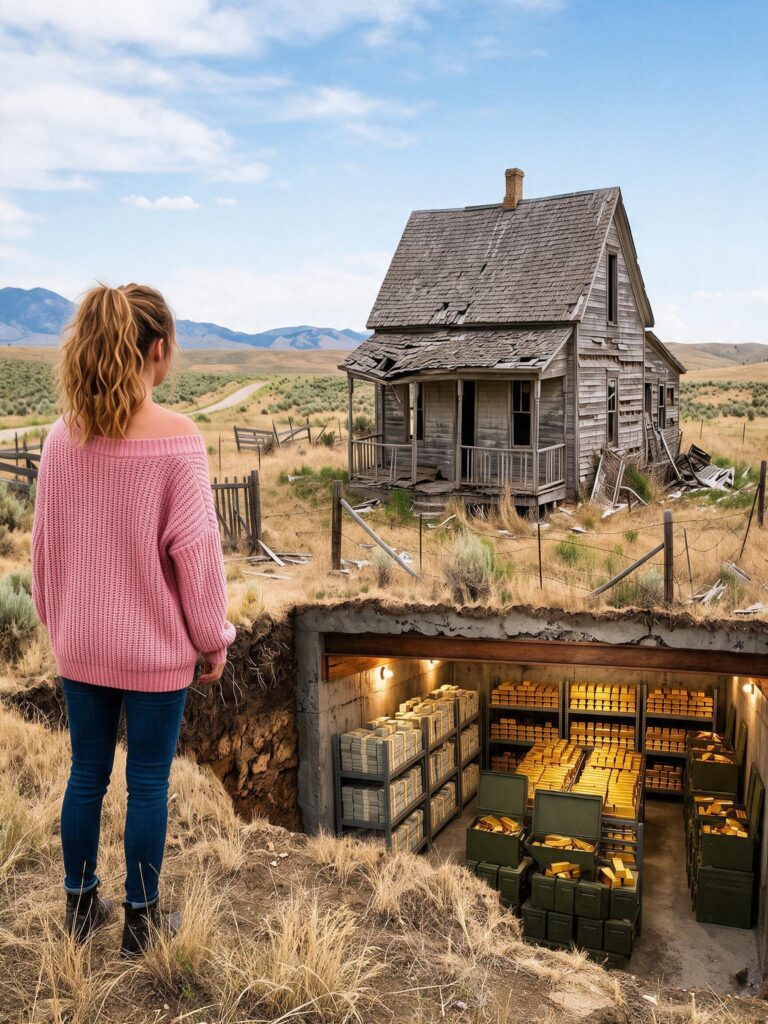
she inherited a cursed wyoming ranch nobody wanted and found her grandfather’s stolen fortune nailed under the rotting bedroom floor
Part 1
The gravel driveway did not crunch under the tires of Sadie Miller’s rusted sedan. It ground down like teeth on grit. She parked near a leaning post that used to hold a mailbox and now held a spray-painted warning, the letters faded but still mean. KEEP OUT. MEANS YOU. She killed the engine. The silence that followed was heavy, broken only by the ticking of the overheated block and the dry, relentless Wyoming wind battering the side of the car.
She sat behind the wheel a long time, staring through the bug-splattered windshield at the inheritance she had never asked for. Seventy acres of dust and sage. A house that looked like it had already lost an argument with the weather and was waiting for someone to admit it. Arthur’s house. Her grandfather’s house. A corpse of a building. The roof sagged in the middle, burdened by decades of snow it had barely survived. The siding, once white, was the color of dirty bone, peeling off in long sharp strips. Tumbleweeds the size of doghouses were piled against the rotting front porch. It looked less like a home and more like a trap that had already caught the man who built it.
Her duffel bag sat on the passenger seat. Three changes of clothes. A stack of final-notice utility bills from the apartment in Denver. Twelve dollars in loose cash. She had not come because she wanted a ranch life. She had come because the landlord changed the locks forty-eight hours ago, and the estate lawyer had said the house was hers, and twelve dollars would not buy a night anywhere a person could lock the door from the inside.
She stepped out. The heat hit her like an open oven door. The air smelled of sagebrush, baked clay, and abandonment. Alkaline dust lifted around her boots. The wooden stairs shrieked under her weight. She bypassed the front door. It looked like it would fall off its hinges if she turned the knob. She walked around to the side entrance near the kitchen, the way a person enters a place they do not trust to welcome them.
Arthur Miller had died six months ago. Sadie had not seen him since she was nine. He had been a difficult, paranoid man who trusted stray dogs more than his own blood, and the feeling had been mutual. Her mother, his daughter, had left this county at seventeen and never brought Sadie back after that one summer. Sadie remembered a man who would not sit with his back to a window. She remembered canned beans and a television with the sound off. She remembered her mother crying in the car on the drive to the highway and saying, “He wasn’t always like that,” and then not explaining what he had been.
When the estate lawyer called to say she was the sole beneficiary, she had assumed there was a catch. There was. The property was in arrears. Thousands in unpaid taxes. A foundation slowly sinking into the desert. A well the county called unreliable. A house the bank had already asked, in a letter she found later in the kitchen, to have inspected for condemnation. The town, what was left of it, had wanted the place bulldozed for years. They called it a cursed inheritance. They did not know what the rotting floorboards were holding up.
She pushed the side door open. It scraped against warped linoleum. The inside was suffocating. Trapped air, stale, carrying the sharp sour tang of old grease, mice, and decay. She dropped the duffel on a kitchen counter obscured by yellowed newspapers and empty tin cans. Dust motes danced in the single beam of sunlight through a cracked pane. In the living room the furniture was a collection of thrift-store rejects. A faded floral sofa slumped against the far wall under a thick layer of grime. A stone fireplace sat choked with ashes and garbage. Broken radios. Rusted tools. Jars of bent nails. Stacks of rotting phone books lined the walls like insulation.
Arthur had not just been a recluse. He had been a hoarder of the most useless variety, or he had wanted the house to look that way. Sadie did not know the difference yet.
“Great,” she said to the empty room. “Thanks, old man.”
A sharp knock at the front door startled her. The glass rattled in the frame. She waded through junk mail and opened it.
A man in a crisp khaki shirt and dark sunglasses stood on the porch, looking entirely out of place. He wiped sweat from his forehead with a pristine white handkerchief.
“You must be the granddaughter,” he said, not bothering to introduce himself. He looked past her. His nose wrinkled at the smell. “Tom Granger. Granger Land Management.”
“I didn’t call any land management.”
“Your grandfather’s lawyer reached out.” He slipped the sunglasses down to the bridge of his nose. Cold, assessing eyes. Not cruel, exactly. The eyes of a man who had priced a lot of other people’s endings. “I buy distressed properties. Fix them up, or sell the acreage to the corporate farms up north. I’ll save you the sales pitch, Ms. Miller. This place is a teardown. The soil is dead. The well is dry. The house is a liability.”
Sadie crossed her arms. “So why are you here?”
“Because I’m willing to take the headache off your hands.” He reached into his shirt pocket and pulled out a folded piece of paper. “I’ll pay off the back taxes, cover the legal fees, and cut you a check for five thousand today. You can get back in your car, drive away, and pretend this place never existed.”
She looked at the number. Five thousand dollars. Enough for a new apartment. Enough to eat. Enough to stop running for a few months. She looked back at the house, at the piles of garbage and the peeling wallpaper. It was a miserable place. It offered her nothing but labor and a roof that argued with the wind. The easiest thing in the world would have been to take the paper and go.
“I’ll give you until tomorrow morning,” Granger said, sensing the hesitation. He turned and walked down the steps. “Don’t think about it too long. The offer expires when I leave town.”
She watched his truck kick up a trail of dust on the highway. She looked at the paper again, then crumpled it in her fist. She was tired of taking the easiest, cheapest way out. The landlord in Denver had been an easy way out for him. Her mother had taken an easy way out of this county and spent the rest of her life acting as if Wyoming were a word you did not say at the table. Sadie decided she would stay one night. Just one night, to see if there was anything worth saving before she handed the keys to a man who wore khakis in the desert.
It was the hardest, best decision she would ever make, and she did not know it yet. She only knew she was angry, and that anger was cheaper than a motel.
The night was entirely without peace. The house did not settle. It argued with the wind. Every gust off the plains made the roof joints scream and the windowpanes rattle like loose teeth. She slept on a relatively clean patch of the living room floor, wrapped in a sleeping bag she had kept in the trunk since the week she started sleeping in the car between shifts. By five in the morning the cold had seeped through the floorboards and deep into her joints. She woke stiff, covered in a thin film of grit, craving coffee she did not have.
The morning sun cast a harsh, unforgiving light on the squalor. Granger was right. The place was a liability. There was no redeeming this rot in any way a bank would recognize. But a stubborn streak, one she suspected she had inherited from the man who ruined the house, kept her from picking up the phone. She wanted to clear Arthur’s bedroom. If there was a family Bible, a photograph, or even a few hidden twenties stuffed in a coat pocket, she was going to find it before she handed anything to Granger. She was not sentimental. She was broke. Broke people check the pockets.
Part 2
Arthur’s bedroom was at the back of the house, at the end of a narrow dark hallway. The door was stuck. Sadie shoved her shoulder against the wood until the swollen frame popped open with a splintering crack. The smell hit her instantly. Camphor, stale pipe tobacco, and closed-in desperation. The room was surprisingly sparse compared to the rest of the house. A bare mattress on a metal frame. A single wooden dresser leaning hard to the left, missing two drawers. The floor covered by an ugly faded linoleum rug that curled at the edges and showed raw pine beneath.
She started with the closet. Empty hangers clattered. A pair of stiff mud-caked boots sat in the corner. The dresser held moth-eaten wool socks and a single rusted pocketknife. She tossed the knife into her pocket. Useless. All of it. She walked toward the window to pry it open and let some air in. As she stepped off the rug and onto the bare pine near the foot of the bed, her boot came down hard.
Thud.
She stopped. Stepped back. Brought her heel down on the same spot.
Thud. Hollow.
It did not sound like wood hitting a joist. It sounded like wood hitting empty space. The floorboards in that corner did not span the length of the wall. Three distinct boards were cut short, terminating in a jagged line about two feet from the baseboard. They were nailed down, but the nail heads were not rusted flush like the rest of the floor. They looked relatively new. Scratched. Pulled and hammered back in more than once.
Her heart did a strange slow roll in her chest. She knelt and ran her fingers over the seam. Dust had settled in the cracks, but a faint draft of cool air seeped up from the gap. She stood, left the bedroom, and went out the back door to the collapsed structure that used to be a tool shed. She dug through rusted chain and brittle plastic tarps until her fingers closed around the heavy cold iron of a flat-headed crowbar.
Back in the bedroom she wedged the lip into the seam of the first cut board and leaned her weight back. The wood groaned. She braced her boot and pulled harder, forearms burning. With a violent screech of metal against wood, the nails tore free. The board popped up and hit her in the knee. She tossed it aside. Beneath it, thick black plastic sheeting, covered in dead spiders and dirt. She leveraged up the next two boards until a two-by-three-foot hole opened in the floor.
She dropped the crowbar. It clattered in the quiet room. She knelt. Her hands were shaking. She grabbed the edge of the plastic and pulled it back. It crinkled, stiff with age. Beneath it was a cavity between the heavy floor joists. It was not dirt. Arthur had dug out the earth under the crawl space and poured a rough concrete tub to seal off the moisture. Inside the depression sat four heavy olive-drab metal boxes. Surplus ammunition crates. Fine white oxidation on the metal. Latches secured with heavy brass padlocks.
She reached down and grabbed the handle of the first crate. It did not move. She planted both hands, braced her knees against the edge of the hole, and heaved. The crate cleared the hole and slammed onto the linoleum with a metallic crash that rattled the windowpanes. Sixty pounds, at least. She stared at the padlock. The pocketknife blade snapped in the keyhole and flew across the room. She grabbed the crowbar and brought the iron head down on the brass. Once. Twice. On the third strike the shackle bent. On the fourth it cracked open.
The latch popped with a sharp hiss, breaking a vacuum seal that had held for who knew how long. She threw the lid back.
She stopped breathing.
She did not find old letters. She did not find a family Bible. She reached in, fingers trembling, and pulled out a heavy dull yellow brick the size of a thick paperback, wrapped in rotting wax paper. The paper flaked away. Under it, the cool heavy gleam of solid gold. A serial number stamped in the center. A purity mark. Beneath it, another. And another. Neatly stacked. Cold to the touch.
She looked from the bar in her hands to the three remaining sealed crates in the concrete tub.
Five thousand dollars. Granger had offered her five thousand dollars. She was holding more than that in her left hand, and she did not yet know how much more.
The bar sat in her lap, heavy and indifferent. It did not sparkle the way it did in movies. It was dull, scratched, dense enough to hurt. She sat on the edge of the mattress, breathing shallow, and counted the bars in the open crate. Twenty. She did not know the exact price of gold. She knew it was measured by the ounce, and these bricks were pounds. Ten, maybe more, each. In one box alone she was looking at a figure that did not belong in a house with tin cans on the counter. And there were three more boxes.
A violent wave of nausea washed over her. She dropped the brick back into the crate. It clacked against the others with a dull thud. Poor people did not dream of wealth. They dreamed of breathing room. An extra hundred dollars to keep the lights on. A transmission that would start in January. This was not breathing room. This was an ocean, and she did not know how to swim.
Her first instinct was to call the police. That was the civilized thing. Civilization had not done her any favors lately. If she called the cops, the state would seize it, tie it up in probate, tax it into dust, or claim Arthur had obtained it illegally and absorb it into forfeiture. Her second instinct was panic. Why did Arthur have this? He had lived in filth and eaten out of tin cans. He had driven a truck with a cracked block and patched his roof with tar paper. You did not live like a feral animal if you had a king’s ransom under your bed, unless the money was not clean. Unless the money was dangerous.
Outside, the crunch of gravel shattered the silence.
Heavy tires on dry stone. A vehicle pulling up to the house.
She scrambled off the bed. Her heart hammered. She kicked the lid shut and shoved the crate toward the hole. It barely moved. She dropped to her knees, planted her boots against the wall, and pushed with all her leg strength until the crate dropped back into the concrete cavity. She yanked the plastic over the boxes, slammed the loose boards into place, dragged the moth-eaten rug over the seam, kicked dust around the edges, and stood up, chest heaving. No time to hammer the nails.
A fist pounded on the front door.
She wiped her palms on her jeans and walked down the hallway, through the living room, and pulled the door open.
Tom Granger stood on the porch without his sunglasses. His eyes were small, dark, and impatient.
“It’s not tomorrow morning yet,” she said. Her voice sounded thin. She cleared her throat. “Did you forget your pitch?”
He did not smile. He looked past her shoulder, trying to see into the dim interior.
“I was in the area assessing a neighboring lot. Figured I’d save us both the trip tomorrow. I brought the paperwork. And I bumped the offer to six thousand for your trouble.” He held out a thick manila envelope.
An hour ago, six thousand would have felt like a lifeline. Now it felt like an insult. More than that, it felt suspicious.
“I thought you said the land was dead,” she said, leaning on the doorframe to block his view. “Why bump the price?”
“Corporate overhead. I have a budget to clear by the end of the quarter. It’s easier to close today. Look, you clearly don’t belong out here. Take the check. Go back to Denver.”
He was pushing too hard. A man who buys worthless land for pennies does not double back the same day to offer more money unless he knows something the seller does not. Did he know about the floor? Or did he only know that the land had mineral rights Arthur had never tapped, or had tapped and then buried the proof of?
“I’m not selling,” she said.
His hand hovered, then lowered. The professional veneer cracked just a fraction, and something sharp showed underneath. Not a villain’s snarl. The irritation of a man whose quarter was getting away from him.
“Excuse me?”
“You heard me. I’m keeping the property.”
“Ms. Miller, let me be perfectly clear.” His voice dropped. “You are sitting on a toxic asset. You owe twenty-two thousand in back taxes to the county. The house is uninsurable. If you don’t sell to me, the county will seize it, auction it, and you’ll walk away with absolutely nothing. I am throwing you a rope.”
“Then I guess I’ll hang myself with it.” She met his eyes and did not blink. “Get off my porch, Mr. Granger.”
For a long moment he only stared. The wind lifted dust onto his expensive shoes. He slipped the sunglasses back on.
“Arthur was a stubborn old fool too,” he said softly. “It didn’t serve him well in the end. I’ll leave the offer on the table, but the price drops back to five tomorrow.”
He walked down the steps. She watched the spotless truck reverse down the driveway and waited until the dust plume faded on the highway before she exhaled.
She locked the front door. She locked the side door. She checked every window latch in the house. She was entirely alone, miles from the nearest neighbor, in a house without a working telephone, guarding a fortune she could not explain. She needed supplies. She needed better locks. And more than anything, she needed to know who Arthur Miller had really been.
Part 3
The town of Oak Haven was less a town than a forgotten suggestion. It sat ten miles east of the ranch, a single dusty main street flanked by faded brick that had peaked in the late seventies. Half the storefronts were boarded. The other half looked like they were hanging on out of spite. Sadie parked in front of a building that advertised hardware, feed, and basic groceries. The bell above the door jingled a dull rusted tune. Inside, the air smelled of fertilizer, oiled leather, and sawdust. A ceiling fan wobbled and did nothing to cut the heat.
Behind the counter stood an older man with a face like a worn saddle and a ball cap pulled low. He was pricing a box of galvanized nails. He did not look up.
“Can I help you find something?”
“Padlocks. The heavy-duty kind. The ones you can’t snap with a bolt cutter.”
He stopped. Pale blue eyes studied her face. The dust on her boots. The exhausted set of her shoulders. The defensive tilt of her chin.
“Aisle four, bottom shelf. Get the solid steel ones. But around here, locks only keep honest folks honest.”
She grabbed four of the heaviest locks she could find, steel hasps, long wood screws, and a cordless drill. In the grocery aisle she added canned soup, instant coffee, and a massive jug of water. At the counter he rang the items with slow precision.
“You’re Arthur’s girl,” he said. It was not a question.
She stiffened. “How did you know?”
“You got his nose. And nobody buys that much lock hardware unless they just inherited a place they don’t trust. I’m Roy. I own this place.”
“Sadie.” She set a worn twenty on the counter, half of what she had left. “Did you know him well?”
Roy snorted. “Nobody knew Arthur well. Man was a ghost. Came in once a month. Baked beans, kerosene, shotgun shells. Paid cash. Never said two words unless he had to.”
“Was he always like that? I haven’t seen him since I was a kid.”
Roy leaned his elbows on the glass and looked out at the empty street. “No. Used to be somewhat normal. Worked for the state out by the old copper mines in the eighties. Something happened out there. State shut the project down, sealed the shafts. Arthur came back changed. Paranoid. Started talking about people watching him, listening to the phone lines. Eventually he just stopped coming into town.”
“People watching him. Who?”
“Suit types. Saw a black sedan follow his truck out of town a few times back in the nineties. Feds, maybe. Or corporate boys. Arthur sold off his mineral rights to a shell company right before he went totally off the grid. Some folks say they shorted him. Some folks say he stole something from them. You can’t trust small-town gossip.” He handed her the bags. “But I’ll tell you this. That land he left you is sour. Too much history. If I were you, I’d take whatever Granger is offering and run.”
“You know Granger?”
“Everyone knows Granger. He’s a vulture. Works for a firm out of Cheyenne that buys up distressed properties. He’s been circling Arthur’s place for five years. Even when Arthur was alive. The old man used to chase him off with a Winchester.”
Her grip tightened on the bags. Granger had not just gotten a tip from a lawyer. He had been hunting this property while Arthur was still breathing.
“Does Granger know what Arthur found out at the mines?”
Roy raised an eyebrow. “Arthur didn’t find anything but a bad attitude, kid. Copper dried up thirty years ago.”
She thanked him and walked into the blinding afternoon. As she tossed the supplies into the passenger seat, she glanced across the street. Parked in the shade of a defunct gas station awning was a dark late-model sedan. Tinted windows. Out-of-state plates. The engine was not running, but the faint glow of a cigarette ember pulsed in the driver’s window.
She did not stare. She got in, locked the doors, and jammed the key into the ignition. Her hand shook. They were not waiting for her to find it. They already knew something was there. They had needed Arthur dead, or at least gone. Now they needed the granddaughter gone too. Granger was the polite knock. The sedan was the other plan.
The drive back felt twice as long. The wide empty horizon no longer looked like freedom. It looked like an arena. No neighbors to hear a scream. No cell service. Seventy acres of dead dirt and a rotting house built, she was beginning to understand, on a secret Arthur had been too afraid to spend.
When she pulled up, the sun was dipping, casting long skeletal shadows across the porch. She did not unpack the groceries. She grabbed the drill, the hasps, and the padlocks, kicked tumbleweeds aside, and drove thick steel screws deep into the rotting doorframe. The drill whined. Her shoulder throbbed. The last screw sank flush. The padlock engaged with a heavy click. She did the same to the back door and the side entrance. She dragged the floral sofa across the living room until her thighs burned and wedged it against the largest picture window.
Tonight she was not just staying the night. She was drawing a line the house had not had in years.
She did not dare turn on the overhead lights, assuming the electricity even worked. She wanted to remain invisible. She sat on the floor with her back against the barricaded front door, hands bruised, knuckles scraped, and listened. The wind howled across the scrub, battering the siding like invisible fists. Every creak sounded like a footstep. Every rattle of loose glass sounded like a pry bar.
She could not sit in the dark and wait. If the men in the sedan were coming, she needed to know exactly what they were looking for, and what Arthur had written down when he was still the kind of man who wrote things neatly.
She took the flashlight back to the bedroom. She did not pull the rug. She knew what was under it. She pulled the remaining dresser drawers and found dust. She flipped the mattress. Stained, undisturbed. She ran her fingers along the hollow bed frame. Empty.
“Come on, Arthur,” she whispered. “You were paranoid. Paranoid people document everything. Where is it?”
Her eyes landed on the closet. The boots she had dismissed. The left one, shaken out, gave her dried mud and nothing else. The right one was noticeably heavier. She reached past the stiff leather collar. Her fingers brushed something hard and flat, wedged into the toe box.
A small black leather tally book, the kind a foreman used on a job site. Cracked and soft. A rubber band that crumbled when she touched it.
She sat on the mattress and opened it. Cramped, erratic handwriting. Dates, numbers, rambling paragraphs about vehicles parked down the street and clicks on the phone line. But the earliest pages, dated October 1989, were neat. Professional. The hand of a man who still believed a record could protect him.
October 12. Shaft four is supposed to be sealed. Found the padlock cut. Went down to check for squatters. Found the pallets instead. Stamped bullion, not copper. Gold. No dust on the crates. Someone is moving it at night.
October 18. Checked the manifest in the site office. Nothing recorded. The company is using the dead shafts as a vault. Evading oversight, or moving money that cannot sit in a bank. Doesn’t matter. They’re shutting the whole operation down next month to pave it over. A permanent vault.
November 2. Took three crates. They’ll never notice it’s gone if they don’t know exactly what they have. Buried it under the foundation. Just a retirement fund. They owe me for the black lung anyway.
The entries grew frantic after that. By 1991 he knew they had noticed. June 5. Black Lincoln parked at the diner. Followed me to the highway turnoff. They know it’s short. They can’t go to the cops because the gold doesn’t exist on paper. But they can come for me. I can’t spend it. I can’t move it. It’s a heavy anchor.
She stared at the page. The company had not forgotten. It had waited. Arthur had outlasted them by living like a ghost, armed and entrenched, eating beans, trusting no one, not even the granddaughter who had his nose. Now Arthur was dead. The property was changing hands. Whoever had inherited the dirty secret needed the site secured before a new owner started tearing up floorboards. Granger was the legal front. The men in the sedan were the other door.
A sharp flash of light swept across the bedroom wall, cutting through the gap in the curtains.
She killed the flashlight. Headlights. A vehicle coming up the long gravel driveway. Not fast. Crawling. The engine idling low.
She crept out with her back to the hallway wall and crouched behind the sofa. A dark sedan sat fifty yards from the house, headlights cutting the dust. The engine cut off. The lights died. Then the heavy thud of a car door. Then another. Footsteps on the gravel. Slow. Methodical. Moving toward the porch.
She tightened her grip on the crowbar until her knuckles hurt. The siege had begun.
Part 4
The wooden stairs groaned under heavy boots. Sadie stayed crouched behind the sofa, barely breathing. Two sets of footsteps. No hurried scrambling. No whispered argument. A clinical approach. The front-door handle clicked. Someone testing the latch. The door did not budge. A shoulder slammed the wood. The frame shuddered. Dry dust rained from the ceiling. The steel screws and the padlock held.
“Lock’s tight,” a voice murmured outside. Deep, raspy, muffled by the door. “New hardware. Hasps are bolted in.”
“Check the back,” a second, smoother voice said. “She’s in there. I saw her car.”
Footsteps retreated and crunched along the side of the house. Sadie did not wait. She abandoned the window, stayed low, and scrambled toward the hallway closet where she had seen Arthur’s emergency supplies earlier and dismissed them as more hoarding. Her hands flew over the shelves in the dark, knocking over empty boxes, until her fingers bumped heavy cold metal. A five-gallon jerrycan. She unscrewed the cap. The sharp volatile fumes of old kerosene hit her face and made her eyes water. Half full. She grabbed the handle and dragged it down the hallway into the bedroom.
Outside, a heavy thud shook the rear of the house. They were kicking the back door. Wood splintered. The padlock held the frame together. She knew it was minutes, not safety. Locks bought time against men who did not care about noise. If the doors held, they would take a window.
She could not fight two grown men with a crowbar. She needed leverage, and she needed it before they were inside.
She tipped the can. Kerosene sloshed across the dry rotting floorboards. She poured it over the linoleum rug that hid the loose boards. Over the mattress. Against the drywall. A pool near the bedroom doorway. The fumes filled the small room, toxic and heavy. She tossed the empty can aside, pulled a box of wooden matches from her jeans, and stepped into the hallway.
Crash. Living room. Heavy glass. They had given up on the doors. A tire iron through the picture window, right above the sofa.
“Clear the glass,” the smooth voice ordered, calm.
She walked to the arched entryway between the hall and the living room. She could not see them clearly. She could see two large silhouettes climbing over the back of the floral sofa, boots crunching on broken glass. One held a long flashlight. The beam clicked on, swept the piles of garbage, hit her, and stopped.
She squinted against the glare. She did not raise her hands. She stood still, a wooden match in her left hand, the box in her right.
“Ms. Miller.” The man with the flashlight stepped down from the sofa. Dark jacket. Practiced ease. “You’ve been busy today.”
“Stop right there.”
Her voice did not shake. The terror had burned down to a cold adrenaline that felt, unpleasantly, like Arthur’s handwriting in the later pages.
The man took another step. “We aren’t here to hurt you. We’re here to retrieve company property. Your grandfather absconded with assets that do not belong to his estate. We know it’s in this house. Show us where it is and you can get in your car and drive away. Just like Granger offered.”
“I know what’s in the floor,” she said, loud enough to carry over the wind through the broken window. “I found the crates.”
The beam dipped, betraying interest.
“Then you know how heavy they are. You can’t take them. Be smart.”
“I also found the ledger.” She twisted the truth just enough to make it a weapon. “The little black book. The one where Arthur wrote down the dates, the shaft numbers, and the names of the men moving unregistered bullion through a dead mine.”
The room went silent. The raspy one shifted his weight. “She’s bluffing.”
“Am I?”
She struck the match. It flared with a sharp hiss and cast an orange glow over her face. The man with the flashlight raised a hand, stopping his partner.
“Put the match out.”
“Take a deep breath,” she said.
The wind blew through the house and carried the suffocating stench of kerosene from the back hallway into the living room. Both men paused.
“I poured it over the bedroom floor,” she said. The match burned down toward her fingers. “I poured it over the crates. I poured it over the ledger.”
“Gold doesn’t burn, you idiot,” the raspy man sneered, taking a half step.
“No. It melts. Into a slab of slag under the ashes of a house fire that is going to bring every fire engine, state trooper, and investigator in the county to this exact spot. And the book that proves your bosses were running a vault that doesn’t exist on paper? That will burn. You’ll have nothing to show except a smoking crater and a federal problem.”
The match burned her thumb. She dropped it inches from a pile of old newspapers and struck another.
“Wait,” the smooth voice said sharply. He lowered the flashlight. “What do you want?”
“I want out. And I want a severance for Arthur. He lived in this filth for thirty years because he couldn’t spend what he took and couldn’t give it back. You’re not walking out of here with all of it while I drive back to a city that already changed the locks on me.”
“How much?”
She looked at the two men standing in the ruins of her grandfather’s miserable, hoarded life. They had come for millions buried thirty feet away, and they had thought a broken window would be enough.
“One crate,” she said. “I take one. You take the other three. You leave tonight, and you never come back to this property. If I see a dark sedan, a man in khakis, or a shadow out of place, I mail the ledger to the IRS.”
The man in the dark jacket stared at her a long time. The wind rattled trash on the floor.
“One crate,” he finally said, voice tight. “We take the rest now.”
“I’ll see mine loaded first. And you better hope I don’t trip in the dark.”
She backed down the hallway, the flame close to her fingers. The men followed slowly and stopped where the kerosene hit the air like a wall.
“Open the floor,” she said. “Lift the rug. Pull the plastic.”
The raspy man scoffed. “We aren’t your movers.”
“Do it,” the other said.
The big man stepped into the soaked room, coughing, kicked the rug aside, and hauled the boards up. Sadie struck a third match as the second died. They leaned into the concrete cavity and heaved the sealed crates onto the pine. The metal scraped. Both of them, for each box. She understood then, in her body, why Arthur had never moved the gold. It was not only fear. It was weight. A fortune you cannot lift alone is a fortune that owns you.
“Put them in your trunk,” she said. “Then you come back for the open one and put it in my car.”
“We could just shoot you,” the raspy man muttered.
“You could. And my dying reflex drops this match into the accelerant. You burn trying to drag three hundred pounds of gold through a flaming hallway. Sound fun?”
“She’s not bluffing,” the smooth-voiced man said. “Move the boxes.”
For half an hour the ruined house filled with the sound of dragging metal and slamming trunks. Sadie never lowered her hand. When the matches ran low she switched to a cheap plastic lighter from the kitchen junk, keeping the small flame dancing. Finally the fourth crate, the open one, the one she had already seen, was dragged down the groaning porch steps. She followed at ten feet. The freezing night air cut through the fumes and cleared her head. They hauled the olive-drab box to her sedan. She popped the trunk. They heaved it in. The old car’s rear suspension sank under the weight.
“The ledger,” the smooth-voiced man said. Dust whipped around his knees in the headlight glare. The professional calm was gone. What was left was exhausted anger.
“I’ll mail it,” she lied, leaning against the car. “If you follow me, or if Granger sniffs around my new zip code, it goes to a federal prosecutor. I guarantee it ruins you worse than one missing crate.”
He studied her face. He saw a woman with nothing to lose, which was not the same as a woman with a plan, but it was close enough in the dark. He nodded once, tight, and walked to the sedan. The door slammed. The car reversed, spun gravel, and tore down the driveway. The taillights bled into the dust until they were gone.
Part 5
Sadie stood alone in the dark. The adrenaline evaporated, and her knees buckled. She went down hard in the dirt, palms on sharp gravel, and dry-heaved while the night swung around her. She had threatened to burn herself alive. She had stood in her grandfather’s hallway and bargained with men who had come through a window. She had walked away with a crate she could not explain to a bank teller and a lie about a book that was, at that moment, still in the inside pocket of her jacket, where she had put it before she ever poured the kerosene.
She had not left the ledger to burn. She had not told them the truth about that. Millions could buy a car that started. Leverage could buy a night of sleep. Arthur had had the gold and no leverage he trusted, and it had turned him into a ghost who bought beans and shells and chased a man in khakis off the porch with a Winchester.
She forced herself up. There was no time to collapse in the yard. Professionals regroup. Agreements made at the end of a match do not always survive daylight.
She walked into the house one last time. Broken glass. Hoarded trash. The reek of fuel. It was not a home. It was a prison Arthur had built to guard a treasure he was too terrified to spend and too proud, or too sick, to return. He had written that they owed him for the black lung. Maybe they had. Maybe he had stolen because the company was already stealing, and maybe that did not make the crates clean. Sadie was not going to settle the moral account in a hallway that smelled like kerosene. She was going to refuse the prison.
She grabbed the duffel from the kitchen counter. Three changes of clothes. The final notices. Twelve dollars, now less the hardware. She left the steel padlock sitting in the dust on the porch and stepped out the side door without pulling it shut. The secret, or most of it, was gone. What remained was hers to carry, and the county could have the sagging roof.
The engine coughed and caught. She steered away from the leaning porch and did not look back until the mailbox post was a dark stroke in the mirror. By the time she hit the interstate the eastern sky was bruising purple and orange. The crate knocked once, softly, when she changed lanes. In the trunk sat enough gold to buy a quiet life where nobody could change her locks because a payment was late. In her jacket sat the tally book, October 1989 written in a neat hand that had not yet learned to be afraid of its own sentences.
She rolled the window down and let the cold morning air flood the cabin. Her thumb still hurt where the match had burned it. Her shoulder hurt from the drill. She thought of Granger’s five thousand dollars, and of Roy saying the land was sour, and of her mother saying he wasn’t always like that and then never saying what he was. She thought of the concrete tub under the floor, poured by a man who could not trust a bank, a lawyer, or his own blood. She was not going to become him. One crate, not four. A book, not a Winchester. A highway, not a bedroom with the nails pulled and hammered back in.
At a truck stop east of Rawlins she bought coffee with the last of the cash and sat in the car where she could see the trunk. The coffee was bad and hot and exactly what she needed. She did not open the crate. She did not need to see the bars again to believe them. She opened the tally book to the last page Arthur had written, years after the frantic entries, the handwriting small and tired.
If she comes, it said, don’t let her live like I did. The gold is a debt. Pay what you must. Keep enough to stand up. Burn the rest before it burns you.
Sadie closed the book. She did not know if he had meant her. She decided he had, because the alternative was that he had written it to no one, and she would not leave him with that. The sun cleared the ridge. The sedan’s heater finally blew warm. She put the book back in her pocket, set the coffee in the cup holder, and pulled onto the interstate with the ranch behind her and the crate riding low over the rear axle.
The bank had wanted the house condemned. The town had wanted it bulldozed. A man in khakis had offered her five thousand dollars to pretend the place had never existed. They had all been right about the rot. They had been wrong about what the rot was hiding, and wrong about what a woman with twelve dollars and her grandfather’s nose would do when the floor answered hollow under her boot. She did not go back to Denver. She did not go back to Oak Haven. She drove toward a town where nobody knew the name Miller, with one crate, one book, and the particular quiet of a person who has refused both the easiest check and the heaviest prison. The wind at the window smelled like sage for a few more miles, and then it smelled like highway, and that was enough.


