Part 1
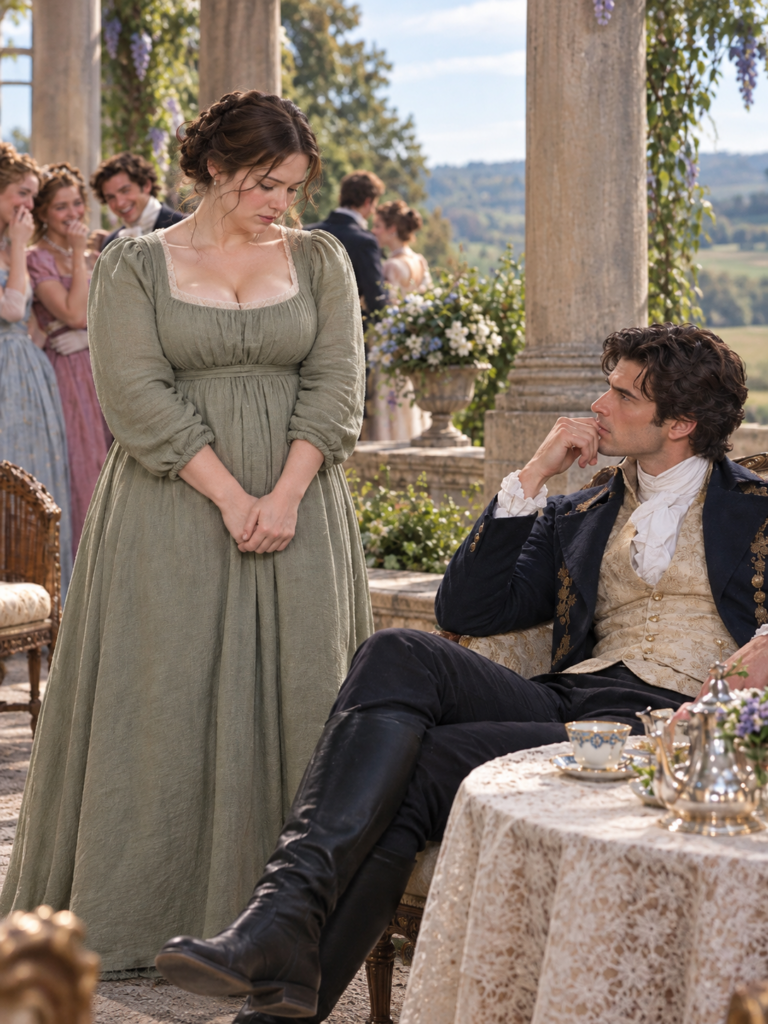
The first time Lady Beatrice Harrow told her niece that no gentleman would ever marry her, Clara Vale was holding a tray of hot tea.
It was an unfortunate moment for such a declaration.
Not because Clara dropped the tray. She had long ago learned not to drop things when people were unkind. But because the youngest housemaid, standing just inside the drawing-room door, heard every word.
And by supper, every servant at Harrowfield House knew that Lady Beatrice intended to take her beautiful daughter to Wycliffe Abbey and bring home a duchess.
Clara, meanwhile, was to be taken along for decoration.
A very particular kind of decoration.
“The sort that makes everything beside it look finer,” Lady Beatrice explained.
Her daughter, Lady Rosamund Harrow, laughed from her place before the looking glass.
“Oh, Mama, you cannot mean Clara.”
“I most certainly do.”
“But she is nearly thirty.”
“Twenty-nine,” Clara corrected quietly.
“And she owns nothing worth speaking of.”
“That,” said Lady Beatrice, “is precisely why she is perfect.”
Clara set the teapot down.
She had discovered over the years that when her aunt used the word perfect, it rarely meant anything agreeable for the person being discussed.
Lady Beatrice held up a letter.
It was written on thick ivory paper and sealed with a duke’s coronet.
“The Dowager Duchess of Wycliffe has invited us to spend a fortnight at the abbey. Her son has finally consented to consider marriage. There will be six eligible young ladies, their mothers, several distinguished gentlemen, and enough opportunity for a clever girl to secure her future.”
Rosamund smiled at her reflection.
“And I am to be the clever girl?”
“You are to be the beautiful girl. Intelligence is useful, my darling, but beauty is what opens the door.”
Her eyes moved toward Clara.
“And contrast is what makes beauty impossible to overlook.”
Clara looked down at her hands.
They were narrow hands, reddened around the knuckles from cold water and mending needles. Her aunt had never considered them attractive.
Nothing about Clara, in fact, had ever been considered attractive.
Her hair was an ordinary brown. Her figure was slender without being fashionable. Her features were quiet and unremarkable, the kind a painter might sketch in the background of a family portrait and forget to finish.
At twenty-nine, she had long since ceased expecting anyone to look at her twice.
She had been living at Harrowfield for seven years, ever since her grandfather died and left her with forty-seven pounds, a collection of books, and a small mahogany writing desk with one drawer that would not open.
Forty-seven pounds did not buy independence.
And the books, as Lady Beatrice frequently observed, had never put bread on anyone’s table.
So Clara had become useful.
She copied correspondence. She kept household accounts when her aunt’s eyesight was tired. She mended gowns, supervised linen, wrote invitations, tended headaches, remembered birthdays, and occasionally sat through entire dinners listening to gentlemen explain matters they understood considerably less well than she did.
She did it all without complaint.
Complaints required a listener.
“Clara,” Lady Beatrice said sharply, “have you heard a word?”
“Yes, Aunt.”
“You will accompany us to Wycliffe Abbey. You will wear your dove-gray gown. You will not compete with Rosamund in conversation, and you will take particular care not to attract the attention of the Duke.”
Rosamund giggled.
“As though she could.”
Lady Beatrice smiled.
“We shall send the plain cousin. His Grace will dismiss her within an evening, and then he will discover what a jewel my Rosamund is.”
Clara said nothing.
But across the room, her uncle lowered his newspaper.
Sir Matthew Harrow was a mild, stout gentleman whose chief ambition in life was to avoid upsetting his wife.
For once, he appeared to be considering an exception.
“Beatrice,” he began.
“What?”
“Perhaps we might allow Clara to enjoy the visit.”
Lady Beatrice stared.
“Enjoy it? She is fortunate to be included.”
Sir Matthew retreated behind his newspaper.
Clara picked up the tray.
And the matter was settled.
Three weeks later, she would travel to one of the grandest houses in northern England.
She would meet one of the richest and most powerful unmarried men in the kingdom.
And she would discover a secret that could destroy his family, his title’s influence, and perhaps his life.
But that evening, as she carried the teacups downstairs, she knew none of it.
She knew only that someone had once again decided what her life was worth.
And that the answer was apparently very little.
Clara’s grandfather had been a peculiar man.
Mr. Elias Vale had spent most of his life measuring land for gentlemen who were convinced their property extended farther than their neighbors believed.
He had been a surveyor.
Not a fashionable profession, but a respectable one, and one requiring an uncommon combination of patience, mathematics, and an eye for details.
He had raised Clara after her parents died when she was eleven.
Their home had been a modest stone cottage on the edge of the Yorkshire moors, where the wind rattled the windows and the kitchen always smelled faintly of ink, damp wool, and apples.
Her grandfather had taught her to read maps before she learned French.
He showed her how rivers altered their courses, why ancient boundary stones mattered, and how a small error in a measurement could deprive a family of the land it had cultivated for generations.
“Land remembers things,” he used to say.
Clara would laugh.
“Land cannot remember, Grandfather.”
“Perhaps not. But the people who draw maps can forget. And sometimes they forget conveniently.”
When Clara was nineteen, her grandfather suffered a severe illness.
His eyesight began to fail.
Within three years, he could distinguish only broad patches of light.
For a man who had spent his life observing every rise and hollow of the English countryside, it was a cruel transformation.
Yet Clara never heard him curse it.
Instead, he changed the way he worked.
He taught her to read measurements aloud. She learned to describe the shape of a field without relying on its color, the direction of a road by the slope beneath their feet, and the location of an old boundary by the sound of water passing through a stone culvert.
He had little wooden markers made for his maps, each with a different notch.
Together, they laid out estates on a large table.
He could follow the roads with his fingers while Clara described what she saw.
One winter evening, as she struggled to explain a complicated drawing, she burst into tears.
“I cannot make you see it.”
Her grandfather reached across the table and found her hand.
“My dear girl, you are not responsible for giving me back my eyes.”
“Then what am I to do?”
“Tell me the truth. That will be enough.”
It was the most important thing anyone had ever said to her.
Years later, she would remember it in a room full of titled gentlemen, when telling the truth threatened to cost her everything.
Wycliffe Abbey stood above a broad valley of pasture, woodland, and tenant farms.
Its towers were older than most of the families invited to visit it, and its western windows looked over a lake so still that the autumn sky seemed to have fallen into the earth.
The abbey had belonged to the Ashcombe family for generations.
Its present master was Edward Ashcombe, the seventh Duke of Wycliffe.
He was thirty-six years old.
He had never married.
And according to fashionable society, he was almost impossible to please.
Some said he had become arrogant after returning from military service abroad. Others insisted that a broken engagement had embittered him.
There were stories of women he had failed to acknowledge, old friends he had walked past without greeting, and social gatherings from which he had departed without offering the smallest explanation.
One lady claimed he had stared directly at her during dinner and failed to recognize her the following morning.
This had caused a lasting offense.
No one considered that there might be a reason.
By the time Lady Beatrice and her party arrived, the abbey was already crowded.
Carriages lined the entrance court. Footmen carried trunks across the gravel. Elegant women appeared in doorways like brightly colored birds, each determined not to be outshone.
Clara stepped down from the carriage wearing her gray gown and an old dark-blue cloak.
She looked up at the abbey.
Along the eastern wall, a row of stone figures watched over the courtyard.
One had lost its head.
Another had been repaired with a face that looked rather surprised to find itself attached to a medieval body.
Clara smiled.
“What is amusing?” Rosamund asked.
“Nothing.”
“Then why are you smiling?”
“I was looking at the statues.”
Rosamund glanced upward.
“How dreadful. Come along.”
They entered.
The first dinner was held beneath a ceiling painted with clouds and cherubs.
Candles burned in silver branches along the great table. Servants moved between the guests, carrying roast pheasant, glazed vegetables, and wine in cut-glass decanters.
At the head of the table sat the Dowager Duchess.
Lady Eleanor Ashcombe was a formidable woman, with white hair, a straight back, and an expression that suggested she had personally disapproved of most of the nineteenth century.
Beside her sat her son.
Clara had expected him to be handsome in the polished, self-conscious manner of society gentlemen.
Instead, the Duke looked tired.
He was tall and broad-shouldered, with dark hair and a narrow scar near his left eyebrow. His expression was composed, almost severe.
But it was not his face that held Clara’s attention.
It was his hands.
When a servant placed a glass beside him, the Duke touched the stem before lifting it.
When the gentleman opposite spoke, the Duke turned his head toward the voice, but his gaze stopped a little short of the speaker.
And when Lady Rosamund approached to be introduced, he waited until she announced herself before addressing her by name.
Clara watched.
Then she looked at the candles.
The Duke was seated where the light fell directly before his eyes.
He blinked more often than the other guests.
Later, when a servant carried away an empty plate, the Duke moved his hand toward a wineglass that was no longer where he expected it to be.
His fingers brushed the tablecloth.
He stopped.
Then withdrew his hand as though he had merely changed his mind.
Clara’s heart tightened.
She had seen those gestures before.
Not in a ballroom.
Not at an aristocratic dinner.
But in a small cottage where an aging surveyor had slowly learned to navigate a world growing dimmer.
Her grandfather used to search for his teacup in exactly the same way.
She looked at the Duke again.
And understood.
The next afternoon brought cold rain.
Most of the guests remained indoors, where Lady Beatrice organized a card game and Rosamund made herself agreeable to the Dowager Duchess.
Clara slipped into the long gallery.
She had been told that the gallery contained several old paintings of the surrounding countryside, including an eighteenth-century survey of the Wycliffe lands.
She found it near the far window.
The map was enormous.
It showed woods, fields, roads, streams, and villages. In the lower corner, beneath a faded coat of arms, was the name of the surveyor who had drawn it.
Clara recognized the hand.
Not the name.
The hand.
The precise little marks beside the measurements, the careful lettering, and a peculiar symbol used to indicate an underground spring.
Her grandfather had shown her the same symbol dozens of times.
She stepped closer.
“An unusual object to admire.”
The voice came from behind her.
Clara turned.
The Duke stood at the entrance to the gallery.
He had entered without a servant.
“I beg your pardon, Your Grace.”
“Most guests come to admire the portraits.”
“I have never been much interested in portraits.”
“Then we have that in common.”
He approached.
His steps were measured.
He carried a walking stick, though he did not appear to need it for support.
“Which map is it?” he asked.
“The survey of your eastern holdings, dated 1748.”
“Ah.”
He stopped beside her.
“Is it accurate?”
Clara glanced at him.
“That depends.”
“Upon what?”
“Whether you mean accurate when it was drawn, or accurate now.”
For the first time, his expression changed.
“An unexpected answer.”
“I hope it was not an impertinent one.”
“Not at all. Explain it.”
She hesitated.
Lady Beatrice had ordered her not to draw attention to herself.
But the Duke had asked a question.
And maps had always been difficult for Clara to resist.
“The river has changed course since the survey was made. You can see where the eastern bank once curved around the mill meadow. And this road…”
She pointed.
“This road was probably abandoned after the northern bridge collapsed. Yet someone has marked a new boundary across the old route.”
The Duke grew still.
“What boundary?”
“The black line running from the ash wood to the southern pasture.”
“Are you certain?”
“Yes.”
A silence followed.
Then he said quietly, “Miss Vale, I wonder whether you might do me a small kindness.”
“Of course.”
“There is a brass plaque beneath the map. Would you read the inscription?”
Clara looked down.
She read aloud.
When she reached the surveyor’s name, the Duke drew a slow breath.
“Thomas Vale.”
“Yes.”
“Any relation?”
“My grandfather’s grandfather.”
The Duke turned toward her.
And although his eyes seemed to rest near her shoulder rather than directly upon her face, his voice sharpened with interest.
“Then you know something of surveying.”
“A little.”
“That sounds suspiciously modest.”
“My grandfather taught me.”
“Was he a surveyor too?”
“Until his sight failed.”
The Duke’s hand tightened around the walking stick.
Clara noticed.
He noticed that she noticed.
For a moment neither spoke.
Then the Duke asked, very softly, “And did he continue to work afterward?”
“Yes.”
“How?”
“With my help.”
The Duke was silent.
Outside, rain struck the tall windows.
At last he said, “You must have been a remarkable granddaughter.”
Clara felt an unexpected warmth rise in her chest.
“No, Your Grace. He was a remarkable grandfather.”
Then a door opened at the far end of the gallery.
A gentleman entered.
He was handsome, fair-haired, and dressed with an ease that suggested every room in which he found himself belonged partly to him.
“Edward!”
The Duke turned.
“Crispin.”
Lord Crispin Ashcombe, the Duke’s cousin and heir presumptive, crossed the gallery.
His smile was charming.
His eyes were not.
“I have been searching everywhere for you. Your steward requires a signature before the county meeting.”
“What document?”
“The grazing agreement. We discussed it.”
“We discussed a proposal, not an agreement.”
“Naturally. Merely a formality.”
Crispin glanced at Clara.
“And who is our charming companion?”
“Miss Clara Vale,” the Duke replied. “Lady Harrow’s niece.”
Crispin bowed.
“Ah. The quiet cousin.”
Clara returned the bow.
His smile widened.
“Do forgive us, Miss Vale. Estate matters are desperately dull.”
“I have always found them interesting.”
“Have you indeed?”
“Particularly when boundaries are involved.”
Crispin’s expression altered so slightly that another person might have missed it.
Clara did not.
The Duke said, “We shall discuss the agreement tomorrow.”
“But Edward—”
“Tomorrow.”
The word was spoken without anger.
It allowed no argument.
Crispin bowed and withdrew.
When the door closed, the Duke remained still.
“Miss Vale,” he said, “did my cousin look at the map when he entered?”
“Yes.”
“Where?”
“At the eastern pasture.”
“And afterward?”
“At me.”
The Duke exhaled.
“Interesting.”
Clara waited.
He turned his head toward the window.
Then asked a question that changed the course of her life.
“Miss Vale, if I were to place a document in your hands, could I trust you to tell me exactly what was written on it?”
“Yes, Your Grace.”
“Even if the truth were unpleasant?”
“Especially then.”
He reached into his coat.
From an inner pocket, he withdrew a sealed letter.
The paper was worn along one edge, as though he had handled it many times.
The seal bore the mark of a London physician.
The Duke held it out.
His fingers stopped several inches short of Clara’s hand.
She moved forward and accepted it.
“Read it,” he said.
She looked at him.
“Here?”
“Here.”
“Is it private?”
“Very.”
“Then are you certain you wish a stranger to know?”
His expression changed.
A faint, bitter smile touched his mouth.
“Miss Vale, I am beginning to suspect that a stranger may be the only person in this house whom I can trust.”
Clara broke the seal.
And began to read.
The letter described a deterioration of the optic nerves following a severe fever suffered several years earlier.
It explained that no treatment then available could reverse the damage.
It warned of increasing difficulty with reading, recognizing faces, and judging distances.
The final paragraph was brief.
Clara read it once to herself.
Then aloud.
“The progression is likely to continue. It is my professional opinion that Your Grace should prepare for complete loss of functional sight within the coming months.”
She stopped.
The rain seemed suddenly very loud.
The Duke held out his hand.
Clara returned the letter.
He folded it carefully.
“Now you know.”
“Yes.”
“Does it frighten you?”
She thought of her grandfather working by the window while winter sunlight faded across the table.
“Not in the way you mean.”
The Duke turned toward her voice.
“Explain.”
“I know that you may lose your sight. I do not know that you must lose everything else.”
For a long moment, he said nothing.
Then he laughed.
Not with amusement.
With surprise.
As though it had been years since anyone had spoken to him without either fear or flattery.
“Miss Vale,” he said, “I think you and I have a great deal to discuss.”
But just beyond the gallery door, Lord Crispin Ashcombe had not yet gone away.
He stood in the shadow of an alcove.
And although he had not heard every word, he had heard enough.
His cousin was going blind.
And the inconvenient woman in gray knew it.
Part 2
The Duke asked Clara to meet him in the old library the following morning.
She almost refused.
Not because she feared him.
Because she knew what her aunt would say.
Lady Beatrice already regarded Clara’s presence at Wycliffe as a charitable indulgence. Any suggestion that Clara might become interesting to the Duke would provoke a displeasure far more serious than the ordinary small cruelties of Harrowfield.
Yet curiosity overcame caution.
At nine o’clock, when the other guests were still gathered over breakfast, Clara entered the library.
The room was immense.
Dark shelves rose to a vaulted ceiling, and ladders stood beneath galleries lined with books.
At its center waited a long oak table.
The Duke sat beside it.
Before him were several documents.
“Miss Vale.”
“Your Grace.”
“Thank you for coming.”
He indicated the chair opposite.
“I have a proposition.”
Clara sat.
He looked down at the papers.
Or rather, he lowered his face toward them.
“I require assistance reviewing certain estate records. My secretary is competent, but my cousin has recently taken a rather enthusiastic interest in supervising his work.”
“Lord Crispin?”
“Yes.”
“Do you distrust him?”
The Duke gave a humorless smile.
“I distrust enthusiasm that appears precisely when a large sum of money is involved.”
Clara glanced at the documents.
“What money?”
“An agreement concerning the eastern pastures. A syndicate wishes to lease the land for quarrying and associated works.”
“Where the tenant farms stand?”
“Near them.”
She looked more closely.
One page described access rights across a meadow used for common grazing.
Another proposed the diversion of a small watercourse.
The final document carried the Duke’s title, ready for signature.
Clara frowned.
“These are not minor arrangements.”
“No.”
“Then why has your cousin called them formalities?”
The Duke leaned back.
“That is what I hoped you might help me discover.”
Clara read.
Then read again.
The Duke listened without interruption.
When she reached a paragraph concerning the southern boundary, she stopped.
“This does not agree with the old survey.”
“How so?”
“The land described here includes a meadow that was not part of the original eastern holding.”
“Boundaries change.”
“Yes. But rights do not disappear merely because someone draws a new line on a map.”
He was silent.
Clara traced a sentence with her finger.
“Your Grace, do you know whether the tenants still use this meadow?”
“I believe they do.”
“Then the agreement may interfere with grazing rights they have exercised for generations.”
“The solicitor who prepared it insists that no customary rights are affected.”
“Has he examined the older records?”
“I do not know.”
Clara looked toward the high windows.
She remembered her grandfather’s voice.
Land remembers things.
“Would you permit me to examine the estate archive?”
The Duke smiled.
“I had hoped you would ask.”
Thus began a strange companionship.
Each morning, Clara met the Duke in the library.
Sometimes they studied maps. Sometimes she read correspondence. On other mornings they walked through the estate while she described changes in the fields, the roads, and the surrounding countryside.
She never took his arm without asking.
And when she did, she did not drag him forward or steer him as though he were a child.
She merely told him what lay ahead.
“A narrow bridge in twelve paces.”
“A branch hanging low on your right.”
“The path turns uphill after the gate.”
The Duke soon understood that she had learned these habits through years of experience.
She did not pity him.
She paid attention.
It was a remarkable distinction.
One afternoon, they crossed a small footbridge above the millstream.
The Duke stopped midway.
“How many people are in the field below?”
“Four.”
“Describe them.”
“Two boys gathering fallen branches. A woman with a basket. And a gentleman standing beside the gate.”
“Do I know the gentleman?”
“Probably.”
“Why?”
“He is waving at you.”
The Duke’s expression tightened.
Clara continued gently.
“Mr. Fenwick, I think. He was introduced at dinner.”
The Duke lifted his hand.
The gentleman waved again, delighted.
“Good afternoon, Your Grace!”
“Good afternoon, Fenwick.”
They walked on.
After a while the Duke said, “You have spared me an embarrassment.”
“Perhaps.”
“I have offended half the county by failing to acknowledge people I could not see.”
“Then half the county has misunderstood you.”
“And the other half?”
“They have not met you.”
He laughed.
The sound startled a blackbird from a nearby hedge.
For a moment, Clara felt the same unexpected happiness she had known as a girl, walking beside her grandfather beneath the Yorkshire sky.
Then she remembered that this man was a duke.
And she was a dependent relative with forty-seven pounds to her name.
Happiness, she reminded herself, was not always a promise.
Sometimes it was only a pleasant afternoon.
The Dowager Duchess took notice before anyone else.
She summoned Clara after luncheon.
Lady Eleanor sat beside the fireplace, wearing dark silk and a brooch shaped like a silver thistle.
“Miss Vale.”
“Your Grace.”
“My son has become unusually cheerful.”
Clara lowered her eyes.
“I am glad.”
“He has also begun discussing survey maps at breakfast.”
“Has he?”
“Until recently, I should have considered that a sign of a serious disturbance.”
Clara almost smiled.
The Dowager watched her.
“Tell me, Miss Vale. What do you want from my son?”
The question landed without warning.
Clara stiffened.
“Nothing.”
“Nothing?”
“Nothing that belongs to him.”
Lady Eleanor’s gaze sharpened.
“That is a curious answer.”
“It is the true one.”
“Most women invited to this house hope to become Duchess of Wycliffe.”
“I was not invited in that capacity.”
“So I understand.”
The Dowager glanced at Clara’s plain gown.
“Your aunt has made certain I understand.”
Clara looked down.
Lady Eleanor was silent for a moment.
Then she said, “My son has endured more than most people know. I will not have him made vulnerable to someone who mistakes his gratitude for affection.”
Clara felt the words strike.
“I would never knowingly hurt him.”
“Good.”
The Dowager stood.
“Then we understand each other.”
But as Clara reached the door, the older woman spoke again.
“Miss Vale.”
“Yes?”
“Does Edward seem happy when you are with him?”
Clara turned.
The Duchess’s expression had changed.
For one brief instant, she looked not like the mistress of Wycliffe Abbey, but simply like a mother.
“Yes,” Clara answered.
Lady Eleanor nodded.
“Then perhaps I have been asking the wrong questions.”
By the end of the first week, Lady Beatrice was furious.
Rosamund had performed at the pianoforte, worn her finest gowns, and smiled until her cheeks ached.
The Duke remained polite.
But each time he had an opportunity to escape, he went in search of Clara.
At dinner, he asked her questions about books.
In the drawing room, he invited her opinions about the estate.
And during an afternoon entertainment, when Rosamund sat directly beside him discussing the fashions of London, he turned toward Clara at the far end of the room.
“Miss Vale, have you ever seen the northern moors in winter?”
Lady Beatrice nearly broke her fan.
That evening, she cornered Clara in her bedchamber.
“What have you been doing?”
Clara was folding a shawl.
“Doing, Aunt?”
“Do not pretend stupidity. It is beneath even you.”
Clara set the shawl down.
“I have been helping His Grace with some papers.”
“What papers?”
“Estate matters.”
Lady Beatrice gave a sharp laugh.
“Estate matters? You expect me to believe that a duke spends hours with a penniless spinster discussing boundaries?”
“It is the truth.”
“Then he must be even more peculiar than society claims.”
Clara remained silent.
Her aunt stepped closer.
“Listen carefully. You are not here to make yourself interesting. You are here because I permitted you to accompany us.”
“Yes, Aunt.”
“Rosamund has a future to consider. You have none. Do not confuse a gentleman’s passing amusement with an offer of marriage.”
Clara went pale.
“I have never imagined—”
“Good.”
Lady Beatrice opened the door.
“Because men like the Duke of Wycliffe marry beauty, fortune, and breeding. They do not marry gratitude.”
When the door closed, Clara remained standing beside the bed.
She told herself that the words meant nothing.
That she had heard worse.
That her aunt’s cruelty was merely another form of ignorance.
But in the quiet room, she discovered that her hands were trembling.
And for the first time since arriving at Wycliffe, she was afraid.
Not that the Duke might dislike her.
But that she had begun to care far too much whether he did.
Two days later, Clara found something extraordinary.
In the oldest section of the estate archive, behind a cabinet containing parliamentary papers, she discovered a narrow wooden box.
Inside were survey notebooks, folded plans, and several leather-bound volumes.
The earliest belonged to the same Thomas Vale whose map hung in the gallery.
One book contained measurements of the eastern meadows.
Another described a boundary dispute settled nearly a century before.
Clara sat at a small desk and read until the afternoon light began to fail.
Then she found a folded parchment.
It was a copy of an agreement between a former Duke of Wycliffe and the tenants of three neighboring villages.
In return for specified rents and services, the villagers had been granted continuing rights to graze livestock and draw water from the eastern meadow.
The rights were described in precise terms.
More importantly, they were tied to landmarks that still appeared on the old survey.
Clara compared the document with Lord Crispin’s proposed agreement.
The difference was unmistakable.
The modern plan treated the meadow as though no such rights existed.
If the Duke signed it, the quarrying company would claim possession of land essential to several tenant families.
They might be left unable to graze their animals or use the stream.
The farms could fail.
And Crispin had repeatedly assured his cousin that the agreement harmed no one.
Clara hurried to find the Duke.
He was in the conservatory, standing among tall orange trees while the rain tapped against the glass.
When she told him what she had discovered, he listened with growing anger.
“Are you certain the document is genuine?”
“It bears the family seal, a matching survey number, and the signatures of two witnesses. The dates agree with the estate books.”
“And Crispin’s document?”
“Omits the tenants’ rights altogether.”
The Duke turned away.
His jaw tightened.
“I have known Crispin since childhood.”
Clara said nothing.
“He was the nearest thing I had to a brother.”
She heard the pain beneath his anger.
“He may not have prepared the agreement himself,” she said.
“He arranged it. He chose the solicitor. He pressed me to sign.”
The Duke rested his hands upon the back of a chair.
“How much is the company offering?”
Clara told him.
He gave a bitter laugh.
“Enough to make a man forget his obligations.”
“Perhaps he believes the tenants can be moved.”
“Then he understands neither the land nor the people who work it.”
Clara hesitated.
“Your Grace, the signed agreement may still be stopped.”
“Yes.”
He turned toward her.
“But first I must obtain the original survey and have it examined by an independent solicitor.”
“I can help.”
“You already have.”
His expression softened.
“More than you know.”
Clara felt warmth rise to her face.
He came a little closer.
“Miss Vale, may I ask something that has nothing to do with boundaries?”
“Of course.”
“Why did you never marry?”
She looked away.
It was a question no one had asked her kindly before.
“Because no one asked me.”
The Duke remained silent.
She tried to smile.
“It is not a great tragedy. Many women do not marry.”
“Did you wish to?”
“Once.”
“And now?”
Clara looked toward the wet panes of glass.
“I think I wished most of all to be chosen. Not because I was convenient, or dutiful, or useful. Simply because someone wanted me near.”
The Duke did not speak for several seconds.
Then he said quietly, “I understand that wish better than you imagine.”
Clara turned back.
He was close enough now for her to see the pale gray flecks in his blue eyes.
He raised a hand.
Stopped.
“May I?”
She understood.
And nodded.
He touched the edge of her sleeve, then found her hand.
His fingers closed gently around hers.
It was the smallest gesture.
Yet Clara felt it more deeply than any compliment she had ever received.
“Will you tell me what you look like?” he asked.
She gave an embarrassed laugh.
“Your Grace, that would be a very disappointing description.”
“Allow me to decide.”
“I have brown hair.”
“I know that much.”
“Ordinary brown.”
“Ordinary according to whom?”
She swallowed.
“My eyes are gray. My nose is too straight. My mouth is rather wide.”
“Continue.”
“There is very little else worth mentioning.”
“Then I shall have to form my own opinion.”
He leaned closer, seeking the best of the fading light.
For several moments, he studied her face.
Not with the quick, appraising glance of a gentleman judging a woman’s appearance.
But with immense care.
As though each feature mattered.
Clara found it almost unbearable.
At last he whispered, “You have been told a great many foolish things.”
She looked down.
“Perhaps.”
“No. Certainly.”
Then he lifted her hand and pressed it lightly between both of his.
“Clara—”
The conservatory door opened.
Lord Crispin stood in the entrance.
He looked from the Duke to Clara.
And smiled.
“What a touching scene.”
The Duke released her hand.
“Crispin.”
“I see our Miss Vale has become indispensable.”
“That is none of your concern.”
“On the contrary. I am beginning to fear it may be entirely my concern.”
His smile vanished.
“I would like a private word, Edward.”
“Then you may speak to me tomorrow.”
Crispin’s eyes moved toward the parchment in Clara’s hand.
And Clara saw something behind his handsome expression.
Not embarrassment.
Not surprise.
Fear.
He recognized the document.
And knew exactly what it meant.
The next morning, the wooden box was gone.
Clara discovered its absence shortly after breakfast.
The cabinet had been moved.
The shelf was empty.
The old survey notebooks, the parchment, the measurements—everything had disappeared.
She searched the adjoining archive.
Nothing.
Then she went to the library and found the Duke.
He stood beside the long table, holding a note from the estate solicitor.
“The company has requested immediate execution of the agreement,” he said.
Clara’s heart sank.
“The records have been taken.”
His expression darkened.
“Which records?”
“All of them. The original documents. The old survey.”
He closed his eyes.
For a moment, neither spoke.
Then he said, “Crispin.”
Clara tried to steady her voice.
“There may be another copy.”
“Where?”
“Perhaps in the county records. Or with the tenant families.”
“Would there be time?”
“The signing is not until Friday.”
The Duke turned toward her.
“Clara, I must tell you something.”
His voice had changed.
She waited.
“The physician wrote again.”
Clara felt a coldness spread through her.
“What did he say?”
“That the change I described is more rapid than he expected.”
She said nothing.
“Yesterday morning I could make out the outline of the clock above the stable courtyard. Today I cannot distinguish it from the wall.”
He looked directly ahead.
“At night, I can no longer tell whether the candles are burning.”
Clara felt tears gather.
She forced them back.
“Then we shall manage differently.”
He gave a weary smile.
“We?”
The word hung between them.
She looked down.
“I meant—”
“I know what you meant.”
He reached toward the table, found its edge, and rested one hand there.
“Clara, I cannot go on concealing this.”
“No.”
“Yet if I admit it publicly, Crispin will insist that I am incapable of administering the estate.”
“Loss of sight does not mean loss of judgment.”
“I know. But the world does not always distinguish one from the other.”
She thought for a moment.
“Then you must give the world no reason to doubt your judgment.”
The Duke turned toward her voice.
“How?”
“By discovering the truth before Friday.”
The missing evidence appeared again that evening.
Not in the archive.
Not in the library.
But in Clara’s own bedchamber.
She returned after dinner to find Lady Beatrice standing beside her dressing table.
The old parchment lay open beneath the candle.
Her aunt’s face was cold.
“Explain this.”
Clara stopped.
“Where did you get it?”
“Lord Crispin found it among your possessions.”
Clara stared.
“That is impossible.”
“Are you accusing a gentleman of lying?”
“Yes.”
The answer surprised them both.
Lady Beatrice stiffened.
“Clara!”
“The document was removed from the estate archive. I have been searching for it all day.”
“Lord Crispin says you stole it in order to frighten His Grace into believing you had saved his estate.”
Clara looked at the parchment.
The trap was suddenly clear.
If she admitted possessing it, she could be accused of theft.
If she denied it, the document could be destroyed.
If she exposed Crispin, he would claim she had fabricated the accusation to improve her position with the Duke.
Lady Beatrice stepped closer.
“You will leave Wycliffe tomorrow morning.”
“No.”
Her aunt froze.
“What did you say?”
“I cannot leave yet.”
“You will do exactly as I command.”
Clara looked at the old parchment.
The faded handwriting.
The boundary measurements.
The rights of families whose names she did not know.
And remembered her grandfather sitting beside the window, telling her that the truth was enough.
“I will leave when this matter is settled.”
Lady Beatrice’s face reddened.
“You ungrateful girl. After everything I have done for you—”
“You gave me a home,” Clara said. “And I have worked for it every day.”
“You have lived upon my generosity.”
“I have earned my place.”
The words came steadily.
She had never spoken them aloud before.
Lady Beatrice seemed almost unable to understand what she was hearing.
“You will never be received at Harrowfield again.”
Clara’s throat tightened.
That threat had governed her life for seven years.
Without Harrowfield, she had almost nothing.
Yet there, on the table, lay proof that others might lose far more.
“Then I shall have to make another life.”
Lady Beatrice stared at her.
Then seized the parchment.
“Very well. Let us see how bravely you speak before the Duke learns what sort of woman you are.”
She swept from the room.
Clara stood motionless.
A moment later, footsteps sounded in the corridor.
Then a soft knock.
It was Sir Matthew.
He entered looking pale.
“Clara.”
“Uncle.”
He closed the door.
For the first time in years, his habitual uncertainty seemed to have deserted him.
“I heard everything.”
She could not answer.
He held out a small key.
It was old brass, its teeth worn smooth.
“Your grandfather sent me something shortly before he died. He asked that it be given to you when you had a home of your own.”
Clara stared.
“What is it?”
“The key to the drawer in your writing desk.”
Her breath caught.
“The drawer that never opens?”
Sir Matthew nodded.
“I am ashamed to say that I put the key away and forgot his request. Your aunt had just settled you here, and I thought…” He faltered. “I thought there would be time.”
Clara took it.
“Why give it to me now?”
His eyes shone.
“Because, my dear girl, I have waited seven years to do one brave thing.”
He touched her shoulder.
“And I believe I have already waited too long.”
Clara scarcely slept.
Before dawn, she opened her grandfather’s writing desk, which had traveled with her to Wycliffe.
The locked drawer resisted.
Then yielded.
Inside lay several letters, a small purse containing twelve gold sovereigns, and a narrow leather notebook.
On its first page, in her grandfather’s familiar handwriting, were the words:
For Clara, who has always known where to look.
She opened it.
The notebook contained copies of surveys her grandfather had studied in the final years of his life.
Among them was a drawing of Wycliffe’s eastern lands.
Clara turned the page.
Then another.
There, carefully reproduced, were the measurements of the disputed meadow.
Her grandfather had once been asked to examine a proposed alteration to the boundary.
He had rejected it.
Beneath his calculations, he had written:
The southern grazing ground belongs to the ancient tenancy rights. No modern conveyance should be accepted without reference to the original grant.
Clara read the words again.
Then pressed the notebook against her chest.
Her grandfather had left her very little money.
But he had left her something else.
A voice from the past.
And a truth that no one at Wycliffe Abbey had expected a forgotten woman to possess.
Part 3
Friday arrived beneath a sky the color of pewter.
The signing was to take place in the abbey’s great hall.
Lord Crispin had arranged it as a public occasion, attended by the quarrying company’s representatives, the estate solicitor, several local landowners, and a handful of invited tenants.
It was an unusual ceremony.
Too unusual, Clara thought.
Contracts were normally signed in private.
Crispin wanted an audience.
He wanted witnesses to his cousin’s failure.
Perhaps he expected the Duke to refuse to read the papers. Perhaps he hoped that an obvious mistake would expose the weakness of his sight.
Or perhaps he meant to provoke an open declaration that would allow him to argue for greater control over the estate.
Clara did not know which.
She knew only that the afternoon would decide far more than the fate of a meadow.
At eleven o’clock, the Duke sent for her.
She found him in the library.
He stood beside the fireplace, dressed in dark blue, his hair carefully arranged, his expression composed.
But his eyes were tired.
“Clara.”
“Your Grace.”
“I hear you are leaving.”
She went still.
“My aunt has ordered it.”
“Will you obey?”
“No.”
A faint smile touched his mouth.
“Good.”
He reached toward the mantel and found the edge of a small clock.
“I wish I could see your face when you say such things.”
Clara felt a sharp pain in her chest.
“You can hear me.”
“Yes.”
He turned toward her.
“And I have learned that your voice tells me more than most faces ever did.”
She could not speak.
He continued.
“My mother believes I should postpone the signing. My solicitor advises delay. Crispin insists the agreement must be completed today.”
“Then do not sign it.”
“That is my intention.”
Clara hesitated.
“I found something.”
She placed the leather notebook in his hands.
He traced the cover with his fingers.
“What is this?”
“My grandfather’s work.”
She explained the survey, the measurements, the ancient tenancy rights.
The Duke listened carefully.
When she finished, he bowed his head.
“Your grandfather sounds like a remarkable man.”
“He was.”
“And he trusted you.”
“Yes.”
The Duke held out the notebook.
“Then I shall trust you as well.”
Clara took it.
He seemed to consider something.
“After today, matters will be different.”
“Yes.”
“People will know.”
She understood.
He meant his sight.
She stepped closer.
“Are you afraid?”
“Of being blind?”
“Of being known to be blind.”
He was silent for a long time.
“Yes.”
There was no pride in the answer.
No attempt to conceal the truth.
Only a man admitting something difficult.
“I have spent years allowing people to think me cold rather than permitting them to see my weakness,” he said. “It was easier to endure their dislike than their pity.”
“Perhaps you will receive neither.”
“Perhaps.”
He gave a small laugh.
“Yet I find myself less afraid today than I expected.”
“Why?”
“Because I am no longer facing it alone.”
Clara looked down.
The Duke reached for her hand.
She let him find it.
“I must ask you something,” he said.
Her heart quickened.
“Yes?”
“When the hall is full, will you stand beside me?”
“Of course.”
“Not because I need someone to guide me.”
She waited.
“Because I should rather have your judgment beside me than that of any man in the room.”
Clara felt tears prick her eyes.
“Then I shall be there.”
He pressed her hand once.
And released it.
At two o’clock, the great hall filled with voices.
The quarrying company’s director, Mr. Silas Merrick, stood beside a table covered with documents.
Lord Crispin moved among the guests with polished confidence.
Lady Beatrice sat near the front, Rosamund beside her.
The Dowager Duchess occupied a high-backed chair beneath the family portraits.
Clara entered quietly.
Several guests turned to look at her.
She had chosen her gray gown again.
Lady Beatrice’s expression hardened.
Clara ignored it.
Then the doors opened.
The Duke entered.
He walked with measured steps, one hand lightly touching the carved back of a chair as he passed.
Clara saw Crispin watching him.
Not with concern.
With satisfaction.
The Duke took his place at the table.
Mr. Merrick bowed.
“Your Grace, we are honored by your willingness to complete this important agreement.”
“I have not yet agreed to complete it.”
A murmur passed through the room.
Crispin stepped forward.
“Edward, surely there is no need to revisit every detail.”
“On the contrary.”
The Duke turned toward him.
“I believe there is every need.”
Crispin laughed lightly.
“Of course. But the papers have already been examined by competent men.”
“Have they?”
“Certainly.”
“Then they will withstand examination again.”
The Duke extended his hand.
“Mr. Merrick, would you place the agreement before me?”
The director did so.
The Duke touched the edge of the document.
Then looked toward Clara.
“Miss Vale.”
Every head turned.
Lady Beatrice stiffened.
Clara crossed the hall.
“Your Grace.”
“Will you read the third paragraph of the conveyance?”
A silence fell.
Crispin took a sharp step forward.
“Edward, I must object. This is a private legal instrument.”
“Being discussed before a public gathering?”
“That is hardly—”
“Miss Vale, please.”
Clara opened the document.
Her voice was clear.
She read the paragraph describing the southern meadow and the company’s proposed access.
Then she stopped.
The Duke nodded.
“And now, if you please, read the corresponding clause from the original tenancy grant.”
Crispin went pale.
Mr. Merrick frowned.
“What original grant?”
Clara opened her grandfather’s notebook.
“The original agreement was entered into during the tenure of the fourth Duke of Wycliffe. It grants certain tenants continuing rights of grazing and access to water.”
“That grant is not before us,” Crispin said sharply.
“The original was removed from the estate archive,” Clara replied.
A murmur spread through the hall.
Crispin turned on her.
“Removed by you.”
Clara met his gaze.
“No.”
Lady Beatrice rose.
“Your Grace, I am deeply distressed to tell you that my niece was discovered in possession of the missing document. I fear she has abused your confidence.”
Clara’s heart hammered.
For a moment, the old instinct returned.
Lower your eyes.
Apologize.
Make yourself small.
Survive.
Then she looked at the Duke.
He was sitting very still.
Waiting.
Trusting her.
She lifted her chin.
“The parchment was found in my room after it had disappeared from the archive. I did not put it there. But I do possess an independent record of the boundary, prepared many years ago by a qualified surveyor.”
Crispin scoffed.
“A dead man’s notebook?”
“A surveyor’s notebook,” Clara corrected.
“Hardly the same as a legal instrument.”
“No. But the measurements can be checked.”
She turned to Mr. Merrick.
“The boundary line in your plan passes through the old millrace. You have treated it as a dry ditch. It is not. Water still flows beneath the road through a stone culvert.”
The director frowned.
“What of it?”
“The western marker lies on the other side of that culvert. Your plan has placed it almost eighty yards farther east.”
Several tenants began whispering.
Clara continued.
“That error makes the meadow appear to belong entirely to the unencumbered estate land. It does not.”
Crispin snapped, “This is absurd. The woman is not a solicitor.”
“No,” Clara said. “I am not.”
She opened another page.
“But I know how to measure land.”
A tenant stood near the back.
He was an elderly farmer with weathered hands and a narrow face.
“Your Grace,” he said hesitantly, “my father showed me the old marker when I was a boy. Stone with a cross cut into it. Still stands beside the stream.”
Another man rose.
“And the millrace runs under the south road, same as it always did.”
Crispin turned angrily.
“This is not a village meeting.”
The Duke spoke.
“No, Crispin. It is a meeting concerning the future of these men’s homes. They are entitled to be heard.”
The room fell quiet.
The Duke rested his palms upon the table.
“Mr. Merrick, did your company commission an independent survey?”
The director hesitated.
“We relied upon the plan supplied by Lord Crispin.”
“And did you examine the tenancy grants?”
“We were assured that none affected the proposed land.”
“By whom?”
Merrick looked at Crispin.
Crispin’s handsome face had lost its color.
“This is becoming ridiculous.”
The Duke waited.
“By whom, Mr. Merrick?”
“Lord Crispin.”
A long silence followed.
Then the Duke said, “And who arranged the solicitor?”
Mr. Merrick swallowed.
“His lordship.”
The Duke turned toward his cousin.
“Crispin, will you explain why you arranged an agreement that could deprive my tenants of rights they have exercised for generations?”
Crispin laughed once.
A hard, ugly sound.
“Because someone must think of this family’s future.”
The Dowager Duchess stiffened.
“What do you mean?”
Crispin looked around the room.
Then at the Duke.
“Tell them, Edward.”
The Duke remained silent.
“Tell them why you need a woman to read a single paragraph.”
Clara felt the blood leave her face.
Crispin stepped forward.
“Tell them why you have been refusing invitations, avoiding old friends, and permitting strangers to think you an arrogant fool.”
“Crispin,” the Dowager warned.
But he was no longer listening.
He had lost control of the agreement.
Now he intended to destroy his cousin’s authority.
“The Duke of Wycliffe,” he announced, “is losing his sight.”
A ripple of shock moved through the hall.
Lady Beatrice gasped.
Rosamund put a hand to her mouth.
The tenants stared.
Crispin continued.
“He can scarcely read. He does not recognize faces. He has been concealing it from everyone while attempting to manage one of the largest estates in the county.”
“Enough,” said the Dowager.
“Is it not true?”
The Duke sat motionless.
Crispin leaned across the table.
“Tell them, Edward. Can you even see the document in front of you?”
The silence became unbearable.
Clara wanted to speak.
To defend him.
To tell the room what she knew.
But the Duke raised one hand.
She stopped.
Slowly, he stood.
He did not reach for his walking stick.
He placed both palms on the table.
And faced the room.
“My cousin has told you the truth.”
No one moved.
The Duke continued.
“Several years ago, I suffered an illness that damaged my sight. The condition has steadily worsened. My physicians believe I shall eventually become completely blind.”
A woman near the front began to weep softly.
The Duke did not lower his head.
“I have concealed this because I feared what people would think. I feared being treated as incapable. I feared that those who had once respected me would begin to pity me.”
He paused.
“That fear led me to make a serious mistake.”
Crispin’s expression brightened.
But the Duke went on.
“I allowed others to manage matters I should have examined more carefully. I placed trust where it was not deserved. And I permitted silence to become a kind of dishonesty.”
He turned toward the tenants.
“For that, I ask your pardon.”
The elderly farmer removed his cap.
The Duke took a breath.
“My sight is failing. My judgment has not vanished. I can still listen, question, weigh evidence, and make decisions. But I shall need trustworthy assistance in matters I can no longer perform alone.”
He turned toward Clara.
“Miss Vale has given me precisely that.”
Clara felt every gaze settle upon her.
The Duke continued.
“She discovered an irregularity in the proposed agreement. She sought evidence. She questioned assumptions that men of greater rank had accepted without hesitation.”
He faced his cousin.
“And she did so while knowing that she might lose the only home she possessed.”
Crispin’s face hardened.
“She has manipulated you.”
The Duke’s voice became cold.
“No.”
One word.
Quiet.
Absolute.
“You have attempted to manipulate me.”
He lifted the unsigned agreement.
Then laid it flat upon the table.
“I will not sign this document.”
A stir ran through the hall.
“Nor will any further negotiation concerning the eastern pastures proceed until the boundaries and customary rights have been independently examined, with the tenants represented.”
Mr. Merrick bowed stiffly.
“Naturally, Your Grace.”
The Duke turned toward his cousin.
“Furthermore, Crispin, you will no longer act on my behalf in estate business.”
Crispin stared.
“You cannot mean that.”
“I do.”
“After everything I have done?”
The Duke’s expression did not change.
“Especially after everything you have done.”
Crispin looked toward his aunt.
The Dowager Duchess rose.
For a moment, she seemed taller than any person in the room.
“Do not appeal to me,” she said.
“Surely you understand—”
“I understand that you attempted to use my son’s illness to enrich yourself at the expense of families who have served this estate for generations.”
Her voice shook, but not from weakness.
“Your father would have been ashamed.”
Crispin flinched.
He looked around the hall.
No one met his eyes.
Then he turned and walked toward the doors.
But before reaching them, he stopped.
“Edward.”
The Duke lifted his head.
Crispin spoke through clenched teeth.
“You will regret trusting people who are beneath you.”
The Duke answered without hesitation.
“I regret only that I trusted someone who believed himself above them.”
Crispin left.
The doors closed behind him.
And the great hall remained silent.
Until the elderly farmer began to clap.
It was a small sound.
Almost awkward.
Another tenant joined him.
Then another.
Within moments, the hall rang with applause.
The Duke stood motionless.
Clara saw his hands trembling slightly.
Not from triumph.
From the exhaustion of having finally told the truth.
She moved toward him.
“Your Grace.”
He turned toward her voice.
“Clara?”
“Yes.”
He held out his hand.
This time, he found hers almost at once.
By evening, the guests knew everything.
And, as commonly happens in great houses, they knew considerably more than had actually occurred.
Some insisted Lord Crispin had forged the entire agreement.
Others claimed he had made secret arrangements with the quarrying company.
The estate solicitor retained the disputed documents for examination, and the Duke ordered that the tenants’ rights be investigated before any new contract could be proposed.
Clara had no desire to listen to speculation.
She had spent the afternoon explaining measurements to the solicitor and helping an estate clerk identify the relevant records.
When she finally returned to her room, she found her trunk standing open.
Lady Beatrice waited beside it.
“We leave tomorrow.”
Clara looked at the packed clothes.
“I shall not return to Harrowfield.”
Her aunt stared.
“Do not be ridiculous.”
“I have made my decision.”
“Where will you go?”
“I do not yet know.”
Lady Beatrice gave a bitter laugh.
“Then perhaps you imagine the Duke will provide for you.”
“No.”
“Do you think he will marry you?”
Clara looked at her steadily.
“I do not know whether he intends to marry anyone.”
“Then you are a greater fool than I supposed.”
Clara took a slow breath.
For seven years, she had feared this woman.
Feared her anger.
Her ridicule.
Her power to decide whether Clara possessed a place at the table or a roof above her head.
But something had changed in the great hall.
For the first time in her life, Clara had spoken plainly before people who mattered.
And they had listened.
She looked at her aunt.
“I am grateful that you housed me after Grandfather died. But I will not spend the rest of my life paying for that kindness by agreeing that I am worthless.”
Lady Beatrice’s face tightened.
“You were always an ungrateful creature.”
“Perhaps you will think so.”
Clara closed her trunk.
“But I am leaving on my own terms.”
At the door, Lady Beatrice stopped.
“You will discover that the world is not gentle to women without beauty or money.”
Clara considered her answer.
Then said quietly, “Perhaps. But neither was your house.”
Her aunt left without another word.
The next morning, Sir Matthew came to say goodbye.
He entered Clara’s room carrying a small parcel.
“I have spoken with your aunt.”
Clara braced herself.
“Has she changed her mind?”
“No.”
He smiled faintly.
“Neither have I.”
He placed the parcel on the table.
Inside was a leather purse.
Clara opened it.
There were banknotes and coins.
“Uncle, I cannot take this.”
“You can.”
“It is far too much.”
“It is seven years of wages I ought to have insisted she pay you.”
Clara stared at him.
He looked embarrassed.
“I have not behaved as well as I should have. I knew you were treated unfairly, and I did very little to prevent it.”
“Uncle—”
“No. Allow me to say it.”
His voice trembled.
“I told myself that keeping peace in the household was kindness. But it was merely easier than doing what was right.”
Clara took his hand.
“You were kind to me.”
“Not often enough.”
He kissed her forehead.
Then smiled.
“Your grandfather always said you had a better head for business than most gentlemen he knew. Perhaps you might find work with a surveyor, or help manage an estate.”
Clara laughed softly.
“Perhaps I might.”
Sir Matthew glanced around the room.
“Whatever you decide, write to me. I should like to know where you are.”
“I will.”
He paused at the door.
“And Clara?”
“Yes?”
“I was proud of you yesterday.”
After he left, she sat on the edge of the bed for a long time.
She had expected freedom to feel exhilarating.
Instead, it felt strangely lonely.
She now had enough money to seek modest lodgings and pursue work.
She had her grandfather’s notebook.
And she had a future she could begin to choose for herself.
But she could not stop thinking of the Duke.
Of his hand finding hers.
Of his face when he admitted his fear.
Of the courage it had taken to stand before the county and tell the truth.
And of the possibility that she would never see him again.
The Duke found her in the map gallery just before sunset.
She stood beside the old survey, looking at the faded lines her ancestor had drawn.
“Miss Vale.”
She turned.
“Your Grace.”
He approached slowly.
His walking stick tapped against the polished floor.
“I have been informed that your aunt is leaving.”
“Yes.”
“And that you are not going with her.”
“No.”
He stopped beside the map.
“Where will you go?”
Clara folded her hands.
“I have been considering York. There may be work for someone acquainted with surveying records.”
“Indeed.”
A silence followed.
Then the Duke asked, “Would you consider remaining at Wycliffe?”
Her heart tightened.
“In what capacity?”
He seemed surprised by the question.
“I have not yet decided upon a formal arrangement.”
Clara looked down.
Of course.
He needed someone to read his correspondence.
Someone to describe documents.
Someone to guide him through the practical difficulties ahead.
She knew how to do all those things.
She had spent her life doing them.
And she loved him.
That was the terrible part.
She loved him enough to stay.
But not if staying meant becoming merely another useful person in his household.
“I cannot,” she whispered.
The Duke went still.
“May I ask why?”
Clara looked at the map.
For a moment, she considered giving him a polite answer.
An excuse about employment.
A concern about propriety.
A promise to write.
But her grandfather had taught her something better.
So she told the truth.
“Because I have spent my whole life being needed by people who did not wish to know me.”
The Duke said nothing.
“I was useful to my aunt. I was useful to my cousin. I was useful to my grandfather, though he loved me dearly. And now…”
She stopped.
“And now?” the Duke asked.
Her voice broke.
“Now I fear that I am useful to you.”
He drew a slow breath.
“Clara—”
“I know what is coming. I know that you need assistance with letters, accounts, and the estate. I know that I could help you.”
“Yes.”
“But I cannot stay if that is all I am.”
Tears blurred her eyes.
“I would rather live alone in a small room than spend the rest of my life beside someone I love, knowing that I was chosen only because I could make his life easier.”
The Duke did not move.
Clara wiped her cheek.
“I am sorry.”
“Do not apologize.”
His voice was very quiet.
She turned away.
“Goodbye, Your Grace.”
“Clara.”
She stopped.
“Will you grant me one more kindness?”
She closed her eyes.
“Yes.”
“Tell me what the gallery looks like.”
She almost laughed through her tears.
“Now?”
“Now.”
Clara looked around.
The last sunlight had entered the western windows.
It touched the old maps and the stone floor, turning the pale walls warm and golden.
“The sun is setting behind the lake,” she said. “The light is coming through the windows in long strips. It lies across the floor like ribbons.”
The Duke listened.
“And the map?”
“The old survey is shining behind its glass.”
“Anything else?”
She looked at him.
“You are standing beside it.”
“And what do I look like?”
Clara swallowed.
“Very serious.”
“Do I?”
“Yes.”
“Then I must correct that.”
He took one step toward her.
“Clara, I did not ask you to remain because I needed someone to read my letters.”
She stared.
“I asked because I have been trying for two days to discover how to tell you that I cannot imagine this house without you.”
Her breath caught.
The Duke continued.
“When I returned from abroad, I believed my life had been reduced to a succession of losses. First my health. Then my independence. Then the pleasure of seeing the people and places I had loved.”
His voice grew rough.
“I thought I was becoming less of a man each year.”
Clara moved toward him.
“But you never treated me as less.”
He smiled faintly.
“You told me where the steps were. You corrected my measurements. You argued with me about boundaries.”
A quiet laugh escaped him.
“You were not frightened of my title. You were not embarrassed by my illness. And when you found me behaving like a fool, you told me so.”
Clara shook her head.
“I never—”
“Not in those words.”
He smiled.
“But you did.”
His expression softened.
“And somewhere among the maps and the rain and your grandfather’s extraordinary wisdom, I discovered that I was looking forward to tomorrow.”
Tears spilled down Clara’s cheeks.
The Duke came closer.
“I have spent years fearing the darkness ahead. Then you arrived, and I began to understand that the future might still contain things worth wanting.”
He held out his hand.
“Not because you can see for me.”
Clara took it.
“Not because you can manage my estate.”
He drew her gently nearer.
“But because you are the one person whose presence makes me wish to be better than I have been.”
She could barely breathe.
“Edward…”
It was the first time she had spoken his name.
His expression changed.
He lifted her hand to his lips.
“Clara Vale, I have no right to ask you to bind your future to mine without telling you what that future may hold.”
“You have told me.”
“I may lose my sight entirely.”
“I know.”
“There will be difficulties.”
“Yes.”
“Some days I shall be angry. Some days I may be afraid.”
“So shall I.”
He gave a soft, unsteady laugh.
“Then perhaps we might face those days together.”
Clara looked into his eyes.
For the first time, she understood that he was not asking her to rescue him.
He was asking her to share his life.
The burdens.
The joys.
The ordinary mornings.
The uncertainty.
The love.
“Clara,” he whispered, “will you marry me?”
She cried then.
Not quietly.
Not gracefully.
She covered her face with one hand, laughing and weeping at once.
The Duke reached toward her.
“Have I distressed you?”
“No.”
“Then what is it?”
She lowered her hand.
“All my life I have been told that no man would ever choose me.”
His expression became tender.
“Then all your life, people have been very badly mistaken.”
She laughed through her tears.
“Yes, Edward.”
He went still.
“Yes?”
“Yes. I will marry you.”
For a moment, he seemed unable to speak.
Then he drew her into his arms.
Clara rested her forehead against his shoulder.
Outside, the lake darkened beneath the evening sky.
The last sunlight faded from the old survey.
And the Duke of Wycliffe, who could scarcely see the woman standing before him, held her as though he had finally found the most precious thing in the world.
Their engagement created a scandal.
Naturally.
Society had expected the Duke to choose a beautiful heiress.
Instead, he had chosen a woman without fortune, fashionable accomplishments, or a face that had ever been praised in a drawing room.
Lady Beatrice declared that Clara had manipulated a vulnerable gentleman.
She repeated this opinion at several dinners.
Unfortunately for Lady Beatrice, the Dowager Duchess attended one of them.
When the accusation was repeated in her hearing, Lady Eleanor set down her teacup.
“Lady Harrow,” she said, “my son has managed the affairs of Wycliffe with considerable ability, despite circumstances most people would have found unbearable.”
Lady Beatrice flushed.
“He is naturally a most distinguished gentleman, but—”
“And Miss Vale has demonstrated more intelligence, courage, and integrity than any young woman I have encountered in many years.”
Lady Beatrice opened her mouth.
The Dowager continued.
“If Edward has been fortunate enough to win her affection, I consider him remarkably blessed.”
There was a long silence.
Then Lady Eleanor added, “I do not believe there is anything further to discuss.”
There was not.
Clara and Edward married in December.
The ceremony took place in the abbey chapel beneath sprays of holly and evergreen.
Snow lay along the window ledges.
The bells rang across the valley.
Sir Matthew gave Clara away.
He wept so freely that the young footman assigned to carry his gloves was obliged to find him a handkerchief.
Rosamund attended as well.
To Clara’s surprise, she approached before the ceremony.
For once, she wore no elaborate jewels.
Her expression was uncertain.
“Clara.”
“Rosamund.”
“I suppose I ought to congratulate you.”
“Thank you.”
Rosamund glanced toward the chapel.
“Mama says you have been terribly clever.”
Clara smiled faintly.
“Does she?”
“Yes.”
A pause.
Then Rosamund said, “I think you have been terribly brave.”
Clara looked at her cousin.
It was the first sincere compliment Rosamund had ever given her.
“Thank you,” she said again.
Rosamund hesitated.
Then took her hand.
“I am sorry we laughed at you.”
Clara’s throat tightened.
She had imagined that apology many times.
Now that it had come, she discovered she needed very little from it.
“I hope you find someone who makes you happy,” she said.
Rosamund nodded.
And for the first time, the two women embraced.
Edward’s sight failed completely the following spring.
The change came gradually.
There was no single dramatic morning on which the world disappeared.
Instead, the familiar shapes grew fainter.
The garden paths dissolved into shadow.
The windows became pale squares.
The faces he had struggled to remember vanished from view.
Clara did not pretend the loss was easy.
There were days when he grew frustrated.
Days when he knocked over a glass or misplaced a book and cursed beneath his breath.
There were mornings when he remained silent longer than usual, grieving the ability to see the sunlight on the lake.
She did not scold him for such grief.
Nor did she treat it as a failure of courage.
Sometimes she sat beside him without speaking.
Sometimes she read.
And sometimes, when he was ready, they went walking.
They learned the gardens anew.
The Duke memorized the pathways, the turns, the sound of water near the fountain.
A skilled secretary helped with documents and correspondence.
The estate’s steward continued his work under the Duke’s direction.
And Clara, who had once feared that love would require her to surrender her independence, discovered that marriage could give her room to exercise it.
She began organizing the old survey archives.
With the Duke’s encouragement, she established a small office where tenants could consult historical boundary records without charge.
Her grandfather’s notebook remained on her desk.
Its worn pages became the foundation of a larger collection, one that eventually helped settle several old disputes without families having to spend money they could scarcely afford.
The eastern meadow remained in use by the tenants.
The proposed quarrying agreement was abandoned after an independent examination confirmed that the plans had overlooked protected grazing and water rights.
Lord Crispin never again held authority over the Wycliffe estate.
He did not vanish into poverty or meet some spectacular punishment.
He simply discovered that the doors once opened by his cousin’s generosity were no longer so easily entered.
And the Dowager Duchess, whose diamonds had always been considered the finest in the county, began telling anyone who would listen that her daughter-in-law’s greatest ornament was her good sense.
Clara found this deeply amusing.
Edward found it even more so.
Years passed.
Children came to Wycliffe Abbey.
Two sons and a daughter, each possessed of a remarkably determined nature.
The eldest loved horses.
The youngest could dismantle a clock faster than the servants could hide it.
Their daughter, Eleanor, inherited Clara’s fascination with maps and insisted on measuring every corridor in the abbey with a length of string.
Edward took immense pleasure in their voices.
He recognized their footsteps.
He knew which child had entered a room by the manner in which the door opened.
And he became skilled at detecting mischief from the sudden silence that followed it.
Clara often laughed that blindness had made him an even more dangerous father.
“No,” Edward would reply. “Fatherhood has taught me to suspect quiet children. Blindness merely encourages me to listen properly.”
Each autumn, when the leaves began to turn, they walked together through the eastern meadow.
The tenants’ cattle grazed beyond the hedges.
The millstream ran beneath the old stone culvert.
The boundary marker still stood where Clara’s grandfather had recorded it.
One evening, many years after their marriage, Edward stopped beside the water.
The children were grown by then.
The abbey had become a place of laughter, visitors, and familiar voices.
Clara stood beside him, her hair threaded with silver.
“Tell me what you see,” he said.
She looked across the valley.
The last sunlight lay upon the fields.
Beyond the meadow, smoke rose from the cottages.
A pair of swallows crossed the stream.
And far above them, Wycliffe Abbey stood against the darkening sky.
“The fields are gold,” she said. “The lake is almost blue-black. The windows of the abbey are catching the sunset.”
“And the old boundary stone?”
“Still exactly where it ought to be.”
Edward smiled.
“A comforting thought.”
Clara slipped her hand into his.
“Do you remember the first time we stood before the old map?”
“Perfectly.”
“You asked me whether it was accurate.”
“And you gave me a most impertinent answer.”
She laughed.
“It was a very sensible answer.”
“It was. Which made it all the more impertinent.”
They stood quietly.
Then Edward said, “Do you know what I remember most clearly from that afternoon?”
Clara turned toward him.
“What?”
“Your voice.”
She smiled.
“You have said that before.”
“I know.”
He lifted her hand.
“But I remember something else.”
“What?”
“How little you seemed to expect from the world.”
Clara looked down.
“I was not very happy then.”
“No.”
He turned toward her.
“And I was a foolish man who believed that losing his sight meant losing his future.”
She tightened her fingers around his.
“You were afraid.”
“Yes.”
He smiled.
“Then a woman in a gray gown came into my library and began correcting my maps.”
Clara laughed.
“And you fell in love with her?”
“Not immediately.”
“Oh?”
“At first, I was merely astonished that someone had discovered my cousin was a scoundrel before I had.”
She laughed again.
Edward raised her hand to his lips.
“Then I learned that she was brave.”
He kissed her fingers.
“And kind.”
Another kiss.
“And wonderfully stubborn.”
“Edward.”
“And that she could describe an ordinary afternoon so beautifully that I began to think I had been looking at the world incorrectly all my life.”
Clara’s eyes filled.
She rested her forehead against his.
For a moment, they stood together in the quiet meadow.
Then she whispered, “They sent me to Wycliffe because they thought no one would want me.”
Edward’s face grew serious.
“I know.”
“They thought I would make another woman appear beautiful.”
He smiled gently.
“And instead, you made me understand what beauty meant.”
A breeze moved through the grass.
Somewhere beyond the hedge, a child called to a dog.
Clara held her husband’s hand.
She had once believed that to be loved, she must first become useful.
That her value lay in the things she could mend, carry, remember, or endure.
But she had been mistaken.
Her worth had never depended upon the work of her hands or the appearance of her face.
And Edward, who had once believed that darkness would leave him with nothing, had discovered that love was not something sight alone could measure.
He had lost the ability to see the world.
But not the ability to know it.
Not the ability to cherish it.
And never the ability to recognize the woman who had chosen to share it with him.
As they turned toward home, Edward asked the same question he had asked her hundreds of times.
“Clara, my love, is the sky beautiful tonight?”
She looked west.
Above the hills, the clouds had opened into long ribbons of rose and gold.
The first star was appearing over the abbey.
“Very beautiful,” she answered.
“Then tell me everything.”
And she did.
For the rest of their lives, she always did.
The End.