
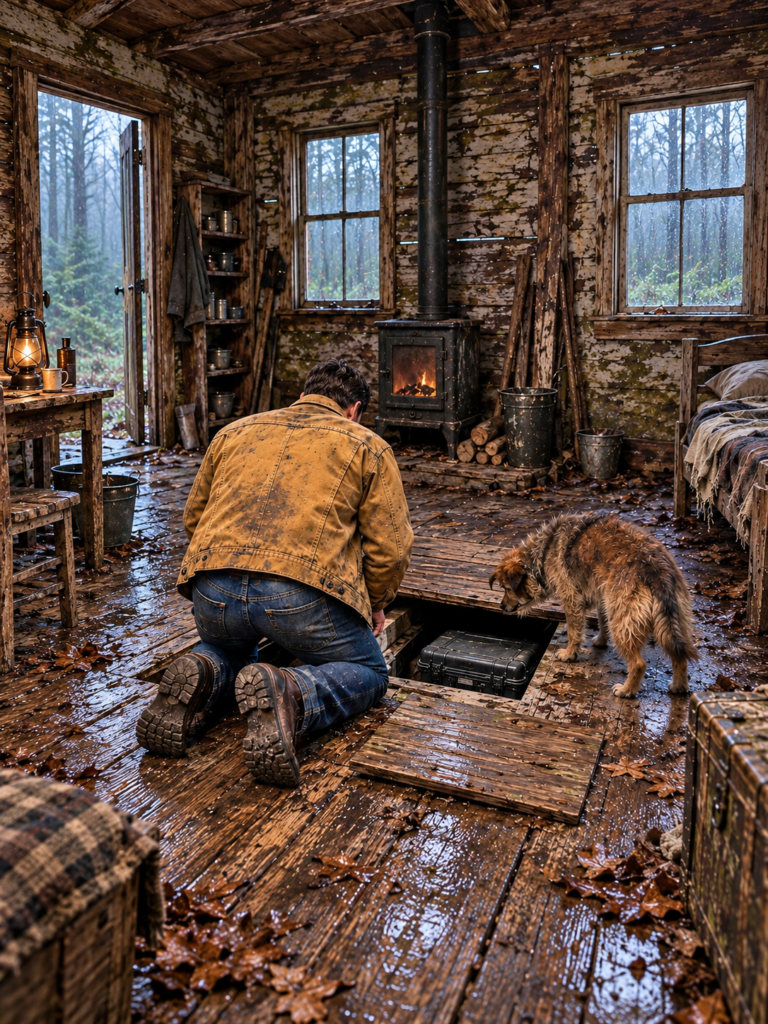
his wealthy in-laws threw a navy seal father and his twins into the freezing rain—never knowing the broken cabin they mocked hid a $200 million family secret
Part 1
Arthur Pendleton did not argue when the front door closed behind him.
He had learned long ago that some doors were better left shut.
The trouble was explaining that to two six-year-old children standing in the November rain.
Maya held his left hand. Leo held his right.
Both wore thin department-store coats that had been good enough for autumn but not for the cold front rolling over western Pennsylvania. Rain struck the stone driveway in silver needles. Wind drove dead oak leaves against the tires of Arthur’s old Ford pickup.
Barnaby, their shaggy rescue hound, stood beside the truck with his head low and one ear folded over.
Behind Arthur, the Carmichael estate glowed through tall windows.
Warm light.
White curtains.
Three chimneys breathing smoke into the gray evening.
Inside were twenty-three rooms, heated floors, two guest suites nobody used, a wine cellar, and a dining table long enough to seat sixteen people.
Arthur and his children were no longer welcome in any of them.
“Daddy,” Maya whispered, “did Grandma get mad at us?”
Arthur crouched despite the pain in his right knee.
“No, peanut.”
“Then why are we leaving?”
He looked at her face.
Claire’s eyes.
That was still the hardest part.
His dead wife’s eyes looking up at him from a six-year-old child’s face.
Arthur brushed wet hair from Maya’s forehead.
“Sometimes grown-ups get sad and confused, and they make choices they think will help them feel better.”
“Did we make them sad?”
“No.”
“Did Barnaby?”
At the sound of his name, the dog looked up.
Arthur almost laughed.
“No. Barnaby didn’t do anything.”
Leo stood quietly beside his sister.
He was the less talkative twin.
Where Maya asked questions until the world surrendered an answer, Leo watched.
Now he looked toward the Carmichael house.
“Grandpa said we were a burden.”
Arthur’s jaw tightened.
“You heard that?”
Leo nodded.
Arthur glanced at the house.
For one second he imagined walking back inside.
Not yelling.
He rarely yelled.
He imagined standing in Richard Carmichael’s elegant drawing room and repeating every sentence the man had spoken so the children could hear Arthur answer them.
You are not burdens.
You are not inconvenient.
You are not something adults discard when grief becomes uncomfortable.
But Arthur knew Richard would only turn it into another fight.
And Arthur would rather sleep in a ditch than make his children watch their father beg.
“Your grandfather was wrong,” he said.
Leo kept looking at him.
“How do you know?”
Arthur put a hand on his son’s shoulder.
“Because I’m your dad.”
The answer seemed to satisfy him.
Arthur loaded their backpacks into the truck.
There wasn’t much else.
Three duffel bags.
Claire’s cedar jewelry box.
A plastic tote of important papers.
Two sleeping bags Arthur still owned from his military years.
Barnaby’s food bowl.
The twins’ school things.
A framed photograph of Claire laughing beside Lake Tahoe five summers earlier.
Everything else remained inside.
Patricia Carmichael had told Arthur the furniture belonged to the house.
Even the dresser in which Maya had kept her socks.
Even the quilt on Leo’s bed.
“Time to go,” Arthur said.
Barnaby jumped into the passenger seat.
The twins climbed into back.
Arthur got behind the wheel.
His hands rested on the cracked steering wheel.
Forty-two dollars.
That was what remained in his checking account until his military disability payment came through in nine days.
Forty-two dollars.
He had once operated missions involving aircraft worth tens of millions.
He had commanded men under fire.
He had stayed awake forty-eight hours on three energy bars and bad coffee while hunting a bomb maker in a province most Americans could not locate on a map.
Now he had to decide whether he could afford gasoline and dinner on the same night.
Arthur turned the key.
The Ford coughed.
Stopped.
He closed his eyes.
“Come on.”
He tried again.
The starter ground.
Barnaby whined.
“Not now, buddy.”
Third try.
The engine caught.
The truck shook violently and settled into a rough idle.
Maya clapped.
Arthur smiled into the windshield.
“See? Adventure.”
He put the truck in gear.
Nobody came outside to say goodbye.
Not Patricia.
Not Richard.
The twins’ grandparents watched them leave from behind curtains.
Arthur saw the movement in an upstairs window.
He did not wave.
He drove.
Six months earlier, Claire Carmichael Pendleton had been alive.
Arthur could still divide his life into that simple measurement.
Before that Tuesday.
After that Tuesday.
Before, Claire complained that Arthur loaded the dishwasher like a man placing explosives.
After, her coffee mug remained in a kitchen cabinet because he couldn’t bring himself to move it.
Before, she slept curled against him.
After, Arthur woke at two in the morning reaching across an empty bed.
Before, the twins fought over who got to sit beside her on movie nights.
After, they stopped asking when she was coming home.
The drunk driver survived.
Claire did not.
Arthur had been away working a security contract in Virginia when the hospital called.
He drove five hours and arrived twenty minutes too late.
Patricia and Richard were already there.
Richard stood against the wall with both hands in his pockets.
Patricia sat beside the bed stroking Claire’s hair.
For one brief moment, grief made all four of them family.
Arthur put his forehead against his wife’s cold hand.
Patricia rested a palm on his shoulder.
Nobody mentioned the arguments.
Nobody mentioned that Richard had once told Claire she could have done better than “a government-trained hired gun.”
Nobody mentioned that Patricia had refused to attend Arthur’s retirement ceremony from the Navy.
Death made old cruelty seem small.
For a while.
The Carmichaels invited Arthur and the twins to stay at their estate.
Arthur accepted because the house he and Claire rented was being sold and because he could barely remember to feed himself.
For the first month, Patricia was gentle.
She helped Maya brush her hair.
Richard took Leo to the pond.
Then grief soured.
Patricia started complaining about toys left in hallways.
Richard complained about Barnaby’s mud.
They complained that Arthur’s truck embarrassed the neighbors.
They complained that he wasn’t “moving forward.”
Arthur found work repairing agricultural equipment at a small shop thirty minutes away, but he was barely making enough to pay Claire’s remaining medical bills.
He refused money from the Carmichaels.
That offended them too.
Everything offended them by the end.
Finally, on a freezing Thursday afternoon, Richard told him to leave.
“We need our home back,” he said.
Arthur had been standing in the front hall.
Patricia stared at a painting instead of him.
“The children need stability,” Arthur said.
“They need a father capable of providing it,” Richard answered.
Arthur had taken hits from bigger men.
None landed harder.
He remembered inhaling slowly.
Holding it.
Exhaling.
He could still hear Claire saying, Don’t give Dad what he wants. He pokes until people explode, then acts shocked by the fire.
So Arthur didn’t explode.
He packed.
Now, three hours north of the Carmichael estate, the rain became sleet.
The truck heater pushed out air only slightly warmer than Arthur’s breath.
He pulled into a gas station.
Twenty-eight dollars bought six gallons of gas, two hot dogs, two chocolate milks, a coffee and a small bag of dog food.
Arthur did the arithmetic twice before paying.
He ate half of one hot dog and gave the rest to Barnaby.
“Aren’t you hungry?” Leo asked.
“Already ate.”
“You didn’t.”
Arthur looked at him.
Leo broke his hot dog in half.
“Mom said sharing is when everybody gets some.”
Arthur swallowed.
“Your mom was smart.”
Leo held the piece out.
Arthur took it.
They drove deeper into the Appalachian foothills.
Darkness came early.
The road narrowed from four lanes to two.
Then two lanes to patched county blacktop.
Then gravel.
Arthur had one place left.
His father’s cabin.
Thomas Pendleton had died seven months earlier.
Heart attack.
Alone.
Arthur learned about it from a county clerk.
There had been no reconciliation.
No final phone call.
Just a certified letter informing Arthur that he had inherited a cabin on thirty-two acres outside an old mining town called Fairmont Ridge.
Arthur had laughed when he read the appraisal.
Thirty-one thousand dollars.
Most of that was land.
The cabin itself had been listed as “uninhabitable.”
He had planned to sell it.
Then Claire died.
Everything stopped.
Now the supposedly worthless cabin was all he had.
The Ford headlights found it at nine fourteen that night.
Maya leaned between the seats.
“That’s a house?”
Arthur parked.
“Technically.”
The porch roof sagged.
Two windows were boarded.
Rusting machinery filled one side of the yard.
An old washing machine lay on its back in the weeds.
Three tires hung from a tree for reasons Arthur could not explain.
His father had spent the last fifteen years of his life collecting things everybody else threw away.
Broken radios.
Copper wire.
Jars of bolts.
Defunct appliances.
Military surplus.
He distrusted banks, government, accountants, contractors, doctors and most neighbors.
Arthur had once accused him of distrusting oxygen.
Thomas replied that oxygen caused rust and therefore deserved suspicion.
That had been one of their last civilized conversations.
“Dad,” Maya said, “is there a bathroom?”
Arthur stared at the cabin.
“We’re about to find out.”
Inside smelled of mouse droppings, old smoke and damp wood.
There was a cast-iron stove, a sagging cot, a wooden table and shelves filled with canned beans dating back to an administration Arthur preferred not to identify.
No power.
No running water.
The hand pump outside worked after twenty furious pulls.
Arthur built a fire using dry scraps stored beneath a tarp.
The twins spread their sleeping bags on the floor.
He wrapped his Navy wool blanket around them too.
Barnaby curled at their feet.
“Are we poor?” Maya asked from inside her sleeping bag.
Arthur stopped feeding wood into the stove.
Children had a way of firing directly into the center of whatever adults were trying to avoid.
He sat beside her.
“We don’t have much money right now.”
“That means yes.”
“It means things are tight.”
“Are we going to stay here forever?”
“No.”
“How long?”
Arthur looked around.
A drop of water fell from the ceiling into an old coffee can.
“Not forever.”
Maya considered this.
Then she touched his face.
“You can use my piggy bank.”
Arthur blinked.
“Thank you.”
“It has eighteen dollars.”
“That’s serious money.”
“And three Canadian coins.”
“Even better.”
She smiled.
Within minutes she slept.
Arthur remained awake.
The fire crackled.
Sleet tapped the window.
His children’s breathing filled the room.
Arthur lowered his head into both hands.
For the first time since leaving the Carmichaels, he let himself feel afraid.
Not combat fear.
Combat fear was clean.
Immediate.
Find cover.
Control breathing.
Identify threat.
Move.
This fear had no direction.
What if the truck failed?
What if the twins got sick?
What if social services discovered they were sleeping in an unheated cabin?
What if Arthur couldn’t make enough money quickly?
What if he lost them too?
“Claire,” he whispered.
The name broke him.
Arthur bent forward.
He did not sob loudly.
He had trained too many years to lose control that way.
Instead his shoulders shook without sound.
Barnaby lifted his head.
The dog rose, padded across the floor and nudged Arthur’s wrist.
Arthur scratched behind his ear.
“I’m sorry, buddy.”
Barnaby turned away.
Walked to the back corner.
Sniffed.
Scratched once.
Arthur ignored him.
Barnaby scratched again.
“Leave it.”
The dog became more insistent.
Scratch.
Scratch.
Scratch.
“Barnaby.”
The hound barked.
Both children stirred.
Arthur stood.
“All right.”
He crossed the room and grabbed Barnaby’s collar.
The dog fought him.
Not aggressively.
Urgently.
His paws scraped at three floorboards beside a stack of firewood.
Arthur’s flashlight beam passed over the floor.
He stopped.
The boards did not match the others.
Same age.
Same stain.
But different joinery.
They had no visible nails.
Arthur crouched.
His father had taught carpentry before paranoia hollowed him out.
Thomas Pendleton did nothing by accident.
Arthur slid his pocketknife into a seam.
The board lifted.
Cold air breathed upward.
Barnaby shoved his nose into the gap.
Arthur pushed him back.
“Easy.”
He removed a second board.
Beneath the floor was a cavity lined with black waterproof membrane.
Something rectangular rested inside.
Arthur reached down.
His fingers found a hard plastic handle.
He pulled.
Heavy.
He shifted his grip and lifted a black waterproof case onto the floor.
Military grade.
Expensive.
Far too expensive for a man who repaired boots with duct tape.
Arthur stared at it.
“Okay, Dad.”
He released the latches.
Inside lay a ledger.
A manila envelope.
A velvet box.
And a letter.
Arthur unfolded the letter.
Arty,
If you found this, either Barnaby is smarter than you or you finally learned to look where everybody else sees junk.
Arthur paused.
Despite himself, he almost smiled.
He read on.
You spent half your life thinking I was a crazy old man. Fair enough. I worked hard to look like one.
There are things I should have told you.
Things I was too proud to say.
Before you were born, I built software for industrial logistics. Nobody called it software back then. We called it systems work. I sold my company in 1984.
I invested almost everything.
Technology.
Telecommunications.
Warehouses.
Data centers.
Land.
I learned early that if people think you have money, they start telling you what you owe them.
So I made myself look poor.
Maybe I went too far.
Arthur’s eyes moved faster.
I watched money destroy two partners, one marriage and most of my friendships.
When you joined the Navy, I decided I wouldn’t give you any.
You needed to become someone before wealth told you who to be.
I know you hated me for it.
Maybe you still do.
The ledger contains the account structure.
The trust is managed by Winston, Hayes & Lowe in New York.
Your verification phrase is Barnaby.
Yes, the dog.
I always liked him.
Current value when I last checked was roughly two hundred million dollars.
Arthur stopped.
His eyes remained on the sentence.
Two hundred million.
He reread it.
Then again.
“No.”
He opened the ledger.
Not rambling notes.
Not delusion.
Account structures.
Holding companies.
Investment returns.
Property schedules.
Arthur recognized enough financial language to know someone serious had prepared parts of it.
He tore open the manila envelope.
Certified statements.
A trust instrument.
Contact information.
A valuation dated ten months earlier.
$201,884,736.
Arthur sat on the floor.
The stove cracked behind him.
He looked at his children sleeping six feet away in borrowed blankets.
Two hundred million dollars.
They had eaten one hot dog between two children because he was saving gas money.
His hands began to shake.
At the bottom of the case sat the velvet box.
Inside was an old Pendleton signet ring and a brass safe-deposit key.
Arthur looked toward Barnaby.
The dog sat proudly.
“You knew?”
Barnaby wagged his tail.
Arthur laughed.
It came out strangely.
Half relief.
Half disbelief.
He covered his eyes.
For one dangerous second Richard Carmichael’s face appeared in his mind.
You’re not capable of providing stability.
Arthur felt something hard forming beneath his grief.
Then he looked at the twins.
No.
First things first.
Heat.
Food.
Safety.
Everything else could wait.
He touched the letter.
His father’s final line read:
Don’t use this money to become important.
Use it to make sure the people you love are safe.
Arthur folded the paper carefully.
“All right, Dad.”
Outside, sleet struck the roof.
Inside, for the first time in six months, Arthur knew his children would be all right.
Part 2
Morning came gray and brutally cold.
The fire had burned low by five.
Arthur rebuilt it before the children woke.
Then he made breakfast from two cans of peaches that had not expired during either Bush administration.
He inspected the labels three times before opening them.
“Fancy breakfast,” Maya said.
“Imported.”
“From where?”
Arthur looked at the can.
“Georgia.”
She nodded as if impressed.
At seven thirty, he loaded the waterproof case into a locked toolbox bolted behind the truck cab.
Then he drove toward Fairmont Ridge.
The town had once supported three coal mines.
Now it supported a Dollar General, a diner, a feed store, a bank branch and a bar that apparently opened whenever its owner woke up.
Arthur parked beside a diner called Millie’s.
Inside smelled like bacon, coffee and fryer oil.
A woman in her sixties with thick glasses approached.
“Sit wherever.”
Arthur chose a booth.
Barnaby remained beneath the table.
Arthur counted his remaining cash.
Nine dollars and eighty cents.
“What’s cheapest?” he asked.
The waitress looked at the twins.
“Pancakes are four bucks.”
“Two orders. Can they split?”
She stared at him for a second.
Then looked at his jacket.
The frayed sleeves.
The children.
The tired dog.
“I can probably find a third order nobody claimed.”
Arthur knew exactly what she was doing.
Pride wanted him to refuse.
Parenthood won.
“Thank you.”
He ordered coffee.
When the pancakes arrived, there were three plates.
Bacon too.
Nobody mentioned it.
Arthur took out an old prepaid phone.
“I need to step outside for two minutes. Can you see them from here?”
The waitress waved him away.
“Honey, I raised five boys. Your two aren’t even a challenge.”
Outside, Arthur dialed the law firm.
A receptionist answered.
“Winston, Hayes & Lowe.”
“I need David Hayes.”
“May I ask who is calling?”
“Arthur Pendleton.”
Keyboard sounds.
“I don’t see an appointment, Mr. Pendleton.”
“Tell him Thomas Pendleton’s son has the black case.”
Nothing.
Then:
“One moment.”
Arthur waited.
Thirty seconds.
Forty.
A man’s voice came on.
“Arthur?”
Older.
Controlled.
But stunned.
“David Hayes?”
“Yes.”
“My father left me documents.”
Hayes inhaled audibly.
“Where are you?”
“Doesn’t matter.”
“We have attempted to contact you for months.”
“Nobody called.”
“Your father’s instructions specifically prohibited investigators. He believed that if we searched, you would interpret it as financial pressure and refuse contact.”
Arthur closed his eyes.
That sounded like Thomas.
“Verification?” Hayes asked.
“Barnaby.”
Silence.
Then Hayes exhaled.
“All right.”
“Is it real?”
“Yes.”
“How real?”
“Current estimated net asset value is approximately two hundred twelve million dollars.”
Arthur leaned against the truck.
A semi rolled down Main Street.
Somebody across the road shoveled slush from a sidewalk.
Normal things.
Two hundred twelve million dollars.
“Arthur?”
“I’m here.”
“We need to arrange identification, signature authentication and transfer authority.”
“How fast can I access cash?”
“How much?”
“Fifty thousand.”
Hayes almost laughed.
“You can access several million today without touching the principal structure.”
“I don’t need several million.”
“What do you need?”
Arthur looked through the diner window.
Maya was pouring syrup.
Leo was giving Barnaby bacon under the table.
“Fifty thousand.”
“Give me an hour.”
Arthur opened an account at the local bank.
The branch manager’s attitude changed when a New York trust attorney called personally.
Arthur disliked the change immediately.
Twenty minutes earlier the manager barely looked at him.
Now he offered bottled water and addressed him as Mr. Pendleton every fourth sentence.
Arthur deposited forty-five thousand.
Took five thousand cash.
Bought winter clothing first.
Maya got a purple parka.
Leo chose green.
Waterproof boots.
Gloves.
Wool socks.
Thermal underwear.
Arthur bought two space heaters he could run from a generator, then stopped.
Why return to the cabin tonight?
He rented a furnished lodge near a state park for one month.
Nothing extravagant.
Three bedrooms.
A fireplace.
Reliable heat.
A kitchen.
The twins ran from room to room.
“Which one is ours?” Leo asked.
“Pick.”
Both children froze.
They were accustomed to sharing.
Maya pointed upstairs.
“That one?”
“Yours.”
Leo selected the room opposite.
Arthur carried their bags inside.
Barnaby jumped onto a couch.
“No.”
The dog stared at him.
“Floor.”
Barnaby lowered himself slowly, demonstrating profound injustice.
That night Arthur cooked eggs, potatoes and toast.
Too much.
He kept placing food on the table.
Fruit.
Yogurt.
Milk.
Cookies.
He knew it was irrational.
After one night of worrying about hunger, abundance felt like insurance.
Maya noticed.
“Dad, are we rich now?”
Arthur looked at her.
“Why?”
“You bought strawberries.”
That hit harder than it should have.
Arthur sat down.
“We have enough.”
“Enough forever?”
He thought carefully.
“Enough if we’re smart.”
“Did Grandpa give you money?”
“My father did.”
“The grandpa we never met?”
“Yes.”
Leo frowned.
“Why didn’t he give it before?”
Arthur had no answer suitable for a six-year-old.
“Because grown-ups are complicated.”
Maya nodded solemnly.
“Like Grandma.”
Arthur almost choked on his coffee.
“Exactly.”
Once the children were asleep, Arthur opened his father’s records at the kitchen table.
He called Hayes.
For four nights they reviewed the trust.
Thomas had not exaggerated.
He had owned data infrastructure properties, warehouse partnerships, stock, land, municipal debt and private investments through layered holding companies.
The fortune had grown quietly for decades.
Arthur did not feel rich.
He felt responsible.
A number on a screen meant nothing unless handled correctly.
On the fifth night he asked Hayes for something else.
“I want financial information on Carmichael Industries.”
Hayes went silent.
“Why?”
“They threw my children out.”
“I understand that.”
“No, you understand the sentence. You weren’t there.”
Arthur’s tone remained calm.
“I don’t want illegal information. Public records. Loans. Liens. Corporate filings. Everything lawfully available.”
“Arthur.”
“What?”
“You inherited this fortune six days ago.”
“I know.”
“And already you’re talking about your in-laws.”
Arthur stared into the fireplace.
“Do you think I’m being emotional?”
“Yes.”
“You’re right.”
Hayes seemed surprised.
Arthur continued.
“That doesn’t mean I don’t want the information.”
Three days later a report arrived.
Arthur read it twice.
Then a third time.
Carmichael Industries was in trouble.
Bad trouble.
The company manufactured specialized metal components for agricultural and industrial machinery.
Richard had inherited it from Patricia’s father and expanded aggressively during the early 2000s.
Then he failed to modernize.
Foreign competitors undercut pricing.
Two major customers left.
Debt increased.
Richard borrowed against equipment.
Then against inventory.
Then against the estate.
The Carmichaels still looked wealthy because looking wealthy was one of their largest expenses.
Country club dues.
Cars.
Travel.
Charity galas.
Jewelry.
Private school donations.
All supported by borrowed money.
The largest obligation was a twenty-three million dollar distressed loan held by a Chicago fund named NorthBridge Capital.
Arthur called Hayes.
“Can that loan be purchased?”
“Technically.”
“Would they sell?”
“Probably. NorthBridge doesn’t care about legacy manufacturing. They care about returns.”
“Price?”
“Perhaps twenty-four or twenty-five million.”
Arthur stared at the report.
If he bought the debt, he would become the Carmichaels’ largest secured creditor.
The idea gave him satisfaction.
That bothered him.
He walked upstairs.
The twins slept.
He stood in their doorway.
Claire’s photograph was on the dresser between their rooms.
Arthur picked it up.
“What would you tell me?”
He could hear her answer.
Don’t become my father just because you finally have more money than he does.
Arthur sat on the floor.
Barnaby settled beside him.
He spent twenty minutes thinking.
Then called Hayes again.
“I want the loan.”
“Arthur—”
“But I don’t want to destroy the company.”
“Explain.”
“If they default, I want control. Before liquidation, I want an independent operating review.”
“You want to save Carmichael Industries?”
“I want to save the people Richard employs.”
“And Richard?”
Arthur looked at Claire’s picture.
“Richard can save himself if he learns how.”
Hayes said nothing for a moment.
“That sounds more expensive than revenge.”
“Probably.”
“Your father would have liked you.”
Arthur’s mouth tightened.
“My father didn’t know me well enough to know what he liked.”
The acquisition took three weeks.
Arthur’s holding company purchased the Carmichael debt without revealing its owner.
During that time he returned to the cabin.
Not because he had to.
Because he wanted to understand Thomas.
He took the twins.
They wore proper winter clothes now.
Arthur repaired the stove pipe.
Replaced broken glass.
Cut brush.
Cleared trash.
Barnaby spent hours investigating every corner.
In a desk drawer Arthur found photographs.
One showed Thomas at thirty-five.
Clean-shaven.
Wearing a suit.
Standing outside a small office building beside three men.
Another showed Arthur himself as a baby.
His father held him against his chest.
Thomas looked terrified.
On the back, Arthur’s mother had written:
Tom’s first morning alone with Arty.
Arthur stared at it.
His memories of his father were mostly hard.
Commands.
Criticism.
Silence.
But here was proof of something softer.
A man holding his newborn son like the child was the most valuable thing he had ever touched.
Arthur sat on the cabin porch.
Leo came beside him.
“Is that you?”
“Yep.”
“You were bald.”
“Most babies are.”
Leo studied the photo.
“Grandpa looks happy.”
Arthur swallowed.
“Yeah.”
“He wasn’t always mean?”
“No.”
That answer surprised Arthur.
His father had been difficult.
Proud.
Paranoid.
Emotionally clumsy.
But not only those things.
Nobody was only their worst qualities.
Arthur began to understand that inheritance included more than money.
Sometimes it included the burden of seeing a dead parent clearly.
Part 3
The Carmichael loan defaulted in February.
Arthur was helping Maya build a model solar system at the lodge when Hayes called.
“Revenue covenant missed by eleven percent.”
Arthur balanced a foam Jupiter on the table.
“So NorthBridge could have called the loan?”
“Immediately.”
“And now we can.”
“Yes.”
Maya held up Saturn.
“Does this look right?”
“Perfect.”
“It has glitter.”
“Saturn deserves glitter.”
She returned to work.
Arthur stepped onto the porch.
Snow covered the pines.
“What happens if we call it?”
“Thirty-day cure period under the amended agreement. If they can’t pay, Pendleton Holdings can enforce secured interests in the factories, equipment, certain receivables and the Carmichael estate under Richard’s personal guarantee.”
Arthur rubbed his jaw.
“Schedule a meeting.”
“With Richard?”
“And Patricia.”
“Do you want them to know it’s you?”
“Not until I’m in the room.”
The meeting was held in Pittsburgh.
Arthur wore a dark suit.
Not expensive by Carmichael standards.
Good fabric.
No visible labels.
Hayes met him outside the conference room.
“You sure?”
Arthur looked through the glass.
Richard sat at the table.
Patricia beside him.
They looked smaller than Arthur remembered.
Not literally.
Something about fear reduced people.
“Yes.”
Hayes opened the door.
Richard looked up.
Confusion came first.
Then disbelief.
Then anger.
“What is he doing here?”
Arthur took a seat.
Patricia went pale.
“Arthur?”
Richard turned to Hayes.
“This is completely inappropriate. Our son-in-law has no role in—”
“Former son-in-law?” Arthur said.
Patricia flinched.
Arthur immediately regretted it.
Claire was still his wife in every way that mattered.
Hayes placed a folder on the table.
“Arthur Pendleton is the beneficial owner of Pendleton Holdings.”
Silence.
Richard stared at him.
“No.”
Arthur did not respond.
“No.”
Richard almost laughed.
“This is absurd.”
Hayes remained professional.
“Pendleton Holdings purchased NorthBridge Capital’s secured Carmichael debt portfolio.”
Richard’s expression changed.
“How?”
Arthur leaned back.
“You once told me leverage was the difference between people who control their lives and people controlled by them.”
“I never said that.”
“You said it at Christmas dinner three years ago.”
Patricia closed her eyes.
Richard stared.
Arthur continued.
“I listened.”
“Where did you get twenty-four million dollars?”
“Family.”
The irony landed.
Richard looked toward Hayes.
Then back at Arthur.
“You’ve come here to humiliate us.”
“No.”
“Don’t lie.”
“I’m not.”
Richard slapped the table.
“You disappear into some mountain shack and come back buying my debt?”
Arthur’s calm slipped.
“You threw your grandchildren into freezing rain.”
Patricia whispered, “Arthur.”
He looked at her.
She was crying.
Not theatrically.
Quietly.
That made the situation worse, not better.
“I was wrong,” she said.
Richard turned.
“Patricia.”
“No.”
She faced Arthur.
“We were wrong.”
Arthur said nothing.
“I couldn’t look at the children without seeing Claire.”
Her voice broke.
“Every time Maya laughed, I heard her mother. Every time Leo came down the stairs, for half a second I thought—”
She covered her mouth.
Arthur felt anger and pity colliding.
Patricia continued.
“That doesn’t excuse what we did.”
“No.”
“I know.”
Richard stood.
“This is pointless. Tell us the cure amount.”
Hayes opened the file.
“Twenty-three point eight million including accrued obligations.”
Richard went still.
“You know we don’t have that.”
“Yes,” Arthur said.
Richard looked at him.
“You planned this.”
“I bought debt you already owed.”
“Same thing.”
“No. One is planning your failure. The other is noticing it.”
Richard walked to the window.
“I built that company.”
“You inherited it.”
Richard turned sharply.
“I doubled it.”
“And then borrowed against everything while pretending nothing was wrong.”
“You think you understand manufacturing because you read a report?”
“No.”
Arthur opened another folder.
“That’s why I hired people who do.”
He slid it across.
Richard did not touch it.
Arthur continued.
“Carmichael Industries isn’t dead. One plant is profitable. Your agricultural components line has customers. Your biggest problems are outdated machinery, executive overhead and debt service.”
Richard stared at the report.
“What do you want?”
Here was the moment Arthur had imagined.
The opportunity to say:
Everything.
The house.
The company.
Your pride.
To order Richard out with twenty-four hours notice.
To make Patricia pack bags while strangers watched.
To let the twins see their grandparents lose the warm house from which they had been expelled.
Revenge stood within reach.
It tasted bitter before Arthur even took it.
“I want you out of management.”
Richard laughed once.
“No.”
“Then Pendleton Holdings enforces the loan.”
“You’d shut down three factories to punish me?”
“No. I’d place the assets under restructuring.”
Richard’s confidence flickered.
Arthur leaned forward.
“You can remain a minority shareholder after recapitalization. No executive authority for three years. Independent board. Professional management. Your personal guarantee on the estate gets released if you cooperate.”
Patricia looked up quickly.
“The house?”
“You keep it.”
Richard stared.
“Why?”
Arthur answered honestly.
“Because my children love you.”
Patricia began crying harder.
Richard’s face twisted.
“You expect me to thank you?”
“No.”
Arthur stood.
“I expect you to decide whether your pride is worth hundreds of jobs.”
He left.
Outside, Hayes followed him to the elevator.
“That wasn’t the plan you described three weeks ago.”
“I changed the plan.”
“Why?”
Arthur watched the floor numbers.
“Because Claire would’ve hated the first one.”
Richard resisted for eight days.
During those eight days he called bankers.
Old friends.
Private equity firms.
A cousin in Boston.
Nobody would lend him enough.
His reputation had been stronger than his balance sheet.
When the appearance cracked, there was little underneath.
On the ninth day he accepted Arthur’s terms.
Arthur did not celebrate.
He returned to Fairmont Ridge.
Spring had begun loosening the ground around the cabin.
He hired nobody at first.
He repaired things himself.
Roof patching.
Door frame.
Floor joists.
The work felt familiar.
Useful.
Maya collected stones beside the creek.
Leo helped stack split wood.
Barnaby pursued squirrels with religious devotion.
One afternoon Arthur discovered an old steel footlocker beneath Thomas’s workbench.
Inside were no financial records.
Letters.
Hundreds.
Most addressed to Arthur.
Never sent.
Arthur sat on the porch and read.
Arty, congratulations on making Chief. I heard through Harold. I should call. I don’t know what to say.
Arty, your mother would be proud of you. I am too, though I suppose I’ve made it impossible for you to believe that.
Arty, I saw a photograph of Claire. She looks like she knows when you’re being stupid. Good.
Arthur stopped reading.
He pressed thumb and forefinger against his eyes.
His father had loved him.
Badly.
Silently.
From a distance.
But love unspoken still left damage.
Arthur understood that now.
He thought of Patricia.
Of Richard.
Of the twins.
He made himself a promise.
His children would never have to discover his love in a locked box after he died.
That evening he sat them down.
Maya was drawing.
Leo held a toy tractor.
“Listen.”
They looked up.
“I need you to know something.”
Maya frowned.
“Are we moving again?”
“No.”
“You look like moving face.”
Arthur smiled.
“No moving.”
He took a breath.
“I love you.”
Leo blinked.
“We know.”
“I know you know. But I’m going to say it anyway.”
Maya shrugged.
“Okay.”
“Every day.”
“That’s a lot.”
“Get used to it.”
She went back to drawing.
Arthur laughed.
Children made complicated truths simple.
The money did not solve grief.
It did not heal the feeling that hit Arthur every morning when he woke without Claire.
But it created space.
Space to be a father instead of a man constantly outrunning bills.
Space to think.
Space to choose.
He began considering the cabin property differently.
Thirty-two acres was not much.
But surrounding parcels were for sale.
Old timberland.
Abandoned farm ground.
A closed horse property.
Thomas’s final letter had said:
Buy yourself decent land.
Protect the kids.
Arthur bought eight hundred acres around the cabin.
Not to build a palace.
To build a life.
Part 4
Summer changed Fairmont Ridge.
Green returned to the hills.
Creeks rose with spring runoff and then settled into clear mountain water.
Arthur moved the twins from the rental lodge into a renovated farmhouse three miles from Thomas’s cabin while construction began on something larger.
Not a mansion.
A working ranch.
Cattle.
Hay fields.
A small orchard.
Horse pasture.
Workshop.
He bought neglected land from families who wanted out and kept several local farmers on leases rather than pushing them off.
The town noticed.
Rumors spread.
Some said Arthur had won the lottery.
Others said he was running drugs.
One man at Millie’s diner confidently explained that Arthur worked for the CIA and the ranch was a secret listening station.
Arthur let him talk.
Meanwhile, Carmichael Industries went through restructuring.
Richard hated every minute of it.
Arthur brought in Maria Delgado, a fifty-eight-year-old manufacturing executive from Ohio who had spent thirty years modernizing failing plants.
She eliminated two layers of management.
Sold Richard’s corporate jet.
Renegotiated supplier contracts.
Invested in robotics where it saved repetitive labor and retrained workers for technical jobs.
The company lost money for two more quarters.
Then stabilized.
Arthur attended board meetings by video.
Richard rarely spoke to him.
Patricia did.
Her first call came in July.
“Leo’s birthday is next week.”
“I know.”
“Could we send something?”
Arthur paused.
Six months earlier Patricia would never have asked permission.
“Yes.”
“Could we visit?”
That was harder.
Maya still asked why Grandma made them leave.
Leo still watched adults closely whenever voices rose.
Arthur would not force forgiveness upon children because adults wanted relief from guilt.
“I’ll ask them.”
The twins discussed it seriously.
Maya wanted Grandma.
Leo wasn’t sure.
“What if they make us leave again?” he asked.
Arthur’s chest tightened.
“They can’t.”
“How do you know?”
“Because this is our house.”
Leo considered.
Then nodded.
Patricia visited alone.
She arrived without jewelry except her wedding ring.
Maya ran to her.
That surprised everybody.
Patricia dropped to her knees in the gravel and hugged her granddaughter.
Then Leo approached slowly.
Patricia did not grab him.
She waited.
Finally he let her hold him.
Arthur turned away.
Barnaby sneezed beside him.
“I know,” Arthur muttered.
Later Patricia sat on the porch.
She looked across hay fields.
“This is beautiful.”
“It’s work.”
“Claire would’ve loved it.”
Arthur stared toward the hills.
“Yes.”
Patricia folded her hands.
“I think about that night every day.”
“So do they.”
“I know.”
Arthur looked at her.
“No, Patricia. I need you to understand. You didn’t just hurt me. Leo thought he was a burden.”
Her face crumpled.
“He heard Richard.”
“Yes.”
She covered her eyes.
Arthur almost comforted her.
Then decided not to rescue her from consequences that belonged to her.
After a minute Patricia whispered, “I don’t know how to repair that.”
“You don’t tell him it didn’t happen.”
“I wouldn’t.”
“You don’t blame grief.”
She nodded.
“You show up.”
“How long?”
“As long as it takes.”
Patricia came back two weeks later.
Then again.
She helped Maya bake biscuits.
She listened to Leo explain cattle breeds.
She stepped in manure once and laughed so hard she cried.
Arthur began to remember that Claire had loved her mother for reasons.
Richard did not visit.
Pride kept him away.
Then in September, Carmichael Industries suffered a fire.
An electrical fault ignited insulation in the older machining plant at two in the morning.
Nobody died.
But twenty percent of the facility burned.
Insurance would cover some losses.
Production interruption could still cost them a major customer.
Maria called Arthur at three thirteen a.m.
Arthur drove east before sunrise.
He spent eighteen hours at the plant.
Not in the boardroom.
On the floor.
Helping crews move salvageable tooling.
Talking to firefighters.
Reviewing temporary production plans.
Richard arrived around noon.
He wore work boots Arthur had never seen.
For several hours they worked within the same building without speaking.
Near midnight they ended up alone beside a loading dock.
Richard sat on a concrete barrier.
Arthur drank water.
“You didn’t have to come,” Richard said.
“Yes, I did.”
“Why?”
“People work here.”
Richard looked across the parking lot.
“You think I don’t care about them.”
“I think you cared about being Richard Carmichael more.”
The older man’s face hardened.
Then softened.
“Maybe.”
Arthur waited.
Richard rubbed both hands over his face.
“Claire used to say that.”
“What?”
“That I cared more about what things represented than what they were.”
Arthur smiled faintly.
“Sounds like her.”
Richard’s eyes filled.
“I miss her.”
Arthur looked away.
“So do I.”
“I blamed you.”
“I know.”
“If she hadn’t married you, she wouldn’t have been on that road.”
Arthur felt old rage return.
He forced himself still.
Richard continued before Arthur could answer.
“I know how insane that sounds.”
“Good.”
“I needed somebody responsible.”
Arthur’s voice hardened.
“A drunk driver was responsible.”
Richard nodded.
“I know.”
“No. You know now because blaming me cost you something.”
Richard accepted that.
The plant buzzed behind them.
Emergency generators hummed.
Finally Richard said, “I heard Leo thinks he’s a burden.”
Arthur looked at him.
“Patricia told me.”
“You said it.”
“I know.”
“He’s six.”
“I know.”
“Don’t say it like that’s enough.”
Richard’s jaw trembled.
“What do you want me to do?”
Arthur thought of Thomas’s unsent letters.
All those words stored too late.
“Tell him you’re sorry while you’re alive.”
Richard came to the ranch in October.
He brought no gifts.
Arthur had suggested that.
The twins were near the barn brushing a pony named Dusty.
Richard approached slowly.
Leo became quiet.
Maya waved.
“Grandpa.”
Richard crouched.
His expensive knees pressed into actual dirt.
“Leo, I need to tell you something.”
The boy looked at Arthur.
Arthur nodded.
Richard continued.
“I said something terrible the day you left my house.”
Leo did not move.
“I called you a burden.”
“You called all of us that.”
Richard swallowed.
“Yes.”
“Were we?”
“No.”
“Then why’d you say it?”
Richard took a long breath.
“Because I was angry and scared and proud, and sometimes adults say cruel things when they don’t want to admit they’re the ones failing.”
Leo looked at the pony.
“Did you want us gone?”
Richard answered carefully.
“I wanted my pain to stop. I thought changing the house would help.”
“Did it?”
Richard’s eyes filled.
“No.”
Leo stroked Dusty’s neck.
“I don’t want to live at your house.”
“You don’t have to.”
“You can visit here.”
Richard looked stunned.
“Can I?”
“If Dad says.”
Arthur looked away before anyone saw his face.
Something changed after that.
Not everything.
Arthur and Richard did not become friends.
They never would.
But hostility exhausted itself.
Richard continued serving as a limited consultant to Carmichael Industries.
For the first time in forty years he reported to somebody else.
It humbled him.
The company recovered from the fire.
The major customer stayed.
Workers got profit-sharing bonuses when the first profitable quarter arrived.
Arthur could have taken most of that profit.
He didn’t.
His father had given him wealth.
Arthur intended to make sure wealth did not make him small.
Then, one evening in November, almost exactly one year after the Carmichaels threw them out, Arthur drove to Thomas’s cabin alone.
Snow had begun.
Barnaby came with him.
Arthur opened the cabin door.
Everything was clean now.
The stove worked.
The roof no longer leaked.
He had preserved the room almost exactly as it had been, except safe.
He sat where he had sat that first terrible night.
He opened Thomas’s letter.
Two hundred million dollars had changed his circumstances.
Not the things that mattered.
Claire remained dead.
His father remained dead.
His children still needed him in the morning.
Grief could not be purchased away.
Arthur finally understood what money could do.
It could protect.
It could amplify.
It could expose.
It could give a person choices.
But it could not decide which choice made him a good man.
That remained unpaid work.
Barnaby scratched once at the repaired floor.
Arthur laughed.
“No more treasure.”
The dog wagged.
Arthur reached down and rubbed his head.
“You already found the important part.”
Part 5
Three years later, morning came bright over Pendleton Valley.
That was not the official name.
Maps still called it Grayson Hollow.
The twins called it Pendleton Valley, and the name stuck among the people who worked there.
Arthur stood on the porch before sunrise.
At forty-three, he carried more gray in his beard than he wanted to admit.
His right knee hurt in cold weather.
His hearing was worse in his left ear.
Life left receipts.
Below him, cattle moved through frosted grass.
Smoke rose from the bunkhouse chimney.
Beyond the river, the first sunlight struck the high ridge and turned snow pink.
Barnaby lay beside Arthur’s boots.
The old hound’s muzzle had gone white.
“You’re getting old,” Arthur said.
Barnaby opened one eye.
“Don’t look at me like that. I’m not the one who sleeps sixteen hours a day.”
The screen door banged.
Leo came outside.
Nine now.
Long-legged.
Serious.
He carried two mugs.
“Coffee.”
Arthur accepted one.
He sniffed.
“Hot chocolate.”
“Mom said kids shouldn’t drink coffee.”
Arthur looked at him.
“You remember that?”
“Some things.”
Arthur felt the familiar ache.
It no longer destroyed him.
Grief had changed shape.
Once it had been a storm occupying the entire sky.
Now it was weather he carried inside himself.
Sometimes sudden.
Sometimes gentle.
Always present.
Maya ran onto the porch wearing one boot.
“Barnaby stole my sock.”
The dog remained motionless.
Arthur looked at him.
“Evidence?”
Maya pointed.
A blue sock protruded beneath Barnaby’s chest.
The dog slowly put one paw over it.
“Traitor,” Arthur said.
The morning became noise.
Breakfast.
School bags.
Mud.
A missing math worksheet.
Barnaby refusing to release the sock.
Arthur had never been happier.
The ranch employed fourteen full-time workers.
It raised grass-fed cattle and grew hay.
A portion of the property had become a retreat for veterans and their families.
Not a luxury spa.
A working place.
Fishing.
Trail repair.
Horses.
Woodshop.
Counseling available without anybody forcing it.
Arthur funded it quietly.
He had also established a rural emergency grant program for widowed parents facing eviction or medical debt.
He named it after Claire.
The Claire Pendleton Family Fund.
Her parents donated too.
That mattered to Arthur more than he expected.
Carmichael Industries had survived.
More than survived.
Under Maria’s leadership the company modernized and expanded into components for electric agricultural equipment.
Richard regained a board seat after three years.
Not control.
A seat.
The first board meeting after his reinstatement, he voted against restoring executive bonuses.
Arthur almost fell out of his chair.
People changed slowly.
Sometimes humiliation changed them.
Sometimes love did.
Usually both.
Patricia became part of the children’s lives again.
She visited monthly.
She wore jeans now at the ranch because Maya once told her pearls looked silly near cows.
Richard came less often but stayed longer.
He had learned to fish with Leo.
Badly.
They seemed to enjoy arguing about knots.
Arthur never returned the Carmichael estate to them because he had never taken it.
The restructuring agreement let them keep it, though Richard eventually sold the property himself.
The house was too large.
Too full of ghosts.
They bought a smaller home outside Pittsburgh.
Patricia planted tomatoes.
Richard complained about squirrels.
Arthur privately considered this justice enough.
One Thanksgiving, the whole family gathered at the ranch.
Arthur nearly canceled twice.
Too many memories.
Too many old wounds.
Then Maya asked whether Grandma could make her sweet potatoes.
So Patricia came.
Richard brought wine.
Maria came with her husband.
Hayes arrived from New York and surprised everybody by knowing how to carve a turkey.
Wyatt Briggs, Arthur’s ranch manager, burned the rolls.
Around the table sat people who would once have refused to share a room.
Arthur looked at Claire’s empty chair.
Not physically empty.
Maya sat there.
But empty in the way certain spaces remained after death.
Patricia noticed him looking.
“She would’ve liked this,” she said.
Arthur smiled.
“She would’ve complained the turkey was dry.”
Richard looked offended.
“It is dry.”
Everybody laughed.
Even Arthur.
Especially Arthur.
After dinner, Richard approached him outside.
Snow had begun.
Soft flakes landed on the porch railing.
“I owe you something.”
Arthur groaned.
“If this is another apology—”
“It isn’t.”
Richard held out a small envelope.
Arthur opened it.
Inside were two checks.
One for the Claire Pendleton Family Fund.
Five million dollars.
Arthur looked up.
Richard shrugged.
“Company dividends.”
“You sure?”
“No.”
Arthur laughed.
Richard handed him a second item.
A folded paper.
Arthur opened it.
It was a photocopy of a note Leo had written at school.
The assignment heading read:
WRITE ABOUT SOMEBODY WHO CHANGED.
Leo had written:
My grandpa used to think being strong meant having more than everybody else.
Now he knows being strong means coming back after you were wrong.
He still gets mad too much.
But he comes back.
Arthur stared at it.
Richard looked toward the pasture.
“I keep a copy in my wallet.”
Arthur folded the paper.
“That’s worth more than the check.”
“I know.”
That answer told Arthur how far the man had traveled.
The next spring, Barnaby slowed down.
At first Arthur pretended not to notice.
The dog slept more.
Stairs became difficult.
He stopped chasing rabbits.
One morning he refused breakfast.
Arthur took him to the veterinarian.
Cancer.
Advanced.
No surgery worth putting him through.
Maybe weeks.
The twins sat on the kitchen floor with Barnaby between them.
Maya cried openly.
Leo stared at the wall.
Arthur crouched.
“We’re going to make him comfortable.”
“Can money fix it?” Maya asked.
Arthur closed his eyes.
There it was.
The question his entire life had been teaching him how to answer.
“No, honey.”
“But we have a lot.”
“I know.”
“Then what’s it for?”
Arthur sat beside her.
“It helps with things money can help.”
“That’s stupid.”
“Sometimes.”
She buried her face in Barnaby’s fur.
Arthur rested a hand on her back.
Barnaby lasted nineteen days.
On the last morning, Arthur carried him outside.
The old dog was lighter than he remembered.
He wrapped him in the Navy blanket from that first night in the cabin.
They sat under an oak tree.
Leo on one side.
Maya on the other.
Barnaby’s breathing was shallow.
Arthur rubbed the dog’s ear.
“You did good, buddy.”
Barnaby opened his eyes.
Arthur smiled through tears.
“You found us a fortune.”
Maya shook her head.
“No.”
Arthur looked at her.
“He found us the floor box.”
Arthur’s throat tightened.
“You’re right.”
Barnaby died with all three of them touching him.
They buried him beside the creek.
Arthur placed Thomas’s old brass key beneath the marker.
Not because the key mattered.
Because the secret no longer did.
The fortune had already done its job.
That night the house felt wrong without paws on the floor.
Arthur stood in the kitchen making pancakes for dinner because nobody wanted real food.
Leo sat at the counter.
Maya stirred batter.
Arthur caught sight of Claire’s photograph on the mantel.
Thomas’s letter rested in a frame beside it.
For years he had thought the story of his life was about what people left behind.
Claire left children.
Thomas left money.
Barnaby left an empty place near the door.
But maybe inheritance wasn’t about what remained after death.
Maybe it was what the living chose to do with what remained.
Arthur had taken his father’s hidden fortune and used part of it against people who hurt him.
He could admit that now.
There had been revenge in him.
A lot of it.
But somewhere between buying Richard’s debt and deciding not to take his home, Arthur discovered something more satisfying than revenge.
Freedom.
Freedom to refuse cruelty.
Freedom to protect without destroying.
Freedom to let people face consequences without becoming their executioner.
Freedom to give his children something better than wealth.
A safe home.
A father who said I love you out loud.
Grandparents willing to return and apologize.
Land they could walk.
Work that mattered.
Memories of a mother nobody was allowed to erase.
Years later, when Arthur was fifty-seven and both twins had left for college, the ranch was still there.
Maya studied veterinary medicine.
Leo became a mechanical engineer and spent summers working at Carmichael Industries, where Richard had finally retired.
Patricia died first.
She left Maya the diamond bracelet she had worn the night she threw Arthur out.
Maya sold it.
The money went to the Claire Fund.
Arthur thought Patricia would have approved.
Richard lived another six years.
Near the end, Arthur visited him in hospice.
Richard was thin.
His voice barely carried.
“You know,” he whispered, “I hated you.”
Arthur sat beside him.
“I noticed.”
Richard smiled.
“You made me feel poor.”
Arthur shook his head.
“You were doing that before I got involved.”
Richard laughed weakly.
“Still a smartass.”
“Still stubborn.”
Richard looked toward the window.
“Thank you.”
“For what?”
“Not taking the house.”
Arthur was quiet.
“I wanted to.”
“I know.”
“I wanted you to feel exactly what those kids felt.”
Richard closed his eyes.
“I did anyway.”
Arthur leaned forward.
Richard continued.
“That’s the part nobody tells you about consequences. Sometimes losing the thing isn’t what hurts.”
“What does?”
“Finally understanding what you did.”
Arthur sat with him until he slept.
Richard died two days later.
At the funeral, Leo stood beside Arthur.
Twenty-two years old now.
Tall.
Confident.
He looked toward the coffin.
“He got better.”
Arthur nodded.
“Some.”
“Was that enough?”
Arthur thought about it.
“Enough for what?”
“To forgive him.”
Arthur looked at his son.
“Forgiveness isn’t a score. You don’t get enough points and win it.”
“So did you?”
Arthur watched wind move through cemetery trees.
“Mostly.”
Leo smiled.
“Mostly sounds like you.”
Arthur put an arm around his shoulders.
They drove back to the ranch.
The old cabin remained on the property.
Arthur never tore it down.
He restored it instead.
Not into a guesthouse.
Into a small museum for the family.
On one wall hung Thomas Pendleton’s photographs.
His letters.
His business history.
His mistakes.
His achievements.
The black waterproof case sat beneath glass.
Beside it was a photograph of Barnaby.
A small brass plaque read:
HE FOUND WHAT PEOPLE HAD HIDDEN.
HE ALSO FOUND THE WAY HOME.
Visitors occasionally asked why a man worth hundreds of millions kept a broken old cabin.
Arthur always gave the same answer.
“Because it wasn’t broken.”
They usually looked confused.
Arthur never explained.
Some things had to be lived before they made sense.
On the twentieth anniversary of Claire’s death, Arthur woke before dawn.
He made coffee.
Walked from the ranch house to the ridge above the cabin.
The valley stretched below him.
Cattle moved through morning fog.
The workshop lights glowed.
A truck crossed the lower pasture.
He was alone now, but not lonely.
There was a difference.
Arthur touched the wedding ring he still wore.
“Kids are good,” he said.
He talked to Claire sometimes.
Not because he expected an answer.
Because love did not become meaningless when conversation became one-sided.
“Maya’s stubborn like you.”
Wind moved through pine needles.
“Leo thinks he’s smarter than me.”
Arthur smiled.
“He might be.”
The sun rose.
For a while he stood watching light fill land his father once told him to buy.
Then he walked down toward the cabin.
Inside, the floorboards remained visible in the back corner.
Arthur crouched.
He ran a hand across the place Barnaby had scratched so many years earlier.
One freezing night.
Two frightened children.
Forty-two dollars.
A dying truck.
A grieving father convinced he had failed everybody he loved.
Arthur wished he could speak to that man.
He would not tell him about the two hundred million dollars.
That was not what the man needed to hear.
He would say:
Your children are going to be all right.
You are going to be all right.
The people who hurt you will eventually stand in front of the truth.
Some will change.
Some will not.
You will have chances to become cruel, and there will be days cruelty feels like justice.
Do not confuse them.
Protect your children.
Say what your father could not say.
Do not wait until somebody dies to tell them they matter.
Arthur stood.
He looked around the small cabin.
Nothing inside seemed worthless anymore.
Not the rough table.
Not the patched wall.
Not the old stove.
Even the scars in the floor had become part of the story.
Outside, morning filled the valley.
Arthur closed the door behind him and walked toward home.


