
The tack-room door struck Joanna’s shoulder again, and she caught it before the wind could slam it against the wall.
For one sharp moment she stood with Cordell’s map against her hip and the empty cot before her.
Then she stepped outside.
His tracks crossed the damp yard toward the ridge road.
The roan had been walking, not running.
That reassured her until she remembered the stitches in Cordell’s side and the distance between her ranch and anywhere he could safely stop.
“Stubborn fool,” she murmured.
She closed the door.
Joanna did not burn the map.
She considered it.
That afternoon she laid it beside the kitchen stove while coffee boiled, watching the flame through the iron door.
Cordell had warned her plainly enough.
Men had already shot two small operators the previous spring. Fences had been cut. Hay burned. Livestock pushed onto ground until smaller outfits could no longer use what had kept them alive.
And now she possessed a drawing connected to the man investigating it.
Fear, Joanna had discovered, was rarely dramatic.
Sometimes it looked like a folded piece of paper beside a coffee cup.
Sometimes it sounded like checking the yard twice before darkness.
Sometimes it meant remembering that one woman, one rifle, and one ranch dog would not stop determined men if they truly came looking.
She picked up the map.
The corner moved toward the stove.
Then she stopped.
Cordell had not ordered her to protect it.
He had not even asked.
He had left information behind while trying to keep danger from following him through her door.
That distinction mattered.
Joanna lowered the paper.
“No,” she said aloud.
The empty kitchen gave no answer.
She carried the map to Lorne’s old desk.
For months she had avoided the bottom drawer because it still contained his figures for selling the sheep, his unfinished calculations, and a pencil sharpened by his hand.
She opened it anyway.
The smell of paper and cedar rose from inside.
Grief arrived quickly, but Joanna had learned that grief did not deserve command merely because it arrived first.
She moved Lorne’s papers aside without throwing them away.
Cordell’s survey went beneath them.
Then she shut the drawer.
That night she slept badly.
Not because she feared Cordell.
Because she did not.
The realization troubled her.
She had known him three days.
Three days was nothing.
Yet she knew how he asked before touching another person’s work. She knew he cared for his horse before himself. She knew he could look at a problem without making the person struggling with it feel foolish.
And she knew the house had seemed emptier after he left than before he arrived.
That was information Joanna did not particularly want.
The next morning she put one cup beside the coffee pot.
Then, without thinking, she reached into the cupboard and took down another.
Her hand stopped.
Joanna stared at the second cup.
She nearly laughed.
Instead she put it back.
Two mornings later she did the same thing.
By the third, she stopped pretending it was accident.
Weeks passed.
The stock dam held through the first freeze.
Joanna tore three warped planks from the lambing shed and began rebuilding instead of bracing what she no longer trusted.
No strangers came asking for Cordell.
No riders lingered along the ridge.
Life returned to the practical measurements by which she had survived the year: feed, water, fence, weather, wool, wood.
Still, each time hoofbeats sounded on the road, she looked up.
Then, three weeks after Cordell’s departure, the mail rider came down the ridge.
He handed Joanna a single envelope.
She knew the careful handwriting before she saw the name.
She carried it inside.
At the kitchen table she broke the seal.
Cordell had reached Miles City.
His evidence had been delivered.
Authorities were moving against Dyer’s operation.
Then, almost as an afterthought, he asked whether the stock dam had survived the freeze.
Joanna read that line twice.
Farther down, the handwriting darkened.
Cordell admitted that he had been thinking about the Powder River country more than a man elsewhere reasonably should.
For several seconds Joanna did not move.
Then she crossed the room to Lorne’s desk, opened the drawer, placed Cordell’s letter beside the hidden survey, and pulled out a clean sheet of paper.
She dipped the pen.
The choice before her was suddenly more difficult than hiding evidence or repairing a dam.
She could answer politely and keep the life she understood.
Or she could tell a near stranger that his absence had changed the shape of her mornings.
Joanna lowered the pen to the page.
The pen touched the paper, and Joanna wrote Cordell’s name before caution could stop her.
She sat back.
For eight months she had built her days around decisions no one else needed to understand.
When a ewe sickened, Joanna chose what to do.
When fence posts leaned, she reset them.
When the dam failed to behave, she fought it until a wounded stranger showed her another way to stand.
There had been a certain safety in answering only to necessity.
Letters were different.
Letters let a person choose what to reveal.
Joanna began with the dam.
It had held through two freezes.
The redirected current was running exactly as Cordell had predicted.
She told him about the lambing shed and her decision to rebuild rather than keep repairing a frame she no longer trusted.
She wrote of the first thin snow across the pasture and how the sheep disliked crusted grass.
She almost stopped there.
It was enough for friendship.
Enough for gratitude.
Too little for truth.
Joanna looked toward the cupboard.
Two cups sat behind its door.
She dipped the pen again.
I have set out two coffee cups on three mornings since you left.
Her face warmed despite the empty room.
She nearly scratched it out.
Instead she continued.
I have decided this means something, though I do not yet know what.
Joanna read the sentence.
Then she sealed the letter before she could become sensible.
Winter settled over the Powder River country.
Cordell’s second letter arrived in December.
By then the world beyond Joanna’s fences had changed.
Two men connected to Dyer had given statements.
Dyer himself had been arrested and was being held while the case moved into federal hands.
Cordell described those facts briefly.
He seemed almost embarrassed by sentences longer than necessary.
Then came the part Joanna read until the lamplight blurred.
He wanted to return in spring.
Not because his horse was tired.
Not because he was wounded.
Not because he needed her tack room.
He wanted to come deliberately.
If she would receive him.
Joanna carried the letter to the stove, warmed her hands, then crossed to the window.
Snow lay pale under the moon.
Lorne rested beneath the cottonwood near the north fence.
She could not see the grave from where she stood, but she knew exactly where it was.
For the first months after his death, every decision about the ranch had felt like either loyalty or betrayal.
Keep the sheep: loyalty.
Change something he had built: betrayal.
Use his desk: betrayal.
Refuse his old plan to sell: perhaps loyalty, perhaps stubbornness.
Grief had made a courtroom out of ordinary life.
But Cordell had never spoken as though Joanna needed permission from the dead to remain among the living.
He had not spoken about Lorne much at all.
He had simply listened when she did.
That mattered more.
Joanna answered.
Come in the spring.
She nearly ended there.
Instead she added that the stock dam would need inspecting after thaw and she could use a second opinion.
She smiled as she sealed the page.
It was not a declaration.
It was not meant to be.
But it was an opening.
The months between December and April became a strange education in waiting without stopping.
Joanna repaired the lambing shed board by board.
She worked with neighboring families during lambing when extra hands were truly necessary, accepting help without promising more than fair return.
The distinction, once learned, became easier to recognize.
Cordell wrote when his work allowed.
His letters remained spare.
A road taken.
A witness found.
A hearing postponed.
A note asking whether the lower pasture had enough shelter after a hard wind.
Joanna wrote more.
She told him which ewe had learned how to unlatch a loose gate.
She told him the kitchen roof leaked above the flour bin only when rain came from the northwest.
She told him that Lorne had once tried to convince her sheep could sense an approaching storm three hours before any person could.
Cordell replied that in his experience, animals were often wiser than lawmen and almost always less vain.
Joanna laughed aloud when she read it.
Then she realized she could no longer remember the last time a letter had made her laugh.
In late April the snow withdrew from the lower ground.
The river darkened.
Green appeared along the banks.
Joanna told herself she was not watching the ridge road.
She watched it anyway.
Cordell arrived one week before the date he had given her.
Joanna was carrying a bucket toward the barn when she saw the dark roan crest the rise.
She stopped walking.
So did he.
For a moment the distance between them held everything that had been safely contained in paper all winter.
Cordell looked healthier.
The hard road-weariness she remembered had eased from his face.
When he reached the gate, he dismounted rather than wait in the saddle.
He removed his hat.
“You’re early.”
“Yes.”
“How early?”
“Seven days.”
“I can count.”
A trace of amusement touched his mouth.
“I kept discovering reasons my business elsewhere was finished.”
Joanna opened the gate.
“The dam held.”
“So you wrote.”
“I know what I wrote.”
His smile deepened by half an inch.
That was enough to change his entire face.
Joanna hated how quickly she noticed.
Cordell led the roan through.
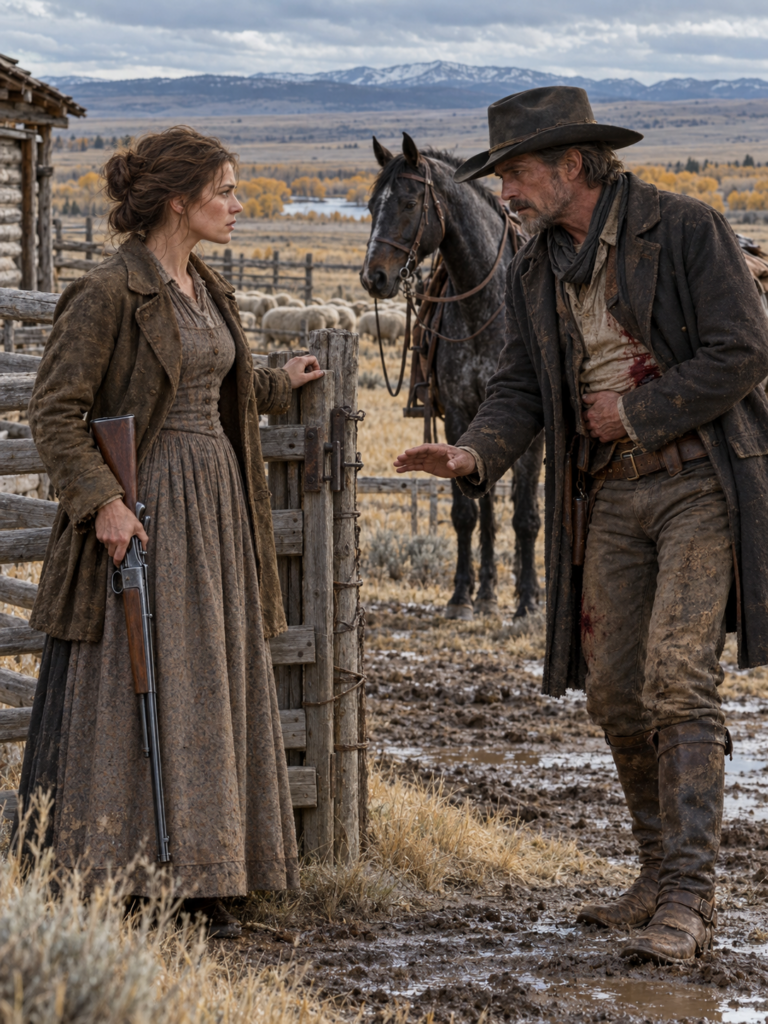
She reached for the gate, then stopped when he said, “Mrs. Hess.”
“Joanna.”
He considered that.
“Joanna.”
The sound of her given name in his voice was far more intimate than it should have been.
“I came with a question,” he said.
Joanna rested one hand on the gatepost.
“Then you can ask it after coffee.”
Something shifted in his expression.
Not triumph.
Relief, perhaps.
She appreciated that too.
Inside, she set two cups on the table without hesitation.
Cordell noticed.
He said nothing.
The restraint was almost unbearable.
They spoke first about work.
Dyer’s case would continue. Cordell might still be required to testify. But the dangerous part—the months of following men who did not know they were watched—was finished.
“And after?” Joanna asked.
“I haven’t decided.”
“That seems unlike you.”
“It is.”
She waited.
Cordell looked down at his coffee.
“The work has kept me moving for years. Before that, the marshal service did the same.”
“You were a deputy eleven years.”
He looked up.
“You remembered.”
“You told me.”
Cordell turned the cup slowly between his hands.
“The marshal I served under was a decent man. When he died, the man who replaced him wanted obedience where I thought judgment was required.”
“So you left.”
“Eventually.”
“Was it difficult?”
“Yes.”
Joanna appreciated the answer because he did not make himself heroic.
“I was good at the work,” he continued. “That makes leaving something harder, not easier.”
“And the detective work?”
“It suited a man who didn’t mind sleeping wherever he happened to finish the day.”
Joanna looked toward the window.
“Do you still not mind?”
Cordell did not answer immediately.
“No.”
The word sat between them.
Joanna’s pulse changed.
Then he said, “That is part of what I meant to ask.”
She stood before he could continue.
“The dam first.”
Cordell blinked.
“The dam?”
“You said you came with intention. I want to know whether your judgment survived winter.”
She stepped toward the door.
After a moment he followed, laughing quietly under his breath.
They walked to the north channel together.
The thaw had raised the water, but the stones held.
Cordell crouched beside the spillway.
Joanna remained standing.
“You moved this one,” he said.
“It shifted during February.”
“And widened the channel here.”
“I was losing the lower edge.”
Cordell examined it.
“You improved it.”
Joanna folded her arms.
“I did not bring you back for flattery.”
“I know.”
He stood.
“I’m telling you because it’s true.”
Something in her chest tightened.
For months she had missed him.
Now that he stood before her, she discovered missing someone was simpler than having them return.
Cordell seemed to understand.
He did not step closer.
“Joanna, I have no intention of moving into your house because I arrived with a question.”
“Good.”
“I have no intention of taking over this ranch.”
“Better.”
“And if you tell me to leave, I leave.”
Her eyes narrowed.
“That sounds rehearsed.”
“It is. I had a long ride.”
Joanna nearly smiled.
Cordell took a breath.
“I don’t know exactly what I am asking yet.”
“Then don’t ask it badly.”
He nodded.
“That is fair.”
They stood beside the water they had redirected together.
Finally Cordell said, “Would you permit me to stay nearby for a time and find out whether what happened between three days and a winter of letters is something we ought to trust?”
Joanna looked at him.
There it was.
Not marriage.
Not possession.
Not rescue dressed as obligation.
Time.
Honesty.
A question.
“The tack room?” she asked.
“If that is what you prefer.”
“For now.”
Cordell nodded.
“For now.”
She started back toward the house.
Then she looked over her shoulder.
“And Cordell?”
“Yes?”
“If you begin repairing things without asking because you think a widow cannot manage her own place, I will put you back on the road.”
His expression stayed solemn.
“What if the hinge is obviously failing?”
“Ask.”
“The fence?”
“Ask.”
“The roof?”
“Especially the roof.”
“What am I allowed to touch without permission?”
Joanna considered.
“Your horse.”
That time he laughed openly.
The sound followed them across the pasture.
Neither of them yet knew whether Cordell had come to stay.
But for the first time, Joanna understood that uncertainty did not have to mean danger.
Sometimes it meant two people had refused to decide each other’s future too soon.
That evening Cordell carried his bedroll to the tack room.
Joanna stood in the doorway while he put it on the same cot where he had bled six months earlier.
He turned toward her.
“There is one more thing.”
“What?”
“The association offered me another investigation.”
Joanna’s hand tightened on the doorframe.
“Where?”
“Wyoming.”
“When?”
“Three weeks.”
“And what did you tell them?”
“I asked for time.”
Joanna stared at him.
Winter letters had made distance romantic because paper could not leave in the morning.
Now distance had a date.
“You said the dangerous part was finished.”
“Here, yes.”
“But your work isn’t.”
“No.”
The April wind moved through the open tack-room door.
Cordell did not ask her to choose for him.
That made the decision harder.
Joanna looked toward the house, then back toward the road beyond the gate.
Three weeks.
For the first time since he returned, she understood exactly what stood between them.
It was not fear of affection.
It was whether either of them was prepared to change the life that had made them who they were.
Joanna kept one hand on the tack-room doorframe while the April wind moved between them.
“Three weeks,” she repeated.
Cordell nodded.
He did not soften the answer.
That was one of the things she had come to trust about him.
“How long would Wyoming take?”
“I don’t know.”
“A month?”
“Possibly.”
“Six?”
“Possibly.”
“A year?”
“If it became the wrong kind of case.”
Joanna looked past him at the rolled bedroll on the cot.
Six months earlier, Cordell had asked for one night.
Now he had returned asking for time while another road waited to take him away.
She was surprised by the anger rising in her.
Not because he had deceived her.
Because he had not.
Truth left fewer places to hide.
“Why come here first?”
Cordell considered his answer.
“Because I wanted to see you before deciding.”
Joanna’s jaw tightened.
“So I am part of your decision.”
“Yes.”
“I will not be the reason you abandon work you believe is right.”
“I did not ask you to be.”
“No. You are very careful not to ask.”
Cordell absorbed that.
Joanna stepped into the tack room.
“Sometimes that can be its own kind of cowardice.”
His face changed.
She had landed the blow.
For an instant Joanna regretted it.
Then Cordell nodded.
“Yes.”
She had expected defense.
The agreement disarmed her.
He sat carefully on the edge of the cot.
“I have spent a long time believing the decent thing is to make myself easy to leave.”
Joanna remained standing.
“That sounds noble when you say it quietly.”
“It isn’t.”
“Good.”
Cordell looked at his hands.
“I had work. I was useful. I knew what was required. When a post changed, I moved. When an assignment finished, I took another.”
“You make it sound like weather.”
“Maybe I let it become weather.”
Joanna leaned against the doorframe.
“Why?”
He lifted his head.
“I was good at arriving where I was needed and leaving before anyone expected more.”
There was no dead wife hidden beneath the answer.
No secret tragedy waiting to excuse him.
Only habit.
Work.
Pride.
And a man who had learned to treat motion as freedom because stopping would require him to decide what he wanted when duty was not deciding for him.
Joanna understood more of that than she wished.
She had done the opposite.
She had turned staying into its own unquestioned law.
After Lorne’s death, she had never asked whether she wanted the ranch.
She had only known she would not lose it.
Those were not necessarily the same thing.
Cordell glanced toward the yard.
“I will refuse Wyoming if I decide I am done with that life. I will accept it if I believe the work still belongs to me. But I won’t ask you to promise anything so I can make the choice easier.”
“Then what are you asking me?”
“That you let me know whether there is something here worth considering while I decide.”
Joanna’s eyes narrowed.
“I thought I had.”
“With letters.”
“Were they unclear?”
“No.”
“Then perhaps detectives are less observant than advertised.”
Cordell’s mouth twitched.
She did not smile.
“Three weeks,” Joanna said. “You may stay three weeks. Tack room. You work if you choose, but we decide together what needs doing. You do not become foreman because you are a man and I am a widow.”
“I had not planned to.”
“You do not pay me for the room.”
He started to object.
She raised a hand.
“You helped rebuild my dam when you had stitches in your side. Consider us even.”
“That was six months ago.”
“The water still runs.”
Cordell thought about that.
“All right.”
“And at the end of three weeks, you make your own decision.”
“Yes.”
“So do I.”
Something in his face softened.
“That seems fair.”
“It is not meant to be fair. It is meant to be clear.”
“Then it is clear.”
Joanna nodded.
“Good.”
She left him there.
For the next three weeks, they learned one another outside danger.
It proved far more revealing.
Cordell was not especially good with sheep.
The first time he attempted to separate one ewe from the flock, Joanna watched him spend ten minutes accomplishing what she could have done in two.
“You can stop smiling,” he said.
“I’m not smiling.”
“You are.”
“Perhaps range detectives are observant after all.”
He looked down at the ewe that had just escaped him.
“I preferred armed men.”
“They probably followed instructions better.”
He laughed.
Joanna taught him how the flock moved when pressured from different angles.
Cordell taught her a more efficient method of setting a corner brace without wasting timber.
He asked before changing anything.
Every time.
Sometimes Joanna wished he would stop asking because permission had begun to feel needlessly formal.
Then she remembered she was the one who had required it.
One afternoon she found him on the roof with a hammer.
Her temper rose instantly.
“Cordell.”
He leaned over the edge.
“The northwest leak.”
“You did not ask.”
“I did.”
“When?”
“This morning.”
Joanna frowned.
“You said the roof was my problem if rain came from the northwest.”
“That was not permission.”
“I asked whether I might look at it.”
“You asked whether you might look.”
Cordell stared.
Then, to Joanna’s astonishment, he climbed down.
No argument.
No insistence that he was already there.
No lecture about common sense.
He set the hammer on the ground.
“You’re right.”
Joanna looked at him.
The matter should have ended.
Instead she felt foolish.
“The roof does leak,” she admitted.
“Yes.”
“And you’re already dirty.”
“Yes.”
She folded her arms.
“Would you repair it?”
Cordell picked up the hammer.
“I would.”
That evening rain came from the northwest.
The flour stayed dry.
Joanna placed two cups on the table.
By the second week, Cordell no longer felt like a guest.
That frightened her.
He knew where the lamp oil was.
He remembered which gate had to be lifted slightly before the latch would catch.
He repaired a loose saddle strap only after leaving it on the table and asking whose it was.
He began leaving his hat on the peg beside the kitchen door when Joanna invited him in for supper.
Small things.
Dangerously small things.
A life rarely announced itself while being built.
It accumulated.
On the seventeenth day, a letter arrived from Miles City.
Cordell read it at the table.
Joanna tried not to watch his face.
“The Dyer matter?” she asked.
He handed her the page.
The case was moving toward formal proceedings. Cordell would likely be called to testify later, but the investigation itself no longer required him in the field.
Joanna gave the letter back.
“And Wyoming?”
“They want an answer tomorrow.”
He folded the paper.
Joanna’s throat tightened.
“What are you going to tell them?”
“I haven’t decided.”
She stood too quickly and carried her cup to the sink.
Cordell remained seated.
“Joanna.”
“No.”
He stopped.
She gripped the edge of the basin.
“I know what you are about to do.”
“What?”
“You are going to ask what I want.”
“Yes.”
“I don’t want to decide your life.”
“I am not asking you to.”
She turned.
“Then why does my answer matter?”
“Because I would be a fool if it didn’t.”
There was more force in his voice than usual.
Cordell rose.
“I know I can live on the road. I have proved that beyond usefulness. What I don’t know is whether the life I have been living is still the life I want.”
“And you think I know?”
“No. I think you know what you want from me.”
Silence filled the kitchen.
Joanna looked toward Lorne’s desk.
The drawer held Cordell’s map and months of letters.
“I want you to stay,” she said.
The words frightened her less after they were spoken.
Cordell did not move.
Joanna continued before he could misunderstand.
“But not because I need you to run this ranch.”
“I know.”
“Not because winter is easier with another pair of hands.”
“I know.”
“Not because you were shot at my gate and I stitched you back together.”
“I know.”
She stepped closer.
“I want you to stay because I like the sound of you walking into this kitchen. Because you see things I miss and let me see what you miss. Because when you disagree with me, I do not feel smaller afterward.”
Cordell’s eyes held hers.
“And because,” Joanna said, “I have spent nearly a year proving I can live without anyone. I no longer wish to confuse that with wanting to.”
Cordell closed his eyes briefly.
When he opened them, the guardedness she remembered from October was gone.
“I wanted you to say that.”
“I noticed.”
“But I would have stayed without it.”
Joanna’s brow furrowed.
“You decided?”
“This afternoon.”
“What changed?”
“Nothing.”
“That is not an answer.”
Cordell reached into his coat and placed an envelope on the table.
It was addressed to the association.
“I wrote my refusal before the mail rider arrived.”
Joanna stared at it.
“Why?”
“Because I realized I was not deciding between useful work and selfishness.”
He touched the envelope.
“I was deciding whether I intended to spend the rest of my life proving that I could always leave.”
Joanna looked at him for a long time.
“You could still do investigative work.”
“Yes.”
“Testify when needed.”
“Yes.”
“Travel sometimes.”
“If we agreed.”
That word settled deeply.
We.
Not permission.
Not ownership.
Agreement.
Joanna reached for the letter.
“You should send it.”
“I intend to.”
“Good.”
She handed it back.
Cordell studied her.
“Is that all?”
“No.”
She stepped closer.
“I would like you to move out of the tack room.”
His eyebrows lifted.
“Where?”
“The house has another room.”
He waited.
Joanna appreciated the waiting even now.
“It has a door,” she continued. “It closes. Your belongings stay yours. Mine stay mine. And if either of us discovers this arrangement makes us miserable, we say so before resentment does the speaking.”
Cordell’s expression changed slowly.
“That sounds almost like terms.”
“They are terms.”
“I accept.”
“You haven’t seen the room.”
“I survived the tack room.”
Joanna smiled.
“There is one more problem.”
“What?”
“You snore.”
For the first time since she had known him, Cordell looked genuinely offended.
“I do not.”
“You do.”
“How would you know from the house?”
“The barn cat leaves when you start.”
Cordell stared at her.
Then Joanna laughed.
He joined her.
The sound filled the kitchen where, months earlier, she had stood listening to silence return after a wounded stranger closed the door.
That night Cordell moved one trunk into the spare room.
Not all his belongings.
Not yet.
Neither of them pretended certainty needed to arrive in one load.
Summer came.
Cordell testified in the Dyer proceedings and returned from Miles City each time he was required.
He kept his detective commission for several months but stopped taking long investigations.
Instead, he began accepting occasional work that could be done from the region—interviews, statements, locating records, advising men who still traveled farther than he wished to.
Joanna never called it retirement.
Cordell never called the ranch his.
Not at first.
The distinction mattered until, eventually, it mattered less.
He contributed money to shared expenses but did not claim ownership of her land.
When he purchased materials for a new section of lambing shed, Joanna insisted they record what he had paid.
Cordell called the accounting excessive.
Joanna reminded him she had warned him not to argue with a woman who raised sheep.
He accepted defeat.
Their courtship, if anyone had asked, consisted largely of work interrupted by coffee.
They repaired fence.
They improved the dam after spring runoff.
Cordell learned sheep reluctantly.
Joanna learned how to read the trail signs and weather changes he noticed almost without thought.
He never turned her into his student.
She never treated his knowledge as magic.
They were simply two adults with different years behind them and different skills in their hands.
Age existed between them.
Twenty-five years could not be wished away.
Joanna considered it carefully because she considered anything capable of changing her future carefully.
One evening near the end of summer, they sat outside the house while the light faded over the Powder River.
“People will talk,” she said.
“They already do.”
“I mean about us.”
“I know.”
“You are twenty-five years older than I am.”
“Yes.”
“You will likely become old before I do.”
“I have already made considerable progress.”
Joanna gave him a look.
Cordell sobered.
“Yes,” he said. “That is true.”
“I don’t want you dismissing it because the answer is inconvenient.”
“I won’t.”
“What if I resent it later?”
“You might.”
“What if you decide I am too young to know my own mind?”
“I would deserve to be thrown off your land.”
She looked toward the river.
“What if people think I wanted a man to save the ranch?”
Cordell was quiet.
Then he said, “Do you?”
“No.”
“Then let them be wrong.”
Joanna turned toward him.
“You make that sound easy.”
“No. I make it sound possible.”
That answer remained with her.
In September, Cordell’s final obligation in the early Dyer case brought him back to Miles City.
He returned after sunset three days later.
Joanna heard his horse in the yard and stepped onto the porch.
Cordell dismounted slowly.
“What happened?”
“Statements accepted. More hearings to come eventually, but the evidence is holding.”
“And Dyer?”
“Still answering for what he did.”
Joanna nodded.
Cordell walked toward her, then stopped at the bottom step.
“I have something else to ask.”
Joanna folded her arms.
“You do have a habit of arriving with questions.”
“This one is worse.”
“That is not encouraging.”
Cordell removed his hat.
He looked almost as solemn as he had the first afternoon at her gate.
“I don’t want your ranch.”
Joanna waited.
“I don’t want your name changed unless you want it changed.”
She stopped breathing for a moment.
“I don’t want you grateful to me. I don’t want obedience. And I have no intention of pretending my age means I know more about your life than you do.”
“Cordell.”
“I practiced this.”
“I can tell.”
He looked irritated with himself.
Joanna’s heart softened.
He continued.
“I want to marry you if marriage is something you want with me. I want to build a life here without taking the life that was already yours. I want to be useful when usefulness is needed and stay out of your way when it isn’t.”
Joanna looked at the man who had once offered money for a tack-room cot because he had been too proud to ask freely for shelter.
“Anything else?”
“Yes.”
“What?”
“I love you.”
The words were simple.
Because everything before them had done the explaining.
Joanna descended one step.
“Why didn’t you begin there?”
“I was trying to be thorough.”
“You were being a detective.”
“That too.”
She came down the final step.
“I will marry you.”
Cordell’s shoulders changed.
Barely.
But Joanna saw months of restraint leave them.
“On conditions,” she added.
He almost smiled.
“Of course.”
“The ranch remains Hess.”
“Yes.”
“Lorne remains part of my life.”
“Yes.”
“You do not decide what I am capable of because you fear for me.”
“I will try.”
“That was the correct answer.”
“And you?”
Joanna considered.
“I will not punish you for leaving when we have both agreed you should go.”
Cordell nodded.
“I will tell you when I need help instead of waiting until I am half drowned in a stock dam.”
“That seems ambitious.”
She ignored him.
“And I will not treat loving you as evidence that I failed at surviving alone.”
Cordell’s face became very still.
“Then yes,” Joanna said again. “I will marry you.”
They did the following month, after the valley had turned gold.
The circuit preacher came out.
Three neighboring families stood witness.
Joanna wore a good dress she already owned.
Cordell wore a coat that fit him badly across the shoulders.
Nothing about the ceremony changed ownership of the ranch.
Nothing erased Lorne.
The grave beneath the cottonwood remained tended.
Joanna kept the Hess name attached to the land because it was the name under which she had fought to keep it alive.
Cordell never objected.
The next summer Joanna entered the tack room and found his detective papers rolled, tied, and placed above the saddle rack.
She stood looking at them.
Cordell came in carrying a bridle.
“You finished?” she asked.
“With the kind of work that expects me gone for months.”
“Why?”
He hung the bridle.
“Because I finally learned that staying is also something a man can choose.”
Joanna glanced toward the old cot.
“You hated that cot.”
“I did.”
“You complained about it for six months.”
“I mentioned its shortcomings.”
“Repeatedly.”
Cordell looked toward the shelf where the papers rested.
“I don’t regret arriving here.”
“You were bleeding on my floor.”
“I regret that portion.”
Joanna smiled.
Two years after the first October afternoon, the Dyer case finally reached its conclusion.
Cordell traveled to give testimony.
When he returned, he found Joanna at the stock dam.
Three smaller operators had recovered grazing access that had been forced away from them.
Dyer’s money had delayed consequence.
It had not prevented it.
Joanna listened while Cordell told her what had happened.
Then neither spoke for a while.
The dam ran cleanly beside them.
Its stones had shifted over two winters.
They had changed the angle twice.
The original pencil marks Cordell had drawn in the mud were long gone.
The principle had remained.
Joanna crouched beside the water.
“Do you remember what you said the first day?”
“I said several things.”
“You said water wants to go where it is going.”
Cordell sat beside her.
“That sounds wiser than I usually am.”
“You said you give it a better path instead of fighting it.”
“I remember.”
Joanna watched the current turn through the spillway.
“For a long time after Lorne died, I thought survival meant holding everything exactly where it had been.”
Cordell said nothing.
She continued.
“I thought changing anything meant losing something.”
“Do you still?”
“No.”
She looked at him.
“The land changed. The house changed. I changed.”
Cordell’s hand rested on the bank between them.
Joanna put hers over it.
That gesture would once have frightened her because she might have mistaken wanting someone for needing permission to keep them.
Now she understood the difference.
Her sheep still required her judgment.
The books were still hers to understand.
Cordell still sometimes traveled.
Joanna still sometimes solved problems without him.
Their marriage had not made either of them incapable of leaving.
That was precisely why staying meant something.
In the house, two cups stood beside the coffee pot.
Not because Joanna had forgotten how to drink alone.
Because most mornings she chose not to.
The old survey remained in Lorne’s desk beneath years of ranch papers and correspondence.
Joanna never destroyed it.
Neither did she display it.
It belonged where it was: among the records of decisions that had changed the land.
Years later, when the spillway needed rebuilding again, Joanna and Cordell stood on opposite banks discussing the angle.
Cordell pointed upstream.
Joanna shook her head.
“You’re wrong.”
“I have been studying water longer than you.”
“You have been standing on the wrong side longer than I have.”
He stared at the current.
Then he crossed the bank and stood where she was.
After a moment he laughed.
“You’re right.”
Joanna handed him the shovel.
“I usually am.”
“No one who knows you would risk arguing.”
Together they moved the first stone.
The water changed direction almost immediately.
Once, Joanna Hess had believed strength meant never asking.
Cordell Mayes had believed decency meant never letting anyone depend upon his staying.
Neither belief had been entirely false.
That was what made them difficult to abandon.
They had simply been incomplete.
The ranch endured because Joanna learned when another pair of hands could strengthen what hers had already built.
Cordell remained because he learned that freedom was not measured only by the number of roads a man could take.
And the tack room where a wounded lawman had once offered money for one night’s shelter remained a tack room.
No shrine.
No grand monument.
Just a useful little room beside a working barn, with an old cot against one wall and detective papers gathering dust above the saddle rack.
Sometimes Joanna passed its open door and remembered the stranger who had sat at her kitchen table with blood on his coat, asking for almost nothing.
Then she would hear Cordell somewhere beyond the barn, arguing unsuccessfully with a sheep or calling to ask whether he could move something she had already told him ten times he was free to move.
And Joanna would smile.
The first time Cordell came through her gate, she had decided whether to let a wounded man stay until morning.
Every day afterward, in smaller and quieter ways, they had kept deciding what came next.
That was the life they built.
Not rescue repaid with love.
Not loneliness cured by ownership.
Not a widow surrendering the ground she had fought to keep.
Not a wandering lawman becoming master of someone else’s home.
Two adults who could have survived separately.
Two people who knew exactly what solitude cost.
Two people who learned that partnership did not require either of them to disappear.
And at the north channel, the water kept running through the stones they had once set together—never still, never forced into its old path, moving forward because someone had finally understood that strength was not always stopping what wanted to change.
Sometimes strength was choosing the better direction together.


