
David stopped with his fist half-raised.
“Mom. What happened last night?”
“I came home.”
He stared at me.
“We turned around and you were just gone.”
“Yes.”
“Rachel was really upset.”
I waited.
He shifted his weight.
“She had to do all the dishes herself.”
For one dangerous second, I thought I might laugh.
Instead, I stepped aside and let him in.
“That sounds manageable.”
He followed me toward the kitchen, still wearing the slightly wounded expression of a man who had arrived expecting an explanation and discovered I did not consider myself guilty.
“I’m serious, Mom. You could’ve said something.”
“I could have.”
“Then why didn’t you?”
“Because I didn’t want to wash the dishes.”
“That’s not what I mean.”
“I know.”
I reached for the coffee pot.
He stood quietly while I poured coffee into his travel mug.
Then his attention shifted.
Not dramatically.
Just a glance toward the hallway.
Toward the console table.
The empty console table.
I saw the instant he noticed.
His eyes came back to mine.
Then drifted toward it again.
He cleared his throat.
“I can’t stay long. I have a meeting.”
“I know. Take your coffee.”
He didn’t move.
“Mom.”
“Yes?”
“Did you forget what day it is?”
“No.”
The room became very still.
“Where’s the envelope?”
“There isn’t one this month.”
David blinked.
I watched him process the sentence as if I had said there would be no electricity.
“What do you mean, there isn’t one?”
“I mean I’m no longer giving you five hundred dollars every month for groceries.”
His mouth opened.
Closed.
Then opened again.
“But we’ve always—”
“No. We haven’t always.”
He frowned.
“You know what I mean.”
“Yes. I do. I started helping when you were out of work.”
“That was years ago.”
“Exactly.”
The word landed harder than I intended.
David looked down at the mug in his hands.
“Mom, that money is part of our budget.”
And there it was.
Not gratitude.
Not embarrassment.
Budget.
My gift had become infrastructure.
Something Rachel and David planned around because they no longer imagined I might stop.
“I understand,” I said.
He looked relieved for half a second.
Then I continued.
“That’s why I’m stopping now.”
His head lifted.
“You can’t just stop.”
I looked at my forty-year-old son standing in the house I had paid off years before, holding coffee I had made him, telling me I could not stop giving him money I had never owed him.
“Actually, David, I can.”
His expression changed then.
Not anger exactly.
Shock.
The kind that comes when a door you never noticed suddenly closes.
“Is this because Rachel asked you to wash dishes?”
“No.”
He gave me a skeptical look.
“Come on, Mom.”
“The dishes were simply the first thing I refused.”
I leaned against the counter.
“The money started when you were unemployed. The Sunday dinners started because I wanted to spend time with all of you. Babysitting started because you occasionally needed help. None of those things began as obligations.”
“They aren’t obligations.”
“Then stopping them shouldn’t feel like a crisis.”
He had no answer.
That bothered him.
David had always been a good son in the easiest sense of the word. He remembered birthdays. He called me. He brought the children over. He hugged me when he left.
But good people can become comfortable inside unfair arrangements if the unfairness benefits them quietly enough.
He put the travel mug on the counter.
“So what happens now?”
“You buy your own groceries.”
He stared at me as though the simplicity offended him.
“You know things are expensive.”
“I do.”
“You’re doing fine financially.”
“Yes.”
He paused.
That sentence said more than he probably realized.
“You’re doing fine.”
Therefore, I should give.
Because I had enough.
Because I had always given.
Because denying them something I could afford felt, to them, morally different from never having offered it in the first place.
“I love you,” I said. “But my savings aren’t a household resource for you and Rachel.”
His jaw tightened.
“Rachel is going to take this badly.”
“That’s hers to manage.”
He left ten minutes later.
Not shouting.
Not slamming the door.
Just stunned.
I watched him walk to his car, and I knew immediately that my real argument had not yet arrived.
It came the next morning at nine-fifteen.
Rachel pulled into my driveway with Leo and Mia in the back seat.
I was buttoning my coat when the front door opened.
Rachel had never knocked if she knew I was home.
“Morning,” she called brightly. “I need you to keep the kids until three.”
Leo ran toward me.
Mia held up a toy rabbit.
“Grandma!”
I kissed them both.
Then I looked at Rachel.
“I can’t today.”
She froze while taking off Mia’s coat.
“What?”
“I have plans.”
Rachel actually laughed.
“What plans? You’re retired.”
It was so casual that for a moment I wondered how many times she had thought those words without saying them.
I rested a hand on Leo’s shoulder.
“The kind retired people make when nobody assumes their time belongs to somebody else.”
Her smile disappeared.
“Patricia, I have brunch with Mom.”
“Then you’ll need to bring the children or make another arrangement.”
“David is slammed at work.”
“I’m sure he is.”
“I’m already late.”
“I’m sorry.”
Her eyes narrowed.
“You don’t seem sorry.”
I looked at her.
“That’s because I’m not responsible for your brunch.”
Leo sensed the shift in the room and moved closer to Rachel.
I hated that.
The children had done nothing wrong.
So I bent down, kissed both their foreheads, and told them I loved them.
Then I handed Rachel Mia’s coat.
“I’ll call David later about seeing them this weekend.”
Rachel stood there staring at me while I locked my front door.
I drove to a garden center.
I bought three ferns.
And because I had been looking at it for months and always found some reason the money would be better spent on somebody else, I bought a deep blue ceramic planter too.
It was not rebellion.
That was the strange part.
I did not feel wild or reckless.
I felt scheduled.
As though my life had finally been placed back on my own calendar.
Later that week, I decided to make oatmeal cookies.
I opened the lower cabinet where my stand mixer always sat.
Empty.
I checked the pantry.
Then the dining room.
Then, absurdly, the garage.
The mixer was gone.
I stood in the kitchen and stared at the empty cabinet.
David had one spare key to my house.
For emergencies.
I called him.
“Did you take my mixer?”
Silence.
Then, “Rachel borrowed it.”
“When?”
“A couple days ago.”
“Was she here while I was home?”
“No.”
Another silence.
“She needed it for the school bake sale.”
I closed my eyes.
“Did she ask?”
“She probably meant to.”
“She entered my house while I was gone and took something without asking.”
“Mom, she was going to bring it back.”
“I’m sure she was.”
He sighed.
“Please don’t turn this into another thing.”
That sentence decided it.
Not because David was cruel.
Because he still thought the problem was my reaction.
I ended the call, looked up the number of a locksmith, and made one appointment.
Two hours later, a man named Tom stood on my porch with a toolbox.
He replaced every exterior lock.
The old deadbolt came off with a metallic scrape.
The new one turned cleanly.
Click.
I tested it twice.
I kept one key on my ring.
A second went into a secure outdoor lockbox.
A third went into my jewelry case.
David received none.
Two afternoons later, I was sitting in my living room reading when I heard scratching at the front door.
Metal against metal.
Someone tried the lock again.
Then harder.
Then came three sharp knocks.
I opened the door.
Rachel stood there with a huge basket of laundry balanced against one hip.
“Your lock is broken.”
“It isn’t broken.”
She frowned.
“I tried David’s key.”
“I know.”
Her eyes moved from my face to the deadbolt.
“You changed the locks?”
“Yes.”
“Why?”
“Because the spare key was being used for things that weren’t emergencies.”
Her cheeks reddened.
“Oh my God. This is about the mixer?”
“It is partly about someone entering my home without permission.”
“I borrowed it.”
“You took it.”
“I brought it back.”
“After I asked where it was.”
She shifted the laundry basket.
Then, as though the previous minute had not happened, she glanced past me toward the hallway.
“Well, since I’m already here, can I run these through your big washer? Ours is acting weird.”
There they were again.
Those five words.
Since I’m already here.
“No.”
Rachel stared at me.
“No?”
“No.”
Her mouth opened in disbelief.
“You’re seriously refusing to let me do laundry?”
“Yes.”
“Because of some dishes?”
“This isn’t about dishes.”
“Then what is it about?”
“My house.”
She laughed once, sharply.
“Patricia, you’re being ridiculous.”
“Maybe.”
I took one step backward.
“But it’s still my house.”
Then I closed the door.
An hour later, David called.
“Mom, we need to talk.”
This time I said yes.
He arrived that evening looking more tired than angry.
He sat on my sofa with his elbows on his knees.
“Rachel is furious.”
“I assumed.”
“She says you locked her out.”
“I changed my locks.”
“She says that’s basically the same thing.”
“It isn’t.”
He rubbed the back of his neck.
“And you wouldn’t let her use the washer.”
“No.”
“And you stopped the grocery money.”
“Yes.”
His frustration finally surfaced.
“Mom, you’re making things really hard.”
I looked at him for a long moment.
“I think things feel harder because you and Rachel are doing more of them yourselves.”
His face tightened.
“You’ve always helped us.”
“I know.”
“So why stop everything now?”
I leaned back.
“Because last Sunday, I finally understood that my help had stopped being received as help.”
He looked away.
“It was dishes.”
“No, David.”
My voice stayed quiet.
“It was every Sunday I arrived early. Every meal I helped cook. Every time I watched your children without being asked properly. Every check I kept writing long after the reason for it ended. Every time Brenda sat down while I worked because somehow I became the mother who served and she became the mother who was served.”
He flinched slightly.
I continued.
“And when Rachel walked into my house while I was gone and took my mixer, you told me not to make it ‘another thing.’”
He lowered his eyes.
“She shouldn’t have done that.”
“No.”
The wall clock ticked between us.
“I love you,” I said. “I love Leo and Mia. But my love does not make my house, time, money, appliances, or retirement automatically available to your household.”
He swallowed.
“It feels like punishment.”
“Then ask yourself why losing access to my things feels like punishment.”
He said nothing.
I let the silence remain.
For years, I had rushed to fill silence before someone became uncomfortable.
That evening, I discovered discomfort was sometimes where understanding started.
Finally, David stood.
At the door he hesitated.
“Thanksgiving is next month.”
“Yes.”
“Rachel’s parents are coming.”
“I know.”
“We usually do it here.”
“I smiled.
“I’ll still host.”
Relief crossed his face.
Then I added, “But this year, everybody is going to contribute.”
His relief vanished.
“How?”
“I’ll send a message.”
The following morning, I opened our family group chat and typed the menu.
I would provide the turkey and a large garden salad.
Rachel and Brenda would handle every other side dish, dessert, bread, and whatever else they wanted on the table.
David replied with a thumbs-up.
Rachel never answered.
I looked at the silent message thread, set my phone facedown, and went back to my coffee.
For the first time in years, I did not chase anyone for confirmation.
I did not ask whether they had seen the message.
I did not offer backups.
And when Thanksgiving afternoon arrived, Rachel walked through my front door with Mia beside her.
David followed carrying one bottle of wine.
Brenda came in behind them.
I looked past all three adults.
No casserole dishes.
No pie boxes.
No grocery bags.
Nothing.
Rachel met my eyes.
Then smiled.
Rachel met my eyes.
Then smiled.
It was not an apologetic smile.
It was the small, confident smile of someone who believed she had already won.
“Oh, Patricia,” she said, slipping off her coat. “I’m so sorry. Work has been an absolute nightmare.”
Brenda nodded beside her as though corroborating testimony.
“And my oven started acting up yesterday.”
Rachel patted my arm.
“But we knew you’d make your usual spread.”
For one second, I simply looked at her.
That sentence answered the question I had been trying not to ask since I sent the group message.
Had they forgotten?
Had there been a misunderstanding?
Had each woman assumed the other was bringing everything?
No.
They had decided not to contribute because they expected me to rescue the day.
The old Patricia always had.
The old Patricia made backup mashed potatoes in case someone’s were lumpy.
She baked two pies even when dessert had been assigned to somebody else.
She kept extra rolls in the freezer.
If someone arrived empty-handed, I smiled, rearranged the oven racks, and made their failure disappear before the children noticed.
I had spent decades turning other adults’ poor planning into evidence of my competence.
Rachel walked toward the dining room.
Then stopped.
Brenda almost bumped into her.
The table looked beautiful.
My good china.
Candles.
Cloth napkins.
A carved turkey.
One large bowl of garden salad.
Nothing else.
Rachel turned toward me.
“Where are the potatoes?”
“There aren’t any.”
She blinked.
“What?”
“I didn’t make potatoes.”
“What about stuffing?”
“No stuffing.”
“Cranberry sauce?”
“No.”
Brenda set her purse down slowly.
“Patricia, surely you have something else in the kitchen.”
“I have exactly what I said I was making.”
David stood near the doorway holding the bottle of wine.
He looked from the table to me.
“You really didn’t make backups?”
“No.”
Something almost like admiration passed over his face before he hid it.
Rachel’s cheeks colored.
“You’re hosting Thanksgiving.”
“And I provided what I told everyone I would provide.”
“What are Leo and Mia supposed to eat?”
“Turkey and salad.”
“They hate salad.”
“Then they can eat turkey.”
Rachel stared at me.
I knew what she wanted.
She wanted me to feel the familiar panic.
Children were disappointed.
Guests were uncomfortable.
A holiday was becoming imperfect.
Surely I would rush into the kitchen and fix it.
Instead, I pulled out my chair.
Brenda spoke next.
“This is ridiculous.”
“No,” I said. “This is lunch.”
Rachel grabbed her phone.
“Fine. I’ll order Chinese.”
“That sounds like a solution.”
She immediately began tapping the screen.
Then I added, “You’ll need to eat it at your house.”
Her fingers stopped.
“What?”
“I don’t want takeout containers spread across my Thanksgiving table.”
Her eyes widened.
“You cannot be serious.”
“I am.”
“So you invited us here and now you’re kicking us out because we didn’t bring mashed potatoes?”
“I invited everyone under the condition that everyone contributed.”
“That is not how family works.”
I almost smiled.
For years, “family” had meant I absorbed the inconvenience.
Now it apparently meant I should keep absorbing it after explicitly saying I would not.
David placed the wine bottle on the counter.
“Rachel.”
She turned on him.
“What?”
“You knew what Mom said.”
“So did you.”
“I brought wine.”
“One bottle.”
He looked embarrassed.
Fair enough.
David was not innocent in this.
He had spent years benefiting from my willingness too.
The difference was that I could now see him beginning to recognize it.
Brenda folded her arms.
“In my family, the host provides dinner.”
I looked at her.
“And in mine, guests who agree to bring food bring it.”
Silence.
Mia tugged on Rachel’s sleeve.
“Are we eating?”
That broke the standoff.
David exhaled.
“Come on.”
Rachel turned.
“Where are we going?”
“The diner.”
Her mouth fell open.
“On Thanksgiving?”
“They’re open.”
Brenda looked horrified.
“You expect me to eat Thanksgiving dinner at a diner?”
David picked up his coat.
“I expect us to eat wherever there’s food we didn’t ask Mom to make after she told us she wasn’t making it.”
That was the first time he had defended the boundary out loud.
Not perfectly.
Not with some grand apology.
But enough.
Rachel’s face changed.
She looked at him as though he had violated an agreement neither of them had ever admitted existed.
Then she gathered the children.
Nobody shouted.
Nobody slammed my door.
Within five minutes, their cars backed out of my driveway.
I stood in the front window watching the taillights disappear.
The house went quiet.
For years, silence after family conflict would have sent me scrambling for my phone.
I would have called David.
Explained.
Softened what I meant.
Offered leftovers.
Asked whether the children were upset.
That evening, I went back to the dining room.
I sat at the table.
I ate turkey and salad on my good china.
It was not the Thanksgiving I had imagined years earlier.
It was better than the one I would have endured.
Two months passed.
The practical effects of saying no began appearing in places I had never noticed.
Five hundred dollars remained in my bank account each month.
So did the money I normally spent on last-minute groceries.
School expenses Rachel mentioned after she had already committed to them.
Extra restaurant checks.
Birthday overages.
Little things.
None of them had ruined me financially.
Together, however, they had formed a steady leak I had mistaken for generosity.
One afternoon, I sat at my kitchen table with a calculator.
Then I looked around.
The cabinet beneath the sink sagged.
Two drawers stuck in damp weather.
The laminate countertop had a burn mark from twelve years earlier.
I had wanted to remodel the kitchen for years.
Every time I considered it, I heard my own internal voice.
You don’t need it.
The old kitchen still works.
That money could help David.
The children might need something.
There may be an emergency.
I closed the calculator.
Then I called a contractor.
Four weeks later, half my cabinets were gone.
Tile samples covered the dining table.
A man was measuring the wall beside the sink when David stopped by.
He entered the kitchen and froze.
“What happened?”
“I’m remodeling.”
“The whole kitchen?”
“Pretty much.”
His eyebrows rose.
“That’s expensive.”
“I know.”
I poured him coffee.
“I’ve wanted quartz countertops and a farmhouse sink for years.”
He looked at the torn-out cabinetry.
Then at me.
“You can afford all this?”
“Yes.”
The answer seemed to surprise him.
That surprised me.
He knew I had savings.
But apparently money I spent on him felt normal while money I spent on myself looked extravagant.
He stared into his coffee.
Then cleared his throat.
“Rachel wanted me to ask you something.”
I waited.
“She’s looking at SUVs.”
I already knew where this was going.
“She wants a new one.”
“All right.”
“She was wondering if you’d co-sign.”
“No.”
The answer came so quickly that David almost smiled.
“Yeah,” he said. “I figured.”
“That’s a firm no.”
“I know.”
He glanced around the construction mess again.
“You really have changed.”
I set my mug down.
“No. I think I’ve just stopped confusing generosity with obligation.”
He nodded slowly.
Then, to my surprise, he did not argue.
The finished kitchen was beautiful.
Pale quartz.
New cabinets.
A deep farmhouse sink.
Sunlight across the island in the afternoons.
And my stand mixer, returned weeks earlier, sat openly on the counter.
Behind a locked door.
The first Tuesday after the work was finished, my doorbell rang.
Not a key scraping in the lock.
A doorbell.
That small distinction mattered.
David stood outside holding a cheap grocery-store bouquet.
“Hi, Mom.”
“Hello.”
He lifted the flowers.
“These are for you.”
I waited instinctively for the request that usually followed.
None came.
“I wanted to see the kitchen.”
I stepped aside.
He walked through the room slowly.
“Wow.”
I laughed.
“You like it?”
“It looks amazing.”
We spent almost an hour drinking coffee at the island.
He told me about a problem at work.
I told him Susan and I had booked a photography trip to Arizona for the summer.
He looked genuinely pleased.
“That sounds great.”
“We’re going near Sedona.”
“You should do that.”
Again, I waited.
No request for money.
No question about babysitting.
No favor tucked inside the conversation.
When he finally stood to leave, he paused near the door.
“I’m glad you’re doing things for yourself.”
I studied his face.
Months earlier, I would have wondered whether he meant it.
That afternoon, I believed he did.
Rachel remained distant.
She did not apologize.
I stopped waiting for one.
Instead, Leo and Mia’s visits became scheduled.
David called first.
We agreed on pickup times.
Nobody appeared on my porch announcing that retirement made my calendar empty.
I still loved those children with everything in me.
The difference was that seeing them became a joy again because it was no longer mixed with resentment I was ashamed to admit.
One Sunday, several months after the Thanksgiving disaster, David brought them over.
Rachel stayed in the car.
Leo raced inside.
Mia carried a coloring book.
David handed me their small overnight bag.
“Pick them up at ten tomorrow?”
“That works.”
Then he paused.
“If that’s still okay.”
I smiled.
“It is.”
He nodded.
Not because he feared me.
Because he was finally learning to ask.
That evening, after the children were asleep, I walked into my new kitchen.
My mixer was exactly where I had left it.
The sink was empty.
The house was quiet.
My phone buzzed.
It was a message from Susan confirming our Arizona flights.
I opened the itinerary, looked at the departure time, and smiled.
For years, almost every important date on my calendar had belonged to somebody else.
School pickups.
Birthday parties.
Sunday dinners.
Family errands.
Appointments I drove other people to.
The date glowing on my screen belonged entirely to me.
I pressed “confirm.”
And for the first time since I had walked away from those greasy plates, I realized I was no longer merely defending my life from my family.
I was finally deciding what to put into it.
The confirmation screen disappeared, leaving my own reflection faintly visible in the dark glass of my phone.
I stood alone in the kitchen and realized something else.
The real change had not happened when Rachel handed me those plates.
It had not happened when I stopped the monthly envelope.
Or when I changed the locks.
Or when Thanksgiving ended with my family driving to a diner.
Those were only visible consequences.
The deeper change was that I had stopped measuring every decision by how disappointed someone else might be.
That summer, Susan and I flew to Arizona.
We woke before sunrise to photograph red rock glowing under a pale pink sky.
We ate terrible pie at a roadside place outside Sedona and laughed so hard about it that the waitress finally asked what was funny.
We spent an entire afternoon trying to photograph a cactus Susan insisted looked “judgmental.”
I sent David a picture of the canyon at sunset.
His reply arrived ten minutes later.
Looks incredible, Mom. Have fun.
I stared at the message longer than I needed to.
There was no second sentence.
No request.
No “while I have you…”
No mention of money.
No childcare problem.
No household emergency.
Just a son telling his mother to enjoy herself.
It was almost painfully ordinary.
That was why it meant so much.
When I returned home, Rachel was still not warm with me.
We were civil at birthdays.
Polite during the children’s school events.
She no longer tried to walk into my house unannounced.
She no longer arrived with laundry.
She never again asked for my mixer.
I heard from David that she still considered the entire situation unnecessary.
Apparently, Brenda agreed.
For a while, that bothered me.
Some foolish part of me still wanted them to eventually understand every detail exactly as I understood it.
I wanted Rachel to look back at that Sunday night and admit that handing me those dishes while she entertained her mother had been humiliating.
I wanted Brenda to acknowledge that she had watched the hierarchy without questioning why one grandmother rested while the other worked.
I wanted somebody to say, Patricia, you were right.
Then I realized requiring their agreement would give them one more piece of authority over my peace.
So I stopped waiting.
My relationship with David changed more slowly.
He did not transform into a different person overnight.
Sometimes he still started a sentence with, “Could you possibly—”
Then I would see him stop.
Reconsider.
Ask himself whether he was requesting help or assigning responsibility.
Sometimes I said yes.
That mattered too.
Boundaries had not turned me into somebody who never helped.
They had returned choice to the helping.
When Leo had a school performance and David asked whether I could pick Mia up first, I agreed.
When Rachel asked three weeks in advance whether I could watch the children for their anniversary dinner, I said yes.
When David mentioned they were short on money one month after an unexpected car repair, I listened.
I did not write a check.
He did not ask me to.
That may have been one of the clearest signs that he finally understood.
The old arrangement had not only trained Rachel to expect my availability.
It had trained David to think accepting from me was harmless because I made it look effortless.
I had participated in that pattern.
That truth was uncomfortable.
But it was important.
I had never said, “This is too much.”
Never said, “Please ask before coming over.”
Never told him the monthly grocery money had become unnecessary.
Never admitted that I resented cleaning after Sunday dinners.
I kept smiling.
Then privately felt overlooked.
That did not excuse Rachel entering my house without permission.
It did not make David entitled to my money.
It did not turn disrespect into misunderstanding.
But it reminded me that reclaiming my life also meant taking responsibility for the ways I had taught people to approach me.
I had made access easy.
Then become angry when people stopped treating it as a privilege.
So I changed the terms.
Not through speeches.
Through repetition.
Ask first.
Respect the answer.
My house is mine.
My money is mine.
My time is mine.
Love does not erase any of those facts.
Nearly a year after the dinner that started everything, David came over alone on a Sunday afternoon.
No children.
No groceries.
No emergency.
I made coffee.
He sat at the island and looked around the kitchen.
“You know,” he said, “Rachel still hates this sink.”
I laughed.
“Why?”
“She says it represents your whole rebellion.”
I looked at the deep white farmhouse sink.
“That’s dramatic.”
“She’s dramatic.”
Then he immediately looked guilty for saying it.
I did not encourage him.
Rachel was his wife.
I had no interest in turning my new boundaries into a campaign against their marriage.
Instead I asked, “How are you two?”
He shrugged.
“Better, actually.”
That surprised me.
He noticed.
“When you stopped doing everything, we had to start figuring out more things ourselves.”
I waited.
He rubbed a thumb against his coffee mug.
“I didn’t realize how much we relied on you.”
There it was.
Not an apology exactly.
Something quieter.
More useful.
“I didn’t realize it either,” I said.
He looked at me.
“I should have.”
The kitchen went still.
I did not rush to tell him it was fine.
For years, I had erased his discomfort almost before he felt it.
This time, I let him sit inside the truth.
After a moment he continued.
“The money especially.”
I nodded.
“When you stopped it, I was angry.”
“I know.”
“I kept thinking, she can afford it, so why is she doing this to us?”
He gave a small embarrassed laugh.
“It took me a while to hear what that sounded like.”
I looked down at my hands.
“I kept thinking, I can afford it, so why not?”
He looked at me.
“Same problem from opposite directions.”
“Pretty much.”
He smiled.
Then his expression turned serious again.
“And the mixer thing was wrong.”
“Yes.”
“I should’ve told Rachel that immediately instead of asking you not to make it a thing.”
“Yes.”
He winced slightly at my second agreement.
I almost softened it.
Almost.
Instead, I let the answer stand.
He deserved the dignity of making a real apology without me rescuing him from it.
“I’m sorry,” he said.
Specific.
No excuse.
No demand that I tell him he was a perfect son.
I reached across the island and squeezed his hand.
“Thank you.”
That was all.
Our relationship never went back to what it had been.
I did not want it to.
The old version looked close from the outside because I was constantly involved in his household.
But proximity and intimacy are not the same thing.
Now David called sometimes simply to talk.
He asked about photographs I was editing.
I asked about work.
He told me stories about Leo and Mia.
Our lives touched without blending into one another.
Rachel and I remained careful.
Eventually, at Mia’s birthday party, she approached me while everyone else was outside watching the children play.
She stood beside the kitchen counter with her arms folded.
“I heard you’re going to New Mexico next spring.”
“I am.”
“With Susan?”
“Yes.”
She nodded.
Then looked toward the window.
“I still think Thanksgiving was ridiculous.”
I smiled.
“I know.”
She glanced at me, apparently expecting an argument.
I did not give her one.
After a moment she said, “But I shouldn’t have used your house like it was ours.”
I stayed quiet.
“And I should’ve asked about the mixer.”
“Yes.”
Her mouth tightened.
That word still irritated her.
Then she exhaled.
“I’m not apologizing for everything.”
“I didn’t ask you to.”
That seemed to disarm her more than anger would have.
She nodded once.
“Okay.”
“Okay.”
That was the closest thing we ever had to reconciliation.
It was enough for the relationship we actually possessed.
Not close.
Not hostile.
Bounded.
Civil.
Real.
Months later, after returning from another short trip, I stood at my kitchen window holding warm coffee.
David had just left after stopping by for an hour.
He had brought nothing.
Asked for nothing.
Needed nothing.
We had simply talked.
His car disappeared around the corner.
The house settled into silence.
Sunset reflected off the quartz counters.
My stand mixer sat exactly where I had left it.
The deep sink was empty.
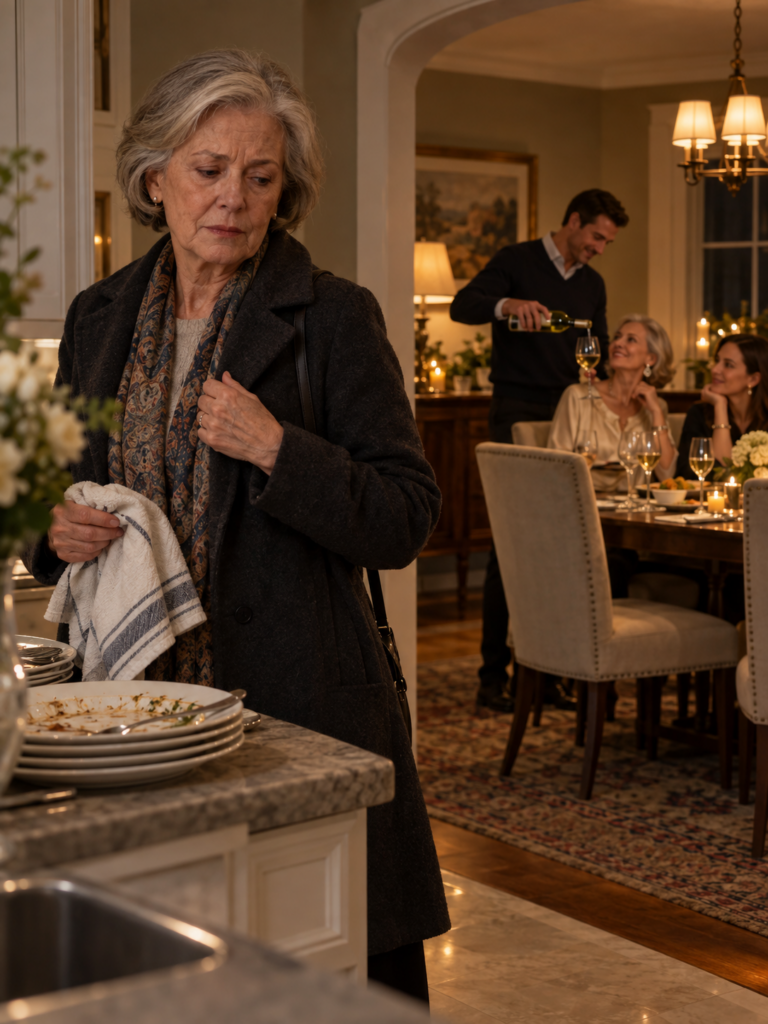
I looked at it and suddenly pictured the kitchen from that Sunday long ago.
Rachel walking toward the living room.
Brenda raising chilled wine.
David laughing beside the sofa.
My hands full of somebody else’s dirty plates.
For years, I had believed the danger in saying no was that people might love me less.
I had been wrong about the danger.
The real danger had been teaching myself that love required endless access.
Five hundred dollars was never the whole problem.
Neither were the dishes.
Neither was Thanksgiving.
Neither was the mixer.
Each one was small enough to explain away.
That was why the pattern lasted.
A plate was only a plate.
A favor was only a favor.
A spare key was only a spare key.
A monthly gift was manageable.
One afternoon of babysitting was not a sacrifice.
One extra holiday dish would not ruin my life.
But patterns are built from things too small to justify a fight.
So are boundaries.
Mine began with a stack of greasy plates.
Everything afterward looked dramatic to people who had benefited from my compliance.
To me, the changes were simple.
I stopped writing checks I did not owe.
I stopped treating every request as an obligation.
I stopped giving out keys simply because someone shared my last name.
I stopped making backup meals for adults who deliberately arrived empty-handed.
I stopped assuming somebody else’s disappointment meant I had done something wrong.
And I spent some of the money I saved on quartz countertops, a farmhouse sink, three ferns, a blue ceramic planter, plane tickets, camera equipment, roadside pie, and photographs of red cliffs beneath an Arizona sky.
None of those things loved me back.
That was never the point.
They reminded me that my life did not exist entirely in service to people I loved.
I still loved David.
I still loved Leo and Mia.
Rachel remained part of my family.
Love stayed.
What disappeared was entitlement.
That evening, I carried my coffee to the sink.
One spoon rested beside the basin.
My spoon.
My cup.
My mess.
I rinsed the spoon and set it in the drying rack.
Then I caught myself laughing.
After all those years, I finally had exactly as many dishes as I had chosen.
I dried my hands.
Not because somebody was waiting for me to keep working.
Not because a daughter-in-law had handed me another task.
Not because my son expected me to come through.
I simply dried them.
Then I turned off the kitchen light, picked up the novel waiting on the table, and walked into my living room.
Behind me, the sink remained empty.
The locks were mine.
The money was mine.
The evening was mine.
And so, finally, was the decision about what I would do with it.


