
The pen was still between my fingers when I looked at the signature.
My own name seemed unfamiliar.
Not because I had forgotten it.
Because for most of my adult life, I had been introduced through someone else.
His wife.
Their mother.
The woman who would handle it.
The woman who would stay home.
The woman who could be counted on.
Signing those papers did not suddenly make me fearless.
It made me frightened in a new direction.
But fear of leaving was no longer stronger than the humiliation of staying.
When my husband realized I was serious about divorce, his first reaction was not remorse.
It was disbelief.
“You’re divorcing me?”
He stared at me as if I had announced that I intended to fly through the ceiling.
“Yes.”
He gave a short laugh.
It was the same dismissive little laugh I had heard on the patio.
“Be serious.”
“I am.”
His expression changed slightly.
“Over what?”
That question told me almost as much as the conversation I had overheard.
I looked at the man I had married at twenty-three.
“Do you remember having your friends over a few weeks ago?”
His eyes narrowed.
“The barbecue?”
“Yes.”
“What about it?”
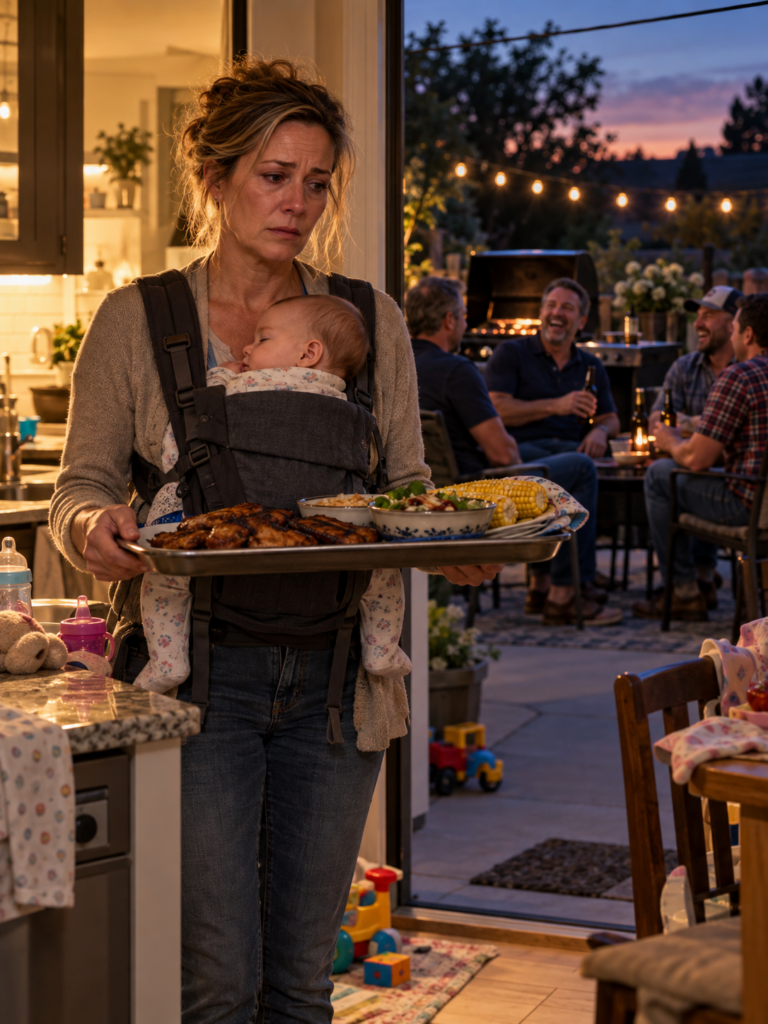
“I was carrying food outside. I heard you talking.”
The color in his face shifted.
Only slightly.
But enough.
I watched him realize exactly which conversation I meant.
For several seconds, neither of us spoke.
Then he did something I had expected without knowing I expected it.
He minimized it.
“Oh, come on. Men complain. We were talking.”
“You said you wanted to leave me.”
“I was frustrated.”
“You said I had accomplished nothing.”
“I didn’t mean it literally.”
“You called me a loser.”
His jaw tightened.
“You’re taking a private conversation out of context.”
I almost laughed.
There it was.
Not an apology.
Not, I’m ashamed you heard that.
Not, I was cruel.
Context.
As if there were some version of thirty-two years of marriage in which describing the mother of your eleven children as a brainless, useless failure became reasonable if only everyone heard the sentences before and after it.
I asked him one question.
“What exactly did you mean, then?”
He opened his mouth.
Nothing came out.
I waited.
Finally he said, “I meant you haven’t really done anything for yourself.”
The words landed differently this time.
Because he said them to my face.
I had spent decades doing things for everyone except myself.
And somehow he had turned that into evidence against me.
“You wanted this family too,” I said.
“I know.”
“No. You wanted me to build this family while you built everything else.”
“That’s not fair.”
“Isn’t it?”
“I worked for all of you.”
“And I worked for all of you.”
He shook his head immediately.
“That’s different.”
That was the moment I stopped hoping the patio conversation had been a temporary cruelty.
He believed it.
Maybe not every ugly word.
Maybe he didn’t truly think I was stupid.
Maybe calling me brainless had been showing off in front of friends.
But underneath the exaggeration was something worse because it had shaped our entire marriage.
He did not consider what I had done to be work.
He had a career.
I had simply existed inside the house while eleven children somehow grew up around me.
I stood.
“I’m proceeding with the divorce.”
His face hardened.
“And what exactly are you going to do afterward?”
There was genuine curiosity in his voice.
Almost pity.
It was the first time I understood how completely he had mistaken dependence for incapacity.
“I’ll figure it out.”
“With eleven children?”
“They’re your children too.”
He stared at me.
That sentence bothered him more than anything else I had said.
For years, of course, he had called himself a father of eleven.
He loved saying it.
People were impressed.
Eleven children.
What a family.
What a life.
But being the father of eleven and carrying the daily responsibility of eleven were two very different identities.
He had mostly been allowed to enjoy the first one.
“You know my work schedule,” he said.
“I do.”
“So obviously you’ll still have them most of the time.”
“I expect to remain their mother most of the time. But you’ll have responsibilities too.”
He ran a hand through his hair.
“This is ridiculous.”
“No. What was ridiculous was standing ten feet away from me while I prepared food for your friends and telling them I’d achieved nothing.”
He looked away.
That was the closest he came to shame that night.
The weeks that followed were difficult.
I am not going to pretend otherwise.
A woman does not spend thirty-two years organizing her identity around one marriage and then wake up the morning after filing for divorce feeling liberated in every possible way.
I worried about money.
I worried about the children.
I worried that my husband had been right about one thing—that too much time had passed.
My education was old.
My English was rusty.
I had been outside the professional world for decades.
Some mornings I woke with our baby crying and thought, What have I done?
Then I remembered the patio.
Not the insult itself.
The certainty behind it.
His certainty that I had nowhere to go because, in his mind, I was nowhere already.
That kept me moving.
Once child support arrangements were in place, I used part of the money for something that would once have felt almost forbidden.
I hired help.
A nanny.
The first time she arrived, I hovered.
I explained feeding schedules twice.
I pointed out where everything was.
I checked my phone every few minutes after leaving the room.
She finally smiled and told me gently, “I’ve got him.”
Those three words nearly made me cry.
Someone else had him.
For one hour, I did not.
And the world did not collapse.
I used some of that reclaimed time for English lessons.
My first session was humiliating in a completely different way.
I knew what I wanted to say, but words that once came naturally seemed buried under thirty years of school runs, grocery lists, doctor appointments, and bedtime routines.
I paused constantly.
I made mistakes.
I went home furious with myself.
Then something happened during the next lesson.
A phrase came back.
Then another.
Then a grammar rule.
Then vocabulary I hadn’t used in years.
My tutor would begin explaining something and I would suddenly remember learning it long ago.
It was still there.
Not gone.
Unused.
There is a difference.
That discovery changed the way I thought about myself.
My husband had looked at me and seen deterioration.
I began looking at myself and seeing neglect.
Neglect could be answered.
I could practice.
I could learn.
I could rebuild.
So I kept going.
Then I joined a gym.
I almost turned around the first day.
Everyone seemed to know where to stand, what to adjust, what buttons to press.
I felt fifty-five in a way I had never felt fifty-five before.
But I reminded myself why I had come.
Not to become twenty-three again.
Not to make my husband jealous.
Not to punish my body for carrying eleven children.
I came because it was still my body.
It deserved care even if it remained wrinkled.
It deserved strength even if it never resembled the women in advertisements.
At first I managed very little.
Then a little more.
My sleep improved.
My energy improved.
More importantly, I had two places each week where nobody called me Mom or asked me where their socks were.
At home, the strangest adjustment was watching my husband realize that divorce did not mean I would continue performing all the invisible parts of marriage for him.
He called about schedules he had never needed to memorize.
He asked questions whose answers had lived in my head for years.
Which child needed what?
Where was this?
When did that happen?
I answered what concerned the children.
I stopped solving everything else.
Then came the arrangement that changed the balance more than any argument ever could.
The children would spend regular time with their father.
Two days a week, several of them at once—including our youngest.
My husband agreed.
At first, he acted almost offended by the suggestion that it might be difficult.
“They’re my kids,” he said.
“I know.”
“I can handle my own children.”
“I hope so.”
He heard sarcasm.
There wasn’t any.
I genuinely hoped he could.
Our children deserved a father who understood their lives beyond photographs, birthdays, and asking how school was.
The first few visits went quietly enough from my side.
I packed what the baby needed.
I explained the important routines.
Then I left.
And something strange happened.
My home became silent.
Not empty exactly.
Silent.
I sat on the couch the first time and kept thinking I had forgotten something.
For decades, silence meant danger.
A toddler was drawing on a wall.
A child had climbed somewhere.
A baby had stopped making noise and needed checking.
Now there was simply no one asking me for anything.
I opened my English materials.
And studied.
At my husband’s house, meanwhile, reality was beginning to collect.
A baby did not care that he had work in the morning.
Children got hungry whether he was tired or not.
Laundry did not become clean because someone complained about it.
Different children wanted different things at the same time.
One evening, while I was preparing to leave for my English lesson, my phone rang.
His name appeared on the screen.
I answered.
His voice was tight.
“I can’t handle this.”
In the background I could hear children talking over one another.
Then the baby began crying.
“Come pick them up early today,” he said.
I looked at the clock.
For thirty-two years, that tone would have made me move automatically.
I would have grabbed my bag.
Changed my plans.
Solved the problem.
Instead, I picked up my English notebook.
“I can’t,” I said.
“What do you mean, you can’t?”
“I have an English lesson.”
He sounded stunned.
“Cancel it.”
“And after that I’m going to the gym.”
There was silence.
Then he said, “You’re choosing the gym while your children need you?”
That sentence stopped me.
My fingers tightened around the notebook.
Because even now, exhausted and overwhelmed by a responsibility he had carried for only a fraction of the time I had, he was trying to turn my absence into selfishness.
I walked to the front door and reached for my coat.
“No,” I said. “I’m choosing not to rescue you from your own parenting time.”
The baby cried louder through the phone.
My husband lowered his voice.
“Please.”
For the first time since I had overheard him on the patio, there was no contempt in it.
Only exhaustion.
And something that sounded dangerously close to understanding.
I slid one arm into my coat.
Then I heard him say my name.
Not “Come get them.”
Not “You have to.”
My name.
And after a long pause, he asked a question I had waited thirty-two years to hear.
“How did you do this every day?”
My hand froze on the second sleeve.
I stood with one arm still outside my coat and listened to the question hang between us.
“How did you do this every day?”
In the background, the baby was still crying.
One of the older children was asking my husband something.
Another voice called from farther away.
For a few seconds, I could almost see his house without being there—the half-finished meal, the bottles, the noise, someone unable to find pajamas, someone else insisting they weren’t tired.
A tiny fraction of the life I had managed for decades.
I could have enjoyed the moment.
I could have laughed.
I could have repeated his own words back to him.
Brainless.
Useless.
Loser.
Instead I said, “You learn because you have to.”
He was silent.
“That’s it?” he asked.
“That’s it.”
“I don’t know what the baby wants.”
“Check the things I already told you. Is he hungry? Is his diaper clean? Is he tired? Is he too warm? Walk with him.”
“I’ve tried.”
“Then try again.”
He exhaled hard.
For years, I had interpreted that sound as a signal.
He was frustrated.
Therefore I should make the frustration disappear.
That evening, I let it remain his.
“I really have to go,” I said.
“You’re actually leaving?”
“Yes.”
Another pause.
Then, quietly, “Okay.”
That one word mattered.
Not because he had suddenly become a different person.
Not because two difficult days with children erased thirty-two years of imbalance.
But because for once, my schedule existed even when it inconvenienced him.
I finished putting on my coat.
“I’ll see them when your parenting time is over.”
Then I ended the call.
My hand shook afterward.
That surprised me.
I had imagined boundaries would feel powerful.
Sometimes they do.
Sometimes they feel like abandoning a job you were trained never to leave.
I stood in the hallway for a moment fighting the urge to call back.
Then I looked at the English notebook in my hand.
I left.
During the lesson, my concentration wandered.
Every instinct I had developed as a mother told me to monitor, anticipate, prevent.
But another thought kept returning.
Their father was with them.
They were not abandoned.
He was overwhelmed.
There was a difference.
By the time the children came back to me, everyone was fine.
Tired.
A little disorganized.
But fine.
My husband looked worse than they did.
He handed me the baby carrier and avoided my eyes.
Then he said, “He was up three times.”
I adjusted our son against my chest.
“Sometimes more.”
He looked at me.
I could tell he was doing arithmetic in his head.
Night after night.
Month after month.
Baby after baby.
“You did all the nights?” he asked.
“Most of them.”
He frowned.
“I thought we split things more than that.”
“No.”
The answer was not angry.
That seemed to unsettle him more.
He stood near the doorway while the children carried their things inside.
“I had work.”
“So did I.”
His mouth tightened automatically.
Then he stopped.
For the first time, he did not say, That was different.
He looked past me into the house.
The same house where he had once seen evidence that I had done nothing with my life.
He seemed to be seeing the machinery behind it now.
Not all at once.
Understanding rarely arrives that cleanly.
But the door had opened.
A few weeks later, I started looking for work.
That frightened me more than the gym.
At the gym, failure meant getting tired.
In the job market, failure felt personal.
I had a large blank space where other applicants had careers.
Thirty-two years.
How was I supposed to explain thirty-two years without apologizing for them?
The first time I began preparing my résumé, I nearly closed the computer.
My old education looked like it belonged to another woman.
Then I stopped.
I had spent years managing schedules that would have overwhelmed many offices.
I could organize.
I could solve problems.
I could communicate.
I could learn quickly because motherhood had required learning constantly.
I did not pretend that raising children was identical to professional experience.
It wasn’t.
I also refused to accept that it meant I possessed no useful abilities.
I applied.
Then I applied again.
I was rejected.
That hurt.
I applied again.
One afternoon, I received an invitation to interview.
I reread the message several times.
The old instinct returned immediately.
Who would handle the baby?
What if one of the children needed something?
Was the timing inconvenient?
Then I remembered something I was still learning.
A family problem did not automatically belong to me first.
I arranged childcare.
I went to the interview.
My hands were cold when I sat down.
My English was not perfect.
I searched for a word once and had to start a sentence over.
Years earlier, that would have humiliated me.
Instead, I finished the sentence.
When they asked about the long absence from paid employment, I told the truth.
I had spent those years raising eleven children.
Then I explained why I was returning now.
I did not mention revenge.
I did not mention my husband.
This was no longer about proving him wrong.
That surprised me.
At first, almost everything I did after leaving had carried a shadow of his insult.
Every new English phrase seemed to answer brainless.
Every hour at the gym answered sagging.
Every application answered accomplished nothing.
But slowly, I realized that if I rebuilt my life only to contradict him, he would still be at its center.
I wanted something larger than that.
I wanted work because I wanted to know what I could still become.
A few days after the interview, they offered me the job.
I sat at the kitchen table staring at the message.
The baby was asleep nearby.
For a moment, I remembered another table decades earlier.
A younger version of me with plans.
Then pregnancy.
Then another.
Then life moving faster than I could reorganize it.
I had loved my children.
That had never been the mistake.
The mistake was allowing the work I did for them to become evidence that I had no other self.
I accepted the offer.
My husband found out because the children mentioned it.
He called me that evening.
“You got a job?”
“Yes.”
There was an odd pause.
“Doing what?”
I told him.
Another pause.
“Full-time?”
“For now, yes.”
“How are you going to manage everything?”
I almost answered automatically.
Then I heard the question differently.
Everything.
Whose everything?
“I’m going to manage my responsibilities,” I said. “You’ll manage yours.”
He sounded irritated.
Then tired.
“I wasn’t attacking you.”
“I know.”
That was true.
He wasn’t attacking me.
He was confronting a world in which the invisible backup system he had depended on no longer belonged exclusively to him.
Our schedules became more structured.
His parenting days mattered because my job existed.
My lessons mattered.
My gym sessions mattered.
The children’s needs still mattered, of course.
But they no longer automatically erased mine.
The more he handled, the less often he called asking me to rescue him.
Instead, he began asking practical questions before problems became emergencies.
What time did the baby usually sleep?
Which child needed something for school?
What groceries disappeared fastest when several of them were staying with him?
At first I answered because cooperation was better for the children.
Then one evening, while exchanging the youngest at the door, he said something unexpected.
“I was wrong.”
I thought I had misheard him.
“About what?”
He looked embarrassed.
Not theatrically broken.
Not transformed.
Just uncomfortable.
“About what you did here.”
My chest tightened.
He continued.
“I thought because I brought in the money, I was carrying everything.”
I said nothing.
He looked at the baby in my arms.
“I didn’t understand how much of my life worked because you were doing the things I never had to think about.”
That was the major answer I had not known I needed.
He had not insulted me because he secretly knew my value and wanted to hurt me.
He had genuinely stopped seeing it.
Years of being protected from the cost of family life had allowed him to mistake invisibility for absence.
But acknowledgment did not erase what he had done.
So when he added, “Maybe we could talk about us sometime,” I did not give him the answer he wanted.
I shifted our son higher on my shoulder.
“We can talk,” I said.
“But understanding my work now doesn’t automatically restore the marriage you destroyed while refusing to see it.”
His face changed.
For the first time, he seemed to understand that learning the lesson did not guarantee he would get the old life back.
And neither of us yet knew what, if anything, would remain between us when the divorce was finally behind us.
In the weeks that followed, my husband did try to talk.
I agreed because after thirty-two years and eleven children, silence would not make our future simpler.
But I stopped confusing listening with surrender.
That distinction changed everything.
He apologized for the patio conversation.
The first attempt was imperfect.
“I was showing off,” he admitted. “The guys were complaining about their wives, and I started talking.”
“That explains why you said it,” I told him. “It doesn’t explain why you believed enough of it to say it.”
He looked down.
Then he said something I had not expected.
“I think I liked believing it.”
I waited.
“If what you did wasn’t real work,” he continued slowly, “then I never had to ask whether the life I built was possible because you gave up another one.”
That was the closest we ever came to naming the central truth.
He had not stolen my career from me.
I had made choices too.
I had agreed to stay home.
I had agreed, again and again, to put another child and another year ahead of returning to work.
Some of those choices I would make again because I loved our children.
But those choices had happened inside a marriage where sacrifice flowed mostly in one direction and recognition flowed the other.
He had been praised for providing for a family of thirteen.
I had been treated as if being provided for meant I contributed nothing.
Eventually, even he had begun believing the story that made him look larger and me look smaller.
The divorce did not punish him.
It changed the terms.
That was enough.
There was no miraculous ruin waiting for him.
He kept working.
He still dressed well.
He still went to the gym.
He remained the father of our children.
But now being their father required time that could not always be rearranged around his preferences.
Some evenings he missed social plans because the children were with him.
Sometimes he went to work tired because the baby had woken during the night.
He learned to plan food for multiple children.
He learned that laundry multiplies when no one is watching.
He learned that “Where is my—?” can be asked seven times in five minutes by seven different voices.
He learned that caring for children is composed of hundreds of tiny decisions that rarely look impressive from outside.
And I learned something too.
I learned that I had helped create the arrangement that exhausted me.
Not because I deserved contempt.
Not because the work was worthless.
But because every time I silently fixed everything, I taught the people around me that everything somehow fixed itself.
Changing that was uncomfortable for everyone.
Including me.
My job was difficult at first.
I made mistakes.
I came home tired.
There were evenings when I wondered whether starting again at fifty-five had been madness.
But each week became slightly easier.
My English improved because I used it.
I stopped translating every sentence in my head before speaking.
I stopped apologizing every time I paused for a word.
At the gym, I became stronger.
My body did not reverse thirty-two years.
That had never been my goal.
The wrinkles stayed.
My stomach still showed what eleven pregnancies had asked of it.
Some days my joints complained.
But I no longer looked at those things through my husband’s disgust.
They were simply parts of me.
Not evidence in a trial.
The strangest change was not physical or professional.
It was ordinary.
I began making decisions without first calculating how my husband would respond.
If I wanted to attend an English lesson, I went.
If it was his parenting day, I trusted him to parent.
If work required my attention, I stopped treating my job as the optional one.
The first time he called during one of his days and asked a reasonable question rather than demanding rescue, I answered it.
When he handled the rest himself, I did not congratulate him.
He was their father.
Competence did not require applause.
Months earlier, I had stood in a kitchen carrying food to men who were laughing while my husband described me as a woman who had achieved nothing.
Now I understood why those words had cut so deeply.
It was not because I secretly agreed.
It was because I had depended on him to remember the price of the life we had built.
When he forgot, I realized I had allowed one person’s judgment to become the mirror I used for myself.
That was what had to end.
Not merely the marriage.
The dependence on his interpretation.
One evening, after bringing several of the children back, he stood at my door longer than necessary.
The youngest was older now and much easier to settle.
My husband looked tired but not helpless.
He had learned.
He glanced past me and noticed my English book on the table.
Beside it was my work bag.
My gym shoes sat near the hallway.
Three objects that would once have seemed unrelated.
Now they represented hours I had reclaimed.
“You really changed your whole life,” he said.
I shook my head.
“No.”
He looked at me.
“I changed the part where my whole life belonged to everyone else.”
He absorbed that without arguing.
Then he surprised me.
“I regret what I said.”
“I know.”
“I mean all of it.”
“I know.”
“I was wrong about you.”
I held his eyes.
Years earlier, I might have needed those words like oxygen.
Now they mattered.
But they did not decide me.
“That’s important,” I said. “Especially because we still have children together.”
Hope appeared briefly in his face.
I continued before he could misunderstand.
“But your regret doesn’t obligate me to rebuild the marriage.”
The hope faded.
He nodded.
It hurt to see.
Justice, I discovered, does not always feel triumphant.
Sometimes the person who hurt you finally understands, and instead of satisfaction, you feel grief for how late the understanding arrived.
There had been good years too.
Children conceived in hope.
Birthdays.
Holidays.
Inside jokes.
Exhausted laughter at two in the morning.
A whole adult life braided together.
Divorce did not turn those memories into lies.
It simply meant the truth about our marriage contained more than the memories we wanted to keep.
“I’m not trying to punish you,” I told him.
“I know.”
“I need you to understand that.”
“I do now.”
That might have been the most meaningful change in him.
Months earlier, he had assumed everything I did was about him because he had been the center around which the household revolved.
Now he understood that leaving him was not revenge.
It was the consequence of discovering that the partnership I believed we had existed very differently in his mind.
We settled into a relationship that was not marriage and was not friendship either.
We were parents.
Sometimes cooperative.
Sometimes awkward.
Sometimes irritated.
But the old arrangement did not return.
He stopped calling me to take the children simply because parenting was difficult.
I stopped automatically volunteering.
When something genuinely important happened, we helped each other because that was good for the children.
When it was merely inconvenient, we handled our own days.
One afternoon, long after that first desperate phone call, I was getting ready for the gym when he called.
For a second, seeing his name on the screen brought back the old memory.
The crying baby.
His exhausted voice.
Come pick them up.
I answered.
He asked me a simple question about one of the children’s schedules.
I gave him the answer.
“Got it,” he said.
Then, almost casually, “Have a good workout.”
I smiled after we hung up.
Not because I had won.
Because neither of us needed the old roles anymore.
I picked up my gym bag and walked past the table where my English notebook lay open beside materials from work.
Years before, my university diploma had disappeared into a closet because I thought motherhood required putting one version of myself permanently away.
For decades, I had treated that choice as irreversible.
It wasn’t.
I could not become twenty-three again.
I could not recover every opportunity I had declined.
I could not undo eleven pregnancies, thirty-two years, or the sentence I had overheard behind a kitchen wall.
I did not want to undo my children.
But I could decide what the years ahead belonged to.
I opened the closet where my diploma had once been buried beneath old family papers.
Months earlier, when I started rebuilding my life, I had taken it out.
For a while I kept it on a shelf.
That afternoon, I picked it up again.
The paper represented neither revenge nor proof that my husband had been wrong.
It represented continuity.
The young woman who had studied hard had not disappeared when she became a mother.
She had carried eleven children.
Raised them.
Aged.
Become exhausted.
Lost confidence.
Been underestimated.
And then, at fifty-five, she had started again.
I placed the diploma where I could see it.
Then I picked up my keys.
Thirty-two years earlier, I had built my life around becoming the wife and mother my family needed.
I was still a mother.
I would always be one.
But I was no longer willing to accept the idea that motherhood had erased everything else I could become.
My husband had once asked his friends why he would want a loser like me beside him.
In the end, I stopped needing him to want me beside him at all.
I walked out the door for the gym, locked it behind me, and went to the life that finally had room for my own name.


