
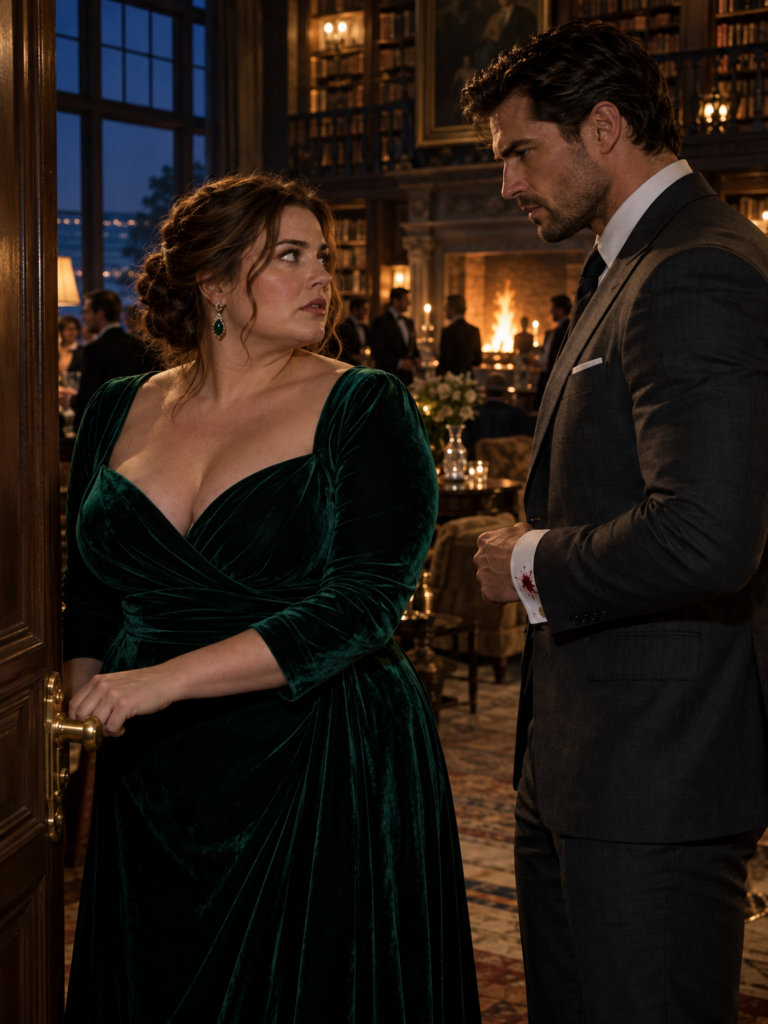
Her fingers closed around the brass handle just as Dominic caught the meaning of what she intended.
He did not grab her.
“Harper, don’t open that door. We’re doing sixty.”
“Then tell the driver to stop.”
“Not here.”
“Then tell me why my dead mother is in your private file.”
Dominic leaned forward.
“Lorenzo. First safe turnout.”
The driver obeyed.
Minutes later the armored car rolled behind an abandoned roadside service station and stopped beneath bare winter trees.
Harper opened the door herself.
Cold air struck her bruised cheek.
She stepped onto the gravel and turned.
“Talk.”
Dominic got out but stayed several feet away.
“Your mother wasn’t only a bookkeeper.”
“I know what she was.”
“No. You know what she told you.”
The sentence hurt more than the blow to Harper’s face.
Dominic saw it.
His voice changed.
“I should have told you sooner.”
“How much sooner?”
“The first week I started seeing you.”
Harper laughed once, without humor.
“So while I was trying to decide whether you actually liked me, you were researching my family.”
“I was investigating a threat connected to you.”
“That is not the same thing as trusting me with the truth.”
“No.”
Again, he did not defend himself.
Harper almost hated that more.
“What threat?”
Dominic looked toward the road before answering.
“Enzo Moretti obtained records from an old organized-crime accountant. Your mother’s name appeared in them.”
“My mother worked construction payroll.”
“The construction company was a front.”
Harper stared at him.
“For who?”
Dominic’s pause told her the answer would redraw her childhood.
“The Gambino organization.”
The parking lot seemed to tilt.
“That’s absurd.”
“I hoped it was.”
“You expect me to believe my mother was laundering money for mobsters?”
“I believe she was more sophisticated than the men employing her understood.”
Harper folded her arms against the cold.
Dominic continued.
“In the early nineties, a large amount of money disappeared through accounts she managed. Nobody ever proved she took it. Nobody found the routing structure afterward.”
“And Moretti thinks I know where it went.”
“Yes.”
“That’s why they grabbed me.”
“Yes.”
“And you knew I might be a target.”
Dominic’s silence became an answer.
Harper stepped toward him.
“You had a man following me.”
“I did.”
“You stopped because I demanded it.”
“Yes.”
“And three weeks later I nearly got dragged into a van.”
His face tightened.
“I replaced visible surveillance with distance coverage.”
Her anger sharpened.
“So you technically obeyed while still deciding what was best for me.”
“Yes.”
That single word stripped away every excuse.
Harper looked at the road.
She could leave.
She could demand a ride back to Manhattan.
She could call police and explain a story involving armed men, an alleged mob ledger, and the man standing beside her.
But whoever Enzo Moretti was, he already knew where she worked.
Dominic spoke quietly.
“The safe house is the safest option I have. But you decide whether we go.”
Harper studied him.
“What happens if I say no?”
“I take you wherever you choose and put security nearby only if you consent.”
“And if I go?”
“You get every file I have on your mother. No omissions.”
His expression was rigid.
“And I stop making decisions for you because I’m frightened.”
That was the first honest thing he had said that sounded costly.
Harper looked down at Dominic’s unlocked phone still in her hand.
Her mother’s photograph filled the screen.
A younger version of the woman Harper remembered stood outside a Queens office building, carrying a ledger beneath one arm.
Harper enlarged the image.
The ledger wasn’t what caught her attention.
A corner of another object protruded from her mother’s bag.
Dark leather.
Embossed spine.
Harper knew that book.
She had donated it to the historical society three years earlier.
The Count of Monte Cristo.
Her mother’s copy.
Harper’s fear changed shape.
“Take me to the safe house.”
Dominic nodded.
“But tomorrow,” she added, “we start with everything you know. Then I decide what happens to anything my mother left behind.”
“Agreed.”
“And Dominic?”
“Yes?”
“If you lie to me again, protection or not, we’re done.”
Pain moved across his face.
“I understand.”
Harper climbed back into the car, opened the file herself, and began reading before Dominic had even shut the door.
Dominic shut the door while Harper scrolled through the first page of the file.
He did not try to take the phone back.
That, more than anything, told her he understood the terms had changed.
The Catskills safe house appeared two hours later behind iron gates and dense pines, less like a mansion than a hardened retreat built by someone who expected enemies to arrive eventually.
Harper noticed cameras before she noticed the stone walls.
Backup generators.
Two access roads.
A guard rotation that overlapped at every shift.
“You designed this place?”
Dominic glanced at her.
“The security.”
“It has a blind slope on the east side.”
Lorenzo, seated in front, looked back.
Dominic did too.
Harper pointed through the windshield.
“Tree cover blocks your upper camera angle for about forty yards.”
Lorenzo stared.
“How did you see that?”
“I spend my life studying old property surveys.”
Dominic’s mouth almost curved.
Harper caught it.
“Don’t look proud. I’m still angry with you.”
“I know.”
Inside, she refused to be carried upstairs despite her bruised cheek and aching shoulder.
Dominic brought ice, water, and a medical kit.
Then he placed a thick folder on the table.
“All of it.”
Harper opened the folder.
Her mother’s legal name was there.
So were aliases Harper had never known.
Payroll records.
Bank transfers.
Photographs.
A federal surveillance note from 1991.
Harper read until the words blurred.
Her mother had not simply processed payments.
She had designed layered accounting structures sophisticated enough to disappear money through legitimate construction projects.
But the final pages were incomplete.
One account sequence ended abruptly months before she left that world.
“Where’s the rest?”
“Missing.”
“Convenient.”
“I know.”
Harper closed the file.
“What does Moretti have?”
“References to a ledger your mother kept independently.”
“The book?”
“I didn’t know that until you recognized it.”
“So he knows a ledger exists, but not what it looks like.”
“Correct.”
Harper paced.
She remembered her mother writing tiny numbers in margins while Harper sat beside her doing homework.
She remembered asking what they meant.
Catalog codes, her mother had said.
Practice.
Harper stopped moving.
Dominic noticed.
“What?”
“My mother annotated books.”
His eyes narrowed.
“She wrote numbers in the margins.”
“What kind of numbers?”
“Long strings. Sequences.”
He rose.
Harper lifted one hand.
“No.”
He stopped.
“I’m thinking.”
He sat again.
That choice mattered too.
Harper closed her eyes.
Her mother had loved Alexandre Dumas. Had talked endlessly about hidden identities, buried wealth, patience, revenge, escape.
Harper had assumed the book mattered because of the story.
Maybe it mattered because it was camouflage.
“I need to see it.”
Dominic’s jaw tightened.
“The historical society is exposed.”
“I didn’t say I’m going tonight.”
He exhaled slowly.
“Good.”
She glared.
“That sounded dangerously close to approval.”
“Occupational habit.”
“Lose it.”
“I’m trying.”
For the first time, Harper smiled.
Only for a second.
The moment frightened her because the attraction between them had survived anger.
Perhaps deepened because anger was finally being allowed into the room.
That night, Dominic gave her the master bedroom and took the adjoining study.
Harper found him there after midnight, sitting awake by the window.
“You aren’t sleeping.”
“Neither are you.”
She entered.
He looked exhausted.
Not powerful.
Not untouchable.
Just a man who had almost watched someone he cared about disappear into a van because his enemies had discovered a weakness before he admitted he had one.
“You called me your weakness in one of those reports.”
Dominic’s expression darkened.
“You read that far.”
“You gave me the file.”
“Yes.”
“Do you think that’s what I am?”
“No.”
“What am I?”
He took time answering.
“The person who makes me question instincts I used to trust.”
“That’s not particularly romantic.”
“It isn’t meant to be.”
Harper sat across from him.
“What instinct?”
“To control every variable before it can hurt someone.”
“And me refusing that scares you.”
“Yes.”
“Good.”
He blinked.
“If we’re going to continue whatever this is, you need to be scared of losing me for the right reasons.”
His gaze held hers.
“Tell me the right reasons.”
“Because I choose to leave. Not because someone takes me.”
Dominic absorbed that in silence.
Then he nodded.
“Understood.”
Harper looked at his hands.
The first night she met him, blood had dried on his cuff.
Now there was none.
“Dominic.”
“Yes?”
“Have you killed people?”
The room went still.
“Yes.”
She appreciated that he did not insult her with a lie.
“Enzo?”
“Not yet.”
“Do not tell me anything that makes me part of planning violence.”
“I won’t.”
“And don’t turn what happened to me into an excuse to become worse.”
His face hardened.
“I can’t promise mercy if he attacks us.”
“I didn’t ask for mercy. I asked you not to make me responsible for choices you make.”
Dominic looked down.
“That’s fair.”
The next afternoon, Harper began building her own timeline from the documents.
Not Dominic’s.
Hers.
She cross-referenced dates with archival donation records remotely accessible through the society database.
Her mother had opened certain shell accounts in the same months she purchased several books.
The purchases looked random.
They were not.
Publication years aligned with account identifiers.
Page numbers matched transaction months.
Harper’s pulse quickened.
“This is a cipher.”
Dominic came to the table but waited for permission.
She nodded.
He approached.
Harper showed him.
“The book isn’t necessarily the ledger.”
“What is it?”
“The key.”
Before he could respond, every light in the room flashed red.
A siren erupted.
Lorenzo stormed in.
“Outer perimeter breach.”
Dominic moved instantly.
“Harper, basement.”
She stood.
“No.”
His head snapped toward her.
“The panic room has no access to the archive database.”
“This is not the moment.”
“It is exactly the moment. If Moretti came because he thinks I hold the key, then hiding me without information makes me useless.”
Gunfire cracked somewhere beyond the stone walls.
Dominic stepped closer.
Fear, not authority, drove his voice.
“Harper.”
She pointed toward the security console.
“Can the basement access internal systems?”
Lorenzo answered.
“Yes. Limited terminal.”
“Then I go. With a laptop.”
Dominic hesitated only a second.
“Do it.”
That was the first time she saw him choose trust over instinct while danger was actually happening.
Lorenzo hurried Harper downstairs.
At the steel door, he handed her a handgun.
She recoiled.
“I don’t know how to use that safely.”
“Then don’t touch it unless there’s no alternative.”
Better.
He locked her inside.
The concrete room vibrated with distant impacts.
Harper sat before the emergency terminal and forced herself to work.
The Count of Monte Cristo donation record appeared.
Accession date.
Storage location.
Conservation notes.
Then another field.
Previous owner inscription photographed during intake.
Harper enlarged the scan.
Her mother had written one sentence beneath the cover.
Not numbers.
A phrase Harper remembered hearing as a child whenever she panicked.
Start where the story starts.
Harper’s breathing stopped.
The first chapter.
The first page.
The first marginal sequence.
She entered the digits into her timeline.
They matched the missing account structure.
Not money yet.
A route.
A chain showing where it had gone.
Harper leaned closer.
Her mother had not merely stolen from criminals.
She had documented them.
A violent crash shook the bunker.
Dust fell.
The outer handle jerked.
Harper backed away.
Again.
Metal screamed.
Someone was cutting through.
She looked at the gun but left it where Lorenzo had placed it.
Instead she picked up the laptop.
If someone came through that door, the information mattered more than pretending she could become a fighter in thirty seconds.
The hinges glowed.
The steel slab crashed inward.
Smoke filled the opening.
A figure staggered through.
Harper raised the laptop like a shield.
“Harper.”
Dominic.
Blood streaked his temple.
His vest was torn.
He dropped to one knee.
She crossed the room before she could think better of it.
He caught her, then stopped himself from pulling her tighter until she wrapped her arms around him first.
“It’s over,” he said against her hair. “Moretti’s attack failed.”
“Enzo?”
Dominic’s expression answered before he spoke.
“Dead.”
Harper closed her eyes.
No celebration came.
Only relief.
Then she pulled back.
“I solved part of it.”
Dominic stared.
“The book is a cipher key. My mother used it to map accounts and transactions.”
“You found the fortune?”
“Maybe.”
She turned the laptop toward him.
“But that isn’t the important part.”
On the screen was a network of dates, account numbers, and initials stretching across years.
Harper pointed to the pattern.
“She didn’t leave me money.”
Dominic leaned closer.
“She left evidence.”
Dominic stared at the screen until the implications settled into the room.
“Evidence against who?”
“Everyone those accounts touched.”
Harper’s hands were still shaking, but her mind had become extraordinarily clear.
Her mother’s numbers were not a treasure map.
They were an archive.
That distinction changed everything.
Dominic sat beside her on the concrete floor.
“Moretti believed there was money.”
“There may be money too. But if my mother preserved transaction chains, names, dates, shell companies—”
“She preserved leverage.”
Harper looked at him.
“No. She preserved truth.”
His expression changed subtly.
The difference mattered to her.
Leverage belonged to men like Dominic.
Truth belonged to whoever could prove it.
They left the damaged panic room twenty minutes later.
The lodge had survived, although shattered windows and scorched stone marked the assault.
Harper stepped around debris and understood something she had resisted since Brooklyn.
Dominic’s world did not become safe merely because he loved her.
Love could not make bullets symbolic.
It could not turn organized violence into romance.
If they had any future, he would have to change more than where she slept.
And she would have to decide what to do with the inheritance her mother had actually left: knowledge.
Two days later, after law enforcement activity around the failed assault made immediate travel impossible, Harper spent nearly every waking hour reconstructing the code from digital scans and Dominic’s records.
Dominic helped only when she asked.
Sometimes that meant calling attorneys.
Sometimes identifying old company names.
Sometimes making coffee at three in the morning and setting it beside her without interrupting.
Once, when he tried to move her chair away from the window because he disliked the sightline, Harper raised one eyebrow.
He put the chair back.
Progress.
By the fourth morning, Harper had reconstructed enough of the cipher to know they had to return to Manhattan.
The original book contained markings never captured in the intake photographs.
Dominic hated the idea.
She could see it in every muscle of his body.
But when he spoke, he said, “What do you need?”
Not, You’re not going.
Not, I forbid it.
Harper answered, “A secure way into the historical society after hours. My director’s permission. Two neutral witnesses. And a lawyer who represents me, not you.”
Dominic nodded.
“I know someone independent.”
“I’ll choose them.”
“Of course.”
She watched him leave to make arrangements.
That small exchange meant more than flowers, cars, or guarded declarations ever could have.
They entered the historical society just after dusk the following evening.
Harper’s director, Dr. Evelyn Shaw, met them at the staff entrance looking deeply unhappy and deeply curious.
Harper had told her only what was necessary: a donated volume might contain historically significant financial annotations tied to ongoing threats.
An attorney Harper selected from three referrals joined them.
So did a retired federal forensic accountant Dr. Shaw trusted.
Dominic remained outside the rare-book vault.
His choice.
Harper noticed.
Inside, fluorescent conservation lights washed the room in cool white.
Dr. Shaw unlocked a climate-controlled cabinet.
There it was.
The leather-bound copy of The Count of Monte Cristo.
Harper had donated it because she believed preserving the book would preserve her mother.
Now she wondered whether her mother had counted on exactly that instinct.
Harper pulled on archival gloves.
Her fingertips hovered above the cover.
For a moment, she was ten again.
Her mother sat at the kitchen table with a pencil tucked behind one ear, laughing because Harper had accused Edmond Dantès of being far too dramatic.
Start where the story starts, sweetheart.
Harper opened the book.
The margins looked familiar.
Numbers.
Tiny arrows.
Underlined words.
But the original pages revealed details the scans had missed.
Some digits were written in graphite.
Others in nearly invisible blue pencil.
Two overlapping systems.
The forensic accountant leaned closer.
“One set is banking.”
Harper nodded.
“The other is indexing.”
She turned pages carefully.
Chapter numbers produced dates.
Paragraph counts produced entity codes.
Repeated underlines created initials.
Hours passed.
No one spoke above a murmur.
Finally, near the middle of the book, Harper discovered a folded conservation strip tucked deep into the binding.
She stopped.
Dr. Shaw frowned.
“That wasn’t in our accession notes.”
Harper opened it.
No account numbers.
A short handwritten letter.
Her mother’s handwriting.
Harper read silently.
Then again.
Her eyes filled.
The attorney asked softly, “Are you all right?”
Harper nodded because she could not yet speak.
Her mother had written the letter years before her death.
Not a confession.
An explanation.
She had entered the Gambino financial network because the Queens construction company employing her had already been compromised. At first she obeyed because she was frightened and alone.
Then she began copying records.
When federal investigations intensified, she diverted a reserve fund controlled by men who were preparing to disappear assets and abandon lower-level employees to prosecution.
She moved the money through protected accounts, but she never spent it.
Instead, she built a documentary trail tying the money to its origins.
She intended eventually to turn the entire structure over through legal counsel.
Then she became ill.
And fear changed her timeline.
The final paragraph was for Harper.
Not instructions to claim a fortune.
Instructions to choose.
If Harper ever found the book, she was to decide whether safety meant silence or whether truth had become safer than secrecy.
No destiny.
No obligation.
A choice.
Harper removed her gloves and walked out of the vault.
Dominic stood when he saw her face.
“What did she say?”
Harper handed the letter to her lawyer instead of him.
That was another choice.
“She left the decision to me.”
Dominic nodded once.
“What are you going to do?”
“Turn the financial record over through counsel.”
His jaw tightened.
He knew what that could expose.
Some of the old companies in the ledger connected to organizations whose successors still existed.
Possibly to people he knew.
Possibly to people he had done business with.
“Everything?” he asked.
“Everything that can be authenticated.”
He looked at her for a long time.
Then said, “All right.”
Harper studied him.
“That may hurt you.”
“Yes.”
“Your businesses.”
“Yes.”
“Your alliances.”
“Yes.”
“And you’re still saying all right?”
Dominic’s expression was tired but steady.
“You asked me once whether I thought you were my weakness.”
She remembered.
“I did.”
“I was wrong. My weakness was believing I could control danger by controlling information.”
He glanced toward the vault.
“If the truth costs me something, then it costs me something.”
Harper felt something inside her loosen.
Not forgiveness yet.
But the possibility of it.
“There’s more,” she said.
The reconstructed accounts led to a substantial pool of money that had remained untouched for decades.
Not limitless wealth.
Not a fairy-tale fortune.
But enough to change institutions, lives, and possibly Harper’s own future.
Her mother’s letter had been clear on one point: the money did not belong to the crime families simply because they once controlled it.
Nor did it automatically belong to Harper.
Its disposition needed lawful review.
Dominic did not argue.
They spent the next several months doing something neither of them was naturally good at.
Waiting.
Lawyers reviewed ownership claims.
Federal authorities authenticated historical records.
Old shell companies were traced.
Some funds were seized.
Some were determined recoverable through civil processes.
Some had no lawful claimant and became part of negotiated settlements.
Harper cooperated through counsel and insisted her identity remain protected as much as legally possible.
The Manhattan Historical Society eventually received a large anonymous charitable gift drawn not from hidden criminal cash but from Dominic’s legitimate holdings.
Harper objected when she first learned his plan.
“You don’t have to buy safety for me.”
“I’m not.”
“Then why?”
“Because your institution protected the book that protected the truth.”
She considered that.
“And because,” he added, “I can afford it.”
“That was almost obnoxious.”
“Almost?”
She smiled.
Their relationship did not heal in a straight line.
Harper returned to her Queens apartment before she ever agreed to live with Dominic.
He hated it.
He said so once.
Only once.
She kept working.
He stopped sending security without asking.
When threats required precautions, they discussed them.
Sometimes they disagreed.
Sometimes Harper accepted protection.
Sometimes she refused it.
Dominic learned that concern did not entitle him to the final word.
Harper learned that accepting help did not erase independence.
Months later, Dominic began restructuring his empire.
Not because Harper demanded a clean transformation overnight.
The source of his power was too entangled for simple declarations.
But he withdrew from street operations.
Lorenzo assumed responsibility for ending remaining conflicts without expanding them.
Dominic separated legitimate commercial real estate holdings from criminal structures under legal supervision and accepted losses he once would have fought to avoid.
There were investigations.
Attorneys.
Taxes.
Settlements.
People who stopped taking his calls.
People who considered restraint weakness.
Dominic let them.
One evening, Harper found him in his office surrounded by boxes of financial records.
“You look miserable.”
“I have discovered that legitimate compliance paperwork is a more effective torture device than most criminals ever invented.”
She laughed.
The sound surprised them both.
He leaned back.
“I missed that.”
“What?”
“You laughing at me.”
“I do it constantly.”
“Not like that.”
Harper sat on the edge of his desk.
The attraction between them had never disappeared.
But now it rested on something stronger than fascination.
Knowledge.
She knew what he had done.
What he regretted.
What he was still capable of.
He knew she was not fragile because she was anxious.
Not passive because she was quiet.
Not grateful merely because he desired her.
He reached toward her hand, then paused.
Harper turned her palm upward.
Permission.
His fingers closed around hers.
A year after the night at the gala, Harper stood on a balcony in Tuscany wearing emerald silk.
The property belonged jointly to neither of them.
That had been deliberate.
Dominic had rented it for several months while final restructuring work on his businesses continued in Europe.
Harper had taken a temporary research fellowship cataloging a private collection of nineteenth-century correspondence in Florence.
Her career had not become an accessory to his escape.
That mattered.
So did the fact that when she decided to stay longer, she told him after making the decision.
Not before.
Dominic came onto the balcony carrying two coffees.
“You’re staring at the vineyards like they’ve offended you.”
“I’m thinking.”
“That usually costs me money.”
Harper accepted the cup.
“Dr. Shaw offered me the deputy collections director position.”
Dominic went still.
“In New York.”
“Yes.”
“When?”
“January.”
He looked toward the hills.
Harper waited.
A year earlier, he might have started solving the problem before she finished speaking.
House.
Security.
Travel.
Schedules.
Now he asked, “Do you want it?”
“I think I do.”
He nodded slowly.
“Then we go back.”
Harper tilted her head.
“We?”
“If you want me there.”
“And your work?”
“I can work from New York.”
“That easy?”
“No.”
She smiled.
“Better answer.”
He set down his cup.
“There’s something else.”
Harper narrowed her eyes.
“That sounds dangerous.”
“It probably is.”
He reached into his pocket.
Her pulse jumped when she saw a small velvet box.
Dominic caught her expression.
“Before you panic, this is not a surprise wedding ambush.”
“Excellent opening.”
He opened the box.
A ring rested inside.
Simple.
Elegant.
No theatrical diamond large enough to purchase a building.
Harper looked from it to him.
“I love you,” Dominic said. “But I’m not asking because you survived my world or because I protected you. And I’m not asking you to disappear into mine.”
His voice roughened.
“I’m asking whether you want to build a life that belongs equally to both of us.”
Harper looked at the ring.
Then at the vineyards.
Then back at the man who once told her to stay close to Lily as though his fear automatically gave him authority.
He no longer stood between her and the door.
He stood beside her.
That was the difference.
“Not yet.”
Dominic went very still.
Harper almost laughed at how carefully he controlled his disappointment.
She touched his face.
“I’m saying not yet, not no.”
His breath left him.
“I want the job. I want my own apartment in Manhattan for at least another year. I want us to learn what ordinary looks like before we make permanent promises.”
He nodded.
“All right.”
“And I want that ring to remain yours until I ask to see it again.”
A faint smile appeared.
“You’re giving me instructions now?”
“Advice.”
His smile widened.
“Better.”
Harper kissed him.
Not because a kiss solved anything.
Because nothing needed solving in that moment.
The choice had already been made.
Months later, she returned to the same Hamptons house for Lily’s birthday.
The library looked smaller than Harper remembered.
Dominic entered behind her wearing a navy suit.
No blood on the cuff.
Harper noticed anyway.
Of course she did.
Dominic followed her gaze and lifted one eyebrow.
“Checking?”
“Occupational habit.”
She crossed to the same brass door where she had once tried to escape him.
Her hand rested on the handle.
The first time she had stood there, she believed beauty belonged to other women, confidence belonged to louder women, and power belonged to men who never seemed afraid.
Now she knew better.
Beauty had never required permission.
Quietness had never meant weakness.
And love, when it was worthy of the name, did not close doors around her.
It waited for her to decide whether to stay.
Harper turned away from the exit.
Dominic did not move toward her.
He waited.
She crossed the room because she chose to.
Then she slipped her hand into his.
“Still think I should wear green more often?” she asked.
His expression warmed.
“I’ve learned not to tell you what to wear.”
“Good answer.”
They walked back toward the music together.
Not king and prize.
Not protector and possession.
Two adults who knew exactly what the other was capable of, exactly what the truth had cost them, and exactly why staying meant more when leaving had always remained possible.


