
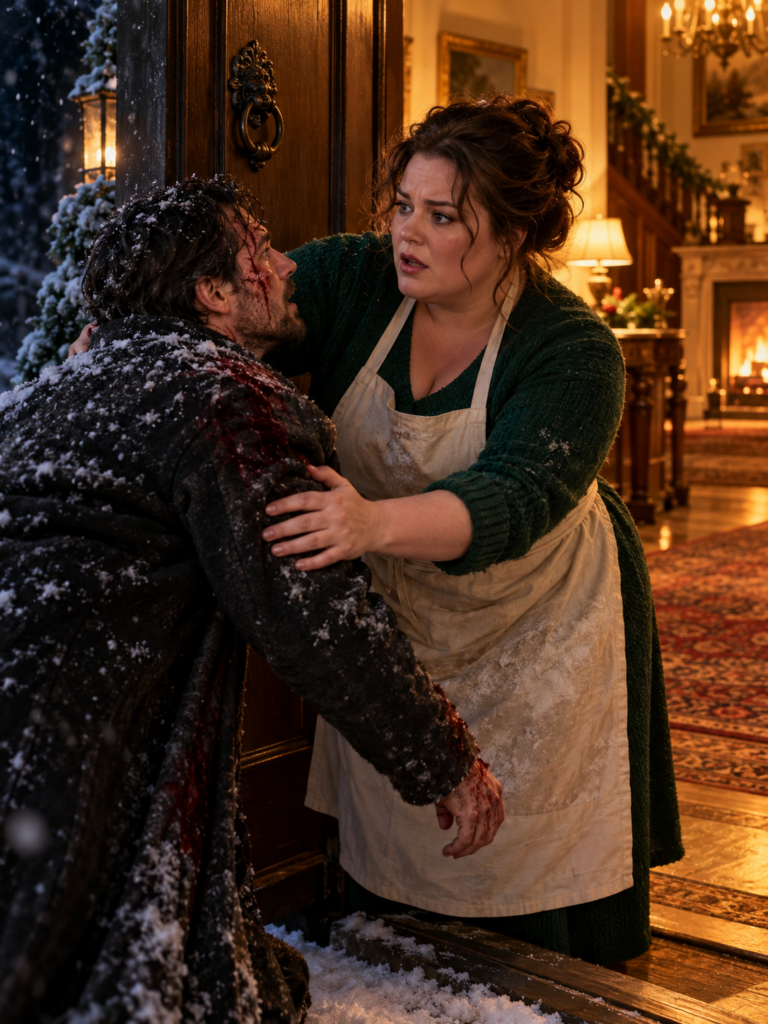
Josephine moved away from the lamp and crossed directly to the window before either man could stop her.
Gabriel forced himself upright.
“Get down.”
She ignored the command, staying to the side of the curtain as Leo had just shown her and lifting the fabric only enough to see the drive.
One vehicle.
Old pickup.
No headlights now.
It rolled toward the house and stopped.
Leo drew his pistol.
Josephine glanced at him.
“Put that where no one downstairs can see it.”
“Mrs. Moretti—”
“There are people in this house who trust me. I will not have somebody frightened into making a mistake because armed men suddenly start running through my hallways.”
Gabriel stared.
“People?”
Josephine finally looked at him.
“Yes, Gabriel. People.”
A knock sounded below.
Three short taps.
Josephine exhaled.
“I know who that is.”
“You don’t know who might be using him,” Gabriel said.
That stopped her.
It was the first advice he had given since arriving that sounded like caution rather than command.
She considered it.
Then nodded to Leo.
“You go downstairs with me. Stay out of sight until I open the door.”
Gabriel pushed his legs toward the side of the bed.
Mitchell shoved him back.
“You will do absolutely nothing.”
“This could be Costa.”
“And if it is, you’ll bleed to death halfway down the stairs and become an obstacle.”
Josephine left before Gabriel could argue.
Leo followed.
At the bottom of the staircase she paused, listening.
Another knock.
Three taps.
Then a familiar voice.
“Jo? It’s Daniel from the lumber yard. I saw lights go dark. Everything all right?”
Josephine’s shoulders loosened slightly.
She opened the inner door but left the dead bolt secured.
“Daniel?”
“Storm’s getting worse. I was bringing salt for the east steps. There’s a strange car behind your carriage house.”
Josephine exchanged a look with Leo.
Daniel continued.
“And tire marks at the lower road. More than one vehicle, I think.”
Leo’s expression sharpened.
“How many?”
Daniel startled at the unfamiliar male voice.
Josephine answered before suspicion could grow.
“Friends had trouble on the road. Leo’s helping me.”
That was technically true.
She hated how easily danger demanded selective honesty.
Daniel lowered his voice.
“Want me to call Sheriff Barnes?”
Josephine looked at Leo.
He shook his head sharply.
Gabriel’s world wanted secrecy.
Her world survived through connection.
For the first time, those two systems collided in her foyer.
“Not yet,” she said. “But tell Helen and Maria not to come in tomorrow morning. Tell anyone nearby the road is iced over.”
Daniel hesitated.
“You sure?”
“No.”
That honesty surprised even Josephine.
“But I will call if I need help.”
She locked the door again after he left.
Leo said, “That man would come back if you asked.”
“So would twenty others.”
He stared at her.
Josephine lifted her chin.
“Gabriel built loyalty one way. I built it another.”
When she returned upstairs, Gabriel had heard enough from the landing to understand.
“You created a network.”
“I created neighbors.”
“For people like Costa, there’s no difference.”
“For people like you, maybe there never was.”
The words struck cleanly.
Gabriel did not defend himself.
Josephine walked to the bed.
“Now tell me why three sets of tire marks may be coming toward my house.”
Gabriel looked at Leo.
Leo looked away.
Josephine saw it.
“What aren’t you saying?”
Gabriel’s jaw worked.
“Simon knew I had property interests in New York.”
“You said Costa didn’t know this place.”
“I said I believed they didn’t.”
“That is not the same thing.”
“No.”
The admission made her angrier than an excuse would have.
“You came here without knowing whether you were bringing armed men behind you.”
“I was bleeding out.”
“And apparently that made my consent optional.”
Gabriel flinched.
She saw it.
Good.
Because eight months ago his decisions had nearly killed her, and tonight his desperation had again placed consequences at her door.
“I am not throwing a wounded man into a blizzard,” she said. “But from this moment on, nobody makes decisions about Oak Haven without me.”
Gabriel nodded.
Josephine held his gaze.
“I need words.”
“Yes.”
“And if staying here puts the people around me in danger?”
His expression changed.
“Then I leave before dawn.”
She had expected resistance.
The immediate answer unsettled her more.
“You would?”
“Yes.”
“Even injured?”
“Yes.”
“Even if leaving makes you easier to kill?”
Gabriel looked toward the warm room around him.
“That stopped being the most important question when you opened the door.”
Josephine felt something shift inside her and hated it.
Because she did not want tenderness from him yet.
Tenderness complicated anger.
Downstairs, glass shattered.
Leo spun toward the hallway.
Gabriel reached instinctively for the pistol that was no longer beside him.
Josephine was already moving.
“Stay here.”
“Josephine—”
She looked back.
“My house.”
Then she ran toward the stairs.
Josephine reached the ground floor before Leo could overtake her.
The broken glass had come from the kitchen.
She stopped outside the doorway.
No footsteps.
No voices.
Only wind.
Leo caught her shoulder before she entered.
“Wait.”
Unlike Gabriel’s grip earlier, his touch was warning rather than restraint. Josephine accepted it and moved behind him.
They entered together.
A pane beside the back door had cracked inward.
Snow powdered the floor.
Leo crouched.
“Impact from outside.”
Josephine pointed.
“There.”
A branch lay half buried near the threshold.
Wind had torn it loose from one of the old maples.
Leo exhaled.
“Storm.”
“Good.”
But Josephine’s relief lasted only seconds.
She noticed something beyond the broken pane.
Tracks.
Not tire tracks.
Footprints.
A single line crossed the snow near the greenhouse and disappeared toward the trees.
“Leo.”
He saw them.
His body went still.
“Those aren’t Daniel’s.”
“No.”
“How do you know?”
“He came from the front road.”
That answer changed the room.
Leo lifted his phone.
No signal.
The storm had swallowed it.
“We lock everything.”
Josephine nodded.
But instead of retreating upstairs, she walked to a narrow cabinet near the pantry and removed an old brass ring holding six keys.
“What are those?”
“Parts of this house Gabriel never bothered to learn.”
They moved through the ground floor together, securing doors and checking windows.
The manor had belonged to Josephine’s mother before illness and family debt turned it into an abandoned burden. Josephine had spent childhood summers there. She remembered which windows stuck in wet weather, which stair groaned near the library, and which servants’ corridor reached the kitchen without crossing the central hall.
She had not thought of those memories as skills.
Tonight they became a map.
When they returned upstairs, Gabriel was standing.
Barely.
His skin had gone gray.
Josephine stopped in the doorway.
“You were told to stay in bed.”
“I heard glass.”
“And?”
“And you ran toward it.”
“Yes.”
Gabriel looked furious.
Not at her.
At himself.
“I brought this here.”
Josephine crossed the room.
“Sit before you fall.”
He obeyed.
Again.
Leo described the footprints.
Gabriel’s eyes sharpened despite the fever beginning behind them.
“One person?”
“That we saw.”
“Could be reconnaissance.”
Josephine spoke.
“Then we assume someone may already know the property.”
Gabriel turned toward her.
“You should take your people and leave.”
“My people live here.”
“I mean tonight.”
“So they drive into a blizzard because your enemies might be outside?”
“Yes.”
“No.”
His voice hardened.
“Josephine.”
She stepped closer.
“You promised nobody makes decisions about Oak Haven without me.”
“This is different.”
“Because now you’re frightened?”
“Because now I know the threat.”
“And you think knowledge transfers authority to you?”
The question silenced him.
Leo glanced toward the door, suddenly interested in anything else.
Gabriel lowered his voice.
“I know what these men are capable of.”
“Then explain it.”
He hesitated.
Josephine almost laughed.
“Exactly.”
The old Gabriel had returned for one reflexive second: hide the truth, issue orders, call secrecy protection.
She turned away.
“Until you tell me what I’m facing, I cannot make an informed choice. So your concern for my safety means nothing if you keep removing the information I need to protect myself.”
Gabriel absorbed every word.
Then he did something Josephine had never seen him do.
He surrendered.
“Simon gave the Costas access to shipment routes, two safe houses, and the names of men loyal to me. Three nights ago he also stole financial records that could destroy what remains of my organization.”
Josephine faced him.
“What kind of records?”
“Payments. Accounts. Properties.”
“Oak Haven?”
“I don’t know.”
“Was it listed?”
Gabriel looked ashamed.
“Yes.”
Her stomach tightened.
“So you didn’t come to a place they couldn’t find.”
“I came to the least likely place they would check first.”
“That distinction might get someone killed.”
“I know.”
There was no defense in his voice.
Only fact.
Josephine paced to the window.
“What does Simon want?”
“My territory.”
“Then why not let him have it?”
Leo stared at her as though she had suggested dismantling the moon.
Gabriel did not.
Instead he looked tired.
“Eight months ago I would have said because surrender is weakness.”
“And now?”
“I’m beginning to think keeping something simply because men died acquiring it might be another kind of weakness.”
Josephine studied him.
The answer frightened her.
Because it sounded genuine.
And genuine change was much harder to dismiss than cruelty.
She turned to Leo.
“Are there weapons in this house?”
Leo hesitated.
Gabriel answered.
“One pistol in my coat. Leo has two.”
Josephine thought of the locked cabinet in the old hunting room.
Her grandfather’s rifles had remained with the property.
She disliked guns. Her grandfather had taught her basic handling as a teenager, but she had not touched one since her mother died.
“I know where there are more.”
Gabriel’s eyes narrowed.
“No.”
Josephine gave him a look.
He corrected himself.
“If you choose to retrieve them, Leo goes with you.”
Better.
She nodded.
The hunting room smelled of cedar and oil.
Most of the cabinet contents were old.
Leo inspected the firearms, setting aside anything unsafe.
Josephine watched his hands carefully.
“Show me the safety again.”
“You’ve used one?”
“A long time ago.”
“That isn’t the same as tonight.”
“No. Which is why I asked you.”
Leo demonstrated.
Josephine repeated the procedure until he was satisfied.
She chose her grandfather’s double-barreled hunting gun because she remembered its weight.
Not because she intended to become a soldier.
Because she refused to be ignorant inside her own home.
They returned upstairs.
Gabriel looked at the weapon in her hands and went pale for an entirely different reason.
“You shouldn’t have to do that.”
“No,” she said. “I shouldn’t.”
His gaze dropped.
That was the accountability she needed more than gallantry.
Hours passed.
The storm worsened.
No one came.
Dr. Mitchell slept in a guest room because the roads were impassable. Leo monitored the lower floors.
Gabriel’s fever climbed.
Josephine stayed because abandoning a sick person was not something she could do—even when the sick person had once abandoned her.
Near three in the morning, Gabriel woke from a fever dream and grabbed her sleeve.
“Don’t lock the door.”
Josephine froze.
He was not fully conscious.
“Gabriel?”
His breathing was uneven.
“Simon… don’t let him lock it.”
She frowned.
“What door?”
Gabriel’s eyes opened.
For the first time she saw fear in them without anger covering it.
He released her.
“Nothing.”
“That wasn’t nothing.”
He looked toward the fire.
Josephine waited.
Eventually he spoke.
“When I was seventeen, my father suspected one of his men had talked to federal agents. The man’s son was my age. My father locked us both in a warehouse office while he questioned the father downstairs.”
Josephine said nothing.
“He wanted me to understand what betrayal cost.”
“What happened?”
“The man died.”
“And his son?”
“Never forgave me.”
“Were you responsible?”
“No.”
Gabriel’s mouth twisted.
“But I learned the lesson my father wanted anyway. Trust gets people killed. Information is leverage. If you care about someone, you keep them outside the room where decisions are made.”
Josephine looked at him for a long moment.
“And that is what you did to me.”
“Yes.”
“No. You did worse. You left me alone in the room and walked away.”
Pain crossed his face.
“Yes.”
She expected apology.
Instead Gabriel said, “Dr. Mitchell told me you almost died.”
“He told you the truth.”
“I didn’t know.”
“You didn’t ask.”
Another silence.
Gabriel nodded.
“I didn’t ask.”
Josephine sat back.
Months ago she had imagined this conversation. In those fantasies Gabriel always begged quickly enough to satisfy her anger.
Reality was slower.
More uncomfortable.
And somehow more meaningful.
“I called my father the first month,” she said. “His number was disconnected.”
Gabriel’s face hardened.
“I can find him.”
“I didn’t ask you to.”
The impulse to solve her pain with power died on his face before he spoke.
“What do you want?”
There it was.
A question.
Not an order.
Josephine looked toward the snow-dark window.
“I wanted to live.”
Gabriel closed his eyes.
“So I called Mitchell. I fired Gallagher. I fixed the boiler. Then the lumber yard needed money and I needed income beyond what you deposited.”
“You invested it.”
“Yes.”
“You never told me.”
“You never called.”
He accepted that too.
“I turned the south acreage into greenhouse space. The town buys produce cooperatively. The manor hosts dinners and book groups. Maria handles schedules. Helen manages supplies. I keep the accounts.”
Gabriel almost smiled.
“You built an operation.”
“I built a community.”
“Stronger than an operation.”
Josephine’s expression softened despite herself.
“You really don’t know what to do here, do you?”
“No.”
“With people who aren’t afraid of you.”
“No.”
“With me.”
His answer took longer.
“No.”
For the first time, Josephine believed him.
Then the perimeter alarm sounded.
Leo appeared instantly.
“Three vehicles at the main gate.”
Gabriel swung his legs down.
Josephine was already standing.
Leo checked the monitor.
“They rammed it.”
A crash boomed through the night.
The house trembled.
Gabriel reached for his coat.
Josephine caught it first.
“You cannot fight with that shoulder.”
“They came for me.”
“They came onto my property.”
“That doesn’t mean—”
A second crash cut him off.
Leo looked at the screen.
“Gate’s down.”
Gabriel stood anyway.
“I draw them east. You and Josephine take the cellar.”
“No,” Josephine said.
Gabriel’s head snapped toward her.
“The cellar is the worst place to go.”
“Why?”
“No exit.”
“That’s the point of a cellar.”
“Not this one.”
She seized the key ring.
“My great-grandfather moved whiskey through this valley during Prohibition. There is a tunnel beneath the wine cellar leading toward the old salt works.”
Leo stared.
Gabriel almost laughed from disbelief.
“You have a smuggling tunnel?”
“I told you that you never learned this house.”
Gunfire cracked outside.
Windows shattered downstairs.
Josephine grabbed the hunting rifle.
Gabriel’s expression changed.
“Josephine.”
She met his eyes.
“You wanted me informed enough to choose?”
He nodded slowly.
“I choose not to die in my own hallway.”
This time he did not argue.
“Lead the way.”
They moved.
Josephine guided them through the dark service corridor beside the library as heavy footsteps entered the front hall.
Leo killed the remaining lights.
The three of them descended a narrow stone staircase concealed behind a pantry panel.
Gabriel stumbled once.
Josephine caught him.
His good hand settled on her shoulder.
“Sorry.”
“Save your strength.”
They reached the wine cellar.
Josephine found the rusted lever behind an empty cask and pulled.
Nothing happened.
Leo joined her.
Together they forced it down.
Stone ground against stone.
A black opening appeared.
Cold air poured from the tunnel.
Leo entered first and switched on his flashlight.
Josephine followed.
Gabriel remained at the threshold.
Footsteps thundered down the cellar stairs.
“Gabriel.”
He turned.
Three armed men appeared in the doorway.
Gabriel shoved Josephine into the tunnel.
“Go!”
Then he slammed the stone panel shut between them.
The stone door sealed with a grinding impact.
Josephine spun instantly and grabbed the lever from the tunnel side.
It would not move.
“Gabriel!”
Gunfire exploded beyond the wall.
Leo seized her arm.
“We keep moving.”
She ripped free.
“He’s trapped.”
“He chose that.”
“So?”
“He bought us time.”
“He does not get to buy my decisions with his life either.”
Another burst of gunfire sounded.
Then a crash.
Then silence.
Josephine’s heart slammed so hard it hurt.
Leo looked torn between orders and reality.
“Mrs. Moretti—”
“Can that door be opened from this side?”
He examined the mechanism.
“Yes. But if we do it, we expose the tunnel.”
“Then you go farther down and cover it.”
“You’re planning to open that?”
“Yes.”
“Gabriel will kill me.”
“If he survives, he can complain.”
Leo almost smiled despite everything.
Then a single gunshot cracked beyond the stone.
Josephine’s decision became immediate.
“Move.”
Leo retreated several yards.
Josephine pulled the lever.
This time the mechanism shifted.
The door opened six inches.
She heard furniture splinter.
A man cursed.
Gabriel groaned.
Josephine widened the gap.
The cellar came into view.
One attacker lay motionless near a broken rack.
Another had fallen beside the stairs.
A third stood over Gabriel.
Gabriel was on one knee.
Blood darkened his shoulder again.
His pistol lay several feet away.
The attacker raised his weapon.
Josephine did not remember deciding.
Her body moved through remembered instructions.
Stock against shoulder.
Feet planted.
Breathe.
Aim.
Her grandfather’s old hunting gun thundered.
The blast filled the cellar.
The attacker collapsed.
Silence followed.
Josephine stood frozen.
Smoke curled in front of her.
Her hands began to shake.
Gabriel looked up.
Not triumphant.
Not proud.
Horrified.
He crossed the distance as quickly as his injury allowed.
“Give me the gun.”
Josephine backed away.
“No.”
His expression changed instantly.
“All right.”
He stopped.
No command.
No grabbing.
“Josephine, look at me.”
She did.
Her breath came too fast.
“I shot him.”
“Yes.”
“He was going to kill you.”
“Yes.”
Her eyes filled.
Gabriel swallowed.
“I am sorry.”
The words broke something open.
Not because she needed absolution for saving him.
Because he understood what his world had cost her.
Leo approached slowly and took the weapon only after Josephine finally extended it voluntarily.
Gabriel remained where he was.
She wiped at her face angrily.
“I hate this.”
“I know.”
“I hate what you brought here.”
“I know.”
“I hate that I had to do that.”
“I know.”
Gabriel’s voice cracked on the last answer.
Josephine looked at him.
The man who had once measured strength by the ability to inflict fear was standing injured and unarmed, giving her distance because she had asked for it without speaking.
Something fundamental had changed.
Not enough.
But something.
Sirens became audible through the storm.
Leo stiffened.
“Police.”
Josephine looked toward him.
“I told Daniel I would call if I needed help.”
“You didn’t.”
“No.”
“He must have.”
For once, Gabriel seemed relieved by a system he did not control.
Local officers arrived with Sheriff Barnes and Dr. Mitchell, who had awakened during the shooting and called from the upstairs landline once service returned.
The aftermath was ugly, complicated, and impossible to conceal entirely.
Josephine refused to allow Gabriel’s name or money to settle it quietly.
That surprised everyone except Gabriel.
“I will give a statement,” she said.
Leo looked alarmed.
“About everything?”
“About what happened in this house.”
Gabriel stood beside her, arm back in a sling.
“You should.”
She studied him.
“You understand what that could mean for you?”
“Yes.”
“You could be arrested.”
“Yes.”
“You’re still telling me to do it?”
“I’m not telling you.”
His eyes held hers.
“I’m saying the choice is yours.”
That answer mattered.
Sheriff Barnes documented the forced entry, the weapons, the men who had breached the property, and Josephine’s shot in defense of Gabriel. Gabriel provided information identifying the attackers as Costa associates and, more importantly, turned over the account records Leo still possessed.
By morning, the snow had stopped.
The valley was painfully bright beneath fresh white.
Josephine stood alone in the kitchen, both hands wrapped around a mug she had forgotten to drink.
Gabriel entered quietly.
He looked terrible.
Pale.
Exhausted.
Human.
“You should be lying down.”
“I wanted to speak before I leave.”
Her fingers tightened around the mug.
“You’re leaving?”
“Yes.”
The word hurt more than she expected.
She resented that.
Gabriel stayed several feet away.
“The Costas will keep coming if I remain useful to them as an enemy.”
“So what will you do?”
“End the reason.”
Josephine waited.
“I’ve already told Leo to contact the five families. I’m surrendering the Boston territories.”
She stared.
“Just like that?”
“No.”
A humorless smile touched his mouth.
“Nothing in my life has ever been just like that.”
“Then why?”
Gabriel looked around the kitchen.
At bread cooling beneath a cloth.
At labeled jars.
At a vase of pine branches Maria had placed near the window.
At ordinary things.
“I spent my life believing power meant forcing the world to make room for me.”
His gaze returned to Josephine.
“You built power by making room for other people.”
She said nothing.
“I came here because I needed somewhere to hide,” he continued. “Then I watched twenty people become ready to stand between you and danger simply because you had treated them well.”
He shook his head.
“I had hundreds of men. The moment fear stopped working, most disappeared.”
“And Simon?”
“Simon stayed until somebody offered him more.”
Josephine understood.
“What happens to him?”
Gabriel’s old expression flickered.
Cold.
Lethal.
Then it changed.
“I gave the evidence to federal investigators through an attorney this morning.”
She blinked.
“You didn’t kill him.”
“No.”
“You wanted to.”
“Yes.”
The honesty mattered.
“Why didn’t you?”
“Because if I stay the man who solves every betrayal by creating a grave, stepping away means nothing.”
Josephine looked down at her coffee.
There it was.
Not redemption.
A first proof of changed behavior.
“What about the financial records?”
“They implicate me too.”
Her head lifted.
“How badly?”
“Badly enough.”
A long silence stretched between them.
“You could go to prison.”
“Yes.”
Fear moved through her before she could stop it.
Gabriel saw.
But he did not mistake it for forgiveness.
“I have attorneys negotiating surrender terms. Some of the businesses can be separated legally. Some cannot. Whatever happens, Oak Haven is yours without condition.”
“It was always mine.”
His expression tightened.
“You’re right.”
He reached inside his coat slowly and placed a folder on the kitchen table.
“No hidden clauses. No debt. No control from me. Your father’s obligation is terminated.”
Josephine stared at the folder.
“You could have done that months ago.”
“Yes.”
“Before I nearly died here.”
“Yes.”
“Before last night.”
“Yes.”
“Before I had to shoot someone.”
His face went white.
“Yes.”
She hated that he refused to soften the truth.
And loved it a little.
That frightened her most.
Gabriel stepped back.
“I cannot ask you to forgive me because I finally understand what I did.”
“Good.”
“I cannot ask you to love me because I changed one decision.”
“Good.”
“I can only stop making the same decisions.”
Josephine’s throat tightened.
Outside, an engine started.
Leo.
Gabriel looked toward the sound.
“I’ll send someone to repair the windows.”
“No.”
He looked back.
“I’ll hire someone.”
The corner of Josephine’s mouth almost moved.
“Right.”
Another correction accepted.
Gabriel nodded.
Then he turned toward the door.
“Gabriel.”
He stopped.
She had not meant to call him.
But she had.
“When you said you were leaving, where exactly are you going?”
“Albany first. Then wherever the attorneys tell me.”
“And after?”
“I don’t know.”
It was perhaps the first future he had ever admitted he could not control.
Josephine studied him.
Eight months earlier he had left her in a freezing manor because he had decided weakness made her disposable.
Now he stood waiting for her to choose whether the conversation continued.
Not because he lacked power.
Because he had finally learned power did not give him permission.
“You cannot stay here,” she said.
Pain crossed his face.
He hid it poorly.
“I understand.”
“Not now.”
He looked up.
Josephine set down her mug.
“I don’t know who you are without the syndicate.”
“Neither do I.”
“I don’t know whether this version of you lasts when there isn’t blood on the floor forcing you to reconsider your life.”
“That’s fair.”
“I don’t trust you yet.”
“I know.”
She folded her arms.
“But if you walk away and disappear for another eight months, that tells me something too.”
Gabriel did not move.
“What are you asking?”
Josephine almost smiled.
“I’m not sure.”
He waited.
She realized that might be the answer itself.
“I want you to handle the surrender. I want you to tell the truth about your part in what happened. I want you to accept whatever legal consequences come from that without using me, this property, or the people here as leverage.”
Gabriel nodded.
“And?”
“When that is done, you can call.”
His breath changed.
“One call?”
“One.”
A faint smile appeared.
“And if you don’t answer?”
“Then you have your answer.”
The smile vanished, replaced by seriousness.
“Understood.”
He left.
This time the front door did not sound like abandonment when it closed.
Josephine stood in the foyer for several minutes afterward.
Then she turned toward the damage.
Three shattered windows.
Broken wine racks.
A damaged cellar door.
Blood that would need professional cleaning.
A greenhouse roof cracked by wind.
Life had not become a fairy tale.
So Josephine went back to work.
Over the following months, the Costa organization fractured under arrests, financial seizures, and testimony from men who preferred prison deals to dying for territory.
Simon was arrested trying to leave the country.
Gabriel surrendered financial records, property information, and testimony about syndicate operations he had once sworn nobody would ever possess.
His attorneys negotiated aggressively.
But Josephine learned through Leo that Gabriel refused one proposed condition involving Oak Haven.
He would not claim the marriage or Josephine’s medical condition made him necessary to her welfare.
“He told them you survived him,” Leo said.
Josephine looked away before he could see what that did to her.
Gabriel eventually received a combination of strict supervision, asset forfeiture, and cooperation requirements rather than disappearing into a federal prison for decades. Much of his criminal wealth vanished.
The legitimate holdings that remained were enough for him to live comfortably.
He sold most of them anyway.
Not to impress Josephine.
She would have rejected that.
He used part of the proceeds to fund restitution attached to businesses harmed by the syndicate.
The rest he placed under independent management.
Then he called Oak Haven.
Josephine watched the telephone ring.
Once.
Twice.
Three times.
Maria looked at her from across the kitchen.
“You going to get that?”
Josephine wiped flour from her fingers.
“Yes.”
She answered.
“Hello?”
Gabriel’s voice came quietly.
“It’s me.”
“I know.”
A pause.
“I finished.”
“I heard.”
Another pause.
“I’m not asking to come back.”
Josephine leaned against the counter.
“Good.”
“I’m asking whether you would have dinner with me.”
She smiled despite herself.
“Where?”
“Somewhere public.”
“That sounds very cautious.”
“I’ve learned caution.”
“Have you?”
“I’m trying.”
Josephine looked through the kitchen window toward the greenhouse.
Spring had returned.
Green shoots pushed through dark soil where snow had covered everything months earlier.
“Friday,” she said.
Gabriel exhaled.
“Friday.”
Their first real date happened almost a year after their wedding.
Not in Boston.
Not at Oak Haven.
At a small restaurant halfway between the manor and Albany where nobody knew Gabriel’s old title and nobody treated Josephine like collateral in a family debt.
He arrived early.
She arrived separately.
That mattered to her.
So did the fact that he did not send a driver.
He stood when she approached the table.
Josephine wore burgundy.
Gabriel looked at her the way he had on the night he returned to Oak Haven, except there was no blood, no desperation, no shock.
Only attention.
“You look beautiful.”
Josephine sat down.
“I was beautiful when you married me.”
His mouth curved.
“Yes.”
“And?”
“And I was too blind and too hollow to see it.”
She blinked.
“You remember.”
“I remember everything you said that morning.”
“Useful survival skill.”
“I learned from an expert.”
Dinner was awkward.
Then funny.
Then difficult.
Josephine asked him about the men harmed by his organization.
He answered.
He asked about the months she had been sick.
She answered.
Neither softened the past.
That became the beginning.
Not forgiveness.
Beginning.
Gabriel rented a modest house forty minutes away.
He visited only when invited.
At Oak Haven, he learned to repair fences badly, stack firewood adequately, and follow greenhouse instructions with embarrassing seriousness.
The first time he tried to reorganize Josephine’s supply system without asking, she stood in the doorway with her arms crossed.
He looked at the shelves.
Then at her.
“I did it again.”
“Yes.”
“I’ll put it back.”
“Yes.”
He did.
No argument.
That mattered more than roses ever could.
Months later, when the lumber cooperative expanded, Josephine created a formal board rather than keeping control solely in her hands.
Gabriel attended one meeting as a guest.
He did not speak until invited.
When a local businessman assumed Gabriel was the financial authority because he was Josephine’s husband, Gabriel corrected him.
“You need Mrs. Moretti. She built this.”
Josephine heard.
She said nothing until later.
Then she kissed him for the first time.
Not because he had rescued her.
Not because he had surrendered territory.
Not because he had suffered.
Because he had finally understood that loving her required no ownership of what she had built.
Gabriel froze when her mouth touched his.
Josephine drew back.
“You can breathe.”
He laughed.
“I wasn’t sure I was allowed.”
“You were.”
“Past tense?”
She kissed him again.
This time he kissed her back.
Slowly.
Carefully.
Asking without words and listening to the answer.
Another year passed before Gabriel moved into Oak Haven.
Even then Josephine made the conditions clear.
“The house remains legally mine.”
“Yes.”
“The cooperative remains mine.”
“Yes.”
“You do not make security decisions without me.”
“Yes.”
“You do not disappear because you think silence protects me.”
“Yes.”
“You tell me when you’re afraid.”
Gabriel frowned.
“That one seems unnecessarily cruel.”
Josephine smiled.
“It stays.”
He sighed.
“Yes.”
“And if we ever reach a point where fear turns you back into the man who believes control equals care?”
“I tell you.”
“No.”
She touched his chest.
“I tell you.”
Understanding entered his face.
“And I listen.”
“Yes.”
He covered her hand with his.
“And if listening isn’t enough?”
“Then I choose what happens next.”
Gabriel nodded.
“Agreed.”
Their marriage had begun as a transaction neither had chosen freely.
What followed could not erase that.
So they did something unusual.
They chose each other afterward.
Oak Haven continued to change.
The damaged wine cellar became a community dining room after Josephine decided she wanted no shrine to the violence that happened there.
The old smuggling tunnel was reinforced and legally inspected, then mostly forgotten except as one of the strange stories attached to the property.
The kitchen expanded.
The greenhouse doubled.
Sunday dinners grew so crowded that Gabriel often ate standing beside the counter.
He seemed happiest there.
Not at the head of a table.
Simply included.
One winter evening, years after the night he returned bleeding, Josephine found him carrying firewood toward the boiler room.
She leaned against the doorway.
“You know we have an automatic system now.”
Gabriel looked at the logs in his arms.
“You said the boiler needed wood.”
“That was years ago.”
“You also said I owed you a wine cellar.”
“You did.”
“I paid that debt.”
Josephine raised an eyebrow.
“Did you?”
Gabriel smiled.
“No. I suppose I’m still working on it.”
She walked toward him.
Her health still required care. There were difficult weeks, medications, respiratory infections, and days when rest mattered more than productivity.
Gabriel never again treated those limits as weakness.
More importantly, neither did Josephine.
She no longer measured survival by pretending her body needed nothing.
She had learned that strength included choosing help without surrendering authority.
Gabriel had learned something similar.
He set down the firewood.
Josephine slipped her arms around him.
Outside, snow began falling across Oak Haven.
The same kind of snow that had once surrounded a freezing house where she believed nobody was coming.
Now light glowed from every first-floor window.
Voices drifted from the library.
Bread baked in the kitchen.
Somewhere upstairs, a radiator hissed steadily.
Gabriel rested his forehead against hers.
“Home?” he asked.
Years ago he would have announced where she belonged.
Now he asked.
Josephine looked around the house she had saved, at the life she had built before he earned any place inside it, and then back at the man who had finally learned that love was not possession, rescue, debt, or command.
“Yes,” she said.
But she smiled before adding the part that mattered most.
“Home.”
And this time, when Gabriel held her, Josephine stayed because staying was entirely her choice. :chatgpt-content-reference{index=”0″}


