
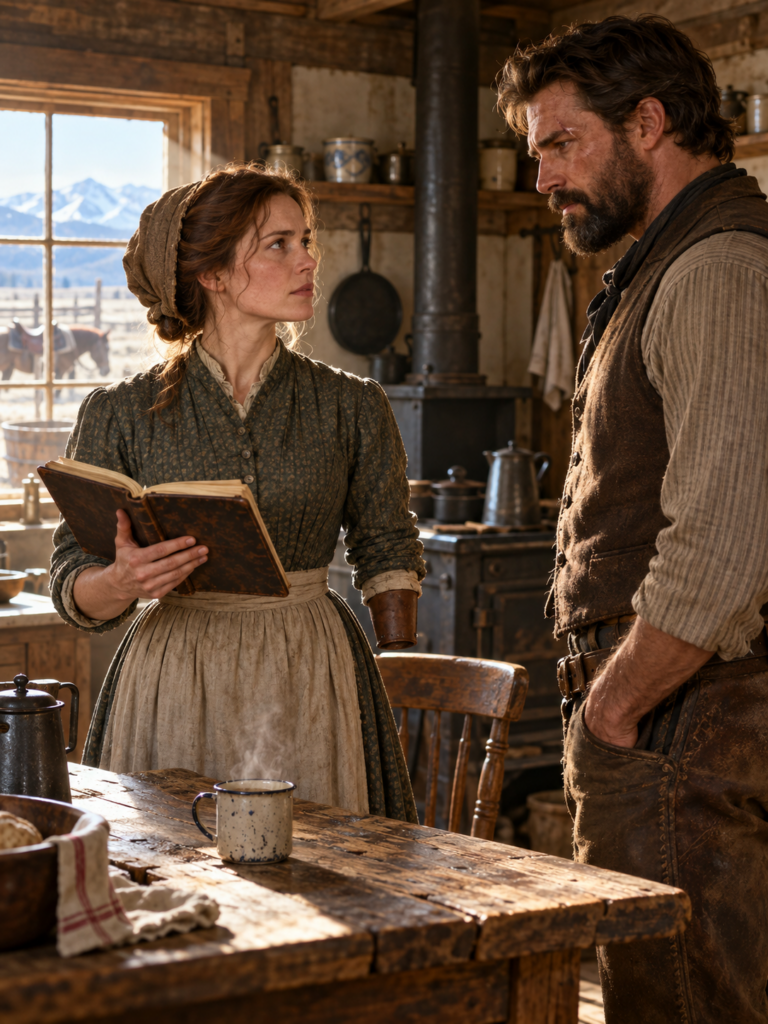
The ledger slid across the pine table and stopped against the stranger’s hand.
“Before you decide what I can do,” Ada said, “perhaps you’d care to explain these numbers.”
The man looked down.
He was lean, gray at the temples, and dressed in the dust-stiffened clothes of someone who spent more time horseback than indoors.
“What’s this?”
“An account showing your employer has paid for feed he never received.”
His expression tightened.
Ezra moved beside the table.
“Cooper Vance,” he said, “this is Miss Merritt. She’s keeping the books.”
Cooper glanced at her cuff again.
“With one hand?”
“With a sound head,” Ezra replied. “Which is what I hired.”
Ada refused to let either man turn her into an argument.
She tapped the ledger.
“The feed deliveries are entered twice in some places, and the weights don’t match the invoices. I’d like to examine the receipts before accusing anyone of dishonesty.”
Cooper looked surprised.
“You think somebody’s stealing?”
“I think sixty dollars hasn’t been accounted for. That is all I can prove today.”
Ezra studied her.
Then he crossed to a shelf and brought down a battered wooden box.
“Every receipt I’ve kept.”
Ada lifted its lid.
The papers inside were crumpled, faded, and badly sorted.
She almost smiled.
“Mr. Colton, I’m beginning to understand why you need a bookkeeper.”
Cooper let out a reluctant grunt.
Ezra’s mouth twitched.
But the amusement vanished when a woman appeared in the passage carrying a folded apron.
“She’s got a room here, then?”
“Mrs. Purdy,” Ezra said, “show Miss Merritt where she’ll be sleeping.”
The older woman surveyed Ada without embarrassment.
“Can you eat stew?”
“Certainly.”
“Good. Can you stand somebody who doesn’t tolerate fussing?”
“I’ve had considerable practice.”
“Then you’ll do.”
Mrs. Purdy led Ada to a small room off the kitchen.
A narrow bed stood beneath the window, with a washstand, a plain wooden chair, and enough space for her trunk.
For two years, Ada had been staying in rooms where everything she touched seemed to remind somebody of what she could no longer do.
This room held no such reminders.
She placed her belongings on the bed.
“Does Mr. Colton always speak so little?”
Mrs. Purdy glanced toward the kitchen.
“More than he used to.”
“Used to?”
The older woman hesitated.
“He was a different man once.”
Before Ada could ask more, voices rose from the adjoining room.
Cooper was still arguing.
“Counting figures isn’t the same as keeping up with ranch work. What happens when something needs doing that requires two hands?”
Ada stepped back into the kitchen.
“Then someone with two hands can do that particular task,” she answered. “Just as someone who can balance accounts ought to balance them instead of leaving the work to a man who cannot.”
Cooper blinked.
Mrs. Purdy made a suspicious choking sound behind her.
Ezra examined the table with unnecessary concentration.
Ada continued.
“I came here for bookkeeping. I didn’t offer to rope cattle or shoe horses. If you need somebody to do either, I suggest hiring the right person.”
Cooper scratched his jaw.
“Well.”
It appeared to be the only word he could find.
Ezra nodded toward the yard.
“North fence needs checking, Cooper.”
The older ranch hand took the dismissal and left.
When the door shut, Ada closed the ledger.
“I don’t want you fighting every man who notices my hand.”
Ezra looked at her.
“I wasn’t fighting.”
“You were about to.”
“Cooper needed reminding what job I hired you for.”
“Then remind him of my work. Let that speak for me.”
For a moment, the rancher seemed almost offended.
Then he nodded.
“Fair enough.”
Ada appreciated that answer more than an apology.
She returned to the table and opened the next bundle of receipts.
Ezra lingered.
Finally, he said, “The old bookkeeper worked here twenty years. His sight failed near the end. I couldn’t bring myself to dismiss him.”
There was something quietly painful in his voice.
Ada looked up.
“That’s why the books were left like this?”
“He died two winters ago. I haven’t found anyone willing to take on the mess.”
“And now you have.”
“Seems so.”
She began separating receipts by date.
Ezra watched her for a moment before turning toward the door.
At the threshold, he stopped.
“Miss Merritt, there’s one more thing you ought to know about this place.”
His voice had changed.
“The last woman who lived here was my wife.”
Ada’s fingers stilled over the papers.
Ezra looked toward the barn outside, his jaw tightening.
“She died six years ago. I don’t speak about it much.”
He reached for the door latch.
“And I don’t know that I’m prepared to have this house feel occupied again.”
Ada stood, gathered the loose receipts against the ledger, and stepped toward him.
“Mr. Colton,” she said quietly, “are you asking me to leave before I’ve worked a single day?”
Ezra’s hand remained on the door latch.
“No,” he answered.
Ada held the receipts close against her waist.
“Then I’ll keep the position until you have a reason to dismiss me.”
He looked back at her.
“That’s reasonable.”
“And if having another person in the house troubles you, I’d rather you say so directly than arrange matters until I feel unwelcome.”
Something in his expression softened.
“I believe you would.”
She returned to the table.
“Now, unless your cattle intend to wait for your discomfort to pass, I’d best find out where that sixty dollars went.”
This time, Ezra actually smiled.
It was brief and uneven, as though the muscles had forgotten the work.
But Ada saw it.
And she remembered it.
By the end of her first week, she had identified the source of the missing money.
For months, one supplier had recorded loads heavier than those the ranch had received. His invoices had been accepted without anyone comparing them against the wagon records.
Ada arranged the evidence in three neat columns.
When Ezra examined her work, he sat for a long time without speaking.
Then he said, “Whitcomb would have liked you.”
“Your former bookkeeper?”
“He never trusted a number until he’d asked it three questions.”
“Then I suspect we’d have gotten along.”
Ezra marked the corrected pages with her initials.
A.M.
She noticed.
“What’s that for?”
“So whoever reads these books later knows who straightened them out.”
Ada looked at the small letters.
For two years, employers had studied the end of her arm before they considered her name.
Here, her name was being placed on work she could take pride in.
She looked away before he could see how much it meant.
The first month passed with more labor than Ada had known since before the mill accident.
She rose early to catch the best of the morning light.
At the kitchen table, she sorted invoices, checked feed purchases, examined wages, and rebuilt the ranch’s neglected accounting records.
She used the leather cuff on her left wrist to hold pages steady while she wrote with her right.
Some evenings her arm ached.
She found ways around it.
When she needed a document held flat, she placed a smooth wooden weight along its edge.
For bundles of receipts, she used string and a shallow tray.
She refused help she did not need.
And learned to accept help when it was useful.
The distinction mattered to her.
Mrs. Purdy understood it almost immediately.
One morning, after watching Ada struggle with a stubborn jar, the cook asked, “Want me to hold that while you turn it?”
“Yes, please.”
Mrs. Purdy held it.
Ada opened the lid.
Neither mentioned the matter again.
That was the beginning of their friendship.
The ranch’s youngest worker was Tobias Reed, a thin thirteen-year-old boy with an unruly cowlick and more questions than restraint.
His father had died some years earlier, and Cooper had become something between a supervisor and an uncle.
One afternoon, Tobias stood beside Ada’s table watching her sort invoices.
“Does your wrist hurt?”
Ada looked up.
“Sometimes.”
“Even though the hand’s gone?”
“Yes.”
He considered that.
“My father lost two fingers to a mower blade. He said they hurt after they were gone.”
“Then he and I shared an inconvenience.”
Tobias nodded gravely.
“Can you still ride?”
“I can. Though I haven’t ridden much since the accident.”
“Mr. Colton has a mare gentle enough for anybody.”
“Then perhaps you’ll introduce us.”
The boy brightened.
And went racing for the barn.
Ada watched him disappear, smiling.
He had not called her brave.
He had not told her she was unfortunate.
He had simply asked a question, believed the answer, and moved on.
How restful ordinary conversation could be.
Cooper required longer.
His first apology came without any spoken admission.
After Ada showed him the corrected feed accounts, he appeared beside her office table carrying a molasses cookie.
He put it next to her ledger.
“Mrs. Purdy made extra.”
Ada looked at the cookie.
Then at Cooper.
“Thank you.”
“Nothing to thank me for.”
He shuffled toward the door.
Ada broke the cookie in half.
“Mr. Vance?”
He stopped.
“The next time you have doubts about my work, ask me before you ask Mr. Colton.”
Cooper took a moment to consider that.
“All right, Miss Merritt.”
Afterward, he brought his own tallies to her without complaint.
Their cooperation slowly became companionship.
At the end of long days, they sometimes shared dry jokes about stubborn horses, careless suppliers, and the remarkable ability of grown men to lose perfectly useful receipts.
Ezra noticed.
He noticed far more than he admitted.
He saw Ada laughing over supper.
He saw Tobias following her from the kitchen to the barn, asking questions about arithmetic.
He saw Mrs. Purdy setting an extra cup on the table before Ada even appeared.
And he saw how the house sounded different.
Doors opened more often.
Conversation lingered.
Laughter traveled through rooms that had been quiet for six years.
At first, he welcomed it.
Then it frightened him.
One evening in November, he found Ada standing near the barn with Cooper.
The older hand had been describing a horse so determined to remove his hat that he finally tied it beneath his chin.
Ada laughed.
Not politely.
Not carefully.
She laughed until she had to cover her mouth.
Ezra stopped walking.
For a moment, the sight struck him with such force that he could not breathe easily.
A woman laughing beside his barn.
The sound of pleasure where silence had lived.
He remembered Louisa laughing in nearly the same place.
And then he remembered fire.
Smoke.
A horse driven almost beyond endurance.
His wife burning with fever while he sat helpless beside her bed.
Ezra turned away before Ada noticed him.
For the next three days, he became distant.
He spent evenings with the ranch hands.
He answered Ada’s questions politely but briefly.
When she entered the office, he found reasons to leave.
Ada endured it until the fourth evening.
Then he announced that he would provide an excellent reference if she wished to return to Larkspur before winter closed the roads.
She laid down her pen.
“Have I made an error in the books?”
“No.”
“Have I neglected my duties?”
“No.”
“Then why are you encouraging me to leave?”
“It’s a hard winter out here.”
“It was a hard winter when you hired me.”
He looked away.
“Town might offer easier circumstances.”
“Town offered me nothing at all.”
The words came out more sharply than she intended.
Ezra looked back.
She drew a slow breath.
“If you don’t want me here, I expect you to tell me plainly.”
He stood beside the window.
Beyond the glass, the barn made a dark shape against the last light.
“I saw you laughing with Cooper.”
Ada blinked.
“You’re dismissing me because I laughed?”
“No.”
“Then I confess I’m at a loss.”
Ezra pressed his palm against the window frame.
For several moments, he said nothing.
Then the words came.
“My wife died in a fire.”
Ada’s anger drained away.
“I know. Mrs. Purdy told me.”
“Then she probably told you I got Louisa out of the barn.”
“Yes.”
“She lived three days afterward.”
His shoulders tightened.
“I sat with her every hour. Kept thinking there must be something else I could do. Some doctor I hadn’t sent for. Something I hadn’t thought to try.”
His voice became rough.
“I’d pulled her out alive. I thought that meant I could keep her that way.”
Ada remained quiet.
He turned from the window.
“When I saw you laughing, I remembered what this place sounded like when Louisa was alive. And I realized how much I’d started listening for you.”
Ada felt her own breath catch.
Ezra lowered his gaze.
“I thought perhaps it would be wiser to have you go before either of us mistook ordinary kindness for something else.”
She considered him for a long moment.
“You’re afraid you’ll care for me.”
“Yes.”
“And rather than risk that, you intend to send me away?”
“I don’t know another sensible answer.”
“Then perhaps you should stop trying to answer a question I haven’t asked.”
He looked startled.
Ada rose from her chair.
“I came here because I needed honest work. I’ve found it. I’ve also found people I respect.”
She stepped closer.
“I don’t know what either of us might feel six months from now. But I won’t be dismissed because you are frightened by the possibility.”
Ezra stared at her.
“You have a fair point.”
“I usually do.”
A faint smile broke through his grief.
Ada looked toward the barn.
“What was she like?”
“Who?”
“Louisa.”
He had clearly expected almost anything except that question.
At last, he answered.
“She sang while she worked.”
“Was she good?”
“Terrible.”
Ada smiled.
“She must have enjoyed it.”
“More than anybody had a right to.”
He gave a small, astonished laugh.
“She named a hen after the preacher’s wife. Claimed they had the same walk.”
For the first time, he spoke of Louisa without sounding as though every word were being pulled from a wound.
Ada listened.
She did not offer to replace what he had lost.
She did not assure him he would never hurt again.
When he finished, she said, “You loved her very much.”
“I did.”
“That needn’t become something you’re forbidden to remember.”
He looked down at his hands.
“I’ve spent six years thinking that if I let myself care about anyone again, I’d be asking to lose them.”
Ada lifted her left wrist.
“I spent two years thinking my life couldn’t properly begin until I was the woman I used to be.”
She looked directly at him.
“Neither of us can live by waiting for what cannot be promised.”
Ezra slowly nodded.
He did not reach for her.
She did not ask him to.
But the following morning, he came to breakfast and sat in his accustomed chair.
When Ada entered, he poured her coffee.
Their eyes met.
Neither referred to the conversation.
Something between them had changed nonetheless.
The ranch settled into winter preparations.
The herd was moved toward sheltered pasture.
Feed stores were checked.
Hay was counted.
The north fence required attention after strong winds damaged a section of it.
Ada kept the accounts and helped where she could, learning which supplies disappeared fastest and which repairs could not safely be postponed.
One item troubled her.
A glass chimney on a bunkhouse oil lamp had cracked.
Cooper had intended to replace it months earlier.
Ada entered the replacement among necessary expenses and drew Ezra’s attention to it.
He promised to see it done.
Then the north fence came down again, and the men spent several days working against the worsening cold.
The lamp was set aside.
The order was forgotten.
Ada noticed its absence from the next supply return and made another mark beside the entry.
She intended to speak to Ezra that evening.
But the ranch was exhausted from fence work, and supper passed with little conversation.
She decided to mention it in the morning.
That night, the temperature dropped sharply.
Ada retired early.
In the small room off the kitchen, she took her father’s Bible from the bedside drawer and read the verse that had sustained her after the mill accident.
“Fear thou not; for I am with thee.”
Her father had spoken those words often.
She remembered him tracing the sentence beneath her childhood finger, patient even when his illness left him short of breath.
For years, she had believed faith ought to make fear disappear.
Now she wondered whether courage meant doing what was necessary while fear remained.
She closed the book.
Outside, the ranch lay still beneath the cold December sky.
Hours later, Mrs. Purdy seized Ada by the shoulder.
“Wake up!”
Ada opened her eyes.
The cook’s face was pale.
“Get your coat. The bunkhouse is burning.”
Smoke drifted past the window.
Ada sprang from bed.
By the time she pulled on her boots, orange light was already spreading across the yard.
Men shouted.
A horse screamed from the lean-to beside the bunkhouse.
And somewhere beyond the flames, Cooper Vance began calling the name of the boy who had been asking Ada arithmetic questions only that afternoon.
“Tobias!”
Ada reached the yard and saw Ezra standing perfectly still in the snow.
His eyes were fixed on the burning building.
He was looking at the fire.
But she understood that he was seeing another one.
Cooper stumbled toward them.
“The boy went back inside for his father’s pocketknife!”
Ada turned toward the doorway.
The west end of the bunkhouse was burning fiercely, but the lower passage near the entrance was still visible.
Cooper seized her arm.
“Don’t!”
She looked toward the trapped boy’s last known position.
Then toward Ezra.
She could wait for a frightened man to defeat the memory of six years.
Or she could act while there was still a way through.
“Get the horses away from that lean-to,” she ordered. “And keep water on the outside wall.”
Before Cooper could protest, she pulled her arm free, covered her mouth with her coat sleeve, and ran toward the open doorway.
Ada crossed the threshold into choking smoke.
Heat struck her face.
She crouched instinctively, searching the dim passage while burning straw crackled somewhere beyond the bunks.
“Tobias!”
A cough answered from the left.
She moved toward it.
The boy was lying beside an overturned bunk, his boot caught beneath a heavy wooden shelf that had fallen across the narrow passage.
His eyes widened when he saw her.
“Miss Merritt!”
“Keep your head low.”
“I can’t get loose!”
Ada knelt beside him.
She grasped his coat with her right hand and pulled.
His boot held fast.
Above them, flames were moving across the ceiling timbers.
She could feel heat building against the side of her face.
Outside, men shouted.
Somebody called her name.
She braced the leather cuff of her left wrist against the shelf and tried to lift it enough to free Tobias’s leg.
The wood barely moved.
For one terrible instant, she remembered the grist mill.
The trapped sleeve.
The relentless machinery.
The certainty that her body had become caught in something stronger than she was.
She forced the memory away.
This was not the mill.
The shelf was not a turning gear.
It could shift.
She planted her knee, changed the angle of her forearm, and drove her shoulder beneath the edge.
The shelf rose a little.
“Pull your foot!” she gasped.
Tobias twisted.
His boot slipped partly free.
Then a sharp crack sounded overhead.
Sparks fell across the empty bunk behind them.
Ada pushed harder.
The shelf shifted another inch.
“Now!”
Tobias tore his foot loose.
He cried out and collapsed against her.
She caught his coat and began hauling him toward the doorway.
He could stumble, but his injured ankle would not hold his full weight.
Ada’s lungs burned.
Smoke blurred the passage.
She had dragged him only a few feet when a shadow filled the doorway.
A man’s hand reached toward them.
“Ada!”
Ezra.
He crouched beside Tobias.
For one second, his eyes met hers.
The terror remained in them.
But he was moving.
“Take his other side,” Ada said.
Ezra obeyed.
Together, they pulled the boy upright, one adult supporting each shoulder, and made their way through the passage.
Cold air struck Ada’s face.
Then they were outside.
Cooper took Tobias from them.
Mrs. Purdy wrapped the boy in blankets and helped him toward the house, where she could get him warm and examine his ankle.
Ada staggered several steps through the snow.
She bent over coughing.
Ezra stood beside her, breathing hard.
Behind them, men continued passing buckets and throwing packed snow against the burning structure.
The bunkhouse roof was already beyond saving.
But the fire had not reached the barn.
The horses had been moved clear.
The workers were accounted for.
With the wind holding away from the house, they concentrated on protecting the remaining buildings.
After another stretch of desperate labor, part of the bunkhouse roof collapsed.
Sparks rose into the dark.
Ada flinched.
Ezra put out a hand as though to steady her, then stopped.
“Are you hurt?”
She examined her coat.
A cuff had been singed.
Her throat was raw, and every breath seemed to scrape against it.
“I don’t believe so.”
“You’re shaking.”
“So are you.”
He looked down.
His hands were trembling.
Neither pretended otherwise.
They remained in the yard until the worst danger had passed.
By dawn, the bunkhouse was blackened and partly ruined, but much of the outer structure remained.
Cooper surveyed it with a grim face.
“There’s a month’s work in that.”
“More, perhaps,” Ezra replied.
“But we have the men to do it.”
Cooper looked toward the house.
“Tobias is coughing, but Mrs. Purdy says he’s breathing easier. Ankle’s badly twisted. She’ll keep an eye on him.”
Ezra nodded.
“Keep him resting. And nobody goes into that bunkhouse until we’ve seen what’s still sound.”
Cooper went to organize the men.
Ada climbed carefully onto the low corral fence and sat facing the charred building.
Her body had begun to shake harder now that she was no longer occupied.
Ezra joined her.
For a long time, they watched pale morning light spread over the broken roof.
Finally, he spoke.
“I couldn’t move.”
Ada turned toward him.
“In the yard,” he continued. “When I first saw the fire.”
“I know.”
“I heard Cooper calling for Tobias. I could see what needed doing. But all I could think of was Louisa.”
His jaw worked.
“I was back in that other yard. Watching the barn burn. Hearing the horses.”
Ada said nothing.
Ezra drew a breath that sounded painful.
“I thought I’d come further than that.”
“You did come further.”
“Not at first.”
“Not at first,” she agreed.
He looked at her.
She continued quietly.
“You were frightened. So was I.”
“You went in.”
“And you came after us.”
“I should have been there sooner.”
“Perhaps. But you came.”
He stared at the scorched bunkhouse.
“I thought for a moment I’d lost you too.”
Ada felt those words settle between them.
Then she looked down at her damaged leather cuff.
“Ezra, I don’t want to be remembered as a woman who ran into a fire without fear. I was terrified.”
His eyes returned to her.
“I went because Tobias was inside, and I thought I could reach him. I nearly couldn’t.”
She swallowed against the pain in her throat.
“If you hadn’t come through that door, I don’t know whether I could have gotten him out.”
Ezra leaned forward, resting his elbows against his knees.
“I don’t know what I’d have done if you hadn’t come through it either.”
Ada allowed the silence to remain.
She would not tell him the fire had been worth it.
No one should have needed to face that danger.
The cracked lamp had been noted and left unrepaired. A boy had nearly died, and the bunkhouse lay ruined.
There was work to do before anyone could claim a lesson from the night.
Eventually Ezra spoke again.
“Your father was a schoolteacher, wasn’t he?”
“Yes.”
“Did he ever teach you Scripture?”
“Every week.”
“My mother read Isaiah to me when I was little.”
Ada turned.
Ezra kept his eyes on the gray horizon.
“Fear thou not; for I am with thee.”
She felt a sudden tightness in her chest.
“My father taught me that verse.”
Ezra nodded slowly.
“After Louisa died, I couldn’t bear hearing it. I’d thought those words meant a man who trusted enough would be spared the worst.”
He rubbed his hands together.
“I couldn’t make sense of what had happened.”
Ada looked at the house, where Mrs. Purdy was caring for Tobias.
“I used to wonder about that too.”
“Do you still?”
“Sometimes.”
She considered the verse.
“But I don’t think it ever promised that nothing would hurt us.”
Ezra looked toward her.
“It speaks of help,” she continued. “Of not being abandoned when we’re afraid.”
His gaze dropped to her right hand resting on the fence rail.
Then to her leather cuff.
“Perhaps I’ve spent six years refusing the help that was still here.”
Ada considered him.
“You’ve cared for people all that time, Ezra. Mrs. Purdy, Cooper, Tobias. Even your old bookkeeper.”
“I never let myself admit how much.”
“Then perhaps that’s what must change.”
He nodded.
When Ada slid down from the fence, he rose beside her.
“Come inside,” he said. “Mrs. Purdy will want to look at you.”
“For once, I don’t intend to argue.”
A faint smile touched his face.
They crossed the yard together.
***
The fire became the ranch’s chief business for the next three weeks.
Ezra arranged repairs to the bunkhouse, and Cooper organized the men who could be spared from tending cattle.
Tobias spent several days resting his ankle.
Mrs. Purdy refused to let him return to the stables until he could walk properly.
Ada brought his arithmetic lessons to the kitchen table.
“You’re making me work while I’m injured,” he complained.
“Your ankle isn’t required for addition.”
“That seems unfair.”
“It is remarkably unfair.”
He grinned and opened his slate.
The boy’s father’s pocketknife had been found in his coat after the rescue.
Once Tobias was well enough to stand without pain, Cooper returned it to him.
“You ever risk your life for this again,” the older man said, “I’ll personally take it away.”
Tobias looked ashamed.
“I thought I could get back out.”
“So did I,” Cooper muttered. “More than once in my life.”
Then he rested a hand on the boy’s shoulder.
Ada watched from the doorway.
There had been a time when she would have assumed the men of this ranch had nothing to teach one another about gentleness.
She knew better now.
Ezra took charge of replacing the lamps and checking every chimney on the property.
He spoke plainly to the men about the neglected repair.
“The cracked glass should have been replaced when Miss Merritt noted it.”
He did not allow Cooper to take the blame.
“I saw the entry. I failed to follow through.”
Ada respected him for that.
She also understood that the responsibility would weigh on him.
It was no longer the same weight he had carried over Louisa’s death.
This time, he could make a repair.
He could change a habit.
He could ask others to remind him when a job was urgent.
And, increasingly, he did.
By January, the bunkhouse stood sound again.
The herd had settled into winter feeding.
The accounts were in better order than they had been in years.
And the smokehouse office, where Ada had taken to working during the busiest hours, had changed in quiet ways.
Ezra began joining her there after supper.
He claimed he needed to check the figures.
But sometimes the figures were finished before he arrived.
On those evenings, he simply sat across from her.
They talked about feed prices.
About Tobias’s arithmetic.
About Mrs. Purdy’s habit of scolding men who came late to meals.
Sometimes they spoke of Ada’s father.
Sometimes of Louisa.
Ada no longer feared saying the dead woman’s name.
Ezra no longer went silent every time he heard it.
One evening, he brought a small carved wooden weight for holding the corners of Ada’s ledger.
He placed it beside her papers.
“Thought this might be useful.”
She tested it.
“It is.”
He nodded and returned to his chair.
Ada looked at the object.
“Thank you.”
He did not make a speech about her bravery.
He did not tell her how extraordinary it was that she continued to work.
He had noticed a practical difficulty and helped her solve it.
She found herself loving that kind of attention.
The realization frightened her.
Not because she believed Ezra would treat her as Warren had.
But because she had built a careful life around needing no man’s opinion of her worth.
Now one particular man’s opinion had begun to matter.
She had to ask herself whether that meant she was surrendering something.
The answer came while she sat alone in the office one afternoon.
She had chosen the work.
She controlled her wages.
She was capable of returning to town.
Her mother’s needs were met from the money she sent regularly, and Ada had begun saving something for herself.
Nothing Ezra had given her required her to give up those things.
He had never demanded that she become smaller so he could feel stronger.
Whatever love might grow between them, she intended to keep it that way.
***
Late in January, Ada found a drawer beneath the ledger shelf.
It had not been there before.
The front was made of neatly fitted pine, with a shallow recessed handle that she could catch easily using her right fingers.
Inside was a smooth sliding support.
A narrow leather-lined groove ran along its near edge.
Ada stared at it.
She placed the ledger on the support and settled the cuff of her left wrist against the groove.
For the first time in months, she could hold the book at a comfortable angle without twisting her arm.
She sat perfectly still.
Then she tested the drawer again.
It moved easily.
The wood had been sanded smooth.
The leather was fitted precisely.
Ezra had measured the way she worked.
He had built the drawer to suit her.
Not because he expected her to work differently.
Because he had noticed what already worked and made it easier.
Ada stood so quickly that her chair scraped across the floor.
She crossed the yard to the barn.
Ezra was sitting near the harness bench, repairing a bridle.
“Ezra Colton.”
He looked up.
“Yes?”
“You built me a drawer.”
He examined the bridle with sudden interest.
“Built one for the office.”
“It has a leather groove exactly where my wrist needs to rest.”
“Does it?”
“Ezra.”
He put down the bridle.
“Does it help?”
Ada looked at him.
“Yes.”
“Good.”
“That is all you intend to say?”
He rubbed the back of his neck.
“I wasn’t sure how to bring it up.”
“Why?”
“Because I know how much you dislike people treating you as though there’s something wrong with you.”
She stepped closer.
“There is something different about how I work. Pretending otherwise doesn’t make me feel respected.”
He looked troubled.
“I know.”
“But helping me do that work without making me ashamed of it does.”
His face changed.
“I’ve watched you brace those books against your wrist for months,” he admitted. “Some evenings I could see it hurting. I wanted to help, but I couldn’t think how to offer without making it sound like I doubted you.”
“So you made the drawer.”
“Yes.”
Ada looked around the barn.
The light was pale through the open doorway.
A horse shifted in its stall.
Dust floated above the workbench.
Nothing about the moment was grand.
But something inside her felt profoundly different from the day Warren Gantry stood in her mother’s parlor and told her what she lacked.
Warren had looked at her changed body and decided she could no longer fit the life he wanted.
Ezra had looked at the same body and changed the furniture so she could continue the life she had chosen.
She drew a careful breath.
“It’s the kindest thing anyone has done for me in a very long time.”
Ezra stood.
“Ada—”
“No. You must let me say it.”
He waited.
“For two years, I’ve had people insist on helping me with things I can do perfectly well. Then, when I genuinely needed work, they told me I couldn’t manage it.”
Her voice grew unsteady.
“You never pretended I had two hands. But you never made me feel that having one meant I was less useful. Or less deserving of a place at the table.”
Ezra looked down.
“I haven’t always handled things well.”
“No. You tried to send me away because you were frightened of caring about me.”
He winced.
“I did.”
“I haven’t forgotten.”
“Neither have I.”
She smiled faintly.
“But you listened when I told you why it was wrong.”
He lifted his eyes.
“I’ve tried to listen ever since.”
Ada looked at the scar through his eyebrow.
She had never asked about it.
She understood now that not every wound required an explanation before another person could offer kindness.
Ezra took one slow step toward her.
“There’s something I’ve wanted to tell you.”
She remained where she was.
“Then tell me.”
He drew a breath.
“For six years I thought the best I could do was keep this ranch running and never let anyone close enough to hurt me the way losing Louisa did.”
Ada nodded.
“I know.”
“When you came here, you wanted employment. I thought I was hiring someone to mend my accounts.”
His voice softened.
“Instead, you showed me how much of my life I’d stopped living.”
Ada felt her eyes sting.
Ezra did not look away.
“You made this place feel like a home again. Not by taking Louisa’s place. Nobody could do that. You did it by being yourself, and making me want to be more than a man who was merely surviving.”
He paused.
“I love you, Ada.”
For several seconds, she could not answer.
The words had come without demand or flourish.
He stood before her, frightened and hopeful.
The same man who had once looked at her leather cuff and spoken the plain truth.
Now he spoke another.
“I don’t expect an answer because I employ you,” he continued. “Your position is yours as long as you want it, whether you feel the same or not.”
Ada swallowed.
He went on.
“I’d like to ask you to stay after winter. Not because you need a place. Because I want to build a life with you.”
Her heart beat hard.
“Are you asking me to marry you?”
“Yes.”
He looked at her steadily.
“If you’ll have me.”
Ada remembered a different man with a hat twisting between his hands.
A man who had looked at her injury and imagined every burden it might place upon him.
She remembered standing alone afterward, convinced no one would ever see her as someone worth choosing freely.
Then she looked at Ezra.
“Before I answer,” she said, “there are matters we ought to settle.”
He nodded.
“Name them.”
“I intend to continue keeping the ranch accounts.”
“I’d be a fool to argue.”
“I intend to be paid for the work I do, or to have an equal say in how we manage the money if the ranch becomes our shared household.”
“You should.”
“My mother must never be made to feel she’s a burden because I help support her.”
“Agreed.”
“And when you’re afraid, you must tell me. You cannot decide for both of us that silence is safer.”
Ezra’s expression grew serious.
“I can promise to try. And to hear you when I fail.”
Ada stepped closer.
“That’s a promise I believe.”
She offered him her right hand.
He took it.
Then she turned her left wrist so the leather cuff rested gently against his palm.
She did not hide it.
Nor did she pretend it was a hand.
It was part of the body in which she had endured, worked, grieved, learned, and begun again.
Ezra touched the cuff carefully.
Ada looked into his eyes.
“I love you too.”
His breath caught.
“And yes,” she added, a small smile breaking through her tears, “I’ll marry you.”
For a moment, he looked as though he scarcely trusted what he had heard.
Then he laughed.
A genuine laugh, rough and astonished.
Ada laughed with him.
When he asked if he might kiss her, she answered by stepping closer.
Their first kiss was gentle.
Nothing was erased by it.
Louisa had still died.
Ada’s hand was still gone.
The fire had still left damage that required repair.
But the future no longer seemed like something either of them had to face alone.
***
They married in March, when the roads were open and travel to Larkspur was manageable again.
The ceremony took place in the small church.
Ada wore a simple dress Mrs. Purdy had helped her alter, with the left sleeve fitted neatly around her leather cuff.
She had considered hiding it beneath a larger sleeve.
Then she decided against it.
Her mother attended, proud and tearful.
Mrs. Purdy cried without embarrassment.
Tobias stood near the doorway, his hair unsuccessfully combed into place.
Cooper Vance offered his arm to accompany Ada down the aisle.
“Your father ought to be here,” he said quietly.
“He ought,” Ada agreed.
Cooper cleared his throat.
“If you’ll allow an old fool to stand in his place for a few steps, I’d count it an honor.”
Ada smiled.
“I’d like that.”
Ezra waited at the front of the church.
When Ada reached him, he looked at her with the same steady attention he had given her across the kitchen table on the day they met.
But now there was no fear hidden behind it.
At least, not the kind that made him retreat.
They exchanged their vows before family and friends.
Neither promised that life would be free of pain.
They promised faithfulness.
Help.
Honesty.
The willingness to remain when difficulties came.
And when Ezra placed the ring on her right hand, he smiled at her with such open happiness that Mrs. Purdy began crying all over again.
***
Marriage did not make the ranch easier to run.
Cattle still required feed.
Fences still broke.
Accounts still needed balancing.
Winter storms still came.
Ada still had mornings when the absent fingers of her left hand ached badly enough to interrupt her work.
Ezra still had nights when memories of the fire woke him before dawn.
But now they had learned to speak about what troubled them.
When Ada’s wrist hurt, she adjusted her work rather than hiding the pain.
When Ezra grew quiet, he no longer disappeared into labor for days without explanation.
Sometimes he told her he had dreamed of Louisa.
Sometimes Ada spoke about Warren, the mill, or the years when she felt her life had narrowed to what strangers believed she could not accomplish.
They did not pretend those memories had vanished.
They gave them room without allowing them to decide every future choice.
Ada continued to keep the accounts in the smokehouse office.
The drawer remained beneath the ledger shelf.
Her initials appeared on completed pages.
Ezra’s appeared beside hers when they reviewed purchases or planned the ranch’s expenses together.
The first time Ada noticed both sets of initials written side by side, she smiled.
“A.M. and E.C.”
Ezra looked over.
“What’s funny?”
“Nothing. I was only thinking how far we’ve come since you offered me four dollars to straighten your books.”
He considered the ledger.
“Best four dollars I ever spent.”
“Your expenses were terrible.”
“They were.”
“Your filing was worse.”
“I’ve improved.”
“Considerably.”
He leaned over the table.
“Would you hire me now?”
Ada pretended to think.
“That depends.”
“On what?”
“Whether you’ve learned not to judge a worker by the number of hands she has.”
Ezra reached for her right hand.
“I learned that lesson some time ago.”
She squeezed his fingers.
Outside, Tobias called from the yard that Cooper needed help with a stubborn gate.
Ezra rose.
Ada followed him to the doorway.
Spring sunlight lay across the barn roof.
The rebuilt bunkhouse stood beyond it, clean and sound, its lamps fitted with new glass.
A fresh breeze carried the smell of thawing earth across the ranch.
Ada looked toward the long road leading back to Larkspur.
Two years earlier, she had believed that losing her hand meant losing the life she was meant to have.
Now she understood something she could never have seen during those first dreadful weeks after the mill.
She had not become the woman she used to be.
She had become someone else.
Someone capable of choosing her work, her home, her friendships, and her future.
And Ezra had changed as surely as she had.
He no longer treated love as a debt that death might demand payment for.
He understood that caring for another person meant accepting uncertainty, telling the truth, and making room for help when his own strength failed.
“Coming?” he asked.
Ada stepped out beside him.
“Of course.”
He offered his arm.
She took it because she wanted to, not because she needed support.
Together, they walked toward the gate.
And on evenings when the work was finished, they still sat across from one another at the same scarred kitchen table where their story had begun.
Sometimes Ada would open the ledger and find Ezra had written something beside her initials.
A note about a purchase.
A reminder about feed.
A figure he wanted checked.
Ordinary things.
The business of a life shared.
She had once believed that being whole meant having everything she had lost restored.
Ezra had believed that being safe meant never allowing himself to need anyone again.
Neither belief had survived the years they spent together.
What endured was quieter.
A husband who asked instead of assumed.
A wife whose work was valued and whose choices were her own.
A ranch where kindness was practiced more often than spoken.
And two people who had learned that loving someone did not require them to be unhurt, unafraid, or untouched by loss.
It required them to keep showing up.
To reach for one another when the burden was heavy.
And to remember that the measure of a life was never simply what remained after something had been taken away.
It was also what a person chose to build with what remained.
For Ada Merritt Colton, that life began on a cold Wyoming morning when a rancher looked at her missing hand and asked the question everyone else had been too polite to speak.
And she, refusing to lower her eyes, asked one of her own.
“Are you still offering the job?”
He had been.
In time, they both discovered that the most important thing offered across that kitchen table was not a wage, a room, or even the promise of a future marriage.
It was the chance to be seen clearly.
And to be chosen without being diminished.


