
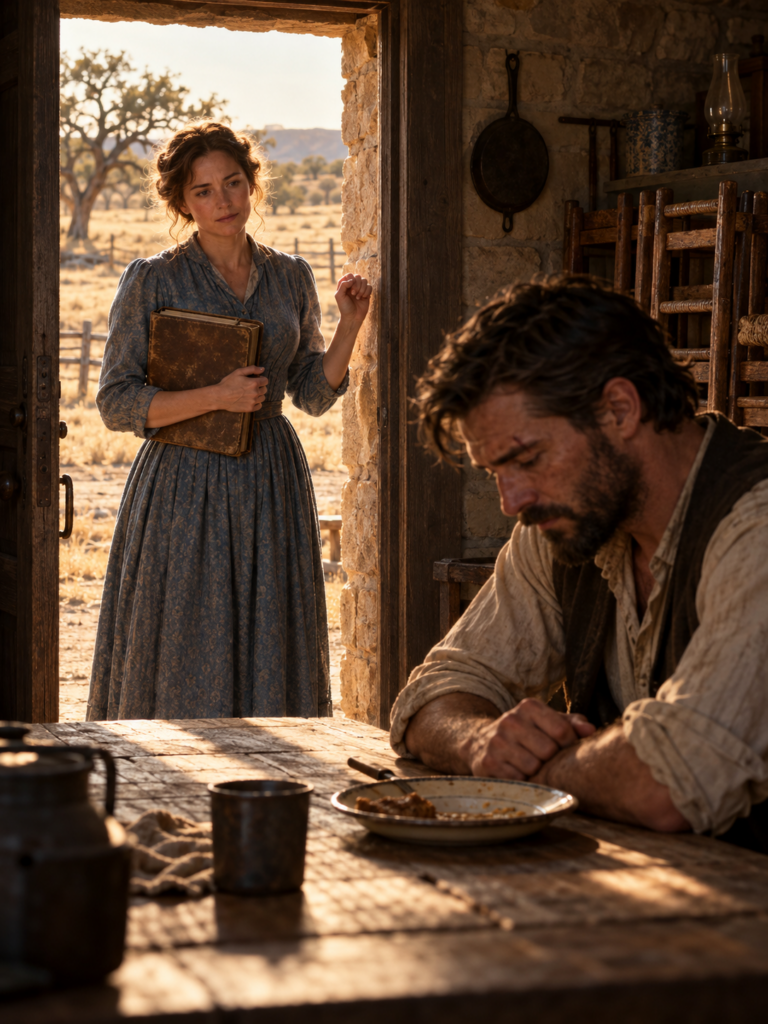
Her fingers closed around the warm parcel, and Ezra released it without touching her hand.
“Thank you,” Judith said.
He nodded, already stepping back.
“See you Monday.”
She rode away carrying the bread beside her ledger, uncertain why a small kindness had unsettled her more than his unpaid account.
When the ranch disappeared behind the hills, she unwrapped the parcel.
Two thick slices of bread lay inside.
Enough for a meal.
She ate one while riding and saved the other for Davey.
The boy was waiting on the loading dock when she reached Branic Mill.
Twelve-year-old Davey Brangan had lived there since a fever took his mother four years earlier. Judith’s father had welcomed him first, and after her father’s death, Judith had never imagined sending him elsewhere.
Davey scrambled to his feet.
“Did he pay?”
“No.”
His hopeful face fell.
“Then what happened?”
“He’s going to build us a horse-powered drive for the mill.”
Davey blinked.
“Can horses do that?”
“With the proper machinery.”
“Will it really turn the stones?”
“That’s what we intend to find out.”
He followed her toward the stable.
“How many horses?”
“Two.”
“How fast will they walk?”
“Davey.”
“Will they live here?”
“Davey.”
“Can I help?”
She turned.
“You may help if you listen more than you talk.”
He considered this.
“That might prove difficult.”
Judith gave him the remaining bread.
His grin nearly broke her heart.
That evening, she worked at the high desk in the mill office, calculating how much the proposed machinery might produce.
Thirty-one customers owed her more than four hundred dollars altogether.
Most were struggling farmers.
She knew some would never pay unless rain returned.
Still, she added the numbers twice.
Then she looked through the open doorway toward the silent grinding stones.
Her father had taught her everything about running that mill.
How to hear when a bearing ran hot.
How to judge meal by touch.
How to dress a stone so its furrows cut cleanly.
He had also taught her never to confuse kindness with sound business.
Judith wondered what he would think of her agreement with Ezra Colton.
On Monday, she received her answer from machinery.
Ezra arrived with his draft horses, Duke and Sally, and an enormous oak beam balanced across his wagon.
He studied the ground beside the mill, measured the available space, and drove a stake into the hard soil.
“The horses need room to make their circle,” he explained.
Judith examined his measurements.
“That brings the sweep close to the old garden.”
“Your garden’s dried out.”
“It is still my garden.”
Ezra moved the stake.
“Then we’ll leave it be.”
She looked at him, surprised.
He had not argued.
He had simply respected her decision.
By Tuesday, the main beam was mounted.
Davey trailed Ezra from morning until evening, asking so many questions that Judith finally imposed a limit of six per day.
Ezra accepted the arrangement with remarkable patience.
At noon, Judith served beans, salt pork, and cornbread.
She set Ezra’s plate at the kitchen table.
Hers remained on the office desk beside the ledger.
He noticed.
“Won’t you eat?”
“I am eating.”
“At your desk?”
“The accounts won’t finish themselves.”
He glanced toward the vacant chairs.
“There’s room at the table.”
“I know.”
He said nothing more.
That afternoon, Judith watched him fit iron against timber with the careful patience of a man accustomed to making imperfect things work.
She began to understand something.
Ezra was not simply paying a debt.
He was investing labor in a mill that did not belong to him, trusting that she would keep her word.
And she was trusting a rancher who had no money to give her.
By Wednesday, she had prepared the grinding stones, working for hours in the dust of the upper floor.
When she descended, weary and white-haired with limestone powder, Ezra waited with a dipper of cool water.
She drank eagerly.
“Where did you get this?”
“From my spring. Brought a bucket this morning.”
Judith lowered the dipper.
“That’s nine miles.”
“Water travels just fine in a wagon.”
She smiled despite herself.
Then he looked toward the machinery.
“Tomorrow we see whether this thing will work.”
The next morning, Duke and Sally stepped into their collars.
Ezra took the reins.
Judith stood at the meal spout, one hand resting against the wood.
“Easy,” she called.
The beam began moving.
Iron teeth caught.
The great runnerstone shuddered.
For a terrifying moment, the mechanism sounded as if it might tear itself apart.
Judith raised her hand sharply.
Ezra slowed the horses.
The vibration steadied.
The stones began to turn.
A thin stream of freshly ground meal fell into Judith’s waiting palm.
She rubbed it between her fingers.
Then she laughed.
Davey shouted from the doorway.
Old Mr. Zeller, who had brought corn that morning, removed his hat.
The mill was working.
It was slow.
It was imperfect.
But it was alive.
By noon, they had ground nine bushels.
Davey carried a bench into the kitchen and set three plates on the table.
Judith stopped beside the doorway.
“What’s this?”
“Three people,” he said. “Three plates.”
“I can see that.”
“Then you ought to sit down.”
Ezra stood nearby, his hat against his chest, plainly prepared to accept whatever she decided.
Judith looked at her office desk.
Then at the table.
Then at the boy who had learned too early what an empty chair could mean.
She pulled out a chair and sat.
Ezra took his place across from her.
Davey climbed onto the bench.
For a moment, nobody spoke.
Then Judith looked toward Ezra.
“Would you say grace?”
He bowed his head.
She did the same.
And when his quiet prayer ended, Judith reached for the cornbread, unaware that the following morning would reveal why Ezra Colton had allowed his own debt to grow while other families went hungry.
Judith broke the cornbread and passed the plate to Davey.
The boy took two pieces before remembering his manners.
Ezra noticed but said nothing.
For the first time in fourteen months, Judith ate her noon meal without a ledger open beside her.
It was a small thing.
Yet the mill seemed different afterward.
The grinding stones continued turning through the afternoon. Farmers arrived with corn and wheat they had been unable to process for weeks. Davey kept a tally while Ezra tended the horses, and Judith adjusted the stones whenever the meal grew too coarse.
By evening, her shoulders ached and her apron was white with flour.
But there was money in the cash drawer.
Not much.
Enough to make tomorrow possible.
The following morning, Judith saddled her mare and rode east to collect several small accounts.
The drought had affected every household in the district.
Fields lay scorched.
Fence rails cast narrow shadows across bare ground.
At the Pettybone farm, Tilda Pettybone met her beside the gate.
The older woman’s face tightened when she saw the ledger.
“I know why you’re here.”
Judith dismounted.
“Your account is three dollars and fifty cents.”
“We haven’t got all of it.”
“I understand this has been a hard summer.”
Tilda gave a weary laugh.
“Hard doesn’t begin to describe it. We lost our corn in June. Sold the calf. Amos has been trying to keep what’s left of the place standing.”
Judith glanced toward the barn.
Two cows stood in the shade.
They were thin, but alive.
“At least you’ve managed to feed the stock.”
Tilda’s expression changed.
“That wasn’t our doing.”
“What do you mean?”
“The Colton man has been bringing feed.”
Judith stared.
“Ezra Colton?”
“Since March. Comes before daylight most weeks, leaves a sack, and goes about his business.”
Judith’s mind moved rapidly through the pages of her ledger.
One hundred pounds of feed.
Collected early.
Again and again.
She remembered weighing those sacks.
She had assumed they were for Ezra’s cattle.
Tilda continued.
“He feeds the Dunlap widow’s two cows, too. And the old Swedish fellow’s mule.”
Judith could hardly speak.
“He bought all that feed on his own account?”
“Far as I know.”
“And never told you he couldn’t pay for it?”
Tilda’s eyes sharpened.
“He never asked us for a cent.”
Judith looked down at the ledger.
The amounts she had demanded on Ezra’s porch suddenly carried another meaning.
He had purchased feed for livestock that did not belong to him.
He had allowed the debt to accumulate because other families had reached the end of what they could manage.
And when she had confronted him, he had accepted her anger rather than reveal their hardship.
“He might have explained,” Judith murmured.
Tilda shook her head.
“Ezra doesn’t much care for being thanked. He sees something needing done and does it.”
Amos Pettybone approached from the field, walking with a slight limp.
When Judith told him the amount due, he searched the farmhouse for their remaining coins.
They found two dollars and twenty cents.
Judith accepted it and wrote a receipt.
“I’ll carry the balance,” she said.
Amos looked relieved.
“Much obliged.”
She mounted her mare.
As she rode away, her thoughts returned to the lonely supper plate.
Ezra had enough concern for his neighbors to feed their animals through the drought.
But no one seemed to know how lonely he was.
And Judith understood something uncomfortable.
She had been doing much the same thing.
She had taken Davey into her home, kept the mill open for struggling farmers, and carried unpaid accounts she could scarcely afford.
Yet she had eaten alone at her office desk for more than a year.
Both of them knew how to help.
Neither seemed to know how to receive help.
That evening, she returned to the mill and found Ezra washing his hands beside the pump.
“Busy day?” he asked.
“Eleven accounts.”
“Any luck?”
“Some.”
She studied his face.
“Mr. Colton, why didn’t you tell me where that feed was going?”
His hands stopped moving.
For a moment, he looked almost embarrassed.
“Who told you?”
“Mrs. Pettybone.”
He dried his hands.
“They needed it.”
“And you didn’t have the money.”
“No.”
“You could have told me.”
“They’ve had a hard enough summer without having their troubles discussed.”
Judith felt the rebuke, though he had not intended one.
“I thought you were careless.”
“I reckoned you did.”
“And you let me.”
Ezra glanced toward the mill.
“Your account was mine to settle. Didn’t see how telling you somebody else’s troubles would change that.”
Judith had no answer.
At supper, she sat with him and Davey again.
She listened to his short grace.
This time, the silence afterward seemed less like emptiness.
On Saturday, when the mill was closed, Judith baked a cobbler from the last dried peaches she had stored the previous season.
She made cornbread, packed both in a basket, and rode nine miles to the Colton ranch.
Ezra was working in a distant pasture.
She could have waited.
Instead, she placed the basket beside his door.
Under the cloth she tucked a note.
A hired man’s wages include dinner. Supper is another matter. Consider this ordinary courtesy.
She signed it with her initials.
Then she rode home before she could reconsider.
That evening, Ezra returned to find the basket.
He recognized Judith’s handwriting.
He read the note twice.
Then he carried the cobbler inside and set it on the long kitchen table.
For years, one chair had served him well enough.
That evening, he took another from the stack and placed it beside the first.
He ate alone.
But the empty chair no longer looked quite so foolish to him.
Three days later, the bank changed everything.
Judith found a letter waiting at the Toiver Crossing post office on Monday morning, August 23.
By ten o’clock, she was seated across from Ellis Garity, the bank manager who had known her since childhood.
He removed his spectacles.
“Judith, I wish this were better news.”
Her stomach tightened.
“My note is due September thirtieth.”
“I know.”
“Then why am I here in August?”
“Our lender in San Antonio has called in the paper behind several local loans. There’s a provision in your father’s agreement allowing us to demand earlier payment under those circumstances.”
Judith sat straighter.
“How early?”
“September first.”
For a moment, she could hear nothing except the clock ticking on his wall.
Nine days.
“Three hundred and forty dollars?” she asked.
“Yes.”
“I have one hundred thirty-three dollars and thirty-five cents.”
“I know.”
“You cannot seriously expect me to find the balance in nine days.”
Ellis leaned forward.
“Listen carefully. If you bring sixty percent of the note and show me the mill is producing again, I’ll carry the rest until the end of October on my own responsibility.”
Judith calculated.
Sixty percent was $204.
She was short $70.65.
“The horse mill won’t earn that in time.”
“Then you’ll need more work than it’s giving you.”
She rose slowly.
Ellis looked genuinely sorry.
But sorrow did not alter the figures.
That night, Judith remained at her desk long after Davey went to bed.
She added the expected grinding charges.
She calculated the maximum number of bushels the horse sweep could manage.
She considered collecting every outstanding account.
The numbers refused to change.
The mill could not produce enough money before September first.
Not unless the great waterwheel turned again.
She laid down her pencil.
Water.
The word seemed to rise off the page.
She remembered the clear stream spilling from Ezra Colton’s trough.
She remembered his answer.
Not so far as I’ve known.
Judith stood.
She crossed the room and opened the office door.
The dead wheel hung beyond the window.
What if the drought had not taken every source of water?
What if the mill had been waiting for something already flowing only a few miles away?
At dawn, she stood beside the horse sweep until Ezra arrived.
He climbed down from the wagon.
“Morning, Miss Renick.”
“Where does the water in your trough come from?”
He blinked.
“Spring above the house.”
“How much water?”
“More than I use.”
“Does it run in summer?”
“Has every year I’ve lived there.”
“Even during the dry season?”
“Even then.”
Judith stepped closer.
“Could that water reach Branic Creek?”
Ezra was silent.
Then he removed his hat.
“My father dug a ditch once. Started above the ranch and ran it down toward the creek. He hoped your father might buy some of the water for the mill.”
Judith hardly dared breathe.
“What happened?”
“They never finished their agreement. Ditch filled with silt over the years.”
“How long?”
“Near a mile and a half.”
“Could it be cleared?”
“Sure.”
“How quickly?”
“One man would need weeks.”
Judith’s heart sank.
Ezra looked toward the motionless wheel.
“Twenty men could do it in a few days.”
She watched him carefully.
“Then we’ll need neighbors.”
His expression closed.
“I don’t much like asking people for things.”
“I know.”
“They’ve got work of their own.”
“They’ve also got grain waiting to be ground.”
He looked away.
Judith spoke more gently.
“You’ve helped half this country without letting anyone know. Perhaps it’s time to give them the chance to help you.”
Ezra remained quiet.
Then he nodded.
“I’ll go see Amos.”
He rode to the Pettybone farm the next morning.
Judith later learned exactly what he had said.
He had stood beside the barn, turning his hat in both hands.
“Amos, I need some help.”
Amos had looked at him for a long time.
“What kind?”
“Clearing my father’s old ditch. Judith’s mill needs water. Can’t manage it alone.”
Amos walked into the barn and returned carrying a mattock.
“Well,” he said, “it’s about time you asked.”
By Wednesday, eleven neighbors had gathered.
Tilda Pettybone brought food.
Hester Dunlap came wearing sturdy boots and carrying a shovel.
Old Mr. Zeller supervised from a nail keg when his knees grew too sore for digging.
Pastor Orin Wills rolled up his sleeves and worked alongside the farmers.
Ezra led them along the old ditch.
The labor was punishing.
Roots had crossed the channel.
Silt packed its bottom.
In places, stones had collapsed from the sides.
They worked beneath a fierce sun, carrying mud and debris in wheelbarrows and wagon beds.
Judith organized water and meals, checked the route, and helped whenever the work allowed.
Davey carried tools and delivered messages.
For four days, the little community dug through the dry earth.
And Judith began to notice something she had never expected.
Ezra laughed.
Not often.
Not loudly.
But when Amos made a remark about the stubborn old ditch, Ezra tipped back his head and laughed with the others.
It changed his face.
He was no longer the solitary man at the kitchen table.
He was a neighbor among neighbors.
On Saturday evening, the final obstruction was cleared.
The channel lay ready.
But the spring gate remained closed until they could inspect the finished line and send the water safely through.
On Sunday morning, the workers gathered at the little church in Toiver Crossing.
Pastor Wills spoke of the lonely finding a place among others.
Judith sat beside Ezra.
Neither pretended the seating was accidental.
When the service ended, Hester Dunlap approached him.
“Mr. Colton, you’ll come to supper Thursday.”
Ezra looked startled.
“I don’t know—”
“You’ll come,” she repeated.
He smiled.
“Yes, ma’am.”
Judith watched him accept an invitation without finding an excuse.
It seemed nearly as remarkable as the ditch itself.
By Monday evening, August 30, the repaired channel was ready.
Ezra opened the spring gate.
Water began traveling toward the mill.
It took hours to arrive.
Judith stood beside the wheel pit after dark, holding a lantern.
Ezra stood next to her.
Davey had been sent to bed.
Neither adult believed he would remain there.
They waited.
And waited.
Then Judith heard a faint sound in the darkness.
Not machinery.
Not wind.
Water.
She raised the lantern.
A thin stream appeared in the dry millrace.
It thickened as more water arrived.
Then the first cold rush spilled across the sill.
The great wheel trembled.
Its lowest bucket filled.
Another followed.
The old timbers groaned.
And the wheel began to turn.
Judith laughed, suddenly and helplessly, as tears filled her eyes.
Ezra stood beside her with his hat in his hands.
For several moments, she could not speak.
Then she looked up at him.
“There’s something I should have told you the day we met.”
He turned.
She swallowed.
“When I came to collect your account, your front door was open. I heard you praying.”
Ezra’s expression grew still.
“How much?”
Judith held his gaze.
“Enough to hear you ask the Lord not to let you eat alone anymore.”
The millwheel turned behind them.
Water shone silver in the lantern light.
“I never meant to listen,” she whispered.
Ezra studied her face.
Then he reached toward the stone rim beside her hand, leaving her room to move away.
“I wondered whether someone was there,” he admitted.
“Are you angry?”
“No.”
“I should have said something sooner.”
“Maybe.”
He gave a small, thoughtful smile.
“But I’m glad you came to the door.”
Judith looked down at their hands resting inches apart.
Then she spoke the truth she had hidden even from herself.
“I’ve been eating alone at my desk since my father died. Fourteen months. I kept telling myself it saved time.”
Ezra listened.
“It wasn’t time I was saving,” she said. “I simply didn’t want to notice the empty chair.”
His hand shifted.
Not toward hers.
Only slightly closer.
He waited.
Judith looked at the moving water.
Then she placed her hand over his.
And for the first time since her father’s death, she allowed herself to believe that keeping the mill might not require living the rest of her life alone.
But the hardest test of everything they had built was still waiting at the bank the following morning.
The bank’s deadline waited for neither Judith’s happiness nor Ezra’s quiet smile.
The wheel had begun turning again.
Now it had to earn enough money to save the mill.
Judith kept her hand over Ezra’s for one more moment beside the stone rim.
Then she straightened.
“We have work to do.”
Ezra looked toward the newly moving wheel.
“Then we’d best get some sleep.”
She smiled.
“After I check the stones.”
“Naturally.”
He lifted the lantern while she examined the machinery.
The water-driven mechanism had stood idle for nine weeks. She could not assume that renewed movement meant everything was ready for a full day’s grinding.
She checked the bearings.
She listened to the gears.
She inspected the meal spout and the tension of the running machinery.
Ezra remained nearby, holding the light where she needed it.
He did not pretend to understand her mill better than she did.
When she finally stepped back, her shoulders relaxed.
“It’ll run.”
“How long?”
“As long as the water keeps coming and the machinery holds.”
“And the water?”
Judith looked toward him.
“That depends on your spring.”
“Then we’ve both got something to tend.”
They closed the mill for the night.
Before Ezra left, he asked whether she needed him back at first light.
She shook her head.
“Earlier.”
His smile came slowly.
“Earlier it is.”
By sunrise on Tuesday, August 31, wagons lined the road approaching Branic Mill.
Mr. Zeller arrived first with the corn he had been storing through the drought.
Behind him came the Pettybones.
The Dunlap family followed.
Farmers from farther down the valley brought sacks of wheat and oats.
Word had spread that the great wheel was turning again.
The loading dock filled with men and women waiting to have their grain ground.
Judith stood in the doorway, hardly believing what she saw.
For nine weeks, she had listened to the empty silence of a useless mill.
Now neighbors were calling greetings across wagon beds, horses stamped impatiently, and Davey hurried from customer to customer with his slate.
“Miss Judith!” he shouted. “We’re going to need another tally board!”
“Then find one!”
“I’ve got one!”
“Then use it!”
He grinned and ran back toward the wagons.
Ezra worked beside the loading dock, lifting sacks and arranging them for grinding.
Judith managed the millstones and the flow of grain.
They established a rhythm.
Ezra carried the sacks.
Davey recorded the quantities.
Judith inspected the grain, set the stones, and oversaw the grinding.
The wheel turned steadily.
Fresh meal poured from the spout.
By midmorning, flour dust coated Judith’s apron.
By noon, her hands ached.
By afternoon, she could scarcely hear the voices outside over the familiar music of the machinery.
Yet she never once wished for quiet.
The sound was her father’s life returning to the building.
Every turning gear reminded her of his careful hands.
Every sack carried across the threshold reminded her why she had refused to abandon the mill.
And each time she looked toward the loading dock, Ezra was there.
Not rescuing her from her work.
Sharing the burden of it.
At six o’clock, after the last customers had been served, Judith closed the mill office door.
Davey climbed onto a stool.
Ezra stood beside the desk.
Judith emptied the day’s receipts and began counting.
Coins clicked against the wooden surface.
She arranged the bills in careful stacks.
She counted once.
Then again.
Seventy-eight dollars and sixty-five cents.
Davey leaned over the ledger.
“Add it to what we already had.”
Judith wrote the figures.
Her cash before the day’s work had stood at $133.35.
The grinding receipts brought it to exactly $212.
She stared at the total.
Ezra waited.
Davey seized his pencil.
“Two hundred and twelve dollars!” he announced.
Judith still said nothing.
The boy looked between the adults.
“That’s more than sixty percent, isn’t it?”
Her hand trembled.
“Yes.”
“Then we’ve done it!”
Judith sat down in her father’s old chair.
For a moment, she could not move.
The bank had demanded $204 toward the $340 note.
She had $212.
Eight dollars more than the minimum.
It was not enough to erase the debt.
But it was enough to win the time she needed.
Davey hurried around the desk and wrapped his arms around her.
She hugged him tightly.
Then he stepped back, embarrassed by his own excitement.
Ezra remained where he stood.
His expression was warm, but he made no claim upon the moment.
Judith looked at him.
“You built the horse sweep.”
He shrugged.
“You kept the stones fit to grind.”
“You brought the water.”
“You found the reason to ask for it.”
She glanced toward the open doorway.
Eleven neighbors had helped clear the channel.
Farmers had brought their grain.
Davey had worked tirelessly.
Ezra had supplied timber, horses, labor, and the spring that made the waterwheel useful again.
The mill had survived because no one person had carried the entire burden.
Judith had spent fourteen months believing that asking for help meant failing her father’s memory.
Now she understood how mistaken she had been.
Her father had built a mill to serve a community.
He had never taught her that serving it required suffering alone.
***
The next morning, September 1, Judith entered the Toiver Crossing Bank carrying $212.
Ellis Garity sat behind his walnut desk.
He looked up as she approached.
“Morning, Judith.”
“Good morning.”
She placed the money before him.
He adjusted his spectacles.
Then he began counting.
Judith stood without speaking.
Outside, wagon wheels rattled across the street.
A horse whinnied near the hitching rail.
Inside, the little bank seemed quieter than the mill had ever been.
Ellis finished counting.
He checked the total against the note.
“Two hundred and twelve dollars.”
“Yes.”
“Sixty-two percent and a little over.”
“Enough?”
He looked up.
“Enough.”
Judith closed her eyes briefly.
Ellis took out the necessary paperwork.
“As agreed, the remaining balance is one hundred twenty-eight dollars. I’ll carry it until October thirty-first under my own arrangement.”
Judith opened her eyes.
“You’ll put that in writing?”
“Of course.”
He prepared the document and handed it across the desk.
She read it carefully.
She had learned never to accept important terms without understanding them.
When she was satisfied, she accepted the arrangement.
Ellis watched her sign.
“I heard your wheel turning yesterday,” he said.
“You did?”
“Clear from the road.”
He shook his head.
“I confess I never expected to hear it again this summer.”
“Neither did I.”
“Someone told me the Colton spring is feeding the race.”
“Through a ditch eleven neighbors helped clear.”
“Quite a piece of work.”
Judith gathered her papers.
“Yes. It was.”
Ellis rose as she prepared to leave.
“Your father would have been pleased.”
That nearly undid her.
She gripped the ledger more tightly.
“Thank you, Mr. Garity.”
Outside, Ezra stood beside the wagon with Duke and Sally.
He had offered to bring her to town, but he had not offered to go into the bank with her.
The business belonged to Judith.
He understood that.
When she stepped into the sunlight, he looked at her face.
He did not need to ask.
Her smile told him.
“October?” he said.
“Thirty-first.”
He nodded slowly.
“That’s time enough to make a proper start.”
Judith looked toward the wagon.
“Then we had better not waste it.”
He held the reins steady while she climbed aboard.
And as they drove back toward the mill, she realized she was no longer frightened by every mile of the road ahead.
The debt remained.
The drought remained.
There would be repairs, difficult customers, and long working days.
But the wheel was turning.
More importantly, she had learned that her own strength did not diminish when another person stood beside her.
***
In the days that followed, the mill settled into a demanding but manageable routine.
Judith kept careful accounts.
The reopened waterwheel allowed her to accept grain that had been waiting through the dry summer.
She continued collecting payments from those able to pay and recording balances for those who needed time.
Ezra worked the remaining days of his agreement.
He tended the horse sweep whenever it was needed and helped maintain the new channel.
The spring water continued running.
But he and Judith understood that it was not limitless.
They checked the ditch regularly, cleared minor obstructions, and took care not to waste what had made the mill possible.
The agreement between them remained clear.
Ezra’s work reduced his account at the agreed daily rate.
His ownership of the spring did not make him an owner of Judith’s mill.
Nor did Judith’s gratitude give him any claim upon her future.
They were two adults whose lives had become connected through honest work.
Something warmer had grown between them.
But neither hurried to name it.
Judith found herself looking forward to the sound of Ezra’s wagon arriving in the morning.
She learned that he had an unexpected sense of humor.
He could spend an hour working silently, then say something so dry that Davey would nearly choke laughing.
He also remembered small things.
He remembered that Judith preferred the mill office window open when the afternoon grew hot.
He learned to recognize the expression she wore when figures did not balance.
When she was busy, he brought water without interrupting.
When she needed advice about timber or harnessing, he answered.
When she knew more than he did, he listened.
And Judith learned to see the rancher beneath the reserve.
Ezra had inherited responsibilities along with his land.
The drought had forced him to make choices about feed, water, and the livestock of neighbors who could not manage alone.
He had made many of those decisions without seeking approval.
But the work on the ditch had shown him another way.
He had spent years imagining that needing company was a private weakness.
Now he knew that even strong neighbors sometimes needed someone to arrive with a shovel.
The change became visible throughout the community.
Amos Pettybone stopped by the mill without an account to settle.
Tilda occasionally brought food for the workers.
Hester Dunlap made good on her invitation to Ezra, and he returned from supper looking quietly pleased.
Pastor Wills continued asking after the ditch and the mill.
The people Ezra had helped were no longer distant recipients of kindness.
They were friends who knew they could offer something in return.
Judith noticed this most clearly when she saw Ezra talking with Amos outside the loading dock one afternoon.
The two men were laughing.
Months earlier, she would have imagined Ezra incapable of such easy conversation.
Now she knew that laughter had not been absent from him.
It had simply gone too long without company.
***
On Sunday, September 5, Ezra invited Judith to dinner.
He made the invitation after church, properly and openly, with Pastor Wills and several neighbors nearby.
“Miss Renick,” he said, holding his hat in both hands, “I’d be pleased if you came to my place for Sunday dinner.”
Judith looked at him.
“At your ranch?”
“Yes, ma’am.”
“Just the two of us?”
He smiled faintly.
“I’ve invited a few others. Thought it was time I made use of that table.”
Her heart softened.
“I’d like that.”
Then she added, “Davey will come with me.”
“I hoped he would.”
That Sunday, Judith drove the nine miles to the Colton ranch with Davey beside her.
The boy was unusually quiet.
She glanced at him.
“What’s troubling you?”
“Nothing.”
“Then why haven’t you asked a single question since we left the mill?”
He thought about that.
“I’ve been saving them.”
“For what?”
“Mr. Colton.”
Judith laughed.
“Then heaven help him.”
They reached the ranch near midday.
The stone house looked much as it had on her first visit.
The same broad porch.
The same patched barn.
The same trough receiving water from the spring above the house.
Yet something had changed.
Judith could not name it until she entered the kitchen.
The chairs were down.
Every one of them.
They stood around the long table rather than stacked against the wall.
The table had been prepared for company.
Hester Dunlap was there.
So were Amos and Tilda Pettybone.
Old Mr. Zeller had brought a pie.
Pastor Wills stood near the window, speaking with Ezra.
Davey hurried inside and began inspecting the seating.
“There’s a whole lot more chairs than last time,” he announced.
Ezra gave him a solemn look.
“Figured I’d better make room.”
“Did you put them all down yourself?”
“Yes.”
“How long did it take?”
“Not long.”
“Were they dusty?”
“Some.”
“Did you have to—”
“Davey,” Judith warned.
The boy grinned.
“That was only four.”
Tilda burst out laughing.
Ezra laughed with her.
Judith stood in the doorway for another moment.
Her eyes traveled across the room.
The long table no longer looked like evidence of a household abandoned by company.
It looked ready for life.
Ezra approached.
“I’m glad you came.”
“So am I.”
He gestured toward the table.
“There’s a chair for you.”
She looked at the one beside his place.
“Then I’ll use it.”
No grand declaration passed between them.
No promise was demanded.
He had invited her.
She had chosen to come.
For Judith, that was enough.
***
Dinner began with everyone gathered around the table.
The meal was simple and plentiful.
There was bread and cooked meat, vegetables, and the pie Mr. Zeller had brought.
Conversation moved easily around the room.
The men discussed the drought and the condition of the fields.
Tilda spoke of the Pettybone cows, now stronger than they had been in spring.
Hester told a story that left Davey shaking with laughter.
Pastor Wills asked how the mill was progressing.
“Better than I dared hope,” Judith answered.
“And the note?”
“Carried through October.”
“Then you’ve earned yourselves some breathing room.”
Judith glanced toward Ezra.
“We’ve all earned it.”
Ezra lowered his gaze modestly.
When the food was ready, everyone settled into their places.
Ezra remained standing at the head of the table.
He looked along its length.
Seven chairs.
A bench for Davey.
Faces that had become familiar through labor and generosity.
People who had accepted his help.
People who had offered their own.
For a moment, he seemed unable to begin.
Then he bowed his head.
The others followed.
“Lord,” he said quietly, “thank You for the food before us, for the hands that prepared it, and for the work that brought us together.”
Judith closed her eyes.
She knew the shape of his prayer.
She had heard it from the porch on the day they met.
She had heard it at the mill.
And she remembered the words he had spoken when he thought no one was listening.
Ezra paused.
His voice grew softer.
“Thank You for the water You kept flowing when everything else went dry.”
A chair creaked.
Nobody spoke.
“And thank You for these good people.”
Judith felt tears gathering.
Ezra continued.
“Lord, I thank You that I don’t have to eat alone today.”
“Amen,” the table answered.
Judith opened her eyes.
Ezra was looking down at his plate.
There was no shame in his expression.
Only gratitude.
She reached for the bread and passed it to him.
He accepted it with a quiet smile.
Then he passed it along to the others.
And dinner began.
***
Later, when the dishes had been cleared and the guests were preparing to leave, Judith stepped onto the porch.
The afternoon sunlight lay golden across the yard.
The horses rested in the shade.
Water continued running into the trough.
She stood for a moment listening to its steady sound.
Ezra came outside carrying two cups of coffee.
He offered one.
“Thought you might want this.”
She accepted it.
“Thank you.”
They stood together without speaking.
From inside the house came Davey’s excited voice, followed by laughter.
Ezra smiled.
“He’s a fine boy.”
“He is.”
“You’re doing right by him.”
Judith looked into her cup.
“I worry I don’t do enough.”
“From what I’ve seen, he’s got a home and somebody who cares whether he eats.”
“Sometimes I think he deserves more than an old mill and a woman who spends half her life worrying over numbers.”
Ezra considered that.
“He’s learning a trade. He’s got neighbors. And he’s got you.”
She looked up.
He continued.
“Seems to me that’s a good deal.”
Judith watched him for a moment.
“You know, when I came here in August, I thought you were a man who refused to pay what he owed.”
“I remember.”
“I was angry.”
“You had good reason.”
“And you never told me about the feed.”
He rested his cup on the porch rail.
“Wouldn’t have changed the debt.”
“It would have changed what I thought of you.”
“Maybe.”
She sighed.
“You’re a difficult man to know, Ezra Colton.”
He smiled.
“I reckon I’ve made it that way.”
“Not entirely.”
They looked toward the trough.
Judith spoke again.
“I used to think keeping the mill meant doing everything alone.”
“And now?”
“Now I think my father would have wanted me to keep it running, even if that meant accepting help.”
Ezra nodded.
“Sounds reasonable.”
She turned toward him.
“And what about you?”
“What about me?”
“Are you going to put those chairs back against the wall when everyone leaves?”
He glanced through the open doorway.
The long table stood in the bright kitchen.
One chair remained beside another.
“No,” he said.
“Good.”
“I may not fill them every Sunday.”
“You could invite people.”
“I reckon I could.”
“And you could accept their invitations.”
“I’m learning.”
Judith smiled.
“That you are.”
A comfortable silence settled over them.
Then Ezra spoke.
“I enjoyed having you here.”
“I enjoyed coming.”
His expression grew serious.
“I’d like you to come again.”
Judith considered him carefully.
She understood what he was asking.
Not for repayment.
Not for gratitude.
Not for someone to surrender her work or abandon her life.
He was asking whether she might choose to spend more time with him.
“I would like that,” she answered.
He nodded.
“Then we’ll arrange it.”
She looked toward the hills.
“And you must come to the mill for supper sometime when there isn’t work waiting.”
His smile deepened.
“Not as a hired man?”
“No.”
“Not to settle an account?”
“No.”
“Just supper?”
“Just supper.”
He looked almost astonished.
Then he said, “I’d be mighty pleased.”
***
The following week brought the usual demands of the mill.
Customers arrived with grain.
Davey kept learning the accounts.
Judith checked the stones and the water supply.
Ezra continued working and tending to the tasks he had promised to finish.
Life did not transform into something effortless simply because the two adults had begun to care for one another.
The drought remained a hardship.
The bank balance still had to be paid.
The mill needed constant attention.
Ezra’s ranch required his time.
Judith’s responsibilities did not disappear.
But something essential had changed.
Their work no longer seemed like proof that they were destined to carry everything alone.
When Judith needed advice, she asked.
When Ezra had a difficult decision, he allowed someone else to hear it.
At noon, the three places at the mill kitchen table remained ready.
Judith stopped eating at her high office desk unless the day’s work truly required it.
Davey made certain of that.
If she grew absorbed in the ledger, he appeared in the doorway.
“Miss Judith, your dinner’s getting cold.”
“I’m nearly finished.”
“You said that yesterday.”
“Davey.”
“And the day before.”
She would put down her pencil.
And she would come to the table.
Sometimes Ezra was there.
Sometimes he was tending his cattle nine miles away.
But she no longer believed an empty chair was something to be hidden.
There were friends who would share a meal.
There was a boy whose laughter filled the room.
And there was a rancher who had learned to ask for company rather than hoping someone might somehow discover he needed it.
As September continued, the mill’s earnings began covering its ordinary expenses and reducing what Judith owed.
The additional time Ellis Garity had granted her gave the business a genuine chance to recover.
The horse sweep remained useful when the water flow needed to be conserved or the channel required maintenance.
Judith kept the ledger with the same care her father had taught her.
She never confused a hopeful future with a balanced account.
Yet she learned that sound business and human kindness did not always have to stand on opposite sides of the page.
Ezra’s original debt remained recorded until paid or worked off.
The neighbors’ smaller accounts remained their own.
Each obligation was handled openly.
And the work they had accomplished together stood as evidence of something no ledger could measure completely.
Trust.
***
One evening, after the day’s grinding had ended, Judith stood beside the great wheel.
Water flowed through the race.
The turning buckets caught the last light.
Behind her, the mill office glowed softly through the window.
Davey was inside putting away the slate.
Ezra stood nearby, preparing to return to his ranch.
Judith looked toward him.
“Do you remember what you said the day I came to collect your account?”
“I said a good many things.”
“Before I knocked.”
He grew quiet.
She continued.
“You asked the Lord for someone to share your supper.”
Ezra glanced down.
“I did.”
“Do you still pray that?”
He thought for a moment.
“Not quite the same way.”
“How, then?”
He looked toward the mill.
“I thank Him for the company He’s already sent. And I ask that I be wise enough not to shut the door on it.”
Judith felt warmth rise in her chest.
“That’s a better prayer.”
“Maybe.”
He turned his hat in his hands.
“And you?”
“Me?”
“What do you ask for now?”
She looked at the wheel.
For weeks she had prayed for rain.
For money.
For another day to keep the mill open.
She still hoped for all those things.
But they were no longer the whole of her life.
“I ask for enough courage to let people care about me,” she said.
Ezra nodded.
“Seems a sensible thing to ask.”
“And patience,” she added.
“For what?”
She looked directly at him.
“For a certain rancher who takes a long while to say what’s on his mind.”
He laughed.
Then he stepped closer, stopping at a respectful distance.
“Judith, I’d like to keep seeing you.”
She smiled.
“I know.”
“Not because you owe me anything.”
“I know that, too.”
“And I don’t mean to interfere with your mill.”
“You’d have a difficult time of it if you tried.”
He smiled.
“That’s plain enough.”
She reached for his hand.
“Then we understand one another.”
He took it gently.
For a while, they watched the water move beneath the wheel.
No promises beyond what they were ready to make.
No grand plans drawn up in haste.
Only two people who had spent a long time believing that strength meant solitude, now choosing to discover what companionship might become.
***
Months later, Judith would remember the first visit to Ezra Colton’s ranch more clearly than almost any other day that summer.
She remembered the long ride.
The dust.
The ledger beneath her arm.
The $86.40 she had needed so desperately.
She remembered seeing precious water overflow a trough while the countryside dried around it.
And she remembered the open door.
At the time, she had believed she was going there to collect what another person owed.
Instead, she had discovered an opportunity to save her mill.
Ezra had found a way to repay her through honest work.
Their neighbors had found a way to repay kindness through labor freely given.
Davey had found more people willing to listen to his endless questions.
And Judith had found that a life devoted to responsibility could still hold room for affection.
She had not surrendered her mill.
She had not surrendered her independence.
She had not been rescued by a wealthy stranger who made all her troubles disappear.
She had worked.
She had made decisions.
She had faced the bank herself.
And when help was offered, she had learned to accept it without believing it made her less capable.
Ezra, too, had changed.
The long kitchen table no longer stood as a monument to the people who were absent.
Its chairs remained ready.
Sometimes friends filled them.
Sometimes Judith and Davey came to supper.
Sometimes only Ezra occupied one end while he read or finished a simple meal.
But the room no longer felt permanently closed against company.
The door could open.
And he had learned to welcome whoever came through it.
What grew between Judith and Ezra did not need to be measured by an immediate wedding or a dramatic promise.
Their affection was evident in the lives they continued building.
In the meals they shared.
In the work they respected.
In the way he never asked her to leave her father’s mill behind.
In the way she never treated his ranch as a place she had a right to command.
They remained themselves.
And they made room for each other.
One Sunday, as the afternoon sun entered Ezra’s kitchen, Judith took the chair beside him while Davey helped carry dishes to the table.
The boy looked around at the assembled neighbors.
“Mr. Colton?”
“Yes, Davey?”
“Do you ever think you’ll need more chairs?”
Ezra glanced at Judith.
Then at the people gathered around his table.
He smiled.
“I reckon we can make more if we need them.”
Judith laughed.
The boy seemed satisfied.
Everyone settled into place.
Ezra bowed his head.
And the man who once whispered his loneliness into an empty kitchen offered a simple prayer of thanks for the people who had come into his life.
When he finished, Judith reached for the bread.
This time, there was someone waiting to receive it.
The meal began.
And for once, nobody at that long wooden table was in any hurry to leave.


