
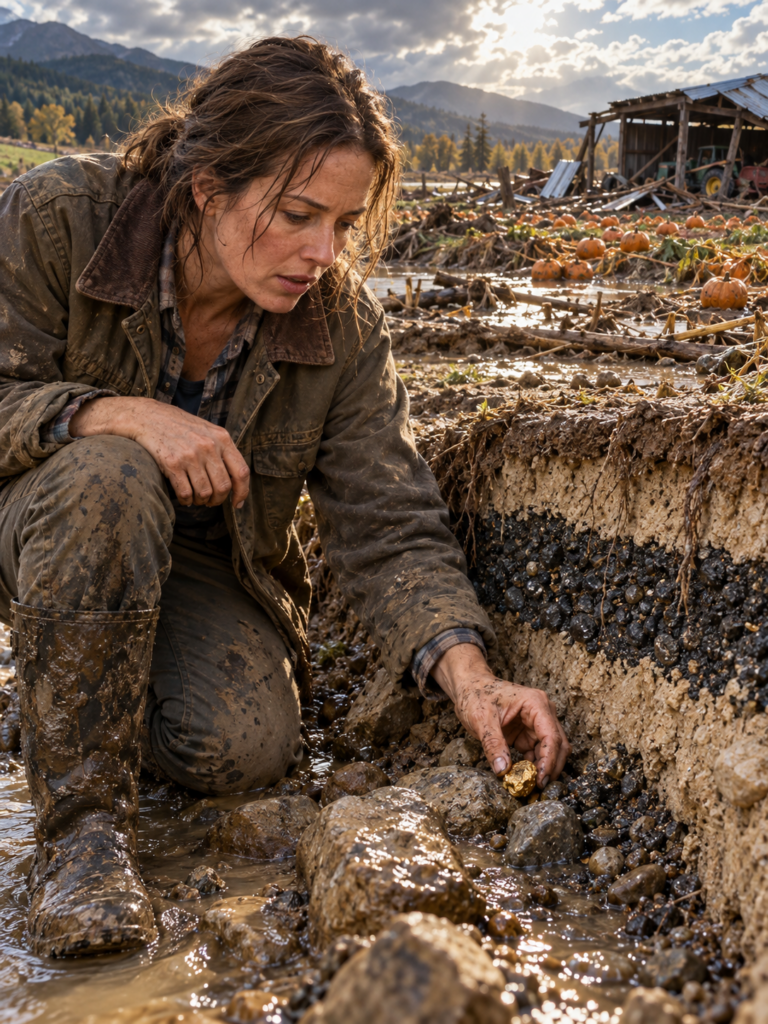
Mara photographed the first page, turned to the next, and stopped when she saw the careful drawing Leon had made of Alder Creek’s southern bank.
The shape matched what she had just seen.
A dark gravel seam running beneath ordinary soil.
A bend in the creek.
A buried channel Leon believed might have carried water long before the existing creek followed its present course.
He had noticed it more than fifty years earlier.
And nobody had ever investigated it properly.
Mara placed the yellow fragment on the kitchen table beside his notebook.
She wanted to believe she had found gold.
But wanting something to be valuable was precisely the kind of mistake she couldn’t afford.
The bank still expected payment.
The destroyed crop wasn’t coming back.
And Warren Pike still wanted her farm.
She needed evidence, not hope.
The next morning, she returned to the creek with sample bags, marking tape, and her phone.
She selected six locations along the newly exposed bank.
At each point, she recorded the location, collected loose gravel and sediment, and made notes about what she could see.
She kept the samples separate.
There would be no guessing later about where each one had come from.
She sent them to an independent assay laboratory two counties away.
Then she returned to the work that was keeping her afloat.
She sold her second truck.
She accepted equipment repair jobs at three neighboring farms.
And every evening, after washing the grease from her hands, she opened Leon’s notebook.
What bothered her was the timing.
Warren’s company had spent years buying land along Alder Creek.
Its upstream reservoir sat on property it controlled.
Warren had approached her before Grant ever became involved.
Then, after two bad harvests weakened her finances, the bank began pushing the same buyer.
The flood came.
And both men appeared with a contract before she had even assessed the damage.
Coincidence was possible.
But each additional fact made coincidence harder to accept.
Eleven days after she sent the samples, the laboratory report arrived.
Mara sat at her kitchen table and opened it.
She read the first result.
Then the second.
Then the third.
Every sample contained natural gold.
All six.
Three showed concentrations significant enough for the laboratory to flag them specifically.
For several seconds she simply stared.
She had lived on this land for three years, and her mother had worked it for decades.
Under the creek bank, beneath the pumpkins and grazing ground, was a mineral deposit nobody in her family had ever confirmed existed.
But the report contained a warning.
The results were preliminary.
Further geological assessment was required before anyone could draw conclusions about commercial value.
Mara understood the distinction.
Gold in six sample bags didn’t mean eighty-four acres of riches.
It meant her grandfather’s suspicion deserved an answer.
She hired Celia Hart, an independent geologist.
Celia spent an afternoon examining the exposed bank and the surrounding terrain.
She studied the sediment layers, the channel alignment, and Mara’s sample records.
Finally, she straightened and brushed the soil from her hands.
“This is consistent with an ancient alluvial channel,” she said.
Mara looked down at the dark gravel.
“And that matters because?”
“Moving water can concentrate heavy minerals over a very long time. Including gold.”
“Can you tell me how much is here?”
“Not from this inspection.”
Celia was careful.
The deposit could be limited.
It could be larger.
Only proper investigation could establish its extent and economic potential.
But her preliminary opinion supported Leon’s old suspicion.
That evening, Mara searched the county planning office’s public records.
She entered Ridgecrest Aggregates into the database.
One application caught her attention.
Ten months earlier, Warren’s company had proposed expanding its extraction operation along a corridor beside Alder Creek.
Mara opened the attached survey map.
The proposed corridor followed the southern creek bank.
The very stretch where her grandfather had identified the buried channel.
The very stretch the flood had exposed.
And the mapped expansion stopped at her property boundary.
Mara checked the filing date.
Ridgecrest had submitted its plans two months before Grant made his first formal purchase offer.
She leaned closer to the screen.
Warren had been planning his expansion before the bank began pressuring her.
He might have known something about the gravel. He might simply have wanted a strategically located property.
The public filing did not establish what was in his mind.
But it proved that his interest in her land had begun long before the flood.
Mara saved the filing, printed the map, and placed it beside Leon’s notebook.
Then she pulled out the photograph of the blocked culvert.
One man wanted her creek bank.
Another man controlled her debt.
And the flood had nearly delivered the farm to them both.
She gathered the records into a folder and reached for the name of a property-dispute attorney in the next town.
Mara dialed Audra Keene’s office with the folder open in front of her.
When the attorney answered, Mara didn’t begin with the gold.
She began with the flood.
She described the blocked culvert, the tire tracks, the reservoir release, and the two men who had arrived with a purchase contract while water was still moving through her fields.
Then she explained what the flood had exposed.
Audra listened without interruption.
When Mara finished, the attorney asked one question.
“Do you have the original photographs?”
“Every one.”
“Good. Don’t alter them. Bring the original files, the laboratory report, and everything you found in the county records.”
Mara drove to the next town with her folder and Leon’s notebook.
Audra was forty-six, practical, and accustomed to separating what clients suspected from what they could establish.
She spread the documents across her desk.
The first thing she examined was the property history.
The Sutton family had held the land since 1954.
Audra reviewed the chain of title and the available records concerning mineral rights.
She found no recorded severance separating those rights from ownership of the land.
That was significant.
Based on the records she reviewed, Mara held the mineral rights associated with her property.
But when Mara began asking what the gold might mean financially, Audra stopped her.
“Gold in the ground isn’t the same as money in your account.”
“I know it needs more testing.”
“More than testing. If anyone intends to extract it commercially, there are surveys, permits, environmental requirements, and operational costs.”
Mara looked at the loan documents.
“And none of that helps me make the next payment.”
“Not immediately.”
The bank could pursue the debt long before a legitimate extraction agreement produced income.
Owning a potentially valuable resource did not solve her immediate financial crisis.
Audra moved the laboratory results aside and picked up the photograph of the blocked culvert.
“This is where we concentrate first.”
Mara leaned forward.
“The flood?”
“The evidence of what caused it.”
A deliberate blockage, if they could prove one, was important.
So was the reservoir’s discharge.
But neither photograph nor suspicion established who had ordered the work.
They needed to connect physical evidence to responsible people.
Audra agreed to represent her, deferring much of her fee against any eventual recovery.
For the first time since the flood, Mara felt she was doing something other than defending herself.
She was beginning an investigation.
Her next call was to Russell Voss, a hydraulic engineer with decades of experience evaluating water movement and drainage failures.
Russell spent three days examining the property, studying rainfall records, reviewing the creek’s topography, and measuring the watermark evidence on Mara’s structures.
Mara walked with him through the damaged lower field.
He asked where she had first noticed the water.
She showed him.
He asked where the culvert had been blocked.
She brought him to the access road.
Then she showed him the photographs taken before anyone cleared it.
Russell studied them for a long time.
“What concerns me,” he said, “isn’t just the water volume. It’s the timing.”
Mara waited.
“The downstream surge appears inconsistent with rainfall alone. The pattern is consistent with a controlled release upstream.”
“From Warren’s reservoir?”
“That’s one possible source, and an important one to investigate.”
He pointed toward the culvert.
“A blockage here would also have changed where the water went.”
Mara looked across the lower field.
Where she had once seen drainage routes, she now saw the mechanics of her losses.
Water had entered from upstream.
Its normal exit route had been obstructed.
And the surge had spread across the most vulnerable part of her property.
Russell’s preliminary report supported that explanation, while acknowledging what he still needed to confirm.
Operational records from the reservoir would help.
Ridgecrest refused to provide them voluntarily.
Warren instead produced a statement from his own engineer, describing the incident as weather-related and the reservoir operations as reasonable.
Mara read it twice.
He wasn’t merely denying responsibility.
He was supplying an alternative technical account.
Meanwhile, Grant Danner called.
He reminded her that investigating Ridgecrest did not change the bank’s repayment schedule.
Mara told him the farm had been damaged.
Grant responded that the loan agreement remained enforceable.
Shortly afterward, her account entered formal default.
Collection proceedings followed.
When Mara opened the notice, she felt the same tightening in her chest she had felt watching water swallow the equipment shed.
Everything she was uncovering might ultimately matter.
But she could still lose the property before she could prove what had happened.
Warren made another offer.
This time, he contacted Audra.
The proposed price was slightly higher.
The conditions were not simply about the land.
Mara would transfer all rights associated with the property and withdraw her outstanding records requests.
Audra read the terms aloud.
Mara listened carefully.
“Why does he care about the records requests if this was just a storm?”
“That’s a question we can ask,” Audra said. “The offer itself doesn’t answer it.”
Mara shook her head.
“I’m not selling.”
Audra put the paperwork down.
“Then we have to protect your position.”
Three weeks after the flood, Mara had encountered a Ridgecrest employee named Dale Richter in a hardware-store parking lot.
Dale worked at the reservoir control station.
He approached her quietly, glancing once toward the store entrance.
“I heard you were asking about the gate,” he said.
Mara turned toward him.
“Do you know what happened?”
He hesitated.
Then he told her that Warren Pike had personally instructed him to open the primary gate on the night of the storm.
According to Dale, the timing had not been driven by an emergency.
Mara asked whether he would speak to her attorney.
His expression changed.
“I’ve got a daughter starting college this fall.”
“I understand.”
“No, I don’t think you do. I can’t lose this job.”
He got into his truck and drove away.
Mara wrote down the conversation as accurately as she could remember it.
Audra considered the information important, but explained the obvious limitation.
Dale’s account was not yet formal testimony.
They could not treat it as independently established fact.
Nevertheless, it gave them a specific person, a specific instruction, and a specific operation to investigate.
Audra filed a civil complaint addressing the flood damage, the obstructed drainage, and the pressure campaign surrounding the proposed sale.
She also asked the court for temporary protection to preserve Mara’s ownership while the dispute proceeded.
Mara sat through the tense days that followed, continuing her repair work and returning home to a farmhouse filled with folders.
Then Audra called.
The court had granted the temporary order.
The bank’s collection proceedings were paused.
Mara stood beside her kitchen window after the call, looking toward the lower field.
She had not won her case.
But for the first time, she had enough time to continue it.
That evening, she reopened the original flood photographs.
She wanted to examine the mud deposits and tire tracks while Russell’s findings were fresh in her mind.
She enlarged the first image.
Then the second.
In the third, she noticed something she had previously ignored.
At the lower right edge of the frame, partly cut off by the photograph’s border, was the back corner of a truck.
Only a quarter panel and part of a license plate were visible.
The vehicle had been parked beyond the access road, near the area where the culvert had been blocked.
Mara stared at the image.
She had been so focused on the obstruction that she hadn’t noticed the truck behind it.
She called Audra.
The attorney had the original image professionally examined and enhanced.
The full plate could not be recovered.
But enough identifying characters were visible to connect the registration to a commercial vehicle assigned to Ridgecrest Aggregates.
It was not proof of who had placed the rocks.
It was proof that a Ridgecrest vehicle had been present near the culvert when Mara photographed the obstruction.
That alone changed the case.
Audra asked Tom Hadley whether he had any additional observations from the night of the flood.
Tom thought for a moment.
Then he mentioned the camera mounted on his gate post.
He used it to record motion near his driveway.
It faced the gate, not the road, so he had never thought to review its footage.
But the camera had a local recording drive.
And the footage from that night was still available.
Tom retrieved it.
Two recordings mattered.
The first showed a wide-body truck moving past his gate toward Mara’s access road about forty minutes before the floodwater reached her lower field.
The second showed what appeared to be the same vehicle returning ninety minutes later.
Audra compared the footage with the photographed truck.
The timing and vehicle characteristics made a Ridgecrest connection increasingly difficult to dismiss.
Using the evidence available, she pursued Ridgecrest’s vehicle dispatch records through the litigation process.
The records identified the truck and its assigned crew.
Its stated purpose that evening had been a routine drainage inspection.
Mara stood across Audra’s desk as they reviewed the entry.
“During the storm?”
“That’s what the record says.”
“At the exact stretch where someone blocked my culvert?”
Audra kept her eyes on the page.
“It’s evidence we can test.”
The driver was questioned separately.
He acknowledged the assignment.
He said he had been told it was a precautionary inspection and had not asked questions about the work.
His statement did not establish that he personally blocked the culvert.
But the dispatch record placed the company crew in the relevant area during the critical period.
The photographs, Tom’s camera footage, and Ridgecrest’s own records now reinforced one another.
Then the equipment supplier for the reservoir’s gate-control system produced maintenance records in response to a subpoena.
Those records contained a timestamp that Ridgecrest had not disclosed accurately.
A manual override had been issued to the reservoir’s primary outflow gate on the night of the flood.
And the independent manufacturer’s timestamp showed that the command occurred forty-seven minutes earlier than Ridgecrest’s submitted operational log indicated.
Mara read both entries side by side.
The numbers were different.
The difference was not a matter of interpretation.
The reservoir gate had been manually overridden earlier than Ridgecrest had reported.
Audra placed the two records next to Russell Voss’s preliminary findings.
The operation of the gate, the timing of the flood, and the obstructed culvert were no longer isolated circumstances.
They were beginning to form a mechanical sequence.
Then Audra received word that Dale Richter was prepared to give a formal deposition.
Mara looked at the timestamped manufacturer’s record once more.
Dale had said Warren personally ordered the gate opened.
Now there was independent evidence that an early manual override had occurred.
The remaining question was whether Dale could explain why Ridgecrest’s own records showed something different.
When the deposition began, Dale looked down at the documents before him.
Then he confirmed that Warren Pike had called the reservoir control station that night and ordered maximum discharge from the primary gate.
He said the order came before the rainfall required such an emergency response under the company’s own procedures.
And he said a second call followed, confirming the drainage crew had completed its assignment at the culvert.
But the most important part of his account concerned what happened two days after the flood.
Warren had instructed him to change the operating log.
The revised record described a gradual, weather-responsive release.
Dale admitted he had made the alteration.
Then he explained that he had kept the original printout.
Audra asked whether the original was available.
Dale nodded.
He had brought it.
When the printout was placed beside the equipment manufacturer’s independent record, the override times matched.
Mara watched Audra align the pages.
The discrepancy was finally explained.
Someone had changed Ridgecrest’s internal account of the reservoir operation after the flood.
And the man who had made the change had just identified who ordered it.
Audra kept the original reservoir printout beside the manufacturer’s record for several seconds.
The matching timestamps gave Dale Richter’s testimony something it had lacked when Mara first met him in the hardware-store parking lot.
Independent corroboration.
Dale’s account was no longer simply an employee’s claim about a conversation he said he had with his boss.
The original printout showed the manual override at the time he described.
The manufacturer’s separate record showed the same command.
And Ridgecrest’s submitted operating log contained a different sequence.
The discrepancy had been created inside the company.
Mara sat quietly while Dale finished answering questions about the changes.
She had spent months imagining what evidence of the flood might look like.
A photograph of someone placing the rocks.
A direct admission from Warren Pike.
A witness who had seen every step of the operation.
Instead, the truth was emerging from several imperfect pieces of evidence that became powerful when examined together.
The log established when the gate opened.
Tom’s camera showed a truck traveling toward and away from the culvert.
Ridgecrest’s dispatch records placed its crew there.
The original photographs showed the obstruction and a company vehicle.
Russell Voss’s engineering work explained how those actions could have produced the damage.
Dale’s testimony connected the gate order to Warren.
And now the operating records showed that Ridgecrest’s account had been altered afterward.
Mara remembered the question she had asked Warren on her flooded porch.
Why was the water still rising after the rain stopped?
He had refused to discuss it.
Now she understood why an accurate answer would have been dangerous to him.
But the case was not complete.
Knowing how the flood had been caused did not automatically explain the coordinated financial pressure that followed.
For that, Audra needed to establish the relationship between Warren Pike and Grant Danner.
The bank officer had repeatedly presented the purchase as a practical solution to Mara’s debt.
He had appeared beside Warren on the morning after the storm.
He had emphasized the damage to her income.
He had continued pressing the loan obligations while she was trying to investigate.
Mara believed the two men had been working together.
Belief was no longer enough.
During document production, Audra obtained internal communications between Warren and Grant covering the four months before the flood.
She reviewed them carefully before asking Mara to come to her office.
When Mara arrived, Audra had arranged the messages in chronological order.
“Read them from the beginning,” she said.
The earliest communications concerned Mara’s financial situation.
Grant had identified her account as vulnerable after the second poor harvest.
That information was valuable to Warren because he wanted the property.
Other messages discussed the effect that increased financial pressure could have on Mara’s willingness to sell.
Warren had responded that accelerating that pressure would improve their position.
Mara continued reading.
She recognized the pattern.
Grant would call after a difficult month and remind her that Ridgecrest’s offer remained available.
Warren would approach her with the same figure she had already refused.
Neither man had seemed particularly concerned with the farm’s independent appraisal.
They had been interested in how long she could afford to say no.
Then Mara reached a message dated the week before the flood.
It referred to an expected weather event and mentioned the reservoir in the context of their negotiations.
The language did not give a complete account of the later operation.
But considered with the gate records, the drainage evidence, and Dale’s sworn testimony, it added another layer to the chronology.
The storm had not simply created an unexpected business opportunity.
The evidence showed that Warren and Grant had discussed increasing Mara’s financial pressure before her fields were destroyed.
Mara put the pages down.
“Grant knew I was struggling,” she said.
Audra nodded.
“Your loan status was part of what he managed for the bank.”
“And he used it to help Warren.”
“The communications strongly support that.”
Mara remembered how Grant had spoken about the purchase agreement.
Not angrily.
Not with obvious threats.
He had described it as the sensible choice.
That was what made the betrayal difficult to accept.
Mara had been ashamed of her debt.
She had worried that her mother’s farm would fail under her care.
And the person responsible for managing her agricultural credit account had treated that vulnerability as leverage in someone else’s acquisition plan.
For months, she had believed she was negotiating against the natural consequences of two bad harvests.
Now she knew the evidence showed something more deliberate.
Her financial troubles were real.
But the pressure surrounding them had been intensified by people with a separate interest in controlling her property.
She asked Audra about the gold.
“Do you think that’s what they wanted all along?”
Audra leaned back.
“We know Ridgecrest planned an expansion along the creek. We know Warren wanted your land. We know what happened during the flood, and we know how the purchase pressure was coordinated.”
“But we don’t have proof they knew about the gold.”
“Not from what we’ve established.”
Mara considered that.
It was tempting to imagine Warren had known everything.
Perhaps Ridgecrest’s surveys had suggested valuable gravel beneath her land.
Perhaps its interest had been driven by the ordinary commercial usefulness of the creek corridor.
The public application showed where the company intended to expand.
It did not reveal every geological assumption behind that plan.
And without additional evidence, Mara could not honestly claim Warren had known of a commercially valuable gold deposit.
What she could establish was enough.
He wanted her property at a steep discount.
The flood had increased her vulnerability.
And the accumulating records connected his company to the actions that caused the damage.
Russell Voss returned to his hydraulic analysis with the new evidence.
He now had the independently recorded gate-override time, Dale’s testimony, the vehicle movements, and the blocked culvert photographs.
His revised report traced the sequence.
The reservoir gate was manually opened.
A sustained discharge moved downstream.
The culvert that ordinarily helped drain Mara’s lower ground had been obstructed.
Water that should have moved through the drainage network was instead directed over the field and toward the equipment shed.
The damage was not explained by ordinary storm runoff alone.
The rain had provided the setting.
The controlled release and blockage had changed what the water did.
Mara read Russell’s findings slowly.
For the first time, she saw an expert reconstruction that joined the pieces into one coherent physical explanation.
She thought about the goats she had moved in the dark.
The equipment she couldn’t reach.
The pumpkins that had disappeared beneath muddy water.
The hours she spent trying to understand why the creek kept climbing.
She had not imagined the difference.
The flood had been engineered.
And its consequences had almost forced her to surrender the property.
The civil proceedings continued.
Ridgecrest challenged aspects of the evidence and defended its actions through counsel.
Mara continued maintaining her records.
She worked repair jobs when she could.
She walked the fields when the ground dried enough to permit it.
She kept paying the ordinary costs of running a farm that was no longer producing enough to support itself.
The temporary court protection gave her time, but it did not repair the property.
Some mornings she woke before sunrise and lay still, listening for the sound of moving water.
She had lived beside Alder Creek long enough to know its ordinary noises.
After the flood, every unusual surge caught her attention.
At times, she wondered whether taking the original offer would have ended the strain sooner.
She could have paid the bank and walked away.
But every time she considered that choice, she pictured the contract on her flooded porch.
The men who had brought it knew she was frightened.
They had expected fear to make her cooperative.
Now the evidence suggested they had helped create the very emergency they were using against her.
Selling would not have undone that.
It would have given them the result they wanted.
Sixteen months after the flood, the civil case settled.
Mara received $960,000.
The settlement addressed property damage, lost agricultural income, and additional negotiated amounts.
The sum was larger than the amount Warren had originally offered to pay for the entire farm.
Yet Mara did not experience it as a sudden fortune.
She understood how much of it had already been spoken for.
There was the outstanding farm loan.
The attorney’s fees.
The engineering costs.
The damage to buildings and equipment.
The drainage repairs.
The income the farm had lost while fields stood unusable.
The settlement could restore stability.
It could not return sixteen months of worry.
Nor could it erase the sight of her mother’s fields beneath floodwater.
Mara signed the final settlement paperwork after reviewing it with Audra.
When she walked out of the office, she stopped beside her truck.
The same truck she had kept when she sold the other one to cover expenses.
For months, every financial decision had been about buying a few more days.
Now she could finally make decisions about the farm’s future.
She paid the remaining loan balance.
The debt that had given Grant Danner such extraordinary influence over her choices was gone.
She arranged for the equipment shed to be rebuilt.
The damaged drainage system was repaired, including a reinforced replacement for the culvert that had been obstructed.
She also reviewed the fields she could restore for planting.
The land remained in her name.
That was the result that mattered most.
In the aftermath of the settlement, Cedar Vale Bank placed Grant on administrative leave.
Its internal review examined his coordination with Warren and his handling of Mara’s account during the acquisition campaign.
The review resulted in Grant’s termination.
Mara heard the news without satisfaction.
She had wanted the bank to recognize what happened.
It had.
But Grant losing his position didn’t repair the nights she spent wondering whether she had failed her family.
That would take longer.
Documentation concerning the reservoir override, the altered operating records, and the culvert obstruction was referred to the county district attorney’s office.
Mara understood that the civil settlement did not amount to a criminal conviction.
She didn’t tell people Warren had been convicted of anything.
She didn’t claim the referral established what prosecutors would ultimately decide.
She had fought to make the evidence matter.
She would not weaken that achievement by claiming outcomes the record didn’t support.
There was still another unresolved question on the property.
The dark gravel beneath the southern creek bank.
Leon Sutton’s old notebook had begun that investigation, but the six assay samples and Celia Hart’s initial inspection were not enough to determine what could be extracted.
Once the settlement had stabilized her finances, Mara commissioned a full independent geological survey.
She wanted a proper answer.
Not rumors.
Not an inflated estimate.
Not another man’s opinion of what her land was worth.
The survey work examined the extent and depth of the alluvial gravel deposit.
Its findings confirmed that the gold-bearing channel continued along the southern bank in a form sufficient to support commercial extraction.
Mara sat with the completed report at her kitchen table.
Beside it lay Leon’s notebook.
She read the geological conclusions carefully.
Her grandfather had never known the full answer.
He had observed unusual sediment and suspected what it might indicate.
He had collected samples.
He had written down his reasoning.
But the farm had never generated enough spare money to pay for the investigation he wanted.
Doreen had inherited the notebook with the rest of Leon’s belongings.
Mara had moved it into the farmhouse after her mother’s death without studying its contents.
For years, the evidence had been sitting in a wooden box and a handwritten record.
Then Warren’s flood had stripped away the soil hiding the gravel.
Mara looked at Leon’s final note again.
“Worth knowing before selling.”
He hadn’t written those words as a prophecy.
He hadn’t known Warren Pike would someday try to acquire the farm.
He hadn’t known his granddaughter would face a debt crisis or a destructive flood.
He had simply understood that an unanswered question about the land could matter.
Mara had finally found the resources to answer it.
She began considering how to make use of the deposit without surrendering the farm.
She had no intention of letting a new company take control simply because commercial extraction required specialized equipment and expertise.
She met with an operator that had no previous relationship with Ridgecrest.
Negotiations focused on a royalty arrangement.
Mara would retain ownership of the land.
The company would conduct approved extraction activities within a defined creek corridor, subject to the necessary permissions and operating conditions.
Water management, environmental review, and surface reclamation were not afterthoughts.
Mara had already seen what careless or deliberately misused water infrastructure could do.
She insisted on understanding the plans.
The cultivated fields were kept outside the extraction zone.
The agreement was structured around the creek corridor rather than the entire eighty-four acres.
After permitting and the required preparations were completed, operations began.
The royalty payments did not arrive as a single miraculous check.
They came quarterly.
They gave the farm a second source of income.
That changed what Mara could plan.
She no longer had to depend entirely on the success of one pumpkin season.
Equipment repairs could be scheduled before a breakdown destroyed the harvest.
Necessary improvements could be paid for without immediately adding another loan.
She could rebuild the goat herd at a responsible pace.
And she could keep selling produce at the regional market because she wanted the farm to remain a farm, not because she was gambling everything on each harvest.
Over time, the place began to recover.
The equipment shed stood again.
The lower drainage system worked as intended.
The northern fields returned to cultivation.
Mara watched young pumpkin vines spread across soil that had once seemed impossible to protect.
Some of the financial uncertainty remained, as it does on any working farm.
But the farm was no longer trapped in the same fragile cycle.
Three years after the flood, Mara stood in the kitchen early one morning, sorting invoices before heading outside.
The room looked much as it had during her mother’s lifetime.
The table still bore faint scratches from years of paperwork and meals.
The windows still faced the fields.
On a shelf above the table sat Leon’s notebook.
Mara kept it where she could reach it.
Not locked in a drawer.
Not packed into a forgotten box.
She had arranged the original sample labels and surviving materials carefully, preserving what her grandfather had left.
The small yellow fragment she first removed from the creek bank had become something different to her.
Initially, she had seen it as a possible answer to her financial troubles.
Then as evidence that Ridgecrest might have had another motive for wanting the property.
Later, as a clue that required geological confirmation.
Now it reminded her of something larger.
The value of the land had never been limited to what someone offered for it during her worst week.
Part of that value was agricultural.
Part was geological.
And part was the history of a family that had kept the place working for generations.
She was careful not to romanticize the hardship.
Her grandfather had worked hard and still could not afford the survey.
Her mother had struggled through seasons that produced little reward.
Mara herself had nearly lost the property.
Love for a farm did not make its debts disappear.
But it had given her a reason to question a deal that made no sense.
And the decision to investigate, instead of signing away her rights under pressure, had preserved something her family could otherwise have lost.
That Tuesday morning in late October, Mara pulled on her boots and walked toward the southern boundary.
The air was cool.
The harvest crew was already working in the northern pumpkin field.
She could hear a vehicle moving along the farm track, the ordinary sounds of work returning to the property.
At the repaired culvert, she stopped.
Water moved through the reinforced pipe and continued into the proper drainage channel.
There was nothing dramatic about it.
No angry surge.
No accumulation against the road.
Just a flow that followed the route it was supposed to follow.
Mara crouched and watched for a moment.
This was where she had first found evidence that the flood might not have been natural.
The packed stones were gone.
The damaged crossing had been rebuilt.
Yet she could still remember exactly where she had stood with her phone, photographing the tracks before someone could erase them.
She remembered Tom Hadley kneeling beside her, looking at the carefully placed material.
She remembered Audra spreading the photographs across her desk.
She remembered the original gate record that contradicted Ridgecrest’s revised account.
And she remembered how close she had come to believing she had no other option than to accept the offer on her porch.
A difficult year had made her vulnerable.
The flood had made her desperate.
But neither circumstance had given Warren Pike the right to manufacture a crisis and use it to take her land.
Mara rose and looked toward the creek.
The exposed bank had eventually led to a geological discovery.
The gold deposit had provided a new financial foundation for the farm.
But it had not been the evidence that established who was responsible for the flood.
That distinction mattered.
The gold explained what the land could contain.
The photographs, witness testimony, technical records, and engineering analysis explained what had been done to it.
Two different truths had emerged from the same disaster.
One concerned the ground beneath her feet.
The other concerned the people who had tried to take it.
She turned north and started back toward the pumpkin field.
The harvest crew had reached the next row.
One of the workers raised a hand when he saw her.
Mara waved back.
She could smell damp soil and cut vines.
The field was producing again.
That evening, after the last equipment had been shut down, she returned to the farmhouse and opened Leon’s notebook.
She read his observations about the old creek channel, tracing the pencil marks with her eyes.
The dark gravel.
The seasonal exposure.
The possibility of placer deposition.
His unfinished plan for a survey.
At the bottom of the page were the four words that had guided her through the first days of the discovery.
“Worth knowing before selling.”
For years, Mara had thought of inheritance as something handed from one generation to the next: acreage, equipment, debt, responsibilities.
Now she understood another part of it.
Leon had left behind an observation nobody had finished investigating.
Doreen had preserved his belongings.
And Mara had inherited the chance to answer his question.
She had almost missed it.
If she had signed Warren’s agreement that morning, she might never have opened the notebook.
She might never have learned about the gold-bearing creek corridor.
She might never have discovered how carefully the flood had been constructed.
The two men had expected the damaged fields to reduce her choices.
They had not expected her to examine where the water came from, where it went, or what it left exposed.
Mara closed the notebook gently.
She did not add a triumphant message beneath her grandfather’s writing.
She didn’t need to.
The farm itself was the answer.
The loan was paid.
The ownership was secure.
The fields were growing.
And for the first time since Doreen’s death, Mara could imagine passing the property forward without the shadow of an approaching deadline.
She placed the notebook back on its shelf, turned off the kitchen light, and looked once more through the window toward Alder Creek.
The water had nearly taken everything.
Instead, by uncovering what had been hidden in the bank and exposing the evidence of what had been done upstream, it had led her toward two truths she might otherwise never have known.
Her grandfather had been right to question the gravel.
And she had been right not to sign.
The land was still hers.


