
The folded paper slid free of the plastic sleeve, and Vernon unfolded it carefully with his left hand.
It was an invoice.
Not a photograph. Not a letter asking for help.
A simple repair bill, yellowed at the folds and covered in small, precise handwriting.
Tessa watched his eyes move down the page.
Cooling system repair.
A twenty-six-foot lobster boat registered to Celia Marlowe of Rockland, Maine.
Winter, 1999.
At the bottom, the total was written clearly.
Zero dollars.
Beneath it was one handwritten sentence:
“When you’re steady again, keep somebody else afloat.”
Vernon read it twice.
Then he looked toward the harbor.
“That was my shop,” he said.
“I know.”
He studied the paper again.
“I’m sorry. I don’t remember your mother.”
Tessa had prepared herself for that answer.
Still, hearing it was strange.
For twenty-six years, this man’s handwriting had occupied a permanent place in her family’s history.
And to him, the transaction had been ordinary enough to forget.
“She wasn’t one of your regular customers,” Tessa explained. “She came because her cooling system failed, and someone told her you might help.”
Vernon turned the invoice over.
There was nothing on the back.
He studied the listed parts and labor, then compared the handwriting with the maintenance notebook resting nearby.
“I wrote this,” he said quietly.
“Yes.”
“Why did I charge nothing?”
Tessa looked at his weathered hands.
“Because she couldn’t afford both the repair and the slip fees.”
He sat motionless.
Then he gave a slight nod.
“That sounds like the sort of situation we saw back then.”
Tessa remembered that day with an uncomfortable sharpness.
She had been twelve.
Her mother was trying to keep a lobster boat working through a difficult winter.
When the cooling system failed, Celia faced a choice between paying for repairs and keeping her slip.
Either way, their livelihood was in danger.
Then a mechanic she barely knew completed the repair and handed her an invoice marked paid.
No promise.
No repayment arrangement.
Just a sentence written below the total.
For years afterward, Celia kept that paper.
Not because the repair had been unusually complicated.
Because someone had understood what losing the boat would mean.
“My mother taught me engines on that boat,” Tessa said. “She taught me how to hear when something wasn’t running properly. How to inspect fuel lines. How to notice a problem before it became expensive.”
Vernon listened.
“And now?”
“I run Northline Marine Technologies.”
He frowned slightly.
“The equipment company?”
She nodded.
“We build monitoring systems and electrical equipment for commercial fleets.”
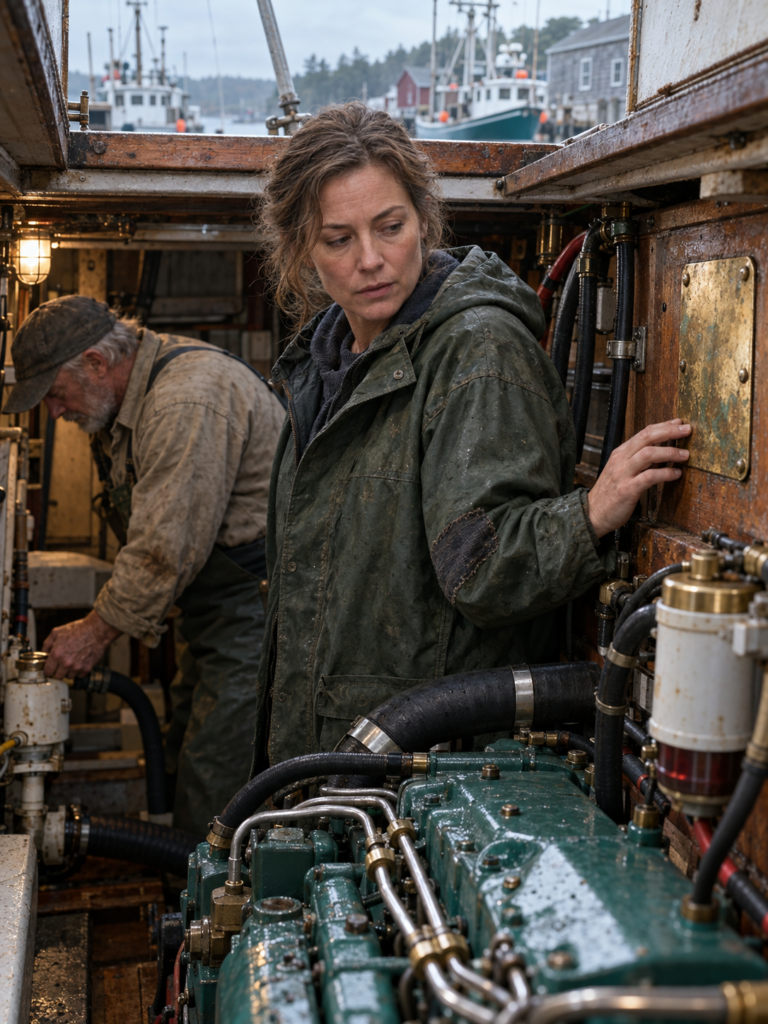
He glanced toward Second Wind’s engine compartment.
Then back at her.
“So that’s why you knew Derek was wrong.”
“He was looking at what he could sell for scrap. I was looking at how you’d cared for it.”
Vernon’s mouth tightened.
For the first time, Tessa saw something other than resignation in his face.
Not pride exactly.
Recognition.
Someone had noticed his work.
“Why did you bid on my boat?” he asked.
Tessa considered telling him she had recognized his name immediately.
But that wasn’t true.
She had noticed Second Wind because its condition contradicted Derek’s claims.
She had only connected Vernon to her childhood after entering the engine compartment.
“I bought it because it deserves to keep working,” she answered. “Finding you was something I didn’t expect.”
Vernon looked down at the invoice.
“And now?”
Tessa leaned forward.
“Now I have a proposal.”
She explained that Northline employed talented younger technicians who understood modern diagnostics but struggled with the mechanical instincts needed to repair older working boats.
The company needed someone who could teach what instruments sometimes missed.
Someone who understood engines from decades of direct experience.
“I’d like to hire you,” she said.
“Three days a week. Senior field mentor. Proper contract. Proper salary.”
Vernon gave a faint, surprised smile.
Then he shook his head.
“You don’t understand.”
He lifted his right hand.
His fingers were slightly curled.
“I injured the nerves three years ago. Can’t reliably hold a wrench anymore.”
Tessa looked at the hand she had noticed that morning.
“I can explain a procedure,” Vernon continued, “but I can’t show someone how to perform it. I tried helping my nephew with a fuel pump. He gave up and found a video.”
He lowered his hand.
“I sold Second Wind because I can’t do what I’ve spent my life doing.”
Tessa wanted to object.
Instead, she listened.
Because she suddenly understood that Vernon hadn’t simply been selling an aging boat.
He was letting go of the last physical connection to the work that had defined him.
And her offer, however generous, had asked him to return to the very thing he believed he could no longer do.
She folded the invoice, slipped it back into its sleeve, and looked toward the engine compartment.
“I understand why you’re saying no,” she told him.
Then she stood, carrying the paper, and stepped toward the gangway without asking him to reconsider.
Tessa stepped off Second Wind and onto the dock, holding the invoice against her rain jacket.
Behind her, Vernon remained on the stern bench.
She could have turned around.
She could have explained why teaching did not necessarily require lifting heavy equipment. She could have offered more money or suggested a different title.
But the conversation had revealed something she hadn’t understood when she made the proposal.
Vernon did not doubt whether her company could afford him.
He doubted whether there was anything left in him worth hiring.
And another argument from a successful executive would not change that.
Tessa returned to her truck.
For several minutes she sat without starting the engine.
Beyond the windshield, the auction crew continued loading equipment. Buyers gathered their papers. A forklift carried a stack of marine supplies toward a trailer.
Life on the dock went on.
The old man who had lost his last boat was already becoming yesterday’s business.
She looked at the plastic sleeve beside her.
Her mother had kept that invoice for a reason.
But perhaps Tessa had misunderstood the lesson.
For years, she believed she would honor Vernon by helping him when the opportunity appeared.
She had imagined repayment as a generous gesture.
Now she wondered whether generosity had been the wrong approach.
Vernon had saved her mother’s livelihood by recognizing a practical problem and solving it without making her feel small.
What problem did Vernon actually need solved?
Not a lack of money alone.
Not even the loss of Second Wind.
He believed his knowledge had become useless because his hands could no longer carry it.
Tessa started the truck and drove toward Portland.
She did not return to Vernon’s house.
And she did not call him with another offer.
The following Thursday, she came back to Bracken Cove for the boat’s removal.
The transport crew had positioned a trailer at the ramp.
Second Wind floated beside the dock, waiting.
Vernon stood nearby with his hands in his jacket pockets.
When everything was ready, Tessa approached him.
“The key?”
He withdrew a small metal key attached to a ring threaded with faded blue rope.
She held out her hand.
He placed the key in her palm.
“I don’t have any others left,” he said.
Tessa curled her fingers around it.
She understood the words meant more than a practical statement.
For nearly half a century, Vernon had always had a boat, a shop, or some reason to be at the harbor.
Now he was handing her his last key.
The transport crew began bringing Second Wind out of the water.
The old hull rose slowly, water streaming from its sides.
The blue name on the stern came into view.
Vernon watched without moving.
He did not criticize the crew’s handling of the cradle, though Tessa could see him examining every adjustment.
When the boat was secured, he turned toward the road.
Tessa almost called after him.
Instead, she let him walk away.
She had made him one promise without saying it aloud.
She would not dismantle Second Wind.
Whatever happened next, this boat would remain a working vessel.
A week later, Tessa contacted Northline’s operations manager.
“I want the unresolved service cases from the last eighteen months.”
“What kind?”
“Commercial vessels where our monitoring equipment showed a fault, but our technicians couldn’t determine the mechanical cause without bringing in outside help.”
Her manager sent the records.
There were twenty-three cases.
Tessa read every one.
At first, the reports seemed unrelated.
One boat had suffered inconsistent fuel delivery.
Another had unexplained electrical draw.
Several had cooling problems.
The faults were neither especially rare nor unusually complicated.
Yet they had confused technicians who were excellent at interpreting modern diagnostic information.
A familiar pattern emerged.
The equipment had reported symptoms accurately.
The technicians had struggled to connect those symptoms to the behavior of older mechanical systems.
They knew what the readings meant.
They did not always know what the boat was trying to tell them.
Tessa thought about Vernon.
His maintenance notebook contained decades of observations that no digital diagnostic system had recorded.
Minor changes in sound.
Patterns of wear.
The order in which problems appeared.
The relationship between a fault and the conditions under which it happened.
Experience had taught him to notice things before instruments confirmed them.
But he had been thinking about that experience as something stored in his hands.
Tessa began to suspect it had been stored somewhere else all along.
She needed to know whether she was right.
On Tuesday, she drove back to Bracken Cove.
This time, she went directly to Northline’s harbor field office.
Three junior technicians were inspecting a thirty-eight-foot commercial lobster boat.
The vessel was seven years old and had been experiencing intermittent power loss under load.
Tessa told them she wanted to observe.
Marcus, a technician who had been with Northline for two years, was working through diagnostic results on his tablet.
The other two technicians checked the corresponding engine systems.
After twenty minutes, the team had identified three possible faults.
None was confirmed.
Marcus frowned at the screen.
“The readings don’t agree.”
“They might,” Tessa said, “if we’re asking the wrong question.”
He looked up.
She took out her phone and called Vernon.
He answered after several rings.
“Tessa?”
“I have a boat at our Bracken Cove field office. We’re getting gradual power loss under load, and our diagnostics aren’t isolating the cause.”
“Which engine?”
She told him.
“What have you checked?”
She described the tests.
There was a pause.
Then Vernon asked, “What happens to the engine note under load?”
Tessa smiled slightly.
“That’s exactly why I’m calling.”
“I told you I can’t do mechanical work.”
“I’m not asking you to. I need an experienced opinion. I’ll pay for your time.”
Another pause.
“Twenty minutes,” Vernon said. “I’ll have a look.”
He arrived in an aging pickup and approached the boat with no apparent enthusiasm for ceremony.
Tessa introduced him to the technicians.
Marcus moved aside.
Vernon stood at the engine compartment opening.
“Start her.”
The engine came to life.
Vernon listened.
“Let her idle.”
Nobody spoke for nearly forty seconds.
Then he asked for the engine to be brought up to operating load.
The note changed.
Vernon tilted his head.
“Have you inspected the fuel return line?”
Marcus glanced at his tablet.
“The system isn’t indicating a return-line fault.”
“How about the day-tank vent?”
“No direct flag there either.”
Vernon nodded toward the engine.
“If the return line’s restricted, your readings can look like a delivery problem. A partly blocked tank vent can make it worse under load.”
Marcus studied him.
“How would you know both are involved?”
“I don’t know yet,” Vernon replied. “I’m telling you where I’d look.”
That distinction mattered.
He was not claiming certainty from a sound alone.
He was using experience to narrow the inspection.
Marcus reached into the engine compartment and traced the return line.
Near a fitting, the rubber section had partially collapsed.
The restriction was subtle.
Under sustained throttle, it was significant.
The team checked the tank vent.
Debris had partially blocked it.
The technicians exchanged looks.
They corrected both problems.
Within twenty minutes, the engine was running properly under load.
Marcus shut down the diagnostic tablet.
He turned to Vernon.
“How did you hear that?”
Vernon shrugged.
“I’ve heard engines behave that way before.”
“But our sensors showed three different possibilities.”
“Your sensors showed effects,” Vernon said. “You still have to work out the causes.”
Marcus considered that.
Then he asked, “Could you explain what we should have been listening for?”
Vernon looked toward Tessa.
She said nothing.
For a moment, the elderly mechanic seemed uncertain.
Then he returned his attention to the engine.
“Run it again.”
Marcus started the motor.
Vernon stood beside the hatch and began describing the sound.
He explained the difference between a normal engine note and the subtle change caused by restricted fuel movement.
He asked the technicians questions.
What happened to power under sustained load?
Why would the symptoms grow gradually?
Which reading described a result rather than the original fault?
Nobody asked him to pick up a wrench.
Nobody seemed interested in whether he could.
Marcus listened with such concentration that he forgot the tablet resting beside him.
When Vernon finished, one of the technicians asked another question.
Then another.
Soon Vernon was explaining how the same type of symptoms could lead an inexperienced mechanic toward the wrong component.
Tessa watched the exchange.
And the answer she had been looking for became visible.
Vernon could teach.
He simply needed students whose questions began with observation rather than instructions for a repair.
When the session ended, Marcus followed him toward the dock.
“Would you be willing to come back sometime?”
Vernon looked surprised.
“Why?”
“Because I want to learn how to recognize that before I’m staring at three conflicting fault codes.”
Vernon opened his mouth.
Then closed it.
For a long moment, he looked toward the harbor.
“I suppose we could talk about it,” he said.
The following morning, Tessa met him at the Harbor Diner.
Two cups of coffee sat on the table.
Between them was a formal employment contract.
Vernon glanced at it.
“I already told you—”
“I know,” Tessa interrupted gently. “You can’t demonstrate physical repairs.”
He nodded.
“I’m not asking you to.”
She turned the contract toward him.
“Senior field mentor. Three days a week. You’ll train our technicians to interpret mechanical symptoms, ask better questions, and understand working vessels. They’ll handle the tools.”
He read the job description.
Then the salary.
His eyebrows rose.
“That’s more than I expected.”
“It’s based on the value of specialized experience.”
Vernon leaned back.
For years, he had thought the skill he’d lost was the only skill anyone wanted.
Now Tessa was offering to pay him for the knowledge he had accumulated while doing that work.
He studied the contract again.
Then he asked the question she had anticipated.
“What about Second Wind?”
Tessa reached into her pocket.
She placed the boat’s key on the table.
The blue rope lay between them.
“Northline is making her a field training vessel.”
Vernon looked at her.
“That old boat?”
“Real equipment. Real engine hours. Real working conditions. Your maintenance notebook stays aboard so our technicians can study the history.”
He took a slow breath.
“You’re not stripping her?”
“No.”
“Or turning her into some display?”
“No. She’ll work.”
Vernon picked up the key, letting the worn rope rest against his fingertips.
Tessa waited.
Finally, he looked at the contract.
“Three days a week?”
“Three.”
“And the younger mechanics do the wrench work?”
“Exactly.”
He considered the words for another moment.
Then he reached for the pen.
Before signing, he asked one last question.
“Will they actually listen?”
Tessa thought of Marcus standing beside the engine compartment, asking to hear the difference.
“I think they’re ready to learn.”
Vernon signed his name.
But when he pushed the paper back toward her, he didn’t smile.
He looked at the blue rope attached to the key.
“There’s something you should understand about Second Wind,” he said.
Tessa waited.
“I didn’t sell her because I stopped loving the water.”
His fingers tightened slightly around the rope.
“I sold her because every time I stepped aboard, I remembered what I couldn’t do anymore.”
He looked up.
“If I’m going to come back to her, I need to know I’m coming back for a reason.”
Tessa nodded.
“Then we’ll make sure you have one.”
Vernon looked down at the contract one final time.
The signature was already there.
But Tessa understood that signing a document and believing in the future it promised were not the same thing.
She reached across the diner table and moved Second Wind’s key toward him.
“Your reason won’t be something I give you,” she said. “It’ll be the people who need what you know.”
Vernon regarded the worn blue rope.
Then he pushed the key back.
“You bought the boat,” he said. “You keep it.”
Tessa slipped it into her pocket.
For the first time since the auction, Vernon seemed willing to discuss something beyond what he had lost.
He asked how many technicians Northline employed.
How often they worked on older vessels.
What kinds of boats they would use for training.
Whether the training would take place in Portland or along the smaller harbors.
Tessa answered each question.
Some answers pleased him.
Others drew immediate objections.
“The classroom won’t teach them enough,” Vernon said when she described the planned training sessions.
“Then we’ll spend more time aboard.”
“And they need to see engines with actual problems.”
“Agreed.”
“Not just clean equipment that somebody prepared for a demonstration.”
Tessa smiled.
“That’s why I bought Second Wind.”
Vernon shook his head.
“She isn’t a broken-down training prop.”
“I know. She’s a working boat. That’s exactly what makes her useful.”
He looked toward the harbor beyond the diner window.
The morning tide was rising.
Fishing boats shifted gently against their lines.
For years, he had known most of those vessels by their engine sounds, their owners, and the repairs they were likely to need next.
Now he had a chance to pass some of that knowledge to people who hadn’t spent their lives on those docks.
There was one thing he still couldn’t quite accept.
“Why are you doing all this?” he asked.
Tessa looked at him.
“I told you. Northline needs better training.”
“That’s the business reason.”
“It’s a real one.”
“I believe you.”
He hesitated.
“But you brought me that invoice.”
Tessa reached inside her jacket and withdrew the plastic sleeve.
She laid it beside the contract.
Vernon looked at the old paper through the clear covering.
The sentence at the bottom had become faint with age, but it remained readable.
“When you’re steady again, keep somebody else afloat.”
For twenty-six years, those words had traveled through Tessa’s life.
Her mother had protected the invoice through moves, difficult years, and the ordinary losses that gradually separated families from their past.
As a child, Tessa had known only that a mechanic had repaired their boat when they couldn’t afford it.
Later, she understood what that repair had preserved.
It kept Celia working.
It kept the family’s livelihood intact at a moment when one mechanical failure could have interrupted everything.
And it kept a twelve-year-old girl close to the machinery she would eventually build her career around.
Tessa had spent years learning to recognize problems that other people overlooked.
She founded a company around that principle.
But until the auction, she had never imagined that the person who helped make her future possible would become someone Northline itself needed.
“I used to think I wanted to pay you back,” she told Vernon.
He shook his head.
“You don’t owe me anything.”
“That’s what I finally understood.”
He looked puzzled.
She touched the invoice.
“My mother couldn’t repay you then. And I can’t really repay what that decision meant to us. But you didn’t ask her to.”
Vernon waited.
“You asked her to help someone else when she could.”
He looked at the paper for a long time.
“I probably wrote that because she was embarrassed about the bill.”
“She was.”
“I didn’t want her thinking it was charity.”
“She didn’t.”
Tessa remembered the way her mother had explained the invoice.
Not as evidence that they had been helpless.
Not as a story about someone wealthy rescuing someone poor.
It was about a man who had noticed a practical problem, understood its consequences, and done what he could.
He had seen a broken cooling system.
But he had also seen the woman whose life depended on getting it running again.
“I still don’t remember the repair,” Vernon admitted.
Tessa nodded.
“I know.”
“That sounds terrible, considering how much it meant to you.”
“It doesn’t.”
“Why not?”
“Because it tells me you weren’t trying to make it into some grand act. You were just doing what you thought was right.”
Vernon looked out the window.
For several seconds, neither spoke.
Then he folded the contract and placed it carefully inside his jacket.
“When do I start?”
***
The first training sessions were not flawless.
Vernon had spent decades repairing engines, not organizing lessons for young technicians.
He was accustomed to looking at a piece of equipment and understanding where to begin.
Explaining that instinct required patience.
Sometimes he skipped steps because the connections seemed obvious to him.
Sometimes a technician asked a question he hadn’t considered in years.
At first, Vernon would gesture toward a component and begin explaining how to remove it.
Then his injured right hand would drift toward the engine.
His fingers would hesitate.
He would stop.
The old frustration returned quickly.
But the younger technicians gradually learned not to interpret those pauses as the end of a lesson.
One of them would step forward.
“Which fitting?”
Vernon would point.
“This one.”
“Before or after we isolate the supply?”
“Before. But tell me why.”
The technician would think.
The discussion would continue.
Vernon began asking more questions and giving fewer immediate answers.
He wanted the technicians to explain not only what they intended to do but what evidence supported their decisions.
That required a different kind of discipline.
He taught them to listen before checking a screen.
To compare how an engine behaved at idle and under load.
To notice whether a fault appeared suddenly or developed over time.
To distinguish a warning generated by a monitoring system from the mechanical condition that caused it.
His lessons didn’t replace modern diagnostics.
They made the technicians better at using them.
Marcus became one of his most attentive students.
The young man had been comfortable with software from the day he joined Northline.
He could interpret data quickly and knew the company’s equipment exceptionally well.
But Vernon pushed him to look beyond the screen.
“What does that reading tell you?” he would ask.
Marcus would answer.
“And what doesn’t it tell you?”
That second question became the harder one.
Sometimes they spent most of a session discussing a fault that could have been repaired in minutes by someone who already knew where to look.
Vernon insisted that understanding the reasoning mattered more than memorizing a shortcut.
A technician who only remembered the repair might solve one problem.
A technician who understood why the repair worked could recognize similar problems elsewhere.
And that was the knowledge Northline had been missing.
The maintenance notebook from Second Wind became an unexpected teaching tool.
Its pages contained nearly thirty years of ordinary mechanical history.
Nothing about the notebook was glamorous.
It had water stains, worn corners, and a cover softened by handling.
But the entries showed how small problems developed across seasons.
The technicians could compare a repair with earlier observations.
They could see how Vernon had tracked engine hours, recurring symptoms, and changes in system behavior.
Sometimes an entry was only a few lines long.
Vernon would explain why he had written it.
At other times, he couldn’t remember the specific repair without studying the surrounding notes.
That became a lesson too.
Experience was valuable.
But experience wasn’t perfect memory.
Careful records mattered because even a knowledgeable mechanic could forget.
Tessa watched the training program develop without turning Vernon into a symbol for the company.
He was an employee doing important work.
He had responsibilities, a schedule, and students who needed honest feedback.
His expertise was respected, but it was also tested.
When he offered a diagnosis, the technicians verified it.
When a system produced a reading that complicated his initial judgment, they discussed the discrepancy.
The best sessions were not the ones where Vernon was always right.
They were the ones where everyone learned how to determine what was right.
Gradually, the hesitations caused by his injured hand became less central to the work.
The injury remained.
It did not disappear because he had found a new purpose.
He still couldn’t reliably grip a wrench.
There were still moments when he watched a younger technician handling a familiar repair and felt the old loss.
But those moments no longer meant he had nothing to contribute.
He could direct attention.
Ask a precise question.
Recognize a pattern.
Explain why a seemingly insignificant sound deserved investigation.
And he could watch someone else use that knowledge successfully.
The difference was enormous.
***
Four months after the auction, Second Wind returned to Bracken Cove.
It was a clear October morning.
The vessel approached the harbor under its own power, the engine running smoothly.
Six Northline technicians were aboard.
They had spent the previous two weeks learning how a healthy diesel sounded under changing conditions, how developing faults affected its behavior, and why mechanical observation mattered even with modern monitoring equipment.
The boat still looked like Second Wind.
Its age had not been disguised.
The blue name remained on the stern.
The familiar cabin, its worn surfaces, and the practical layout Vernon had maintained for years were still there.
The vessel had not been transformed into a polished advertisement.
It had become what Tessa promised it would become.
A working training boat.
Vernon was at Northline’s Bracken Cove field office that morning.
He had arrived at seven for a session on cooling system diagnostics.
Two technicians spent much of the morning discussing the differences between restricted circulation, reduced heat transfer, and inaccurate temperature readings.
Vernon had insisted they explain how they would distinguish among the possibilities before beginning work.
When the session ended, he collected his bag and headed toward the parking lot.
The dock lay along his route.
He heard Second Wind before he saw it.
The sound carried across the harbor, familiar enough to make him turn.
For a moment, he stood perfectly still.
Then he walked closer.
Marcus was at the helm.
The boat was approaching the slip with the careful, deliberate movements of someone who understood that docking was not a performance.
He reduced speed.
Adjusted his approach.
Allowed the vessel to move the final few feet toward the fender.
Then he brought it alongside.
Vernon watched every movement.
He had spent years bringing Second Wind into that harbor himself.
He knew how the hull responded to the water.
He knew how much momentum the boat carried after the throttle was reduced.
And he knew how easily an inexperienced operator could misjudge the final approach.
Marcus handled it well.
The boat settled gently against the dock.
The engine stopped.
For a moment, the harbor seemed unusually quiet.
Vernon gave one small nod.
Marcus saw it.
He smiled.
It was the kind of approval that meant more because it had not been offered casually.
A few yards away, Tessa stood watching.
She wore her faded green rain jacket.
The same one she had worn to the auction.
Inside its pocket was the old plastic document sleeve.
She had kept it there since the morning she handed Vernon the invoice.
She could have placed it in a frame.
She could have displayed it in Northline’s offices as an inspirational story.
She could have told employees that the man training them had once helped their chief executive’s mother.
But she hadn’t.
The invoice was not a marketing device.
It was a private reminder of how their paths had crossed.
Vernon stepped closer to the boat as the technicians secured the lines.
Marcus climbed onto the dock.
“How was that?”
Vernon looked toward Second Wind.
“You brought her in a little farther from the slip than I would.”
Marcus waited.
“But you corrected early, and you didn’t rush the last few feet.”
“So?”
“So you did fine.”
Marcus laughed.
“That’s high praise coming from you.”
Vernon almost smiled.
Then he noticed the maintenance notebook through the cabin doorway.
It was still aboard, exactly as Tessa had promised.
One of the technicians had been using it during the training voyage.
The familiar spiral binding lay beside a newer set of instructional materials.
Vernon looked at it with an expression Tessa couldn’t quite read.
For nearly thirty years, those pages had been a record of his responsibility.
Every repair had been something he needed to complete.
Every entry had helped him remember what to inspect next.
Now other people were using the same notebook to understand how a working vessel aged.
The record had become useful in a way he had never anticipated.
Marcus followed his gaze.
“We found the entries about the fuel system work you did a few years ago,” he said.
Vernon nodded.
“Anything interesting?”
“You tracked a change in operating behavior before you replaced the worn part.”
“That’s usually how it happens.”
“But you kept notes before you knew what the fault was.”
“Of course.”
“That’s the part we’re trying to get better at.”
Vernon considered that.
Then he looked toward the six technicians.
They were discussing the voyage and comparing what they had heard under different engine loads.
One described a vibration he had noticed.
Another explained why it had not indicated the fault he initially suspected.
They were not merely repeating Vernon’s words.
They were thinking with the habits he had spent decades developing.
And for the first time, he could see those habits surviving outside his own work.
Tessa walked over.
“She sounds good,” she said.
Vernon nodded.
“She always could, when somebody listened.”
Tessa rested a hand on the rail.
“Are you happy with how they’re doing?”
“Mostly.”
She smiled.
“Mostly?”
“They’re still too quick to trust the first explanation.”
“So you’re staying busy.”
“Very.”
He watched Marcus help secure the final line.
Then he said something Tessa had not expected.
“I thought that boat was the last thing I had left.”
She turned toward him.
“When I sold her, I figured that was the end of it. No shop. No wrench work. No reason to come down here except to watch other people do what I used to do.”
He looked at his right hand.
The fingers were still curled.
The injury had not improved.
“But I was wrong about one thing.”
Tessa waited.
“I thought the knowledge was gone because I couldn’t do the work with my hands anymore.”
He glanced toward the technicians.
“Turns out I can still explain what I’m hearing.”
“You can do more than that.”
He gave a small shrug.
“Maybe.”
Tessa knew better than to turn the moment into a speech.
Instead, she took the plastic sleeve from her pocket.
“There’s something I’ve never told you about this.”
Vernon looked at the invoice.
“What?”
“How many times I wondered whether I’d ever find the man who wrote it.”
He seemed uncomfortable.
“Tessa, it was one repair.”
“To you.”
He said nothing.
“My mother kept that paper because the repair gave her a chance to keep working. When I was older, she explained why she valued it.”
Vernon studied the document.
Tessa continued.
“I used to think the important part was the zero at the bottom.”
“The bill?”
“Yes. The fact that you didn’t charge her.”
Vernon nodded slightly.
“But the more I thought about it, the more I realized the sentence mattered just as much.”
She pointed to the handwritten line.
“When you’re steady again, keep somebody else afloat.”
Vernon read the words.
He had written them twenty-six years earlier.
At the time, he had no reason to believe they would be remembered.
The repair had been a routine act of practical kindness during a slow period at the shop.
He had seen a woman whose boat needed work and whose money was already committed elsewhere.
He did what he could.
Then he moved on.
He couldn’t have known that Celia would preserve the invoice.
He couldn’t have known her daughter would spend years studying engines.
Or that the child who had watched him repair a cooling system would eventually build a company supplying equipment to commercial fleets.
He certainly couldn’t have known that one day he would stand beside his own boat, unable to perform the mechanical work he loved, while that same child—now an adult—helped him find another way to remain useful.
The chain of events was almost impossible to appreciate from either end.
But none of it required a miracle.
Celia had needed help.
Vernon had provided it.
Tessa had learned something from watching.
And years later, she had found a way to apply the same principle.
Not by handing Vernon money and calling the debt settled.
By noticing the difference between what he could no longer do and what he still had to offer.
“I didn’t really give you anything back,” Tessa said.
Vernon frowned.
“You gave me a job.”
“Because you’re good at it.”
“You bought my boat.”
“Because it was worth keeping.”
He looked at the invoice.
“Then what was all this?”
Tessa considered her answer.
“I think it was the same thing you did for my mother. You saw what she needed, and you helped her keep going. I saw something in your work that you couldn’t see anymore.”
Vernon lowered his eyes.
The harbor moved quietly around them.
A line creaked against a cleat.
Someone farther down the dock called for a tool.
The technicians continued securing Second Wind.
Nothing about the scene was grand.
No crowd had gathered.
Nobody was waiting for Vernon to make a speech.
That suited him.
After a while, he said, “Your mother must have been a good teacher.”
“She was.”
“She taught you to look at a boat properly.”
Tessa smiled.
“She taught me to look at people properly, too.”
Vernon gave a short, quiet laugh.
“Well, don’t make too much of me.”
“I won’t.”
She slipped the invoice back into its sleeve.
Then she returned it to her jacket pocket.
There would be no ceremonial repayment.
No photograph of Vernon holding an oversized check.
No public announcement that a wealthy CEO had rescued an elderly fisherman.
Those would have been easy stories to tell.
But they would have missed the important part.
Vernon hadn’t been rescued from having no value.
He had been reminded of value that had never disappeared.
The loss of his physical ability was real.
The grief that came with it was real.
But neither canceled decades of understanding.
And Second Wind had not become valuable because someone wealthy purchased it.
Its value had been visible in the maintenance log, the carefully secured wiring, the clean fittings, and the attention given to machinery long after the paint began to fade.
Derek Sloan had stood at the auction and seen a boat worth stripping.
Tessa had recognized a vessel that could keep working.
But even she had initially misunderstood the deeper problem.
She had believed offering Vernon a teaching position would be enough.
It took watching him refuse, investigating Northline’s own failures, and giving him a chance to solve a real mechanical problem before she understood what the position needed to be.
The lesson was not that every older worker could simply find a new purpose.
Vernon’s transition had required a genuine need, meaningful work, fair compensation, and technicians willing to learn.
It also required him to risk discovering that the abilities he still possessed were worth sharing.
That had been his decision.
Tessa could open the door.
He had to choose to walk through it.
As the technicians prepared to leave the dock, Vernon checked his bag.
“Thursday,” he said.
Tessa glanced at him.
“What about Thursday?”
“Cooling systems again. Marcus wants to go over the difference between intermittent flow restriction and a faulty temperature reading.”
“Sounds useful.”
“It will be if he does his homework.”
Tessa laughed.
Vernon adjusted the strap of his bag and started toward the parking lot.
He did not linger beside Second Wind.
He didn’t need to.
The boat was no longer something he had to keep in the water himself to prove he still belonged to the harbor.
It had a purpose.
So did he.
Tessa watched him go.
Then she turned toward the vessel.
Its blue name caught the October light.
Second Wind.
When she first saw those words, they were simply the name of an aging fishing boat.
Now they meant something different.
Not a return to the past.
Not the restoration of something that could never be exactly as it had been.
A continuation.
Vernon had once helped a young mother keep her boat working.
That mother’s daughter had grown up to create technology for people whose livelihoods depended on boats.
And now six technicians were learning from a man who had almost believed his working life was finished.
Tessa rested her hand on the rail one final time.
In her pocket, the old invoice remained folded along the same worn creases.
She no longer thought of it as a debt waiting to be repaid.
It was a reminder that a useful act could continue long after the person who performed it had forgotten.
Across the parking lot, Vernon reached his truck.
He set his bag on the passenger seat and climbed inside.
He had another lesson to prepare.
Another group of questions to answer.
Another Thursday at the harbor.
And behind him, Second Wind rested against the dock with a new generation learning how to care for it.
The boat’s name had finally become true in a way neither its owner nor its buyer could have predicted.
Not because Vernon had recovered the use of his hand.
But because the knowledge he thought had ended with it was now moving forward in six other pairs of hands.
And this time, he knew exactly where it was going.


