
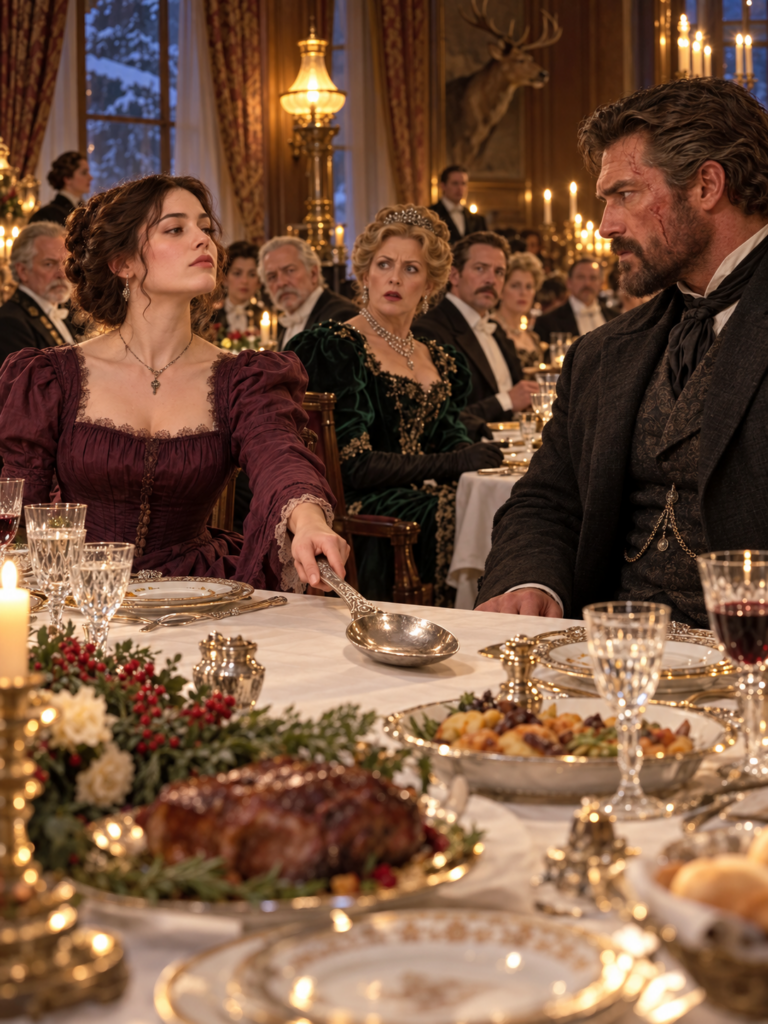
Bellen had reached the bottom veranda step when Ambrose came after her and stopped far enough away that his shadow no longer covered hers.
A carriage waited beyond the hotel lamps.
So did Lady Greer.
Not physically.
Her words did.
No decent man will approach you now.
Bellen stared at the carriage door.
“I need you to understand something.”
Ambrose said nothing.
“If I leave with you, people will say I did it because I attached myself to your name.”
“They already say worse about me.”
“This concerns me.”
That made him straighten.
Bellen continued.
“You may offer me safety tonight. You may not decide what it means tomorrow.”
Ambrose looked at her for a long moment.
Then he nodded once.
“Fair.”
No argument.
No injured pride.
No speech about protection.
Just agreement.
The driver climbed down to open the door.
Before Bellen entered, she turned back toward the hotel. Greer and several other women were visible behind the glass.
Bellen lifted her chin.
Then she got into the carriage.
The next morning she was kneeling beside her aunt’s weak coal fire when a knock shook the little rented house.
Her aunt nearly dropped the breakfast teapot.
Bellen already knew.
She opened the door herself.
Ambrose Prescott filled the narrow entry.
In daylight he appeared less like a ballroom legend and more like what he actually was: a working rancher with money enough to employ men but habits formed by weather, animals, and long distances.
His gaze fell on the soot streaking Bellen’s hands.
“You build your own fires.”
“Our maid left when we could no longer pay her.”
He did not pity her.
“I’m leaving north tomorrow.”
Disappointment came so quickly Bellen resented herself for feeling it.
“I hope the trail is clear.”
Ambrose reached into his coat and withdrew a folded packet.
“I came because I require something from you.”
Her aunt appeared in the parlor doorway.
Bellen crossed her arms.
“What?”
“A partner.”
She stared.
“My ranch supports several families. I have cattle, leased grazing ground, a freight contract, and interests in two producing coal claims. I can manage men, stock, winter feed, machinery, and weather. I am bad at nearly everything that must happen inside my own house.”
“You need a housekeeper.”
“I have one.”
“Then an accountant.”
“I employ one.”
Bellen frowned.
Ambrose held out the packet.
“I need a wife.”
Her aunt made a strangled sound.
Bellen did not move.
“Why?”
“Because I watched you last night.”
“That is not sufficient reason to marry anyone.”
“No.”
He lowered the papers.
“I watched you understand a room faster than people who have spent their whole lives controlling one. I watched you calm a frightened waiter without humiliating him. I watched you answer cruelty without begging anyone to rescue you.”
His voice softened.
“And when I offered you help, you told me the limits of it.”
Bellen’s pulse quickened.
Ambrose continued.
“My ranch does not need an ornament. It needs someone willing to make decisions when I am forty miles away with cattle. Someone who can read accounts, challenge suppliers, manage household hiring, hear complaints without being fooled by flattery, and tell me when I am wrong.”
“You assume I can do all that.”
“I assume you can learn what you do not know.”
That answer pleased her more than praise would have.
“What are the terms?”
Her aunt gasped again.
Ambrose almost smiled.
Bellen ignored both of them.
“My aunt depends upon me. Her debts must be settled and she must receive enough to live without begging relatives.”
“Agreed.”
“I control the household accounts placed under my care.”
“Yes.”
“I choose staff within an agreed budget.”
“Yes.”
“I am not expected to ask permission every time I ride into town.”
“No.”
“And the marriage itself?”
Ambrose became completely still.
Bellen forced herself not to look away.
“You told me last night that I decide what your protection means. I expect that rule to survive a wedding.”
“It will.”
He set the folded papers on the table rather than pressing them into her hand.
“You would have your own room in the west part of the house. I sleep on the eastern side. Nothing changes unless you choose it.”
Bellen glanced down at the packet.
“And if I discover I hate the north?”
“I provide you transportation back and enough money to establish yourself without returning here dependent on anyone.”
Her aunt whispered his name as though he had proposed insanity.
Perhaps he had.
Bellen touched the papers.
A marriage arranged after one supper should have felt absurd.
Yet every condition that mattered was being spoken plainly.
Ambrose was not asking her to become grateful.
He was asking her to work.
He was also giving her something no polite man had offered in four humiliating seasons.
A way to refuse later.
Bellen picked up the agreement.
“I will read every page.”
“I expected you to.”
“If your lawyer has hidden anything, I will find it.”
“I hope you do.”
“And I will not leave today.”
Ambrose’s brow lifted.
“I need time to understand exactly what I am choosing.”
“How much?”
“Until tomorrow morning.”
Her aunt whispered, “Bellen.”
Bellen kept her gaze on him.
“If the offer disappears because I ask for one night to think, then it was never an offer worth accepting.”
Ambrose’s expression changed.
Not anger.
Approval.
He took one step backward.
“Tomorrow morning.”
Then he turned toward the door.
Bellen unfolded the first page while he was still crossing the narrow hall, because whether she chose the feared rancher or remained in the life that was slowly consuming her, she intended the decision to belong entirely to her.
Bellen was still reading when Ambrose pulled the front door closed behind him.
She read until the weak coal fire burned out.
Then she carried the agreement to the window and read it again by morning light.
The arrangement was startlingly plain.
Her aunt’s debts would be paid.
A yearly allowance would remain hers.
Bellen would receive independent control over household expenditures within a stated budget and authority to dismiss or hire domestic staff.
If the marriage failed, she retained enough money to live separately.
Nothing in the document bound her body, labor, or personal property to Ambrose beyond what local law already complicated through marriage.
The final clause had been added in different handwriting.
Bellen recognized at once that it had probably been Ambrose’s demand.
Should Mrs. Prescott wish to depart the ranch permanently, transportation and sufficient settlement for independent residence shall be provided without accusation of desertion.
She stared at those words longest.
Her father had left her nothing.
Society offered women like her very little.
Ambrose Prescott, whom polite people called savage, had written an exit into the agreement.
When he returned the next morning, Bellen was waiting in the parlor wearing her plainest traveling dress.
Her battered trunk stood beside the wall.
Ambrose stopped.
“You read it?”
“Twice.”
“And?”
“I found one objection.”
His face tightened.
“You refer to me throughout as Mrs. Prescott.”
“You would be.”
“I know. But household and ranch business should recognize my authority clearly. If I am expected to negotiate contracts in your absence, your employees must know my signature carries weight.”
Ambrose stared at her.
Her aunt stared harder.
Bellen held out the marked papers.
“I added language.”
Ambrose took them.
He read.
Then the great scarred rancher laughed until her aunt crossed herself.
“You haven’t married me yet and you’re rewriting my lawyer’s work.”
“He was imprecise.”
“He will dislike you.”
“Then he may improve.”
Ambrose folded the agreement.
“Anything else?”
“Yes.”
Bellen looked directly into his eyes.
“I am not going north because I am frightened of poverty.”
“Good.”
“I am going because you are offering work with consequence.”
His expression settled.
“And because,” she added, “you did not punish me for saying no last night.”
Something quieter entered his face.
“Then I’ll spend the rest of my life trying not to make a liar of myself.”
Bellen extended her hand.
“I accept.”
He took it.
Nothing dramatic happened.
No thunder.
No sudden declaration.
His hand was rough and warm around hers.
That steadiness frightened her more than passion might have.
They married by simple civil ceremony before departing.
Her aunt wept through most of it.
Ambrose remained grave.
Bellen signed her name carefully.
Then she stepped outside with her husband and climbed into a northbound coach carrying nearly everything she owned in one trunk.
The journey lasted days.
Towns grew smaller.
Roads roughened.
Open country widened.
Rail gave way to coach, then to ranch roads cut between long slopes of brown grass and dark timber.
Bellen watched Ambrose during the journey.
He read livestock reports.
He calculated freight charges.
At coaching stops, hostlers knew his name.
Some respected him.
Some feared him.
He never used fear when courtesy worked.
At one rough inn, the keeper became so nervous at seeing Prescott that he forgot half their order.
Bellen stepped around her husband.
“We need hot food, water for washing, and proper feed for both teams before they travel again.”
The keeper nodded frantically.
“And no one rushes the horses to satisfy us,” she added. “They have carried us all day.”
Ambrose looked at her after the man hurried away.
“You know horses.”
“My father lost money breeding them. That required me to learn more than he ever did.”
“Useful misfortune.”
“Those are usually the only kind left afterward.”
His mouth curved.
By the fourth afternoon, the Prescott ranch appeared beyond a long valley.
It was not a grand palace transferred absurdly onto the frontier.
It was a working property grown over decades.
A large stone-and-timber house stood on a rise above corrals, barns, bunkhouses, sheds, fenced winter pasture, and long stacks of hay weighted against the wind.
Beyond lay dark foothills.
Snow marked the higher country.
Men paused their work when the coach arrived.
Women emerged from the house.
Every expression told Bellen the same thing.
They expected the city bride to fail.
Ambrose helped her down.
Bellen landed in mud.
She looked at the housekeeper, Mrs. Higgins, whose gray hair had been pulled into a knot so tight it appeared painful.
“Welcome, ma’am.”
“Thank you.”
Mrs. Higgins glanced anxiously toward Ambrose.
Bellen followed the look.
The staff waited for him to explain her place.
Ambrose did not.
He looked at Bellen.
The choice was deliberate.
She understood.
“I would like to see the food stores before supper,” Bellen said. “Not because I suspect anyone. I need to know what winter requires here.”
Mrs. Higgins blinked.
“Yes, ma’am.”
“And the kitchen staff?”
“Two women and a girl.”
“The girl looks exhausted.”
The youngest servant lowered her gaze.
“How long has she been working?”
Mrs. Higgins hesitated.
“Since before light.”
“Then someone else serves supper.”
Ambrose said nothing.
Mrs. Higgins studied Bellen differently.
“Yes, ma’am.”
Inside the house, Bellen found disorder rather than neglect.
Bills had been paid twice.
Other bills had gone unpaid because no one knew which desk contained them.
Coal had been rationed badly in servants’ rooms while an unused guest wing remained heated.
The pantry held too much expensive preserved fruit and too little flour.
Three different men ordered household supplies without speaking to one another.
No villain had caused it.
No secret thief waited to be exposed.
The house had simply been run without clear authority because Ambrose spent most of his time where his skill was needed most—outside.
On the second morning, Bellen entered his study carrying three ledgers.
“You are paying two suppliers for lamp oil.”
Ambrose looked up from a cattle tally.
“Am I?”
“Yes.”
“That seems unnecessary.”
“It is.”
She dropped the ledgers onto his desk.
“One contract ends today.”
“You choose which.”
She paused.
“You aren’t going to ask?”
“I married someone for judgment.”
“That is a dangerous habit.”
“So I am told.”
For the first several weeks, they worked more than they spoke.
Bellen reorganized stores.
She required written purchase records.
She increased fuel for the staff rooms after discovering that two workers had been sleeping in their clothes against the cold.
She changed nothing merely to prove she could.
When Mrs. Higgins objected to moving the dry goods, Bellen asked why.
Mrs. Higgins explained that spring runoff occasionally flooded the lower wall.
Bellen left the stores where they were.
Respect grew from that decision faster than it would have from an order.
Ambrose saw it.
He also saw Bellen’s hands change.
Ink stained her fingers.
Cold reddened her knuckles.
Riding gloves roughened her palms.
She learned which ranch horses were trustworthy.
He taught her how to recognize approaching weather by the clouds trapped along the ridge.
She taught him that three suppliers had been charging different prices because they assumed he never compared invoices.
At night they ate together.
Sometimes they argued.
Sometimes they laughed.
Always he returned to the east side of the house.
Bellen kept the west.
The long hallway between them remained a visible fact neither pretended not to notice.
One evening, after nearly three months, Bellen found Ambrose repairing a leather harness beside the kitchen stove because the tack room was too cold.
“You employ men for that.”
“They’re sleeping.”
“So should you.”
He pulled the needle through the leather.
“So should you.”
Bellen sat opposite him.
The kitchen had emptied.
A single lamp burned between them.
“Why did you really leave society?”
Ambrose’s hands slowed.
“You know about the beating.”
“I know what happened. I do not know why you stayed away ten years.”
He set the harness down.
“Because they wanted repentance for stopping him, not for failing to stop myself afterward.”
Bellen remained silent.
Ambrose looked toward the dark window.
“I could admit I went too far. They heard that as permission to pretend the stable boy never mattered.”
His voice became quieter.
“So I left.”
“Was that pride?”
“Yes.”
The answer surprised her.
“And anger.”
He met her gaze.
“And cowardice.”
Bellen frowned.
“They frightened you?”
“No.”
He flexed one scarred hand.
“I frightened myself.”
The kitchen seemed smaller.
“I discovered there are moments when hurting someone feels righteous enough to become easy. I did not want to become a man who seeks those moments.”
Bellen looked at his hands.
The same hands that had placed his coat around her without closing it.
The same hands that had signed an agreement allowing her to leave.
The same hands now repairing a harness for someone else to use at dawn.
“Are you?”
“Am I what?”
“That man.”
Ambrose looked at her steadily.
“I work at not being him.”
It was the best answer he could have given.
Several days later, Bellen rode with him to inspect winter cattle.
The cold bit through wool.
She watched Ambrose move among the animals with surprising patience.
He never rushed frightened stock.
He cursed broken equipment more readily than living creatures.
When one young hand jerked angrily at a nervous horse, Ambrose took the reins.
“Give him his head.”
“He won’t stand.”
“He won’t stand while you fight his mouth.”
Ambrose loosened the rein.
The horse settled.
“Strength is not the same as pressure.”
Bellen heard the words long after they rode home.
That evening she found a new set of account shelves installed in her sitting room.
No note.
No announcement.
Only shelves built to her height because she had once complained that the study cabinets forced her to climb a chair.
She touched the smooth wood.
Ambrose had listened.
The next night she entered his study while he reviewed mining reports.
He looked up.
Bellen closed the door behind her.
His eyes followed the motion.
“We need to discuss something.”
Ambrose laid down the papers.
“All right.”
She approached the desk.
“The marriage has worked.”
A guarded expression came over him.
“As business.”
“Yes.”
His jaw hardened almost imperceptibly.
Bellen noticed.
“I did not say only as business.”
Ambrose stayed motionless.
She came around the desk.
“I thought survival would be enough for me.”
He stood.
The room changed when he did.
He was still enormous.
Still scarred.
Still capable of frightening anyone who measured danger by appearance.
But he did not move toward her.
Bellen stopped within arm’s reach.
“I have money now.”
“Yes.”
“I have authority.”
“Yes.”
“I could leave tomorrow under the agreement you wrote.”
“Yes.”
The word cost him something.
She heard it.
Bellen placed her palm against his chest.
His breath stopped.
“That is why this matters.”
Ambrose’s voice was rough.
“Bellen.”
“I stayed first because I gave my word.”
Her fingers curled slightly against his shirt.
“Now I am staying because I want this life.”
His eyes closed once.
Then opened.
“Do not say anything you think you owe me.”
“I owe you honesty.”
“That is all.”
Bellen looked toward the dark hallway beyond the study door.
“The west room is still mine.”
“It always will be if you want it.”
“And your door?”
“Still unlocked.”
She lowered her hand.
Ambrose let her.
No grasp.
No demand.
No attempt to turn the moment into something she had not chosen.
Bellen stepped back.
“Good night.”
Pain flashed across his face so quickly another person might have missed it.
He bowed his head.
“Good night.”
She walked out.
Crossed the hall.
Passed her own door.
Stopped.
For three months the distance between the west rooms and Ambrose’s quarters had existed as proof that he meant what he promised.
Now, standing alone beneath the low lamplight, Bellen realized the same distance could become proof of something else.
Not obligation.
Choice.
She turned toward the long gallery leading to the eastern side of the house and began walking.
Bellen took another step into the long gallery.
Then another.
The house had gone quiet.
Wind moved beneath the eaves, but the night was not dramatic enough to make her decision for her.
No blizzard sealed the roads.
No danger drove her from her room.
No financial necessity remained.
No cruel woman stood behind her.
No man waited at the end of the corridor with the right to demand anything.
That mattered.
Bellen passed the tall windows one by one.
At the far end stood Ambrose’s door.
She reached it.
Rested her hand on the latch.
Unlocked, exactly as promised.
Bellen opened the door.
Ambrose stood near the fire with his back toward her.
He turned immediately.
For once, the feared rancher appeared afraid.
Not of her.
Of misunderstanding.
He did not move.
Bellen entered and shut the door.
Ambrose’s eyes flicked toward it, then returned to her face.
“You crossed the gallery.”
“Yes.”
His voice dropped.
“Why?”
Bellen almost laughed.
After everything they had survived, discussed, negotiated, repaired, purchased, fed, counted, argued over, and built together, he still required her to say it.
Good.
She walked closer.
“Because I wanted to.”
Ambrose released a long breath.
Bellen stopped before him.
“You once told me strength was not the same as pressure.”
“I remember.”
“You have never pressured me.”
“I have wanted to.”
She raised an eyebrow.
His mouth tightened.
“Wanting and doing are different things.”
“Exactly.”
Bellen touched his scarred hand.
“This is me doing something.”
He looked down at their joined hands.
Then at her.
“What?”
“Choosing my husband.”
The words altered him.
His shoulders lowered.
His entire face seemed to lose a decade of hardness.
Slowly he raised his free hand.
He stopped before touching her cheek.
Bellen leaned into his palm.
Only then did he move.
His thumb brushed her skin.
“I do not know how to do this elegantly.”
“I have seen elegant.”
She smiled.
“I prefer competent.”
The laugh that escaped him was half relief, half disbelief.
Then Bellen kissed him.
She initiated it.
That distinction mattered to both of them.
Ambrose responded with restraint at first, as if some part of him still feared the force of his own affection.
Bellen drew him closer.
The kiss deepened, not because he claimed her, but because she remained.
When they separated, he rested his forehead against hers.
“You are certain?”
“Yes.”
“Tomorrow?”
“Yes.”
“Next month?”
“I reserve the right to complain.”
His eyes opened.
“That sounds like marriage.”
“It sounds like partnership.”
Something almost boyish crossed his harsh face.
“Then stay.”
Bellen touched his cheek.
“I already did.”
Their marriage changed after that night, but not into perfection.
Ambrose still had a temper.
Bellen discovered that quiet anger could fill a room more effectively than shouting.
She refused to let him retreat into silence when something affected them both.
The first serious test came in spring.
A supplier from a nearby town arrived claiming an old agreement entitled him to charge the ranch nearly double for freight through a mountain route.
Ambrose read the demand and stood so abruptly his chair scraped the floor.
“I’ll speak to him.”
Bellen looked up from her accounts.
“No.”
Ambrose stared.
“He is lying.”
“I know.”
“He thinks because you signed the last contract—”
“I know what he thinks.”
Ambrose reached for his coat.
Bellen closed the ledger.
“Sit.”
His eyebrows rose.
“Bellen.”
“You gave me authority over these contracts.”
“I did.”
“Then do not take it back because a man has angered you.”
Ambrose went still.
The truth struck.
He removed his hand from the coat.
“What do you propose?”
“I propose showing him his own numbers.”
The freight man entered expecting the feared Prescott.
He found Bellen.
She placed three invoices on the table.
“You charged one ranch twelve cents per hundredweight less than ours on the same route.”
The man shifted.
“Different arrangement.”
“You charged another ten cents less.”
“Volume.”
“We move more freight than either.”
He tried bluster.
Bellen waited.
He tried condescension.
She waited again.
When he finally appealed to Ambrose, the rancher sat by the window and said only, “You’re speaking to the person who signs those accounts.”
Bellen remembered that moment for years.
Not because she won the negotiation.
Because Ambrose did not rescue her from it.
He allowed the authority he had promised her to remain hers even when his instinct urged him to intervene.
The contract dropped to a fair rate.
After the man left, Bellen turned.
“That was difficult for you.”
“Excruciating.”
“You nearly spoke six times.”
“Seven.”
She laughed.
Ambrose came behind her chair and bent to kiss the top of her head.
“I am learning.”
“So am I.”
They were.
That spring, Bellen rode the property with Mrs. Higgins and reorganized purchasing for the ranch house and bunkhouses.
She established a small account allowing isolated workers’ families to obtain emergency supplies from the ranch store during late storms or illness, to be repaid through work only if they could afford it.
Ambrose objected to the bookkeeping, not the generosity.
“People will take advantage.”
“Some will.”
“That does not trouble you?”
“It troubles me less than allowing honest families to suffer because one dishonest man might collect two sacks of flour.”
Ambrose considered.
“You sound like me when I defended the stable boy.”
“No.”
Bellen dipped her pen.
“You used your fists.”
He grunted.
“An unnecessarily sharp distinction.”
“A necessary one.”
He smiled.
The stable boy from Ambrose’s past was no longer a boy.
His name was Thomas Reed, and he managed the ranch horses exactly as Ambrose had said.
Bellen met him that summer.
Thomas walked with a slight stiffness in one leg.
He was calm with animals, quick with younger workers, and utterly unimpressed by Ambrose’s title or temper.
One afternoon Bellen found the two men repairing a corral gate.
Thomas looked at Ambrose.
“You ever tell her the whole of it?”
Ambrose stopped hammering.
Bellen looked between them.
“The whole of what?”
Thomas leaned on the post.
Ambrose’s face hardened.
“Thomas.”
“She deserves to know.”
Bellen folded her arms.
“Know what?”
Ambrose set down the hammer.
For a moment, she saw the old fear return.
Not fear that she would leave because of violence.
Fear she might discover that his legend had been simplified in a way flattering to him.
“I told you I found Harrington beating Thomas.”
“Yes.”
“I did.”
Thomas remained silent.
Ambrose looked at his hands.
“What I did not tell you is that I had seen signs before that day.”
Bellen’s chest tightened.
Ambrose continued.
“Marks on another stable hand. A dog injured without explanation. People who would not look at Harrington directly.”
“You suspected.”
“Yes.”
“And did nothing?”
“I told myself I lacked proof.”
Thomas’s expression remained unreadable.
Ambrose looked toward the hills.
“I told myself another man’s property was another man’s affair. I told myself intervening would create trouble for everyone dependent on our two holdings.”
Bellen felt the truth settle.
“So the beating was not only anger at what you saw.”
“No.”
“It was anger at yourself.”
“Yes.”
Thomas spoke.
“He saved me.”
Ambrose shut his eyes briefly.
Thomas continued.
“But he should have stepped in sooner.”
Ambrose nodded.
“I should have.”
Bellen understood then why he had remained away from society.
Not merely because polite people condemned him.
Not merely because he feared his own violence.
He had built an entire identity around being the man who acted when others would not.
Yet underneath that story sat the knowledge that once, before acting dramatically, he had first chosen convenience.
Bellen stepped toward him.
“You cannot repair that by hating yourself forever.”
Ambrose’s gaze hardened.
“I know.”
“Do you?”
He looked at her.
Thomas quietly walked away, leaving them beside the half-repaired gate.
Bellen continued.
“You protect everyone now before they ask. Servants. Riders. animals. Me.”
His jaw tightened.
“Is that wrong?”
“It can be.”
Ambrose frowned.
“When protection becomes deciding for them.”
Silence.
Bellen touched the gate between them.
“You did not marry a woman who needed another jail with warmer rooms.”
Pain crossed his face.
“I know.”
“You knew it in words from the beginning.”
She stepped closer.
“I need you to know it when you are frightened.”
He stared at her.
“What am I frightened of?”
“Losing what you love.”
That landed.
Ambrose looked toward the ranch house in the distance.
Toward the home that had changed since Bellen arrived.
Curtains now softened several windows.
The west sitting room held her account shelves.
His study held two desks.
The kitchen staff rotated proper rest.
The bunkhouses received steady fuel.
A second chair sat beside the fireplace in his private room because Bellen had started reading there in the evenings.
None of those changes were dramatic.
Together they had transformed the place.
Ambrose finally spoke.
“I spent years believing control was the opposite of helplessness.”
Bellen waited.
“It is not.”
“No.”
He looked at her.
“Trust is.”
Bellen’s expression softened.
“That sounds suspiciously elegant.”
“Don’t tell anyone.”
She smiled.
He finished repairing the gate.
That, too, mattered.
He did not turn every difficult conversation into romance.
Sometimes accountability meant returning to the work.
Summer passed.
Then autumn.
The ranch prospered, though not magically.
Cattle prices shifted.
One hay field produced poorly.
A wagon axle broke forty miles from home.
Two workers left for better opportunities.
Nothing became easy merely because Bellen and Ambrose loved one another.
What changed was how problems were carried.
Together.
When Ambrose had to ride out for several days, Bellen ran the property within her authority without pretending to know cattle better than the foreman.
When she faced contracts involving stock she did not understand, she asked questions.
When Ambrose returned, he did not redo her decisions simply because he was husband and owner.
If he disagreed, he said so.
If she remained unconvinced, they argued.
Sometimes she was wrong.
Sometimes he was.
Their life grew stronger in the space where either could say it.
Nearly a year after the banquet where Lady Greer had seated them together as a joke, a letter arrived.
Bellen recognized the handwriting.
Her aunt.
Inside was news from the city.
Lady Greer had married Lord Hastings.
They had already developed a reputation for exhausting dinner parties.
Bellen laughed until Ambrose came from the adjoining room.
“What happened?”
She handed him the letter.
He read.
“Hastings married her willingly?”
“Apparently.”
“Remarkable courage.”
“Or weak judgment.”
“Perhaps both.”
Bellen folded the letter.
Her smile faded into something thoughtful.
Ambrose noticed.
“What?”
“I was thinking about that supper.”
“I try not to.”
“I am glad it happened.”
He stared at her.
“Cruelty from bored people nearly decided your future.”
“No.”
Bellen rose.
“They attempted to decide my future.”
She walked to the window.
Outside, ranch workers moved cattle toward lower pasture.
Smoke rose from the bunkhouse chimneys.
Mrs. Higgins crossed the yard carrying a basket and directing two younger workers with ruthless efficiency.
Thomas stood near the corral with a colt.
Bellen placed one hand against the glass.
“The difference matters.”
Ambrose came beside her.
“Yes.”
“I chose to sit.”
“You were assigned the chair.”
“I chose not to run.”
He nodded.
“I chose the spoon.”
A smile touched his mouth.
“The famous spoon.”
“I chose your carriage.”
“Yes.”
“I chose to read the agreement.”
“Yes.”
“I chose this ranch.”
His expression grew serious.
“Yes.”
Bellen turned.
“And I chose you.”
Ambrose looked away for a moment.
Even now, those words affected him more than praise, fear, or obedience ever could.
He reached into his pocket.
Bellen raised an eyebrow.
“What are you doing?”
Ambrose placed something on the windowsill.
A large, plain serving spoon.
Bellen stared.
Then laughed.
“Where did you get that?”
“I asked the hotel to send one.”
“You kept it?”
“For a year.”
“That is absurd.”
“Yes.”
She picked it up.
The metal had dulled slightly.
“You stole hotel silver to preserve our courtship?”
“I paid for it.”
“That makes it only marginally better.”
Ambrose took the spoon from her and turned it in his broad hand.
“At the time, it was the first useful thing anyone in that room offered me.”
Bellen’s smile softened.
“That soup was terrible.”
“Unforgivable.”
He set the spoon on the desk beside both their ledgers.
Not in a locked cabinet.
Not as a relic.
Just among the working objects of their shared life.
Months later, when business required them to return to the city, Bellen entered another crowded dining room on Ambrose’s arm.
The room quieted.
Old stories moved faster than greetings.
The fear surrounding Ambrose remained.
So did curiosity about the woman beside him.
Lady Greer was present.
Her eyes widened when Bellen entered wearing a well-made dark plum dress.
Not extravagant.
Not chosen to defeat anyone.
Simply hers.
Ambrose leaned toward Bellen.
“Would you like to leave?”
The question was genuine.
She could.
That was the point.
Bellen looked across the room.
Once, every chandelier and polished glass had seemed designed to expose what she lacked.
Now none of it possessed any authority she had not chosen to give.
“No.”
Ambrose’s gaze followed hers toward Greer.
“Would you like me to frighten Hastings?”
“No.”
“A pity.”
Bellen smiled.
“I would like supper.”
They took their assigned seats.
A waiter approached carrying soup.
Ambrose looked at the small spoon beside his bowl.
Then slowly turned his head toward Bellen.
She stared back.
Neither spoke.
The waiter looked confused when both began laughing.
Across the table, several people watched as though they had missed a private joke.
They had.
The joke belonged only to them now.
Not the cruel dare.
Not the humiliation.
The transformation.
Later that night, far from the noise of the dining room, Bellen stood with Ambrose on the hotel veranda.
Years seemed to fold into a single breath.
The first veranda had been cold.
She had worn his coat.
He had offered a carriage.
She had demanded that his protection mean only what she chose.
Now Ambrose stood beside her without attempting to shield her from a room she no longer feared.
Bellen rested both hands on the railing.
“You kept your promise.”
“Which one?”
“That my choices would remain mine.”
Ambrose was silent.
Bellen looked at him.
“There were times you nearly forgot.”
“Yes.”
“Times I nearly mistook stubbornness for independence.”
“Yes.”
“We were not especially graceful.”
“No.”
She smiled.
“But we learned.”
Ambrose leaned one shoulder against the railing.
“I had believed a home was a place where nothing could reach you.”
Bellen waited.
He glanced toward the bright windows.
“I was wrong.”
“What is it?”
“A place where you can be reached without being destroyed.”
Her throat tightened.
“That was elegant again.”
“I blame you.”
Bellen took his hand.
The scarred knuckles no longer symbolized a frightening legend to her.
They were not proof that violence made him strong.
They were proof of something harder.
That a man capable of force could learn restraint.
That protection could become trust.
That remorse could become changed behavior instead of lifelong punishment.
Ambrose turned her hand palm upward.
Her own skin had changed too.
Ink stains.
Fine work calluses.
A small scar from repairing a broken pantry latch because she had been too impatient to wait for help.
No one looking at her now would mistake her for the quiet woman who survived rooms by becoming invisible.
“What did you find in me?” Ambrose asked.
Bellen considered.
“Room.”
He frowned.
“That is not particularly romantic.”
“It is to me.”
She squeezed his hand.
“You gave me room to become larger than the life I had been allowed.”
Ambrose looked down.
“And you?”
“What did you find?”
Bellen looked back through the glass at the polished dining room.
Then, in memory, farther north—to their working house, the barns, the accounts, the long hallway, the second chair by the fire, the people who no longer lowered their eyes when their employer entered.
“I found work worth doing.”
She looked at him.
“A home I was free to leave.”
Ambrose’s fingers tightened gently.
“And a reason not to.”
They returned north soon afterward.
The serving spoon traveled with them.
Bellen placed it in the kitchen crock among ordinary utensils.
Mrs. Higgins found it ridiculous.
Thomas used it once to serve beans without realizing its significance.
Ambrose objected so strongly that Bellen laughed for several minutes.
“It is a spoon,” she reminded him.
“It is our spoon.”
“You sound sentimental.”
“I am dangerous enough to survive the accusation.”
So the spoon remained where useful things belonged.
Used.
Washed.
Occasionally misplaced.
Always found again.
Much like the life they had built.
The ranch never became a fairy tale.
Winter remained cold.
Accounts remained tedious.
Cattle ignored romance.
Workers argued.
Suppliers cheated when given opportunity.
Roof shingles came loose.
Ambrose still became too quiet when worried.
Bellen still tried to solve three problems alone before admitting she needed help.
But the house changed around their choices.
Doors opened.
Firewood stayed stocked.
People spoke directly.
Bellen managed what she understood and learned what she did not.
Ambrose protected what required protection and slowly stopped protecting others from decisions that belonged to them.
And whenever either forgot the difference between love and control, between independence and isolation, the other remembered.
Years after that first dinner, a young hired girl once asked Bellen whether the stories about Ambrose Prescott were true.
“Which stories?”
“That everyone used to fear him.”
Bellen looked across the yard.
Ambrose was arguing with Thomas about a stubborn gate hinge.
He appeared enormous, scarred, impatient, and entirely capable of frightening strangers.
“Yes,” Bellen said.
The girl hesitated.
“Were you afraid?”
Bellen thought of the glittering supper.
Lady Greer’s smile.
The ridiculous soup.
The serving spoon.
The veranda.
The agreement on her aunt’s table.
The unlocked door.
“I was afraid of many things then.”
“Of him?”
Bellen watched Ambrose finally stop arguing and hold the gate steady while Thomas repaired it his own way.
She smiled.
“Not for very long.”
That evening, she walked back toward the ranch house.
Ambrose saw her coming and waited on the porch.
He did not come down to lead her.
He knew she required no leading.
When Bellen reached him, he held open the door.
Warm light spilled across the boards.
Behind him waited the home they had not discovered whole.
They had built it through agreements kept, arguments survived, authority shared, mistakes admitted, work divided, affection freely given, and doors that remained unlocked.
Bellen stepped inside because she wished to.
Ambrose followed.
And the door closed against the cold—not trapping either of them within, but sheltering the life both had chosen to make there.


