
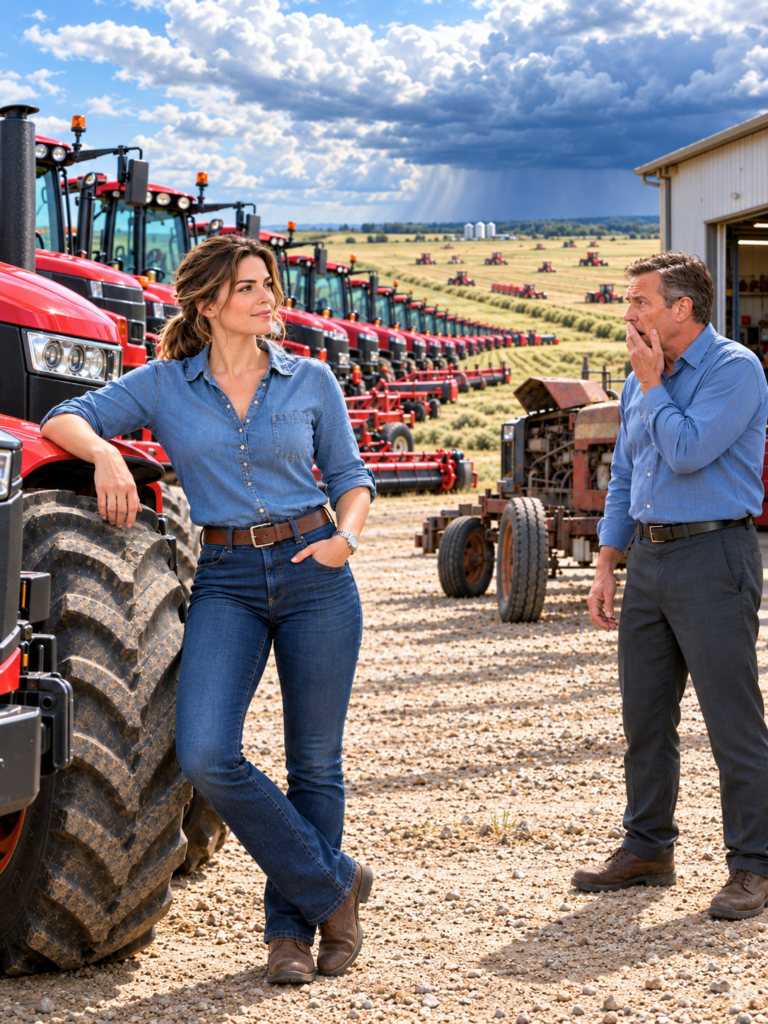
the dealer told her to sell the farm—nine days later, fifteen tractors rolled into her fields and everything changed
Part 1
“Sell the land.”
Lenora Vance stared across the service counter at Brent Kesler, certain she had misunderstood him.
Behind the glass wall of Kesler Farm Equipment, late-summer sunlight flashed off rows of polished tractors lined up like new pickup trucks at a dealership. Red paint. Clean tires. Price tags large enough to pay off houses in Brier Junction.
Her own tractor sat somewhere behind the building.
At least she hoped it did.
She had dropped it off six days earlier.
“I paid your inspection fee,” Lenora said. “I’m not asking for financial advice. I’m asking what’s wrong with my tractor.”
Brent leaned back in his office chair.
At forty-six, he dressed less like a farm-equipment dealer than a man who spent his afternoons at country clubs. White shirt. Expensive belt. Watch that had never been dragged through hydraulic fluid.
“We know what’s wrong with it.”
“Then tell me.”
He smiled.
“The question is whether it makes sense to fix.”
Lenora folded her arms.
She was fifty-eight years old and had been repairing equipment since before Brent Kesler was old enough to drive. Her father, Dale Vance, had put her on an International 706 when she was twelve because a rainstorm was moving in and he needed somebody to pull wagons.
She had ground gears.
Killed the engine twice.
Cried once where he could not see her.
By dark, she could drive it.
Her father had never praised easily.
That evening he had simply handed her a bottle of orange soda and said, “Tomorrow you’ll do better.”
That was how Dale Vance loved people.
Not with speeches.
With another morning.
Lenora looked through the window toward the service yard.
“I need the diagnosis.”
Brent tapped a folder lying on his desk.
“I’ve already worked out your best option.”
He slid a packet toward her.
Lenora did not touch it.
On the first page was a financing proposal for an equipment package.
Three new tractors.
Two balers.
A mower-conditioner.
Trade-in credit for most of the older Vance Fieldworks fleet.
The total financed amount made her stomach tighten.
“This isn’t what I asked for.”
“This is what you need.”
“No. I need the tractor repaired.”
“That machine is tired.”
“So am I. Nobody’s offered to trade me in.”
Brent gave a small laugh that vanished when Lenora did not join him.
“You’ve got a major hydraulic problem on an aging unit. You’re about to enter peak cutting. The rest of your fleet isn’t much younger.”
“I’m aware of my own equipment.”
“Then you’re aware you don’t have time to play mechanic.”
Lenora leaned forward.
“Put one of your technicians on it.”
Brent’s face changed slightly.
Not anger.
Annoyance.
The annoyance of a man whose customer had refused to follow the path he had prepared.
“I’m not tying up shop hours on a machine that belongs in a salvage yard.”
Lenora stared at him.
Through the side door she saw Colin Ree, the technician who had checked in her tractor six days earlier.
Colin noticed her.
For half a second their eyes met.
He started toward the office.
Brent turned sharply.
“Colin, we’re fine.”
Colin stopped.
Something in his expression bothered Lenora.
Not confusion.
Discomfort.
He knew something.
Brent turned back.
“The way I see it, you’ve got one option worth taking. Trade the old fleet. Sign the package. Get modern machines under warranty. We move forward together.”
Lenora’s voice went quiet.
“And if I don’t?”
Brent shrugged.
“Then I hope the weather is kind.”
Outside, heat shimmered above the asphalt.
The forecast said it would not be kind.
A strong storm system was predicted to reach central Kansas in nine days.
Before then, Lenora had almost two thousand acres of hay to cut, ted, rake, bale, haul, inspect, and deliver.
Four hundred sixty acres belonged to the Vance family.
The rest belonged to neighbors who contracted Vance Fieldworks because Lenora’s crews showed up when they said they would.
Those acres fed cattle across three counties.
More importantly, Crosswind Feed Supply paid Lenora under a seasonal volume agreement.
Miss the contract badly enough and she did not simply lose one year’s profit.
She lost the cash flow that covered payroll, fuel, repairs, land taxes, insurance, and the next planting season.
Brent pushed the contract toward her.
“This offer expires Friday.”
Lenora looked down at the paperwork.
Then at him.
“You already had this prepared.”
“We know our customers.”
“No.”
She tapped the first page.
“You knew I was coming in today.”
Brent smiled again.
“Same thing.”
Lenora stood.
“I want my tractor back.”
“That’ll involve transport charges.”
“I brought it here.”
“And if you move it without authorized work, there will be yard and diagnostic fees.”
“You just said you’re not going to work on it.”
“Correct.”
Lenora stared at him long enough that Brent’s smile faded.
“My father bought parts from your father for twenty-six years,” she said.
“That was a different business climate.”
“I suppose it was.”
She walked out before anger made her say something useless.
Colin stood near the shop door.
He glanced toward Brent’s office.
Then he said quietly, “Mrs. Vance—”
“Lenora.”
He swallowed.
“The hydraulic fault isn’t—”
The door behind him opened.
Brent stepped outside.
“Colin, bay three is waiting.”
Colin looked at Lenora.
Then he went inside.
That told her more than whatever sentence he had been about to finish.
She drove home with both hands tight on the wheel.
Brier Junction had never been much of a town.
A grain elevator.
A feed store.
Two churches.
A diner.
A bank that had changed names four times without changing much else.
Twenty miles outside town, county blacktop narrowed between fields burned pale gold by August.
Lenora turned onto Vance Road.
Her father had always laughed at the name.
“We don’t own the road,” he used to say. “County just got tired of figuring out where we lived.”
The family ground spread west toward a line of cottonwoods.
The farmhouse sat on a low rise overlooking machine sheds, hay barns, fuel tanks, and a gravel lot scarred by decades of tires.
Lenora had lived there most of her life.
She had left once.
Twenty-two years ago, after marrying a man named Michael Crane and moving to Wichita.
That lasted seven years.
Michael liked the idea of a farm woman more than the reality of one.
He liked Lenora when she came to dinner in boots and laughed loudly.
He liked her less when harvest season meant she went home to help her father for three weeks.
Their divorce had been sad rather than ugly.
No children.
No war.
Just two people discovering that love did not always make lives fit.
Lenora returned to Brier Junction.
Her father did not say I told you so.
He handed her the keys to an old pickup and said, “South fence needs checking.”
Another morning.
That was Dale.
Three years ago, cancer had taken him in four months.
He left Lenora the farm and Vance Fieldworks.
Her younger brother, Russell, inherited an equal share financially, but he wanted no part of running equipment.
Russell handled warehouse coordination, contracts, trucking, and paperwork.
Lenora handled everything that grew, broke, leaked, stalled, squealed, or depended on weather.
She parked beside the office trailer.
Russell was inside staring at two computer screens.
At fifty-two, he had their father’s narrow face and their mother’s nervous habit of tapping a pencil against his thumb.
“How bad?” he asked.
“They want us to replace half the fleet.”
“Repair estimate?”
“They wouldn’t give me one.”
Russell stopped tapping.
“That’s strange.”
“That’s one word.”
Lenora dropped Brent’s proposal onto his desk.
Russell looked through it.
His eyebrows rose.
“Good Lord.”
“Exactly.”
“This payment would run almost eighteen thousand a month.”
“With a balloon.”
Russell found the final page.
“And they want the old tractors for that trade number?”
“Yep.”
“That’s robbery.”
“Robbery requires less paperwork.”
Russell sat back.
Outside, an engine started near the shop.
One of their hired hands moved a rake tractor toward the fuel tanks.
Russell looked through the window.
“How long until the weather?”
“Nine days, maybe less.”
“And without the 7718?”
“We’re too slow.”
“How slow?”
Lenora did not answer.
Russell knew.
The failed tractor was their highest-horsepower machine.
It pulled the large mower-conditioner on heavy ground and took over baling when needed.
Without it, every other tractor had to shift jobs.
That meant unhooking implements.
Changing hydraulic connections.
Moving machines between fields.
Losing hours.
In ordinary weeks, lost hours were irritation.
In hay season, lost hours became ruined feed.
Russell rubbed his face.
“There is another thing.”
Lenora immediately disliked his tone.
“What?”
He turned his monitor.
An email sat open.
STONEBRIDGE ACRE PARTNERS.
The company had been trying to buy Vance land for two years.
They were acquiring farms across Kansas, combining them into large leased operations.
Their previous offers had been easy to ignore.
This one was not.
The number at the bottom was almost thirty percent higher.
“When did this arrive?”
“Forty minutes ago.”
Lenora stared at the timestamp.
Less than an hour after she had left Kesler Farm Equipment.
Russell saw what she was thinking.
“You can’t prove anything.”
“I didn’t say I could.”
“Maybe it’s coincidence.”
“Maybe.”
She hated the word.
Russell closed the email.
“You know what Dad would say.”
“No, I don’t.”
“He’d say land is land and debt is debt.”
Lenora looked at him.
Their father had spent the last twenty years of his life believing one good season would finally put them ahead.
One drought.
One broken baler.
One cattle-market collapse.
One hospital bill.
Always another obstacle.
Russell had watched their father work until pain bent him at the waist.
Lenora understood why her brother feared the farm.
That did not mean she could sell it.
“Do you want out?” she asked.
Russell looked surprised.
“Len—”
“I’m asking.”
He stared at the closed Stonebridge offer.
“I don’t know.”
“That’s not an answer.”
“It’s the answer I have.”
His voice sharpened.
“I watched Dad die worrying about whether the second cutting would make enough to cover notes he shouldn’t have still had at seventy-four.”
“He didn’t die because of the farm.”
“No. But the farm never let him rest.”
Lenora said nothing.
Russell’s eyes softened.
“I don’t want to watch it do the same to you.”
She looked through the office window.
Beyond the machine shed, fields rolled toward the horizon.
Her father had walked those fields with her when she was six.
He taught her to rub soil between her fingers.
To smell hay before rain.
To listen for bearing noise.
To never park equipment with an empty fuel tank in winter.
Land carried memory in ways bank accounts did not.
But memory did not pay bills.
“I’m not selling tonight,” Lenora said.
Russell nodded.
“That’s fair.”
She took the Kesler proposal.
“I know somebody.”
“Who?”
“Ardan Pike.”
Russell frowned.
“The dealer down south?”
“Independent guy.”
“Sixty miles away.”
“Sixty-seven.”
“You’ve called him before?”
“No.”
“How do you know him?”
“Dad did.”
That night Lenora called Prairie Lantern Machinery.
Ardan Pike answered on the second ring.
His voice sounded older than she expected.
She explained the failed tractor.
The weather window.
The acreage.
The dealer problem.
When she finished, Ardan did not offer sympathy.
He asked one question.
“Do you need one tractor repaired, or do you need a harvest operation that can finish two thousand acres?”
Lenora sat at the kitchen table.
The question settled differently than anything Brent had said.
She looked at the calendar.
At delivery commitments.
At crew schedules.
At the red marks showing how often one tractor changed jobs.
“I need to finish the season.”
“Then stop thinking about the broken tractor.”
Lenora picked up a pencil.
“What should I think about?”
“Capacity.”
Ardan paused.
“How many machines would you need if you built the operation around the acreage instead of around what you already own?”
For the next three hours, Lenora did math.
Not hopeful math.
Not desperate math.
Work math.
Five zones.
Five crews.
Three tractors per crew.
One machine cutting.
One tedding and raking.
One baling.
No daily implement swaps.
No waiting for a tractor to finish forty miles away.
Fifteen tractors.
Vance Fieldworks had four machines Lenora trusted enough to count.
She needed eleven more.
At 11:47 p.m., Russell came into the kitchen.
He found his sister surrounded by maps, invoices, coffee cups, and a yellow legal pad.
“What are you doing?”
Lenora looked up.
“Figuring out whether Brent Kesler just did us a favor.”
Part 2
At six the next morning, Lenora called Ardan.
“I need eleven tractors.”
Silence.
Then a low whistle.
“You don’t ease into things, do you?”
“I have eight days.”
“What horsepower range?”
Lenora gave him numbers.
Ardan began asking questions.
Hitch setups.
Hydraulic capacity.
PTO requirements.
Tire condition.
Hours.
Transport distance.
Lenora answered from memory.
By seven, Ardan had started calling dealers, auctions, banks, contractors, and farm operators across three states.
He found two tractors in Nebraska from a custom harvester upgrading before corn season.
Three Massey Fergusons sat behind a dealership in Oklahoma after a financing deal collapsed.
A farm-equipment lender had four repossessions in western Kansas.
Another two machines came from a ranch family retiring near Salina.
None were pretty.
Lenora did not need pretty.
She needed engines that started and hydraulics that held pressure.
By afternoon, she had one problem.
Inspection.
Buying machines under deadline pressure was how farmers inherited other people’s failures.
Lenora called Colin Ree.
He answered after work.
“I probably shouldn’t be talking to you.”
“You probably shouldn’t.”
There was a pause.
“What do you need?”
“I have eleven used tractors to inspect in three states.”
Colin laughed once.
Then stopped when he realized she was serious.
“Eleven?”
“Yes.”
“What are you doing?”
“Trying not to sell my father’s land.”
That ended the jokes.
Colin worked evenings and weekends with her.
He drove south with Ardan.
Checked oil samples.
Pulled service codes.
Crawled under machines with a flashlight.
Rejected one tractor because of transmission noise.
Rejected another because coolant pressure suggested a head-gasket problem.
Ardan replaced both leads within twelve hours.
Two days later, Lenora sat inside Prairie Lantern Machinery with contracts stacked in front of her.
The numbers were brutal.
Total equipment transaction: $615,000.
Trade-in value from older equipment: $210,000.
Company cash: $75,000.
Remaining financing required: $330,000.
Exactly the amount Lenora had quietly secured that spring through an agricultural lender.
She had planned to spend it carefully over two or three seasons.
Not in one afternoon.
The loan officer looked at her across the conference table.
“You understand that if this harvest underperforms, your leverage goes up substantially.”
“Yes.”
“And after closing you’ll have roughly twenty-eight thousand dollars in unrestricted operating reserve.”
“Yes.”
“That isn’t much.”
“No.”
“Do you still want to proceed?”
Lenora thought of Brent Kesler telling her to sell.
She thought of her father.
Then she forced both thoughts away.
This decision could not be about pride.
Pride was expensive.
Could fifteen machines increase capacity enough to protect the Crosswind agreement?
Yes.
Could they finish priority acreage before rain?
Probably.
Could Vance Fieldworks support the equipment debt if they kept enough contracted ground for several seasons?
Yes.
Barely.
Could the decision destroy them if multiple things went wrong?
Also yes.
Lenora signed.
On Thursday morning, the first trailers arrived in Brier Junction.
People stopped what they were doing.
A cashier at McCord’s Market stepped outside.
Two high school boys filmed from bicycles.
At the diner, someone counted aloud as tractor after tractor rolled through town.
Seven.
Nine.
Twelve.
Fifteen total when combined with the Vance machines.
By noon, the equipment yard looked transformed.
Red machines stood in a long uneven line.
Some faded.
Some scratched.
One missing a plastic side panel.
All functional.
Russell walked the row slowly.
“You really did it.”
Lenora stood beside him.
“We haven’t done anything yet.”
Fifteen tractors did not harvest two thousand acres by themselves.
Lenora divided the territory into five zones.
Crew One handled the Vance home ground and two neighboring farms.
Crew Two worked northwest.
Crew Three took fields near the river.
Crew Four covered the southern contracts.
Crew Five stayed mobile, attacking whatever acreage threatened to bottleneck.
Russell rebuilt transport schedules.
Fuel supplier Marlow Petroleum agreed to stagger deliveries.
Seasonal workers called cousins and neighbors.
Retired operators volunteered to fill shifts.
Lenora hired three additional drivers.
By Friday afternoon, Vance Fieldworks looked less like a family operation and more like a small military unit built around weather.
At five the next morning, Lenora stood in the yard with twenty-six people.
Some were drinking coffee.
Some were tightening gloves.
Engines idled behind them.
The air smelled of diesel and cut grass.
Lenora did not give a speech.
“This only works if we stop thinking like five separate crews,” she said. “If one zone gets ahead and another gets buried, we move. Don’t protect your assignment. Protect the harvest.”
She pointed toward the equipment.
“No shortcuts on moisture. No shortcuts on safety. If something sounds wrong, shut it down. We can lose an hour. We cannot lose a person.”
A man named Joe Ramirez raised his coffee cup.
“What if Russell sounds wrong?”
Russell answered from behind the group.
“Been broken for years.”
Laughter broke the tension.
Lenora looked at her crew.
“Let’s go.”
Fifteen tractors left the yard.
From the cab of her truck, Lenora watched them split at the county road.
For one brief moment, she allowed herself to feel hope.
Then the work began.
The first day exposed every weakness in the plan.
Crew Three ran out of twine.
Crew Five reached a property and discovered the landowner had left irrigation equipment blocking field access.
One new driver misunderstood a route and took a baler nine miles in the wrong direction.
A cutter blade broke.
A rake lost teeth.
A hydraulic coupler failed.
Nothing catastrophic.
Everything costly in minutes.
By dark, Lenora had driven 183 miles without leaving the county.
She ate a gas-station sandwich while standing beside a fuel tank.
At 10:30 p.m., she returned home.
Russell sat at the kitchen table with manifests.
“How bad?”
“Messy.”
“Acres?”
“Better than the old system.”
“How much better?”
“Thirty-eight percent.”
Russell looked up.
“That good?”
“If we hold it.”
They did better the second day.
By the third morning, the crews found rhythm.
Cutters moved first.
Tedders followed according to drying time.
Rakes formed clean windrows.
Balers worked behind them.
Instead of each tractor constantly changing jobs, machines remained attached to their implements.
Hours disappeared from transitions.
Fields that previously waited for one another began moving simultaneously.
Lenora stood on a hill late Sunday afternoon watching three different crews operating in the distance.
A mower crossed the western field.
A rake moved in slow circles to the south.
Bales appeared behind another machine like building blocks scattered across gold grass.
For the first time, she understood what Ardan meant.
Capacity.
Not one tractor.
Not one repair.
The whole system.
Her phone rang.
Jocelyn Mercer.
Crosswind Feed Supply.
Lenora answered immediately.
“Jocelyn.”
“We tested the first load.”
Something in the woman’s voice tightened Lenora’s chest.
“And?”
“Uneven.”
Lenora turned away from the field.
“How uneven?”
“Several bales within tolerance. Several above.”
“How far above?”
Jocelyn gave her the readings.
Lenora closed her eyes.
Not catastrophic.
But unacceptable under contract.
“We’re holding the next acceptance until we review.”
“For how long?”
“I can’t answer yet.”
“Jocelyn, I’ve got product moving.”
“I know.”
“And weather in five days.”
“I know that too.”
Jocelyn’s voice stayed calm.
“Last season Crosswind took a quality hit from a supplier whose hay came in wet. We lost customers. My buyers are watching moisture numbers like hawks. I can’t accept hay I can’t defend.”
Lenora stared at the crews.
Speed.
Everything had been built around speed.
She had solved the capacity problem and created another.
“Give me until morning.”
“Lenora—”
“Morning.”
She ended the call.
Russell reached her twenty minutes later.
“What happened?”
She told him.
He stared across the field.
“You think we’re cutting too fast?”
“No.”
“Baling too soon?”
“In some zones.”
“How many?”
“Don’t know yet.”
He rubbed the back of his neck.
“We can’t slow down.”
“Yes, we can.”
“The rain—”
“I know about the rain.”
Lenora faced him.
“If we put two thousand acres of bad hay in the warehouse, all we’ve done is move the failure under a roof.”
That evening she pulled Crew Two and Crew Four temporarily.
Men complained.
The forecast showed rain moving closer.
Every instinct demanded motion.
Lenora ordered more moisture probes distributed and required multiple readings across each field rather than one reading from a convenient bale.
The change cost them nearly a day.
The next morning proved it was correct.
Low spots in two fields retained far more moisture than the ridges.
Had the crews continued, several hundred bales would have failed Crosswind specifications.
Russell stood beside Lenora while readings were marked on a clipboard.
“Dad would have kept moving.”
Lenora knew what he meant.
Dale Vance had believed the solution to almost every problem was more work.
Sometimes he had been right.
Sometimes work had merely carried him faster toward the wrong result.
“Dad isn’t running this harvest,” Lenora said.
Russell looked at her.
“No.”
It was the first time either of them had said something that sounded like permission to change their father’s methods.
That afternoon a tractor in Crew Five blew a hydraulic line.
Ardan got a service truck there in three hours.
Three hours was excellent.
Three hours was also almost half a good drying afternoon.
Then the weather forecast changed.
Rain was now expected eighteen hours earlier.
Lenora stared at the radar.
Four days.
Maybe less.
Her phone began ringing.
Landowners.
One after another.
“When will you reach our place?”
“Are we still on schedule?”
“I heard Crosswind rejected your hay.”
“Somebody told me those tractors are bank repossessions.”
“Are you in financial trouble?”
The rumor reached Gerald Hoffstead before sunset.
He controlled 120 contracted acres.
“I need to know if I should bring somebody else in,” Gerald said.
“Who?”
“I’ve made calls.”
“To who?”
“That isn’t the point.”
“It is if you’re planning to put another crew onto acreage under contract with me.”
Gerald sighed.
“Lenora, I’m not trying to hurt you. I need this hay off.”
“So do I.”
“I heard you couldn’t get normal financing.”
Lenora went still.
“Who told you that?”
“People are talking.”
“They’re wrong.”
“Well, people don’t usually buy eleven used tractors in three days because everything is going great.”
Lenora fought the urge to hang up.
“Give me twenty-four hours.”
“The weather doesn’t care about twenty-four hours.”
“I know that better than you do.”
Silence.
Gerald’s voice cooled.
“Tomorrow, Lenora.”
He disconnected.
Lenora stood beside her truck as the sun dropped red behind the fields.
She felt exhausted enough to sleep standing.
A pickup pulled into the field.
Colin Ree got out.
He carried a folded piece of paper.
“What’s that?”
“My copy.”
“Of what?”
“The original inspection report on your tractor.”
He handed it to her.
Lenora unfolded the document.
The diagnosis was complete.
Failed hydraulic pump assembly.
Replacement part available through regional inventory.
Estimated shop labor.
Expected turnaround.
Everything Brent had told her was uncertain had been identified on the first day.
She looked at the date.
Six days before Brent tried to sell her the package.
“You knew.”
Colin looked miserable.
“I wrote it.”
“Why didn’t you tell me?”
“I tried.”
“Not hard enough.”
He accepted that.
“My wife is pregnant.”
Lenora’s anger stopped.
“Third kid,” Colin continued. “Mortgage. Insurance through Kesler.”
He looked toward the tractors working in the distance.
“I told myself it wasn’t my decision. Brent owned the shop.”
Lenora thought of all the ways people explained silence.
Mortgage.
Children.
Job.
Fear.
Sometimes the explanation was true.
That did not make the silence harmless.
“What changed?”
Colin looked at her.
“He put my name on the file.”
Lenora frowned.
“He documented that I recommended replacement because repair wasn’t practical.”
“But you didn’t.”
“No.”
Colin’s jaw tightened.
“I can live with being afraid of losing a job. I can’t live with somebody turning my work into a lie.”
Lenora folded the report.
“You willing to say that in writing?”
“Yes.”
“Then write it.”
Her phone rang again.
Russell.
She answered.
“We have a bigger problem,” he said.
“How much bigger?”
“Crosswind hasn’t released payment.”
Lenora went cold.
“The fuel account is due.”
“I know.”
“Marlow knows?”
“They called me ten minutes ago.”
She looked across the field at fifteen tractors.
Fifteen machines.
Twenty-six workers.
Two thousand acres.
And without diesel, all of it became metal sitting in grass.
“How much cash is left?” she asked.
Russell gave her the number.
Lenora looked toward the darkening sky.
The twenty-eight thousand dollars was almost gone.
Part 3
At 9:15 that night, Lenora and Russell sat in the farm office.
Nobody spoke for several minutes.
A fluorescent light buzzed overhead.
Through the window, headlights moved in the equipment yard as the last crews returned.
Russell turned his laptop toward her.
“Payroll Friday.”
“I know.”
“Fuel account before the next delivery.”
“I know.”
“Insurance draft Monday.”
“Russell.”
He stopped.
Then he opened another document.
Stonebridge Acre Partners.
Their purchase offer remained active.
“They’ll wire a deposit within twenty-four hours if we sign the preliminary agreement.”
Lenora stared at him.
“That’s selling.”
“Not immediately.”
“It’s starting to sell.”
“Yes.”
Russell did not hide from it.
“We use the deposit as a bridge. Finish harvest. Decide after.”
“You think they’re going to hand us six figures and let us casually change our minds?”
“There are exit provisions.”
“There are penalties.”
“Yes.”
Lenora stood and walked to the window.
Her father’s old machine shed was visible beyond the yard.
Dale had built the first half himself in 1983.
The roofline crooked slightly because he had refused to wait for help when setting rafters.
He always meant to fix it.
Never did.
Lenora could sell the land.
There was no shame in that.
Farm families did it every week.
Some because they were tired.
Some because children wanted different lives.
Some because years of drought, debt, taxes, and equipment costs finally became heavier than memory.
Stonebridge’s money could pay everything.
The new equipment debt.
Existing notes.
Property taxes.
Russell’s share.
Lenora could buy a small house.
Maybe travel.
Sleep when rain hit the roof instead of thinking about whether hay was still lying in a field.
A sensible person could take the offer.
She thought of her father dying in the downstairs bedroom.
The last clear conversation they had happened two weeks before hospice.
Dale could barely eat.
Still, he asked whether Lenora had replaced a worn bearing in the north baler.
She became angry.
“Dad, stop worrying about machinery.”
He looked surprised.
“I’m not worried about machinery.”
“Then why are you asking?”
“Because you’re going to need it.”
She sat beside his bed.
“I don’t know if I want this without you.”
Dale took a long time answering.
“Then don’t keep it for me.”
Lenora remembered staring at him.
He continued.
“Land doesn’t love you back, honey. Don’t make it into a religion.”
Those words had shocked her.
This from a man who had sacrificed almost everything to the farm.
“But if you choose it,” he had said, “choose it because it’s still a life worth having. Not because I died here.”
Lenora blinked back tears in the office.
Russell was watching her.
“You okay?”
“No.”
“Me neither.”
She sat down again.
“We’re not taking Stonebridge’s money tonight.”
Russell closed his eyes briefly.
“Then what?”
Lenora pulled the field map toward her.
“We stop trying to save everything.”
“What does that mean?”
“It means this schedule is wrong.”
“We built it three days ago.”
“We built it around assumptions that are no longer true.”
She uncapped a marker.
“Crosswind payment held. Fuel limited. Rain earlier. Some ground too wet to bale. One crew behind.”
Russell watched her circle fields.
“What are you doing?”
“Priority.”
“Our contracts are priority.”
“No. Some contracts are physically impossible before the rain.”
“You want to abandon customers?”
“I want to stop lying to ourselves.”
Lenora went zone by zone.
Fields already cut had highest priority because rain on down hay caused greater quality loss.
Fields nearest Crosswind specifications came next.
Contracts tied to immediate delivery requirements followed.
High-moisture stands that could survive rain remained standing.
Remote acreage with expensive transport moved later.
By midnight, a different harvest map existed.
Not perfect.
Possible.
Russell studied it.
“If we do this, some landowners are going to be furious.”
“Yes.”
“We lose revenue.”
“Yes.”
“We could lose contracts next year.”
“Yes.”
He stared at her.
“And you think this saves us?”
“I think pretending we can do everything destroys us.”
The next morning Lenora hired an independent hay inspector named Carl Baines.
Carl spent the day at the Crosswind warehouse sampling Vance inventory bale by bale across multiple lots.
His report arrived at 6:30 the next morning.
Seventy-nine percent met contract specification.
Twenty-one percent exceeded the preferred moisture threshold.
Not good.
Not fatal.
Lenora drove to Crosswind’s regional office with the report in a binder.
Jocelyn Mercer met her in a small conference room.
Lenora placed the binder on the table.
“No arguments.”
Jocelyn raised an eyebrow.
“That’s unusual.”
“Here’s every load. Sampling locations. Moisture readings. What passed. What didn’t.”
Jocelyn flipped through pages.
“You paid for independent inspection?”
“Yes.”
“Why?”
“Because if I’m wrong, I want to know how wrong.”
Jocelyn continued reading.
Lenora waited.
Finally Jocelyn looked up.
“What are you asking for?”
“Release payment at full contract rate for compliant inventory. Discount the out-of-spec portion according to your standard quality schedule.”
Jocelyn leaned back.
“Most suppliers would be trying to persuade me the readings don’t matter.”
“The readings matter.”
“You’ll take a significant hit on the discounted portion.”
“I know.”
“You aren’t disputing it?”
“No.”
Jocelyn tapped the binder.
“This makes my job easier.”
“That’s the idea.”
Payment on accepted inventory cleared late that afternoon.
Lenora called Marlow Petroleum from the Crosswind parking lot.
“We can settle the fuel account.”
The supplier’s manager, Charlie Marlow, laughed.
“I’ve been waiting for that phone call.”
“You held delivery for me?”
“I held one truck.”
“Why?”
“Your dad pulled my father’s combine out of mud in ’94.”
Lenora closed her eyes.
Twenty-nine years of distance, and Dale was still reaching into her harvest.
“I’ll pay you today.”
“I know.”
Fuel arrived before sunrise.
The tractors rolled again.
Lenora called every landowner whose schedule changed.
She did not hide the problem.
No excuses.
No false promises.
“Your north field stays standing through the rain,” she told one rancher. “If I cut it tomorrow, I cannot guarantee it gets baled before weather.”
“That’s going to cost me quality.”
“Yes.”
“What are you doing about your service fee?”
“Reducing it twelve percent on those acres.”
Silence.
“That fair?”
“No,” the man said. “Fair would be no rain.”
Lenora almost smiled.
“But I can live with twelve.”
Gerald Hoffstead was harder.
“You told me tomorrow,” he said.
“I told you I’d give you an answer tomorrow.”
“So what’s the answer?”
“We can cut eighty acres before weather. Forty needs to wait.”
“I’ve got somebody who says they can do all of it.”
“Who?”
“Kesler gave me a name.”
Lenora’s grip tightened on the phone.
“Of course he did.”
“What does that mean?”
“Nothing I can prove.”
Gerald was silent.
Lenora continued.
“Ask the other crew how many moisture probes they’re running. Ask where your hay goes if they can’t get it off before rain. Ask whether their promise is in writing.”
Gerald said nothing.
“I won’t promise you work I don’t think I can finish.”
“That might cost you my business.”
“I know.”
Half an hour later, Gerald called back.
“Send the schedule amendment.”
Lenora exhaled.
“Thank you.”
“Don’t thank me. Get eighty acres done.”
“Yes, sir.”
For four days, the operation ran harder than anything Vance Fieldworks had attempted.
Headlights moved across fields before sunrise.
Crew members slept in trucks during thirty-minute breaks.
Russell coordinated fuel, hauling, warehouse slots, and route changes from a folding table inside the machine shed because the office phone never stopped ringing.
Lenora drove from zone to zone.
She checked moisture herself.
Changed knives.
Carried bearings.
Brought sandwiches.
Settled arguments.
Pulled a pickup from soft ground.
At two in the morning she found Colin asleep sitting against a tractor tire with a wrench still in his hand.
She woke him.
“Go home.”
“Need to finish this line.”
“You have a pregnant wife.”
“I know.”
“Then go home.”
“What about you?”
Lenora looked at him.
“I don’t have a pregnant wife.”
He laughed tiredly.
“You know what I mean.”
She did.
“No heroes,” Lenora said. “Go sleep.”
Colin went.
At sunrise on the final dry day, Lenora climbed into a tractor herself.
One field remained with hay on the ground.
Eighty-seven acres.
Rain expected by evening.
She pulled the baler while Joe Ramirez raked ahead.
Clouds built in the northwest.
By noon the wind changed.
At two, humidity rose.
At three, thunder was audible.
Russell called.
“Radar says two hours.”
“We need three.”
“Then you’re not making it.”
“We’ll see.”
“Lenora.”
“What?”
“Dad died thinking he had one more hour for everything.”
She stopped.
The tractor idled.
Clouds darkened the horizon.
Russell’s voice softened.
“Don’t make me watch that.”
Lenora looked at the field.
Thirty acres remaining.
She could push.
Run faster.
Ignore the slight increase in moisture.
Maybe finish.
Maybe put people and equipment at risk.
Her father’s voice lived inside her.
Keep moving.
But another memory answered.
Don’t keep it for me.
Lenora keyed the radio.
“All crews, stop at four-thirty.”
Joe answered first.
“We can finish.”
“No.”
“We’ve got maybe twenty acres—”
“Stop at four-thirty.”
Nobody argued after the second order.
At 4:27, the first drops struck Lenora’s windshield.
By five, rain swept sideways across the field.
Twenty-three acres remained.
Lenora parked the tractor in the yard and sat inside the cab listening to rain hammer the roof.
The operation had not beaten the storm.
Not completely.
For ten minutes, nobody approached her.
Then Russell climbed onto the steps and opened the cab door.
“We got the cut hay covered.”
Lenora nodded.
“Warehouse?”
“Full.”
“Crosswind?”
“Delivery tomorrow postponed because roads are going to be sloppy.”
“How many acres unfinished total?”
“Three hundred twelve.”
She closed her eyes.
“That much?”
“Standing acreage.”
“Revenue loss?”
“Manageable.”
“Define manageable.”
“Painful, not fatal.”
She leaned back.
Rain washed dust from the windshield.
Russell sat on the step.
“You saved the farm.”
Lenora opened her eyes.
“No.”
“We’re still here.”
“That’s not the same.”
Russell smiled faintly.
“For us, it might be.”
The rain lasted two days.
When skies cleared, Vance Fieldworks returned to the unfinished acreage.
Yields fell on some fields.
Quality slipped on others.
Lenora honored every revised contract.
Where they caused delays, she reduced fees.
Where product quality fell below grade, she documented it.
By the end of the season, all two thousand acres were complete.
Not on the original schedule.
Not at the original margin.
But complete.
After payroll, fuel, discounts, interest, and repairs, profit was thin enough to make Russell whistle.
The farm survived.
The equipment debt remained.
Twenty-eight thousand dollars of reserves had nearly disappeared.
Lenora had not become rich.
No miracle buyer rescued her.
No stranger arrived with a check.
She had simply reached the other side with the land still theirs.
One cold November afternoon, after the last tractor had been serviced for winter, Lenora went into the office.
Colin’s inspection report lay in the top drawer.
She took it out.
Russell looked over.
“You finally going after Kesler?”
“No.”
He frowned.
“No?”
“I’m submitting documentation.”
“Same thing.”
“No.”
Lenora put the service invoices, dates, phone records, original inspection report, and Colin’s written statement into a binder.
“Going after him would be personal.”
“And this isn’t?”
“No.”
She closed the binder.
“This is paperwork.”
Her father would have hated that sentence.
Which made Lenora enjoy it.
Part 4
The regional dealer network acknowledged Lenora’s complaint three weeks later.
Then nothing happened.
December passed.
Snow covered the fields.
The fifteen tractors sat inside sheds or beneath covered storage.
Every month Lenora made the equipment payment.
Every month the number reminded her what surviving had cost.
People in Brier Junction gradually stopped talking about the dramatic harvest.
They moved on to wheat prices, a school-board dispute, and whether the new Dollar General would hurt McCord’s Market.
Kesler Farm Equipment stayed open.
Brent remained behind the counter.
For a while, Lenora wondered if submitting the complaint had mattered.
Then Colin called.
“Brent knows.”
“About the review?”
“Regional auditor showed up.”
“How’d Brent take it?”
“I’m calling you from my truck.”
Lenora understood.
“You fired?”
“Not yet.”
“Quit?”
“Thinking about it.”
“Don’t quit angry.”
“What?”
“Don’t make your family pay for a decision you made in the parking lot.”
Colin laughed without humor.
“You sound like my wife.”
“She sounds intelligent.”
“What do I do?”
Lenora stared through the kitchen window at frozen fields.
“Document everything.”
“That’s your answer?”
“Yes.”
“It isn’t satisfying.”
“No. But satisfying decisions are overrated.”
Two weeks later Colin accepted a job at Prairie Lantern Machinery.
Ardan created a mobile-service position for him covering Brier Junction and nearby counties.
The change meant longer drives.
Slightly better pay.
More independence.
Most importantly, his name belonged to his own work again.
In January, the dealer network requested an interview with Lenora.
Two regional managers and an attorney arrived at Vance Fieldworks.
Russell insisted on sitting in.
They asked Lenora to describe the timeline.
She did.
No embellishment.
No speculation.
“When did Mr. Kesler tell you the machine was not worth repairing?”
She gave the date.
“When did you first see Mr. Ree’s diagnostic report?”
She gave the date.
“Did Mr. Kesler ever directly state that repair was impossible?”
“He said putting a technician on it wasn’t worth the shop’s time.”
“Did he state parts were unavailable?”
“He gave changing explanations about parts and backlog.”
“Did you believe he intended to force you into purchasing new equipment?”
Lenora paused.
Russell looked at her.
This was the moment anger could become accusation.
“I believe the documents show he had a viable repair diagnosis and did not offer it to me.”
“That wasn’t my question.”
“I know.”
“Do you believe he intended to pressure you?”
“I can’t prove what was in his head.”
The attorney studied her.
“You’re declining to speculate?”
“Yes.”
“Why?”
“Because I don’t need to.”
Lenora slid Colin’s report across the table.
“The paper is enough.”
Six weeks later, the finding arrived.
Kesler Farm Equipment had received a viable documented repair diagnosis on the first day.
Management delayed authorizing work.
The customer was not accurately informed of the repair pathway.
The dealership attempted to redirect the customer toward a substantially higher-margin equipment transaction.
Inspection and storage fees had been charged without corresponding authorized service.
The network ordered reimbursement.
Brent’s dealership entered a formal service audit.
Additional customer files would be reviewed.
The letter did not use the word greedy.
It did not accuse him of trying to destroy Vance Fieldworks.
It did something more damaging.
It documented what happened.
Russell read it twice.
“That’s it?”
“What were you expecting?”
“I don’t know. Fireworks.”
“We’re farmers.”
Lenora poured coffee.
“Paperwork is our fireworks.”
A month later, the review expanded.
Other customers had similar complaints.
Not all.
Enough.
A rancher said Kesler had declared a transmission uneconomical to repair before trying to sell a replacement machine.
A widow from Rawlins County said she paid diagnostic fees on equipment never moved into a service bay.
A young farmer produced texts showing repeated pressure to refinance multiple machines together.
No dramatic arrest happened.
No sheriff marched Brent through town.
His dealership remained open.
But trust eroded.
Farmers began driving sixty miles to Prairie Lantern.
Ardan’s service department grew.
Colin became busier than he had been at Kesler.
By spring, Prairie Lantern opened a weekly satellite service day in Brier Junction.
Then came the question everyone asked Lenora.
“Did Brent Kesler call Stonebridge?”
She always answered the same way.
“I don’t know.”
The timing remained suspicious.
Stonebridge’s improved offer had arrived less than an hour after Lenora walked out of Kesler’s dealership.
Rumors connected Brent to a regional land broker.
Someone claimed they played golf together.
Another said Kesler received referral commissions.
Russell wanted to investigate.
Lenora refused.
“We don’t have proof.”
“We could find it.”
“Maybe.”
“You don’t want to know?”
“Yes.”
“Then why stop?”
Because Lenora had learned something during harvest.
Not every unanswered question deserved all of her energy.
The farm required enough.
“If evidence comes, we’ll deal with it.”
“And if it doesn’t?”
“Then I’m not building a life around a suspicion.”
Russell was quiet.
“You’re different.”
“Older.”
“No.”
He looked toward the equipment yard.
“You would’ve chased it before.”
“Probably.”
“What changed?”
Lenora thought about the storm.
About shutting down twenty-three acres short.
About admitting some work would wait.
“You can’t save everything.”
Russell smiled.
“Sounds familiar.”
Stonebridge stopped calling.
The old tractor that started everything returned to Vance Fieldworks in April.
Colin repaired it through Prairie Lantern.
Total repair cost, including transport, was less than four percent of Kesler’s proposed equipment package.
Lenora stood beside the tractor while Colin started it.
The engine caught.
Hydraulics lifted smoothly.
He shut it down.
“You keeping it?”
“As backup.”
“After everything?”
“Especially after everything.”
Colin laughed.
“Most people would’ve sold it.”
“Most people don’t know this tractor.”
Lenora rested a hand on the faded hood.
It had carried her father through the final years he worked.
Dale had worn a shiny spot into the steering wheel with his left palm.
Lenora did not confuse sentiment with reliability.
The machine would never again be the single piece of equipment holding the harvest together.
But she also did not believe every old thing deserved replacement just because someone could finance something newer.
Some things needed repair.
Some needed retirement.
Wisdom was knowing the difference.
That summer, Vance Fieldworks entered harvest with fifteen tractors available.
They did not deploy all fifteen every day.
That was the first change.
The second was money.
Lenora created two reserve accounts.
One for fuel.
One for emergency repair.
A fixed percentage of every payment went into them before she and Russell discussed profit.
Russell complained at first.
“That money is just sitting there.”
“That’s what reserves do.”
“It could pay principal.”
“It could also buy diesel when somebody holds a payment.”
That ended the argument.
The third change was service redundancy.
Prairie Lantern became primary.
A second independent mechanic in another county became backup.
No single dealer would ever again decide whether Vance Fieldworks’ season moved or stopped.
The fourth change was harder.
Lenora reduced total contracted acreage.
Russell nearly dropped his coffee when she told him.
“We have more equipment.”
“I know.”
“We can handle more.”
“Maybe.”
“So why reduce?”
“Because capacity isn’t permission to fill every empty hour.”
Russell stared.
Three years earlier, their father would have taken every acre offered.
Then complained the farm was killing him.
Lenora had inherited more than land from Dale.
She had inherited habits.
Some were worth keeping.
Others were not.
“I want margin,” she said.
“Financial?”
“That too.”
“What other kind is there?”
“Time.”
Russell leaned back.
“You’re serious.”
“Yes.”
“What are you going to do with time?”
Lenora considered the question.
“I have no idea.”
That September, she found out.
For the first time in years, Lenora attended the Brier County Fair without working a booth, hauling equipment, or answering harvest calls.
She bought lemonade.
Watched children show calves.
Listened to a bluegrass group.
Ardan Pike found her near the livestock barn.
“You look uncomfortable.”
“I am.”
“Why?”
“Nothing’s broken.”
“Give it time.”
She laughed.
They walked between exhibits.
Ardan was sixty-four, widowed, with three grown daughters who lived out of state.
During the equipment crisis, Lenora had barely noticed anything except his competence.
Now she noticed the way he stopped to talk with people without looking past them.
The way farmers trusted him.
The way he remembered names.
They bought pie at a church booth.
No romance arrived like a thunderstorm.
No dramatic declaration.
Just two older people sitting at a folding table discussing tractors and grandchildren neither of them had.
For Lenora, that was enough.
Late that evening, she returned home.
The farm was quiet.
Stars covered the Kansas sky.
She stood outside the machine shed.
Fifteen tractors sat inside.
Not trophies.
Not revenge.
Tools.
That distinction mattered.
The fleet had not proved Brent Kesler wrong.
The season had taught Lenora something harder.
Brent was never the real threat.
Dependence was.
Depending on one machine.
One dealer.
One buyer.
One perfect forecast.
One idea of how the farm had always been run.
Lenora had nearly lost everything not because she lacked strength, but because the operation had too little room for anything to go wrong.
Her father built a business around endurance.
Lenora was trying to build one that did not require suffering as proof of worth.
She wished Dale could see it.
Then she imagined what he would say.
Fifteen tractors? You planning to invade Oklahoma?
Lenora laughed alone in the dark.
Part 5
Three seasons later, Russell found Lenora in the equipment yard before sunrise.
The first cutting was ready.
The air smelled of dew, diesel, and sweet grass.
Fifteen tractors stood fueled.
Not all the same.
Not all new.
But maintained.
Logged.
Assigned.
Ready.
Russell held the season schedule in one hand.
In the other were the keys to the tractor Kesler had refused to repair years before.
“You sure you want this old thing on Crew Four?”
“Backup machine.”
“Colin says it could work full schedule.”
“I know.”
“Then why baby it?”
Lenora gave him a look.
“Because I finally learned having capacity doesn’t mean using all of it until something breaks.”
Russell smiled.
“You say things now Dad would’ve called lazy.”
“Dad once replaced a water pump by flashlight because he refused to wait until morning.”
“He got it running.”
“He also dropped a wrench on his forehead.”
Russell laughed.
He handed Lenora the season sheet.
“Three landowners asked about adding acreage.”
“How much?”
“About four hundred total.”
“No.”
“You haven’t looked at the numbers.”
“Do we have enough reserve to lose Crosswind for ninety days?”
Russell’s smile faded.
“Yes.”
“Enough to replace a major baler without new debt?”
“Yes.”
“Enough operators without running seventy-hour weeks?”
He hesitated.
“No.”
“Then no.”
He nodded slowly.
“Only if we can handle it.”
“And only if we have reserves.”
“That’s becoming annoying.”
“Good.”
Russell walked toward the office.
Lenora watched him go.
Their relationship had changed too.
He no longer talked about selling every time the farm became difficult.
She no longer treated every concern about risk as cowardice.
Russell had been right about their father.
Dale loved the farm.
The farm also consumed him.
Both could be true.
Lenora climbed onto the old tractor.
The seat had a crack Colin kept promising to replace.
She did not let him.
Her father’s duct-tape repair still wrapped the left edge.
The engine started on the second turn.
Lenora rested her hand on the worn steering wheel.
For a moment, she was twelve again.
Her father beside her.
“Clutch slow.”
“I know.”
“No, you don’t.”
“I do.”
“You killed it twice.”
“I’m learning.”
Dale had looked across the field.
“That’s all anybody’s doing.”
At fifty-eight, Lenora had thought she understood farming because she knew machines, weather, soil, contracts, and labor.
At sixty-one, she understood something else.
A farm could survive mistakes if the people running it admitted them early enough.
That was true of moisture.
Money.
Machinery.
Families.
Pride.
Especially pride.
She shut the tractor off.
No need to run it yet.
The grass would tell them when.
At nine that morning, a pickup entered the yard.
Lenora recognized it.
Brent Kesler stepped out.
His dealership had survived the audit, though barely.
The regional network stripped some of his authority.
Customers left.
His business downsized.
The polished rows of equipment outside Kesler Farm Equipment were half what they used to be.
Lenora had not spoken to him since the day he told her to sell.
Russell came out of the office.
“What does he want?”
“I don’t know.”
“Want me here?”
“No.”
Russell did not move far.
Brent approached.
He looked older.
Not broken.
Just less certain.
“Lenora.”
“Brent.”
His eyes moved toward the tractors.
“You built quite an operation.”
“We’re doing all right.”
“I was in the area.”
She waited.
Neither pretended that was true.
Brent pushed his hands into his jacket pockets.
“I wanted to say something.”
“All right.”
He looked toward the old tractor.
“That the one?”
“The one what?”
“I wouldn’t repair.”
“You mean the one your technician diagnosed on day one?”
Brent winced.
“I deserved that.”
Lenora said nothing.
He took a breath.
“I handled it wrong.”
“Yes.”
“I was under pressure from the network to increase whole-goods sales.”
Lenora kept watching him.
“My margins were bad. Service wasn’t making enough. We had inventory sitting.”
“That explains it.”
“I know it doesn’t excuse it.”
That answer surprised her.
Brent looked toward the ground.
“At some point I started looking at customers and seeing transactions.”
Lenora thought of farmers coming through his doors.
People whose machines were connected to crops.
Cattle.
Mortgages.
Payroll.
A tractor was not merely a product when a season depended on it.
“When did that change?” she asked.
“What?”
“When did you start seeing people again?”
Brent gave a tired smile.
“Probably after enough of them stopped coming.”
Lenora almost felt sorry for him.
Almost.
“Did you contact Stonebridge?”
He looked up.
For years, she had never asked him directly.
Brent’s face tightened.
“No.”
“You know somebody there?”
“Yes.”
Her pulse shifted.
“Who?”
“A regional broker. Kevin Marsh.”
“Did you tell him my tractor was down?”
Brent hesitated.
Lenora’s voice hardened.
“Brent.”
“We talked.”
“When?”
“That week.”
“What did you say?”
“That you might be under pressure.”
Lenora stared at him.
“You told a land buyer I was under financial pressure.”
“I didn’t tell him to contact you.”
“You knew what he did.”
Brent’s silence answered.
Anger rose.
Old anger.
Hot enough that Lenora could almost smell Kesler’s showroom again.
Sell the land.
She had wondered for three years.
Now she had the answer.
Russell stood thirty feet away.
Watching.
Waiting.
Lenora could call Claire Donnelly from the agricultural paper.
She could post publicly.
She could tell every farmer in the county.
Brent seemed to understand.
“I know what you’re thinking.”
“No, you don’t.”
“I’ll put it in writing.”
That surprised her.
“Why?”
“Because you were right.”
“About what?”
“Paper.”
He smiled bitterly.
“It’s harder to argue with paper.”
Lenora studied him.
“Why tell me now?”
Brent looked toward the fields.
“My daughter came into the business.”
Lenora waited.
“She asked why so many service records from that year were flagged.”
He swallowed.
“I lied to her.”
“And?”
“She knew.”
There it was.
Not regulators.
Not money.
Not losing customers.
Shame had finally become personal.
“I don’t want her learning how to run a business from the man I was then.”
Lenora’s anger cooled.
Not vanished.
Changed.
“You can’t undo it.”
“I know.”
“You nearly put this farm into a position where selling looked reasonable.”
“I know.”
“You used information from a repair shop to help someone pressure a customer.”
Brent nodded.
“Yes.”
“That’s worse than bad salesmanship.”
“Yes.”
Lenora crossed her arms.
“What are you going to do?”
“I’ve already ended the referral relationship.”
“That isn’t enough.”
“No.”
“Tell the dealer network.”
“I will.”
“Put it in writing.”
“I will.”
“Refund anybody else you treated the same way if the records show it.”
Brent hesitated.
Lenora waited.
Finally he nodded.
“I will.”
She looked toward Russell.
Her brother had heard enough to understand.
Lenora faced Brent again.
“If you do those things, I won’t turn this into a public spectacle.”
His shoulders loosened slightly.
“But don’t mistake that for protecting you.”
“I won’t.”
“If you lie again, I’m done being quiet.”
“I understand.”
Brent walked back to his truck.
Before getting in, he turned.
“For what it’s worth, I really did think you’d sell.”
Lenora almost smiled.
“I almost did.”
That surprised him more than anything.
He drove away.
Russell approached.
“You’re letting him off easy.”
“No.”
“You could bury him.”
“Probably.”
“So why not?”
Lenora looked toward the equipment shed.
“Because I spent too much of my life thinking winning meant somebody else had to lose everything.”
Russell considered that.
“You believe him?”
“Enough to verify.”
“That sounds more like you.”
Two months later, Brent submitted a written disclosure.
The dealer network expanded its review.
He admitted sharing customer financial-pressure information with a land broker without authorization.
The consequences were serious.
Not theatrical.
He paid penalties.
Lost certain network privileges.
Refunded additional customers.
His business became smaller.
But it remained open under new compliance oversight, with his daughter managing service operations.
Lenora never became his customer again.
Forgiveness, she decided, did not require returning to the same counter.
That year’s harvest went smoothly.
Not perfectly.
A bearing failed.
A driver quit mid-season.
One landowner argued about a moisture deduction.
A storm arrived ten hours earlier than predicted.
Normal problems.
Manageable problems.
Because Vance Fieldworks now had space around them.
At the end of harvest, Russell brought the books to Lenora’s kitchen.
“Want the good news?”
“Always suspicious when you say that.”
“We made the largest operating profit since Dad died.”
Lenora sat down.
“How much?”
He showed her.
She whistled.
“Don’t get excited.”
“Why?”
Lenora pointed.
“Repair reserve first.”
Russell groaned.
“Fuel reserve.”
“I knew you’d say that.”
“Equipment principal.”
“There goes the fun.”
“Then bonuses.”
Russell stopped.
“Bonuses?”
“For crews.”
“How much?”
She told him.
Russell smiled.
“Dad never did that.”
“I know.”
“What about us?”
Lenora poured coffee.
“We get what’s left.”
“Now you sound exactly like Dad.”
They laughed.
That winter, Lenora finally replaced the cracked kitchen floor her father had promised to fix for fourteen years.
She painted the back bedroom.
Bought a better mattress.
Took four days away from the farm and drove with Ardan Pike to Colorado.
The first morning there, she woke at five automatically.
Ardan opened one eye.
“Go back to sleep.”
“Can’t.”
“No hay here.”
“I know.”
“No tractors.”
“I know.”
“No Russell.”
“Best part.”
Ardan laughed into the pillow.
Lenora walked onto the cabin porch.
Snow covered the mountains.
For once, she could not see any Vance land.
The absence felt strange.
Then peaceful.
She understood something her father never quite learned.
Leaving for four days did not mean abandoning a farm.
Rest was not betrayal.
The land remained.
Russell handled calls.
Crews managed equipment.
The reserves stayed in the bank.
The world moved without Lenora forcing it forward.
When she returned home, nothing had collapsed.
Three years after the harvest that nearly broke them, Crosswind offered Vance Fieldworks a longer contract.
Lenora refused the first version.
Jocelyn Mercer laughed.
“You’ve changed.”
“How?”
“You used to be afraid of losing us.”
Lenora considered that.
“Maybe.”
“Now?”
“Now I know a customer can be important without being allowed to become a single point of failure.”
Jocelyn leaned back.
“That’s annoyingly sensible.”
“Age.”
They renegotiated.
Better payment timing.
Clearer inspection standards.
Partial payment release for verified compliant inventory.
Both sides benefited.
Lenora signed.
That evening she drove home as the sun lowered across Kansas.
The fields were green after spring rain.
She turned onto Vance Road.
Fifteen tractors sat near the machine shed.
Russell stood beside one, talking with a new seasonal operator.
Colin’s service truck was parked nearby.
Ardan leaned against a fence drinking coffee.
For a moment, Lenora saw her father standing among them.
Not literally.
Memory did not need ghosts.
Dale existed in the crooked shed roof.
The old tractor steering wheel.
The habit of checking weather before breakfast.
Russell’s pencil tapping.
Lenora’s refusal to quit.
But the farm no longer looked exactly like Dale’s.
That mattered too.
Lenora parked.
Russell walked over.
“Tomorrow’s forecast moved.”
“How much?”
“Drying window opens around ten.”
“Moisture?”
“Still high in the bottoms.”
“Then we wait.”
He nodded.
No argument.
Three years earlier, waiting would have frightened them.
Now it was a decision.
Lenora looked toward the tractors.
Brent Kesler had once been certain one broken machine and one bad week would be enough to force her off the land.
What he had not understood was that Lenora Vance’s real strength was never stubbornness alone.
Stubborn people could break.
Her father had taught her how to keep moving.
Failure taught her when to stop.
The storm taught her to prioritize.
Crosswind taught her that speed without quality was merely another kind of mistake.
Colin taught her that silence had a cost.
Russell taught her that survival meant nothing if the farm consumed the people trying to save it.
And fifteen tractors taught her that resilience was not one strong machine running until it failed.
It was a system with backups.
People who told the truth.
Money held in reserve.
Room for bad weather.
Room for mistakes.
Room for life.
At sunset, Lenora walked alone to the edge of the home field.
The first cutting stood waist-high in places.
Wind moved through it in long waves.
When she was young, Dale had taught her to listen to grass.
“Everything talks if you’re quiet long enough,” he used to say.
Machines.
Soil.
Animals.
Weather.
People too, Lenora had learned.
Sometimes what they said was not what mattered.
Sometimes it was what they refused to say.
She bent down and rubbed a stem between her fingers.
Still damp.
Not ready.
Tomorrow, maybe.
She stood.
Behind her, the equipment yard was quiet.
Fifteen tractors waited.
Nobody needed to prove anything tonight.
Lenora smiled toward the darkening fields.
“We’ll start when you’re ready.”
Then she walked back toward the farmhouse while the last light settled across two thousand acres that were no longer something she had to save at any cost.
They were simply land.
Work.
Memory.
A livelihood.
A life.
And this time, Lenora intended to live it.

