
Ezra looked again toward the mercantile, but Greta slipped the ledger securely beneath the cloth in her basket.
“Fourteen times?” he asked.
“Since the harvest.”
“And always the same error?”
She nodded.
“A little more taken than should be. Never a little less.”
He considered that.
“Have you spoken to the storekeeper?”
“No.”
“Why not?”
Greta gave him a look that made him regret the question before she answered.
“You saw what happened when I spoke about one purchase.”
Elias drew closer to her.
Ezra removed his hat.
“Fair point.”
Greta adjusted her basket.
“I must go home. I have sewing to finish.”
“May I walk with you?”
She hesitated.
The road was public, the hour still early, and Elias was beside her.
“Until the turning,” she said.
They walked past the last storefronts toward the open flats.
For a while, Ezra spoke about ordinary things.
The late frost.
The condition of the road.
The difficulty of getting a plow blade properly sharpened.
Greta answered politely.
But her hand remained over the ledger.
At last Ezra said, “I don’t mean to pry. Still, if you have records showing what happened, somebody ought to examine them.”
“Somebody will.”
“Who?”
She looked at him.
“I have not decided.”
It was spoken without hostility.
Ezra recognized the boundary and let the matter rest.
When they reached her cabin, he noticed the freshly turned garden soil, the neatly stacked wood, and the blue shutters whose paint had begun to fade.
Elias ran ahead to open the gate.
“This is a fine little place,” Ezra said.
“It is ours to care for,” Greta answered.
She did not offer to show him inside.
He did not ask.
Three days later, Ezra returned with a length of stovepipe in his wagon.
Greta met him at the gate.
“What brings you here?”
“Your chimney was smoking badly when we passed. I’ve got a piece of pipe that might improve the draw.”
She crossed her arms.
“I cannot pay for it.”
“I didn’t ask for money.”
“Then what do you ask?”
He lifted a shirt from the wagon.
“The shoulder seam has given way. I reckon you’re better with a needle than I am.”
She examined the garment.
“You are proposing a trade?”
“If it suits you.”
Greta glanced toward the crooked chimney.
“That is a good shirt.”
“It’s less good with a hole in it.”
She almost laughed.
“Very well.”
He worked on the pipe while she repaired the shirt.
Elias carried tools and asked so many questions that Ezra finally handed him a harmless length of wood and showed him how to measure it.
By afternoon, the smoke drew properly up the chimney.
Greta examined Ezra’s repaired shirt.
The seam was firm, neat, and nearly invisible.
Ezra inspected it with genuine admiration.
“That’s better than when I bought it.”
“Then you owe me a better stovepipe next time.”
He grinned.
Over the following weeks, they began to know one another.
Ezra stopped by when work allowed.
Greta sometimes served coffee on the porch.
Elias read aloud from his school primer while his aunt sewed.
Their friendship grew in small, unremarkable hours.
But Greta’s uneasiness in town did not disappear.
One Sunday, Reverend Teague spoke about the duty to treat strangers justly.
Several members of the congregation lowered their eyes.
Greta listened from the back pew with Elias beside her.
Ezra sat farther forward.
He did not turn around to see whether she had heard.
He knew she had.
Then came the church supper for the Hollis family.
A late frost had damaged their stores, and the congregation gathered to provide food, flour, coal money, and whatever assistance could be spared.
Greta brought a dish she had prepared herself.
She offered to help count the money being collected.
Mrs. Ordway, who supervised the relief table, directed her toward the far end instead.
“We have the accounts attended to, dear.”
“I can help.”
“I’m certain you mean well.”
Greta looked at the tin containing the donations.
The familiar humiliation returned.
A woman who had counted every penny to keep a household fed was being told she could not be trusted near a charity collection.
Ezra approached carrying an armful of split wood.
He saw the exchange.
He set down the wood and looked toward Greta.
She understood what he intended.
She shook her head very slightly.
Not another speech.
Not another room remembering only that Ezra Colton had saved her.
He paused.
Then, instead of confronting Mrs. Ordway, he pulled out the bench beside Greta and sat down.
She leaned toward him.
“This will cost you something.”
“Perhaps.”
“People will talk.”
“They already do.”
She looked at his hands resting on his knees.
“Why stay?”
He glanced toward the table.
“Because leaving would say I agree.”
Greta looked away before he could see the emotion in her eyes.
For the remainder of the meal, Ezra stayed beside her.
He did not speak for her.
He did not demand gratitude.
And when the gathering ended, Greta made a decision she had delayed for months.
On the road home, she took the battered ledger from her basket.
“Mr. Colton.”
He stopped.
“There is something about last winter you should know.”
She opened the book to its oldest marked page.
Then she placed her finger beside a number.
“Before anyone began laughing at my counting,” she said, “there was a paper I could not read.”
Ezra lowered his gaze to the number beneath Greta’s finger.
The figure itself was ordinary.
What troubled him was the way she held the ledger, as though years of work and a great deal of wounded pride had been pressed between its covers.
“What paper?” he asked.
Greta took a breath.
“Last winter, when the cold came early, the church committee brought us coal, flour, and blankets. Elias was still growing, and I had not earned enough from sewing to put much aside.”
She glanced toward the boy, who was walking several paces ahead, stopping now and again to kick a loose stone from the road.
“I was grateful. I still am.”
Ezra waited.
“Mrs. Ordway’s husband wrote a list of the things we received. He told me it was only to show that they had been delivered.”
“And you signed it?”
“I made my mark.”
She looked toward the fields.
“I could read the numbers, but the written English was difficult. The hand was unfamiliar. He pointed to where I should mark, and I trusted him.”
Ezra said nothing.
“Later, I learned that the paper named two blankets. Only one had come to us.”
“Did you tell them?”
“Yes.”
“And?”
“They showed me my mark.”
Greta’s mouth tightened.
“That was their answer. I had acknowledged receiving everything, so I must be mistaken.”
Ezra looked toward the distant church steeple.
“You weren’t mistaken about the blankets.”
“No. But nobody wished to hear that.”
She closed the ledger.
“Afterward, whenever there was a question involving money, people remembered the paper. They said I was confused. They said I misunderstood. They began to speak to me as though I could not count the fingers on my own hands.”
She lifted those hands.
Roughened fingers.
Small needle marks.
The hands of a woman who earned every coin through patient work.
“I can read numbers in Swedish or English,” she said. “Numbers do not change because a man dislikes my accent.”
Ezra looked at her.
“No, they don’t.”
“And yet I began to doubt myself.”
That admission cost her more than anything she had said.
“I would count my money twice before going to the store. Then I would count it again on the road. If someone laughed, I began to wonder whether I had made an error after all.”
She looked down.
“That was the worst of it. Not that they doubted me. That I let their doubt enter my own head.”
Ezra thought of the mercantile.
Of Silas Pruitt’s careless smirk.
Of the laughter he had interrupted.
He had believed that exposing one mistake would set matters right.
Now he understood how small that intervention had been.
“I didn’t know,” he said.
“You didn’t ask.”
The words were not cruel.
They were accurate.
He accepted them.
“I’ll do better.”
Greta did not answer immediately.
Then she nodded.
They continued toward the cabin.
When Elias ran ahead to open the gate, Greta slipped the ledger beneath her arm and said, “There is coffee left from breakfast. If you would like some, you may stay a while.”
Ezra smiled.
“I’d be glad to.”
Inside, the cabin smelled of clean linen and wood smoke.
The repaired stovepipe drew properly.
Greta placed the ledger on the table beneath the window.
Ezra sat only after she indicated a chair.
“Would you like to see it?” she asked.
“Yes.”
She opened to the first page of her household accounts.
The writing was uneven in places.
Some purchases were identified by small marks rather than complete words.
But the figures were organized with a precision Ezra seldom saw in the accounts of men who had conducted business all their lives.
“These marks?” he asked.
“Flour, thread, lamp oil, cloth. I know what each means.”
She turned several pages.
“October. Two cents too much.”
Another.
“November. Again.”
She guided his attention down the columns.
“Fourteen purchases. Fourteen differences.”
“Always against you?”
“Always.”
Ezra examined the figures carefully.
A pattern emerged.
Not a dramatic theft involving large sums.
Something quieter.
A few cents here.
A few cents there.
Amounts small enough to escape notice in a prosperous household, but large enough to matter to a woman who stretched one sack of flour through as many meals as she could.
“You’ve been keeping these since harvest?”
“Yes.”
“Why didn’t you bring them sooner?”
She met his eyes.
“Would you have believed them before you saw what happened at the counter?”
Ezra opened his mouth.
Then closed it.
“I hope I would.”
“I hope so too.”
Her smile was sad.
“Hope is not the same as proof.”
The next Tuesday, Greta visited Elmer Dunore, owner of the mercantile.
She carried her ledger herself.
Elias accompanied her.
Ezra walked with them but remained outside when Greta asked him to wait on the porch.
“I want him to hear me,” she explained. “Not a rancher speaking in my place.”
Ezra nodded.
Inside, Mr. Dunore listened as Greta described the repeated discrepancies.
He was a respectable businessman, accustomed to being trusted.
He had employed his young clerk for several years without serious complaint.
The idea that his store accounts might be wrong offended him more than he cared to admit.
“Prices change, Miss Linkfist,” he said.
“These prices were marked.”
“Perhaps you remember them differently.”
“I wrote them when I came home.”
He glanced at her ledger.
“Your handwriting is not always clear.”
“The numbers are.”
His expression hardened.
“I will speak to Silas.”
Greta waited.
“And examine the accounts?”
“I’ll handle the matter.”
“May I know what you find?”
“I believe we’ve discussed this enough.”
She looked at him for a long moment.
Then she closed her book.
“Thank you for hearing me.”
She left before he could decide whether that was gratitude or criticism.
Outside, Ezra saw that her eyes were dry.
Her fingers, however, shook as she fastened the ledger closed.
“How did it go?”
“He listened to the sound of my voice.”
“And the figures?”
“He did not listen to those.”
Ezra wanted to return inside.
Greta saw the intention immediately.
“No.”
He stopped.
“Let me finish this my way.”
He looked toward the door.
Then back at her.
“All right.”
Several days later, Ezra went to the mercantile for nails.
He was standing near the tool bin when old Henry Voss disputed the change Silas had given him.
The clerk flushed, checked the figures, and discovered an error.
Henry raised his voice.
Silas corrected it promptly.
Watching them, Ezra realized something important.
The young clerk did not seem particularly skilled at cheating.
He seemed careless.
With an established customer like Henry Voss, carelessness brought immediate correction.
With someone less confident in English, or less certain that a complaint would be taken seriously, the same error could remain unchallenged.
The unfairness did not require a secret conspiracy.
It required only a habit nobody in authority had bothered to correct.
Ezra told Greta what he had seen.
She listened carefully.
“So it happens to others.”
“At least once.”
“Then perhaps there are more.”
The next discovery came through Elias.
He spent an afternoon visiting the Halverson family, where Mrs. Halverson often welcomed him to help with small tasks in the garden.
Her daughter-in-law, recently arrived from Norway, was discussing a troublesome purchase.
The figures did not agree with the money she had paid at the mercantile.
Elias listened.
He asked her to repeat the amounts.
Then he added them himself.
The difference was small.
Two cents.
But the boy knew precisely what it meant.
He ran home with the news.
“Aunt Greta! Someone else has the same trouble!”
Greta set aside her sewing.
“Who?”
He explained.
She listened without interrupting.
By the time he finished, she was already reaching for her ledger.
That week she visited the Halverson household.
Then a German family near the rail spur.
Then the Novaks, a Bohemian family still learning the language and customs of their new home.
Some households kept careful accounts.
Others remembered purchases but needed help reconstructing the sums.
Greta sat with them patiently.
She used figures, simple English, and whatever gestures were necessary.
Elias helped where he could.
She did not promise that every complaint would prove correct.
Instead, she checked each calculation against the available prices and records.
When an amount could not be confirmed, she left it aside.
When the figures agreed, she copied them.
By the end of the week, she had assembled records from five households.
The same small discrepancies appeared again and again.
Greta spread the books across her table.
Ezra examined them.
“Well,” he said, “this is harder to dismiss.”
Greta looked at the different hands.
A Norwegian woman struggling with English.
A German farmer who had disliked admitting that he might have been overcharged.
A Bohemian wife who had needed help setting her remembered numbers on paper.
Different families.
Different languages.
The same problem.
“For months,” Greta said, “I thought the shame was mine alone.”
Elias stood beside her.
“It isn’t, Aunt Greta.”
“No.”
She rested one hand on his shoulder.
“It isn’t.”
Ezra moved a ledger nearer the lamplight.
“What will you do?”
Greta considered.
“I went to the storekeeper privately. That did not help.”
“No.”
“Then I will take the figures where other people can examine them.”
“The Grange meets Thursday.”
“I know.”
He looked at her.
“That’s a room full of people.”
“Yes.”
“Some of them will be the people who laughed.”
“I know that too.”
Ezra waited.
Greta gathered the ledgers into a neat stack.
“Mr. Colton, there is something I want from you.”
“Name it.”
“Stand beside me.”
He nodded.
“Gladly.”
“But do not make the speech for me.”
“I won’t.”
“And if they interrupt?”
He hesitated.
Greta noticed.
“Ezra.”
“I’ll wait for you to ask.”
She smiled slightly.
“Good.”
Thursday arrived beneath a broad, clear sky.
By evening the Grange Hall was crowded.
Farmers came directly from their fields.
Women settled on wooden benches with children beside them.
Reverend Teague stood near the front.
Mr. Dunore arrived with his store ledger.
Greta had asked him to bring it.
He had agreed reluctantly, perhaps believing that a public examination would settle the matter in his favor.
Ezra stood near the wall.
Elias sat in the front row.
Greta placed the five household ledgers on the table.
When her turn came, she rose.
Her heart pounded so hard she could feel it beneath her bodice.
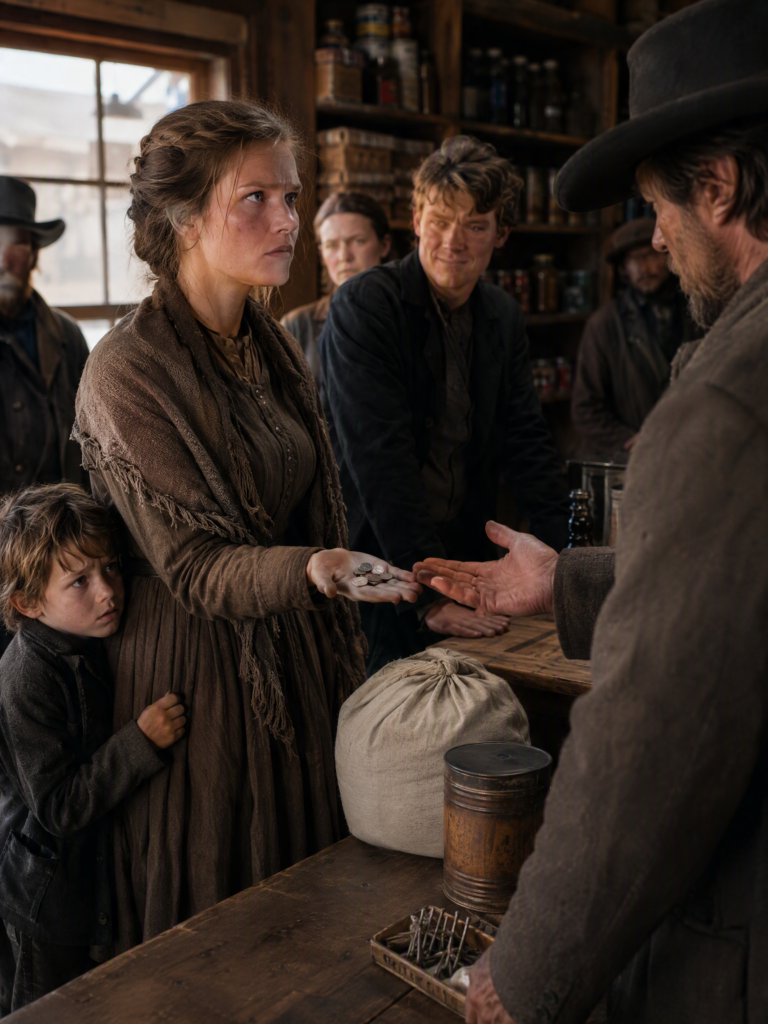
She thought of the mercantile.
The laughter.
The last penny pushed across the counter.
Then she looked at Elias.
The boy was watching her with complete confidence.
Greta steadied her hands.
“I have brought numbers,” she began.
Her English was careful.
Some words came slowly.
But she did not apologize.
“For several months I have kept account of my purchases. I believed the sums were wrong. When I asked, I was told I remembered badly.”
She touched the other ledgers.
“Now I have accounts from four more households. They show similar differences.”
Mrs. Ordway shifted on her bench.
“Miss Linkfist, surely a handful of imperfect records cannot prove every accusation.”
Greta looked at her.
“I am not asking anyone to trust a record merely because I made it.”
She turned toward Elmer Dunore.
“I ask that we examine the store’s own figures.”
A murmur passed through the hall.
Mr. Dunore drew himself upright.
“My books are available.”
“Then please read one entry.”
He opened the ledger.
Greta indicated a purchase from October.
“Flour,” he read. “Forty cents. Bacon, thirty-five. Coffee, twenty-five.”
He looked at the total.
“One dollar and twenty cents.”
Greta waited until he had finished.
Then she spoke clearly.
“Forty and thirty-five makes seventy-five.”
Several people began adding in their heads.
“Twenty-five more makes one dollar.”
She looked toward the audience.
“Not one dollar and twenty cents.”
Mr. Dunore stared down at the page.
He repeated the addition.
Slowly.
Once.
Then again.
His face reddened.
Reverend Teague took a pencil and checked the figures.
“She’s correct.”
The words seemed to settle across the entire room.
Greta did not smile.
There was no pleasure in humiliating somebody else.
She simply turned another page.
“Shall we examine the next account?”
Mr. Dunore said nothing.
He turned the ledger.
And as the hall watched, Greta began reading the numbers that would finally force Larksburg Crossing to reckon with what it had refused to see.
Mr. Dunore turned the page with hands that had begun to tremble.
Greta stood opposite him, her own ledger open on the table.
The hall was silent except for the scrape of chairs and the faint rustle of paper.
No one seemed willing to make the first careless remark.
“Please read the next entry,” Greta said.
The storekeeper swallowed.
He found the date she indicated and began listing the purchases.
This time several people wrote the figures on scraps of paper.
Others counted on their fingers.
A small error appeared again.
Not twenty cents.
Less.
But the amount was beside the point.
When they checked another household’s record, they found a price that had been copied incorrectly and carried forward through later purchases.
Mr. Dunore examined the figures with growing disbelief.
He had considered himself an orderly businessman.
His shop served families from across the surrounding settlements.
He had trusted Silas Pruitt to manage ordinary transactions while he attended to suppliers and larger accounts.
And because business continued and customers rarely complained, he had assumed the system was working.
Now his own books told him otherwise.
Greta stood quietly while the evidence accumulated.
She had imagined this evening many times.
Sometimes she had pictured the storekeeper becoming angry.
Sometimes she had imagined the room laughing again.
She had never imagined that the most powerful sound would be silence.
A man near the back cleared his throat.
Otto Brandt rose.
He was a German farmer with rough hands and a face browned by years of outdoor work.
“I thought my wife was mistaken,” he said.
His English was heavily accented.
“I told her so. She was not.”
He looked down at his hat.
“I should have checked.”
Then he sat.
His wife reached for his hand.
Across the aisle, Aneska Novak nodded.
Her English was not yet sufficient for a long speech before the entire room.
But her ledger was on the table.
Her figures had been examined.
Her presence required no further explanation.
Greta looked from one family to another.
She remembered sitting at the Novak kitchen table, patiently putting together the numbers of purchases made over several months.
She remembered the woman’s relief when the sums began to agree.
Until then, Aneska had believed that struggling with English meant she was struggling with arithmetic too.
Greta had recognized that feeling.
It was the same doubt that had followed her from the mercantile to her own kitchen.
Now the room was beginning to understand.
Not because Ezra Colton had defended her.
Not because a wealthy man had spoken kindly of her character.
Because the numbers could be checked by anyone willing to look.
Mr. Dunore closed the ledger.
His face was flushed.
“I have made assumptions,” he said.
The admission seemed difficult.
Greta remained still.
“Silas has worked for me several years. I believed the accounts were sound. Clearly they are not.”
Reverend Teague rose.
“Then I expect the question before us is how to put matters right.”
Mr. Dunore looked at the rows of faces.
“I’ll examine every disputed account. Any customer who was overcharged will be repaid.”
Someone asked about older purchases.
He hesitated.
Then nodded.
“Those too, where the records can be checked. I’ll allow interest on older amounts, as seems fair.”
Greta spoke.
“And customers who have no complete ledger?”
He looked at her.
“They may bring what records they have. We’ll compare them with the store books.”
She studied his face.
“Will they be listened to, even when their English is imperfect?”
The question hung in the room.
Mr. Dunore looked away for a moment.
Then he met her eyes.
“Yes, Miss Linkfist.”
It was the first time that evening he had used her name without sounding impatient.
Silas Pruitt stood near the side wall.
He had arrived late and remained there, apparently hoping not to be noticed.
Now Mr. Dunore turned toward him.
“Silas.”
The young man stepped forward.
His face had lost the smug expression Greta remembered from the mercantile.
“Sir?”
“Do you understand what these accounts show?”
Silas looked toward the table.
“Yes.”
“Can you explain it?”
He swallowed.
“I’ve been careless.”
A few people stirred.
Silas continued before anyone could interrupt.
“I wasn’t taking the money for myself. I wasn’t trying to cheat anyone.”
Greta watched him steadily.
“I believe that,” she said.
Silas looked surprised.
“But that does not mean the harm was small.”
“No, ma’am.”
“You corrected the mistake when Mr. Voss challenged you.”
Silas lowered his eyes.
“Yes.”
“When I challenged you, you laughed.”
His face reddened.
“I did.”
“Why?”
He hesitated.
“I thought you had counted wrong.”
“Because of my accent?”
He gave no answer.
Greta waited.
At last he nodded.
“Yes.”
The admission was plain.
There was no grand excuse.
And something about its simplicity made the whole room more uncomfortable.
Silas had not needed to be a particularly wicked man to do harm.
He had only needed to believe that certain people were easier to dismiss than others.
Greta closed her ledger.
“Then I hope you will remember what happened the next time someone speaks differently from you.”
Silas nodded.
“I’m sorry, Miss Linkfist.”
She accepted that he had spoken the words.
Whether he would live differently remained to be seen.
Mr. Dunore announced that Silas would work the counter under closer supervision and that figures would be checked carefully before purchases were completed.
The arrangement would remain until customers had reason to trust the accounts again.
Reverend Teague stepped forward.
Several weeks earlier, he had spoken from Exodus about the treatment of strangers.
Now he looked over the congregation and said, “We cannot claim to love our neighbors while refusing to hear them.”
Nobody argued.
Mrs. Ordway sat with her hands folded tightly in her lap.
Greta noticed her expression.
The older woman had been proud of the relief committee for years.
She had managed its coal money and household assistance with careful attention.
Yet when Greta had offered to help, Mrs. Ordway had treated her as though the simple act of touching the money might be dangerous.
Greta wondered whether the woman understood now.
But there would be time to discover that.
She had not come to the hall seeking affection.
She had come seeking accuracy.
And at last she had received it.
When the meeting ended, several people approached her.
Some offered congratulations.
Others apologized for doubting her.
Greta listened politely.
She did not pretend that a few agreeable words could erase months of humiliation.
But neither did she refuse to recognize the beginning of change.
The families whose accounts she had helped gather thanked her in their own ways.
Mrs. Halverson’s daughter-in-law clasped her hands.
Otto Brandt nodded with solemn respect.
Aneska Novak smiled so broadly that no translation was necessary.
Elias hurried toward his aunt.
“You did it!”
Greta knelt to meet him.
“We did something important.”
“You showed everyone.”
“Not alone.”
She glanced toward the families.
“They brought their records. They told the truth. That matters.”
Elias threw his arms around her.
She held him closely.
For a moment she thought of her sister.
She wished the boy’s mother could have seen how bravely he had helped.
Then she stood and found Ezra waiting near the doorway.
He had not stepped forward to receive praise.
He had not spoken over her.
He had kept the promise he made on the porch.
“Well?” she asked.
Ezra looked at the ledgers in her arms.
“Seems to me those figures spoke clearly enough.”
“Do you think they will remember?”
“What?”
“That I was right.”
He smiled.
“I reckon they’ll remember that.”
They walked home beneath a clear evening sky.
Elias went ahead, holding a small parcel of food sent by Mrs. Halverson.
The road was familiar now.
The open prairie stretched dark and quiet beyond the last houses.
Greta carried her ledger beneath one arm.
Ezra walked beside her.
After a while, he said, “I nearly spoke when Mrs. Ordway interrupted.”
“I know.”
“I remembered what you asked.”
“Good.”
He looked down.
“Wasn’t easy.”
Greta laughed softly.
“You are accustomed to being heard, Mr. Colton.”
“Seems I am.”
“Then perhaps you are learning something too.”
He turned toward her.
“I believe I am.”
She looked away before he could see how much pleasure the answer gave her.
The following week, the relief committee called a smaller meeting.
This time Mrs. Ordway asked Greta to attend.
The room behind the church was plain and cool.
The coal money tin stood on the table.
Mrs. Fenwick, who kept the written names and records, sat with an open ledger.
Greta entered cautiously.
She remembered being turned away from the counting at the Hollis family supper.
She remembered the older woman’s gentle, immovable smile.
Now Mrs. Ordway rose.
“Miss Linkfist.”
“Mrs. Ordway.”
“Please sit.”
Greta did.
The older woman folded her hands.
“I have something to say.”
Greta waited.
“I have been responsible for this committee’s accounts for eleven years.”
“Yes.”
“I took pride in keeping everything orderly.”
“That is good work.”
Mrs. Ordway looked down.
“It can be. But I let my pride decide who was fit to help.”
Greta did not rescue her from the discomfort.
The older woman continued.
“When you offered to count, I refused you. Not because you had done anything wrong, but because I believed what people were saying about your abilities.”
She looked directly at Greta.
“I was mistaken.”
For several seconds neither woman spoke.
Then Mrs. Ordway turned the ledger toward her.
“I would like you to take responsibility for the figures. The money, the quantities, the totals. Mrs. Fenwick can continue keeping the written names.”
Greta examined the open page.
The invitation was more than a polite gesture.
It was a responsibility.
And it involved precisely the skill the town had mocked.
“Do you ask this because you feel sorry for me?” Greta said.
Mrs. Ordway straightened.
“No.”
“Because people will think well of the committee?”
“No.”
“Then why?”
“Because you’ve shown you can do it accurately.”
Greta looked at the pencil lying beside the ledger.
“And the written English?”
“Mrs. Fenwick will keep that part, as she always has. You needn’t pretend to know what you are still learning.”
Greta considered.
“And if I disagree with something?”
“Then say so.”
The older woman gave a small, reluctant smile.
“Clearly.”
At last Greta picked up the pencil.
“Then we shall do it properly.”
That was how her place at the table changed.
Not through a dramatic speech.
Not through an act of charity.
Through work.
The same kind of careful work she had been doing at her kitchen table for months.
Over the following weeks, the relief accounts became more orderly.
Mrs. Fenwick recorded names and written descriptions.
Greta checked quantities and totals.
Mrs. Ordway began asking questions instead of issuing decisions without discussion.
The arrangement was not always comfortable.
Old habits rarely vanished because people admitted them once.
But errors were corrected.
And no one suggested that Greta should sit away from the money.
The refunds from the mercantile were made gradually as disputed purchases were reviewed.
Some families received only small amounts.
Others discovered that repeated mistakes had cost them more than they realized.
Greta received the money owed to her.
She did not treat it as a fortune.
She put some toward household necessities and kept some aside.
What mattered most was not the number of coins returned.
It was that the storekeeper had acknowledged they belonged to her.
Silas changed slowly.
He became more careful with figures.
He checked totals before handing back change.
And when an unfamiliar customer hesitated over English words, he learned to wait instead of laughing.
One Saturday, Greta returned to the mercantile with Elias.
She placed her purchases on the counter.
Silas calculated the sum.
Greta counted out her money.
He checked it.
“Correct, Miss Linkfist.”
She nodded.
“Thank you.”
There was no applause.
Nobody needed to intervene.
The transaction was ordinary.
That was what made it so satisfying.
Outside, she found Ezra waiting beside his wagon.
He had brought supplies from his ranch and offered to take her and Elias home.
Greta settled the basket beside her.
“Everything all right?” he asked.
“Yes.”
She looked toward the store.
“For once, it was simply shopping.”
Ezra smiled.
“That’s a pleasant change.”
On the road, Elias asked whether his aunt would always help count the church money.
“As long as they want the help and I have time for it,” Greta answered.
“Will you teach me to keep a ledger?”
“You already know a great deal.”
“Not everything.”
“Neither do I.”
Ezra glanced at her.
“You’ve both taught me something about figures.”
Greta raised an eyebrow.
“What is that?”
“That the smallest amounts can tell the biggest story.”
She smiled.
“Then I expect you will check your ranch accounts more carefully.”
“I already have.”
“And?”
He sighed.
“I owe myself an apology for several poor calculations.”
Elias laughed so hard he nearly dropped his cap.
Soon, Greta’s household settled into a gentler rhythm.
She continued taking sewing work.
Her garden grew.
Elias studied his lessons, helped with small tasks, and spent afternoons with the Halverson family when Greta’s work required quiet.
Ezra visited when he could.
He brought work of his own sometimes—a worn cuff, a broken strap, a piece of equipment he wished to repair.
He did not invent reasons to take over her household.
If something needed fixing, he asked before beginning.
If Greta declined, he accepted it.
And she, in turn, began allowing him to see more of her ordinary days.
There were evenings when she was too tired to entertain anyone.
Ezra learned that the best thing he could do was help carry water, drink his coffee, and leave early.
There were mornings when she had finished a difficult order and felt proud of the work.
He listened as she described the stitching, the measurements, and the price she had agreed to accept.
He never suggested that his ranch could provide everything and make her labor unnecessary.
He understood by then that her work was not merely a way to survive.
It was part of how she made her place in the world.
One evening they sat together on her porch.
The blue shutters stood open.
Elias was inside, reading near the lamp.
A warm wind moved through the garden.
Ezra turned his hat slowly between his hands.
“Greta.”
“Yes?”
“I’ve been meaning to ask something.”
She set down her sewing.
“That sounds serious.”
“Perhaps it is.”
He looked at the fence.
Then back at her.
“I’ve come to care for you.”
She remained very still.
He continued before she could answer.
“I know you’ve made a life for yourself here. I respect it. I wouldn’t ask you to give that up simply because I happen to want more time in your company.”
Greta looked toward the doorway where Elias sat.
“And what is it you want?”
Ezra considered the question.
“To know you better. To keep coming here, if I’m welcome. To see whether what we’ve begun might become something lasting.”
She studied his face.
There was no demand in it.
No assumption.
No promise of rescue.
Only a man risking an honest answer.
“And if I tell you I am not ready?”
“Then I’ll bring my torn shirts when you agree to mend them and otherwise behave myself.”
She laughed.
“You have already brought too many torn shirts.”
“Then I’ll have to learn to be gentler with them.”
Greta looked out across the garden.
A year earlier, she might have accepted any respectable man’s attention with gratitude.
Not because she loved him.
Because she feared the future without help.
Now she knew she could make decisions from a different place.
She had work.
She had her home.
She had Elias.
She had begun to earn the respect of people who once doubted her.
She did not need Ezra Colton to give her a name worth carrying.
And that made his affection more precious, not less.
“I would like you to keep coming,” she said.
His expression softened.
“Glad to hear it.”
“But slowly.”
“As slowly as you wish.”
“And do not think I shall agree with you merely because I like you.”
Ezra laughed.
“I have already learned that.”
She reached for his hand.
He turned his palm upward and let her take it.
For a while they sat without speaking.
Inside, Elias sounded out a difficult word.
Greta listened.
She had begun studying English more confidently herself.
The written words still required patience, but she no longer mistook difficulty for shame.
Some evenings Elias helped her.
Other times Mrs. Fenwick explained an unfamiliar phrase while they worked on the relief accounts.
Greta was learning at her own pace.
And for the first time, she did not feel compelled to hide that she was learning.
One Saturday later that summer, she and Ezra stopped outside the mercantile.
The Novak family stood near the entrance.
Aneska was examining several unfamiliar coins in her palm.
Her husband tried to explain something, but both appeared uncertain.
Greta recognized the look immediately.
She had worn it herself often enough.
She handed Ezra the basket she was carrying.
“Would you hold this?”
“Of course.”
Then she approached Aneska.
“May I help?”
The woman’s face brightened.
Greta sat beside her on the low boardwalk step.
Together they counted the coins.
Greta explained the values slowly.
She did not snatch the money.
She did not make the calculation into a performance.
She allowed Aneska to repeat the sum until she was satisfied.
Then she smiled.
“You have it.”
Aneska smiled back.
Ezra watched from a little distance.
Once, he might have stepped forward.
He might have counted the coins himself, hoping to spare someone embarrassment.
Now he understood that help could mean knowing when not to take the work from another person’s hands.
When Greta returned, he gave her the basket.
“You were a good teacher.”
She looked surprised.
“I only showed her what I know.”
“That’s generally how teaching begins.”
She laughed.
They walked toward the wagon.
Elias hurried ahead to climb onto the seat.
At the rail, Greta paused.
“Ezra?”
“Yes?”
“Do you remember the morning we met?”
“Rather well.”
“You told that clerk I knew how to count.”
“I did.”
“And I was angry with you.”
“I remember that part too.”
She looked up at him.
“I was not angry because you were wrong.”
“I know.”
“I was angry because I was tired of needing somebody else to make people listen.”
Ezra nodded.
“You had reason.”
Greta considered his face.
“You have changed since then.”
“So have you.”
She smiled.
“Perhaps. But I could count before you came into the store.”
He laughed.
“That much is certain.”
She reached for his hand.
“And now,” she said, “I think I am ready to let you walk beside me for a little farther.”
Ezra held her hand gently.
“I’d like that.”
They climbed into the wagon.
The road stretched west beneath the long summer light.
Elias sat between them, talking about his lessons and the vegetables growing beside the blue-shuttered cabin.
Ezra listened.
Greta watched the familiar fields pass.
There had been a time when every trip into town required courage.
A time when she counted her money as though the coins themselves might betray her.
A time when she believed that speaking with an accent made her less worthy of being heard.
Those days had not vanished from memory.
But they no longer decided what she could become.
She had found her own voice.
The town had learned, imperfectly but meaningfully, to hear it.
And the rancher who first defended her had learned that love was not a matter of standing in front of a woman and fighting all her battles.
Sometimes it was standing beside her while she fought her own.
Sometimes it was repairing a chimney, accepting a correction, keeping a promise, or remaining silent while the truth received the attention it deserved.
Greta looked at the man beside her.
He met her eyes and smiled.
No grand declaration was necessary.
They had time to discover what their future might hold.
And neither needed to hurry past the friendship that had brought them this far.
The wagon rolled on toward the little cabin with blue shutters.
In Greta’s basket lay her purchases, properly counted and fairly paid for.
And beneath them rested the small, battered ledger that had once held fourteen lonely proofs nobody wanted to believe.
Those numbers had helped her reclaim something worth considerably more than the money owed.
Her dignity had never truly been lost.
She had simply learned to stop letting others set its price.


