
Ezra reached his horse, gathered the reins, and stopped with one boot against the stirrup.
He had been thinking of bringing Grace a sack of flour.
Perhaps some dried beans.
Perhaps a little bacon.
But he knew she would recognize the offering for what it was.
Charity delivered by a man she scarcely knew.
And after their conversation outside the church, he understood that such a gesture might close the very door he hoped to open.
He needed a better idea.
Two days later, he entered the Harlow House carrying his customary load of firewood.
Agatha Doyle was behind the desk.
“Mrs. Doyle, I need somebody to cook for my ranch hands.”
She looked up.
“Is that so?”
“Two men working the winter feed. I’ve been doing the cooking, and we aren’t getting along very well.”
“Your cooking or the men?”
“Mostly the cooking.”
Agatha smiled despite herself.
“I’ve heard stories.”
“Most of them deserved.”
He leaned against the counter.
“I want to offer Miss Tilman three afternoons a week. Proper wages. She can decide whether the work suits her.”
Agatha studied him.
“And you haven’t arranged this merely because you know she’s having a difficult time?”
“Those men need feeding whether Grace takes the job or not.”
“But you’d rather hire her.”
“Yes, ma’am.”
“Why?”
Ezra looked toward the kitchen.
“Because she’s good at what she does. And because I think she ought to have a chance to earn more without working herself into the ground.”
Agatha considered that answer.
Then she nodded.
“I’ll put it to her.”
Grace refused.
Not politely.
Not hesitantly.
Immediately.
“No.”
Agatha folded her arms.
“You haven’t heard the wages.”
“I don’t need to.”
“You might.”
“Mrs. Doyle, Mr. Colton has been watching me for weeks. Now he suddenly discovers he requires a cook?”
“Have you tasted his biscuits?”
“That isn’t the point.”
“Perhaps you ought to see the kitchen before deciding.”
Grace resisted for three days.
Then practicality overcame suspicion.
She rode out to Ezra’s ranch.
It was a small, hardworking place.
The house was plain.
The stable was sound.
The cattle were in fair condition.
But the kitchen was a disgrace.
A sack of beans stood unopened near the wall.
Hard biscuits lay in a tin.
A piece of salt pork rested beside the stove.
One of the hired men admitted that yesterday’s dinner had consisted of beans burned to the bottom of a pot.
Grace lifted the lid.
Looked inside.
And stared at Ezra.
“Mr. Colton, are you attempting to poison these men?”
“No, ma’am.”
“Then you’ve developed a remarkable talent for doing it accidentally.”
One of the hands laughed.
Ezra looked embarrassed.
Grace examined the available provisions.
“You truly need somebody who can cook.”
“That’s what I said.”
She turned to him.
“Three afternoons weekly. I set my hourly rate. I cook the meals, but I will not be responsible for laundering clothes or mending anything.”
“Agreed.”
“If Mama needs me, her care comes first.”
“Understood.”
“And you’ll pay me as an employee, not as someone you’re trying to rescue.”
Ezra held her gaze.
“That’s exactly what I intend.”
Grace offered her hand.
He shook it.
The work began the following Tuesday.
Within an hour, the kitchen smelled of fresh bread and properly seasoned stew.
The ranch hands ate seated at the table.
Ezra noticed something else.
Grace worked differently when she controlled her own duties.
She organized the pantry.
Calculated portions.
Told the men what needed washing.
And refused to take on tasks outside the agreement.
She was not merely grateful.
She was competent.
And Ezra found himself respecting her more with every passing afternoon.
At the end of the first week, he counted her wages into her hand.
She examined the amount.
“Correct.”
He smiled.
“Glad to pass inspection.”
For a moment, Grace’s expression softened.
Then she tucked the money away.
“Tuesday, Mr. Colton.”
“Tuesday, Miss Tilman.”
But December brought the first hard cold.
Constance’s breathing worsened.
Dr. Hartwell insisted she spend more time resting in bed.
Grace could no longer leave her unattended for long stretches.
She reduced her hours at the boardinghouse.
Then surrendered two of her three afternoons at Ezra’s ranch.
The additional wages stopped arriving just as the doctor increased her mother’s medicine.
The rent was already overdue.
And when Grace approached Elam Crabtree at the mercantile, he told her that another family wanted the rooms in January.
He could wait until the end of December.
No longer.
Grace thanked him.
She did not plead.
But outside his store, she stood for several minutes with both hands pressed against her skirt, trying to decide where her mother could possibly go.
There was no money left.
She had already sold her grandmother’s brooch.
Then her silver thimble.
Then the sewing kit her father had given her when she turned sixteen.
The last object had hurt most.
It represented the trade she had been taught, the work she could always return to if circumstances improved.
Now it belonged to Crabtree.
That Sunday evening, Grace found Ezra behind the boardinghouse kitchen.
He had just finished loading an empty feed sack into his wagon.
“Mr. Colton,” she said.
He turned.
She was trembling.
“I need to ask for help.”
The words seemed to cost her everything.
Ezra stepped away from the wagon.
“All right.”
“I don’t need you to fix my entire life.”
“I didn’t suppose you did.”
“But the rent is due, and Mama’s treatment cannot stop, and I’ve sold nearly everything worth selling.”
Her voice broke.
She steadied it.
“I need help finding a way to keep our rooms.”
Ezra listened without interruption.
Then he asked the one question Grace had not expected.
“What would you like me to do?”
She stared at him.
He had not offered to take over.
Had not announced that he would pay.
Had not told her what a sensible woman ought to accept.
He had asked.
Grace drew a careful breath.
“Speak to Pastor Caro. Ask whether the church can help with the rent, openly and honestly. And ask Mr. Crabtree about my father’s sewing kit.”
Ezra nodded.
“Anything else?”
“Yes.”
She lifted her chin.
“Please don’t tell my mother. I need to do that myself.”
“I’ll respect that.”
Grace looked at him.
For the first time in months, she had allowed someone to share the problem.
But she still had to face the woman whose pride had made the truth so difficult to tell.
And as Ezra climbed into his wagon, Grace turned toward the boardinghouse door and reached for its cold iron latch, knowing the next conversation might hurt her mother more than the unpaid rent itself.
Grace’s fingers closed around the iron latch.
She did not open the door immediately.
Through the kitchen window came the ordinary sounds of evening: a pot striking the stove, Agatha calling instructions, the scrape of chairs in the dining room.
The boardinghouse continued its work.
Grace wished, for a moment, that she could do the same without thinking.
But the truth had been spoken aloud.
And now it belonged to more than one person.
She entered the kitchen, washed her hands, and returned to her duties.
Outside, Ezra drove toward the church.
He found Pastor Wendell Caro sorting hymnbooks in the small office beside the sanctuary.
The pastor looked up when Ezra appeared.
“Something troubling you, Mr. Colton?”
“There’s a family in town having a hard winter.”
“Most families are having some kind of hard winter.”
“This one may lose its rooms before the New Year.”
Pastor Caro set aside the hymnbook.
Ezra explained what Grace had authorized him to say.
He did not recount every private difficulty.
He did not mention her mother’s medical condition in unnecessary detail.
And he did not present himself as the family’s appointed guardian.
He explained that assistance had been requested and that the church might be able to help.
Pastor Caro listened.
Then he said, “We spend a great deal of Sunday asking people to care for their neighbors. I’d be ashamed if we refused the opportunity when somebody finally asked.”
Ezra nodded.
“But the family wants discretion.”
“Then we’ll give them discretion.”
The pastor agreed to bring the need before the church deacons.
No public announcement would identify the recipients.
Any collection would be an act of voluntary assistance, not a debt secretly placed upon Grace and her mother.
Ezra thanked him.
Then he crossed the street to the mercantile.
Elam Crabtree was closing the shutters.
“What can I do for you?”
“I wanted to ask about a sewing kit Miss Tilman sold you.”
Crabtree paused.
“What about it?”
“She’d like to know whether it might be recovered.”
“I bought it fairly.”
“I haven’t suggested otherwise.”
Crabtree studied him.
Ezra continued.
“Her mother’s been ill. Grace has been selling what she could to manage the bills. That particular kit came from her father.”
The merchant’s expression changed.
He had known the Tilman family for years.
He remembered Grace’s father carrying freight accounts into his store.
He remembered Constance teaching children who could now scarcely recall being children themselves.
Yet he had seen Grace sell the brooch, the thimble, and the kit without once asking what desperation lay behind those transactions.
“I didn’t know how far matters had gone,” he admitted.
“Neither did I until she told me.”
Crabtree looked toward a shelf behind the counter.
The sewing kit remained there.
After a moment he said, “I’ll return it.”
Ezra shook his head.
“She didn’t ask for a hidden present.”
“I understand.”
Crabtree considered the matter.
“Then I’ll tell her plainly. I paid too little for it because she needed money in a hurry. I’d rather return it than make a profit from that kind of bargain.”
Ezra accepted the answer.
“It’s hers to decide what she makes of that.”
“Quite right.”
By the following week, both arrangements were underway.
Pastor Caro had spoken with the deacons.
Crabtree had put aside the sewing kit.
But Grace’s greatest difficulty remained upstairs above the mercantile.
Constance Tilman did not know they were behind on rent.
She did not know how much of the household’s possessions had disappeared.
And Grace had become so practiced at concealing sacrifice that telling the truth felt almost like an accusation.
One afternoon, Constance noticed her daughter standing at the stove without eating.
“Sit down, Grace.”
“I’ve got things to finish.”
“Those things can wait long enough for supper.”
Grace placed a bowl on the table.
Then returned to the stove.
Constance watched her.
She had noticed the change in her daughter months earlier.
The thinner face.
The exhausted eyes.
The missing brooch.
But she had not asked.
Part of her was afraid she already knew the answers.
And those answers would mean admitting how much her daughter had surrendered.
A few days later, Louisa Fenwick, a widow from the church, arrived with a basket of baking.
She meant well.
She had a warm heart and an unfortunate tendency to speak before remembering what ought to remain private.
While Constance thanked her for the bread, Louisa mentioned that the congregation hoped its collection would ease the family’s difficulties before Christmas.
The room went still.
“Collection?” Constance asked.
Louisa realized too late what she had said.
She attempted to explain.
Then apologized.
But the damage was done.
When Grace returned that evening, her mother was waiting beside the window.
The basket stood untouched upon the table.
“Sit down.”
Grace recognized the tone.
It was the voice Constance had used years earlier when teaching stubborn schoolboys who hoped to escape their lessons.
“What is it, Mama?”
“I understand the church is collecting money for us.”
Grace stopped.
“Who told you?”
“That isn’t the question.”
Grace put down her shawl.
“Mama, I intended to explain.”
“When?”
“Before the collection.”
Constance folded her hands.
“Did you ask them for charity?”
“I asked Pastor Caro whether the church might help us through the winter.”
“You had no right to do that without telling me.”
Grace felt a familiar pressure rising behind her ribs.
“The rent is overdue.”
Constance stared.
“How overdue?”
“Since October.”
The older woman’s face changed.
“And you said nothing?”
“I knew how you’d answer.”
“You should have told me.”
“You’re right.”
That admission disarmed Constance for an instant.
Grace continued.
“I should have told you sooner. But every time I imagined the conversation, I could hear you saying we’d manage somehow. And I couldn’t find another somehow.”
Constance looked away.
Grace’s voice grew unsteady.
“I sold Grandmother’s brooch. Then the thimble. Then Father’s sewing kit.”
Her mother’s hand tightened around the chair arm.
“You sold his kit?”
“Yes.”
“Why didn’t you come to me?”
“Because you cannot make money appear by knowing we’re short of it.”
The words emerged more sharply than Grace intended.
She lowered her voice.
“I’m sorry. But I cannot keep choosing between your medicine and the rent while pretending everything is fine.”
Constance looked toward the window.
Outside, a few thin snowflakes drifted past the glass.
“I saw you growing thinner,” she said at last.
Grace did not answer.
“I saw the brooch missing. I told myself you’d moved it.”
“Why?”
Constance swallowed.
“Because the truth would mean I was more dependent upon you than I wished to be.”
Grace reached toward her.
Constance pulled back.
“I won’t accept a collection.”
“Mama—”
“I’ve worked all my life. Your father worked all his life. We never asked the church to keep us.”
“People helped us in other ways.”
“That’s different.”
“Is it?”
Constance’s expression hardened.
“I’d like to rest.”
Grace stood for a moment.
Then left the room.
For three days, the household became painfully quiet.
They spoke when necessary.
Grace prepared meals.
Constance refused extra portions.
Neither could find a way to retreat without feeling defeated.
Grace understood her mother’s pride because she had inherited it.
But she was beginning to recognize the cost.
Pride had made her delay asking for help until she was almost too exhausted to use it.
Pride had kept her mother from discussing what they could realistically afford.
And pride now threatened the assistance that might keep them housed through winter.
On the second evening, Grace caught herself eating while standing beside the stove.
She stopped.
Looked at the chair.
And sat down.
It was a small act.
Nobody applauded.
Nothing in the household accounts changed.
But she finished her supper seated at the table.
The following Tuesday, December sixteenth, the temperature dropped sharply after sunset.
A thin covering of snow crusted the street.
The north wind pressed against the windows.
Constance had been breathless throughout the day.
Dr. Hartwell’s instructions were clear: rest, prescribed treatment, and as little exertion as circumstances allowed.
Grace helped her mother into bed.
She arranged extra pillows to make breathing easier.
Then she went to tend the stove.
A strange sound came from the bedroom.
Not a cry.
A harsh, interrupted breath.
Grace hurried back.
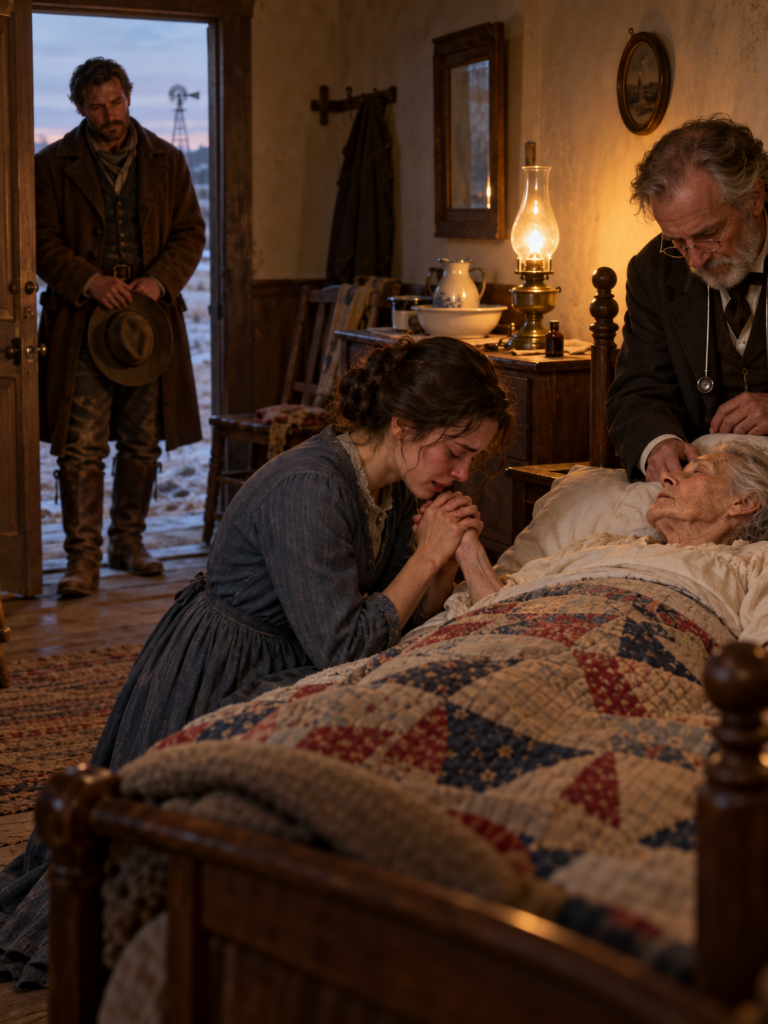
Constance was sitting upright, gripping the bedding.
Her face had changed color.
She was struggling to draw air.
“Mama?”
Constance tried to answer.
Only a broken gasp emerged.
Grace moved immediately.
She supported her mother in a more upright position, arranged the pillows, and opened the window slightly despite the cold.
Then she knelt beside the bed.
“I’m here.”
Constance gripped her hand.
The pressure was unexpectedly strong.
But the breathing grew worse.
Grace knew she needed Dr. Hartwell.
And she knew she could not leave her mother alone for long.
She looked toward the dark window.
Then toward the door.
Ezra’s ranch lay east of town, beyond the last buildings.
He kept horses ready.
He was accustomed to riding in difficult weather.
And he had never once made Grace regret asking him for assistance.
She called for help from the adjoining rooms, making certain someone would remain close to Constance.
Then she ran.
She did not stop for her coat.
She barely noticed that she was wearing house slippers.
The cold struck her bare ankles as she crossed the frozen street and continued toward the edge of town.
By the time she reached Ezra’s house, her lungs were burning.
A lamp glowed through the window.
She struck the door with both fists.
Ezra opened it.
One look at her face was enough.
“My mother,” she gasped. “She can’t breathe.”
He was already reaching for his coat.
“Is somebody with her?”
“Yes.”
“Good. I’ll fetch Hartwell.”
He took the horse from the stable and rode hard toward the doctor’s house.
Grace started back toward town.
Ezra caught up briefly and told her to return directly to her mother.
Then he pressed on.
The minutes stretched terribly.
Grace entered the room above the mercantile and found Constance still struggling.
She took her mother’s hand.
“Help is coming.”
Constance’s eyes followed her.
Grace kept speaking softly.
She did not know whether the words comforted her mother.
But she could not bear the silence.
At last, footsteps sounded on the stairs.
Dr. Hartwell arrived with Ezra immediately behind him.
The physician set down his bag.
He examined Constance and began tending to her.
He adjusted her position, attended to the prescribed medicine with caution, and instructed Grace how to help keep her mother calm and supported.
Ezra remained by the doorway.
He could not treat the illness.
He could not guarantee the outcome.
But he could stay.
The doctor worked.
The wind rattled the window.
The lamp burned lower.
Constance’s breathing eased slightly, then became strained again.
Grace held her mother’s hand throughout.
At one point, Ezra saw her lower her head until her forehead almost touched the bedcover.
Her voice was barely audible.
“Lord, please. Just let me have a little more time with her.”
Ezra looked away.
He had heard Grace argue over wages.
He had heard her defend her independence.
He had heard her laugh at his dreadful cooking.
But he had never heard her voice stripped of every defense.
Now he understood.
She was not merely frightened of poverty.
She was terrified of losing the last person who remembered the life she had known before everything went wrong.
He remained at the doorway, his hat held against his chest.
And when Dr. Hartwell finally turned toward them with a grave expression, Grace tightened her grip on her mother’s hand, waiting to learn whether there was anything more they could do.
Grace tightened her hold as Dr. Hartwell examined Constance once more.
The physician listened carefully to her breathing.
Then he drew his chair closer.
“The immediate distress has eased somewhat,” he said. “But she is still seriously ill. I want her kept as quiet and comfortable as possible tonight.”
Grace nodded.
“Will she recover?”
Dr. Hartwell did not offer a comforting promise he could not keep.
“Her heart remains weak. I cannot tell you what tomorrow will bring. But she is breathing more easily than when I arrived.”
Grace closed her eyes.
It was not certainty.
But it was something.
The doctor reviewed the care Constance would require and the warning signs that meant he should be summoned again.
He emphasized that the medicine must be given according to his instructions.
Then he turned his attention toward Grace.
“Have you eaten today?”
She looked startled.
“I—”
“Miss Tilman.”
Ezra watched her expression change.
For months she had answered that question with excuses.
Tonight, she seemed too exhausted to invent one.
“Not enough,” she admitted.
Dr. Hartwell glanced at Ezra.
“Then perhaps somebody can see to that while I remain here.”
Ezra nodded.
“I’ll ask Mrs. Doyle downstairs.”
Grace began to object.
The doctor raised one hand.
“You won’t be of use to your mother if you collapse beside her.”
The words were firm, but not unkind.
Grace fell silent.
Ezra left quietly.
He returned with a bowl of warm broth and bread.
He set them on the small table.
Then stepped back.
Grace looked at the food.
For a moment, shame rose through her.
She had spent months keeping others from discovering how little she ate.
Now the doctor knew.
Ezra knew.
And her mother lay in bed only a few feet away.
But the hunger was real.
So was the exhaustion.
Grace drew up a chair and began eating.
She did not finish quickly.
She took small mouthfuls, pausing to watch Constance breathe.
Ezra remained near the doorway until the doctor told him that there was nothing further he could usefully do for the moment.
He considered leaving.
Grace looked up.
“Mr. Colton?”
“Yes?”
“Would you stay a little longer?”
He returned to the chair beside the door.
“Of course.”
It was the first time she had asked him for company rather than practical assistance.
He understood the difference.
The room remained quiet.
The doctor wrote a few notes.
Constance rested against her pillows.
Outside, the snow continued falling.
After a while, Constance opened her eyes.
“Grace?”
Her daughter was beside her immediately.
“I’m here, Mama.”
Constance looked toward the doctor.
Then toward Ezra.
She seemed to be gathering her thoughts with considerable effort.
“There’s something I’ve been too stubborn to say.”
Grace leaned nearer.
“It can wait.”
“No.”
Her mother’s voice was weak.
But the familiar determination remained.
“I knew you were struggling.”
Grace swallowed.
“I tried not to show it.”
“I know.”
Constance looked toward the window.
“I saw the weight falling from you. I saw your grandmother’s brooch disappear. I heard you come home late and leave before daylight.”
She paused for breath.
“I told myself you had matters in hand because admitting otherwise meant admitting I could no longer take care of you the way I once did.”
Grace’s eyes filled.
“You’ve taken care of me all my life.”
“That’s no reason to let you destroy yourself taking care of me.”
The words entered the room quietly.
Ezra lowered his gaze.
Constance turned toward him.
“You arranged some of this help?”
“Only what Grace asked me to arrange, ma’am.”
She studied him.
Even exhausted, she retained the measured look of a schoolteacher examining a pupil’s answer.
“And you didn’t pay people to pretend the assistance came from somewhere else?”
“No, ma’am.”
“Good.”
She looked back at Grace.
“I’ve been foolish.”
“Mama.”
“Let me finish.”
Grace nodded.
Constance’s fingers tightened around hers.
“We have confused independence with never needing anyone. Your father wouldn’t have wished this for us.”
Grace began crying.
“I didn’t want you to feel ashamed.”
“I know.”
“I thought if you learned about the rent, or the medicine, or the things I sold, you’d blame yourself.”
“I would have.”
Constance took a careful breath.
“But I might also have helped you decide what to do.”
Grace bent her head.
The truth hurt because it was so simple.
She had wanted to protect her mother.
Yet by concealing every difficulty, she had denied her the chance to participate in decisions about their shared life.
For the first time, Grace understood that love could become a form of control when fear prevented honest conversation.
“I should have told you,” she whispered.
“Yes.”
“Can you forgive me?”
Constance’s expression softened.
“Can you forgive me for making honesty so difficult?”
Grace rested her forehead against her mother’s hand.
“Yes.”
For a while, neither spoke.
Then Constance looked toward Ezra.
“The church may help us.”
Grace lifted her head.
“Mama?”
“I won’t pretend I find it easy.”
“I know.”
“But I’ve taught too many children that helping one another is a Christian duty to spend my old age refusing what I encouraged them to offer.”
Ezra smiled faintly.
“That sounds reasonable, Mrs. Tilman.”
She gave him a tired look.
“I don’t recall asking for your judgment, Mr. Colton.”
“No, ma’am.”
A small laugh escaped Grace through her tears.
And despite the strain in her breathing, Constance smiled.
By morning, the worst of that night’s crisis had passed.
But Dr. Hartwell remained cautious.
Constance’s condition was chronic and serious.
She would need continuing attention.
There might be other difficult nights.
The medicine was not a cure.
Rest would not restore all the strength she had lost.
Grace listened without pretending otherwise.
Yet the circumstances around her mother could improve.
And this time, she would not attempt every part of that improvement alone.
The following Sunday, Pastor Caro and the church deacons proceeded with the collection.
The congregation was told only that a local household required assistance through the winter.
Nobody named the Tilman family from the pulpit.
Nobody stood up to make a spectacle of their hardship.
People contributed what they could.
The money was sufficient to cover the overdue rent and provide a modest reserve for immediate needs.
When Grace learned the amount, she sat quietly beside Agatha Doyle.
“I don’t know how to thank everyone.”
Agatha patted her hand.
“By allowing them to do a good thing without making it into a debt you’ll spend the next ten years repaying.”
Grace smiled through her tears.
“That sounds suspiciously like advice.”
“It is.”
“Uninvited advice.”
“The finest kind.”
They laughed.
A few days later, Elam Crabtree climbed the stairs to the Tilman rooms carrying a parcel wrapped in brown paper.
Grace opened the door.
“Mr. Crabtree?”
He removed his hat.
“I have something that ought to be returned to you.”
He placed the parcel in her hands.
She recognized its shape before removing the wrapping.
Her father’s sewing kit.
For a moment, she could not move.
Crabtree spoke before she could ask.
“I bought it from you when you needed money urgently. I made a better bargain than I ought to have done.”
Grace looked up.
“I agreed to the price.”
“You did.”
“Then you owe me nothing.”
“Perhaps not. But I’ve reconsidered whether I ought to profit from it.”
He glanced toward the open parcel.
“Your father was a good man. I knew him a long time. I’d rather see his gift back with his daughter.”
Grace touched the worn leather.
“I cannot pay you what it’s worth.”
“I’m not asking you to.”
He gave a small shrug.
“Call it a merchant discovering he’s made an error of judgment.”
She smiled faintly.
“That’s an unusual confession.”
“Don’t spread it around. I’ve a reputation to preserve.”
Grace laughed.
Then thanked him sincerely.
When he departed, she carried the kit to her mother.
Constance recognized it at once.
“Oh, Grace.”
“I have it back.”
Her mother reached out.
Grace placed it upon her lap.
For several minutes, they examined the familiar needles, scissors, and little compartments.
Then Constance said something that would have been impossible for her a month earlier.
“Perhaps we can do a little sewing together when I’m stronger.”
Grace kissed her forehead.
“I’d like that.”
The weeks after Christmas were different.
Not easy.
But different.
Agatha adjusted Grace’s hours to make room for her mother’s care.
The boardinghouse continued paying her fairly for the work she performed.
Pastor Caro ensured that the church’s assistance did not become an excuse for public scrutiny.
Constance began accepting meals without first asking who had paid for every ingredient.
And Ezra continued delivering feed and firewood each Tuesday.
He did not behave as though his role in arranging help entitled him to greater intimacy.
He still removed his hat when entering the Tilman rooms.
He still asked before offering advice.
And when Grace needed time with her mother, he accepted that without complaint.
The courtship developing between them was almost invisible to outsiders.
There were no grand declarations.
No sudden proposal.
No promise that marriage would solve the family’s difficulties.
Instead, there were conversations.
Ezra learned that Grace had once expected to make a living through sewing.
She had helped her mother with commissions before the family’s circumstances forced her into boardinghouse work.
The returned kit was more than a keepsake.
It was a reminder that she possessed skills she could use again.
Grace learned that Ezra’s cattle ranch was neither large nor especially prosperous.
He worked hard because the business required it.
He took carpentry jobs when he could.
And he considered unnecessary debt a danger best avoided.
“You speak about money like a man who’s argued with it,” she told him once.
“I have.”
“Who won?”
“Money, usually.”
She laughed.
He liked making her laugh.
But he liked something else even more.
He liked that she no longer seemed compelled to hide every difficulty behind a smile.
One Tuesday in early January, Ezra carried a basket of split wood into the Harlow House kitchen.
He stopped in the doorway.
Grace was sitting at the table.
Before her stood a plate of bread, meat, and potatoes.
She was eating.
Not hurriedly.
Not while standing.
Not between carrying dishes.
She had placed her work aside and given herself time for a meal.
Ezra stared.
Grace noticed.
“Mr. Colton, are you expecting the table to collapse?”
“No, ma’am.”
“Then what are you looking at?”
He set down the basket.
“A sight I’ve been hoping to see for quite a while.”
She glanced at her plate.
A faint blush rose in her cheeks.
“It’s only dinner.”
“I know.”
“People eat dinner every day.”
“That’s what I’ve been trying to tell you.”
She laughed.
Then looked toward the empty chair opposite her.
After a moment, she pushed it back with her foot.
“Would you care to sit?”
Ezra hesitated.
He had spent months trying not to turn his concern into an obligation she had never accepted.
This invitation was different.
It was hers.
“If you’ve no objection.”
“None.”
He removed his hat and sat down.
They spoke about ordinary things.
The condition of the roads.
The price of feed.
Agatha’s complaints about travelers who expected hot water at all hours.
The two ranch hands who now regarded Grace’s cooking as an indispensable part of civilization.
Eventually, Ezra said, “I owe you an apology.”
Grace looked surprised.
“For what?”
“For those first questions about your meals. I reckon I made you feel watched.”
“You did.”
He winced.
She continued.
“But you were right to be concerned.”
“That doesn’t mean I had a right to demand answers.”
“No.”
She considered him.
“You’ve become rather good at asking instead of deciding.”
“I’ve had a patient teacher.”
“Patient?”
“Occasionally.”
She smiled.
It was the kind of smile Ezra had once believed he might never see directed toward him.
He wanted to reach across the table.
He did not.
Not yet.
Instead, he finished his coffee.
And when the meal ended, Grace allowed herself another few minutes in the chair before returning to work.
She discovered that the boardinghouse did not fall apart because she had rested.
The realization was almost embarrassing.
For so long, she had believed that every hour not spent working was a failure of duty.
Now she understood that no household was strengthened by exhausting the person upon whom it depended.
Her mother noticed the change.
“You have more color,” Constance remarked one afternoon.
“I’m eating better.”
“So I see.”
“And sleeping more.”
“An astonishing idea.”
Grace smiled.
Constance set down her mending.
“Does Mr. Colton still visit on Tuesdays?”
“He delivers the wood.”
“That wasn’t what I asked.”
Grace blushed.
“Mama.”
Constance lifted one eyebrow.
“I may have a weak heart, but my eyes remain serviceable.”
Grace returned to folding linen.
For a while, neither spoke.
Then Constance said, more gently, “He’s a decent man.”
“Yes.”
“And he seems to respect you.”
“He does.”
“Good.”
Grace looked up.
Her mother did not press further.
That, too, was new.
Through the remainder of winter, Constance’s recovery was slow and uneven.
Some days she could sit comfortably and sew for an hour.
Other days, crossing the room left her breathless.
Grace followed Dr. Hartwell’s instructions as carefully as circumstances allowed.
When her mother needed rest, she rested.
When she needed assistance, Grace asked for it.
Neither pretended the illness had vanished.
But their home had ceased to be a place where every difficulty had to remain secret.
By spring, the first green shoots appeared in the grass along the creek.
Constance could spend more evenings seated at the table.
Her hands were not as steady as they had once been, and she worked more slowly.
But she continued mending because she enjoyed the usefulness of familiar work.
Grace placed her father’s sewing kit on an open shelf where it could be seen.
Not hidden away like something shameful.
Not guarded like a relic too precious to touch.
Used.
Its scissors cut thread.
Its needles mended clothing.
And each time Grace opened it, she remembered that accepting help had not stripped her of the ability to provide for herself.
It had helped her preserve that ability.
Ezra continued visiting.
Sometimes he found Grace working.
Sometimes he found Constance seated by the window.
Sometimes Agatha joined them, bringing news from the boardinghouse.
The chairs around the table were no longer reserved for people too proud to need one another.
They were simply available.
One spring evening, Ezra stopped by after finishing his deliveries.
Grace had been sewing.
She set down her work when he entered.
“Would you like coffee?”
“If you’re having some.”
“I am.”
She prepared two cups.
Then sat opposite him.
For a few moments, they watched the last sunlight fade from the window.
Ezra turned his hat slowly between his hands.
“Grace, I’ve something to ask you.”
She looked at him.
“Yes?”
“I was wondering if you might let me call upon you properly. Not because of the work, and not because there’s something you need me to arrange.”
Her expression changed.
“Properly?”
“As a man hoping to know you better.”
Grace looked toward her mother’s room.
Then back at Ezra.
“You understand I cannot abandon Mama’s care.”
“I wouldn’t ask it.”
“And I intend to keep working.”
“I’d expect nothing else.”
“And I don’t want to be grateful to you in place of being fond of you.”
Ezra grew very still.
“Neither do I.”
Grace considered him for a long moment.
“Then perhaps we should begin with a walk on Sunday.”
A smile slowly appeared on his face.
“I’d like that.”
“So would I.”
Neither spoke of marriage.
Neither made promises that required more certainty than they possessed.
But when Ezra left that evening, Grace walked with him to the doorway.
He turned toward her.
“Sunday, then?”
“Sunday.”
He placed his hat upon his head and stepped into the cooling air.
Grace watched him go.
Not because she feared losing the person who had saved her circumstances.
But because she had begun to care for the person himself.
When she returned to the table, Constance was waiting.
“You’ve been smiling a great deal.”
Grace shook her head.
“You’re becoming impossible, Mama.”
“I’ve been difficult for years. It seems strange that you’re only noticing.”
They laughed together.
Then Grace sat down beside her mother.
The sewing kit lay open.
There was work to finish before bedtime.
But neither woman hurried.
Outside, the town settled beneath the evening sky.
At the Harlow House, paying guests were gathering around the dining table.
At Ezra’s ranch, the cattle were fed and the hired men had a proper supper.
And upstairs above the mercantile, a mother and daughter sat together in the home they had almost lost.
The illness remained.
The work remained.
The future was uncertain.
But Grace no longer faced those things as though love required her to bear them alone.
She had learned to ask for help without surrendering her judgment.
Constance had learned to receive it without surrendering her dignity.
And Ezra had learned that caring for a woman meant more than noticing her suffering.
It meant listening carefully enough to respect the way she wished to be helped.
One afternoon, many months after he had first noticed the empty chair, Ezra entered the boardinghouse kitchen.
Grace was eating her dinner.
She looked up.
“There’s another chair, Mr. Colton.”
He smiled.
“So I see.”
“It’s yours if you want it.”
He sat.
She returned to her meal.
Nothing extraordinary happened.
No great speech.
No sudden fortune.
No promise that hardship would never return.
Just a woman who had finally learned she deserved a place at the table, and a man who was grateful that she had chosen to make room for him.
And that quiet invitation meant more than all the grand promises he could have offered.


