
Jeb closed both hands around the paddle as Mattie stepped aside, and for the first time since her arrival at Broken Spur, he entered her work instead of merely judging it.
“How hard?”
“Slowly. Scrape the bottom.”
He stirred.
The mixture resisted.
“You do this alone every day?”
“Mostly.”
His mouth tightened.
Mattie saw the realization but gave him no comfort from it.
She measured another scoop of cracked barley.
Jeb watched.
“What did your father’s brewery do with spent grain?”
“Sold some. Fed some to livestock. Threw away what wasn’t safe.”
“And the molasses?”
“Extra energy when used carefully.”
“You really knew how to save the herd before I asked.”
Mattie tipped the grain into the vat.
“I knew something worth trying.”
“That isn’t the same answer.”
“No.”
She faced him.
“You want the other answer?”
“Yes.”
“I offered help. You told me cooking wasn’t ranching.”
Jeb looked down at the paddle.
“I remember.”
“So do I.”
The old shed creaked in the cold.
Neither pretended the wound was smaller than it was.
After a moment Jeb said, “I’m sorry.”
Mattie’s hands stopped.
Not because the apology solved anything.
Because it was the first one that did not arrive disguised as explanation.
“You should be.”
He nodded.
“Yes.”
That mattered more.
Outside, one of the cattle lowed.
Jeb resumed stirring.
Mattie studied him.
“You’re favoring the injured leg.”
“It’s improving.”
“That was not what I said.”
A reluctant smile touched his face.
“You always this exact?”
“When people avoid answers.”
They worked until twilight.
Over the following days, Jeb stopped calling the mixture Mattie’s experiment and started calling it feed.
That change seemed small.
It was not.
He hauled water when his leg allowed.
She taught him what spoiled grain smelled like before rot turned obvious.
He taught her which cattle lost condition fastest in cold weather and how he judged a storm by the way they bunched near a fence.
Neither became master of the other’s work.
They simply stopped pretending only one kind of knowledge mattered.
By late winter, several animals that had looked doomed were carrying weight again.
Jeb began sleeping more.
Mattie noticed because the kitchen lamp no longer burned until two in the morning.
She noticed other things too.
He started asking before moving her belongings.
He stopped calling the pantry room temporary.
He repaired its window latch without mentioning it.
Then one evening he stood outside her door holding a small iron key.
“This should have been yours the first night.”
Mattie looked at the key.
“The door never locked.”
“I know.”
He placed it in her palm.
“I fixed it.”
She closed her fingers around it.
“Thank you.”
He nodded and turned away.
“Jeb.”
He looked back.
“This does not mean I’ve agreed to marry you.”
His face reddened slightly.
“I know.”
“Good.”
Another beat.
“I haven’t asked.”
“You did through an agency.”
He winced.
“Fair.”
Mattie almost smiled.
Then hoofbeats sounded beyond the yard.
Six riders appeared along the eastern fence.
They were driving cattle.
Broken Spur cattle.
Jeb’s posture changed instantly.
He stepped off the porch, then nearly folded when his healing leg failed under him.
Mattie caught the post instead of him.
“Stay here.”
“They’re taking the herd.”
“You can barely stand.”
He reached toward the Winchester resting inside the doorway.
Mattie took it first.
Jeb stared.
“You know how to use that?”
Mattie looked at him.
“You still haven’t learned, have you?”
“Learned what?”
“To ask.”
She stepped into the yard before he could answer.
The riders had already seen her.
One laughed.
Another shouted something the wind took away.
Mattie raised the rifle.
She did not aim at a man.
The first shot cracked into open sky.
The riders stopped.
Mattie levered another cartridge into place.
Her second shot struck the fence post several feet from the lead horse.
Wood splintered.
The horse jumped sideways.
Mattie kept the barrel low afterward.
“Turn them back!”
For several long seconds no one moved.
Then the lead rider looked toward the ranch house.
Toward Jeb standing badly on one leg.
Toward Mattie holding the rifle steadily.
He turned his horse.
The others followed.
The stolen cattle began moving back across the eastern field.
Mattie remained where she was until every rider disappeared beyond the rise.
When she returned, Jeb was staring at her.
“Where did you learn that?”
“My father kept empty bottles behind the brewery.”
“You shot bottles?”
“For years.”
Jeb let out a disbelieving breath.
“You are full of things I never bothered discovering.”
Mattie handed him the rifle.
“That is closer to the truth.”
He accepted it without argument.
Then his expression changed.
“What?”
Mattie followed his eyes.
A black wagon had appeared at the gate.
Elias Rutherford stepped down wearing his fur-lined coat.
He looked at the returning cattle.
Then at the fresh rifle mark in the fence post.
Then at Mattie.
And the smile that spread across his face was not surprise.
It was recognition.
He walked toward them.
“Mrs. Higgins.”
Mattie went still.
He had never been introduced to her.
Jeb noticed too.
“How do you know her name?”
Rutherford ignored him.
His gaze stayed fixed on Mattie.
“Your father had the same look when somebody interfered with his plans.”
The cold seemed to deepen around her.
Mattie tightened her grip on the porch rail.
“You knew my father?”
Rutherford’s smile faded.
“Better than you may want to know.”
Jeb stepped forward despite his injured leg.
Mattie stopped him with one hand.
“My question,” she said.
Rutherford looked at her.
Then toward the equipment shed where the old fermentation vat stood beneath its canvas cover.
“You might ask why a Milwaukee brewery mark is stamped on a vat that has been sitting on a Montana ranch longer than you have.”
Mattie’s breath caught.
She had seen that small brass emblem.
She had told no one.
Rutherford put his hat back on.
“And when you decide you want the answer, Mrs. Higgins, you may discover your trip west was never only about marriage.”
He turned toward his wagon.
Mattie stepped off the porch after him.
“Stop.”
Rutherford paused.
She took another step.
“Tell me what my father has to do with Broken Spur.”
He looked back once.
“No.”
Then he climbed into his wagon and drove away, leaving Mattie in the frozen yard with Jeb behind her and the old shed directly ahead.
She did not wait for permission.
Mattie crossed the yard, seized the shed door, and pulled it open while Jeb limped after her.
The shed door slammed against the inside wall, and Mattie stepped into the cold, grain-scented darkness before Jeb could reach her.
“Lantern,” she said.
He stopped at the threshold.
His injured leg was worsening after the walk across the yard.
Mattie saw it immediately.
“Sit.”
“Mattie—”
“Sit, or go back to the house.”
He looked irritated.
She pointed toward an overturned crate.
Jeb sat.
Only then did Mattie light the lantern.
The old vat stood where it always had, broad and iron-banded beneath a canvas sheet.
Mattie pulled the canvas away.
Near the lower rim was the small brass plate she had noticed during her first week.
An oval.
A barley sheaf.
And the initials of her father’s Milwaukee brewery.
H.H.
Higgins House.
Jeb leaned forward.
“You’re certain?”
“I spent half my childhood polishing brass plates exactly like that.”
“Could somebody have bought the vat secondhand?”
“Yes.”
Mattie crouched.
“Which would explain how it got here.”
She ran one finger around the plate.
“But not why Rutherford knew about it.”
Jeb studied the vat.
“Did your father ever mention Montana?”
“No.”
“Broken Spur?”
“No.”
“Rutherford?”
“No.”
The absence unsettled her more than any answer might have.
Mattie examined the lower rim.
The brass emblem had scratches around it.
Old scratches.
Not from ordinary use.
She took a narrow screwdriver from Jeb’s tool shelf.
“What are you doing?”
“Looking.”
She worked beneath one edge.
The plate shifted.
Jeb straightened.
“It comes off?”
“Apparently.”
Mattie loosened two tiny screws.
Behind the brass mark was not treasure.
Not gold.
Not a hidden deed.
Only a narrow cavity cut into the old wooden housing around the vat base.
Inside lay a folded oilcloth packet.
Mattie stared.
Jeb did not move.
“This is yours to open,” he said.
She appreciated that he understood without being told.
Mattie drew out the packet.
Inside were three things.
A short letter in her father’s handwriting.
Several pages of grain calculations.
And a freight receipt dated years earlier.
Her fingers trembled.
She unfolded the letter first.
Mattie,
If this reaches you by the route I arranged, then circumstances have moved faster than I hoped.
She stopped reading.
Jeb waited.
“You don’t have to read it aloud.”
Mattie swallowed.
“I want to.”
She continued.
Years ago I supplied grain-processing equipment to a Montana cattle operation whose owner was experimenting with brewery by-product as winter feed. The idea worked better than expected, but the partnership failed after debts and dishonesty entered it. One man involved was Elias Rutherford.
Jeb swore quietly.
Mattie kept reading.
I withdrew. The vat remained. So did some of my calculations. I believed the matter ended.
It did not.
Recently I learned Rutherford had begun acquiring distressed ranches in that same region. Broken Spur appeared among them.
Mattie lowered the page.
Jeb’s face had changed.
“Your father knew about my debt.”
“Apparently.”
“But why send you?”
She looked back at the letter.
The answer came in the next lines.
Because Mattie understands the grain work better than anyone I trust, and because I fear Rutherford is repeating the same scheme—creating or worsening scarcity, purchasing land under pressure, then profiting from feed methods he did not develop.
Mattie stopped again.
Jeb stood despite his leg.
“What?”
“He thought Rutherford might be using ranch debt to acquire properties.”
“That is a serious accusation.”
“My father says he feared it. Not that he proved it.”
Jeb nodded immediately.
“Important difference.”
Mattie looked at him.
Three months earlier, she doubted he would have made that distinction.
She returned to the page.
I did not tell Mattie directly because she would have refused to participate in any scheme that treated marriage as business. I hoped only to place her near the evidence, not bind her to any man.
Mattie’s face went hot.
She read the sentence twice.
Then a third time.
Jeb understood from her silence that something had wounded her.
“What?”
She handed him the letter.
He read.
His jaw tightened.
“He used the marriage agency.”
Mattie stared at the vat.
“My father arranged for me to be sent here under false pretenses.”
“He says he didn’t intend to bind you.”
“He let me believe a man wanted a wife.”
Jeb said nothing.
That was the right thing.
Mattie’s anger needed room.
“My own father.”
She stood.
“He knew how many times people had treated me as something to be evaluated.”
Her voice roughened.
“He knew what it meant for me to answer that advertisement.”
Jeb folded the letter carefully.
“He was wrong.”
Mattie looked at him.
“Even if his concern about Rutherford was right.”
“Yes.”
No defense.
No excuse.
Just the line clearly drawn.
Mattie breathed slowly until she could trust her voice.
The rest of the letter was practical.
Her father believed the original feed calculations hidden with the vat might prove the method predated anything Rutherford later claimed as his own.
The freight receipt showed Rutherford had once taken delivery of brewery equipment at Broken Spur years before Jeb owned the ranch outright.
But there was no secret fortune.
No ownership transfer.
No miraculous document that solved Jeb’s debt.
Only evidence that Rutherford’s connection to the ranch, and to Mattie’s father, went back much farther than either of them had known.
Jeb read the grain pages.
“These are close to what you’ve been doing.”
“They’re older versions.”
“Can they help?”
“Yes.”
Mattie examined one calculation.
“And they may explain why the vat was designed this way.”
“What about Rutherford?”
“That depends on what he has actually done.”
Jeb leaned back against the crate.
“You don’t want to assume.”
“No.”
“Even after today?”
“Especially after today.”
A faint smile moved across his face.
“What?”
“You sound like a rancher.”
Mattie raised one eyebrow.
“Cooking still isn’t ranching?”
He winced.
“I deserved that.”
“Yes.”
They brought the papers into the house.
For the next two days they compared Jeb’s debt records with older ranch documents.
Most told them nothing.
Then Mattie found something in an equipment ledger from before Jeb’s father died.
Rutherford had supplied emergency hay during two previous bad winters.
At sharply inflated prices.
That by itself was not proof of wrongdoing.
But the timing made Mattie uneasy.
Jeb saw why.
“He makes money when ranches run short.”
“Yes.”
“And if they cannot pay?”
“He takes collateral.”
Jeb stared toward the hills.
“Broken Spur.”
Mattie closed the ledger.
“Possibly.”
“Not possibly. The loan says it.”
“The loan proves he can take the ranch if you default. It does not prove he caused the shortage.”
Jeb looked frustrated.
“You always stop one step before the satisfying conclusion.”
“That is usually the step that keeps people from making fools of themselves.”
He laughed despite himself.
By then, something between them had changed more profoundly than either admitted.
They worked at the same table.
Not as rancher and cook.
Not even as a failed bride arrangement.
As two adults trying to understand the same problem.
Jeb began telling Mattie the things he had hidden out of pride.
His father had died five years earlier.
His younger brother followed two years after that from illness.
Neither death was Rutherford’s doing.
Neither concealed a dramatic crime.
They were simply losses.
Ordinary enough to be cruel.
Jeb had inherited more responsibility than readiness.
He borrowed through one bad season.
Then another.
Each time he believed he could work harder and recover.
Instead, debt tightened.
“I wrote to the agency because I thought a wife would solve the house,” he admitted one night.
Mattie looked at him across the table.
“The house?”
“Meals. Accounts. Order.”
“You wanted a housekeeper with vows.”
His face reddened.
“Yes.”
The honesty surprised a laugh out of her.
Jeb covered his eyes briefly.
“That sounds worse aloud.”
“It was worse in practice.”
He lowered his hands.
“I know.”
“And when I arrived?”
“I panicked.”
“Because of my size.”
“Yes.”
Mattie appreciated that he did not soften it.
“I had imagined someone small.”
“Why?”
“I don’t know.”
“That is rarely true.”
Jeb thought.
“Because I had built a picture of a wife that had nothing to do with a real woman.”
There it was.
Ugly.
Accurate.
Mattie waited.
“I saw you,” he continued, “and decided instantly you did not fit it.”
“That hurt.”
“I know.”
“No. I need you to hear me.”
He became still.
“It hurt because I had spent years being measured that way. Every dress fitting. Every social gathering. Every man who looked past me toward a thinner woman. Then I came all this way because I thought I had finally been chosen before being seen.”
Her voice trembled once.
“And then you saw me.”
Jeb looked stricken.
Mattie continued.
“And rejected me anyway.”
“I did.”
“Do not apologize again yet.”
He nodded.
“I need you to understand the wound before you ask forgiveness for it.”
He sat quietly.
Then said, “I think I do now.”
“Think?”
“I’ll keep learning.”
That was better.
Much better.
Three days later, Conrad Kohrs arrived at Broken Spur.
He was not summoned by destiny or secret arrangement.
A neighboring cattleman had mentioned that Jeb’s herd looked unusually healthy considering the winter.
Kohrs came because cattle interested him.
For nearly two hours he inspected the animals.
Mattie stood beside Jeb while the experienced cattleman checked coats, weight, movement, and condition.
Finally he asked, “What got them through?”
Jeb looked at Mattie.
“She did.”
Mattie felt something settle inside her.
Not because she needed his praise.
Because he gave credit without being forced.
Kohrs asked questions.
Mattie explained the feed process carefully.
Not as a miracle.
As controlled salvage of usable grain, observation, adjustment, and patience.
He listened.
Then he made an offer for a significant portion of the herd at a price high enough to change everything.
Jeb did not answer immediately.
He looked at Mattie.
“What do you think?”
Kohrs noticed.
So did Mattie.
She considered winter reserves, breeding stock, spring grass, debt, and what they could afford to lose.
“Not the whole number,” she said. “Sell fewer animals at that price. Keep the strongest breeding cows.”
Kohrs smiled.
Jeb nodded.
They negotiated together.
Within days, the sale brought enough money to satisfy Rutherford’s secured payment and leave Broken Spur with a smaller but healthier herd.
When Rutherford arrived to collect, Jeb paid him.
Rutherford counted the money twice.
Then looked at Mattie.
“You found the papers.”
“Yes.”
“Your father always did enjoy contingency plans.”
Mattie stepped closer.
“He used me.”
Rutherford’s expression shifted.
“Your father feared what I was doing.”
“Was he right?”
Rutherford looked toward the cattle.
“I made loans.”
“At terms desperate ranchers accepted.”
“They signed.”
“That isn’t what I asked.”
He smiled faintly.
Mattie understood then that he would not confess to some grand hidden scheme because perhaps there was none to confess to.
He had profited from desperation.
Possibly encouraged it.
Possibly merely exploited it.
The documents did not prove more.
She refused to invent what she could not establish.
“You will not own Broken Spur,” she said.
“No.”
“Then we are finished.”
Rutherford’s eyes moved toward Jeb.
“Are you?”
Mattie followed the glance.
Jeb stood beside the barn, watching.
Rutherford continued.
“Your debt is paid. You are free to go back east.”
The words struck more sharply than she expected.
Free.
She was.
For the first time since arriving.
The ranch did not need her to survive the week.
Jeb no longer needed a cook he could not afford to lose.
Mattie had enough money from her wages and a share Jeb insisted she accept for the feed work to purchase passage east.
Her choice had become real.
That evening, she packed her battered trunk.
Not because she had decided to leave.
Because she needed to know she could.
Jeb appeared in the pantry-room doorway.
He saw the trunk.
His face went still.
“Are you going?”
“I don’t know.”
He nodded once.
The restraint cost him.
Mattie could see that.
“You have every right,” he said.
“Yes.”
“I won’t stop you.”
“I know.”
Another silence.
Then Jeb reached inside his coat.
He withdrew an envelope.
The marriage agency seal was unmistakable.
Mattie froze.
“What is that?”
Jeb’s face changed.
“A letter I should have shown you when you arrived.”
Her entire body went cold.
“About me?”
“Yes.”
“Give it to me.”
He hesitated.
Mattie’s expression hardened.
“That hesitation is making this worse.”
He held out the letter.
She took it.
Before she could break the seal, Jeb said, “Mattie.”
She looked at him.
“The agency told me before you arrived that you had been selected for Broken Spur specifically.”
“Because of my father?”
“I did not know that then.”
“What did you know?”
His face tightened.
“That they believed your family experience might help the ranch.”
“And you said nothing?”
“I thought it was salesmanship. A way to convince me to accept their choice.”
Mattie stared at him.
“You knew I had been chosen for reasons beyond marriage.”
“I knew they claimed you had useful experience.”
“And you still put me in the kitchen without asking what that experience was.”
“Yes.”
The single word hung between them.
Mattie broke the seal.
Inside, the agency letter confirmed what Jeb had said.
Miss Martha Higgins has experience unusually suited to the conditions at Broken Spur and has been recommended through a private sponsor familiar with both parties.
Mattie lowered the page.
“Private sponsor.”
“My father.”
“Looks that way.”
Jeb’s voice was quiet.
Mattie looked at him.
“When were you going to tell me?”
“I don’t know.”
“That is not good enough.”
“No.”
She folded the letter.
Jeb swallowed.
“I was ashamed.”
“Of what?”
“That I had been given every reason to ask who you were and chose not to.”
The answer hurt precisely because it was honest.
Mattie placed the letter atop her packed trunk.
“I need to decide whether I can trust a man who hides something because he is ashamed of what it says about him.”
Jeb nodded.
“I know.”
“No promises?”
“No.”
“No telling me I belong here?”
“No.”
“No asking me to stay because I saved the ranch?”
His jaw tightened.
“No.”
Mattie looked toward the window.
Outside, spring sunlight lay across Broken Spur.
The ranch was alive.
So was she.
Nothing now prevented her from leaving except her own desire.
That was exactly why the decision mattered.
She closed the trunk.
Jeb’s face fell slightly.
Then Mattie said, “Take me to the old shed.”
He looked up.
“Why?”
“Because before I decide whether I leave Broken Spur, I want to know whether my father left anything else beneath that brewery mark.”
Jeb stepped aside from the doorway.
“All right.”
This time, when they walked toward the shed, he did not lead.
He walked beside her.
Jeb matched Mattie’s pace all the way to the old shed.
That, more than any apology, told her something had changed.
He did not reach for the door first.
He did not take the lantern from her.
He did not tell her what he thought they would find.
Mattie opened the shed herself.
Spring had softened the ground outside, but the building still held winter’s smell—old timber, grain dust, iron, and sourness from the vat.
She went directly to the brass Higgins House mark.
The hidden cavity behind it was empty now.
Mattie searched the surrounding wood.
Nothing.
Jeb remained near the door.
“There may not be anything else.”
“I know.”
She checked beneath the vat.
Then along the inside rim.
Still nothing.
A year earlier, perhaps she would have kept searching until absence turned into failure.
Now she stopped.
“My father left what he meant to leave.”
“The letter and calculations.”
“Yes.”
Jeb stepped nearer.
“Does that help?”
“No.”
Mattie sat on an overturned bucket.
“It helps me understand. That isn’t the same thing.”
He waited.
“My father knew Rutherford had some connection to Broken Spur. He believed my knowledge might matter here. Instead of asking me whether I wanted to help, he arranged my life.”
Jeb’s expression tightened.
“Through marriage.”
“Yes.”
“He was wrong.”
“Yes.”
Mattie appreciated how easily he said it now.
Not because he disliked her father.
Because he had learned that good intentions did not erase control.
“My father probably thought he was protecting me from refusing something important.”
“Would you have refused?”
“Possibly.”
“Then it should have been yours to refuse.”
Mattie looked at him.
The man who had once assumed a wife’s role before understanding the woman was now defending her right to reject the very plan that had brought her to him.
That mattered.
It did not settle everything.
But it mattered.
“I loved him,” she said.
Jeb nodded.
“I know.”
“He taught me almost everything that saved this ranch.”
“I know.”
“And I can still be angry.”
“Yes.”
The simplicity of that answer brought tears unexpectedly close.
Mattie blinked them away.
Jeb did not move nearer.
He let her decide whether comfort was wanted.
After a moment she said, “Come sit.”
He pulled another crate beside hers.
For a while they listened to wind move through the gaps in the shed boards.
Then Mattie looked at him.
“Why didn’t you marry me when I arrived?”
His face went serious.
“We already answered that.”
“No. We answered why you judged me.”
Jeb waited.
“I want the whole answer.”
He leaned forward, forearms on his knees.
“When I wrote to the agency, I told myself I wanted a wife.”
Mattie said nothing.
“What I wanted was relief.”
“From the ranch?”
“From everything.”
His voice was quieter than she had ever heard it.
“My father died. Then my brother. Each time somebody said I had to keep going because Broken Spur depended on me.”
He looked toward the open doorway.
“I started believing a man proved himself by needing nothing.”
Mattie almost smiled.
“You were very bad at that.”
“I was catastrophic.”
She laughed once.
Jeb continued.
“By the time the debt got bad, I wanted someone who would make the house easier without requiring me to become different.”
Mattie understood.
“A wife who would fit around the life you had already decided to live.”
“Yes.”
“And when I arrived?”
“You were too real.”
She raised an eyebrow.
“That sounds suspiciously flattering.”
“It is not meant to be.”
He met her eyes.
“You asked questions. You expected answers. You took up room.”
Mattie’s expression sharpened.
Jeb held up one hand.
“I mean that differently now.”
“Explain.”
“You did not shrink yourself.”
She waited.
“I had imagined a wife who would somehow enter Broken Spur without forcing me to notice how badly I was managing it.”
Mattie considered that.
“And my size made you reject me first.”
“Yes.”
“Say the ugly part.”
He looked uncomfortable.
“That was the ugly part.”
“No.”
She leaned closer.
“You thought a woman who looked like me would embarrass you.”
Jeb closed his eyes briefly.
“Yes.”
The word cut.
Even now.
Perhaps especially now.
Mattie looked away.
Jeb did not rush to soften it.
“I am ashamed of that,” he said. “Not because you proved useful. Not because you lifted that beam. Because it was a small way to measure another person.”
Mattie turned back.
“If I had been helpless, would you still think it was wrong?”
His answer came slowly.
“I want to say yes.”
“That is not what I asked.”
Jeb exhaled.
“Three months ago? Maybe not.”
Mattie respected the answer.
“Now?”
“Yes.”
“Why?”
“Because usefulness and dignity are not the same thing.”
The words settled between them.
He continued.
“You did not earn the right to be treated decently by saving me.”
Mattie’s throat tightened.
“You should have had it when you stepped off the stagecoach.”
That was the apology she had needed.
Not praise for her strength.
Not gratitude for his life.
Recognition that kindness had been owed before she proved anything.
Mattie sat quietly.
Then she said, “I forgive you.”
Jeb’s face shifted.
“But.”
He almost smiled.
“There is always a but.”
“There should be.”
He nodded.
“I forgive what you did. That does not mean I will marry you.”
His smile vanished.
“I know.”
“Do you?”
“Yes.”
She studied him.
Then reached into her apron pocket and drew out the pantry-room key.
She placed it on the crate between them.
Jeb looked at it.
“You gave me this because the room should have been mine.”
“Yes.”
“If I stay, I keep a room that is mine.”
“Of course.”
“If we marry someday, I still keep things that are mine.”
“Yes.”
“My wages. My letters. My father’s papers.”
“Yes.”
“And ranch decisions that depend on my work are discussed with me.”
Jeb’s brows rose.
“Discussed?”
Mattie narrowed her eyes.
He smiled.
“Yes.”
“Good.”
She picked the key up again.
“I have another condition.”
“Name it.”
“If you ever say ‘cooking isn’t ranching’ again, I get to remind you of it until we are both dead.”
He laughed.
“I accept under protest.”
“That protest is denied.”
They left the shed without discovering any further secret.
Mattie was unexpectedly grateful.
She had feared another hidden mechanism, another person directing her life from afar.
Instead there was only the truth already before her.
Her father had manipulated circumstances because he believed the result justified the method.
Rutherford had profited from desperate ranchers and may have understood more about Broken Spur’s feed potential than he admitted.
Jeb had judged her by appearance and concealed a letter because shame made cowardice convenient.
None of those truths vanished simply because the ranch had survived.
And none required Mattie to spend the rest of her life defined by them.
She had a choice.
That evening she unpacked her trunk.
Not completely.
Only enough to make the decision deliberate.
Jeb saw it when he passed her open door.
He stopped.
“You’re staying?”
“Through spring.”
His relief was obvious.
Mattie held up one finger.
“Through spring.”
He nodded.
“Through spring.”
No demand for more.
That was the first reason she considered giving more.
Spring work at Broken Spur arrived all at once.
Fence repair.
Calving.
Mud.
Water channels clogged with winter debris.
Feed calculations changed as grass returned.
Mattie still cooked because she liked much of it and because someone had to.
Jeb cooked twice a week because he finally admitted someone did not have to mean her.
His first biscuits could have been used as ammunition.
Mattie told him so.
He ate two anyway.
They rewrote the ranch accounts together.
Mattie’s knowledge of brewing by-products developed into something larger than an emergency measure.
She began recording exact proportions, cattle response, temperature, storage time, and waste.
Not because she intended to pretend one winter’s success made her an expert cattle nutritionist.
Because she understood the value of careful notes.
Jeb built shelves for her records in the pantry room.
He asked where she wanted them before hammering a single nail.
She noticed.
He knew she noticed.
Neither made a ceremony of it.
Conrad Kohrs returned once the grass came up.
This time, he brought another cattleman who wanted to know whether Mattie’s feed method might help reduce winter losses elsewhere.
Mattie spoke with them herself.
Jeb stood nearby only when invited into the conversation.
Later he said, “You could make money from this.”
“I know.”
“More than cook’s wages.”
“I know.”
He looked amused.
“You enjoy saying that.”
“More than I should.”
They worked out an arrangement.
Mattie would prepare written guidance for neighboring ranchers using only methods she knew from experience and her father’s notes, with clear warnings about spoilage and careful trial feeding.
She kept the income.
That was Jeb’s suggestion.
Mattie accepted because it was fair, not because it was generous.
By midsummer, Broken Spur had stabilized.
Not become rich.
Not transformed into some grand cattle empire.
The roof still leaked over one storage bay.
Two fence lines remained temporary.
Jeb still worried over every major expense.
Mattie still sometimes woke wondering whether she had made a foolish choice by staying.
But the ranch was no longer sliding toward Rutherford’s hands.
And she was no longer living in it as someone awaiting a decision about her worth.
Then the agency wrote again.
The envelope arrived with the weekly mail.
Mattie recognized the seal immediately.
She carried it unopened to the porch where Jeb was repairing a saddle strap.
He saw the mark.
“You want me to leave?”
“No.”
“You want me to stay?”
“Yes.”
She handed him the envelope.
“Hold this while I open it.”
He did.
Inside was a letter from the agency director.
Mattie read it twice.
Jeb waited.
“Well?”
“My father paid an additional fee.”
Jeb’s face hardened.
“To send you here.”
“Yes.”
“Anything else?”
“He asked them to match me specifically with Broken Spur after learning you had applied.”
Jeb swore quietly.
Mattie continued.
“The agency says they did not know why.”
“Convenient.”
“Perhaps.”
She looked at the final paragraph.
“They offer to refund part of my travel expense because the arrangement was improperly represented.”
Jeb stared.
Mattie laughed.
“What?”
“It may be the first useful thing that agency has done.”
“Will you take it?”
“Yes.”
His brows rose.
“You thought I’d refuse on principle?”
“I have occasionally mistaken you for proud.”
“You should not confuse dignity with refusing money already owed.”
Jeb grinned.
She folded the letter.
Then her face sobered.
“There’s one more thing.”
He waited.
“My father died before he could explain any of this to me.”
Jeb’s expression softened.
Mattie had known the fact for months.
But the letter made the permanence sharper.
There would be no confrontation.
No apology.
No chance to ask whether he had understood the humiliation he risked putting her through.
She would have to carry both truths together.
He loved her.
He wronged her.
Neither erased the other.
Jeb set the saddle strap aside.
“Do you want company?”
Mattie looked at him.
Not What’s wrong?
Not You should forgive him.
Not He meant well.
Just a choice.
“Yes.”
He sat beside her on the porch.
They remained there until sunset.
A week later, Mattie went to town alone.
Not because she wanted distance from Jeb.
Because she wanted to prove to herself that staying at Broken Spur did not mean disappearing into it.
She opened an account at the mercantile in her own name.
She bought cloth for a new dress.
She ordered paper for her feed records.
Then she visited the stage office.
The clerk looked surprised.
“Leaving?”
“Not today.”
Mattie asked the fare to Milwaukee.
He told her.
She wrote it down.
Then she returned to Broken Spur.
Jeb was at the gate when she arrived.
His face betrayed one quick flash of fear at the sight of the stage-office note in her hand.
Mattie saw it.
“You can ask.”
He swallowed.
“Are you leaving?”
“No.”
Relief crossed his face.
“But I wanted to know what it costs.”
He understood almost immediately.
“The road.”
“Yes.”
“You need to know it is open.”
“Yes.”
Jeb nodded.
“Good.”
She smiled.
“Good?”
“If you stay only because leaving feels impossible, I don’t want it.”
That answer moved something in her more deeply than any declaration could have.
Autumn returned.
Nearly a year had passed since Mattie arrived.
Broken Spur entered winter with full hay storage, a smaller healthy herd, repaired shelter, and far less debt.
The old fermentation vat remained in use.
Mattie had polished the Higgins House brass emblem.
Not because she approved of what her father had done.
Because she refused to surrender everything he taught her merely because he had made one grave choice badly.
Meaning could change without history being erased.
The pantry room changed too.
It remained hers.
Jeb never entered without knocking.
But one wall now held her records.
Another held a new wool coat she bought with her own earnings.
Her battered trunk sat beneath the window.
Not packed.
Not hidden.
Available.
One cold evening, Jeb found her in the north barn—the rebuilt one—checking a brace.
“You know,” he said, “most people look at roofs from below.”
“Most people built this one wrong the first time.”
“That was the old crew.”
“You owned the old crew.”
“I feel unjustly implicated.”
Mattie climbed down.
Jeb held the ladder steady but did not reach for her unless she asked.
When her boots touched the floor, she found him unusually serious.
“What?”
He removed his hat.
“Oh, no.”
His brows rose.
“What?”
“You are holding your hat.”
“I often hold my hat.”
“Not like that.”
He looked down at it.
“How am I holding it?”
“Like a man preparing to make trouble.”
He laughed once.
Then sobered.
“Maybe.”
Mattie waited.
“Last year,” he began, “I asked an agency for a wife because I thought marriage meant finding a woman who fit into the life I had already built.”
“Yes.”
“I was wrong.”
“Yes.”
“This is going badly.”
“It is accurate so far.”
He took a breath.
“I don’t want to ask you to fit into my life.”
Mattie became still.
“I want to ask whether we might keep building one that belongs to both of us.”
Her heart began beating harder.
Jeb continued.
“I’m not asking because you saved Broken Spur.”
She watched him.
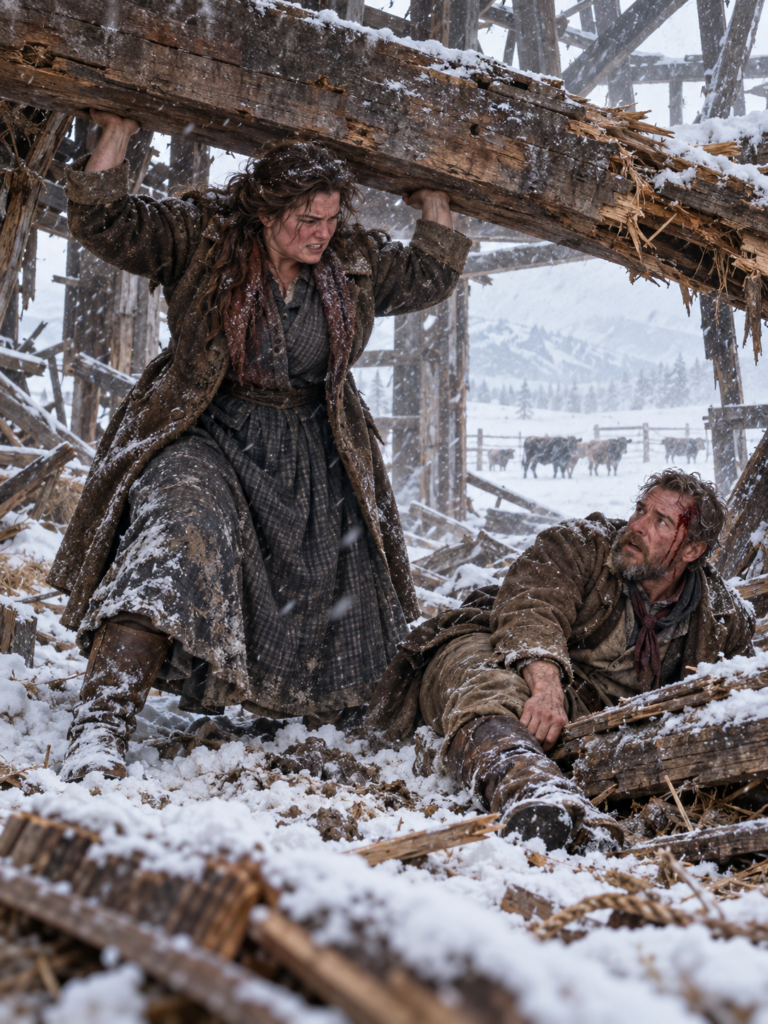
“I’m not asking because you saved me beneath the barn.”
Her throat tightened.
“I’m not asking because your feed work makes money.”
He stepped no closer.
“And I’m not asking because winter is coming and I want somebody in the kitchen.”
“Wise.”
“Mattie.”
“Continue.”
His mouth twitched.
“I’m asking because I love you.”
There it was.
Quiet.
No performance.
No crowd.
No agency letter.
No debt forcing urgency.
Mattie looked at him for a long time.
“I love you too.”
Jeb’s eyes closed for half a second.
Relief.
Then she continued.
“That is not yet an answer.”
His eyes opened.
“I know.”
Good.
She walked past him toward the barn door.
He followed at a respectful distance.
Outside, early snow had begun drifting across the yard.
Mattie stopped beneath the porch.
“If we marry, Broken Spur does not remain solely your life with me added to it.”
“No.”
“My feed work remains mine.”
“Yes.”
“The money from it remains under my control unless we agree otherwise.”
“Yes.”
“I want a legal arrangement written before the marriage.”
Jeb blinked.
Then nodded.
“All right.”
“I want the pantry room to remain my workroom.”
“Of course.”
“And I want a second desk in the main room.”
He looked confused.
“Why?”
“Because I am tired of moving your cattle ledgers when I need the table.”
He laughed.
“Done.”
Mattie studied him.
“You agree very quickly.”
“I had a year to learn.”
She let silence stretch.
Then she reached into her coat pocket.
The stage-office note was still there.
She unfolded it.
Jeb recognized it.
“The fare east.”
“Yes.”
Mattie tore it once.
Then stopped.
Jeb watched.
She looked at the two pieces.
And instead of throwing them away, she folded them again and returned them to her pocket.
His eyebrows rose.
“Keeping it?”
“Yes.”
“Why?”
“Because I want to remember that I stayed while leaving remained possible.”
Jeb’s eyes brightened.
Mattie extended her hand.
“Ask again.”
He stared at her.
Then took her hand carefully.
“Martha Higgins, would you marry me?”
She squeezed his fingers.
“Mattie.”
He smiled.
“Mattie Higgins, would you marry me?”
“Yes.”
He did not pull her into him.
He waited.
Mattie stepped forward herself.
When they kissed, the snow continued falling around Broken Spur exactly as it had on the afternoon she arrived.
But nearly everything else had changed.
They married in town several weeks later.
Nothing grand.
No romantic spectacle designed to prove a point.
The legal arrangements Mattie requested were written first.
Her earnings remained hers.
Her work remained recognized.
Broken Spur’s larger decisions became shared ones after marriage.
Jeb kept responsibility for work he knew best.
Mattie did the same.
Neither mistook partnership for sameness.
Years later, people in the region still told the story of the winter Mattie Higgins saved Broken Spur cattle with brewery grain.
Some told the barn story too.
In those versions the timber grew heavier every year.
Four hundred pounds became five.
Then six.
Mattie stopped correcting people eventually.
Jeb never did.
“She moved it enough,” he would say.
That became his favorite phrase.
Enough.
She did not need to become legendary.
She had needed room.
Respect.
Choice.
And work worth doing.
The old vat remained beneath the equipment-shed roof.
Its brass Higgins House emblem stayed polished.
Mattie never hid the letter her father left there.
She kept it with her records.
Not as proof that his deception had been right.
As proof that love and wrongdoing could occupy the same history, and that she was allowed to decide what to keep from both.
Rutherford never acquired Broken Spur.
He continued lending money elsewhere.
Some ranchers dealt with him.
Others became more cautious after hearing what had happened at Broken Spur.
Mattie never claimed more than she could prove.
Jeb learned to admire that about her.
One winter evening several years after her arrival, they stood in the rebuilt north barn while snow tapped lightly against the boards.
A young steer nosed through a trough filled with the feed mixture that had once saved the herd.
Jeb leaned on the rail.
“You remember the first time I found you making this?”
Mattie smiled.
“You said I had wasted three days.”
“I was an idiot.”
“You were under considerable strain.”
He glanced at her.
“That sounds suspiciously forgiving.”
“Do not worry. I still keep a complete list.”
“I assumed.”
He looked toward the heavy roof beam above them.
“And that storm?”
Mattie followed his gaze.
The rebuilt timber was secured with stronger bracing now.
“I remember.”
“You saved my life.”
Mattie looked at him.
“You changed yours afterward.”
Jeb considered that.
“Not alone.”
“No.”
She slipped her hand into his.
“Neither did I.”
They walked back toward the ranch house.
Two desks stood in the main room.
Her pantry room door still had its lock.
Her trunk remained beneath the window.
The note with the fare east stayed tucked inside it, faded at the folds but never discarded.
Not a threat.
Not an escape plan.
A reminder.
Broken Spur had once been a place Mattie was sent under other people’s arrangements.
It became home only after those arrangements stopped controlling her.
Jeb opened the front door.
Mattie entered first because she happened to reach it first.
Nothing more dramatic than that.
Behind them, cattle shifted quietly in the cold.
Inside, two sets of ledgers waited on two desks.
And beneath the equipment-shed roof, the old brewery mark remained fixed to the vat that had once carried someone else’s plan for Mattie’s future.
Now it carried only what she chose to make from it.


