
The Widowed Rancher Noticed His Cook Never Ate Lunch — Then He Saw Who She Saved It For.
Milbrook, Montana Territory, 1886.
Nathaniel Brooks noticed on a Wednesday.
Not the first Wednesday Rebecca Lane worked in his kitchen.
The 3rd.
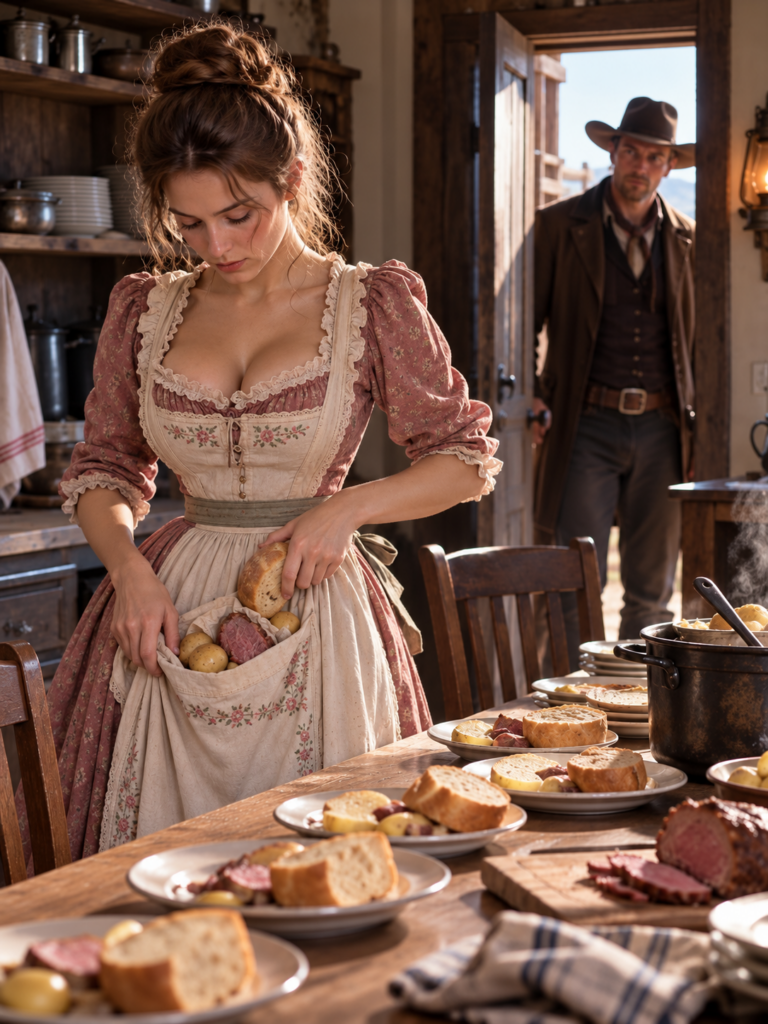
She had prepared lunch for 12 men.
She set her own plate at the far end of the table, served everyone else, and never touched it.
When Rebecca believed no one was watching, she wrapped bread, cold meat, and 3 boiled potatoes in a cloth.
She slipped the bundle into the large pocket of her apron with the practiced speed of someone who had done the same thing before.
Then she washed the plate she had never used, returned it to the shelf, and began washing the other dishes.
Nathaniel stood in the doorway of his office and considered what he had seen.
The obvious explanations came first.
Perhaps she was stealing food.
Possible, although the careful wrapping did not quite fit.
Perhaps she intended to eat it later.
Also possible, but that meant going hungry through the rest of the working day.
The 3rd explanation did not occur to him until supper.
Nathaniel sat alone at the end of the long table in a house that had been quiet for 2 years.
He thought about bread, cold meat, and 3 boiled potatoes wrapped in cloth.
He thought about where they might be going.
He went to bed without finding an answer.
Thursday morning, he rose intending to discover it.
Rebecca had been in Milbrook since the previous February.
Her parents died in December 1885.
Her mother went first, from pneumonia.
Her father died 11 days later.
The doctor called it heart failure.
Rebecca understood it differently.
To her, it seemed that her father had simply decided he did not want to continue without her mother.
Rebecca was 24.
Owen was 14.
Iris was 10.
Sam was 6.
The Lane family house belonged to their creditors almost from the moment both parents were gone.
Rebecca packed everything worth carrying in 2 trips, found the cheapest room available in Milbrook, and began searching for work.
She never considered separating the children.
It was not a decision she consciously made.
The possibility simply did not exist in her mind.
Owen, Iris, and Sam were her family.
Family was not something divided because circumstances became inconvenient.
Their rented room was in Mrs.
Garvey’s house at the south end of Milbrook.
There were 2 beds, a small stove, and an east-facing window that caught the morning light.
Mrs.
Garvey was practical.
She charged a fair amount.
She asked few questions.
And in November, she occasionally left additional firewood outside the door without explaining why.
In rural communities such as Milbrook, children who lost both parents did not always enter formal institutions.
Orphanages existed in some larger towns, but in isolated areas younger children were often absorbed into relatives’ or neighbors’ households, or, as in Rebecca’s case, cared for by an older sibling capable of working.
There was no organized support system comparable to what would exist generations later.
What existed was community, often informal and unspoken.
A landlord who left extra wood outside a door.
A reverend’s wife who passed along news about employment.
A storekeeper willing to extend credit longer than strict business sense might advise.
An eldest child quietly becoming the adult because nobody else could.
People often respected that responsibility without organizing assistance around it.
Help, when it came, usually began because an individual noticed.
Rebecca’s job at Brooks Ranch began through just such a chain.
The reverend’s wife heard from the blacksmith’s wife that the ranch cook had left for Billings.
Rebecca presented herself at Brooks Ranch on a Monday morning.
Nathaniel asked 4 practical questions about cooking.
She gave 4 practical answers.
“Can you start Wednesday?”
“Yes.”
She started Wednesday.
She cooked for 12 ranch hands and for a rancher who sat at the far end of the table and rarely made conversation.
During those first weeks, Rebecca observed that Nathaniel Brooks had arranged his life to require as little from it as possible.
He had run the ranch for 2 years without his wife.
Not alone in a practical sense.
He employed 12 hands.
His foreman, George, was the most reliable man Nathaniel had ever hired.
Seasonal labor came whenever the work demanded it.
Brooks Ranch operated because Nathaniel managed it with the methodical efficiency of someone who had decided that if the work continued, something important was still happening.
Clara Brooks died in October 1884.
She had been 32 years old.
She and Nathaniel had been married for 7 years.
Clara noticed things Nathaniel did not notice.
She said things he had not realized needed saying.
After her death, he did not replace any of that.
He filled the space with work.
The house became somewhere he slept, ate, and tried not to think about what had existed there before.
George respected him.
The ranch hands liked him.
Seasonal workers returned because Nathaniel paid fairly.
None of those arrangements required him to notice much beyond the work itself.
He had spent 2 years deliberately not noticing anything else.
Clara would have noticed.
She used to tell him, “You’re looking at the fence and not the field.”
Nathaniel had never entirely understood what she meant while she was alive.
He understood it better now, standing in his office doorway and watching Rebecca hide her uneaten lunch beneath her apron.
He followed her Thursday.
At least that was what happened in practice.
Nathaniel told himself he needed to inspect the south fence line.
Rebecca’s route toward Milbrook also went south.
Those 2 facts happened to overlap in a way he was not yet willing to examine too closely.
Rebecca walked quickly.
Purposefully.
The food bundle remained hidden in her apron.
She never looked behind her.
The south end of Milbrook was where the lowest rents could be found.
Rebecca turned toward Mrs.
Garvey’s place.
The door opened.
3 children came running.
The smallest was a boy of 6 or perhaps 7.
Rebecca caught him before he reached the step and lifted him onto her hip, saying something into his hair.
A girl of about 10 immediately began talking, apparently delivering an entire day’s worth of news at once.
The oldest was a boy of 14 with the posture of someone carrying more responsibility than his years had prepared him for.
He was moving firewood from the stack beside the door without anyone asking him.
Nathaniel remained across the street for a while.
This was not what he had expected.
He had expected an explanation simple enough to resolve the question of the wrapped food.
What stood before him was not simple.
But it made complete sense.
Rebecca spent all day feeding other people.
Then she brought her own food home to 3 children who ran to meet her……

Nathaniel reined in his horse under the shade of a cottonwood tree, thirty yards across the quiet street.
He watched Rebecca lower six-year-old Sam to the ground, pulling the carefully wrapped cloth bundle from her apron pocket with a small, triumphant smile.
Ten-year-old Iris clapped her hands, while fourteen-year-old Owen stood near the woodpile, watching his sister with an expression of fierce, protective gravity that Nathaniel recognized immediately.
It was the look of a person who had learned far too young that the world could collapse beneath your feet at any moment.
Nathaniel looked at the four of them—poor, tired, and utterly determined—and felt something long-buried stir beneath the heavy stone of his own grief.
For two years, he had been living like a man who had already died, merely keeping the ranch moving out of habit.
He had been looking at the fence and not the field.
He turned his horse back toward the ranch without making his presence known.
On Friday morning, Nathaniel arrived at the kitchen earlier than usual.
The sun had not yet risen over the eastern ridges, but the kitchen stove was already roaring, red embers glowing through the draft grate.
Rebecca was at the large pine worktable, her sleeves rolled past her elbows, kneading a massive trough of biscuit dough with methodical rhythm.
When she heard his boots on the floorboards, she paused, quickly wiping a dusted cheek with the back of her forearm.
“Mr.
Brooks,” she said, her voice even and polite.
“Breakfast will be ready in twenty minutes.
The hands are just coming in from the bunkhouse.”
Nathaniel didn’t sit down at the head of the table.
He walked over to the dry sink, picked up a clean wooden crate he had brought in from the pantry, and set it on the edge of her worktable.
Rebecca lowered her hands into the flour, watching him with a sudden, subtle tension in her shoulders.
From his pocket, Nathaniel pulled out a small black ledger and laid it beside the crate.
“I’m changing the cook’s terms, Miss Lane,” he said plainly.
Rebecca’s eyes darted from the ledger to his face.
“Have I done something unsatisfactory, sir?
The men—”
“The men are eating better than they have in two years,” Nathaniel interrupted quietly.
“That’s not the problem.”
He opened the crate.
Inside were four fresh pint jars of preserved peaches, two slabs of cured salt pork, a sack of stone-ground cornmeal, and a five-pound tin of white sugar—supplies from the ranch’s winter storehouse.
“Starting today,” Nathaniel said, keeping his voice matter-of-fact, “your compensation includes a family ration from the pantry every Friday.
In addition, you are expected to take home three complete meals from the kitchen every evening.”
Rebecca froze.
The colour drained slightly from her face, replaced by a sudden, hot flush at her collar.
She looked at the crate, then up at him, her chin lifting with a defensive sharpness that told him everything about how hard she had been fighting to keep her pride intact.
“I don’t require charity, Mr.
Brooks.
I earn my wage, and I—”
“It isn’t charity,” Nathaniel said, stepping back so he wasn’t crowding her.
“It’s an operational adjustment.
A cook who sits at my table and doesn’t eat her own food makes the hands nervous.
George asked me yesterday if the stew was poisoned because you wouldn’t touch it.”
It was a blatant lie—George hadn’t asked anything of the sort—but it gave her a way out that didn’t compromise her dignity.
Rebecca searched his eyes, looking for pity, condescension, or double meaning.
She found none.
Nathaniel’s face was as calm and unreadable as the mountain ridges behind the barn, but his eyes held an understanding that cut straight through her defenses.
She swallowed hard, her hand resting against the edge of the dough trough.
“You saw,” she whispered softly.
“I saw,” Nathaniel acknowledged.
“And I saw Owen stacking wood yesterday at Mrs.
Garvey’s.”
He paused, adjusting his hat.
“He’s fourteen?”
Rebecca nodded silently.
“The ranch needs a boy for the stock pens three afternoons a week,” Nathaniel said.
“Sorting feed, cleaning stalls, mending harnesses.
Pays fifty cents a day and includes supper at the main table.
If he’s willing to work, tell him to show up Monday at noon.
George will show him what to do.”
A heavy silence settled over the warm kitchen.
The coffee pot on the stove began to rattle softly, steam puffing from its spout.
Rebecca looked down at the crate of food, her hands trembling slightly against the white flour.
For ten months, she had been carrying the weight of three young lives entirely on her own shoulders, expecting no help, asking for no mercy, fighting the cold and the hunger day by agonizing day.
To have someone simply step forward, notice the burden, and offer to share the weight—without demanding anything in return—was a shock that nearly broke her composure.
She looked up, her dark eyes shiny with unshed tears, though her voice remained steady.
“He’s a good boy, Mr.
Brooks.
He works hard.”
“I know,” Nathaniel said.
“He looks like his sister.”
He turned toward the doorway, pausing with his hand on the frame.
“And Miss Lane?”
“Yes, Mr.
Brooks?”
“Eat your lunch today.
There’s plenty for everyone.”
By November, the arrangement had transformed the rhythm of the Brooks Ranch.
Owen arrived every Monday, Wednesday, and Friday like clockwork.
He was quiet, dutiful, and eager to learn.
George took a shine to the boy instantly, teaching him how to doctor a lame calf, how to throw a dally around a saddle horn, and how to read the weather coming off the peaks.
Within three weeks, the hollow look in Owen’s cheeks had filled out, replaced by the sturdy, broad-shouldered posture of a young man finding his footing in the world.
Little Iris and Sam began coming out on Saturdays when Rebecca did the weekly baking.
Nathaniel had cleared a corner of his office—a room that had been dark and locked for two years—and set up a small wooden table where Iris could practice her writing and Sam could draw pictures of the ranch horses with charcoal scraps from the forge.
For Nathaniel, the quiet, heavy gloom that had hung over the big house since Clara’s death began to dissipate, pushed back by the sound of small footsteps in the hallway and the rich, comforting scent of fresh bread drifting from the kitchen.
One sharp, cold afternoon in late November, the first heavy snowstorm of the season rolled down from the mountains, burying the valley under six inches of white powder by three o’clock.
Nathaniel walked into the kitchen after checking the stock shelters.
He found Rebecca standing by the window, watching the thickening snowfall with a worried expression.
“It’s going to drift by dark,” Nathaniel said, knocking the snow from his boots.
“The road to town will be impassable by nightfall.”
“I know,” Rebecca murmured, her fingers nervously pleating her apron.
“I need to get back to Mrs.
Garvey’s before the trail fills in.
Sam doesn’t have proper boots for this kind of snow, and—”
“I’ve already sent George with the big buckboard,” Nathaniel interrupted quietly.
Rebecca turned, surprised.
“What?”
“George took the team to town an hour ago,” Nathaniel said, leaning against the doorframe and pouring himself a cup of coffee.
“He’s picking up Iris and Sam, along with their carpetbags and Mrs.
Garvey’s rent money for the rest of the month.”
Rebecca stared at him, her lips parting in shock.
“Mr.
Brooks… what are you talking about?”
Nathaniel set his mug down on the table.
“The small house near the east pasture,” he said, his tone casual, though his heart was thumping against his ribs in a way he hadn’t felt in years.
“The one my brother lived in before he moved to Oregon.
It’s tight, dry, and has a good stone fireplace.
I had the hands haul two cords of oak up there yesterday and fire up the stove to warm the plaster.”
He looked directly into her eyes.
“You and the children are moving in today.”
Rebecca took a step back, her hand flying to her chest.
“Nathaniel… no.
I can’t accept that.
That’s… that’s too much.
I am your cook, not a charity case—”
“It isn’t charity, Rebecca!”
Nathaniel said, his voice rising slightly, cutting through her protest with an intensity that made her stop short.
He walked over to the pine table, standing across from her, his face earnest and exposed in a way it hadn’t been in a long time.
“Look at this house,” Nathaniel said softly, gesturing toward the warm, living kitchen around them.
“Two years ago, I locked myself in my grief.
I thought my life was finished.
I thought the only thing left for me to do was manage fence lines until I died.”
He reached across the table, placing his large, calloused hand flat on the wood, inches from hers.
“You walked into this kitchen, carrying the weight of three children on your back, refusing to let circumstances break you.
You brought life back into this house.
You brought noise, and hope, and a reason to look at the field instead of the fence.”
He took a deep breath, his grey eyes searching hers.
“The house by the east pasture is sitting empty.
You and those children belong here, on this land, where you’re safe, warm, and taken care of.
Not because I pity you… but because I can’t bear the thought of you walking away into the cold every night.”
Rebecca looked at his hand on the table.
She looked at his face—at the honest, steady, unyielding strength of a man who had suffered deeply, but had chosen to open his heart again anyway.
Slowly, her own trembling hand slid across the pine wood, her fingers gently covering his.
A soft, watery smile broke across her lips, lighting up her face in a way Nathaniel knew he would never forget for the rest of his life.
“They’re going to track mud into the hallway,” she whispered, a tear finally slipping down her cheek.
Nathaniel’s hand turned over, his fingers wrapping firmly around hers.
“Let them,” he said softly, a genuine, warm smile breaking through his beard for the first time in two years.
“I’ll fetch the mop.”

