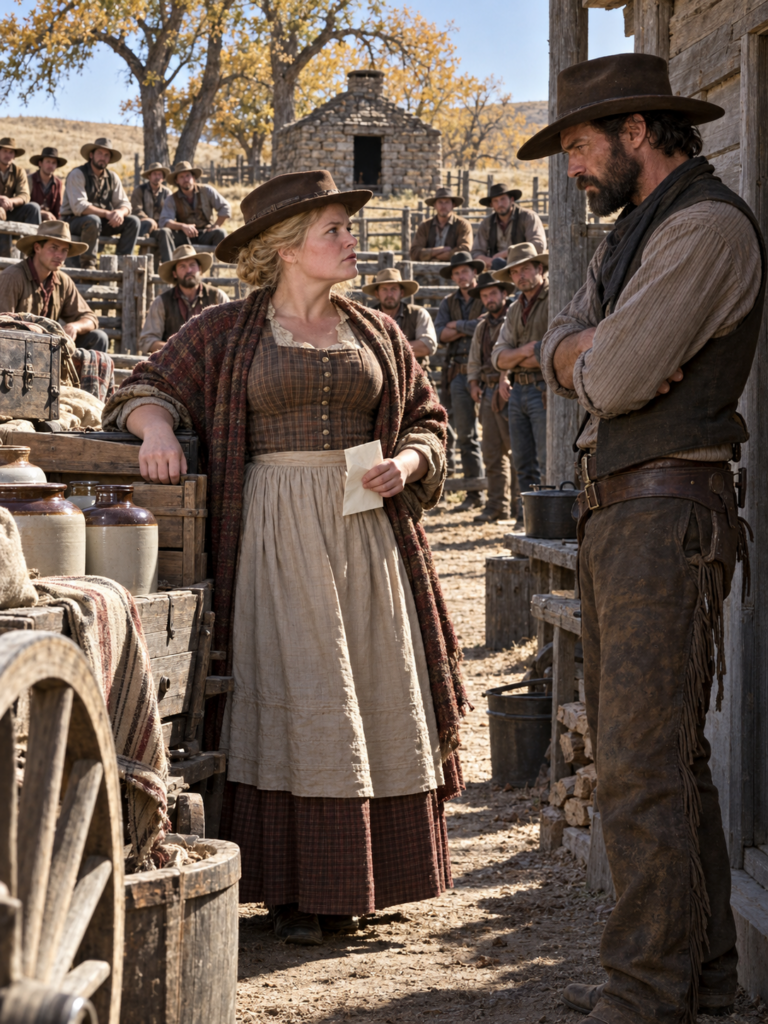
Ansel’s eyes fell immediately upon the green book in Britta’s hand.
He stopped so abruptly that the heel of his boot scraped against the cookhouse step.
“Where did you get that?”
“From the provisions box Mr. Ober brought me.”
He looked at the worn cover.
“That was Clara’s.”
“I know.”
For several seconds neither spoke.
Then Ansel held out his hand.
Britta offered him the book.
He did not take it.
Instead, he turned toward the smokehouse beneath the trees.
“What have you been doing in there?”
“Examining what can still be used.”
“That building is closed.”
“Your foreman gave me written permission.”
“I didn’t.”
Britta took the employment letter from her pocket.
“Then you and Mr. Ober need to settle that between yourselves.”
Ansel looked at the paper.
It carried Lyall’s signature, the agreed monthly wages, and the promise of access to the smokehouse.
He could have dismissed her.
Both knew it.
But he had already heard the men talking about supper. He had heard Moses withdraw his notice. And he had eaten the first decent meal the cookhouse had produced in months.
“What do you want with it?” he asked.
“A business.”
He looked at her sharply.
Britta gestured toward the creek.
“There are hog tracks in the brush. Your old pens need repair, but the smokehouse itself is sound. There is corn in your crib and good salt in the barrels.”
“Those hogs were Clara’s.”
“Then somebody ought to see what became of them.”
Ansel’s face hardened.
“They went wild after she died.”
“They’re still on your land.”
“They won’t be easy to catch.”
“I don’t intend to chase them.”
He studied her, uncertain whether she was making fun of him.
Britta explained her plan.
Feed the hogs gradually into the old lot. Repair the fences. Fatten the animals before winter. Preserve enough pork for the crew and sell the rest.
“Your wife kept excellent accounts,” she said. “She sold cured meat to neighboring outfits and the Larkin hotel.”
Ansel looked again at the book.
For one moment his expression softened.
“She was good at it.”
“Better than good.”
He swallowed.
Then his eyes moved to the notebook tucked beneath Britta’s arm.
“What’s that?”
“My figures.”
“On the hogs?”
“On several things.”
“Like what?”
Britta thought of the six-thousand-dollar loan.
She thought of the nine hundred dollars withheld.
Then she remembered the empty Omaha shop and the way people had dismissed her father’s suspicions until there was nothing left to save.
“Things worth checking before I speak of them.”
Ansel frowned.
“I don’t care for secrets on my ranch.”
“Neither do I, Mr. Teague.”
Their eyes met.
The words hung between them.
Then Ansel looked toward the yard.
“You’ve got nine days before the wagon returns.”
“Hogs won’t be ready in nine days.”
“That’s your difficulty.”
“Your fall shipping is near, isn’t it?”
“October twenty-sixth.”
“Then keep me through the drive. I’ll feed your men all the way to the railroad. When we return, you can decide whether you still want me gone.”
“And the hogs?”
“I’ll do what work I can without taking your cowboys away from the herd.”
He considered this.
At last he took the employment paper, turned it over, and wrote permission for her to remain through shipping and use the old hog lot and corn crib.
Britta read every word.
Only then did she put it away.
“Thank you.”
Ansel nodded once.
But as he turned, she spoke again.
“Mr. Teague?”
He stopped.
“Your wife left a fine smokehouse.”
His shoulders tightened.
“I know.”
“I don’t intend to pretend she never worked there.”
He turned slowly.
Britta held Clara’s book against her chest.
“I intend to respect what she built.”
For the first time, Ansel looked at her without the impatience of a man waiting for a stranger to leave.
Then he walked toward the barn.
***
That evening Britta stood inside the abandoned smokehouse.
She had cleaned the table and loosened the rusted hooks.
On a shelf sat the stoneware crocks she had brought from Omaha.
She opened her notebook.
The old loan remained there in neat figures.
Six thousand owed.
Fifty-one hundred received.
Nine hundred missing.
She knew the lender’s name now.
Horus Bellamy of Larkin.
She also knew Ansel owed much more than he could pay from one autumn cattle shipment.
But figures alone would not save him.
She needed the original note, the bank records, and the courage of a man who had stopped looking closely at his own affairs.
She closed her notebook and lifted a hammer from the worktable.
Outside, the old hog-lot gate sagged on its hinges.
She set the hammer against the loose peg.
The first blow drove it deeper into the timber.
The second struck cleanly.
On the third, she heard a horse approaching.
Ansel had returned.
He stopped beside the fence and looked at the repairs.
Britta did not put down the hammer.
“If you want me gone,” she said, “you’ll have to tell me before I finish this gate.”
Ansel dismounted.
He looked at the rotten rail, the fresh peg, and the woman who had traveled 260 miles to find a future.
Then he reached for the other end of the timber.
“Hold it steady.”
Britta braced the rail.
And together they lifted it back into place.
The rail settled into its notch with a dull wooden thud.
Britta kept both hands beneath it while Ansel fitted the last peg.
For a moment they worked without speaking.
Then he stepped away and examined the gate.
“That’ll hold.”
“It will if the next three rails do.”
Ansel looked toward the remaining damage.
“You always have another task waiting?”
“Usually several.”
Something resembling amusement crossed his face.
Then it disappeared.
He set the hammer on the fence.
“Lyall can spare you nails.”
“Thank you.”
“And don’t let those hogs eat all the winter corn.”
“I’ve written down what they’ll need.”
“Of course you have.”
He returned to his horse.
Britta watched him ride toward the house beneath the hackberries.
She wondered how long a man could remain surrounded by the work his wife had loved and still refuse to look at it.
Then she returned to the fence.
She had a business to build.
***
By the ninth evening, thirty hogs had wandered into the repaired lot.
Britta had drawn them there with small, regular feedings of corn.
Kit watched from the top rail as the old torn-eared barrow entered last.
She swung the gate shut.
Kit gave a triumphant shout.
“Thirty!”
“Quiet,” Britta said. “You’ll frighten our guests.”
They laughed together.
At noon the following day, the freight wagon came back through the ranch.
Its driver looked toward Britta.
She showed him the revised agreement.
He continued toward Larkin without her.
Ansel stood in the barn doorway while the wagon disappeared.
Britta saw him there.
Neither mentioned it.
The first cold night came soon afterward.
With Lyall’s assistance, Britta began preparing the first pork from the hog lot.
She used her grandmother’s sugar-curing method, measuring salt, brown sugar, and seasoning with the care of someone whose reputation would rest on every finished piece.
For days she tended the meat, checked its condition, and prepared the old smokehouse for use.
When it was ready, she lit the pit.
Corn-cob smoke rose through the chimney beneath the hackberry branches.
Ansel saw it while returning from the north range.
He stopped his horse on the hill.
For nearly two years, that chimney had been cold.
Clara had designed it herself.
He remembered standing beside her while she argued that the first chimney he built would never draw properly.
She had been right.
She had usually been right about such things.
Now smoke was rising again.
He watched until it drifted into the darkening sky.
Then he rode home.
He did not enter the smokehouse that evening.
***
On October twelfth, Horus Bellamy arrived at Hackberry in a black buggy with yellow wheels.
Beside him rode Virgil Stroud, the ranch’s range boss.
Bellamy wore a fine gray suit and carried himself with the easy confidence of a man who held other people’s futures in his desk drawers.
Britta served him coffee.
He praised it generously.
“Where did Teague find a cook like you?”
“Omaha.”
Bellamy smiled.
“I’ve done business there.”
Britta remembered her father’s shop.
She kept her expression pleasant.
“Have you?”
“A little.”
Through the window, Bellamy noticed the hog lot.
“Clara’s animals?”
“Their descendants,” Britta answered.
He laughed.
“Well, Ansel. Seems your new cook has taken a fancy to the old ways.”
Ansel said nothing.
After supper, Bellamy, Stroud, and Ansel spent an hour in the ranch house.
When the visitors left, Bellamy was smiling.
Ansel was not.
Late that evening he entered the cookhouse carrying a statement.
Britta was preparing dough for the morning biscuits.
“May I trouble you for coffee?” he asked.
She poured him a cup.
He sat at the table and pushed the paper toward her.
“Bellamy says he may not renew.”
Britta wiped her hands and read it.
Principal: six thousand dollars.
Interest to December first: four hundred.
Total due: sixty-four hundred.
Then she reached the final line.
Her stomach tightened.
“Mr. Teague, this includes your home section.”
Ansel frowned.
“The cattle secure the note.”
“Not according to this.”
She pointed.
“And the hay meadows.”
He took the paper and read.
Once.
Twice.
Then his face changed.
“Virgil brought me the renewal in April.”
Britta waited.
“He said it was the same as the old agreement. I signed it while sitting on my horse.”
“Did you read it?”
“No.”
Outside, wind moved through the bare branches.
Ansel lowered his head.
Behind his house stood Clara’s grave.
If Bellamy took the home section, he would lose the land around it too.
Britta spoke gently.
“We should see the original papers.”
He rose.
For a moment she thought he might say something more.
Instead, he carried the statement outside.
The light in his house burned until morning.
***
The roundup began on October twentieth.
Britta traveled with the chuck wagon, feeding men who spent long days gathering cattle across the rolling Sand Hills.
On the second evening, she served the sugar-cured bacon from the first smoking.
The men approached the wagon by smell alone.
Ned Rusk took one bite and stopped.
He chewed slowly.
Then he removed his hat.
“My mother used to cure bacon like this.”
Britta looked at him.
“Did she?”
“Back in Missouri.”
His voice roughened.
“I’d forgotten what it tasted like.”
Nobody mocked him.
When he finished eating, he came to Britta.
“Those hogs of yours need tending?”
“Yes.”
“Then I’ll help.”
She studied the man who had laughed at her arrival.
“Even if it’s pig work?”
Ned shifted uncomfortably.
“Especially then.”
Later, Ansel ate beside the campfire.
He finished his portion and looked toward Britta.
“Clara always said the smoke ought to take its time.”
“She wrote the same thing in her book.”
He looked into the coals.
“I should have listened to her about a great many things.”
It was the first time he had mentioned his wife without withdrawing immediately afterward.
Britta sat beside him.
“She left useful knowledge behind.”
“She did.”
“And you haven’t lost it.”
He looked at her.
For once, he seemed willing to believe her.
***
The cattle reached Larkin after four days on the trail.
The market was poor.
Ansel sold 110 steers for less than he had expected.
After paying the crew their outstanding wages, he had only $1,165.
The mortgage demanded $6,400.
Britta saw the calculation forming behind his eyes.
He had no intention of asking for pity.
He had almost no hope of finding the money.
That afternoon she visited Dela Frick, the woman who operated the freight service.
Dela listened while Britta described the loan without naming its borrower.
“Bellamy,” Dela said immediately.
Britta looked up.
“You know him?”
“He ruined my husband’s outfit with the same sort of charges.”
Dela introduced her to Edwin Marsh, a former clerk who had worked in Bellamy’s office.
Edwin described a second record book in which Bellamy tracked money retained from borrowers.
Britta listened carefully.
“Would you testify?”
Edwin looked frightened.
“Under oath, yes.”
She thanked him.
Then she returned to Ansel.
She found him sitting beside the empty cattle pens.
Without ceremony, she placed Clara’s green book in his hands.
“Read the last pages.”
Ansel stared at his wife’s handwriting.
He turned one page.
Then another.
At last he spoke.
“She warned me.”
Britta sat beside him.
“About the loan?”
“About borrowing at all. She wanted us to wait before expanding the herd.”
He pressed his fingers against the book.
“I was proud. I wouldn’t listen.”
His voice grew quieter.
“When she asked about the missing money, I told her it was men’s business.”
He closed his eyes.
“Then she fell ill. Six days later she was gone.”
Britta waited while he fought to steady himself.
“I never read her accounts again.”
“She was trying to protect you.”
“I know that now.”
He looked at her.
“What do we do?”
Britta took out her notebook.
“First, we prove what Bellamy actually gave you.”
***
At the Stockman’s Bank, the cashier confirmed the original deposit.
Five thousand one hundred dollars.
Not six thousand.
At the courthouse, they obtained copies of the recorded mortgage and its later renewal.
Virgil Stroud had witnessed the paper that added the home section and hay meadows.
The figures matched Clara’s suspicions.
But they needed legal advice.
They took the records to Orin Pickett, a lawyer recommended by Dela.
Pickett examined them carefully.
“If the unlawful charges can be established, you may be able to challenge the debt,” he said.
Britta showed him her calculations.
He checked them.
Then he looked up.
“You’ve done good work, Miss Lund.”
She accepted the compliment without smiling.
“What is our difficulty?”
“Proof of Bellamy’s intention. The lender will call the withheld money a customary commission.”
Britta thought of Edwin Marsh.
“He kept another book.”
Pickett leaned forward.
“Then I want to speak to that clerk.”
Edwin agreed to make a sworn statement.
He produced a small diary containing entries copied from Bellamy’s own records.
Among them was the original nine-hundred-dollar deduction from Ansel’s loan.
Other documents revealed that Bellamy had been corresponding with a land company interested in the Hackberry’s spring and meadows.
And one letter named Virgil Stroud as his man inside the ranch.
Ansel read it in silence.
Then he turned toward Britta.
“You were right about him.”
“Yes.”
He looked at the lawyer.
“What can we lawfully offer to settle this?”
Pickett reviewed the payments, the withheld sums, and the available defense.
His proposed tender was $2,400.
Enough, he believed, to give them a strong position if Bellamy refused and the matter went before a judge.
But it had to be ready by December first.
Ansel had $1,165.
The difference was still enormous.
Britta looked down at her notebook.
Then she told them about Leland Ashby.
The railroad’s superintendent of eating houses.
She had already given him a sample of her sugar-cured bacon.
He wanted eight thousand pounds for the winter, provided the ranch could meet his requirements.
His proposed advance was $1,240.
Ansel stared.
“Eight thousand pounds?”
“Yes.”
“Can you make that much?”
“With the hogs we’ve got, and more from the homesteaders.”
“How many more?”
“About sixty.”
He sat very still.
Then he said, “Tell me what you need.”
Britta opened her notebook.
“Hogs, corn, working space, and men willing to help.”
Ansel nodded.
“You’ll have them.”
For the first time, the Hackberry’s survival no longer depended only on a cattle sale.
It depended upon a woman who had arrived with six stoneware crocks and a plan nobody had bothered to hear.
***
By early November, the hog lot held ninety-eight animals.
Britta and the crew had traded unproductive cattle for hogs from neighboring homesteaders.
She kept breeding animals back and prepared the rest for winter curing.
The first hard freeze arrived on November fourth.
She had arranged the work carefully.
But when she went to the bunkhouse at dawn, the men were gone.
Virgil Stroud had sent them to the north hay camp.
Without Ansel’s authority.
The season’s cold weather could not be relied upon to last.
Britta looked at Lyall.
“Then we begin.”
He put on his coat.
“Together.”
They started the difficult work themselves.
Kit returned first, having turned his horse around rather than obey Stroud.
Ned and Moses followed.
By the second day, more men had come back.
The crew worked through the cold until the processing was complete.
Afterward, Britta began the exhausting work of curing and storing the meat.
She measured and recorded every batch.
She tended the smokehouse late into the night.
When her hands ached too badly to close, she rested them briefly against the table and continued.
The ranch had become her livelihood.
And she intended to keep her word.
***
On November ninth, Bellamy returned for supper with Stroud.
He praised the meal.
Then Stroud began accusing Britta of interfering with private financial affairs.
Bellamy expressed concern that the rancher’s business was being discussed in town.
Seventeen men listened.
Britta stood beside the table holding the coffee pot.
Ansel looked toward Bellamy.
He thought of the mortgage.
The deadline.
The land where Clara was buried.
And fear made his decision for him.
“Miss Lund handles the cooking,” he said. “She has no authority to speak for the ranch.”
The cookhouse fell silent.
Britta placed the coffee pot on the table.
She untied her apron.
Folded it carefully.
And walked outside.
Ansel found her in the smokehouse later that night.
She was working beneath the lantern.
“I’m trying to save this place,” he began.
“So am I.”
“Bellamy could refuse to deal with us.”
“He already intends to take your land.”
Ansel said nothing.
Britta faced him.
“You let those men shame me in front of your crew because you were afraid to contradict them.”
He looked down.
“I was.”
“I won’t accept that.”
“I know.”
“No, Mr. Teague. I don’t believe you do.”
She placed the ledger between them.
“My father lost his business because he kept trusting a man who smiled while robbing him.”
Ansel’s expression changed.
Britta continued.
“I’ll finish the work I promised. But I will not let another man decide when I’m allowed to speak.”
Ansel looked toward the door.
Then back at her.
At last he nodded.
“I owe you an apology.”
“Then give it where you wronged me.”
He stood silently for a long moment.
Then he removed his hat.
“Tomorrow morning.”
Britta turned back to the meat.
“And close the door, please. You’re letting the cold air in.”
He obeyed.
The following morning he rose before the crew, entered the cookhouse, and stood at the head of the table.
Every cowboy watched.
Britta turned from the range.
Ansel looked directly at her.
“Yesterday I said Miss Lund had no right to speak for this ranch.”
He paused.
“I was wrong.”
The room remained silent.
“She’s found what I refused to read. She’s put the smokehouse to work. She’s fed this crew and shown me how to fight for the place I’ve nearly lost.”
He swallowed.
“I should have stood beside her when those men accused her. Instead I kept quiet.”
Britta watched him steadily.
“I’m sorry, Miss Lund.”
He held her gaze.
“And I won’t do it again.”
Nobody laughed.
Nobody looked away.
Britta nodded.
“Thank you, Mr. Teague.”
Ansel sat down.
For the first time since her arrival, she believed he understood that respect meant very little unless it survived a difficult moment.
Then Lyall entered carrying another message from Larkin.
It concerned the railroad bacon contract.
Britta unfolded the paper.
Her face grew pale.
Someone had told Ashby the Hackberry hogs were dying of disease.
The railroad was reconsidering its order.
Without that payment, there would be no money to challenge Bellamy.
And December first was only days away.
Britta read the message again.
Then she laid it in front of Ansel.
“Whoever sent this knows precisely what that contract means to us.”
Ansel scanned the letter.
“Does Ashby believe it?”
“He hasn’t canceled yet. But he wants proof that the meat is sound.”
Lyall stepped closer.
“There’s not a sick hog on the place.”
“I know,” Britta said. “And we’ll show him.”
Ansel looked toward the window.
Beyond the cookhouse, the smokehouse chimney sent a thin line of blue into the November sky.
“Can you arrange an inspection?”
“I can invite him here.”
“And his own doctor?”
“Especially his own doctor.”
Ansel nodded.
“Write the letter. I’ll sign it.”
Britta looked at him.
“You’ll put your name to the curing business?”
“Your name belongs there too.”
He pulled out a chair.
“Let’s write it together.”
They spent the evening preparing the invitation.
Ashby could examine the surviving livestock, the curing rooms, the storage spaces, and the finished products.
He could bring a medical man of his own choosing.
He could question anyone employed on the ranch.
Britta insisted upon that last condition.
She would rather lose the agreement honestly than have it secured through concealment.
Ansel watched her write.
“You’re certain?”
“Yes.”
“Even with Bellamy waiting?”
“Especially with Bellamy waiting.”
When the letter was complete, they signed it.
The freight driver carried it to Larkin the following morning.
For three days, they continued working without knowing whether Ashby would come.
Then a reply arrived.
He would visit on Thanksgiving Day.
And he would bring Dr. Emory Platt.
Britta folded the message into her notebook.
Kit, hovering near the door, asked whether that was good news.
“It means we still have a chance.”
She looked toward the smokehouse.
“And we intend to use it.”
***
Before the inspection, Ansel had one more matter to settle.
He sent for Virgil Stroud.
The range boss came into the yard at dusk, walking with his usual easy confidence.
Ned, Moses, Kit, and Lyall stood nearby.
Ansel held up the renewed mortgage.
“You brought me this agreement in April.”
“I did.”
“You told me nothing important had changed.”
“That was my understanding.”
“My home section was added.”
Stroud shrugged.
“You signed it.”
Ansel’s jaw tightened.
Then he showed him the correspondence linking Bellamy to the land company.
“And Bellamy calls you his man.”
Stroud glanced at the paper.
“Some clerk’s notion.”
“Then explain the report sent to the railroad concerning diseased hogs.”
For the first time, Stroud’s confidence faltered.
Ansel continued.
“The report was false. And you had every reason to keep the curing trade from succeeding.”
Stroud looked around the yard.
Nobody defended him.
“You’re making a mistake, Ansel.”
“I made the mistake when I let you handle business I should have examined myself.”
He folded the papers.
“You’re dismissed. Your wages will be paid through today. Take your own belongings and leave the ranch’s horses behind.”
Stroud stared at him.
“Bellamy will take this place before Christmas.”
“Maybe,” Ansel answered.
“But you’ll have no part in running it.”
Stroud left before midnight.
Britta watched from the cookhouse as his horse disappeared into the northern darkness.
She did not feel triumphant.
There was still a deadline.
There was still a lender ready to seize the ranch.
And nearly everything they had worked for hung upon a single railroad order.
But one thing had changed.
Ansel Teague had stopped letting fear choose his loyalties.
***
The smokehouse required steady tending.
Britta could not be awake every hour, and the men helped wherever their ranch work permitted.
They brought corn cobs.
Carried water.
Moved supplies.
Watched the chimney.
One night, Britta woke and realized she had overslept her usual fire check.
She dressed quickly and hurried through the cold.
Inside the smokehouse, she found Ansel sitting beside the pit.
He was feeding a few cobs onto the low coals.
The light warmed his weathered face.
“You should be asleep,” she said.
“So should you.”
She checked the fire.
The smoke was clean and steady.
“Who showed you how to manage it?”
“Kit.”
“He’s been paying attention.”
“Apparently.”
Britta sat across from him.
Above them, the hanging meat rested in the gentle smoke.
For several minutes, neither spoke.
Then Ansel said, “Clara used to sit here at night.”
Britta looked up.
“Did she?”
“With her accounts beside her. She could tell what the smoke was doing by the smell before she opened the door.”
“She must have been remarkable.”
“She was.”
He rested his elbows on his knees.
“I thought if I kept this place shut, I wouldn’t have to think about losing her.”
Britta watched the coals settle.
“Did it work?”
“No.”
He looked around the room.
“It only meant I lost this too.”
Britta folded her hands.
“My father had a provisions shop in Omaha. After the auction, I couldn’t bear to walk down the street where it stood.”
Ansel listened.
“For a long time I believed beginning again would mean admitting everything we had built was gone.”
“And now?”
“Now I think the work itself is how I keep him with me.”
Ansel glanced toward Clara’s old worktable.
Britta continued.
“Your wife built something good. It was worth preserving. But you don’t have to leave it empty to prove she mattered.”
He looked at her for a long time.
“No,” he said finally. “I suppose I don’t.”
He picked up another corn cob.
“Is this the right amount?”
Britta smiled.
“A little less.”
He broke it in half.
“Like that?”
“Exactly.”
He placed it on the coals.
Outside, the wind moved gently through the bare hackberry branches.
Inside, they kept the fire alive together.
***
Thanksgiving morning brought light snow.
The Nebraska hills stretched pale and silent beneath the winter sky.
Britta was preparing supper when the first wagon appeared.
Leland Ashby arrived with Dr. Platt.
Dela Frick followed with Edwin Marsh, Orin Pickett, and the county clerk, Aldis Finch.
Several homesteading families who had traded hogs to the Hackberry came as well.
Britta had invited them because their work was part of what the smokehouse represented.
The business did not belong to one man’s generosity.
It had been built through the labor and trade of people along the Calamus River.
Ashby stepped down from his buggy.
“Miss Lund.”
“Mr. Ashby.”
He looked toward the smoking chimney.
“You’ve been busy.”
“We have.”
Dr. Platt asked to see the livestock first.
Britta led him to the hog lot.
The breeding animals were healthy and active.
He examined them carefully, questioned her about their care, and continued to the smokehouse.
There he inspected the curing rooms, storage areas, cleanliness, and finished meat.
Britta answered every question.
When he finished, he turned toward Ashby.
“I find no evidence supporting the report of disease.”
Ashby looked at Britta.
“Then I’d like to taste what you’ve been making.”
“That’s why you’re here.”
She led them toward the cookhouse.
***
Seventeen cowboys sat along one side of the tables.
The visitors and homesteading families filled the other.
Outside, snow collected along the window ledges.
Inside, the room smelled of roast ham, beans, biscuits, onions, coffee, and the rich sweetness of carefully smoked bacon.
Britta had chosen familiar food.
The same sort of supper she had prepared on the evening Ansel tried to send her away.
Only this time, the bacon was hers.
Not salvaged from an old barrel.
Not bought from a distant supplier.
Raised, cured, and smoked on the Hackberry.
Ashby took the first taste.
He chewed thoughtfully.
Then he reached for another piece.
Britta stood near the end of the table.
“What do you think?”
Ashby considered the question.
“I think,” he said, “that every eating house on my line will want to know why the bacon from Omaha never tastes like this.”
Ned Rusk grinned into his plate.
Kit nearly dropped his fork.
Ansel did not move.
He was watching Britta.
Ashby continued.
“Eight thousand pounds. Delivery through the winter. Fifteen and one-half cents a pound.”
He took a folded contract from his coat.
“Payment on signing, after a satisfactory inspection. You’ve met the condition.”
Britta looked at the document.
The advance would be $1,240.
Enough, when added to Ansel’s remaining cattle proceeds, to make the settlement Pickett had calculated.
But she had one condition.
“The bacon goes out under my name.”
Ashby raised his eyebrows.
“Your name?”
“Lund’s Sugar-Cured. Hackberry Ranch.”
She pointed to the space for product identification.
“On the packages and in the eating houses.”
He considered it.
Then he smiled.
“Very well. If people begin asking for it by name, I’ll know whom to blame.”
Britta held out her hand.
“I expect they will.”
Ashby added the provision.
He signed.
Ansel signed for the ranch.
Britta signed for the curing operation.
The witnesses followed.
Then Ashby handed over the bank draft.
Britta held the paper in both hands.
For six years she had saved and planned, hoping one day to build a business under her own name.
Now a major railroad buyer had agreed to carry that name.
She did not speak immediately.
Ansel stood beside her.
“Are you all right?”
She looked at him.
“I think so.”
He smiled.
“Good.”
She handed him the draft for the ranch’s settlement fund, with the transaction recorded between them.
“Five days,” she said.
Ansel placed it safely in his vest.
“Five days.”
There was no guarantee of victory.
Bellamy still held the recorded mortgage.
But now they had the money to make their case.
And this time they would face him with witnesses, documents, and a lawyer.
***
December first arrived bitterly cold.
Horus Bellamy sat in his office above the Larkin bank.
On his desk lay the prepared notice for the sale of the Hackberry’s cattle and land.
He was expecting failure.
He had calculated Ansel’s likely cattle receipts.
He had heard the rumors of difficulty at the ranch.
He knew the home section and spring were desirable to the land company whose representatives would arrive after the new year.
He had no reason to imagine that a woman hired to cook biscuits could interfere with his plans.
At ten o’clock, the office door opened.
Orin Pickett entered.
Behind him came Ansel and Britta.
Then the bank cashier.
The county clerk.
Dela Frick.
And Edwin Marsh.
Bellamy lowered his feet from the stove fender.
“Ansel. This is unexpected.”
Pickett placed a leather satchel on the desk.
“Not entirely, Mr. Bellamy. Your note falls due today.”
He opened the satchel.
Inside were banknotes and gold.
He counted out $2,400.
Bellamy laughed.
“That is considerably less than the amount owed.”
“It is the amount my clients tender in settlement.”
“The note calls for $6,400.”
Pickett nodded.
“It does.”
He laid out the original mortgage.
Then the bank’s record showing that only $5,100 had reached Ansel’s account.
Then the receipts for withheld charges.
Then Edwin’s sworn statement and diary.
Bellamy’s smile began to fade.
Pickett explained their legal position.
The money retained at the beginning and again on renewal, when considered with the interest demanded, gave them a substantial basis to challenge the debt.
The amount already paid had to be accounted for.
The remaining sum being offered was supported by their calculations.
Bellamy could accept it and release the security.
Or he could refuse and face a legal challenge supported by his own records.
Bellamy looked toward Edwin.
“You kept copies?”
Edwin’s voice trembled.
“Yes, sir.”
Dela stepped forward.
“And there are other borrowers whose accounts deserve examination.”
She named several outfits affected by similar charges.
Bellamy’s face hardened.
Pickett placed the prepared mortgage releases beside the money.
“My clients are prepared to litigate if necessary.”
For a long time, Bellamy sat without speaking.
Outside, wagons moved along the snowy street.
Ansel stood beside Britta, looking steadily at the man who had nearly taken everything from him.
At last Bellamy reached for the pen.
He signed the satisfaction of the cattle mortgage.
Then the release of the real estate mortgage.
Aldis Finch took the documents immediately to the courthouse.
Before noon, they were recorded.
The Hackberry Ranch was free of Bellamy’s claim.
Its cattle remained Ansel’s.
Its spring and hay meadows were secure.
And Clara’s grave would remain beneath the trees behind the house she had loved.
***
On the courthouse steps, Ansel stood beside Britta while the wind pushed fine snow against their coats.
Neither spoke at first.
Then Britta opened her gloved hand.
A five-dollar gold piece lay on her palm.
Ansel looked at it.
“What’s that?”
“What was left after the settlement.”
He stared.
She smiled faintly.
“I’d like to open a new account.”
“In whose name?”
“Lund’s Sugar-Cured.”
Ansel looked toward the courthouse door.
Then back at her.
“I think we should discuss your future at the Hackberry.”
Britta closed her fingers around the coin.
“Yes,” she said.
“I think we should.”
***
The following evening, the seventeen cowboys gathered in the cookhouse after supper.
Britta sat at the long table.
Ansel placed a document before her.
He had asked Pickett to prepare new terms.
“Forty dollars a month,” he said, “with a third of the curing trade’s clear profits.”
Britta read the agreement.
Then she took out her pencil.
“No wages.”
The room went silent.
Ansel looked up.
“What do you propose?”
“A partnership.”
She began explaining.
Half the curing business’s net profit, calculated quarterly.
A ten-year lease covering the smokehouse, hog lot, and washhouse at one dollar a year.
The ranch would sell hogs and corn to the curing trade at ordinary market prices.
She would maintain separate accounts.
Her business would not be made responsible for the ranch’s obligations.
The ranch would not carry hers.
Every shipment would bear her trade name.
When she finished, she placed the pencil on the paper.
“That’s what I want.”
Ansel read it.
Slowly.
Then he looked at her.
“Half?”
“Half.”
Lyall cleared his throat.
“Take the bargain, boss.”
Ned grinned.
“Before she asks for a share of the cattle.”
Laughter moved around the table.
Ansel ignored it.
He crossed out the original percentage.
Wrote one half.
Then signed.
Britta took the pen and signed beneath him.
For a moment, she looked down at the document.
It was not an employment arrangement.
It was the beginning of the business she had been planning since Omaha.
Something she controlled.
Something she could build.
Something no man could take from her merely by deciding she was no longer welcome in his kitchen.
She held the agreement close.
“Thank you, Ansel.”
He looked surprised to hear his first name.
“You’re welcome, Britta.”
It was a small moment.
But both knew something had changed.
***
That night the cookhouse emptied slowly.
Lyall remained near the stove with his coffee while the last men drifted toward the bunkhouse.
Ansel carried a crate from the smokehouse and set it beside Britta.
Inside were six stoneware crocks.
The same crocks she had unloaded from the freight wagon on her first day.
Her family’s equipment.
The tools that had traveled 260 miles with her.
“I thought these ought to stay somewhere safe,” he said.
Britta looked into the crate.
Then at him.
“They’ve done a great deal of traveling.”
“So have you.”
She smiled.
“Yes.”
He pulled out a chair.
“May I sit?”
She nodded.
For a while they talked about the winter orders.
The hogs.
The work of preparing another season’s supply.
Then Ansel fell quiet.
Britta waited.
He turned his hat slowly between his hands.
“I’ve something else to say.”
“All right.”
“I was wrong about you from the first moment.”
She raised an eyebrow.
“Only the first?”
He smiled faintly.
“A good many moments afterward.”
“That’s more accurate.”
He looked toward the smokehouse window.
“When Clara died, I thought the best I could do was keep everything as she left it. The house. Her smokehouse. All the routines.”
His voice grew rough.
“But I wasn’t preserving her life. I was closing myself away from the one I still had.”
Britta listened.
“You came here with a wagonload of crocks and more courage than any man on this place was willing to recognize.”
She looked down.
Ansel continued.
“You found the accounts I had refused to read. You showed me what I was doing wrong. And when I treated you badly, you told me plainly.”
“Someone had to.”
“Yes.”
He breathed slowly.
“I’ve come to admire more than your work.”
Britta looked up.
The cookhouse was quiet now.
Only the small fire murmured in the stove.
Ansel reached across the table, then stopped short of touching her hand.
“We’ve made one partnership tonight. If, someday, you’d want more than that with me, I’d be grateful for the chance.”
Britta felt her chest tighten.
He continued before she could answer.
“There’s no hurry. And I don’t expect your business to become mine. I wouldn’t ask you to surrender what you’ve worked for.”
He looked at her steadily.
“I care for you, Britta. But whatever you decide, our agreement stands.”
For a long time, she could not speak.
She thought of her father’s shop.
The auction.
The long years of saving wages.
The wagon driver waiting to take her away.
She remembered Ansel standing on the cookhouse steps, refusing even to learn who she was.
And she remembered him now, sitting across from her without trying to decide her answer.
Slowly, Britta reached across the table.
She placed her hand over his.
“I intend to keep my own books, Ansel.”
He nodded.
“I know.”
“And I intend to make a success of this business.”
“I believe you will.”
“And I won’t be anyone’s replacement for Clara.”
His expression softened.
“I wouldn’t want you to be.”
She studied him.
Then she turned her hand beneath his, letting their fingers meet.
“Then perhaps we can find out what else we might build.”
Ansel’s hand closed gently around hers.
There was no kiss that night.
No sudden promise of marriage.
No attempt to hurry a feeling that had grown through months of difficult work.
Only a man and a woman sitting beside a low fire, beginning to trust what they had chosen.
***
Spring came early to the Nebraska Sand Hills.
The hackberry trees turned green.
The Calamus River ran high with melted snow.
And Lund’s Sugar-Cured became a name railroad travelers began asking for.
Ashby purchased every pound of the first order.
When the next season approached, he renewed at a better price and requested twice as much.
Dela Frick’s freight wagons carried the shipments to Larkin.
Edwin Marsh helped keep the curing accounts.
Kit managed the hog lot.
Ned Rusk, once the loudest man to mock Britta, became one of her most dependable helpers.
Moses Tull took pride in the smokehouse’s reputation, though he claimed his only interest was making certain the finished bacon received proper testing.
The crew laughed whenever he said it.
Bellamy eventually left Larkin as more borrowers challenged his lending practices.
The land company found property elsewhere.
Virgil Stroud never returned.
And Ansel began taking a more careful interest in the ranch’s affairs.
He read what he signed.
He listened before dismissing advice.
He asked Britta about numbers he did not understand.
She asked him about livestock and grass and winter feed.
Each knew things the other did not.
Neither needed to pretend otherwise.
The ranch remained his responsibility.
The curing business remained hers under their written agreement.
Their affection grew alongside the work.
Some evenings Britta ate supper with Ansel in the house.
Other nights he joined her in the cookhouse after the crew had gone.
They walked beside the river.
They spoke of Clara and of Britta’s father.
They learned that grief did not disappear when another person came into a life.
It simply stopped being the only thing that lived there.
One evening, Britta found Ansel beside Clara’s grave.
He was standing beneath the new leaves.
She approached quietly.
“Would you rather be alone?”
He looked at her.
“No.”
She stood beside him.
After a while he spoke.
“Clara would have liked you.”
Britta smiled.
“She might have disagreed with my curing times.”
“She’d have argued for hours.”
“Then I wish I’d known her.”
Ansel looked toward the smokehouse.
“So do I.”
He took Britta’s hand.
And together they walked back toward the buildings where the evening fires were being lit.
***
By the following autumn, the old smokehouse no longer stood silent beneath the hackberries.
Its chimney smoked steadily.
New crocks lined the shelves.
The hog lot had been repaired and expanded.
The curing accounts filled fresh ledgers in Britta’s neat handwriting.
The business was earning its own money.
The ranch was standing on firmer ground.
And the woman who had once been ordered back onto a freight wagon now had a place that no one could dismiss her from with a shouted command.
One crisp evening, a Frick wagon rolled into the yard carrying more supplies.
Britta came out of the smokehouse wiping her hands on her apron.
Ansel was standing near the corral.
The driver recognized her.
“Miss Lund! Same place I brought you last year.”
Britta looked at the wagon.
She remembered climbing down while seventeen men watched.
She remembered setting her stoneware crocks in the dust.
She remembered having nowhere in Omaha to return to.
“Yes,” she said quietly. “The same place.”
The driver glanced toward the busy cookhouse.
“Looks different now.”
Britta looked at the smoke rising above the trees.
“It does.”
Ansel approached and lifted one of the supply crates from the wagon.
“Where would you like this?”
“In the smokehouse, please.”
He nodded and carried it where she directed.
The driver watched, amused.
“Didn’t you once tell her to go home, Mr. Teague?”
Ansel stopped.
He looked at Britta.
Then he smiled.
“I did.”
“And now?”
Ansel set the crate down beside the smokehouse door.
“Now I know better.”
Britta smiled back.
But she corrected him.
“Not entirely.”
He raised his eyebrows.
“What have I missed?”
She held out her hand.
“The crate belongs on the left shelf.”
Ansel laughed.
He lifted it again.
And put it precisely where she wanted.
As evening settled over Hackberry, the cookhouse filled with the familiar sound of men coming in hungry from the range.
Britta stood at the smokehouse door for a moment, watching them.
She had not saved the ranch by becoming a different sort of woman.
She had saved it by being exactly the woman Ansel had failed to recognize.
A capable cook.
A careful bookkeeper.
A daughter who remembered what had been stolen from her family.
A businesswoman determined never again to surrender control of her future.
And a woman who, after rebuilding her independence, had freely allowed someone to love her.
Ansel came back from the cookhouse with two cups of coffee.
He handed one to her.
“Everything ready?”
“Nearly.”
“What remains?”
Britta looked toward the long table, where her notebook lay open beside the newest orders.
“Tomorrow’s figures.”
He glanced at the pages.
“Need any help?”
She took a sip of coffee.
“With the carrying and counting, perhaps.”
“And the rest?”
She smiled.
“I’ll tell you when I need you.”
Ansel nodded.
“I’ll be here.”
They stood together while smoke rose into the golden October sky.
The smokehouse had once been a place Ansel could not bear to enter.
For Britta, it had become the workshop she had crossed the plains to find.
For both of them, it had become proof that an old life could be honored without keeping a new one from beginning.
And when Ansel reached for her hand, Britta took it.
Not because he owned the ranch.
Not because she owed him for allowing her to stay.
But because he had finally learned that a woman’s worth was not measured by how much room a man was willing to give her.
And she had found a man willing to stand beside her while she claimed the room she needed.
The first day Britta Lund came to Hackberry, seventeen cowboys watched their employer order her away.
A year later, those same men gathered around her table, eating bacon that carried her name.
And when Ansel Teague came through the door, he took off his hat, greeted her with a smile, and asked where he could be useful.
That was the home they were building.
Not one inherited through silence.
Not one purchased with obedience.
But one made stronger by honest work, shared respect, and love neither of them had been willing to demand.
Outside, the hackberry leaves trembled in the evening wind.
The smoke continued rising.
And Britta Lund was exactly where she had chosen to be.