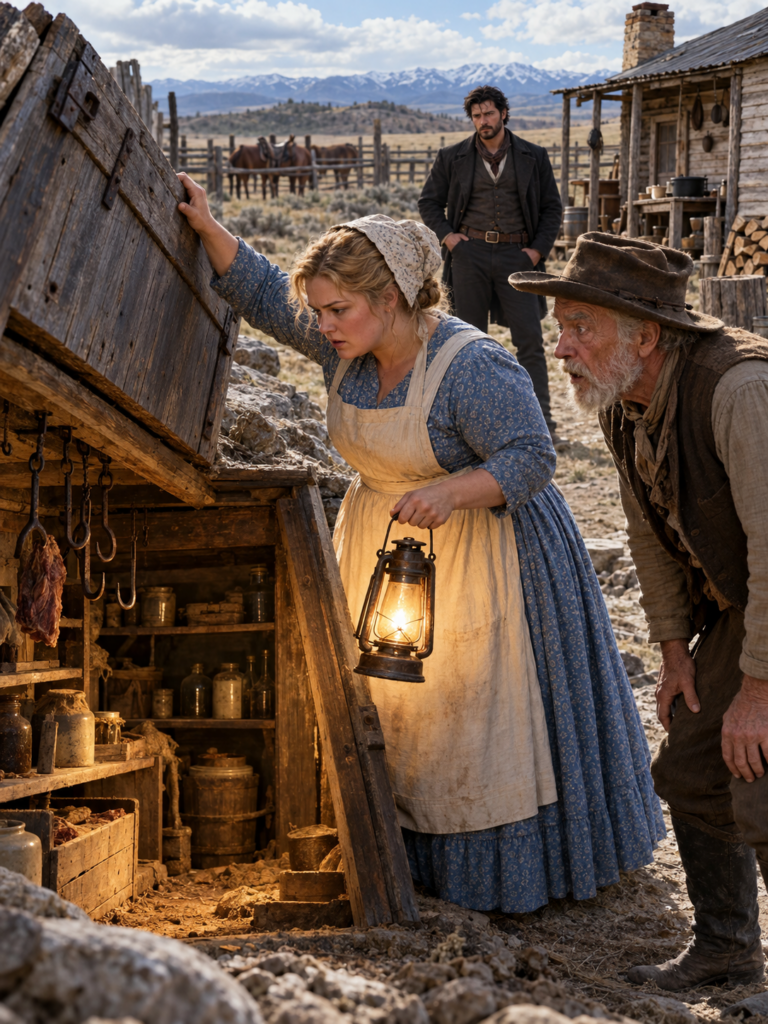
Ida lifted the lantern and carried it toward the cellar door.
The ranch yard lay silent beneath the dark Dakota sky.
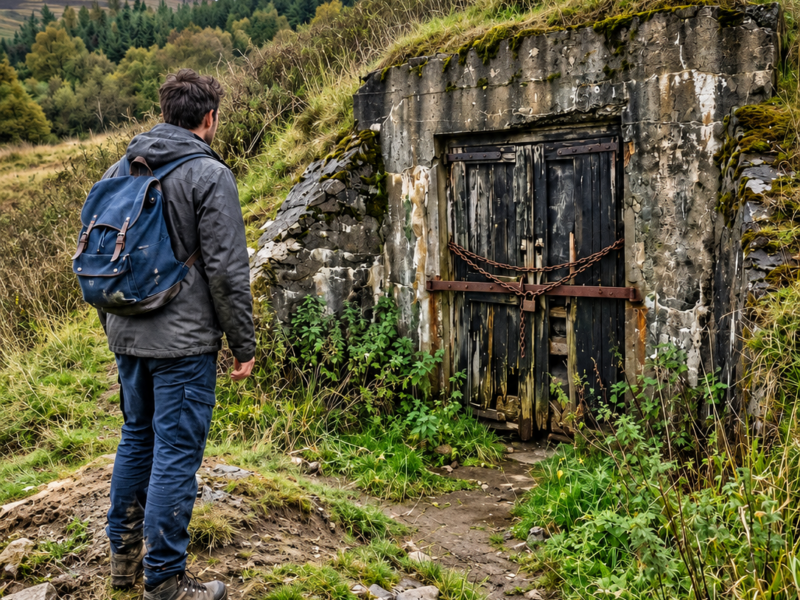
Behind the cook shack, the hillside waited with its old stone doorway and iron hinges.
She entered carefully.
The shelves smelled of damp earth, salt, and wood smoke.
Ida set her lantern on the cutting block and opened one of Anders Bakke’s notebooks.
For years, the old cook had recorded the working life of this ranch more faithfully than anyone expected.
The pages held no grand declarations.
Only meals.
Dates.
Weather.
Men.
Places.
And small details another person might overlook.
She examined several entries, then shut the book.
The ledger in the kitchen troubled her.
A ranch could lose money through poor judgment.
But the repeated purchases from Thorne’s butcher shop suggested something more deliberate.
Ida knew the difference between an expensive mistake and a system designed to benefit the seller.
Someone needed to examine the agreement that supposedly prevented Box Elder from feeding its own men.
She returned the notebook to the trunk.
The next morning, she found Hyram near the barn.
“Who decided the ranch couldn’t butcher its own cattle?” she asked.
“Virgil said it was in the note.”
“Have you read it?”
“No.”
“Has Jonas?”
Hyram looked away.
“He’s had a hard two years.”
Ida did not press him.
She knew grief could make ordinary decisions feel impossible.
But she also knew that grief did not make debts disappear.
A few days later, she had the root cellar’s smoke room drawing properly again.
Pete helped clear the flue.
Hyram repaired the hinges.
Rufus began leaving seasoned wood near the entrance without being asked.
Ida arranged to purchase pork from the Angstrom family rather than the butcher connected with Thorne.
Soon a thread of blue smoke rose above the hillside.
The ranch hands stopped to watch it.
Hyram removed his hat.
“Looks like the old days.”
Ida glanced at him.
“Before Annie died?”
He nodded.
“And before Anders left.”
The smoke was visible from the river road.
It brought memories back to the men.
But it also attracted someone else.
Lyman Thorne arrived in a polished buggy with matched gray horses and a smile that never quite reached his eyes.
Virgil Seer accompanied him to the cook shack.
Thorne inspected the clean tables, working range, and newly prepared meat.
“An impressive improvement,” he said.
Ida kept kneading bread.
“Thirty-three men need feeding.”
“Indeed. Though you understand every animal on this ranch stands pledged to my company.”
“So I’ve heard.”
“I trust you won’t be slaughtering any of them.”
Ida looked up.
“I haven’t done so.”
Thorne studied her.
“Good.”
His gaze shifted toward the smoke curling above the hill.
“Jonas is fortunate to have found someone so industrious.”
When he departed, his smile remained pleasant.
His warning did not.
That evening, Hyram entered the kitchen looking older than he had that morning.
“July first,” he said.
Ida wiped flour from her hands.
“What about it?”
“Thorne wants the remaining forty-nine hundred dollars. If Jonas can’t pay, he claims the right to take the herd and the ranch’s range and water rights.”
Ida turned toward him.
“All of it?”
“That’s what his paper says.”
“Who signed the paper?”
“John Redfern. Jonas’s father.”
“Have you seen the signature?”
Hyram shook his head.
“Virgil brought the note to Jonas after the old man died.”
Ida remembered the purchases, the underpriced cattle, and the store belonging to Thorne.
A wealthy company appeared to be profiting from every side of Box Elder’s troubles.
“Then I’d like to read that note.”
Hyram hesitated.
“Jonas might not welcome it.”
“He needn’t like the question. But he ought to know what he’s being asked to surrender.”
At dawn, she approached the ranch office.
Jonas sat beneath a lamp, a cold cup of coffee beside his father’s desk.
Ida stopped in the doorway.
“Mr. Redfern, may I see the agreement with Thorne?”
His face closed.
“My father’s debts are my responsibility.”
“I understand.”
“Then leave the matter alone.”
Ida remained still.
“Would you read me the part that forbids you from feeding your men your own beef?”
Jonas looked up.
She continued.
“I know provisions. I know livestock prices. And I know that a document may be made to sound more restrictive than its words.”
For a moment, neither spoke.
Then Jonas opened his desk and removed a folded paper.
He held it beneath the lamp.
Ida waited while he read.
The cattle were pledged as security, with delivery terms concerning the autumn shipment.
She listened carefully.
Then she asked him to repeat the section.
Jonas complied.
Ida met his eyes.
“Those words concern pledged cattle and delivery. They don’t plainly say you must buy every pound of supper meat from Thorne’s market.”
Jonas looked down at the note.
For months, he had accepted Virgil’s interpretation without examining it.
Now a woman he had nearly sent away had questioned it with nothing more than ordinary knowledge and the courage to ask.
He folded the paper.
Then he stood and walked toward the yard.
Ida followed him as far as the office door.
He called to Hyram.
“Cut out a suitable steer for the cook. We’ll account for it properly.”
Hyram stopped in his tracks.
Then he grinned beneath his mustache.
Ida stood in the doorway, suddenly aware that the rancher’s command had changed more than supper.
It meant Jonas Redfern had begun questioning the men who controlled his father’s papers.
And somewhere in the office behind him lay a document claiming the right to take everything his family owned.
Jonas’s command carried across the yard.
Hyram moved toward the cattle pens before his employer could reconsider.
Ida remained outside the office, watching the old foreman’s purposeful stride.
The decision was not yet a victory.
A disputed interpretation of a debt agreement would not by itself prevent Lyman Thorne from claiming the ranch.
But at least Jonas had begun to examine what others told him.
That evening, the root cellar held fresh beef for the first time in nearly a year.
Ida planned carefully.
Some cuts would be preserved.
Others would feed the crew immediately.
She reserved the short ribs for the smoke room.
She had learned the value of that cut from her uncle Nils, who believed that patient heat could make an inexpensive piece of meat worthy of any hotel table.
Now she had an idea that connected the land, the ranch, and the woman Jonas had lost.
She asked Hyram about Annie’s chokecherry jelly.
He grew quiet.
“Those jars were hers.”
“I know.”
“Jonas hasn’t touched them.”
“I won’t either unless someone who knew her believes she’d want them used.”
Hyram stood beside the cellar shelves.
“Annie made food to be eaten,” he finally said. “She’d be cross if she thought her jelly was sitting here gathering dust while thirty-three men went hungry.”
Ida opened three jars.
She heated the dark preserve with cider vinegar and pepper.
Later, she brushed it over the ribs as they finished smoking above seasoned box elder wood.
Rufus watched from the doorway.
“Fruit jelly on beef?”
“Try it before deciding it’s foolish.”
He stayed to watch the meat darken over the coals.
By supper, the smell had reached the far corrals.
When Ida carried the first platter into the cook shack, the men fell silent.
The ribs were dark and shining, their smoky edges holding a sharp, sweet glaze.
Rufus took a bite.
He stared at his plate.
Then he looked at Ida.
“That,” he said slowly, “is worth staying on this ranch for.”
Benny Ruiz laughed.
Pete began asking whether any would be left for breakfast.
The men reached for second portions.
Then Jonas tasted his.
He stopped.
Ida saw his expression change.
He placed the rib down.
Without speaking, he rose and walked outside.
The laughter faded.
Hyram leaned toward her.
“He remembers Annie’s jelly.”
Ida lowered her serving spoon.
“I should have asked him.”
“Maybe. But give him a little time.”
She finished feeding the men.
Hours later, carrying a lantern to check the cellar, she found Jonas sitting against the stone doorway.
An empty jelly jar rested in his hands.
He looked toward her.
“Annie used to argue with me about wasting food.”
Ida stood a few feet away.
“I’m sorry if I hurt you.”
“You brought back something I thought I’d never taste again.”
His voice was rough.
He explained that Annie had died of lung fever in January 1883.
His father, John Redfern, had died that April.
Two losses in one season had left him scarcely able to conduct the ranch’s affairs.
That summer, Virgil had presented the supposed debt.
Jonas had accepted it.
He had permitted the cook shack to close.
He had let Anders go.
“I couldn’t bear passing a kitchen that reminded me of her,” Jonas admitted.
Ida listened.
She did not tell him grief was over.
Nor did she pretend that allowing Virgil to make decisions had been harmless.
When Jonas finally rose, he took the folded debt note from his vest.
This time, he handed it to her.
“Read every part.”
Ida accepted it.
“I will.”
She spent the night studying its language.
Nine thousand dollars at ten percent interest.
The cattle pledged as security.
A clause allowing the holder to seize the herd and valuable ranch rights if the debt remained unpaid on July first.
The instrument claimed to have been signed by John Redfern at Sully Springs on October 14, 1882.
Virgil Seer’s name appeared as witness.
Something about that date troubled her.
At dawn, she returned to the root cellar.
She opened Anders’s notebook for 1882 and found the October entries.
On October fourteenth, the Box Elder wagon had been at Beaver Creek during roundup.
The book recorded John Redfern as sick and unable to leave the wagon.
It also recorded Virgil Seer attending him.
Ida read the entry again.
Beaver Creek lay roughly sixty miles from Sully Springs.
John could not have signed a paper in town that day if the cook’s account was accurate.
She carried the book directly to Hyram.
He remembered that rainy roundup.
He remembered John’s illness.
And he remembered Virgil remaining beside the old man.
The three of them assembled around the kitchen table.
Jonas examined the conflicting dates.
His face lost color.
“Then someone put my father’s name on a paper he never signed.”
“That’s what the evidence suggests,” Ida answered.
Jonas started toward the door.
“I’ll confront Thorne.”
Ida stepped into his path.
“Not yet.”
He looked at her sharply.
“Why not?”
“Because we need evidence independent of this ranch. If we show him everything before we’re ready, he can spend the next two months finding reasons to discredit it.”
Jonas stopped.
He did not like being restrained.
But he knew she was thinking clearly.
They agreed to seek the stock growers’ official roundup records and a statement from Anders Bakke, now living in Miles City.
Ida wrote the letters.
Jonas authorized them.
Then she arranged for the correspondence to travel through Agnes Whitcomb, the proprietor of the Sully Springs Hotel, rather than through the ranch mail handled by Virgil.
Agnes agreed to protect the letters and store the old daybook in her safe.
During the wagon ride home, Pete confessed something important.
The night Anders had left the ranch, Pete had seen Virgil burning a clothbound book in the cook shack stove.
At the time, he had thought little of it.
Now Ida understood why the cellar books mattered.
Virgil apparently believed the old cook’s records had been destroyed.
He did not know eight earlier volumes remained behind the padlocked door.
Ida thanked Pete for telling her.
“If anyone asks, will you repeat what you saw?”
“Every word.”
The spring roundup began soon afterward.
For three weeks, Ida drove the chuck wagon behind four mules while the crew worked the scattered cattle.
She cooked over trench fires, baked biscuits in Dutch ovens, and supplied smoked meat that kept the men better fed than they had been for months.
Rufus rode near her wagon during the first creek crossing.
He offered no insults.
When she handled the mules without difficulty, he simply nodded and went about his own work.
At night, Jonas sometimes joined her beside the fire.
One evening, after the men had retired, he helped scour the cooking pots.
He asked about her uncle’s shop.
Ida told him how she had worked beside Nils in St. Paul for nine years.
After his death, she had tried to keep the business alive.
But the landlord sold the building for railroad use.
A clause in the lease gave her little time to leave.
She lost the premises and sold most of the equipment for a fraction of its worth.
Afterward, she found work in Bismarck.
“I read that lease,” she admitted, rubbing sand around a blackened skillet. “Just not carefully enough.”
Jonas listened.
“So I learned something. Before I sign another business paper, I intend to know what every word means.”
“Reasonable.”
“I want more than cook’s wages forever.”
“What do you want?”
“My own smoked-meat business again. The Northern Pacific dining cars need steady suppliers. I’ve spoken to a steward about it.”
Jonas considered her answer.
“Then you’re thinking larger than this kitchen.”
“I am.”
He smiled faintly.
For the first time, Ida saw a man who was interested in her future rather than merely grateful for her food.
Before leaving the fire, Jonas asked what her uncle’s old sausage stuffer looked like.
She described its worn green paint, iron body, wooden crank, and the initials N.L. cut into the handle.
Jonas asked no further questions.
When the roundup returned in early June, Virgil was waiting.
At supper, with all thirty-three men present, he publicly accused Ida of taking ranch records and sending letters about Jonas’s family debts.
He implied she had come with private ambitions and might be exploiting the Redfern family’s difficulties.
Jonas looked toward her.
“Did you remove Anders’s book?”
“Yes.”
The answer was true.
She had put it in Agnes’s safe.
Virgil watched Jonas carefully.
Rather than explain that he had authorized the investigation, Jonas allowed his wounded pride to take control.
“Then bring it back,” he said. “My father’s affairs aren’t yours to manage.”
The words struck Ida harder than his rejection on her first morning.
Every man at the table heard them.
She had acted with Jonas’s knowledge.
She had protected evidence that could save the ranch.
And he had let Virgil make her appear dishonest.
Ida finished serving supper.
She washed the dishes.
Then she went to the office.
Jonas sat at his father’s desk.
“You gave me permission,” she said.
He looked up.
“I know.”
“You asked me to help you discover what happened.”
“Yes.”
“And in front of those men, you allowed Virgil to accuse me.”
Jonas said nothing.
Ida placed her folded apron on his desk.
“I’ll finish the work I agreed to do. I’ll continue helping establish the truth about that note. But I won’t surrender my judgment to your bookkeeper, and I won’t pretend you treated me fairly.”
She turned toward the door.
“Ida.”
She stopped.
Jonas struggled for words.
He was accustomed to making decisions for others.
He was not accustomed to admitting how badly he had failed someone whose opinion mattered to him.
Before he could speak, Ida said quietly, “Think carefully about what you intend to say next.”
Then she left.
For the first time since arriving at Box Elder Ranch, she wondered whether saving the place would mean losing the possibility of belonging there.
Ida crossed the dark yard without looking back.
The cook shack stood ahead, its windows dim beneath the moonlight.
She entered her small room behind it and closed the door.
Her trunk rested against the wall.
She had arrived with that trunk, her tools, and the hope of earning enough to begin again.
Now she possessed knowledge that might save a ranch.
But she was no longer certain the rancher deserved the trust she had placed in him.
She sat on the bed and considered leaving.
It would have been understandable.
She had already endured ridicule, suspicion, and now public humiliation.
Yet there were thirty-three working men whose livelihoods depended on Box Elder.
There was Hyram, who had trusted her from the beginning.
Pete, who had found the courage to testify about what he saw.
And Anders, whose faithful records might restore an honest man’s name.
Ida could not abandon those people merely because Jonas had failed her.
She would finish what she began.
But whether she remained afterward was her decision.
***
The next morning, work continued.
Virgil behaved as though the previous evening had settled the matter.
He smiled when he passed Ida.
She ignored him.
Hyram came into the cook shack and removed his hat.
“I was ashamed of what happened.”
“It wasn’t your doing.”
“I should’ve spoken.”
Ida placed fresh bread on the table.
“Then speak when it matters next.”
He nodded.
Two days later, additional news arrived from Dickinson.
The stock growers’ records supported the account in Anders’s daybook.
The Box Elder roundup party had been at Beaver Creek on the disputed date.
John Redfern and Virgil Seer were among those recorded there.
That evidence was valuable.
But Ida still wanted to understand the document itself.
She knew that a forged signature might be difficult to prove through recollection alone.
The paper offered another possibility.
Late one night, she examined the printed form beneath a lamp.
She read beyond the handwritten figures.
Beyond the names.
Beyond the disputed clauses.
At the bottom edge, almost too small to notice, stood the printer’s identification.
Brower and Son.
Dickinson.
Ida stared at the letters.
Printed business forms did not simply appear out of nowhere.
Someone had ordered them.
Someone had paid for them.
And someone might still remember when.
The following day, she arranged to investigate the printer’s records.
The discovery proved decisive.
Otto Brower’s order books established that the printed form used for the supposed 1882 debt had not been available on the date written upon it.
Whatever else Thorne and Virgil claimed, John Redfern could not have signed that particular paper in October 1882.
It had been produced later.
The false date was no longer supported only by the memory of men at a roundup.
The document itself carried evidence against its claimed origin.
Meanwhile, Pete’s account of the burned book suggested Virgil had attempted to destroy a record that might expose the fraud.
The evidence accumulated.
Ida and Hyram worked with legal counsel to preserve it.
Jonas, once he understood how thoroughly Virgil had misled him, finally confronted his own conduct.
He found correspondence from Dickinson that Virgil had concealed.
He also learned how the bookkeeper had tried to steer suspicion toward Ida.
One night, Jonas knocked on her door.
She opened it with a candle in her hand.
He stood outside holding his hat.
“I owe you an apology.”
Ida waited.
“What happened at supper was wrong,” he continued. “You acted with my permission. I knew you were protecting evidence, and I let Virgil make you appear dishonest.”
She looked at him steadily.
“Why?”
“Because I was ashamed that I hadn’t seen what was happening on my own ranch. When he accused you, I let that shame turn into anger.”
“At me.”
“Yes.”
He drew a breath.
“I was wrong.”
Ida studied him.
He did not blame grief.
He did not blame his father.
He did not pretend that Virgil’s dishonesty excused his own silence.
At last, she nodded.
“I accept that you know what you did.”
Jonas looked up.
“But I haven’t yet heard you correct it before the men who heard the accusation.”
“I will.”
“Then I’ll believe your apology when you do.”
He accepted the condition.
Before leaving, he placed the original disputed note in her care for the legal work.
“Use it wherever it’s needed.”
Ida took the paper.
“Thank you.”
Jonas hesitated.
“I hope I haven’t lost your trust altogether.”
She considered him.
“You’ve damaged it.”
His expression tightened.
“But it may be repaired,” she added. “That depends on what you do.”
***
Legal counsel arranged to question Virgil with the conflicting documents before him.
At first, the bookkeeper denied wrongdoing.
He insisted that any inconsistencies were ordinary clerical mistakes.
But the printer’s records were difficult to explain.
So were the independent roundup records.
And when the testimony of Anders, Hyram, and Pete was added, his account began to collapse.
Eventually, Virgil admitted his part in preparing the fraudulent instrument with Lyman Thorne.
The debt had been manufactured after John Redfern’s death.
It was designed to give Thorne leverage over Box Elder Ranch at a time when Jonas was too overwhelmed by loss to investigate.
The inflated claims, questionable cattle valuations, and restrictions on ranch supplies had all worked toward the same purpose.
Thorne wanted the ranch’s valuable cattle, range, and water rights.
Virgil had made that ambition possible by controlling what Jonas believed.
Ida listened to the account with a sickened heart.
For more than a year, thirty-three men had eaten poorly.
A faithful cook had lost his position.
The ranch had paid unreasonable costs.
And Jonas had lived beneath a debt his father had never honestly incurred.
The cruelty lay not only in the money.
It lay in the way the men had been made to doubt their own ability to survive.
When Ida returned to Box Elder with news of the evidence, the yard looked just as it had on the day of her arrival.
The same corral.
The same porch.
The same low cook shack.
But the place felt different.
The forgotten cellar was open.
Its smoke rose above the hill.
And the woman who had once been told to leave now carried the truth in her hands.
***
That evening, Jonas stood before the thirty-three ranch hands in the cook shack.
Ida remained at the range.
She did not know what he intended to say.
He removed his hat.
“There’s something I need to put right.”
The men grew quiet.
Jonas looked toward Ida.
“When Virgil accused Miss Lindgren of interfering in my father’s affairs, I let him speak as though she had done something dishonest.”
He paused.
“I knew better.”
Hyram stood near the doorway.
Rufus folded his arms.
Pete watched without blinking.
Jonas continued.
“She was acting with my permission. She was trying to discover what had been done to this ranch, and she found evidence that I failed to look for.”
Ida’s hand tightened around the ladle.
Jonas faced the men again.
“The debt used against us was founded on a forged paper. My father did not sign it. Miss Lindgren found the records that exposed it.”
A murmur passed along the table.
“She found Anders’s books. She noticed the impossible date. She found the printer’s mark. And she kept working after I embarrassed her in this very room.”
He swallowed.
“I had no right to treat her that way.”
Then he turned toward Ida.
“I’m sorry.”
She met his eyes.
No private tenderness could have replaced that admission.
He had chosen to tell the truth in front of the people who mattered.
Rufus rose.
He removed his hat.
Pete followed.
Then Benny Ruiz.
Then the others.
Thirty-three cowboys stood in quiet respect before the woman they had once laughed at.
Ida looked down at the soup she had been serving.
For a moment, she could not speak.
Then she drew a careful breath.
“Sit down, gentlemen. Supper’s getting cold.”
The men obeyed.
And when Pete made a remark about the amount Rufus had eaten during roundup, Jonas laughed aloud.
The sound surprised everyone.
It surprised Jonas most of all.
***
The legal challenge was not yet finished.
Thorne still intended to assert his supposed rights.
The balance he claimed was due on July first.
But now Box Elder possessed evidence strong enough to resist.
The ranch prepared carefully.
Jonas’s counsel had statements from the printer, records from the stock growers, Anders’s notebooks, and Virgil’s account.
Ida ensured the original documents remained protected.
She had learned from her uncle’s lost business that truth mattered little if nobody could prove it.
When Thorne arrived to press his claim, the ranch was ready.
Other cattlemen from along the river had gathered for a meal at Box Elder.
Thorne expected to find an isolated debtor.
Instead, he found a yard full of witnesses and neighboring stockmen who had reason to listen.
His lawyer began presenting the note.
Jonas’s counsel challenged its authenticity.
The printer’s records contradicted its date.
The roundup records contradicted its claimed location.
And Virgil’s statement explained how the document had been manufactured.
Thorne’s polished composure finally failed.
He glanced around the yard.
The men he had hoped to control through separate debts and quiet pressure were listening together.
He could no longer depend on every rancher knowing only his own trouble.
His lawyer withdrew from the confrontation.
Thorne departed without the cattle he had expected to claim.
Ida watched his buggy disappear down the river road.
She felt no desire to follow him.
The ranch still required a court decision.
But for the first time, she believed that justice might prevail.
***
The case was heard in Dickinson on August 19, 1884.
The proceedings lasted two days.
Witnesses testified to the origin of the document, the location of John Redfern during the 1882 roundup, and the circumstances surrounding the forged agreement.
Otto Brower presented his printing records.
Dwight Ransom confirmed the stock growers’ documentation.
Anders Bakke spoke about his daybooks and the men he had fed at Beaver Creek.
Virgil’s testimony established the conspiracy.
By the end, the evidence no longer depended upon one person’s word.
The court declared the fraudulent note void.
The Thorn Land and Cattle Company was ordered to compensate Box Elder for the two hundred eighty steers it had taken under the arrangement, valued at $7,560.
The decision freed Jonas from the false obligation that had threatened his family land.
In the following weeks, Thorne lost his position with the company.
Virgil departed the territory by train in September.
Box Elder Ranch paid its legitimate outstanding debts.
For the first time in a long while, Jonas could examine his accounts without expecting another ruinous demand.
But Ida was not thinking only about the debts.
She was thinking about the future she had once hoped to build in St. Paul.
And about a promise she had made to herself.
She would never again build her livelihood upon a paper she did not understand.
***
On the evening they returned from Dickinson, Jonas came to the cook shack with his lawyer, Cyrus Alby.
Ida was finishing the bread.
Jonas laid a proposed agreement on the table.
“I’ve been considering your smoked-meat business.”
Ida wiped her hands.
“So have I.”
“The ranch has livestock. We’ve got the cellar and a working smoke room. There’s timber for fuel and transport to the railroad connections.”
He glanced at the document.
“I’d like to help establish a larger operation, with you managing production.”
“What terms?”
“One-third of the earnings from the smoke trade.”
Ida was quiet.
Then she shook her head.
“No.”
Cyrus Alby looked up.
Jonas did not seem offended.
“What would you consider fair?”
“Half the net earnings after agreed costs.”
She pulled out a chair.
“My uncle’s recipes remain my property. The ranch sells beef to the business at an agreed fair market price. If another supplier can provide what we need, the business must be free to buy elsewhere.”
Jonas listened.
“And the buildings?”
“Constructed to my drawings. I know what arrangement the work requires.”
She hesitated.
“One more thing.”
“Go ahead.”
“My name comes first.”
Jonas looked at her.
“Lindgren and Redfern?”
“Exactly.”
He smiled.
“Then let’s put it in writing.”
Cyrus began drafting.
It took most of the evening.
Every clause was examined.
Ida questioned anything she thought unclear.
Where a provision could be read in two ways, she demanded more exact wording.
Jonas listened without impatience.
When the agreement was finally ready, she read it from beginning to end.
Then she signed.
Not as an employee receiving charity from a wealthy rancher.
Not as a woman grateful to be allowed to remain.
As a partner.
The following week, an unexpected crate arrived from St. Paul.
Rufus and Pete carried it into the cook shack.
Ida removed the boards.
Inside lay an old cast-iron sausage stuffer.
The remains of green paint clung to its body.
Its crank had a worn wooden handle.
And cut into that handle were her uncle’s initials.
N.L.
Ida touched the marks.
For several seconds, she could not speak.
She found a bill of sale indicating that Jonas had purchased it from a junk dealer in St. Paul.
He had begun searching for the machine shortly after their conversation by the roundup fire.
Long before the legal case was resolved.
Long before he knew she might remain at Box Elder as his business partner.
He had remembered what she lost.
And he had tried to return one part of it.
Ida closed her eyes.
Her uncle’s shop was gone.
Her years working beside him could never be repeated.
But the machine he had taught her to use stood before her again.
That evening, she climbed the hill behind the root cellar.
Jonas sat near the old smoke flue, looking toward the Little Missouri.
She sat beside him.
“You found it.”
He nodded.
“Took some looking.”
“Why?”
Jonas turned his hat slowly.
“Because I couldn’t undo what happened to your uncle’s shop. But I thought perhaps I could give you back something that belonged to it.”
Ida looked toward the cook shack below.
“That was a generous thing to do.”
“I’ve owed you better treatment than you received when you first came here.”
“You apologized for that.”
“I know.”
She smiled.
“And I’ve accepted.”
They sat quietly while the last daylight touched the distant buttes.
Then Jonas spoke again.
“Ida, I loved Annie. I always will.”
“I know.”
“For a long time, I believed there was no room in my life for another person.”
Ida waited.
“But you’ve become someone I want beside me. Not because you saved the ranch. Not because you can feed the men. Because I value your company, your judgment, and the way you make me remember that a future is still possible.”
Her throat tightened.
Jonas looked directly at her.
“I’d like us to consider something beyond our business partnership. I don’t expect an answer tonight.”
Ida considered the man before her.
He had wounded her pride.
He had admitted it.
He had learned to listen.
He had stood before his men and corrected a wrong that would have been easier to conceal.
She liked the care with which he spoke.
And she liked that he was willing to give her time.
“Ask me again when the first snow comes,” she said.
Jonas smiled.
“Then I’ll know you’ve had time to consider it.”
Ida laughed.
“Enough time to read every word.”
He laughed too.
She reached for his hand.
They watched the evening settle over the valley, neither needing to say more.
***
The first snow fell during the third week of October 1884.
By then, the new smokehouse stood beside Anders’s old cellar.
Ida had supervised its construction.
Three smoke rooms gave the business greater capacity.
A cooling room kept the work organized.
A loading entrance faced the ranch road.
And above the door hung the name she had insisted upon.
Lindgren and Redfern Smoked Meats.
Her name first.
The first shipment had already gone east for the Northern Pacific dining cars.
Forty hams.
One hundred pounds of bacon.
Two hundred pounds of beef sausage.
Twenty racks of smoked beef ribs glazed with chokecherry.
The dining car steward soon requested a larger shipment.
Ida read the message twice.
Then she placed it beside the business accounts and began planning the next week’s work.
Anders Bakke had returned to Box Elder.
He lived near the new smokehouse and helped cook several days a week.
He also began a fresh daybook.
The old man’s records had once saved the ranch.
Now he recorded the meals and work of its renewal.
Rufus had become Hyram’s trusted right hand.
Benny Ruiz still praised the food.
Pete wrote long letters home to Iowa, including more descriptions of smoked ribs than his mother probably needed.
And every evening, the thirty-three ranch hands entered a warm cook shack where proper supper awaited them.
Ida no longer carried the entire burden alone.
She directed the smoke trade with help from the people whose work made it possible.
Jonas respected her decisions.
Their partnership was practical, exact, and sometimes argumentative.
But both had learned the difference between a disagreement and a betrayal.
On the evening of the first snow, Jonas entered the cook shack and looked toward Ida.
She stood beside the range, ladling soup.
He glanced at the flakes passing the window.
She saw the look.
She remembered his promise.
And she smiled.
But thirty-three men were waiting for their supper.
Jonas smiled back and sat down.
He understood that her answer could wait until the meal was served.
Outside, fresh snow softened the hills.
Above the old root cellar, smoke rose steadily from Anders’s restored flue.
Beside it, the new smokehouse sent its own column into the darkening sky.
From the river ford, a traveler could see the glowing cook shack windows and recognize the ranch by the smell of its fires.
Ida had arrived at Box Elder with a trunk, a letter promising forty dollars, and a determination to rebuild her life.
The men had laughed at her.
Their employer had tried to send her away.
Now her name stood upon a business she owned in partnership, and the ranch she had helped save could look toward another year without the shadow of a fraudulent debt.
She had not earned love by feeding hungry men.
Nor had she been rewarded with a home because she saved a rancher.
She had demonstrated her knowledge, defended her dignity, demanded fair terms, and chosen what she wanted to build.
And Jonas had learned that love could not flourish where pride refused accountability.
He had not forgotten Annie.
He had not forgotten his father.
He had simply allowed the life around him to become full again.
That evening, Ida finished serving supper and set down her ladle.
She walked toward the long table.
Jonas rose to meet her.
Beyond the windows, the snow continued falling.
And in the warm, noisy heart of Box Elder Ranch, Ida Lindgren reached for his hand.