
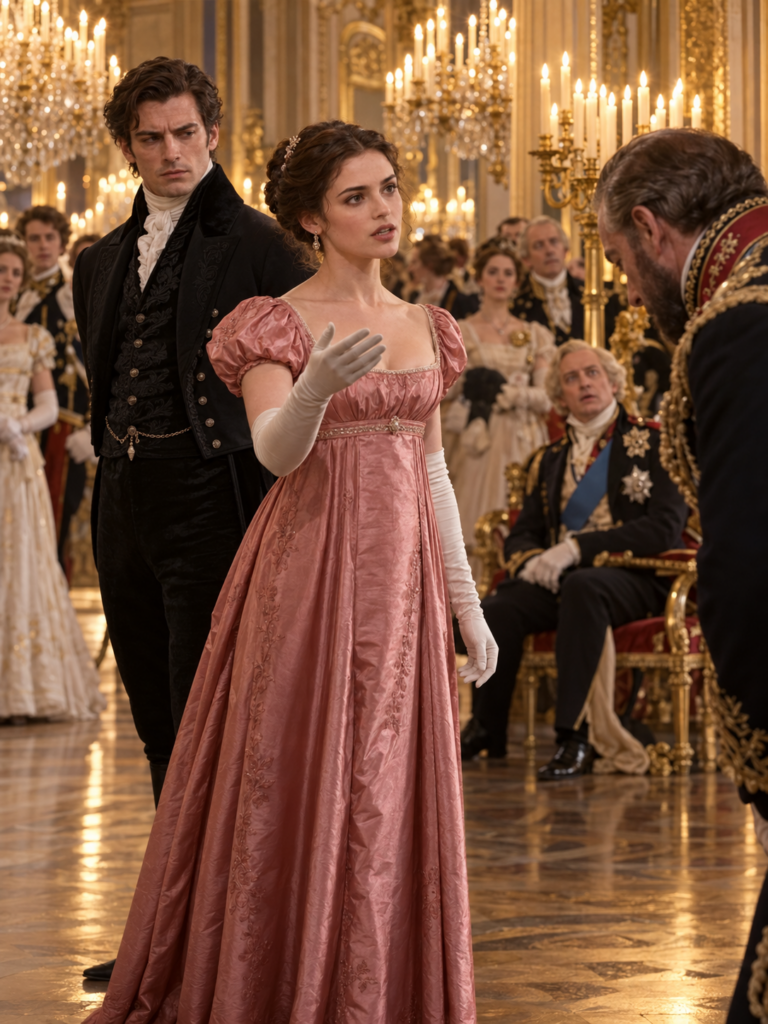
Beatrice’s raised hand settled gently upon the edge of a nearby table as she continued speaking, and the Russian count’s expression grew steadily less comfortable.
She was not repeating a clever phrase memorized for the occasion.
She knew the routes, the ports, the commercial pressures, and the reasons each delegation wished to appear stronger than it truly was.
The Prince Regent listened with growing pleasure.
Then Baron von Hessle, the Prussian representative, interrupted.
“Commerce is one thing, madam. Military necessity is quite another.”
Beatrice turned toward him.
“Certainly, Baron.”
He smiled at her apparent agreement.
“A nation survives through strength, not discussions of shipping accounts.”
“An army must still be supplied.”
The baron folded his arms.
He replied in German, speaking rapidly and with unmistakable condescension.
Whatever her knowledge of merchant vessels, he suggested, a lady from Yorkshire could know nothing of military roads or the movement of troops.
Beatrice answered in German.
His arms unfolded.
She described the difficulties of maintaining supply lines across poor roads, the importance of grain to cavalry operations, and the danger of planning campaigns around provisions that might never arrive.
Her argument was precise enough to force him into a serious disagreement rather than the easy ridicule he had anticipated.
By the time she finished, he was asking where she had studied European military geography.
“My father required me to read maps before he permitted me to debate them.”
The Regent laughed delightedly.
Kalin did not.
He had heard his wife speak Russian and German within minutes.
He had spent their entire acquaintance treating her as though she possessed no education worth mentioning.
And he suddenly remembered the small book she had carried from Yorkshire.
He had dismissed it without even examining the title.
Genevieve approached, visibly furious.
“Your Grace,” she said in French, “one must admire your accomplishments. Although scholarship can hardly compensate for a complete lack of refinement.”
Beatrice looked at her for a long moment.
Then she answered in French so natural and accomplished that several nearby courtiers turned in surprise.
“Refinement, madam, is best demonstrated by the courtesy one extends when there is nothing to be gained.”
Genevieve stiffened.
Beatrice continued quietly.
“You have spoken freely in my presence because you assumed I could not understand you. I understood perfectly.”
A flush spread across Genevieve’s cheeks.
“And you allowed it?”
“I wished to discover how people behaved when they believed themselves unobserved.”
The words struck harder than any raised voice.
Genevieve glanced toward Kalin.
He offered no rescue.
For the first time that evening, he could not even meet her eyes.
The Spanish envoy, Lord Navarro, made an appreciative observation in his native language.
Beatrice answered him in Spanish.
The Regent clapped his hands.
“And how many languages does our remarkable duchess possess?”
“Enough to recognize when a conversation concerns me, Your Royal Highness.”
A Venetian musician standing nearby praised her versatility in Italian.
She thanked him in the same language.
The Regent’s amusement became open admiration.
Five languages had now passed naturally through her conversation: English, Russian, German, French, and Spanish, with Italian added almost casually.
Yet it was not the languages alone that impressed him.
It was her command of the subjects beneath them.
“You must sit near me at supper, Duchess.”
Beatrice inclined her head.
“I should be honored.”
Kalin stepped forward.
“My dear, perhaps we ought—”
“Please do not interrupt,” she said.
He stopped.
The Regent looked between them.
Beatrice turned to her husband, her face composed.
“You brought me here with the expectation that I would fail. I know what you intended afterward.”
Kalin’s expression changed.
“You misunderstand—”
“No. I heard what you said to Lady Genevieve.”
The revelation left him speechless.
Beatrice took a deliberate step away from him and toward the Regent’s offered arm.
She had not yet decided what her marriage would become.
But she knew it could not continue upon the terms her husband had imagined.
And when the Regent invited her to lead the way toward supper, Beatrice accepted, leaving Kalin standing beside the woman he had preferred—and forcing him to follow at a distance.
Kalin followed at a distance, unable to decide whether the greater humiliation lay in being ignored by his wife or in realizing how thoroughly he had underestimated her.
The doors of the supper room opened before them.
A long table glittered beneath chandeliers. Silver reflected the candlelight, and servants moved between the chairs with practiced discretion.
Beatrice was shown to a place near the Prince Regent.
Kalin discovered his own name much farther down the table.
He looked toward the head of the room, expecting his wife to notice his discomfort.
She was already speaking to Count Vulkoff.
It was the first time since their marriage that Kalin had seen her apparently at ease in company.
And she had achieved that ease without him.
Lord Cavendish, who had attended the gathering at Rothwell House earlier that week, leaned toward him.
“Your wife is extraordinary, Rothwell.”
Kalin reached for his glass.
“So it appears.”
“You concealed her talents remarkably well.”
The duke said nothing.
Cavendish smiled knowingly.
“An excellent strategy. Allow everyone to underestimate her, then introduce her at the decisive moment.”
Kalin felt a wave of shame.
The explanation was so flattering that he could almost have accepted it.
He could permit society to believe this had been his design.
He could bask in his wife’s success while concealing the fact that he had tried to prevent it.
But his gaze traveled down the table.
Beatrice was listening carefully as the Regent discussed commercial restrictions.
When she answered, she did not flatter him.
She disagreed respectfully, distinguished between established facts and uncertain reports, and offered an alternative worth considering.
The Regent listened.
So did the Russian count.
Kalin recognized something deeply uncomfortable.
His wife had the habits of a serious mind.
He had cultivated only the appearance of one.
At length, a discussion arose concerning English timber and the difficulty of negotiating foreign supplies.
Beatrice glanced toward her husband.
“Your Royal Highness, my husband’s Cornwall property includes woodland. He might be able to speak more directly to the practical question of domestic supply.”
The Regent turned expectantly.
“Rothwell? What say you?”
Kalin went cold.
He possessed property in Cornwall.
He knew the appearance of its house, the quality of its shooting, and the cost of entertaining guests there.
But he had never studied the reports of its timber production.
He could not tell the Regent what portion of the land was woodland, what had been felled, or what remained commercially useful.
He swallowed.
“I should prefer to consult my steward’s latest figures rather than offer an uncertain estimate, sir.”
Beatrice regarded him steadily.
It was the first entirely sensible thing he had said all evening.
“A wise precaution,” she replied.
She returned the discussion to the broader commercial question.
Kalin lowered his eyes.
His answer had spared him a public blunder, but it had exposed a private failure.
He did not know the estate whose revenues supported him.
He could recite the names of fashionable hostesses, assess the pedigree of a hunting horse, and recognize the most expensive wine on a table.
Yet he could not speak confidently about the livelihoods of those who worked his land.
For the first time, he wondered what his father had left behind beyond debts.
And what his own extravagance had done to make those debts worse.
The evening continued.
Beatrice spoke with the Regent, the foreign representatives, and several distinguished guests who requested introductions.
By the time the final course was removed, her reputation had altered beyond recognition.
The woman mocked as an ignorant provincial had become one of the most discussed people at court.
But the victory did not make her happy.
She knew perfectly well that admiration could be another kind of confinement.
Men who had laughed at her silence now wanted to claim credit for her speech.
Several congratulated Kalin upon his brilliant wife, as though her abilities were another acquisition that belonged to him.
She accepted compliments graciously.
She also noticed who asked for her opinions and who merely admired the novelty of an educated woman.
Those were not the same thing.
When the royal evening finally ended, Kalin accompanied her to their carriage.
For several minutes, neither spoke.
Rain tapped against the roof.
The streets glistened beneath the lamps.
Kalin broke the silence.
“You made certain everyone understood how little I knew.”
Beatrice watched the passing buildings.
“You were given an opportunity to discuss your own estate.”
“You knew I couldn’t.”
“I suspected you did not.”
He leaned forward.
“Then why ask?”
“Because you have spent our marriage explaining everything I am unfit to understand. I thought it might be useful for you to experience the difficulty of being expected to speak without preparation.”
He flushed.
“That was cruel.”
She turned toward him.
“Yes. It was.”
Her answer startled him.
“I am not proud of every word I spoke tonight, Kalin. But I will not pretend that your treatment of me was harmless merely because I possessed the means to answer it.”
Kalin stared at her.
He had expected triumph.
Instead, she offered him an assessment more painful because it was accurate.
“You knew about Genevieve?”
“Before the wedding, I knew you had an attachment. Afterward, I discovered you had no intention of ending it.”
“Why did you not confront me?”
“Would it have mattered?”
He opened his mouth.
No answer came.
Beatrice continued.
“I was not seeking a romantic marriage. I understood the financial arrangement. But I expected the ordinary courtesies due between two people who must share a household.”
“And you think I failed to provide those?”
“You arranged for me to look ridiculous in public. You allowed your friends to insult me. You threatened to send me away if I embarrassed you.”
Kalin looked down at his hands.
Beatrice’s voice remained quiet.
“You did not simply fail to respect me. You treated my unhappiness as the means of securing your own comfort.”
The carriage stopped outside Rothwell House.
Kalin descended without speaking.
Beatrice followed after the footman opened her door.
Inside, she asked that breakfast be served in her private sitting room.
Then she retired.
Kalin remained in the entrance hall, staring at the staircase long after she disappeared.
He had never felt less like the master of his own house.
The next morning brought no relief.
He entered his study expecting to find correspondence from court.
Instead, he discovered Beatrice surrounded by estate accounts.
She had changed into a plain gray morning dress. Several ledgers lay open upon the desk, their pages marked with slips of paper.
Beside them rested a summary written in her own hand.
“What is the meaning of this?” he demanded.
Beatrice finished the calculation before answering.
“I asked the steward for the household books and the most recent estate reports.”
“Without consulting me?”
“I requested information concerning a household to which my fortune has contributed substantially.”
Kalin shut the door.
“These matters are complicated.”
“They are also alarming.”
He approached the desk.
She turned a ledger toward him.
“The money my father advanced discharged a considerable portion of your obligations. Yet the household continues to spend more than the properties reliably produce.”
Kalin examined the figures.
He had seen similar pages before.
He had simply never looked at them all together.
Beatrice pointed to separate columns.
“There are outstanding obligations connected to the London household, gambling losses, and purchases that cannot be justified while the estate remains burdened.”
His face warmed.
She moved another paper toward him.
“Your expenditure upon Lady Genevieve is particularly difficult to reconcile with your obligations to tenants and creditors.”
“That is a private matter.”
“It becomes an estate matter when the bills are paid from estate income.”
Kalin turned away.
Beatrice allowed the silence to settle.
Then she spoke again.
“I have also discovered that several of your tenants have requested repairs which remain undone.”
He looked back sharply.
“What repairs?”
“The steward’s correspondence will provide the particulars. I have not visited the properties, so I will not pretend to know their condition firsthand. But the requests deserve answers.”
He stared at the papers.
“You intend to take control of everything.”
“No. I intend to stop contributing to a ruinous arrangement.”
She handed him a document.
“These are the conditions under which I am prepared to continue living in this house.”
Kalin read the first line.
His face hardened.
Lady Genevieve was to cease visiting the household, and he was to end the relationship.
He read farther.
Beatrice required access to the accounts, consultation over significant spending, and a genuine role in planning how her family’s money would be used.
Kalin was to assume responsibility for learning about the properties from which he drew his income.
They would retain separate bedchambers.
And no physical intimacy would be presumed from the marriage.
He set the paper down.
“You have no intention of being a wife to me.”
“I have every intention of behaving honorably within this marriage. But I will not share your bed merely because a ceremony has given you legal standing as my husband.”
The words burned through his pride.
“You are proposing to make me a servant.”
“No. I am asking you to become responsible for your own affairs.”
He walked to the window.
Below, a delivery cart stopped at a neighboring house.
London moved on without concern for the ruin occurring inside his study.
After a long silence, he asked, “And if I refuse?”
“Then I shall consult my father and obtain advice concerning the financial arrangements and the separate establishment available to me. I will not pretend my choices are unlimited under the law. But neither will I continue supplying money without conditions.”
He understood the difference.
She was not claiming powers she did not possess.
She was exercising the influence she actually had.
And she knew the value of it.
“You have thought this through.”
“For considerably longer than you have thought about our marriage.”
He returned to the desk.
“Would you truly leave?”
“If remaining requires me to accept the treatment I have endured, yes.”
He studied her.
Then he asked the question that should have occurred to him before their wedding.
“What did you want from this marriage?”
Beatrice’s expression altered.
Not much.
But enough.
“I wanted a life in which my abilities need not remain hidden. I wanted the opportunity to do work that mattered. My father could educate me, but he could not give me every freedom that education made me desire.”
“And you believed marriage would?”
“I hoped it might.”
Kalin looked away.
He had taken her hope and made it an inconvenience.
He examined the proposed agreement again.
Some provisions would require formal arrangements beyond the paper before him. Others concerned his conduct, which no solicitor could improve without his cooperation.
But the essential demands were clear.
Fidelity.
Financial honesty.
Respect.
The right to refuse intimacy.
A meaningful voice in the household.
He took up his pen.
“Very well.”
Beatrice did not smile.
“Read the final condition carefully.”
He did.
It stated that no improvement in his conduct would oblige her to offer romantic affection in return.
Kalin looked at her.
“You expect so little of me.”
“I expect you to keep your promises. That would be a beginning.”
He signed the document as an acknowledgment of the terms he had agreed to pursue.
Then Beatrice signed beneath him.
For several moments, neither moved.
Finally, Kalin said, “I shall write to Lady Genevieve today.”
“Very well.”
“And I shall speak to the steward about Cornwall.”
“There are reports ready for you.”
He almost laughed at the absurdity.
She had anticipated his first task.
But when he reached for the papers, Beatrice closed one of the ledgers.
“There is one matter more, Kalin.”
He looked up.
She placed the book from the carriage beside the agreement.
The unfamiliar script on its cover caught his attention.
“You once told me to leave this behind because it would make me appear provincial.”
He remembered.
A sharp embarrassment rose in his throat.
“What is it?”
“A philosophical work in Arabic.”
“You read Arabic as well?”
“Yes.”
He sat slowly.
“How much else do I not know?”
Beatrice rested her hand upon the book.
“Nearly everything.”
And for the first time, Kalin understood that repairing the estate might prove considerably easier than earning the trust of the woman seated opposite him.
Kalin looked at the Arabic book, then at the woman who had carried it through their wedding journey while he mocked her ignorance.
“Will you tell me?” he asked.
Beatrice studied him.
“Tell you what?”
“The things I ought to have asked before we married.”
She considered the request.
Then she closed the book.
“Not all at once.”
It was a modest answer.
For Kalin, it was also the first genuine permission she had offered him.
He accepted it without pressing further.
During the weeks that followed, Rothwell House changed.
Not suddenly.
And not through the grand gestures Kalin had once used to impress people whose opinions he valued.
The changes began with papers.
There were bills to examine, household expenses to reduce, letters to write, and reports to compare.
Kalin discovered that the financial troubles troubling his estates could not be repaired through a single fortunate marriage settlement.
His father’s gambling had left substantial obligations, but his own carelessness had continued the damage.
He had treated property as an inexhaustible source of income.
The land, however, required investment.
Buildings deteriorated.
Tenants needed repairs.
Stewards required supervision.
Commercial decisions had consequences that could not be measured by whether the next season’s entertainment remained affordable.
Beatrice did not do all the work for him.
That surprised him.
He had expected her to take command and leave him with ceremonial duties.
Instead, she placed information before him and insisted that he understand it.
When he proposed an economy that would delay necessary repairs to tenant cottages, she challenged him.
When he questioned a steward’s estimates without evidence, she asked him to establish the facts.
When he admitted that he did not understand a report, she explained the figures without making him feel stupid.
But she did not flatter him for learning what he should already have known.
He began spending his mornings reviewing estate correspondence.
He attended the House of Lords more faithfully.
He listened rather than merely appearing to listen.
And when a matter required expertise he lacked, he sought informed advice.
The greatest change came when he stopped pretending knowledge he did not possess.
At the end of the first month, Beatrice found him studying a memorandum on agricultural improvements.
“You have been at that for two hours,” she observed.
“It is badly written.”
“Is it?”
“Yes. The author assumes that increasing production carries no additional cost. He seems not to have considered the expense of improving the soil.”
Beatrice extended her hand.
“May I?”
Kalin surrendered the paper.
She read the passage.
Then she looked at him.
“You are correct.”
He waited for further criticism.
None came.
She returned the document.
A peculiar warmth spread through him.
It was not the pleasure of winning an argument.
It was the satisfaction of having done the work necessary to possess an opinion of his own.
By the time autumn settled over London, their household was markedly different.
The extravagant gatherings that once dominated its calendar became less frequent.
The accounts were brought under closer supervision.
Kalin ended his relationship with Genevieve.
He did not ask Beatrice to congratulate him for doing so.
Nor did he blame his mistress for choices he had willingly made.
Lady Genevieve initially responded with angry letters.
When those received no encouragement, she turned toward other social circles.
Beatrice neither pursued her nor engineered her destruction.
She had no desire to spend her newfound influence punishing a woman who had already lost her place in the Rothwell household.
Her energies were directed elsewhere.
She organized small suppers at which political discussion took precedence over fashionable display.
Foreign diplomats began requesting invitations.
So did members of the government.
But Beatrice understood that reputation could become dangerous when it encouraged carelessness.
She never represented private conversations as official agreements.
She distinguished rumor from confirmed information and insisted that those with legal authority undertake the responsibilities belonging to them.
The Prince Regent continued to find her conversation unusually engaging.
Her opinions attracted notice, though she possessed none of the formal power exercised by ministers or members of Parliament.
She made use of what influence she could.
And gradually, people began seeking her judgment on matters that had nothing to do with her husband.
Kalin watched this transformation with feelings he scarcely knew how to name.
He was proud of her.
He was ashamed of his former treatment.
He admired her intelligence, her discipline, and the ease with which she could distinguish a serious question from an empty compliment.
But admiration alone was not love.
That realization came more slowly.
It began when he noticed how tired she appeared after evenings spent entertaining officials who valued her ideas but still expected her to amuse them.
It deepened when he discovered that she sometimes sat awake long after midnight, reading by the library fire.
And it became impossible to deny when he heard her laugh one afternoon.
He had entered the study to find her correcting an error in a translation.
The mistake was so absurd that she could not contain her amusement.
For a brief moment, her carefully measured composure vanished.
She laughed with the unaffected delight of the young woman she might have been had she not learned to guard herself so closely.
Kalin stood in the doorway.
He wanted to hear that laughter again.
More painfully, he wanted to be someone in whose company she felt free to laugh.
He began to understand the difference between possessing a celebrated wife and knowing a person.
He had never truly wanted the second because he had assumed the first was all marriage required.
Now he wanted conversations that had nothing to do with society.
He wanted to know why she preferred certain books.
He wanted to hear about her childhood in Yorkshire.
He wanted to discover whether she loved the moors or merely considered them familiar.
He wanted to know what frightened her.
And he wanted her to ask him questions in return.
Yet their agreement remained in place.
Separate rooms.
Separate routines.
Courtesy without intimacy.
Beatrice had not promised that his improvement would change her feelings.
He tried to remember that whenever loneliness tempted him to demand a reward.
One rainy evening in late October, Kalin found her sitting beside the library fire.
An Arabic book rested upon her lap.
She looked up as he entered.
“Have the Cornwall reports arrived?”
“Yes.”
“Are they satisfactory?”
“Better than the previous quarter.”
“Good.”
She returned her attention to the page.
Kalin remained beside the door.
The rain struck the windows with the same uneven rhythm he remembered from their first carriage journey.
He thought of the woman sitting opposite him in her plain brown traveling dress.
How casually he had insulted her.
How confidently he had assumed she would endure it.
At last he said, “Beatrice, may I speak with you?”
She looked up.
“Of course.”
“Not about the accounts.”
Her fingers paused against the page.
“Very well.”
He approached the hearth but stopped a respectful distance from her chair.
“I have spent months trying to think of a proper apology.”
Her expression became guarded.
“You have apologized before.”
“I have apologized for individual things. The dress. The gathering with Genevieve. The way I spoke to you at the palace.”
“Yes.”
“But I have never adequately acknowledged what I intended.”
Beatrice closed the book.
Kalin felt his courage falter.
He continued anyway.
“I married you for your fortune. I planned to humiliate you before court and use that humiliation as an excuse to send you away. I meant to keep the benefit of your father’s money without offering you a place in my life.”
She said nothing.
“I knew you would be unhappy. I simply considered that less important than my own convenience.”
The admission cost him more than he had expected.
He had spent his adult life finding elegant explanations for selfish conduct.
For once, he wanted none.
“I am ashamed of the man who made that plan,” he said. “And I am ashamed that it took a public humiliation to make me examine myself.”
The clock sounded quietly in the hall.
Beatrice watched him.
“Why did you tell yourself I deserved such treatment?”
Kalin looked at the floor.
“I don’t believe I ever thought you deserved it.”
“Then why?”
He searched for the answer.
“Because I could.”
The words hung between them.
He looked up.
“I had the title. I had the house. I believed society would accept whatever explanation I offered. You were a stranger, and I saw no reason to trouble myself with your feelings.”
Beatrice’s face grew very still.
“That is nearer the truth.”
He nodded.
“I know.”
“And now?”
“Now I understand that a title cannot make a dishonorable man honorable.”
She watched the fire for a moment.
Then she asked, “What is it you want from me tonight?”
Kalin took a breath.
“I want you to know I regret what I did. I want you to know that the changes I have made are not a bargain offered in exchange for your affection.”
He swallowed.
“And I want to tell you that I have fallen in love with you.”
Beatrice remained motionless.
He continued before fear could force him into silence.
“I did not intend it. I certainly did nothing to deserve your confidence. But it is true.”
Her gaze searched his face.
“What do you love, Kalin?”
The question caught him unprepared.
He might once have answered by praising her beauty or her intelligence.
He knew now that neither would be enough.
“I love that you will not pretend to agree when you believe I am wrong. I love the pleasure you take in solving a problem. I love the kindness you show people who have nothing to offer you.”
His voice roughened.
“I love the way you read by the fire and forget the rest of the room. I love that you can disagree with the Prince Regent and then worry whether the servants have been kept too late arranging supper.”
Beatrice’s expression softened almost imperceptibly.
“And?”
“I love that you have built a life in this house which does not depend upon my approval.”
He hesitated.
“That may be the thing I admire most.”
Silence followed.
Kalin did not approach her.
He had spent months learning to stop at the distance she had chosen.
He would not forget that lesson now.
At last, Beatrice spoke.
“My father educated me because he understood how vulnerable a woman could be when she had neither independent authority nor the means to challenge those who exercised it.”
Kalin listened.
“He had seen accomplished women dismissed because they lacked titles, fortunes, or influential husbands. He wanted me to understand the world well enough to defend myself within it.”
She turned the book over in her hands.
“But the education had a cost.”
“What cost?”
“I learned to prepare for an argument before it began. To recognize an insult before anyone spoke it. To distrust compliments and examine every offer.”
A faint sadness entered her voice.
“I became very skilled at protecting myself. I became less certain how to trust.”
Kalin remained silent.
“When you first came to Yorkshire, I hoped we might at least become friends.”
The admission struck him deeply.
“You did?”
“Yes. I knew the marriage was arranged for money and position. I was not a girl imagining a romantic courtship. But I believed two sensible adults might still build a tolerable life.”
She looked directly at him.
“Then you spoke to me as though I were an embarrassment you had been forced to purchase.”
Kalin closed his eyes briefly.
“I remember.”
“I began concealing my education because you had already decided what sort of woman I was. Every conversation became an opportunity to discover how far your contempt extended.”
“And at the ball?”
“At the ball I finally decided I would rather endure your anger than continue helping you diminish me.”
He nodded slowly.
“You were right.”
“I was frightened.”
He looked up in surprise.
Beatrice gave a small, rueful smile.
“Did you imagine I was entirely fearless?”
“I thought you knew exactly what you were doing.”
“I knew the languages. I knew the diplomatic subjects. I did not know whether the room would listen to me or destroy my reputation for daring to speak.”
She looked at her hands.
“Nor did I know what you might do afterward.”
The confession filled him with fresh shame.
He had watched her move through the ballroom believing she possessed an extraordinary confidence.
He had never considered what courage it required to act while afraid.
“I gave you reason to fear me,” he said.
“Yes.”
“I cannot undo that.”
“No.”
They sat with the truth.
Then Beatrice surprised him.
“You have changed, Kalin.”
He looked toward her.
“I have tried.”
“I know. I have seen what you do when there is no audience. You read the reports. You answer difficult letters. You no longer leave every unpleasant decision to someone else.”
She paused.
“You have also respected the arrangement between us, even when you disliked it.”
“That was what I promised.”
“Yes,” she said. “And you kept the promise.”
For the first time that evening, hope entered his chest.
He tried not to let it govern his words.
“Will you ever forgive me?”
Beatrice considered the question.
“I think I have begun to.”
His throat tightened.
“But forgiveness is not the same as love,” she added.
“I understand.”
“Do you?”
“Yes.”
She studied him for another moment.
Then she set the book aside.
“What if I wished to discover whether affection might grow between us?”
Kalin stared.
She held his gaze.
“I am not promising that it will. I am asking whether we might try to know each other without treating every conversation as a contest.”
He moved a step nearer, then stopped.
“I would like that very much.”
Beatrice glanced toward the empty chair opposite her.
“Then sit down.”
It was a small invitation.
But to Kalin it meant more than any triumph he had once imagined winning at court.
He sat.
For a little while they spoke about nothing more serious than books.
Beatrice explained why she admired certain philosophers while disagreeing with their conclusions.
Kalin confessed that his education had been broad but shallow, polished toward social accomplishment rather than sustained inquiry.
She suggested a volume that might interest him.
He asked whether she would discuss it with him after he had read it.
“Yes,” she said.
Then she smiled.
And this time, the smile remained.
Their courtship began within their marriage.
It was awkward.
Sometimes unexpectedly funny.
Kalin had to learn how to ask questions without treating every answer as a judgment upon his intelligence.
Beatrice had to learn that she could disagree with him without preparing for retaliation.
Neither task was accomplished in a single evening.
There were missteps.
When Kalin grew irritated during an argument about estate policy, he once used the commanding tone that had come so naturally to him before.
Beatrice closed the ledger.
“I shall continue when we can discuss this without orders.”
He immediately regretted his manner.
He apologized.
But she still left the room.
He did not pursue her.
The next morning, he returned to the subject more carefully.
She listened.
He listened.
And they reached a decision together.
It was not a dramatic reconciliation.
It was something far more difficult to build.
A dependable habit.
As winter advanced, Beatrice began inviting him to join her evening reading.
Sometimes they argued about politics.
Sometimes they discussed the tenants in Yorkshire or the practical needs of the Cornwall property.
Sometimes they shared the quiet companionship of two people absorbed in separate books.
Kalin gradually discovered the woman beneath the composure.
She loved the Yorkshire countryside.
She disliked excessively elaborate food.
She had a surprisingly dry sense of humor.
And she had always wanted to travel beyond England, not as an ornament accompanying a husband, but as a person whose observations might be taken seriously.
One evening, he asked where she would go first.
“Perhaps Italy,” she answered.
“For the art?”
“The libraries. Though I should not object to the art.”
He laughed.
“Then we ought to see both.”
She looked at him.
“We?”
“If you would welcome my company.”
Her expression warmed.
“I might.”
The estate’s fortunes improved slowly.
Necessary economies were enforced. Wasteful expenditure diminished. Repairs were planned according to urgency, and the stewards were required to provide clearer accounts.
Not every difficulty disappeared.
Some tenants remained dissatisfied.
Some projects cost more than expected.
And there were disagreements over priorities.
But Kalin no longer fled those responsibilities.
He visited the properties and learned from the people who worked them.
Beatrice continued to review the accounts and advise on the financial decisions to which her fortune was connected.
Both understood that the laws of their society did not automatically grant a wife equal authority over every aspect of her husband’s estate.
They therefore sought proper legal advice where formal protections and financial arrangements were needed.
Kalin did not interpret that precaution as an insult.
He recognized it as part of giving substance to the trust he claimed to value.
By spring, their relationship had acquired a gentleness neither had expected.
Beatrice sometimes reached for his arm when they walked.
He still asked before entering her private sitting room.
Their separate bedchambers remained by mutual agreement, no longer a punishment but a boundary they could reconsider only together.
One evening, after returning from a small gathering, they paused beside the library door.
Kalin turned to her.
“Are you happy?”
Beatrice thought carefully.
“I am happier than I believed I could be when I first arrived.”
He smiled.
“I am glad.”
“And you?”
“I have less freedom to behave foolishly than I once possessed.”
She raised an eyebrow.
“An unfortunate loss.”
“A devastating one.”
She laughed.
Kalin loved the sound as much as ever.
Then her expression grew serious.
“There is something I should like to ask.”
“Anything.”
“If we continue as we are, will you sometimes resent that I am not the quiet, accommodating wife you expected?”
He answered without hesitation.
“No.”
“Think carefully.”
“I have.”
“And when I disagree with you publicly?”
“I hope I shall have prepared my argument properly.”
Her lips curved.
“And if you haven’t?”
“Then I shall suffer the consequences.”
She laughed again.
He grew quiet.
“Beatrice, I do not want you smaller so that I may feel larger.”
She looked at him for a long time.
Then she took his hand.
It was she who moved closer.
It was she who chose to kiss him.
The kiss was gentle, uncertain, and entirely unlike the brilliant confrontation through which London had first discovered her.
It belonged to neither the court nor the drawing room.
It belonged only to them.
When they parted, Kalin did not claim that everything was now forgiven or settled.
He simply rested his forehead lightly against hers after she welcomed the gesture.
“We may still quarrel,” she murmured.
“Almost certainly.”
“I may prove exceedingly difficult.”
“You have already demonstrated the possibility.”
“And you?”
“I shall endeavor to be worth the trouble.”
She smiled.
“I should like that.”
The following summer, they traveled together to Yorkshire.
The old Harrington library remained much as Beatrice remembered it, filled with crowded shelves, maps, and the familiar scent of leather bindings.
Kalin stood in the doorway as she moved toward the desk where she had once studied under her father’s watchful eye.
She picked up a worn book.
“This was the first volume I translated for him.”
Kalin approached.
“May I see it?”
She placed it in his hands.
He examined the unfamiliar writing.
For a moment, neither spoke.
Then he said, “I wish I had asked about your books in the carriage.”
Beatrice smiled faintly.
“So do I.”
He looked toward the window.
Outside, rain moved over the Yorkshire hills.
It reminded him of their first journey.
Of the silence.
Of the plain brown dress.
Of the dismissive words he had spoken because he believed himself entitled to speak them.
He turned back.
“Would you have told me what you were reading?”
“Perhaps.”
“Even then?”
“If you had asked with genuine interest.”
He lowered his eyes.
“What an extraordinary opportunity I wasted.”
She stepped beside him.
“You cannot change that journey.”
“No.”
“But we can decide what sort of journey comes next.”
He looked at her.
“Have you something in mind?”
“Several things.”
“Should I be alarmed?”
“Almost certainly.”
He laughed.
She opened a map upon the desk.
Together they began discussing the places they might visit, the books they hoped to find, and how their responsibilities at home could be managed during their absence.
There was no grand declaration.
No audience.
No royal applause.
Only two people planning a future neither had been able to imagine when they first met.
Years later, London would still remember the evening when the Duchess of Rothwell astonished a royal gathering by answering foreign diplomats in their own languages.
Some called it her greatest triumph.
Others preferred to describe the humiliation of the duke who had underestimated her.
Beatrice cared very little for either interpretation.
The victory that mattered most to her was not that powerful men had fallen silent when she spoke.
It was that she no longer had to conceal her abilities to secure peace in her own home.
Kalin, for his part, never again mistook obedience for respect or possession for love.
He remained imperfect.
So did she.
But the partnership they built required neither perfection nor surrender.
It required effort, honesty, boundaries, and the willingness to keep choosing one another.
And sometimes, on rainy evenings, Beatrice would sit beside the library fire with an unfamiliar book open upon her knees.
Kalin would enter, glance at the pages, and ask what language she was reading.
She would tell him.
Then he would pull up his chair and ask her to explain.
Not because he needed to master every language she knew.
Not because her knowledge had become another prize belonging to him.
But because he wanted to understand the world she loved.
And because, at last, he understood something far more important than anything he had learned at court.
A wife was not a possession to be displayed, silenced, or hidden away.
She was a person whose life deserved to be known.
And the finest privilege his title had ever brought him was not the right to command Beatrice Pendleton.
It was the chance, freely offered and continually earned, to stand beside her.


