
Part 1
“Take that tray and go where you belong.”
Beatrice Moretti’s diamond-covered fingers closed around Clara Coretti’s upper arm.
Before Clara could answer, the older woman pushed her toward the catering entrance, hard enough to make her stumble against a passing waiter.
A sharp pain shot beneath Clara’s left ribs.
She caught herself against the service cart, swallowing the cry that rose in her throat.
“Mrs. Moretti, I was told there was a seat reserved for me at the family table.”
Beatrice’s expression barely changed.
“Family?” She gave a humorless laugh. “You should be grateful my husband allowed you through the front entrance. Your father sold you to pay his debts, sweetheart. A wedding ring doesn’t make you one of us.”
Behind her, hundreds of elegantly dressed guests continued eating, laughing, and drinking beneath the crystal chandeliers.
No one intervened.
Clara lowered her gaze to the champagne flutes trembling in her hands.
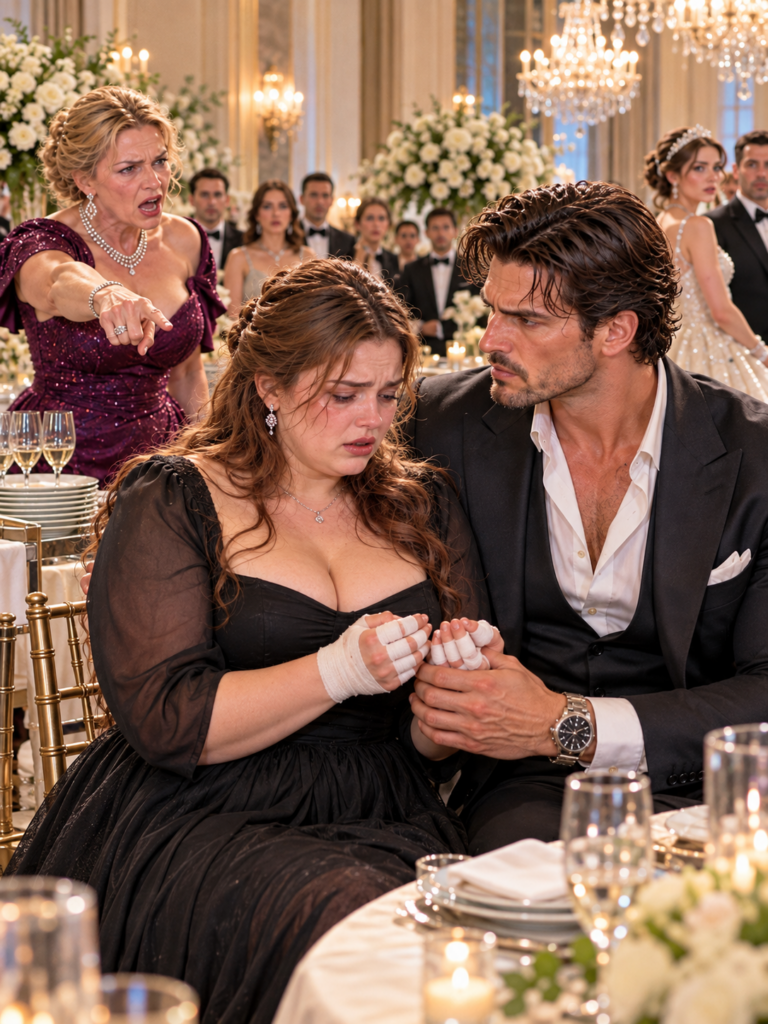
Every fingertip was wrapped in medical tape.
And somewhere on the crowded dance floor, Dominic Coretti’s younger sister was wearing a wedding gown Clara had spent forty nights making with those injured hands.
Nobody knew.
Not the bride.
Not the guests.
Not even, Clara believed, the husband who had purchased her freedom from her father’s creditors six months earlier.
Beatrice leaned closer.
“Now be useful. The staff needs help clearing glasses.”
Clara could have argued.
She could have reminded Beatrice that Dominic Coretti was the most feared mafia boss in New York, and that humiliating his wife might be a dangerous mistake.
But Clara knew the difference between having a powerful husband’s name and having his protection.
For six months, she had possessed the first without ever asking for the second.
So she accepted the tray.
And walked toward the servants’ entrance.
The Pierre Hotel, on East 61st Street in Manhattan, had hosted royalty, presidents, billionaires, and families whose wealth had survived generations of scandal.
Tonight, its grand ballroom belonged to a different kind of aristocracy.
Five hundred guests filled the room beneath cascading chandeliers. White lilies spilled from towering arrangements. A string quartet played beside the dance floor, and waiters carried silver platters through the crowd with practiced discretion.
Some of the guests controlled legitimate corporations.
Others controlled the men who made certain those corporations encountered no unexpected difficulties.
The wedding was being celebrated as a union between two powerful families.
To anyone outside their world, it was an extravagant social event.
To the people sitting at the head table, it was a treaty.
Dominic Coretti’s younger sister, Sophia, had married into the Moretti family.
The marriage was supposed to end years of hostility and establish an alliance powerful enough to dominate New York’s criminal underworld.
Everything about the evening had been planned to communicate wealth, permanence, and control.
Everything except Clara.
She stood beside stacked catering tubs in a plain black dress, collecting abandoned glasses while women wearing necklaces worth more than her childhood home passed without looking at her.
She was accustomed to being overlooked.
Before her marriage, the women in her family had earned their living through tailoring and dressmaking on Mulberry Street.
Her grandmother had taught her to distinguish handmade lace from machine-produced imitation before she could properly write her own name.
Her mother had taught her how to turn an ordinary length of silk into something beautiful enough to make a bride cry.
Her father had taught her a different lesson.
He had taught her how quickly a family could lose everything.
Gambling debts had consumed the last of their savings. Then the workshop. Then the equipment. Eventually, even the family’s modest home had become collateral.
By the time Dominic Coretti entered their lives, Clara’s father owed half a million dollars to men who did not accept apologies.
Dominic had settled the debt.
The price was marriage.
There had been no elaborate courtship, no tender confession, no promise of everlasting devotion.
Clara would become his wife, conduct herself discreetly, and stay out of his affairs.
In return, the creditors would leave her family alone.
At the time, Clara had regarded those terms as the only door left open to her.
Dominic had never pretended it was a love match.
He provided an enormous estate, servants, security, and material comforts she could never have imagined.
But he rarely entered her rooms.
He spoke to her politely when their paths crossed, sometimes asking whether she required anything, but his attention always seemed divided between her answer and the violent world waiting beyond the house.
She never demanded more.
It was easier not to expect tenderness than to discover it had never been offered.
Yet Sophia had been different.
Dominic’s younger sister had never treated Clara as an embarrassing addition to the family.
She visited Clara’s rooms, talked to her about ordinary things, and asked questions about sewing because she genuinely wanted to hear the answers.
When Sophia laughed, she reminded Clara of the girls who used to gather around her mother’s worktable, dreaming about dresses they could not afford.
And forty nights earlier, Sophia had arrived at Clara’s door in tears.
Her custom wedding gown, commissioned from an exclusive Parisian atelier, had been destroyed during a suspicious customs incident.
The elaborate ivory silk, intricate lace, and carefully fitted construction were ruined.
There was no time to commission a replacement of comparable quality.
Clara remembered Sophia sitting at the edge of her bed, trying desperately to sound composed.
“I know people think it’s foolish to care this much about a dress.”
Clara had sat beside her.
“It isn’t foolish.”
“Everyone keeps telling me the marriage matters more. I know that. But I wanted one thing about this day to feel like mine.”
Clara had understood.
Sophia was entering a marriage whose political consequences had occupied far more conversations than the young bride’s happiness.
Clara knew what it meant to have an important decision made around you rather than with you.
She had also spent her childhood watching women transform heartbreak, poverty, and disappointment into beautiful garments for other people’s celebrations.
So she asked Sophia to describe the dress.
Not the price.
Not the designer.
How she had imagined feeling when she wore it.
Sophia talked about flowing ivory silk, tiny pearls, and lace delicate enough to resemble frost against glass.
After Sophia left, Clara went to the estate’s unused attic.
There, among old furniture and trunks, she began working.
She used everything she remembered from her family’s workshop.
Alençon lace. Intricate hand-finishing. Carefully constructed silk panels. Ten thousand seed pearls, each secured with patient, exact stitches.
For forty nights, while Dominic conducted business and the estate settled into silence, she sewed beneath an attic lamp.
The needle pierced her fingertips so often that the skin stopped healing properly.
She kept scraps of muslin beside her work to catch the blood before it could stain the ivory silk.
When the wounds became too painful, she wrapped her fingers in fresh medical tape and continued.
Sometimes she fell asleep in the chair for a few minutes, only to wake with her head against the worktable.
But every morning the dress was closer to completion.
When Sophia finally received it, she believed the family had arranged an emergency replacement through a discreet boutique in Milan.
Clara let her believe it.
She had wanted Sophia to remember the wedding as a beautiful day, not as another sacrifice someone had been forced to make.
Tonight, beneath the ballroom lights, the gown shimmered around Sophia as she danced with her new husband.
Clara watched from beside the kitchen doors.
For a moment, despite her pain, she smiled.
Then she reached for another empty champagne flute.
The tape around her index finger had begun to loosen.
She pressed it back into place.
A sudden movement tugged at her injured ribs, and she had to brace herself against the cart.
The pain in her side was different from the pain in her hands.
That injury had nothing to do with sewing.
It was forty-eight hours old.
And the man who had caused it was sitting comfortably among the Morettis.
Clara looked toward Dante Moretti, the groom’s older brother.
He was laughing at something another guest had said, one hand curled around a glass of expensive scotch.
The sight of him made her stomach contract.
She turned away before he noticed her watching.
A subtle change traveled through the ballroom.
Conversations faltered near the main entrance.
Men who had been leaning comfortably in their chairs straightened.
The string quartet continued playing, but the rhythm suddenly seemed secondary to the sound of the heavy mahogany doors opening.
Dominic Coretti had arrived.
He wore a charcoal suit tailored to his broad shoulders, with neither an unnecessary ornament nor a visible sign of the weapons his enemies assumed he carried.
His dark hair was neatly styled. His expression revealed almost nothing.
But his eyes moved continuously.
They were a cold gray, the color of the sky before a winter storm.
Dominic did not need to raise his voice to command attention.
Some men frightened others by demonstrating what they could do.
Dominic had built his reputation on ensuring they remembered what he had already done.
Senior figures rose as he approached.
Several greeted him with restrained smiles that contained more caution than affection.
Lorenzo Moretti, the groom’s father, stood near the head table and spread his arms.
“Dominic. Finally. Come and enjoy your sister’s wedding.”
Dominic shook his hand briefly.
His eyes moved past Lorenzo.
There was an empty place at the family table.
But not the one he was looking for.
“Where is Clara?”
Lorenzo hesitated just long enough to be noticeable.
“Your wife wasn’t feeling well. Beatrice thought she should rest somewhere quiet.”
Dominic looked at him.
“Rest?”
“The celebrations can be exhausting. Especially for someone unaccustomed to this kind of occasion.”
Lorenzo gestured toward the seat beside him.
“Come. Sit. We have much to celebrate.”
Dominic remained standing.
Across the room, Sophia turned beneath her husband’s arm.
The folds of her ivory dress moved like water, scattering reflections from thousands of tiny pearls.
Dominic’s attention caught on the hem.
He recognized something.
Not the design itself.
The stitching.
A repeating, almost invisible pattern in the way the lace joined the silk.
It was a technique he had not seen for years.
His late father had once favored suits made by old craftsmen on Mulberry Street, men whose work looked ordinary to anyone who did not know what to examine.
Dominic remembered watching his father run a thumb along the inside of a jacket and explain that real craftsmanship was often hidden where only the wearer would know to look.
The technique on Sophia’s gown belonged to that same tradition.
He studied the lace for another second.
Then he turned and searched the ballroom.
Past the gold-trimmed chairs.
Past the guests and the immense floral arrangements.
Past a cluster of wealthy men debating something beneath an ice sculpture.
And finally, near the catering entrance, he found his wife.
Clara was holding a heavy pitcher of ice water.
Her dark dress was unadorned, her hair pinned back without jewelry.
She stood beside two busboys, waiting for them to finish collecting dishes.
Even from across the room, Dominic noticed that she was holding the pitcher awkwardly.
Then he saw her fingers.
Medical tape covered every one.
He remembered the estate’s security reports.
For weeks, they had recorded Clara entering the old attic after midnight and sometimes remaining there until dawn.
The detail had seemed strange.
He had never asked her about it.
Now he looked again at Sophia’s dress.
At the hand-finished lace.
At the pearls.
At Clara’s bandaged fingers.
The pieces arranged themselves into a truth so simple that he was ashamed he had not recognized it sooner.
His wife had made the gown.
And she was standing among the servants while his sister danced in the masterpiece she had created.
Dominic began walking.
He crossed directly through the crowded dining area, forcing guests to move their chairs as he passed.
A senator interrupted his conversation mid-sentence.
A woman lowered her champagne glass.
Lorenzo called his name.
Dominic did not respond.
Clara noticed the movement when a waiter beside her suddenly stepped away.
She looked up.
Her husband was coming toward her.
For an irrational moment, she wondered whether she had done something wrong.
She tried to set the pitcher down, but its weight pulled painfully at her ribs.
Dominic reached her before she managed it.
Without speaking, he took the pitcher from her hands and placed it on the service cart.
The dull sound of the glass touching metal seemed unusually loud.
“Clara.”
She looked at him.
“Dominic. I’m sorry. I didn’t realize you were here.”
His gaze moved over her face, her dress, and finally her hands.
“Why are you standing here?”
She glanced toward the head table.
“Mrs. Moretti said the family seating was full.”
He turned his head slightly.
Across the ballroom, Beatrice Moretti was watching them.
The older woman’s expression changed when Dominic met her eyes.
Clara hurried to soften the explanation.
“It’s all right. The catering staff needed help, and I wasn’t doing anything important.”
Dominic looked back at her.
“Show me your hands.”
She instinctively folded them against her dress.
“It’s nothing.”
“Please.”
The word surprised her.
He extended his hand and waited.
After a moment, she placed her fingers against his palm.
He supported them with astonishing care.
The medical tape was frayed and faintly stained. Beneath it, the skin was swollen from countless punctures.
Dominic examined the wounds without speaking.
Then his eyes moved toward Sophia.
“The dress,” he said quietly.
Clara’s breath caught.
“What about it?”
“You made it.”
She lowered her gaze.
He did not need an answer.
“Forty nights,” he murmured.
She looked up sharply.
“How did you know?”
“I saw the security logs.”
His thumb moved gently along the side of her bandaged hand.
“I should have asked.”
For a moment, the sounds of the wedding seemed to recede.
Clara did not know what unsettled her more: that he had discovered her secret or that he seemed genuinely troubled by it.
“I only wanted Sophia to be happy,” she said.
Dominic studied her.
His expression was unlike anything she had seen during their marriage.
There was anger in it.
But the anger was not directed at her.
“Come with me.”
He kept her hand in his and led her toward the family table.
The guests parted.
By the time they reached the front of the ballroom, the conversation around the head table had stopped.
Dante Moretti occupied the seat intended for the bride’s family.
He glanced at Clara’s black dress and smirked.
“What’s this? The help gets promoted?”
Dominic stopped beside his chair.
“Stand up.”
Dante leaned back, amused.
“Relax, Coretti. There’s plenty of room near the kitchens. She seemed perfectly happy there.”
Dominic gripped the back of the heavy wooden chair.
With one sharp movement, he pulled it away from the table.
Dante lurched forward, spilling scotch across his expensive shirt.
He scrambled to his feet as the chair struck the floor.
Dominic stepped closer.
He spoke so quietly that only the nearest guests could hear.
“You injured my wife once, Dante. Don’t mistake my restraint for permission to do it again.”
Dante’s face lost color.
Dominic continued.
“If you ever lay a hand on her, or speak to her that way again, there will be consequences you cannot negotiate your way out of.”
Lorenzo rose.
“Dominic, this is my son’s wedding—”
“Then teach your other son how to behave at it.”
Lorenzo stopped.
Something passed between the two men.
A recognition of power.
A warning.
Dominic picked up the fallen chair, placed it properly beside the table, and pulled it out for Clara.
His voice changed when he addressed her.
“Sit here. Beside me.”
She hesitated.
“Dominic, everyone is looking.”
“Then let them see where my wife belongs.”
Clara sat.
Dominic took the adjacent chair, moving it close enough that their shoulders almost touched.
Beneath the white tablecloth, he took her injured hand again.
For the first time in six months, Clara sat beside her husband not because a marriage agreement required it, but because he had chosen to have her there.
She wanted to believe the moment meant something.
Then she looked across the table.
Lorenzo Moretti was watching them.
The older man lowered his eyes to his gold wristwatch.
He checked the time.
Slowly, deliberately, he looked up and smiled at Clara.
There was no embarrassment in his expression.
No resentment over what Dominic had just done.
Only a terrible kind of anticipation.
And Clara realized that Beatrice’s decision to send her among the catering staff might never have been about humiliation alone.
Something else was happening.
Something the Morettis did not want Dominic Coretti’s wife sitting close enough to witness.
Part 2
Dominic could feel Clara trembling.
Her hand rested in his beneath the tablecloth, so small against his that he could almost enclose it entirely.
He had spent years learning to read people.
A glance toward an exit. The brief movement of a hand toward a concealed weapon. A pause before an answer that arrived too carefully.
But he had failed to read the woman living beneath his own roof.
Or perhaps he had never tried.
The distinction disturbed him.
“Tell me something,” he said, keeping his voice low enough that the other guests could not hear.
Clara turned toward him.
“Why didn’t you tell me about the gown?”
She looked at Sophia, who was laughing as her new husband guided her across the dance floor.
“Would it have changed anything?”
“Yes.”
“How?”
Dominic opened his mouth.
Then closed it.
He could have promised money, recognition, a private celebration, any number of gestures that would have cost him nothing.
But she had not asked for any of those things.
She had given Sophia something that could not be purchased in time for the wedding.
And she had paid for it with forty nights of exhaustion and physical pain.
“I would have made sure you weren’t doing it alone,” he finally said.
Clara studied him.
“You have more important things to worry about.”
“That is what I thought.”
The answer unsettled her because he did not sound proud of it.
Dominic turned her hand over, examining the tape that had loosened near her thumb.
“Do they still hurt?”
“Sometimes.”
“How much?”
“Enough that I can’t hold a needle properly anymore.”
Something changed in his expression.
For a man whose life revolved around money, influence, and force, it was an unusually helpless moment.
He knew how to destroy an enemy’s financial empire.
He knew how to make dangerous men reconsider their loyalties.
He knew how to identify a threat before it reached his front door.
But he could not undo forty nights of damage to his wife’s hands.
“Clara,” he said, “the dress wasn’t ruined by accident.”
She looked at him.
“What?”
“The customs incident. The delay. The damage.” He paused. “The Morettis arranged it.”
Her eyes moved toward Beatrice.
“Why would they do that to Sophia?”
“To embarrass my family. A small insult, publicly delivered, at a wedding meant to celebrate our alliance.”
Clara stared toward the dance floor.
Sophia had been so devastated that night.
The young woman’s tears had not been political.
They had been real.
“And they were willing to hurt their own bride to do it?”
Dominic gave a humorless smile.
“People like Lorenzo sometimes confuse cruelty with strength.”
Clara considered the thousands of tiny pearls she had sewn by hand.
All those hours.
All that pain.
She had thought she was repairing an unfortunate accident.
Instead, she had unknowingly undone a calculated humiliation.
Dominic seemed to understand what she was thinking.
“They wanted my sister walking into that church feeling diminished,” he said. “You made certain she didn’t.”
Clara shook her head.
“She came to me crying. That’s all.”
“That was enough for you.”
The simplicity of the statement made her throat tighten.
She looked away.
Dominic was quiet for several seconds.
Then his attention moved toward her left shoulder.
“There’s something else.”
Her entire body became still.
His hand rose cautiously toward the neckline of her dress.
He brushed his knuckles near her collarbone, stopping when he felt the thickness of medical gauze beneath the fabric.
Clara caught her breath and pulled away.
Dominic immediately withdrew his hand.
“I’m sorry.”
She stared at him.
He lowered his voice further.
“I know what happened behind the compound.”
The blood seemed to drain from her face.
“The alley?”
He nodded.
For a moment, Clara could hear nothing but the quartet.
Then the memory returned with brutal clarity.
Forty-eight hours earlier, the Coretti family compound had been crowded with preparations for the wedding rehearsal dinner.
Caterers carried equipment through the service entrances.
Drivers lined up expensive vehicles outside.
Security teams checked arrivals against lists.
Everyone appeared too busy to notice one exhausted woman slipping outside for a few minutes of air.
Clara had been awake most of the previous night, finishing the smallest details on Sophia’s gown.
Her fingertips burned.
She had gone toward the rear service alley, hoping the cool air would ease the headache pressing behind her eyes.
That was when she heard the sound.
A small, muffled whimper.
She stopped.
Beyond several stacked wooden crates, Dante Moretti stood beside his Mercedes.
A young boy was backed against the brick wall.
Clara recognized him as Leo, the seven-year-old son of the catering manager.
Leo could not speak.
His small hands moved frantically as he tried to communicate.
Broken wine glasses were scattered across the asphalt. A crate lay overturned nearby.
There was a scratch along the paintwork of Dante’s car.
Dante held a steel tire iron.
“You know how much this car costs?” he demanded.
Leo recoiled.
His mouth opened, but no words came.
Dante stepped closer.
“Look at me when I’m talking to you.”
Clara moved forward.
“Leave him alone.”
Dante turned.
His expression shifted from anger to amusement.
“Well. The Coretti charity case.”
“He’s a child.”
“He damaged my property.”
“It was an accident.”
Dante glanced at the shattered glass.
“Then someone has to teach him to be careful.”
He raised the tire iron.
Clara saw Leo’s terrified face.
She did not weigh the danger or consider whose family Dante belonged to.
She moved.
The blow intended for the boy struck her left shoulder and ribs.
Pain tore through her body with such force that her knees hit the asphalt.
For an instant, she could not breathe.
She could only hear the ringing inside her head and feel Leo trembling beneath her.
Dante laughed.
“Still trying to be a hero?”
Clara curled herself around the child.
“Please,” she gasped. “He’s done nothing to deserve this.”
Dante lifted the tire iron again.
She knew she could not survive another full-strength blow without risking something worse than a broken rib.
Her hand moved toward the money hidden in her pocket.
Three thousand dollars.
It was everything she had secretly saved to purchase asthma medication for her younger brother.
Money she had accumulated a little at a time, holding on to each bill because her brother’s breathing problems could not be solved with good intentions.
Clara pulled out the folded cash.
“Take it.”
Dante stopped.
She pushed the money toward his polished shoes.
“It’s more than enough for the damage. Just leave him.”
Dante looked down.
Then he took the money.
“You should remember your place,” he said.
He kicked her hard in the thigh.
Clara curled further around Leo.
Dante spat near her shoulder and walked away, leaving the tire iron behind.
She remained on the wet asphalt until she could breathe without nearly fainting.
Leo’s small hands touched her face.
His eyes were full of terror.
“It’s all right,” she whispered.
She forced herself to sit up.
“You’re safe.”
The boy could not answer, but he clung to her.
Clara checked his scraped knees, cleaned away the blood as best she could, and stayed with him until he was calm enough to return to his father.
Only then did she confront the pain in her own body.
Her shoulder was badly bruised.
Every breath sent a sharp sensation through the left side of her chest.
She suspected one of her ribs was fractured.
But she said nothing.
She had learned long ago that revealing an injury did not guarantee that anyone would help.
Before leaving the alley, she retrieved the discarded tire iron.
She wrapped it in a linen cloth.
Dante had hurt her, threatened a child, and taken her brother’s medication money.
She intended to give the weapon to Dominic’s enforcers as evidence.
She was frightened of accusing a Moretti without proof.
Tonight, she had brought the wrapped iron to the hotel’s catering area, planning to turn it over after the wedding.
But when Beatrice sent her among the staff, Clara had hidden it beneath the service cart instead.
She had not expected to need it again.
Back at the wedding table, Clara stared at her husband.
“You saw that?”
Dominic’s expression darkened.
“I was on the second-floor balcony.”
She waited.
He did not look away.
“I saw Dante strike you. I saw you shield the boy. And I saw you give him your money.”
Clara tried to understand what she was hearing.
For forty-eight hours, she had believed she was alone with the memory.
Now she discovered that her husband had witnessed it.
“You were there,” she said.
“Yes.”
Her voice became quieter.
“Then you know what he did.”
“I know.”
A painful question rose in her chest.
Why hadn’t he stopped it?
Why had she spent the following two days trying to hide her injuries if he already knew?
Dominic seemed to read the question.
“I should have prevented it,” he said.
Clara stared at him.
He did not attempt to excuse himself.
“I have no defense for what happened to you.”
His fingers loosened around hers, giving her room to withdraw.
She did not.
For a long moment, neither spoke.
Then Dominic said something she had never heard him discuss.
“When I was ten, rival men attacked my mother in the street.”
Clara turned toward him.
Dominic looked past the glittering tables.
“I was a child. I couldn’t stop them. There were people watching from their windows, but nobody came outside.”
His voice remained controlled, though the memory had clearly never left him.
“I remember thinking that one person moving toward her might have changed everything.”
Clara felt the weight of his words.
He looked directly at her.
“You saw a boy you didn’t know. You had no protection, no weapon, no reason to believe anyone would help you. But you moved toward him.”
“He was frightened.”
“So were you.”
“Yes,” she admitted.
Dominic lowered his forehead against her temple for a brief moment.
The gesture was so unguarded that Clara stopped breathing.
“I have spent my life surrounded by people who mistake power for courage,” he murmured. “You showed more courage in that alley than most of them will ever possess.”
She closed her eyes.
His words reached a place inside her that had gone untouched for years.
“Dominic…”
“Dante will answer for what he did.”
There was no theatrical anger in his voice.
That made the promise more frightening.
“Tomorrow, I’ll deal with him.”
Clara looked at him.
“I don’t want anyone else hurt because of me.”
His expression softened.
“You didn’t cause this.”
He paused.
“And tonight, you’re going to let someone take care of you for once.”
For the first time since their marriage, Clara felt the possibility of something beyond obligation.
Not because Dominic was wealthy.
Not because men feared him.
But because he was finally speaking to her as though her pain mattered.
She leaned slightly toward him.
His hand closed around hers again.
For a few precious seconds, the ballroom seemed almost peaceful.
Then Clara noticed the waiter carrying a bottle of Barolo past the adjacent table.
And the warmth vanished from her body.
She recognized nearly everyone on the catering team.
Beatrice’s humiliation had placed her among them for much of the reception.
She had helped clear their trays.
She had shared bread with them near the kitchen.
The catering manager had thanked her for her kindness, unaware that she had saved his son’s life two evenings earlier.
Clara knew the busboys, the servers, and the head sommelier.
The man carrying the Barolo was not the head sommelier.
He moved differently.
His eyes kept shifting from the wineglasses to the guards positioned along the walls.
A folded white towel hung over his arm.
Something rigid distorted the fabric beneath it.
Clara looked toward the south wall.
Two men wearing catering jackets were collecting dishes.
She had never seen them before.
Their jackets fit badly around the waist, as though something heavy was concealed beneath them.
A cold sensation moved down her spine.
She glanced toward the main doors.
A length of industrial chain had been looped through the large brass handles.
The doors were locked.
Her gaze moved to Lorenzo Moretti.
He was not drinking.
His untouched wine stood beside him while he watched Dominic with an expression of unbearable patience.
Dante sat farther down the room.
His hand rested inside his suit jacket.
He was watching the Coretti guards.
Clara’s breathing shortened.
She looked down at Dominic’s phone.
Its screen showed that the cellular connection had disappeared.
The device had been working earlier.
Now there was no service.
A signal jammer.
The unfamiliar catering workers.
The chained doors.
Lorenzo’s repeated glances at his watch.
The deliberate removal of Clara from the family table.
And the strange customs sabotage intended to weaken the Coretti family’s standing before the wedding.
Separate details suddenly formed one terrible picture.
The Morettis had gathered the Coretti leadership inside a room they could seal.
This was not merely a wedding celebration.
It was an ambush.
Clara squeezed Dominic’s hand.
“Don’t turn around,” she whispered.
He continued looking pleasantly toward the dance floor.
But she felt his fingers become still.
“Tell me.”
“Keep smiling.”
Dominic lifted his champagne glass.
To the surrounding guests, they appeared to be sharing a quiet conversation.
Clara leaned toward his shoulder, hiding her mouth from Lorenzo.
“The man serving wine near table four doesn’t belong to the catering team.”
Dominic took a small sip.
“Go on.”
“There are strangers near the south wall. Their jackets are hiding weapons.”
His expression did not change.
“The main doors have been chained. Your phone has no signal.”
A fraction of a second passed.
Clara watched the false sommelier move behind one of Dominic’s bodyguards.
The towel shifted.
She saw the outline of a suppressed pistol.
“Dominic,” she whispered, barely moving her lips. “The wine server has a gun. He’s behind your men.”
Dominic set his glass down.
For an instant, Clara felt the full weight of the man he was outside their private conversation.
The dangerous intelligence.
The absolute command of his fear.
The speed with which he made decisions when other people would still be trying to understand what was happening.
“When the quartet stops,” he whispered, “get beneath the table. Keep your eyes open.”
Clara’s stomach twisted.
“What are you going to do?”
“Keep you alive.”
The lead cellist lifted his bow.
For a moment, nothing happened.
Then the music stopped.
Clara dropped.
Dominic moved at the same instant.
The false sommelier pulled the pistol from beneath his towel.
He aimed toward Dominic’s back.
But Dominic already had both hands beneath the edge of the massive oak table.
With a violent movement, he heaved it over.
Crystal shattered.
Silver platters crashed to the floor.
The enormous wedding cake collapsed in a spray of broken decorations and ivory icing.
The heavy table struck the carpet on its side just as the gunman fired.
Bullets tore into the wood above Clara.
Splinters scattered across her hair.
Then the ballroom erupted.
Guests screamed.
Chairs overturned.
Gunfire burst from the south wall as the fake busboys dropped their trays and revealed compact automatic weapons.
The Coretti security detail returned fire.
Dominic drew a black pistol from his ankle holster.
He leaned beyond the overturned table, fired two controlled shots, and sent the false sommelier collapsing onto the marble.
Clara crouched beside him, her wounded ribs burning with every breath.
The air filled with smoke, shattered plaster, and the bitter smell of gunpowder.
People rushed toward the main doors.
They found the chains.
Panic spread through the crowd.
The Coretti guards were trapped in dangerous positions around the ballroom.
Their opponents had planned the assault carefully.
They knew where the security teams would stand.
They knew where the guests would gather.
They had chosen their positions before the first shot.
Dominic pressed a spare magazine into Clara’s hand.
“Hold this. Stay low.”
She gripped it despite the pain in her fingers.
Around them, gunfire continued.
Dominic’s men fought to protect the surviving guests, but the attackers controlled the exits.
Clara could hear someone praying.
Someone else was calling for a child.
Then an amplified voice broke through the chaos.
“Enough!”
Lorenzo Moretti stood on the bandstand with a microphone.
Armed men surrounded him.
His expensive suit remained immaculate.
“Tell your men to stop shooting, Dominic. Unless you want your sister to die before her wedding night is over.”
The gunfire slowed.
Then stopped.
From behind a shattered ice sculpture, Dante Moretti emerged.
He was dragging Sophia by her hair.
Her beautiful gown was ruined.
The ivory silk had been torn. Dirty water and blood stained the lace, and the pearls scattered light across the damaged fabric.
A silver revolver was pressed against her temple.
Sophia sobbed, struggling to stay on her feet.
Dante pulled her upright.
“Look at your precious sister,” he shouted. “Look what all that money bought her.”
Dominic went completely still.
Clara saw something change in his eyes.
The cold calculation was still there.
But beneath it lay a fear he could not entirely conceal.
Dante cocked the revolver.
The metallic click seemed to reach every corner of the ballroom.
“Come out, Coretti.”
Sophia whimpered.
Dante pressed the barrel harder against her head.
“Put down your gun. Walk into the middle of the room. Then kneel.”
Lorenzo watched from the bandstand.
The remaining Moretti gunmen lifted their weapons toward Dominic’s hiding place.
Clara understood the plan.
If Dominic surrendered, Lorenzo would have him killed.
If he refused, Dante would kill Sophia.
And after Dominic was gone, there would be no reason to spare his wife.
No reason to spare the Coretti guards.
No reason to honor the marriage treaty that had brought them there.
The entire empire would collapse in a single night.
Dominic glanced at Clara.
There was an apology in his eyes.
She caught his wrist.
“Don’t.”
He lowered his face close to hers.
“She’s my sister.”
“They’re going to kill you.”
“I know.”
“Dominic, please.”
He looked at her bandaged fingers gripping his sleeve.
For a moment, she saw how much he wanted to remain beside her.
Then he gently freed himself.
“I can’t let them kill her while I stand here.”
He removed the magazine from his pistol and placed the weapon on the carpet.
Slowly, he rose.
The Moretti gunmen turned their rifles toward him.
Dominic stepped beyond the barricade with his hands raised.
Lorenzo smiled.
Dante began laughing.
“That’s it, Coretti. Now show everyone who’s in charge.”
Dominic walked toward the center of the ballroom.
Clara remained on the floor, holding the spare magazine he had given her.
Every instinct told her to scream.
Instead, she looked around.
There were overturned chairs, fallen trays, broken glass, and pools of spilled wine.
Beside the service cart lay the same pile of catering supplies she had stood near earlier.
Beneath a crushed bus tub, part of a stained linen napkin had come loose.
Something dark and metallic showed beneath it.
Clara recognized the object immediately.
Dante’s tire iron.
The weapon that had broken her rib.
The weapon she had brought as evidence.
It was only a few feet away.
Across the ballroom, Dante forced Dominic down toward his knees.
Clara looked at the distance between the service cart and the kitchen doors.
She remembered the narrow routes the catering workers used behind the floral arrangements.
She remembered how the armed men had ignored her when she was carrying dirty glasses.
And she understood something they had overlooked.
The Morettis had spent the entire evening treating her as if she were invisible.
Now, with her husband facing execution, invisibility was the one advantage she still possessed.
Part 3
Clara had learned many things during six months in the Coretti household.
She had learned which hallways remained quiet after midnight.
She had learned that the most dangerous conversations were often conducted in the softest voices.
She had learned to recognize fear beneath expensive suits and arrogance beneath polished manners.
But the most important lesson had come from watching how people treated her.
They looked through her.
They talked over her.
They assumed that silence meant ignorance and that obedience meant weakness.
Dante Moretti had made the same mistake.
Now he stood thirty feet away, forcing her husband to kneel, while the men around him watched Dominic as though no one else in the ballroom mattered.
Clara lowered herself onto her stomach.
Pain exploded beneath her ribs.
She pressed her lips together to stop the sound escaping.
Then she crawled.
Broken glass glittered beneath overturned chairs.
She dragged herself toward the service cart, moving slowly enough to avoid attracting attention.
Her fingertips brushed the stained linen.
She pulled it aside.
The tire iron was still there.
Cold.
Heavy.
Familiar.
For a moment, her mind returned to the alley.
Dante’s laughter.
The terrified child beneath her.
The sickening impact of metal against bone.
Her younger brother’s three thousand dollars disappearing into a cruel man’s pocket.
She had been helpless then.
Or at least Dante had believed she was.
Clara wrapped both hands around the iron.
The rough steel tore against her bandages.
Fresh blood spread beneath the medical tape.
She tightened her grip.
Ahead of her, Dante pushed Dominic’s shoulder downward.
“Kneel properly,” he said.
Dominic’s knees touched the carpet.
Sophia sobbed beside him.
Lorenzo descended from the bandstand, surrounded by armed men.
His smile was calm.
The smile of someone who believed the evening’s outcome had already been decided.
Clara moved into the narrow service passage behind the floral arrangements.
She knew this route because she had spent the earlier part of the reception collecting dirty dishes.
The arrangement that had concealed her humiliation now concealed her movements.
A fallen chair blocked part of the passage.
She maneuvered around it, ignoring the pain that spread through her left shoulder.
Dante was still talking.
He wanted to savor the moment.
He wanted Dominic Coretti, the man whose reputation had intimidated entire criminal families, to acknowledge defeat.
That arrogance kept his attention fixed forward.
Clara drew closer.
Ten feet.
Six.
Three.
Her breathing became shallow.
She could barely feel her hands.
At the center of the ballroom, Dante shoved the revolver against Sophia’s temple.
“Tell your men to surrender,” he ordered.
Dominic kept his voice level.
“Let my sister go.”
Dante laughed.
“Still giving orders?”
Sophia shut her eyes.
And Clara stepped out from behind the floral arrangement.
She did not shout.
She did not warn him.
She swung the tire iron with every remaining ounce of strength.
The steel struck the back of Dante’s knee.
A terrible cracking sound cut through the ballroom.
Dante screamed.
His leg folded beneath him.
Sophia stumbled sideways as his grip weakened.
Clara raised the iron again.
Pain nearly blinded her, but she brought it down across the wrist holding the revolver.
The impact shattered bone.
Dante released the weapon.
It struck the marble and slid away.
Sophia scrambled free.
For one suspended instant, nobody seemed capable of understanding what had happened.
The quiet wife.
The woman they had ordered to sit with the servants.
The woman Dante had beaten and dismissed.
She stood behind him with blood soaking through the bandages on her hands.
Then Dominic moved.
He surged upward, striking the nearest Moretti gunman before the man could react.
Dominic seized the attacker’s rifle and turned it toward Lorenzo’s armed guards.
The Coretti security detail recognized the opening immediately.
Gunfire erupted again.
Dominic’s men broke from behind their cover and forced the Moretti gunmen away from the surviving guests.
Lorenzo shouted orders.
Dante lay on the marble, clutching his broken wrist and screaming.
Clara staggered backward.
The tire iron slipped in her hands.
She could barely draw enough breath to remain standing.
Through the confusion, she saw Sophia crawl behind an overturned chair.
She was alive.
Dominic was alive.
That was all Clara needed to know.
Then the kitchen doors burst open.
A small figure appeared in the entrance.
Leo.
The seven-year-old boy stood trembling beneath the harsh service lights.
His face was pale.
His clothing was dusty.
Behind him, the corridor filled with movement.
Armed NYPD tactical officers entered with agents from the FBI’s organized crime units.
“Police! Drop your weapons!”
The order thundered through the ballroom.
More officers poured through the service entrance.
Leo had crawled through the industrial ventilation passages behind the pantry and reached the building’s emergency lockdown override.
He had activated the mechanism that allowed the authorities to gain access despite the Morettis’ attempt to seal the ballroom.
The boy who had been considered too powerless to defend himself had found a way to save the people trapped inside.
Clara stared at him.
Leo saw her.
For a moment, neither moved.
Then the boy raised one trembling hand.
Clara tried to smile.
The expression broke when another wave of pain seized her ribs.
Around the ballroom, the balance of power changed completely.
The surviving Moretti gunmen began dropping their weapons.
Police forced them to the floor.
Federal agents moved toward Lorenzo.
His face had lost its color.
“This is a misunderstanding,” he said, looking from one agent to another. “You have no idea who you’re dealing with.”
An agent pushed him against the wall and secured his hands.
The evening’s evidence supported a sweeping racketeering investigation, including charges connected to the planned attack and the organized violence behind it.
Lorenzo’s carefully constructed empire was no longer protected by the men he believed he controlled.
Dante lay among the shattered decorations, begging for someone to help his injured leg and wrist.
Paramedics rushed toward him.
The silver revolver lay several feet away, sealed off as evidence.
Police began moving the surviving guests toward safety.
Some were crying.
Others stared silently at the destruction around them.
The ballroom that had welcomed five hundred of New York’s wealthiest and most dangerous people now resembled the aftermath of a battlefield.
Crystal hung broken from the chandeliers.
White lilies lay crushed beneath chairs.
The enormous wedding cake had been reduced to ruined tiers and scattered icing.
Sophia sat wrapped in a blanket, her torn gown pooled around her.
The pearls Clara had sewn so carefully were scattered across the marble.
But Sophia was alive.
Clara let the tire iron fall.
The impact rang against the floor.
Her knees gave way.
She collapsed onto the carpet.
Dominic saw her fall.
Everything else ceased to matter.
He moved past the federal agents, the armed officers, and the paramedics tending to the injured.
He dropped to his knees beside his wife.
“Clara.”
Her eyes were open.
She was trying to breathe.
He reached for her, then stopped himself, suddenly terrified of worsening the injury to her ribs.
“Look at me.”
She did.
“Dominic.”
“I’m here.”
Her face was pale with pain.
“Is Sophia safe?”
He glanced toward his sister.
“Yes.”
“And Leo?”
“He’s safe too.”
Clara closed her eyes.
A faint sound escaped her.
It might have been relief.
It might have been exhaustion.
Dominic slid one arm carefully behind her, supporting her without pressing against her injured side.
He drew her gently against his chest.
The expensive charcoal suit was stained with blood, dust, and spilled wine.
He did not notice.
For years, he had believed that protecting his family meant possessing enough power to destroy anyone who threatened them.
Tonight, his sister and his life had been saved by a woman he had barely known how to speak to.
A woman he had allowed to live alone inside his enormous house.
His arms tightened slightly around her.
“I’ve got you.”
Clara’s fingers curled weakly against his jacket.
“I thought they were going to kill you.”
“I know.”
“I couldn’t let them.”
Dominic lowered his face into her hair.
His breath shook.
“I know.”
Around them, emergency workers continued clearing the ballroom.
An officer approached, then stepped away when a paramedic indicated that Clara required attention.
Dominic remained beside her as the medical team examined her injuries.
He held her undamaged palm as gently as he could.
Clara looked toward the shattered tables.
“I ruined the wedding.”
Dominic gave a short, disbelieving laugh.
“You saved the bride.”
“The dress…”
He followed her gaze.
The ivory silk was torn and stained beyond recognition.
Hundreds of pearls glittered across the ruined floor.
Forty nights of painstaking work had been destroyed in minutes.
“Clara,” he said quietly, “my sister gets to live long enough to wear another dress.”
She looked at him.
His eyes were wet.
“You made that possible.”
Clara wanted to answer.
Instead, exhaustion finally overtook her.
She allowed her head to rest against his shoulder.
For the first time in her marriage, she did not feel that asking for his support was an imposition.
Three hours later, rain moved softly against the reinforced windows of Dominic Coretti’s private study.
The estate was silent.
The chaos of the Pierre Hotel felt impossibly distant, though the pain beneath Clara’s ribs made it impossible to mistake the night for a dream.
She sat on the leather sofa wearing an oversized cashmere sweater belonging to Dominic.
The sleeves covered most of her hands.
Medical professionals had already examined her injuries and attended to the damage caused by the violence.
Now Dominic knelt before her on the thick rug.
A shallow crystal bowl of warm water rested on the coffee table beside a first-aid kit.
He carefully took her right hand.
“I need to remove the old tape.”
Clara nodded.
He began with her little finger.
The adhesive had dried against the wounded skin.
He worked slowly, using warm water and a soft cloth to loosen it.
Each time she flinched, he stopped.
“Does that hurt?”
“A little.”
“Tell me if it’s too much.”
She watched him in silence.
This was the same man who had commanded armed guards through a firefight only hours earlier.
The same man whose name frightened powerful people across the city.
Yet now he was kneeling on a rug, struggling to remove medical tape without hurting her.
His concentration was absolute.
One finger at a time, he uncovered the damage she had inflicted on herself while sewing the gown.
Hundreds of tiny punctures.
Swollen skin.
Calluses split open by repeated needle strikes.
Fresh abrasions caused by gripping the tire iron.
Dominic cleaned each wound.
He said nothing for a long time.
Clara studied his face.
There were faint lines of exhaustion around his eyes.
His shirt collar was open.
For once, he looked less like a feared mafia boss and more like a man trying to understand how close he had come to losing something irreplaceable.
“You don’t have to do this yourself,” she said.
“I know.”
“The staff could help.”
“I know that too.”
She waited.
Dominic gently dried her fingers.
“I spent six months believing that providing you with everything was the same as caring for you.”
Clara looked down.
“You provided a great deal.”
“Not what you needed.”
She did not contradict him.
He continued working.
“I knew what your father owed. I knew what marrying me would mean for your family’s safety. I knew the terms of our agreement.”
His hands became still.
“But I didn’t ask what any of it meant to you.”
Clara swallowed.
“I knew what I was agreeing to.”
“You agreed because you had no better choice.”
The words rested heavily between them.
Dominic looked up.
“That isn’t something I can pretend was fair simply because I kept my side of the bargain.”
Clara felt her throat tighten.
She had expected anger from him after the wedding.
Perhaps gratitude.
Perhaps instructions about how she should behave now that the Moretti alliance had collapsed.
She had not expected this quiet admission.
“I never hated you,” she said.
Dominic’s expression softened.
“I know.”
“I was frightened of your world. And sometimes I was lonely.”
His eyes closed briefly.
“When Sophia came to my room crying, I understood her.”
Clara looked toward the rain-streaked windows.
“She was surrounded by people deciding what her wedding should accomplish. Everyone talked about the family and the alliance and what it would mean for everyone else.”
She turned back.
“She just wanted one thing that belonged to her.”
Dominic listened.
“So I made the dress.”
He nodded.
“And the boy?”
Clara’s voice became softer.
“He couldn’t defend himself.”
“And you gave Dante the money intended for your brother.”
“Yes.”
“Why didn’t you ask me for help?”
She looked at her uncovered fingers.
“Because I didn’t know whether I was allowed to.”
Dominic went still.
The answer was more painful than any accusation she could have made.
He had given his wife access to extraordinary wealth.
And somehow, beneath his roof, she had come to believe she needed permission to ask for help with her younger brother’s medication.
He bowed his head.
Clara watched him.
For the first time, she understood that Dominic Coretti’s greatest limitation was not the enemies waiting beyond his gates.
It was the distance he had taught himself to keep from everyone who might matter to him.
After another moment, he finished cleaning her hands.
He held them carefully between his own.
Then he reached into the inner pocket of his jacket.
He withdrew a thick manila envelope.
He placed it on Clara’s lap.
She looked at it.
“What is this?”
Dominic remained on his knees.
“Something I should have offered you a long time ago.”
She opened the envelope.
Inside were legal documents.
She read the heading.
Then she read it again.
Her breath caught.
“Annulment papers?”
“They’re signed.”
Clara looked up sharply.
Dominic continued before she could speak.
“There is also a bearer bond worth ten million dollars. It’s clean money, and you can take it without being tied to my businesses.”
She stared at him.
Outside, rain tapped gently against the glass.
Dominic’s voice was rough.
“You saved Sophia. You saved me. You prevented Lorenzo from turning that ballroom into a slaughterhouse.”
He swallowed.
“And before any of that, you gave forty nights of your life to make my sister happy. You suffered in silence because the people around you made you believe that was all you were entitled to do.”
Clara shook her head.
“Dominic—”
“Please. Let me finish.”
She went quiet.
“I paid your father’s debt and called the arrangement a marriage. But tonight I saw what that arrangement cost you.”
He looked toward the envelope.
“There is a car waiting outside. If you want to leave, you can go anywhere you choose. You won’t owe me anything.”
His hands tightened slightly around hers.
“No one from my world will be permitted to pursue you. You will have my protection without being required to remain my wife.”
Clara stared at the documents.
Freedom.
Real freedom.
Not a borrowed room inside someone else’s estate.
Not security purchased at the price of silence.
Ten million dollars and the legal means to begin again.
She could leave the city.
She could help her younger brother.
She could rebuild the family workshop on Mulberry Street or start somewhere entirely new.
No one would have the right to tell her where to sit.
No one would be able to use her father’s debt to claim ownership of her future.
Dominic had given her the one thing their marriage agreement had never provided.
A choice.
She looked at him.
“You would really let me go?”
His expression tightened.
“If that’s what you want.”
“Even after tonight?”
“Especially after tonight.”
She searched his face.
There was no manipulation in it.
No concealed demand.
Only a terrible sadness he was making no effort to disguise.
“What do you want?” she asked.
Dominic looked down at their joined hands.
For several seconds, he did not answer.
Then he said, “I want you to stay.”
Clara’s heart gave a painful twist.
He looked up.
“But I want you to stay because you choose me. Not because of a debt. Not because you’re frightened. And not because you think you owe me for protecting your family.”
Clara lowered her gaze to the envelope.
Six months earlier, she would have believed ten million dollars was the answer to every problem in her life.
Tonight, she understood that money could provide independence.
But it could not decide whom she loved.
Nor could gratitude.
Nor fear.
She had to make that decision herself.
Clara withdrew the annulment papers.
Dominic watched without moving.
She held the documents between her bandaged fingers.
Then, deliberately, she tore them in half.
The sound seemed extraordinarily loud in the quiet study.
Dominic stared.
Clara tore the papers once more and let the pieces fall onto the rug.
“I don’t want the money,” she whispered.
His expression changed.
“And I don’t want the car.”
“Clara…”
She leaned forward carefully, protecting her injured ribs.
“I didn’t stay beside you tonight because of our agreement.”
He held very still.
“I didn’t crawl across that ballroom because you paid my father’s debt.”
Her eyes filled.
“I did it because I couldn’t bear the thought of watching you die.”
Dominic’s breath caught.
Clara touched his face with one wounded hand.
“But if I stay, things cannot be the same.”
He covered her fingers with his.
“I know.”
“I can’t spend another six months being invisible in my own marriage.”
“You won’t.”
“And I need you to speak to me. Even when the truth is difficult. I won’t be protected by being kept in the dark.”
Dominic nodded.
“You have my word.”
She searched his eyes.
For the first time, she believed that the man in front of her was not simply making another agreement.
He was making a promise he understood might require him to change.
Clara rested her forehead gently against his.
“I want to stay,” she whispered.
Dominic closed his eyes.
The breath that left him sounded almost like relief after a lifetime of holding it in.
He lifted her hands and pressed his lips against the scarred palms.
Not as a man claiming what belonged to him.
But as a man acknowledging something he had nearly lost.
Clara leaned toward him.
He gathered her carefully against his chest, mindful of every injury.
For several moments, neither spoke.
Outside, rain continued falling over the estate.
The house that had once felt enormous and empty seemed different now.
The danger beyond its walls had not disappeared.
Dominic’s past had not been erased.
And the wounds on Clara’s hands would need time to heal.
But the distance between them had finally begun to close.
Dominic held her as though she were the one steady thing remaining in a world that had come apart.
For the first time in years, he felt something he had never managed to purchase or command.
Peace.
Then the heavy mahogany doors of the study creaked open.
Dominic lifted his head.
The change in him was immediate.
His eyes sharpened.
His shoulders became still.
A maid stood in the doorway.
Her face was white with fear.
She held a polished silver tray in both hands.
“Mr. Coretti,” she whispered. “This was delivered for you.”
Dominic did not rise.
Clara turned toward the tray.
Resting on the silver surface was a single flower.
A pure black lily.
Beside it lay an envelope sealed with dark wax.
An unfamiliar crest had been pressed into the seal.
Or at least it was unfamiliar to Clara.
Dominic recognized it.
She knew he did because all the warmth drained from his expression.
He stared at the black lily.
Then at the ancient emblem.
It belonged to a power that the criminal underworld believed had been eradicated a century earlier.
For several seconds, the study remained silent.
The maid trembled in the doorway.
Clara looked from the envelope to her husband.
“Dominic?”
He took her injured hand in his.
His grip was gentle.
But his gaze remained fixed on the wax seal.
Outside, thunder rolled across the darkened grounds of the Coretti estate.
Dominic had survived the Moretti betrayal.
His sister was alive.
His wife had chosen to remain beside him.
For one brief moment, he had believed their darkest night was behind them.
Now, on a silver tray beneath the study lights, lay a black lily from a family that was supposed to have vanished a hundred years ago.
And whatever had sent it knew exactly where to find them.


