
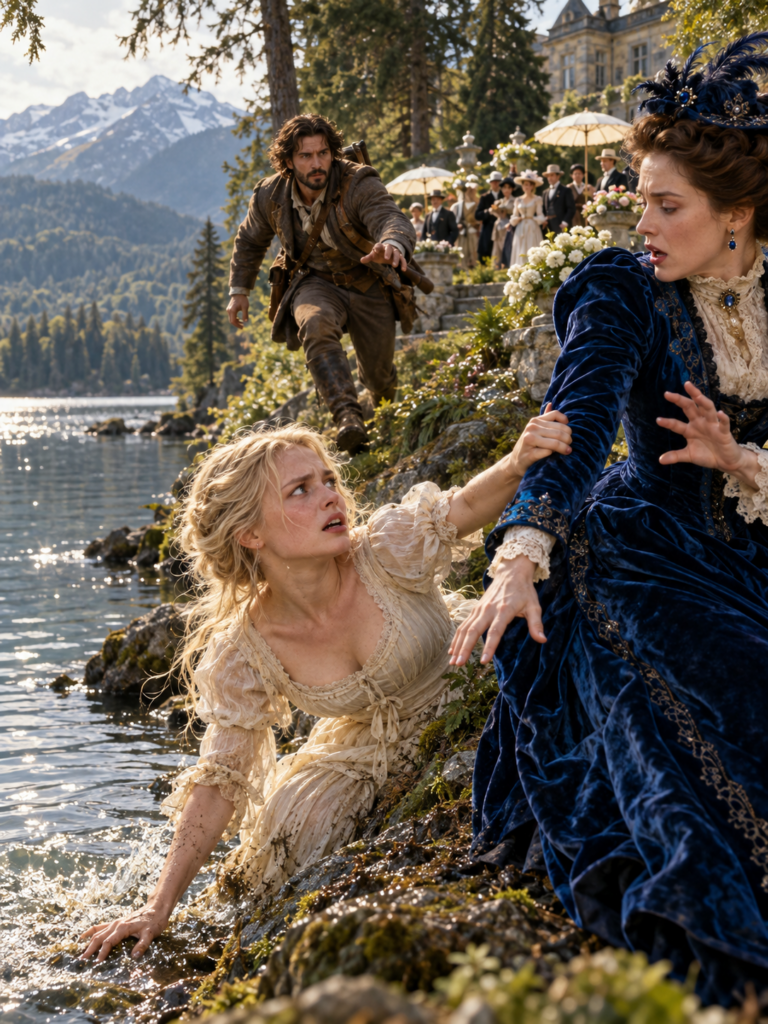
The cup trembled so badly that warm tea spilled across Basia’s fingers.
Arch reached for a cloth but stopped when she tightened her grip.
“I can manage.”
“All right.”
He placed the cloth within her reach and returned to his chair.
That small act unsettled her almost as much as his rescue.
At Devon’s estate, a woman’s wishes mattered only when they were convenient. Servants obeyed rank, relatives obeyed fortune, and everyone expected Basia to obey everyone else.
Yet this imposing stranger had accepted her refusal without argument.
She drank.
The warmth eased her throat, though every breath still scraped painfully through her chest.
“How long have I been here?”
“Since afternoon. It’s well past dark now.”
“My aunt will be looking for me.”
Arch said nothing.
Basia watched him.
“You don’t believe that.”
“I heard the music still playing when I took you away.”
“That doesn’t mean they knew.”
“The woman who pushed you knew.”
Basia lowered the cup.
She remembered Levvenia’s expression after the shove. Not remorse. Not even immediate panic.
A calculation.
“Frederick will believe her,” Basia murmured.
“Perhaps.”
“He is going to marry her.”
“That doesn’t make her truthful.”
Basia gave a small, humorless laugh, followed by a painful cough.
Arch moved to fetch more water, then waited until she could breathe comfortably again.
She studied him over the rim of her cup.
He wore rough wool, heavy canvas trousers, and the expression of a man accustomed to deciding things without consulting society.
A scar crossed one eyebrow.
His hands were broad and calloused.
He looked nothing like the polished gentlemen who had spent her life explaining what she ought to think.
“Why were you there?”
“Checking snares above the property.”
“Are you employed by Frederick?”
“No. I trap and trade on the mountain. The Duke’s guests seldom trouble themselves to climb that far.”
“You don’t like them.”
“I don’t know enough of most of them to say.”
She raised an eyebrow.
He conceded, “I know enough about the one who pushed you.”
For the first time since the lake, Basia almost smiled.
Then she remembered what she had lost.
Her room. Her few belongings. The protection of an old name, however grudgingly given.
“If I stay away,” she said, “people will think I’m dead.”
“Until you tell them otherwise.”
“And if I do, I’ll have nowhere respectable to live afterward.”
Arch looked toward the fire.
“There’s a village below the ridge. Work may be found there. I can take you when you’re well enough.”
She waited for the condition.
There was none.
“You would help me leave?”
“Of course.”
“Even after carrying me all this way?”
He gave her a puzzled look.
“Getting you out of the lake doesn’t give me a claim upon the rest of your life.”
Basia turned her face toward the fire.
That was when she began to cry.
Not loudly.
The tears simply came, one after another, while she struggled to understand why basic decency felt more astonishing than any kindness she had received in the great house.
Arch remained where he was.
After a while, she wiped her cheeks with the cloth.
“May I stay here until I can walk properly?”
“Yes.”
“I will need to know where everything is. And I won’t have anyone deciding my future without consulting me.”
“Fair enough.”
Her gaze moved toward the narrow door, the iron latch, the mountain darkness beyond.
“Then I must ask one more thing.”
“What is it?”
“Promise you won’t tell the Duke I’m alive before I decide what to do.”
Arch considered her request.
“I won’t carry word to him without your consent. But if someone asks after you, I won’t tell a lie that puts you in danger.”
Basia nodded.
It was the first agreement she had ever made with a man in which she felt herself an equal party.
She set the cup down.
Then, despite the ache in her lungs, she pushed back the blankets and swung her feet toward the floor.
“Where are you going?” Arch asked.
“Only to the door.”
“You can barely stand.”
“I know.”
He rose but did not touch her.
She placed her bare feet on the floorboards, gripped the bedframe, and waited for the dizziness to pass.
Then she crossed the few steps to the door.
Below the mountain, the estate had already decided what kind of woman she was.
Here, she had not yet decided.
She put her hand upon the iron latch and began to lift it.
The latch rose beneath Basia’s hand, and the cabin door opened into the cold mountain night.
Wind moved through the pines.
Far below, where the mountains descended toward the valley, she could make out a faint cluster of lights.
Devon’s estate.
From this height it looked strangely insignificant.
Basia gripped the doorframe as dizziness swept over her.
Arch remained close enough to catch her if she fell, but he did not attempt to turn her around.
“That’s where I spent nearly all my life,” she said.
He followed her gaze.
“In that house?”
“In the parts of it nobody notices.”
Her voice weakened.
She coughed, and Arch urged her back toward the warmth.
This time she accepted his arm.
He helped her sit and closed the door.
“One day,” she whispered, “I’m going to walk through those front doors without being afraid.”
Arch stirred the embers.
“Then first you must get strong enough to walk across this room.”
She almost laughed.
The next morning she woke with aching ribs, a raw throat, and a stubborn determination that proved more durable than her strength.
Arch had placed dry clothes and a pair of oversized boots beside the cot.
Her muslin dress hung near the hearth, clean of lakeweed but stained and torn beyond reasonable repair.
“Those boots belonged to a lad I traded with,” Arch explained. “You can put wool in the toes.”
Basia examined them.
“Do you expect me to walk about the mountain dressed like this?”
“I expect you to keep your feet warm.”
She smiled despite herself.
When she attempted to carry a full bucket from the water barrel, her strength deserted her.
Arch took it before she dropped it.
“You’re not fit for that yet.”
“I dislike being useless.”
“Resting after nearly drowning isn’t useless.”
He set the bucket down.
“If you must do something, there’s mending on the table. But I’d rather you didn’t collapse trying to impress me.”
She sat by the fire and examined his torn wool shirt.
She had spent years sewing because it was one of the few skills her relatives considered appropriate for a poor gentlewoman.
Now she discovered that the same skill could provide something genuinely useful.
Arch’s stitches were dreadful.
“Who repaired this?” she asked.
“I did.”
“Was the shirt trying to escape?”
He looked at the crooked seam.
“Kept the cold out.”
“Only because the cold took pity on you.”
A reluctant laugh escaped him.
It was the first time she had heard it.
Over the following days, her coughing gradually lessened, though Arch watched for any renewed difficulty in her breathing.
He showed her how to tend the hearth safely and how to arrange split wood away from damp ground.
When she recovered enough strength, she accompanied him to the nearby stream.
The first bucket she carried was only half-full.
She insisted on carrying it herself.
He did not mock the small accomplishment.
“Well done,” he said.
She found those two words surprisingly precious.
At Devon’s estate, no one praised her for the hours spent making herself useful. Here, another person’s honest recognition meant more than all the empty compliments exchanged beneath chandeliers.
Arch learned things about her as well.
She knew how to mend leather with proper tools, could keep a careful household account, and had an excellent memory for people and conversations.
She knew which village traders supplied the estate kitchens and which servants had worked there longest.
She understood the peculiar machinery of aristocratic reputation.
And she possessed a dry wit that emerged more often as her fear diminished.
One morning she inspected the food stored along the cabin wall.
“How do you know what you’ve enough of?”
“I look.”
“That is not an accounting system.”
“It’s served me well.”
She found a scrap of paper and began making a list of supplies and quantities.
When she finished, Arch discovered he had less salt than he believed and enough dried beans to last considerably longer than expected.
He studied the figures.
“I stand corrected.”
“An excellent beginning.”
He shook his head, amused.
By the fourth day she could walk the clearing without needing to rest. The next morning Arch went down to the village for provisions.
Before leaving, he told her when he expected to return and showed her where food, water, and firewood were kept.
He also left the cabin key on the table.
“You’ll need it if you go outside.”
Basia held it for a moment after he had gone.
She had never possessed a key to any room in Devon’s house.
Her bedroom could be entered by her aunt, a maid, or anyone her relatives considered important.
This simple iron key felt heavier than it ought to.
She spent the afternoon mending her damaged dress and taking in the waist of an old pair of canvas trousers Arch had agreed she might use.
She was tired of clothing designed to restrict her movements.
By sunset, she had a serviceable pair of trousers, though the stitching was not particularly handsome.
Arch returned while she was putting another log on the fire.
He brought salt, flour, a length of stout cloth, and news.
Basia recognized something in his expression.
“What have you heard?”
He placed the supplies on the table.
“They say you drowned.”
She went still.
“Who says?”
“Everyone.”
He told her the village’s account.
Lady Basia had wandered from the garden party in a melancholy state and accidentally slipped into the lake.
Her absence had been discovered too late.
The Duke had ordered a search of the shallows, but the dangerous depth of the lake had defeated the efforts of his servants.
Levvenia, according to the story, had been overcome by grief.
Basia listened without interrupting.
“How long did they search?”
“About an hour, according to the men in the village.”
She looked at her hands.
An hour.
Twenty-two years of life had earned her sixty minutes of inconvenience.
“And Frederick?”
Arch hesitated.
“The wedding will go ahead. They’ve moved the date forward.”
“When?”
“Three weeks from the day you disappeared.”
Basia stood abruptly.
Her chair scraped the floor.
“So that is their answer.”
Arch said nothing.
She walked to the window.
For several moments she stared into the deepening twilight.
Then she spoke.
“If I went back now, Levvenia would say I had fallen and struck my head. Frederick would believe her because the alternative would embarrass him.”
“Possibly.”
“My aunt would be relieved for precisely as long as it took her to realize I had caused a scandal.”
Arch came to stand beside the table.
“What do you want to do?”
Basia turned.
“I want them to hear the truth in front of people they cannot dismiss.”
He regarded her thoughtfully.
“The wedding.”
“Yes.”
“That gives you less than three weeks.”
She looked at the boots by the door.
“Then I had better learn how to walk farther than the stream.”
Arch’s expression grew serious.
“Basia, I saw the shove. I can stand witness to it. But going down there could put you in danger again.”
“I know.”
“And you don’t have to do it.”
“I know that, too.”
That answer pleased him more than any declaration of vengeance could have done.
He would help her because she had chosen her course, not because he wished to decide it for her.
The next days became a period of careful preparation.
Arch taught her to move over loose rock, to keep her balance on steep paths, and to recognize which sections of the mountain could be traveled safely.
He showed her how to handle the pistol he kept for protection, emphasizing restraint and caution.
She discovered that shooting required patience rather than anger.
He also taught her a few ways of freeing herself if someone seized her wrist.
The first time he demonstrated, he stopped immediately when her face changed.
“What is it?”
“Nothing.”
He released her.
“Tell me.”
She looked away.
“Levvenia held me like that.”
Arch lowered his hands.
“Then we won’t practice it until you want to.”
Basia swallowed.
After a moment, she offered him her wrist again.
“Show me slowly.”
He did.
And when she managed to pull free, she stepped backward with a breathless smile.
“There.”
“Better.”
“I should have known that by the lake.”
“You know it now.”
Their days were not all grim preparation.
Sometimes she ruined the potatoes.
Sometimes Arch forgot her supply lists and returned from the village without the very thing she had sent him to buy.
Once, while she repaired his shirt, he produced a bowl of stew so poorly seasoned that she stared at him in disbelief.
“You have lived all these years eating this?”
“I’ve managed.”
“That is a generous description.”
He laughed until she began laughing too.
Those were the moments that frightened her in a different way.
She was beginning to imagine ordinary mornings after the wedding.
Mornings when she might wake without fearing her aunt’s displeasure.
Days filled with useful work.
Evenings when Arch would bring his boots to the hearth and tell her something he had seen on the mountain.
But she kept those imaginings to herself.
She had too little experience of freedom to confuse gratitude with love.
One evening, while he was repairing a worn strap, she asked why he had made his life so distant from other people.
Arch considered the question.
“I came up here for the work. There was good trapping then, and I liked being my own master.”
“And you never wished to go back?”
“To living by other people’s expectations? No.”
“Surely everyone needs company sometimes.”
His hands slowed.
“Sometimes.”
He looked at her.
“But company ought to be chosen.”
Something changed between them then.
Neither spoke of it.
The following morning, Basia took the shears from his tool chest and cut her long pale hair to her jaw.
It was uneven and rough.
When Arch saw her, his eyes widened.
“Well?”
He considered the result.
“Won’t catch in the branches now.”
“That is the finest compliment I have received in years.”
He grinned.
As the wedding approached, Arch brought reports from the village.
The estate was filling with guests. Carriages arrived daily. Guards had been hired to watch the main approaches.
Basia remembered the house better than any guard newly arrived from the city.
She also remembered the disused springhouse passage that connected with the rear service corridors.
Arch knew its entrance from working near the estate boundary.
Together they considered their approach.
She would not enter carrying a drawn weapon or threaten the guests. Her strongest advantage was the truth, spoken in a room full of witnesses.
Arch agreed to accompany her as the man who had seen the assault.
They prepared a written account of what had happened.
Basia signed it, and Arch added his name as witness.
She folded the statement carefully and placed it inside her vest.
On the morning of the wedding, she stood before the cabin’s little mirror.
Her shortened hair framed a face she scarcely recognized.
She wore altered canvas trousers, a wool shirt, a leather vest, and the borrowed boots.
She was no longer dressed for acceptance in a drawing room.
She was dressed to move.
Arch offered her his heavy coat.
“You can still turn back.”
“I know.”
“And if you decide to leave after we arrive, I’ll leave with you.”
Basia looked at him for a long moment.
“Thank you.”
They descended the ridge together.
The journey took hours. At the edge of the estate, they rested beneath the trees and watched the guards stationed near the carriage road.
Beyond them rose the enormous white stone house.
Basia’s pulse quickened.
She remembered every humiliation within those walls.
Every invitation given reluctantly.
Every kindness that had to be repaid in obedience.
Arch noticed her trembling hand.
“Are you frightened?”
“Terribly.”
“That doesn’t mean you must go on.”
She straightened.
“No. But it means I want to go on for the right reason.”
“And what’s that?”
She looked toward the house.
“Because the truth belongs to me, even if they refuse to hear it.”
They crossed through the trees toward the overgrown springhouse.
Its iron latch was stiff with rust.
Arch tested it once.
Then he stepped aside.
Basia placed both hands against the heavy door, felt the metal yield, and pulled it open.
The springhouse door swung inward with a low scrape.
Cold, damp air touched Basia’s face.
For a moment she stood in the entrance, looking into the narrow passage that ran beneath Devon’s estate.
She had traveled through this tunnel years earlier, when she was still a girl allowed to wander among the servants and forgotten rooms of the household.
It had seemed mysterious then.
Now it offered a way back into the place that had attempted to erase her.
Arch lifted a lantern.
“Ready?”
Basia nodded.
They entered.
The tunnel smelled of wet stone and old timber. Water dripped steadily somewhere beyond the lantern’s glow.
Arch closed the outer door behind them.
Their footsteps were muffled by damp earth.
As they moved toward the house, faint sounds reached them through the walls.
Voices.
The rumble of preparations.
Music rising and falling from rooms above.
Basia recognized the service stair at the end of the passage.
She led the way.
A maid carrying folded linen nearly collided with them at the first landing.
The girl stopped so suddenly that several sheets slipped from her arms.
Her eyes widened.
“Lady Basia?”
Basia lifted a finger to her lips.
The maid stared at her shortened hair, rough clothing, and unfamiliar companion.
“They said you were dead.”
“I know.”
The girl’s face crumpled.
“We were told the lake took you.”
“It nearly did.”
The maid looked toward the upper corridors.
“Her Grace is preparing for the ceremony.”
“I’ve come to speak before it is finished.”
“Will there be trouble?”
Basia considered the question.
“I expect so. But none that need fall upon you.”
She bent to gather the fallen linen.
The maid watched in bewilderment.
In the old days, Lady Basia would have apologized for causing an inconvenience.
Now she simply returned the sheets and continued upstairs.
The upper passage opened near a drawing room adjoining the grand conservatory.
Beyond its doors, two hundred guests waited beneath a glass roof decorated with white roses.
The ceremony had begun.
Basia heard the officiant’s measured voice.
Then Frederick’s familiar reply.
Her stomach tightened.
Arch stood beside her.
“Shall I open the doors?”
Basia looked at the polished mahogany.
She remembered being a frightened young woman who had stood silently beneath a willow while Levvenia humiliated her.
That woman had believed silence might keep her safe.
Basia reached for the brass handle.
“I will.”
She pushed.
The doors opened with a sharp report against their stops.
Every head turned.
The officiant fell silent.
A violinist lowered his bow.
At the far end of the conservatory, beneath an arch of roses, stood Frederick, Duke of Devon, splendid in black velvet.
Beside him stood Levvenia, glittering with pearls.
For one long moment, neither moved.
Then Levvenia’s bouquet began to shake.
Frederick took a step forward.
“Basia?”
She walked into the conservatory.
Her heavy boots sounded against the marble floor.
Guests drew away from her, staring at the short hair, weathered face, and garments that belonged more naturally to a mountain clearing than a ducal wedding.
But Basia did not lower her eyes.
“Good afternoon, Frederick.”
His mouth opened.
Closed.
“We were told—”
“That I drowned?”
A murmur passed through the room.
Frederick glanced toward Levvenia.
“Good heavens. How can this be?”
“By the efforts of a man who saw me pushed into the lake and pulled me out.”
The murmuring grew louder.
Levvenia gripped Frederick’s sleeve.
“She’s confused. The poor creature must have injured her head.”
Basia looked directly at her.
“No.”
Her voice was quiet.
“You seized my arm. I told you to release me. Then you shoved me into the deep water.”
Levvenia’s face reddened.
“How dare you?”
“I dare because I remember it.”
“You slipped!”
“Then why did you not call for help?”
The question moved across the conservatory like a sudden chill.
Levvenia stared.
Basia continued.
“You were beside me when I went under. Yet no one knew until afterward that I was missing.”
“She’s lying!”
A few guests shifted uneasily.
Frederick raised a hand.
“Basia, surely this matter might be discussed privately.”
She turned toward him.
“Privately?”
There was no anger in the word.
Only disbelief.
“You have already discussed my death publicly. You have allowed the world to believe I wandered away in melancholy and brought about my own misfortune.”
Frederick’s expression tightened.
“We searched the lake.”
“For an hour.”
“The current was dangerous.”
“It was.”
Basia looked toward Arch.
“And yet a man who owed me nothing entered it because he saw what your bride had done.”
Arch stepped into the doorway beside her.
He did not threaten anyone.
He simply stood where all could see him.
Frederick studied his rough clothing.
“Who is this man?”
“Arch. He works the mountain above your estate.”
The Duke’s face took on a familiar look of distaste.
“A trapper?”
“Yes.”
Arch spoke for the first time.
“I was checking snares on the ridge. I saw Lady Levvenia put both hands against Lady Basia and push her into the water.”
Levvenia shook her head violently.
“No. No, this is absurd!”
Arch continued, evenly.
“I came down by the lower shore and found her beneath the water. When I brought her out, she was barely breathing.”
He looked at Frederick.
“I took her to my cabin because she asked not to be brought back to the woman who had pushed her.”
The room grew still.
Now there were two people telling the same story.
One had nearly died.
The other had risked his life retrieving her.
Levvenia’s lips trembled.
“He’s a savage. A common mountain brute. You’ll believe him over me?”
Basia reached inside her vest.
She removed the folded statement.
“This is my account of what happened. Arch has signed it as witness.”
Frederick stared at the paper.
“What do you intend to do with that?”
“Keep a record that cannot be smoothed away by your household.”
“You’re creating a scandal.”
Basia felt a strange calm.
For years, the possibility of scandal had been used to frighten her into obedience.
Now she saw its true meaning.
A scandal was not necessarily a disgraceful act.
Sometimes it was simply the discovery of something powerful people wished concealed.
“I did not create what happened by the lake.”
She looked at Levvenia.
“She did.”
Frederick’s jaw tightened.
“Surely there is some misunderstanding.”
Basia met his gaze.
“Ask your bride why she believed I was looking at you.”
He hesitated.
Levvenia turned sharply.
“Frederick, don’t listen to her!”
Basia continued.
“She believed I wanted your attention. She believed my presence threatened her position. I told her I was watching your spaniel.”
Several guests exchanged incredulous glances.
A woman near the front put a hand over her mouth.
Basia almost smiled.
“Your dog was attempting to steal a sausage, Frederick. It was the most interesting thing happening at the party.”
Someone gave a startled, involuntary laugh.
Frederick flushed.
Levvenia looked furious.
“You insolent creature!”
And there, before two hundred witnesses, the beautiful bride displayed the contempt she had spent years concealing beneath perfect manners.
Basia watched her.
The sight no longer frightened her.
“You told me I did not belong in your world,” she said. “You were correct about one thing.”
Levvenia stared.
“I do not want to belong to a world where money is mistaken for goodness, and cruelty is excused because it wears silk.”
Frederick stepped toward her.
“Basia, you’ve made your point.”
“No, Frederick. I’ve only begun.”
She turned to the assembled guests.
“I have no fortune. I have little influence. Until recently I had no place of my own. That is why Lady Levvenia believed she could push me into the lake and afterward call my death an accident.”
Her gaze returned to her cousin.
“And it is why she expected you to believe her.”
Frederick looked away.
Basia held out the statement.
“You may read this, if you wish. But you will not have the only copy.”
It was not a threat of documents already dispatched or powerful friends waiting in London.
It was a promise to preserve her own testimony.
Frederick seemed suddenly less concerned with his bride than with the many distinguished faces turned toward him.
“Levvenia,” he said quietly, “is any part of this true?”
She gave a short, desperate laugh.
“Of course not.”
But her eyes moved from him to Arch, then to Basia.
Her composure was failing.
“She was provoking me,” she said.
The room fell silent.
Frederick went still.
Basia felt her heart strike once, hard, against her ribs.
“What did you say?”
Levvenia swallowed.
“She was insolent. She was trying to humiliate me.”
“So you did touch her?”
“I merely meant to teach her—”
Levvenia stopped.
Too late.
She had admitted more than she intended.
Frederick stepped away from her.
“You told me she was alone when she fell.”
Levvenia’s expression twisted.
“Frederick, surely you understand—”
“No,” he said.
For the first time that afternoon, his polished composure fractured.
“You told me you had last seen her near the terrace.”
Basia watched the exchange without satisfaction.
The truth had not turned Frederick into a courageous man.
It had merely become too visible for him to ignore.
One of the older guests moved toward the officiant and quietly asked that the ceremony be suspended.
Others were whispering urgently.
Levvenia looked around the room, searching for an ally.
Not one person stepped forward.
She turned upon Basia.
“You’ve ruined me!”
Basia considered the woman who had stood above her while she drowned.
She had imagined this moment so often.
There had been nights when she pictured a magnificent victory, an entire room applauding her courage.
But now she felt only an exhausted sadness.
“No,” she replied. “You chose what you did. I chose to live.”
Levvenia began to weep.
Frederick stood rigid beside the altar.
The guests watched, fascinated by the destruction of an alliance once celebrated as brilliant.
Basia turned away.
Frederick hurried after her.
“Where will you go?”
She stopped.
That question, more than any other, reminded her how little he understood.
For years she had been the poor cousin who could be summoned, corrected, pitied, and dismissed.
He could scarcely imagine that she might have a destination of her own.
“I haven’t decided everything,” she said.
“Then remain here until matters are settled.”
She shook her head.
“No.”
“Basia, your reputation—”
“My reputation did not keep me above the water.”
He looked wounded.
Perhaps he expected gratitude for the offer.
Perhaps he believed the household was still doing her a favor.
She softened her voice.
“You may tell my aunt that I am alive. Tell her I am safe. But do not send anyone after me without asking first.”
Frederick opened his mouth again.
Then closed it.
For once, he let her go.
Arch waited near the conservatory doors.
He had remained out of her way throughout the confrontation, offering testimony only when it was needed.
Basia understood what that meant.
He could have spoken for her.
He could have stood between her and the people who had caused her suffering.
Instead, he had trusted her to speak.
She approached him.
“Shall we?”
He offered a faint smile.
“Whenever you’re ready.”
Together they walked out.
They passed the drawing room, descended the great staircase, and crossed the marble entrance hall.
A pair of servants stood beside the front doors.
One recognized Basia and quietly lowered his head.
She nodded to him.
Then she walked outside.
Cold air filled her lungs.
For the first time since the lake, she drew a long breath without pain.
Beyond the gardens, the mountains rose dark and beautiful against the afternoon sky.
Arch looked toward the ridge.
“We have a fair climb ahead.”
“I know.”
“You may want to rest before we start.”
“That would be sensible.”
He raised an eyebrow.
“From you, that sounds dangerous.”
She laughed.
It came freely, without calculation.
They stopped beneath the trees and shared bread and cheese from Arch’s pack before starting the ascent.
For a while they walked without speaking.
The estate fell farther behind them.
Basia had expected to feel triumph.
Instead, she felt a strange lightness mingled with grief.
She had confronted her family.
She had exposed Levvenia.
She had walked away from a house that had never truly wanted her.
But a question remained.
She had escaped her old life.
What was she going to do with the new one?
Arch broke the silence as they approached a steep section of trail.
“There’s something I ought to say.”
Basia stopped.
He looked uncomfortable.
That alone was enough to command her attention.
“Go on.”
“You have every right to decide where you’ll live. The village is there if you want it. I know people who might help you find work.”
Basia watched him.
“And?”
He adjusted the strap of his pack.
“And you can remain at the cabin while you make up your mind.”
“That sounds reasonable.”
He nodded.
But he did not resume walking.
Basia took a step closer.
“Arch.”
He looked at her.
“Is there something else?”
A long silence followed.
At last he spoke.
“I’ve grown accustomed to having you there.”
She felt warmth rise into her face.
He continued, awkwardly but with determination.
“I like hearing you complain about my cooking. I like finding my shirts mended properly. And I like that you argue with me when I deserve it.”
She smiled.
“Which is often.”
“More often than I thought.”
His expression grew serious.
“I don’t want you staying because I pulled you out of that lake.”
“I know.”
“And I won’t have you thinking that a roof over your head costs you affection.”
“Arch—”
He shook his head.
“Let me finish. I’m not particularly practiced at saying these things.”
She waited.
He looked past her toward the mountains.
“I lived alone because the work suited me, and because I didn’t care to answer to other people. Somewhere along the way, I mistook never having to answer to anyone for never needing anyone.”
He met her eyes.
“You’ve made me see a difference.”
Basia felt the last of her practiced defenses begin to soften.
“I was frightened of being alone,” she admitted. “So I accepted being unwanted instead.”
He listened.
“I let my relatives decide what I wore, where I went, and when I was permitted to speak. I thought enduring it made me respectable.”
She looked down at her rough hands.
“Then Levvenia pushed me into the lake, and I discovered how little respectability was worth when nobody thought I mattered.”
Arch moved nearer but left a small space between them.
“You mattered before I found you.”
Tears pricked her eyes.
“I wish I’d known it then.”
“You know it now.”
The simplicity of his answer nearly undid her.
They stood beside the trail while the wind moved softly through the pines.
Finally, Basia said, “I don’t know what lies ahead.”
“Neither do I.”
“But I know I don’t want to return to Devon’s house.”
He nodded.
“And I know I want to learn more than I’ve learned these past weeks. I want work I can call my own. I want a say in how I live.”
“You should have all of that.”
She drew a breath.
“And I want to know whether what has grown between us is something we can build a life upon.”
Arch went very still.
“Are you certain?”
“Not of everything.”
She smiled.
“But I’m certain I want the chance to discover it.”
He held out his hand.
She took it.
For a moment they stood together, neither moving.
Then Arch asked softly, “May I kiss you?”
Basia looked up into the weathered face she had come to know so well.
“Yes.”
His kiss was gentle at first, almost uncertain.
There was nothing possessive in it.
Nothing demanded.
She stepped closer and kissed him again, this time with the full confidence of someone choosing rather than yielding.
When they parted, Arch rested his forehead briefly against hers.
“I never expected you,” he whispered.
“I never expected myself,” she answered.
He laughed quietly.
And they continued up the mountain.
By the time they reached the cabin, dusk had settled among the pines.
Basia opened the door with the iron key she carried in her pocket.
The fire had burned low.
Arch fetched kindling while she brought water from the barrel.
They moved around each other with the familiar ease of people who had begun learning one another’s habits.
Nothing about the cabin had changed.
There was still a rough table, a narrow cot, mismatched crockery, and more tools than comfortable furniture.
Yet it no longer seemed merely a shelter against the mountain weather.
There was room for something more.
That evening, Basia spread her account papers and supply list across the table.
“I’ve been thinking about our stores.”
Arch looked wary.
“Should I be alarmed?”
“Probably.”
She showed him the figures.
With her careful accounting and his knowledge of the trading routes, they could manage the cabin’s provisions more reliably and perhaps increase what they earned from the pelts he took to market.
Arch studied her notes.
“You’re suggesting we work together?”
“Yes.”
“And divide what we earn?”
“Fairly.”
He considered that.
“Fairly seems right.”
She leaned back in her chair.
“And there’s another matter.”
“Of course there is.”
“The sleeping arrangements.”
Arch looked toward the cot, then toward the place near the hearth where he had slept since her arrival.
She continued.
“I don’t wish to remain a guest with no certainty of my own place.”
“Then we’ll make you one.”
“A room?”
“We can partition the cabin before the worst of the cold. It won’t be grand.”
“I have had enough of grand rooms.”
Arch smiled.
“We’ll plan it together.”
Those few words mattered more than any promise of luxury.
The next weeks were filled with work.
They repaired a section of the roof, improved the storage shelves, and prepared the cabin for colder weather.
Arch taught Basia how to judge safe footing on icy ground and where to find shelter when the wind rose suddenly along the ridge.
She kept the household accounts and learned to help with the parts of his trade suited to her developing strength and experience.
When they went to the village, she began speaking for herself to traders rather than standing silently behind him.
Some people recognized her.
Most asked questions.
She answered as much as she wished.
There were rumors from Devon’s estate.
The wedding had not taken place.
Levvenia had departed soon afterward, and Frederick was trying to manage the consequences of the public accusations.
Basia’s testimony had been heard by so many witnesses that it could no longer be dismissed as the invention of an unstable young woman.
What legal consequence might follow remained uncertain, but the family could no longer honestly pretend that she had slipped unnoticed into the lake.
Basia found that this was enough for her to begin living.
She did not wish to spend every remaining day waiting for news of Levvenia.
Her life had already been shaped by that woman’s cruelty for too long.
Now there were different questions to answer.
How much flour should they store?
Could the damaged shutter be repaired before the next hard wind?
Would the little garden she hoped to plant survive in the sheltered ground near the cabin?
And could two people, accustomed to very different sorts of solitude, learn to share a home without either losing themselves?
They did not always agree.
Basia sometimes pushed herself too hard.
Arch sometimes made decisions out of habit without consulting her.
Once he traded for supplies she had already carefully accounted for, and she confronted him beside the hearth.
“You cannot ask me to keep the accounts and then act as though they don’t exist.”
Arch looked at the duplicate provisions.
“You’re right.”
She blinked.
“I had prepared a much longer argument.”
“Save it for the next time I’m foolish.”
She smiled reluctantly.
“There will be a next time.”
“Almost certainly.”
Their partnership grew not because every day was easy, but because each learned to listen when the other objected.
And when Arch began building the partition for her room, Basia stood beside him with a carpenter’s square, checking measurements.
He trusted her judgment.
She trusted his hands.
Neither thought the other’s work less important.
The cabin changed gradually.
A curtain hung beside the new partition.
A second shelf held Basia’s few belongings.
The table acquired a proper place for her papers and sewing things.
Two cups stood near the hearth instead of one.
As winter approached, Basia looked around one evening and realized she had not thought of Devon’s estate all day.
It startled her.
Then it pleased her.
The house below had once filled every corner of her imagination.
Now her concerns were smaller, more immediate, and infinitely more her own.
One night Arch found her standing at the doorway.
The moon lit the snowy peaks beyond the pines.
“Cold?” he asked.
“A little.”
He brought her shawl.
She accepted it, smiling.
“Do you ever think of the lake?”
“Yes.”
“So do I.”
He stood beside her.
“Sometimes I wonder what would have happened if you hadn’t been checking those snares.”
Arch’s face grew serious.
“I don’t like to think about it.”
“Neither do I.”
She looked out at the mountains.
“For a long time, I believed the greatest thing you did was pull me out of the water.”
Arch took her hand.
“Wasn’t it?”
“No.”
She turned toward him.
“The greatest thing was letting me decide where I would go afterward.”
He was silent.
Then he kissed her hand.
“It was always your decision.”
Basia rested her head against his shoulder.
For years she had mistaken obedience for safety.
She had thought love, if it ever came, would be another arrangement in which someone more important chose her fate.
But here was a man who had offered her shelter without demanding permanence, affection without demanding gratitude, and companionship without asking her to surrender her independence.
She knew now that she could leave.
That knowledge made staying meaningful.
When spring eventually reached the mountain, the earth softened along the sheltered side of the cabin.
Basia brought seeds from the village and marked out a little garden.
Arch helped break the stubborn ground.
Together they planted the first rows.
The work was slow, and neither expected abundance from the thin mountain soil.
But Basia liked watching something grow where there had previously been only stones.
One afternoon, as they rested beside the unfinished garden, Arch asked a question he had been holding for some time.
“Do you think you might want a larger home someday?”
She looked toward the cabin.
“Perhaps.”
“Farther down the ridge, where the land is easier?”
“Perhaps.”
He smiled.
“You’re difficult to pin down.”
“I have only recently learned the pleasure of having choices.”
“Then take all the time you need.”
She looked at him for a long moment.
“I can tell you one thing.”
“What’s that?”
“Whatever home we make, I want us both to have a say in building it.”
Arch took her hand.
“Agreed.”
“And I want a better kitchen.”
He laughed.
“That sounds less like a request.”
“It is an essential requirement.”
He drew her closer.
“Anything else?”
She pretended to consider.
“Another chair. A window facing the valley. And perhaps someone who can season a stew without spoiling it.”
“That last one may be difficult.”
“I am willing to be patient.”
He kissed her.
Above them, the mountain wind moved through the pines.
Far below lay the lake where Basia had nearly died, and beyond it the great white house where she had once believed she must spend her life making herself acceptable.
She no longer feared either place.
They belonged to her past.
What stood before her was unfinished, uncertain, and entirely real.
She had survived the water.
She had spoken the truth.
And she had learned that freedom was not a single victorious moment inside a crowded room.
It was every ordinary morning afterward when she could wake, open her own door, and decide what to do with the day.
Beside her stood the man she loved.
Not her master.
Not her rescuer forever.
Her chosen partner.
Basia took his hand and led him back toward the cabin, where two cups waited on the table and a fire would soon be lit.
For the first time in her life, she was not returning to a place where she was merely permitted to stay.
She was going home.

