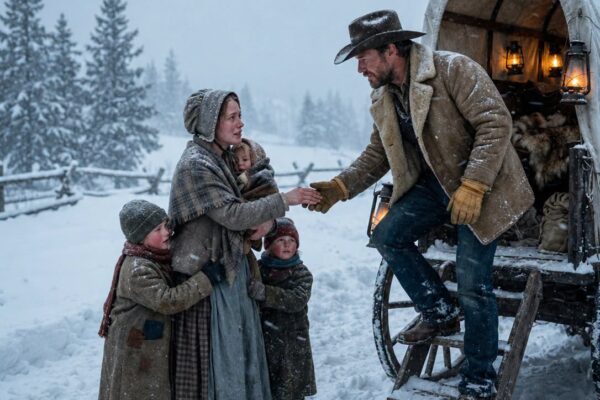
I let a homeless man with a leg brace sleep on our couch for one night because my son couldn’t stop looking at him shivering outside. The next morning, I left for work expecting him to be gone before I came home. But when I opened the door that evening, I froze. He was still inside—and what he had done to my apartment while I was gone made me go pale.

…Then I unlocked my door.
And stopped.
The first thing I noticed was the front door.
It closed.
Normally, I had to lean my shoulder into it and lift slightly while turning the lock.
That evening, it swung inward without resistance.
Leo almost walked into my back.
“Mom?”
I didn’t answer.
Because the second thing I noticed was the faucet.
It wasn’t dripping.
For six months, that faucet had kept time in our kitchen.
Drip.
Drip.
Drip.
At night, I sometimes stuffed a dish towel into the sink because the sound made me irrationally angry.
Now there was silence.
Then I smelled bread again.
Not from the hallway.
From our kitchen.
My stomach tightened.
“Stay behind me.”
Leo frowned.
“Why?”
“Just do it.”
I stepped inside.
The living room looked different.
Not rearranged.
Fixed.
The loose cabinet hinge beneath the television had been tightened.
The drawer I’d been kicking closed for weeks sat perfectly flush.
The broken slat in one of the dining chairs had been reinforced.
Even the crooked shelf above the couch was level.
For a few seconds, my brain refused to make sense of what my eyes were seeing.
Then I heard movement in the kitchen.
I grabbed the heaviest thing within reach.
A ceramic umbrella stand.
Not an ideal weapon.
But it was there.
Julian appeared in the doorway holding a dish towel.
He froze when he saw me.
Then his eyes dropped to the umbrella stand.
“I can explain.”
“You’re still here.”
“Yes.”
“You said you’d leave.”
“I know.”
My pulse was hammering.
Leo peeked around me.
“Julian!”
“Stay back, Leo.”
That changed Julian’s face.
He immediately set the towel down and lifted both hands.
“You’re right.”
“What?”
“You’re right to be angry.”
I stared at him.
“I should’ve left.”
“Then why didn’t you?”
His jaw tightened.
“Because I couldn’t get down the stairs.”
Only then did I really look at him.
His face had lost color.
Sweat stood along his hairline despite the apartment being cool.
And he was leaning heavily against the doorframe.
“What happened?”
“The knee locked.”
“You were walking last night.”
“Barely.”
“You carried groceries.”
“That was stupid.”
He said it simply.
No self-pity.
No excuse.
I lowered the umbrella stand slightly.
“How long?”
“Since around seven this morning.”
“You’ve been stuck here all day?”
“I tried leaving twice.”
He nodded toward the couch.
“My backpack’s still there because I figured if I could get the swelling down, I’d go.”
I looked at his knee.
The brace was tighter than it had been the night before.
The skin above it looked swollen.
Then I noticed the tools on the dining table.
A screwdriver.
Pliers.
A small adjustable wrench.
All mine.
I looked back at him.
“So you decided to renovate my apartment?”
His expression almost became embarrassed.
“I was sitting around.”
“With an injured leg.”
“I don’t sit well.”
Leo moved around me before I could stop him.
“You fixed the faucet!”
Julian nodded.
“And the door,” Leo said.
“Yes.”
“And my chair?”
Julian looked at him.
“You lean back on two legs.”
Leo’s expression became defensive.
“Sometimes.”
“You cracked the support.”
Claire looked at her son.
“Leo.”
“It was already old.”
I closed my eyes for half a second.
Then opened them.
“Julian, sit down.”
“I should leave.”
“You can barely stand.”
“I promised.”
“And apparently you’re going to destroy your knee trying to keep that promise.”
He didn’t argue.
That bothered me more than if he had.
I pointed at the couch.
“Sit.”
He did.
Carefully.
I put my purse down and crouched near his leg.
Working at a rehab clinic did not make me a doctor, but it did mean I knew enough to recognize when something was wrong.
“Can you bend it?”
“Not much.”
“Pain level?”
“Five.”
I looked at him.
“Real number.”
“Seven.”
“Any numbness?”
“No.”
“Did you fall?”
He hesitated.
“Julian.”
“Once.”
“When?”
“This morning.”
My irritation shifted.
“You were here alone and fell?”
“I got back up.”
“That wasn’t my question.”
Leo sat beside him.
“Did you hit your head?”
“No.”
“Are you sure?”
Julian gave him a look.
“Yes, nurse.”
Leo looked pleased.
I touched the outside of the brace.
“Your leg feels warm.”
“I noticed.”
“You may need urgent care.”
Julian shook his head immediately.
“No.”
That response was too fast.
“Why?”
“I’m fine.”
“You are visibly not fine.”
“It’ll settle.”
“Do you have insurance?”
Silence.
There it was.
I sat back.
“No.”
He looked away.
I knew what that meant.
Not stubbornness.
Math.
Urgent care meant money.
An ER meant worse.
If he had no insurance and no stable address, one swollen knee could become a bill he would never escape.
I knew because I saw people delay care for exactly that reason every week.
“I can take you to the county clinic tomorrow.”
“No.”
“Why not?”
“I said I’m fine.”
“Stop doing that.”
He looked at me.
“Doing what?”
“Pretending refusing help is the same as not needing it.”
That landed.
His expression changed.
Not anger.
Recognition.
Leo looked between us.
Then he pointed toward the kitchen.
“What’s the bread?”
Julian blinked.
“Bread.”
“I know.”
“Banana bread.”
Leo’s eyes widened.
“Did you make it?”
“Your bananas were turning black.”
I stared at him.
“You baked because you couldn’t walk?”
“I mostly sat.”
“You fixed my faucet, repaired furniture, adjusted my door, and baked banana bread.”
“Yes.”
“With a bad knee.”
“Yes.”
I looked around the apartment again.
There were other things.
The cabinet beneath the sink had been cleaned out.
The warped baseboard beside the refrigerator was secured.
A loose outlet cover had been replaced.
Nothing major.
Nothing invasive.
He hadn’t entered my bedroom.
He hadn’t touched personal things.
He had simply repaired everything in the common rooms that had been quietly failing around us.
I felt something strange in my chest.
Not gratitude yet.
Something closer to embarrassment.
Because I had walked inside expecting theft.
Instead, a man with almost nothing had spent the day fixing things I couldn’t afford to fix.
“You didn’t have to do any of this.”
“I know.”
“Why did you?”
He looked down at his hands.
“Because you let me sleep somewhere warm.”
“That doesn’t mean you owed me labor.”
“I know.”
“Then why?”
He shrugged.
“Needed to be useful.”
The words were quiet.
Too quiet.
I had heard versions of them before.
From patients whose injuries had taken away jobs.
From older men after strokes.
From women recovering from accidents who apologized every time a therapist had to help them stand.
Needed to be useful.
As if usefulness and worth were the same thing.
I stood.
“You’re staying another night.”
Julian looked up.
“No.”
“Yes.”
“Claire.”
“Your knee is swollen, it’s dark outside, and it is fourteen degrees.”
“I can manage.”
“You couldn’t manage the stairs this morning.”
“I don’t want you thinking I’m taking advantage.”
I crossed my arms.
“I think you repaired my apartment while injured and baked my child banana bread.”
Leo had already found the loaf.
“Can I have some?”
“After dinner.”
He sighed dramatically.
I looked back at Julian.
“You’re staying.”
His mouth tightened.
“One more night.”
“One more night.”
That was how it started.
Except the next morning, the county clinic told us Julian’s situation was worse than I expected.
A ligament injury.
Post-surgical complications.
Inflammation severe enough that they wanted imaging.
The brace was not from a recent accident.
It was from an operation four months earlier.
That detail bothered me.
Because four months earlier should have meant follow-up appointments.
Physical therapy.
Gradual recovery.
Not sleeping outside a grocery store.
The clinician asked questions.
Julian answered as briefly as possible.
Then came one that changed the room.
“Where did you have the surgery?”
Julian gave the name of a hospital in St. Paul.
The clinician typed.
Then stopped.
“Who was your surgeon?”
Julian gave another name.
The woman looked at the computer again.
Her face changed.
“Mr. Mercer, did you ever receive your discharge plan?”
“Yes.”
“Physical therapy referral?”
“Yes.”
“Workers’ compensation case?”
Julian went still.
“Yes.”
I looked at him.
Workers’ compensation.
That meant this was not simply a man who had fallen through every crack.
Someone had been responsible for his injury.
“What happened to the case?” the clinician asked.
Julian looked at the floor.
“Closed.”
“Why?”
“My employer said the accident wasn’t work-related.”
“Was it?”
“Yes.”
She frowned.
“What happened?”
For the first time, Julian looked angry.
Not loud anger.
Old anger.
The kind that has been carried too long.
“I was on a loading dock.”
He spoke slowly.
“Industrial supply warehouse. Night shift.”
A pallet rack collapsed.
Julian saw it begin to tilt.
Another worker was underneath.
He pushed the man clear.
The rack came down across Julian’s leg.
Tore ligaments.
Fractured his tibia.
Required surgery.
His employer initially reported the injury as workplace-related.
Then things changed.
A supervisor said Julian had entered a restricted section without authorization.
Another claimed he had ignored safety procedures.
The company insurer denied the claim.
“Why didn’t you appeal?” I asked.
He laughed once.
“I did.”
“What happened?”
“My lawyer wanted money I didn’t have.”
“You had an attorney?”
“For two months.”
Then Julian lost his apartment.
Could not return to work.
Could not afford therapy.
The man he had saved from the collapsing rack had stopped answering calls.
The company terminated Julian for “failure to return after medical leave.”
By the time he realized how quickly everything was collapsing, he had no address, no working phone, and no way to keep fighting.
I felt my professional brain wake up.
Claims.
Documents.
Timelines.
Statements.
That was my world.
Not workers’ comp specifically.
But evidence was evidence.
“What company?”
He looked at me.
“Why?”
“Name.”
“NorthStar Industrial Supply.”
I knew it.
Not personally.
But everyone in Minneapolis knew NorthStar.
Warehouses all over Minnesota.
Thousands of employees.
Large enough to have lawyers whose job was making problems disappear.
The clinician left to arrange imaging.
I leaned toward Julian.
“Do you still have paperwork?”
“Some.”
“Where?”
“In the backpack.”
“All of it?”
“Whatever I didn’t lose.”
“When we get home, I want to see it.”
He shook his head.
“No.”
“Why?”
“This isn’t your problem.”
“I know.”
“You’ve already done enough.”
“I gave you a couch.”
“And drove me here.”
“That isn’t enough to qualify for sainthood.”
“Claire.”
“Julian.”
He stared at me.
I recognized the look.
People use it when they are trying to preserve dignity by refusing the only hand available.
“I adjust insurance claims for a living,” I said.
“I know.”
“You didn’t know that when you stayed.”
“You told me at dinner.”
“Then you know I spend every day reading reports written by people who hope nobody notices the sentence that doesn’t fit.”
His expression changed.
“Let me look.”
“You can’t fix it.”
“Maybe not.”
I paused.
“But I can tell you whether somebody lied.”
That evening, Julian opened the backpack.
Inside was almost nothing.
Two shirts.
Socks.
A toothbrush.
A photograph of a woman and little girl.
And a plastic folder.
The folder was bent at the corners.
Inside were medical papers.
Employment letters.
Emails printed at a library.
A denial notice.
A disciplinary report.
I read for forty minutes.
Then went back to the first page.
Read it again.
Then a third time.
“What?” Julian asked.
I didn’t answer.
I laid three documents side by side on the kitchen table.
Incident report.
Supervisor statement.
Termination letter.
“What time did the accident happen?”
“2:18 a.m.”
“You’re sure?”
“Yes.”
“This report says 2:18.”
I tapped the second document.
“This supervisor says he gave you a verbal warning at 2:23 for entering the restricted area.”
Julian frowned.
“So?”
“So you were in an ambulance by 2:26.”
He stared.
I pointed to another line.
“And according to the medical intake form, paramedics arrived at 2:21.”
Silence.
Leo was doing homework at the other end of the table.
He looked up.
“Is that bad?”
I ignored him for a moment.
“This statement was written later.”
Julian nodded.
“Three days.”
“By a supervisor who claims he spoke to you five minutes after you were injured.”
Julian’s face hardened.
“I never noticed that.”
“You weren’t supposed to.”
I kept reading.
Then found something else.
The company claimed the area had been marked restricted because of a known damaged rack.
But the incident report said the warning tape was installed after the accident.
Different pages.
Different departments.
Nobody had bothered making them agree.
I felt that familiar rush.
The moment a claim stops being confusing and starts becoming clear.
“Julian.”
He looked at me.
“They built the denial backward.”
“What?”
“They decided what they needed the story to be, then wrote documents to support it.”
His mouth opened slightly.
I slid the papers toward him.
“I can’t prove fraud from my kitchen.”
“But?”
“But this is not clean.”
For the first time since I’d met him, hope appeared in his face.
It frightened him more than despair had.
“What do I do?”
“Tomorrow, I make calls.”
He immediately shook his head.
“No.”
I leaned back.
“There it is again.”
“What?”
“You’d rather sleep outside than owe someone.”
His jaw tightened.
“I know what it feels like when people help and then remind you forever.”
I went quiet.
That sentence carried history.
I didn’t ask.
Instead I said, “Then let’s make it clear.”
He looked at me.
“You don’t owe me.”
“Claire—”
“You fixed my door.”
“I fixed a hinge.”
“You fixed half the apartment.”
“Because I was stuck there.”
“You baked bread.”
“Your bananas were dying.”
“Tragic.”
Leo raised his hand.
“The bread was good.”
“Thank you, Leo.”
Julian almost smiled.
I pointed at the documents.
“I am looking at these because somebody may have used paperwork to ruin your life.”
I met his eyes.
“That bothers me professionally.”
“Professionally?”
“And personally.”
I let that sit.
“No debt.”
He looked down at the papers.
Then nodded.
The next two weeks became complicated.
Julian stayed on the couch.
Not because either of us planned it.
Because things kept happening.
First, the legal aid attorney agreed to review the case.
Then the attorney found that Julian’s claim had been closed without several required medical records ever being considered.
Then the man Julian had saved finally answered his phone.
His name was Eric.
He cried when Julian spoke to him.
That surprised all of us.
Eric hadn’t stopped answering because he didn’t care.
He had stopped because NorthStar’s supervisor warned him that if he “got involved,” his own job could disappear.
He had a wife.
Two children.
A mortgage.
He had been afraid.
But fear has expiration dates.
When the attorney asked whether Eric would give a statement now, he said yes.
Then he said something even better.
“There was video.”
Julian sat upright.
“What video?”
“Loading dock camera.”
The company had claimed the angle did not capture the accident.
Eric knew that was false because a supervisor showed him the footage the next morning.
The video showed Julian pushing Eric away.
It also showed the rack collapsing without warning tape anywhere near it.
The attorney went very quiet.
“Do you know if they kept it?”
Eric said he didn’t.
The attorney did.
Three days later, NorthStar received a preservation demand.
Two days after that, everything changed.
The video still existed.
Someone had archived it.
Maybe because deleting it would have been worse.
Maybe because corporations are sometimes too large for their own lies to travel cleanly.
The footage matched Julian’s story.
Exactly.
The workers’ compensation case reopened.
Then the company suddenly wanted to settle.
Julian refused the first offer.
That shocked me.
The man who had been apologizing for eating eggs in my kitchen looked at the number and said, “No.”
The attorney smiled.
“Good.”
The second offer covered medical bills, back wages, rehabilitation, and enough compensation to make permanent housing possible.
There was also a separate employment settlement.
I never asked the final amount.
I didn’t need to.
I knew it was enough when Julian sat at my kitchen table holding the letter and cried without making a sound.
Leo stood beside him.
“Did you win?”
Julian wiped his face.
“Kind of.”
“That means yes.”
“Then yes.”
Leo hugged him.
Julian froze.
Then wrapped one arm around my son.
I looked away.
Some moments belong partly to the people watching them and partly to the people who need privacy while having them.
Three months after the night outside the grocery store, Julian moved out.
He found a one-bedroom apartment in a building with an elevator.
Near his physical therapy clinic.
On moving day, his belongings fit into the trunk of my car.
That bothered me.
Three months in my home and his entire life still fit into one trunk.
At the new apartment, we carried everything upstairs.
Leo placed the backpack in the bedroom.
Then looked around.
“Your couch is terrible.”
Julian stared at the secondhand couch he’d bought.
“You have strong opinions for someone who doesn’t pay rent.”
“Mom says cheap couches hurt your back.”
“I said our old couch hurt my back.”
“Same thing.”
Julian laughed.
His leg was better.
No longer in the rigid brace.
A smaller support instead.
He still limped.
The doctors said he might always.
But he was walking.
Working too.
Not at NorthStar.
Never again.
A vocational rehabilitation program had connected him with a building maintenance company.
It turned out a man who couldn’t sit still and fixed strangers’ faucets for fun had marketable skills.
Before we left, Julian handed me an envelope.
“No.”
“You haven’t opened it.”
“I know what envelopes mean.”
“You do insurance.”
“Exactly.”
“Open it.”
Inside was a check.
I stared at the number.
Three thousand dollars.
I looked up.
“No.”
“Claire.”
“No.”
“For rent.”
“You slept on my couch.”
“For three months.”
“You fixed everything I own.”
“That wasn’t rent.”
“You bought groceries when the settlement advance came.”
“That wasn’t enough.”
“Julian.”
His expression changed.
Serious.
“Please.”
I stopped.
He looked toward Leo, who was inspecting the kitchen cabinets as if he might be purchasing the apartment himself.
“I needed your couch.”
Then back at me.
“But I needed something else more.”
“What?”
“For someone to look at my situation and not decide I must’ve done something to deserve it.”
My throat tightened.
He continued.
“Most people saw the brace and the backpack and looked away.”
He smiled faintly.
“Your son didn’t.”
I glanced at Leo.
Julian folded the check once.
“Take it.”
I shook my head.
“No.”
“Why?”
“Because you don’t owe me.”
His eyes narrowed.
“You’ve said that before.”
“I meant it.”
He looked frustrated.
Then I had an idea.
“Fine.”
I took the check.
His expression relaxed.
“I’m giving it back.”
“Claire.”
“Not to you.”
I turned to Leo.
“Remember the shelter Julian called that night?”
Leo nodded.
“The one that was full?”
“Yes.”
I looked at Julian.
“We donate it.”
He stared at me.
“To the shelter.”
Silence.
Then he smiled.
A real smile.
“Half.”
“What?”
“Half to the shelter.”
He pointed at me.
“Half for Leo’s winter boots and your heating bill.”
My face went hot.
“How do you know about—”
“Your heating bill sat unopened on the counter for six weeks.”
I stared.
“You noticed that?”
He raised an eyebrow.
“I fix things.”
That was the moment I started crying.
Not when the settlement came.
Not when he moved into an apartment.
Not when the case reopened.
Over a heating bill.
Because for months, I had believed I was the person helping him.
And apparently, somewhere along the way, he had been seeing all the things I was trying not to let anyone notice.
Leo looked horrified.
“Mom, are you crying?”
“No.”
“You are.”
“Allergies.”
“In winter?”
“Extremely aggressive winter allergies.”
Julian laughed.
We compromised.
Half went to the shelter.
The rest paid my heating bill, bought Leo boots, and replaced the couch Julian had nearly destroyed sleeping on it.
I fought him on that last one.
Lost.
A year passed.
Then another.
Julian became part of our lives in the strange, gradual way some people do.
No announcement.
No label.
He came over for dinner.
Helped Leo build a volcano for school and somehow made it powerful enough to spray baking-soda lava across half the kitchen.
He repaired things in the building until our landlord started paying him instead of pretending maintenance requests didn’t exist.
He took Leo fishing.
I learned he hated mushrooms.
He learned I watched terrible crime shows after Leo went to sleep.
Sometimes he sat on the new couch and corrected the television detectives.
“They contaminated the scene.”
“You repair apartment buildings.”
“I contain multitudes.”
I threw popcorn at him.
The first time he asked me to dinner without Leo, I pretended not to understand.
“Leo has school.”
“I know.”
“He usually eats dinner.”
“I am aware.”
“So?”
Julian stared at me.
“Claire.”
I smiled.
He groaned.
“I’m asking you on a date.”
“Oh.”
“You knew.”
“Maybe.”
He looked toward the ceiling.
“You let a homeless stranger sleep in your house but make a man work this hard to ask you to dinner.”
“Different risk assessment.”
That made him laugh.
We went.
Slowly.
Very slowly.
Because kindness is not romance.
Gratitude is not love.
Dependency is not consent.
I knew that.
So did Julian.
By the time we kissed for the first time, he had his own apartment, his own income, his own life.
Nothing owed.
Nothing confused.
Leo found out the next morning because nine-year-olds who become eleven-year-olds develop terrifying observational skills.
“You kissed Julian.”
I nearly dropped my coffee.
“What?”
“He smiles differently.”
“That is not evidence.”
“He does.”
Julian walked in carrying donuts.
Leo pointed at him.
“See?”
Julian stopped.
“What?”
“Nothing,” I said.
“Mom kissed you.”
Julian nearly dropped the donuts.
“Leo!”
“What? You did.”
I buried my face in my hands.
Julian started laughing.
Years later, people still ask how we met.
Julian usually says, “Her son found me.”
That’s more accurate than saying Claire invited me home.
Because Leo was the one who stopped.
The one who saw.
Children do that sometimes.
Adults learn to look away because we are overwhelmed by how many problems we cannot solve.
Children haven’t learned that trick yet.
They see someone cold and ask why he’s cold.
They see someone alone and ask where he’s going to sleep.
They make compassion inconvenient.
I’m grateful for that.
Julian keeps the old knee brace in a box in our garage.
Not for sentimental reasons.
He says medical devices are expensive and somebody might need it.
That is Julian.
Always fixing.
Always saving screws in little jars.
Always believing something broken might become useful again.
Last winter, we drove past the grocery store where we met.
The temperature was below zero.
A woman stood near the entrance with two bags and no gloves.
Julian looked at me.
I looked at him.
Leo, now fourteen, sighed from the back seat.
“We’re stopping, aren’t we?”
“Yes,” Julian said.
“We’re always stopping now.”
Leo shook his head.
But he was smiling.
We bought her gloves.
A hot meal.
Called a shelter with space.
Nothing dramatic.
No miracle.
We didn’t bring her home.
We had learned that compassion can have boundaries and still be compassion.
But as we drove away, I thought about that first night.
About how afraid I’d been opening my apartment door.
How pale I’d gone when I saw Julian was still inside.
I thought he’d stayed because he wanted something.
I was right.
Just not in the way I feared.
He wanted to leave something better than he found it.
A faucet.
A door.
A broken chair.
Eventually, a life.
Mine included.
And sometimes I still stand in my kitchen late at night listening to the silence where that faucet used to drip.
It reminds me how close I came to saying no outside that grocery store.
I had good reasons.
Money.
Safety.
Fear.
Exhaustion.
All reasonable.
Maybe saying no wouldn’t have made me a bad person.
But I said yes once.
Just for one night.
I thought I was giving a freezing stranger a couch.
I didn’t know I was opening the door to the man who would eventually teach my son how to drive, repair every broken thing in our first house, stand beside me at my mother’s funeral, and complain for twenty years that I still bought the wrong kind of coffee.
The night I met Julian, Leo asked me one question.
“Can we help him?”
At the time, I thought he meant for a few hours.
A meal.
A warm room.
A couch.
Now I know better.
Sometimes helping someone does not mean rescuing them.
Sometimes it simply means giving them enough warmth, enough time, and enough dignity to reach the next door themselves.
And sometimes, if you’re lucky, they come back through that door later.
Not because they owe you.
Because they chose you.