
Eli looked down at the deed Josie had pushed across the table.
The county seal was genuine.
So was the clerk’s handwriting.
And the eighteen-dollar purchase recorded at the bottom had truly taken place.
“That paper records the sale,” he said. “It doesn’t prove the taxes behind the sale were owed.”
Josie studied him.
“Then Agnes’s property was taken without cause.”
“That’s what I believe.”
“And you knew?”
He touched the ink-darkened finger of his right hand.
“I knew something was wrong with the records.”
“When?”
“Two summers ago.”
The answer hurt more than she expected.
For eight days, this man had eaten at her table, repaired her roof, and fed the dead woman’s chickens.
All while knowing the land beneath their feet might have been taken through fraud.
“Tell me the rest.”
Eli pulled out the second chair but did not sit.
“I started noticing mismatched entries in the tax ledgers. Small farms along the creek. Payments appeared in one place, while another record showed arrears.”
“Who handled those accounts?”
“The senior clerk, Cyrus Bell, supervised the office.”
“And you?”
“I prepared notices and maintained part of the tax books.”
Josie remembered the expensive watch chain hanging against Garrett Lund’s gray vest.
“Why did you speak to Lund?”
“He was the county’s largest taxpayer. I thought someone with that much land would care whether the books were honest.”
“And did he?”
“He offered me money to stop asking questions.”
The stove gave a dull metallic snap as it cooled.
Josie stared at Eli.
“What did you do?”
“I refused.”
“Then why are you hiding in a barn?”
He pressed his lips together.
“Because refusing the money wasn’t the end of it.”
“Mr. Marsh.”
“I was afraid. And I made a choice I should have refused.”
She waited.
But he did not continue.
At last, he said, “I’ll tell you the whole of it before the week’s out.”
“That isn’t your decision alone.”
“No, ma’am.”
“Until then, you sleep in the barn. You don’t touch my documents. And you don’t make another repair without telling me first.”
He accepted each condition without argument.
Josie gathered the deed and returned it to her pocket.
“If you expect me to trust you, Eli, don’t make me discover every important thing by accident.”
He lowered his eyes.
“I understand.”
***
The first hard snow arrived three days later.
It came across the Nebraska prairie in thick, slanting sheets.
By midafternoon, the barn was barely visible from the house.
Eli had secured the worst roof gaps, but wind still forced its way through the kitchen window frames.
He tied a guide rope between the house and chicken coop before the visibility disappeared.
Together they carried the hens indoors.
One escaped beneath Josie’s skirt.
Another flapped onto the table.
Eli caught it and earned a peck for his trouble.
Despite everything, Josie laughed.
Then the wind struck hard enough to shake the entire house.
The laughter died.
They stuffed rags into the window cracks, kept water close to the stove, and moved the remaining firewood inside.
By evening, the snow had buried the porch steps.
There would be no trip to Alder Fork.
Not until the weather cleared.
On the following afternoon, Josie investigated the northern bedroom.
Its door had been swollen shut since she arrived.
She pushed against it until the wood finally yielded.
Inside stood an old trunk with brass corners.
Agnes Voss’s initials had faded across the lid.
Josie opened it carefully.
There was a Bible, spectacles, a yellowed garment, and a neatly folded quilt.
The quilt caught her attention.
A log-cabin pattern, stitched in red and brown.
Josie lifted it.
One side felt strangely heavy.
She turned the fabric over, running her fingers along the lower seam.
Years of sewing had taught her to recognize a concealed pocket.
And here was one.
She fetched her scissors.
With careful movements, she opened a short length of stitching.
Three folded papers slid into her lap.
Josie opened the first.
A county tax receipt.
Paid in full.
The second showed another year’s payment.
The third had been issued only nine days before the notice that supposedly justified the auction.
Three dates.
Three amounts.
Three numbered receipts.
4417.
5209.
6031.
Josie’s heart hammered.
“Eli!”
He appeared in the doorway.
She raised the papers.
“Agnes kept the proof.”
His face drained of color.
“Where did you find them?”
“Inside her quilt.”
He reached toward the papers, then stopped.
Josie drew them closer.
“Don’t touch them.”
Eli lowered his hand.
“She was always clever about keeping things safe,” he whispered.
Josie looked from the receipts to the deed on the table.
“If these are genuine, Agnes never owed the taxes they used to sell her land.”
Eli nodded slowly.
“And the person who wanted that creek frontage knew exactly what he was doing.”
Josie folded the receipts.
Outside, the storm roared against the house.
She understood now why Garrett Lund had offered two hundred dollars for an eighteen-dollar ruin.
But another question was growing more frightening.
If the county had deliberately taken Agnes’s land, what had Eli Marsh done to help make it possible?
She held the receipts against her chest.
And when Eli finally looked at her, Josie asked the question he had spent eight days avoiding.
“Did you sign the papers that took this woman’s home?”
Eli did not answer immediately.
Outside, the snow struck the window like handfuls of gravel.
Josie stood beside the open trunk, holding the three tax receipts against her chest.
“Eli. I asked you a question.”
He looked at the floor.
“Yes.”
The word was barely audible.
Josie felt herself go cold.
“You signed the papers?”
“I stamped the notices.”
“For Agnes?”
“And five other properties.”
She stared at him.
He rubbed his hands together once, then forced them apart.
“I was told the entries had been checked. That the notices were routine. I knew the books had been altered in places, but I let myself believe someone above me had corrected the mistakes.”
“You knew there were mistakes.”
“Yes.”
“And you kept signing?”
He raised his eyes.
“For longer than I can defend.”
Josie glanced toward the window, toward the cottonwood tree beyond the snow.
Agnes Voss had lived on that land eleven years.
She had buried her husband, kept her chickens, preserved her receipts, and stayed alone when her neighbors might have expected her to leave.
And this man had helped prepare the paperwork used to take it from her.
“Why didn’t you stop?”
“Because I was frightened.”
“Of Garrett Lund?”
“Of losing my position. Of being accused of dishonesty. Of finding out that men I had trusted were using my work to hurt people.”
Josie’s voice hardened.
“And what happened when you finally found out?”
“I confronted Bell. Then Lund. Lund offered money. I refused it. After that, missing tax money was blamed on me.”
“Was any of it yours?”
“No.”
“But your stamp was on the notices.”
“Yes.”
Eli swallowed.
“When I understood what had happened, I left the courthouse. By then Agnes was ill. I came here and tried to help her keep the place standing.”
“Without telling her?”
“I told her the records were wrong. I didn’t tell her how much of the paperwork carried my hand.”
Josie turned away.
A painful silence stretched between them.
Then she asked, “Why did you bury her?”
Eli looked toward the north wall.
“Because she died alone. And because no one else came.”
Josie closed her eyes.
It was possible to pity him.
It was also possible to be furious.
Both feelings lived in her at once.
“You should have told me before I let you stay.”
“I know.”
“Before I fed you.”
“Yes.”
“Before I started believing you were an honest man.”
His face tightened.
“I wanted to be.”
She looked at him.
“That isn’t the same thing.”
“No, ma’am.”
***
The storm continued for three days.
There was nowhere either of them could reasonably go.
Josie made Eli sleep beside the stove rather than return to the unheated barn in the dangerous cold, but she kept her distance.
They spoke when work required it.
They checked the roof.
They fed the chickens.
They made sure the fire stayed alive.
One evening, while they were carrying another armful of wood inside, Eli’s sleeve caught on a nail.
The old fabric tore.
Josie reached for it automatically.
Then stopped.
Eli noticed.
“You don’t have to mend it.”
“I know.”
She took the coat anyway.
“Sit down. It’s letting the cold through.”
He obeyed.
She worked by lamplight, making small, even stitches.
For a long time, neither spoke.
Then Eli said, “You know what frightens me most?”
Josie did not look up.
“What?”
“That Agnes may have thought I came here out of pity.”
“Didn’t you?”
“Some. But she gave me work when I couldn’t find any. Fed me when I had nothing. She treated me as though I was still a decent man when I couldn’t bear to examine whether I was.”
Josie pulled the thread tight.
“That doesn’t erase what you did.”
“No.”
“But it explains why you stayed.”
He nodded.
She handed back the coat.
Their fingers brushed.
He drew his hand away first.
Josie found she did not want him to.
That troubled her more than she cared to admit.
***
On the fourth morning, the wind stopped.
The world outside was white and painfully bright.
Josie was pouring coffee when she noticed three riders approaching through the snow.
Eli came to the window.
His face changed immediately.
“The rider on the left is Ward Crane. He works for Lund.”
“And the middle?”
“Sheriff Brannigan.”
Josie set down the coffeepot.
Eli looked at her.
“There’s a warrant for me. They say I stole county tax money.”
“Did you?”
“No.”
“But you ran.”
“Yes.”
A fist struck the door.
“Miss Harlan! Open up!”
Josie looked toward the root cellar.
There was a concealed entrance beneath a worn rug near the storage barrel.
She had discovered it while inspecting the house.
“Down there,” she said.
Eli stared at her.
“Josie—”
“Go.”
“Don’t risk yourself for me.”
“I’m not doing it for you alone.”
She held up the receipts.
“I’m doing it because somebody wants these papers destroyed, and you’re one of the few people who understands what they mean.”
He hesitated.
“Go,” she repeated.
He disappeared into the cellar.
Josie pulled the rug back into place.
Then she opened the door.
Sheriff Brannigan stood on the porch with two men behind him.
“Morning, Miss Harlan.”
“Sheriff.”
“We’re looking for Eli Marsh.”
“Why?”
“County warrant. Embezzlement.”
Josie folded her arms.
“Interesting. I’ve recently learned there are some questions about the county’s accounting.”
The sheriff’s expression tightened.
“We aren’t here to discuss that.”
“Then what are you here to discuss?”
“Whether Marsh is on your property.”
She stepped aside enough to let them see the room.
Crane pushed past her and searched the house.
He opened cupboards, inspected the bedroom, and looked behind the stove.
The sheriff remained near the door.
His eyes moved toward the two cups on the kitchen table.
Josie noticed.
She said nothing.
At last, Crane returned.
“Nothing.”
Brannigan studied Josie.
“Mr. Lund is still prepared to buy this place.”
“So I’ve heard.”
“Two hundred dollars is a generous offer.”
“Then he can keep being generous somewhere else.”
The sheriff’s face hardened.
“Think carefully, Miss Harlan.”
“I have been.”
The men left.
Josie watched until their horses disappeared beyond the bend.
Then she sat heavily at the table.
Her hands were trembling.
Eli emerged from the cellar, covered with dust.
“You helped me,” he said.
Josie looked up sharply.
“Don’t mistake that for forgiveness.”
“I won’t.”
She pointed to the receipts.
“Those papers prove Agnes paid her taxes. We need to find out what the county did with the money.”
Eli nodded.
“And if they arrest you before we can prove it?”
“Then you’ll have to do it without me.”
Josie stared at him.
For the first time, she understood that Eli was prepared to accept the consequences of his own choices.
But she also understood something more uncomfortable.
She had begun caring whether he survived those consequences.
***
That afternoon, Josie ordered Eli to leave.
Not because she no longer believed him.
Because the danger had reached her doorstep.
“I need to know whether the man repairing this house is trying to honor Agnes or protect himself,” she told him.
Eli stood by the kitchen door.
“Both,” he admitted. “I wish I could say it was only the first.”
She felt tears rise unexpectedly.
“Then take your guilt somewhere else until you know what to do with it.”
He accepted the words.
Before leaving, he placed the three receipts on the table.
“They belong with you.”
Josie watched him take his hat.
The door closed gently.
She hated that he had not slammed it.
Anger would have been easier to bear if he had given her something new to resent.
That evening, the kitchen felt larger and colder.
Two cups remained on the table.
One still held the last of his coffee.
She poured it away.
***
By morning, someone had fed the chickens.
There was fresh wood beside the porch.
And the damaged sheet metal over the northern corner had been secured more firmly.
A steaming tin cup stood on the porch railing.
Josie stared at it.
She knew whose hands had left it there.
She also knew he had respected her instruction not to enter the house.
She carried the cup inside.
Then she spread Agnes’s three receipts across the kitchen table.
4417.
5209.
6031.
For years, Josie had worked with needles, patterns, invoices, and her father’s shop accounts.
She knew that a document could be copied.
She also knew that numbered receipts were ordinarily issued from books that retained a matching stub.
If Agnes had received receipt 4417, the courthouse should possess a corresponding record.
Unless someone had altered it.
Josie examined the three documents again.
The numbers were stamped, not handwritten.
That mattered.
Someone could forge a signature.
Someone could rewrite an amount.
But three separately numbered receipts had to fit somewhere inside the county’s records.
And if they did not fit, the mismatch might reveal exactly where the fraud had begun.
She sat very still.
Then she reached for paper.
She copied the receipt numbers, dates, and amounts.
She packed Agnes’s quilt with the documents.
And she prepared the wagon.
***
The following Monday, Josie drove into Alder Fork.
She had chosen the day deliberately.
The county commissioners met on the first Monday of each month.
She was not going to argue with Lund in the street.
She was going to put the evidence before the people responsible for county records.
At the courthouse, five men sat around a long table.
Garrett Lund was among them.
His smile faltered when he saw her.
“Miss Harlan. This is a private meeting.”
Josie stepped forward.
“Then perhaps you’ll forgive me for bringing a public matter into it.”
She laid Agnes’s quilt across the table.
Beside it, she arranged the three receipts.
“These belonged to Agnes Voss. They show that her property taxes were paid.”
The chairman frowned.
“What exactly are you alleging?”
“That the county sold her land for taxes she did not owe.”
Lund gave a short laugh.
“Those papers could be fabricated.”
“Certainly,” Josie answered.
He looked surprised.
She continued.
“That’s why I want the county’s receipt books examined.”
She pointed to the numbers.
“Four-four-one-seven. Five-two-zero-nine. Six-zero-three-one.”
Across the room, an elderly man with white hair and spectacles hanging from a cord stopped moving his pencil.
Cyrus Bell.
The senior clerk.
Josie faced him.
“Mr. Bell, each receipt should have a matching stub in your books. May we see them?”
Bell’s hand trembled.
Lund leaned forward.
“There’s no need for this performance.”
Josie kept her voice level.
“If the receipts are false, the stubs will help establish that. If the receipts are genuine, the same records may show who altered the account.”
The chairman looked at Bell.
“Bring the books.”
Bell remained motionless.
“Mr. Bell?”
The old clerk slowly stood.
“They’re in the safe.”
He left the room.
Eleven minutes passed.
Josie counted every one of them.
Then Bell returned carrying a large green ledger.
He opened it on the table.
His shaking finger moved down the page.
He stopped at receipt 4417.
The entry had been rewritten.
The ink was darker than the surrounding lines.
The lettering tilted differently.
And beneath the new date, the faint remains of another could still be seen.
Bell turned to 5209.
The same thing.
Then 6031.
Again, the same.
The chairman leaned forward.
“Mr. Bell, what does this mean?”
Bell removed his spectacles.
“It means these entries were altered.”
“By whom?”
Bell looked across the table at Garrett Lund.
The rancher’s smile disappeared.
Then Bell spoke.
“And it means an innocent man has been blamed for something I helped conceal.”
At that instant, a familiar voice came from the open doorway.
“My name is Eli Marsh.”
Josie turned.
He stood without his hat, his patched coat hanging loose around his shoulders.
He looked frightened.
But he did not retreat.
“I stamped the notices used to sell Agnes Voss’s property,” he said. “And five others.”
He looked at the commissioners.
“I have a warrant against me. I won’t run from it anymore.”
Josie took one step toward him.
“Eli, they’ll arrest you.”
He looked at her.
“Then I’ll tell them the truth before they do.”
And Sheriff Brannigan rose from his chair, his hand moving slowly toward the badge on his vest.
Sheriff Brannigan’s fingers closed around the badge on his vest.
For a moment, Josie thought he was preparing to summon his deputies.
Instead, he removed the badge and placed it on the table beside the green ledger.
“Mr. Marsh,” he said, “you’ll give your statement here. And Mr. Lund will give his separately.”
Garrett Lund rose so abruptly that his chair scraped across the floor.
“This is absurd.”
Nobody answered.
Lund turned toward Cyrus Bell.
“Tell them those records were corrected as part of ordinary county business.”
Bell stared at the altered entries.
For thirty-one years, he had worked among those books.
He knew the difference between a routine correction and a deliberate falsehood.
At last, he spoke.
“I was told it was routine.”
“By whom?” the chairman asked.
Bell closed his eyes.
“By men who wanted those properties sold.”
Lund’s face hardened.
“You’d better be careful what you accuse me of.”
Josie watched the old clerk lift his head.
“Mr. Lund, I’ve been careful for far too long.”
The words were quiet.
But something changed in the room.
Bell explained how the legitimate tax payments had been recorded and later altered in the arrears books.
He admitted that he had accepted explanations he should have challenged.
He admitted that when Eli Marsh began questioning the figures, he had dismissed the younger man’s concerns.
And when the investigation threatened to expose the scheme, Eli had been blamed for missing money.
“I knew he hadn’t stolen it,” Bell said.
Eli’s expression tightened.
Josie looked toward him.
He did not appear relieved.
Not yet.
The confession had cleared one part of his history while leaving another painfully visible.
He had still stamped notices that should never have been issued.
He had still failed to stop what he suspected.
And Agnes Voss had lost the security of her home before she died.
***
The hearing continued into the afternoon.
Josie explained where she had found the receipts.
She described the hidden pocket stitched into Agnes’s quilt.
Then she told the commissioners about Garrett Lund’s offer.
“Two hundred dollars,” she said. “For property the county had sold me for eighteen.”
Lund folded his arms.
“The creek frontage was useful to my ranch.”
“Then why didn’t you bid at the auction?”
He looked at her coldly.
“I don’t recall being obliged to explain every business decision I make.”
Josie nodded.
“You aren’t. But the county is obliged to explain why it sold land that had no unpaid taxes.”
The chairman asked Bell to produce the records for the other five properties.
Eli identified the notices he had stamped.
One by one, the names were read aloud.
Families who had lost small farms.
Families who had struggled to understand how a debt they believed settled had become grounds for losing land.
The pattern centered on properties along the same creek.
Garrett Lund had wanted control over that water.
Not one ruined homestead.
Not one widow’s broken house.
A chain of properties that would strengthen the Double L’s position along the creek.
Josie thought of Agnes walking nine miles to Alder Fork with her tax money tied into a handkerchief.
She imagined the elderly woman standing before a county clerk, carefully counting out coins, receiving a numbered paper, and taking it home believing she had done what the law required.
The cruelty of it was not merely that Agnes had lost land.
It was that she had done everything she was supposed to do.
And the record had been changed behind her back.
***
The commissioners arranged for the disputed books to be secured and referred the matter to the appropriate territorial authorities.
Eli gave a full statement.
He described his employment, the inconsistencies he had discovered, Lund’s attempt to purchase his silence, and his own decision to abandon the courthouse after realizing what the notices had accomplished.
He did not excuse himself.
When the chairman asked whether he had knowingly stamped the Voss notice, Eli answered carefully.
“I believed the senior clerk when he called it routine. But I already had doubts about the records. I should have insisted on checking.”
Josie watched his hands.
The same hands that had repaired her roof.
The same hands that had fed Agnes’s chickens.
The same hands that had put official stamps on papers capable of stripping a family of its home.
For days she had wanted him to declare himself innocent.
Instead, he was doing something harder.
He was describing precisely where his innocence ended.
By evening, the commissioners had gathered enough evidence to proceed with a broader investigation.
Garrett Lund left under a cloud of suspicion and formal scrutiny.
The accusations against Eli remained to be examined, but the claim that he had stolen the missing taxes had been gravely undermined.
Josie stepped outside as the courthouse emptied.
The air smelled of cold earth and wagon dust.
Eli stood near the steps.
His hat was turning slowly between his hands.
“Are you going back to the homestead?” he asked.
“Yes.”
He nodded.
“Good.”
She waited.
He looked as though he wanted to say more.
Then he simply stepped aside to let her pass.
Josie stopped.
“Eli.”
He looked up.
“You could have stayed hidden.”
“I could have.”
“Why didn’t you?”
He considered the question.
“Because you’d found what I failed to protect. And I wasn’t going to leave you to face them alone.”
Her throat tightened.
She wished the answer had made everything simple.
It did not.
But it mattered.
***
The formal proceedings occupied the next two days.
The evidence supported setting aside the fraudulent tax sale of Agnes Voss’s homestead.
The earlier receipt records were examined.
Bell’s admissions were taken into account.
Other affected families were told their tax assessments and land transfers would be reviewed.
Lund denied directing the alterations.
His denials became increasingly difficult to reconcile with the records and testimony.
The broader case would take longer to resolve, but the immediate false tax claim against the Voss property could no longer be defended.
There remained one problem.
Josie’s own title had come through the defective sale.
Agnes was dead.
No heir had been found.
The court had to determine how the land could lawfully be entered and acquired following the invalid auction.
Josie listened without interrupting.
She had expected to fight Garrett Lund for her home.
She had not expected that proving the fraud might cast doubt upon the document she herself had purchased.
Then the judge addressed her.
“Miss Harlan, you acted in good faith when you paid for the property.”
“Yes, sir.”
“You’ve also contributed materially to establishing the truth.”
“I only wanted the land to be honestly mine.”
The judge nodded.
“That is the proper question.”
He explained that the county would have to correct the invalid sale and address the ownership record through the appropriate procedures.
Josie would not be asked to conceal the problem or profit from a false claim.
When the court authorized the lawful disposition of the unclaimed property, she would be given the opportunity to complete a legitimate purchase.
The required amount was eighteen dollars.
Josie stared at him.
“The same eighteen?”
“The amount required under the corrected disposition.”
She swallowed.
“I paid it once.”
“And that payment was made under a defective proceeding. The county must account for it rather than collect the money from you twice.”
Josie looked at the clerk’s desk.
She had counted eighteen dollars there once while twelve men watched.
This time, the corrected transaction would require a proper receipt, a lawful entry, and a record nobody could quietly rewrite.
“I don’t want a gift,” she said.
“You aren’t receiving one.”
“I want the papers right.”
The judge gave a small smile.
“So do I.”
The original payment was credited toward the proper transaction.
Josie completed the corrected documents in the presence of witnesses.
Cyrus Bell prepared the receipt himself, carefully checking every figure before signing.
His hands trembled as he handed it over.
“For the honest record,” he said.
Josie accepted it.
Then she folded the paper and placed it inside her coat.
Her eighteen dollars had finally purchased what she thought she had bought in the first place.
A home she could claim without owing anyone her freedom.
***
Eli’s warrant was withdrawn after the investigation failed to support the allegation of embezzlement.
That did not make the past disappear.
He had given his account of the notices.
He had acknowledged his failure to challenge the fraudulent instructions soon enough.
And he would have to live with the knowledge that Agnes had suffered while he was afraid to act.
Josie found him outside the courthouse on the third afternoon.
He was sitting on a bench, holding his hat in both hands.
“It’s finished,” she said.
He looked up.
“The sale?”
“The title has been corrected.”
“I’m glad.”
She sat beside him.
For a time, they watched wagons pass through the street.
Then Josie spoke.
“There’s a surveyor in Kearney who needs someone familiar with county records.”
Eli turned.
“How do you know?”
“Mrs. Ketterman told me. Apparently, she knows everything worth knowing in three counties.”
He almost smiled.
“I don’t know if anyone would employ me after this.”
“You could tell them what happened.”
“I’d rather they knew.”
Josie studied him.
The man beside her was not the mysterious stranger she had discovered in the barn.
She knew his failures now.
His fear.
His willingness to run.
And the courage it had taken him to come back and tell the truth.
“I said some hard things to you,” she began.
“You were right to say them.”
“I said I couldn’t forgive you.”
“You did.”
She folded her hands.
“I can’t promise that I forgive everything today.”
Eli nodded.
“I haven’t asked you to.”
“But I don’t want to spend the rest of my life remembering only the worst thing you’ve done.”
He turned toward her.
Something moved across his face.
Hope, perhaps.
Or simply relief at being seen clearly.
“I’d like to return in the spring,” he said.
“To the homestead?”
“Yes. If you’d welcome a visit.”
Josie thought of the barn.
The chickens.
The stove door that still needed fixing.
And the strange quiet that had filled the house after he left.
“You can come in the spring,” she answered.
“Thank you.”
“Don’t thank me yet. That roof still leaks.”
He smiled properly this time.
“I’ll bring tools.”
She looked away so he wouldn’t see how much the smile affected her.
***
Winter settled over Nebraska.
The days shortened.
Snow gathered against the fence posts and drifted into the low corners of the yard.
Josie lived alone.
That had been her original intention.
For the first few weeks, she told herself she was relieved.
Nobody occupied the barn.
Nobody left tools beside the stove.
Nobody made terrible jokes about her cooking.
The chickens were less amusing without Eli among them.
The house was quiet.
Too quiet, sometimes.
But Josie refused to mistake loneliness for helplessness.
She had worked too hard to own that home.
She intended to learn how to keep it.
She repaired the stove door herself after borrowing the proper tools.
She learned to seal the northern window more securely.
She found that six chickens could produce an astonishing amount of commotion without accomplishing much of anything.
When the cold grew severe, she brought them inside long enough to protect them.
They expressed no gratitude.
Josie found their arrogance comforting.
She also returned to the work she knew best.
Sewing.
At first, she mended her own clothes.
Then Mrs. Ketterman sent a customer from Alder Fork.
A torn dress.
Then another.
A coat that needed a new lining.
A child’s winter garment requiring careful repairs.
Word traveled.
Women began arriving in wagons with folded fabric and small payments.
Josie set up a sewing table near the kitchen window.
She kept careful accounts.
By March, she had thirty-one dollars saved in a tin box above the stove.
Thirty-one dollars she had earned herself.
The sight of those coins gave her a satisfaction no expensive dress ever could.
She was no longer a woman surviving on the last money left from her father’s ruined business.
She was building another business.
On land that belonged to her.
***
Letters came from Kearney every two weeks.
Eli wrote in neat, restrained handwriting.
His new employment involved measuring, copying, and checking property records.
He described the work.
The weather.
The odd habits of his employer.
Occasionally, he described a problem he had caught before it became a serious error.
He never wrote as though a new position erased the past.
But Josie could see him learning to trust his own judgment again.
She answered with news from the homestead.
One hen had learned to open the coop latch.
Mrs. Ketterman had declared her sewing prices too low.
The northern corner of the roof remained determined to let water through whenever the thaw began.
Their letters grew longer.
Sometimes Josie read one twice before folding it away.
Sometimes she began another before she had entirely decided what to say.
Neither used the word love.
Neither even used the word home in the way both were beginning to think of it.
At the end of March, Eli wrote:
“I hope the metal patch over the northern corner has survived. I have thought of that part of the roof more often than a sensible man ought to.”
Josie read the sentence until she was smiling.
Then she replied:
“The patch has survived, though barely. It would be improved by a man who knows how to fasten it properly and remembers where I keep the ladder.”
She sealed the letter.
Her heart felt strangely light.
***
April came slowly.
The last snow retreated from the fields.
The ground softened.
Josie prepared a small garden behind the house, measuring the rows with string.
On a clear morning late in the month, she was kneeling beside freshly turned soil when she heard wagon wheels.
She raised her head.
A familiar figure stood beside the wagon.
Eli Marsh.
His coat was cleaner, his face shaved, and he looked less like a man expecting the world to punish him for breathing.
He removed his hat.
“Morning, Miss Harlan.”
Josie sat back on her heels.
“You’re late.”
“Am I?”
“The roof has been leaking for a week.”
“I came as quickly as I could.”
“You said spring.”
“It is spring.”
“Barely.”
He smiled.
She rose, brushing dirt from her apron.
For a moment, they simply looked at each other.
Months had passed.
During that time, Josie had imagined this reunion often.
In her imagination, she always had something sensible to say.
Now she had nothing sensible at all.
So she asked the question that mattered.
“Why did you come back?”
Eli put his hat on the wagon seat.
“Because I wanted to see you.”
“That isn’t an answer to everything.”
“No.”
He stepped closer, but kept enough distance for her to choose whether to close it.
“I wanted to see whether you’d permit me to spend some time here. Help with the repairs. Work beside you, if there’s work you want done.”
“And after the repairs?”
He looked toward the barn.
The cottonwood stood behind it, its new leaves trembling in the breeze.
“I’ve spent a long time trying to make peace with a woman who’s gone,” he said.
Josie waited.
“I couldn’t undo what happened to Agnes. I couldn’t bring her back. And I made the mistake of thinking that if I kept working hard enough, perhaps the guilt would eventually disappear.”
“Has it?”
“No.”
She appreciated the answer.
“But I learned something while I was away.”
“What?”
“That a man can’t repair yesterday by refusing to live tomorrow.”
Josie felt her throat tighten.
Eli continued.
“I care for you, Josie. More deeply than I expected to care for anyone again. I’d like to know whether there’s a place for me in the life you’re making.”
She studied him.
This was not a man demanding gratitude for a repaired roof.
Not a man claiming her land.
Not a man suggesting she needed marriage to secure her future.
He was offering himself without attempting to bargain away her independence.
“You understand that this place is mine,” she said.
“Yes.”
“And my sewing business is mine.”
“I know.”
“And if you stay, we’ll have to decide together how the work is divided.”
“I’d expect that.”
She folded her arms.
“I’m stubborn.”
“I’ve noticed.”
“I don’t take kindly to being ordered about.”
“That was made clear the first evening.”
“And I’m a terrible cook.”
Eli’s expression softened.
“Josie, I ate your cornbread.”
She tried not to laugh.
Failed.
The sound startled her.
It seemed to belong to a younger version of herself, before debt and disappointment had taught her to ration happiness.
Eli laughed with her.
Then she stepped forward and took his hand.
“You may stay,” she said.
“For how long?”
She looked at him.
“For as long as we both want you here.”
He squeezed her hand gently.
“I’d like that very much.”
***
They began with the roof.
Eli brought the ladder from the barn.
Josie held it steady while he climbed.
He showed her how he intended to fasten the patch.
She pointed out a weak board he had missed.
He climbed down to examine it.
“You’re right.”
“Of course I am.”
“I’ll try not to make a habit of being surprised.”
“Good.”
The work took most of the afternoon.
When they finished, Josie went inside to prepare coffee.
Eli repaired the porch railing before joining her.
They sat beside the kitchen table, watching late sunlight brighten the window.
There was no ceremony.
No announcement.
No sudden transformation into wealthy landowners.
Just two adults who had lost their trust in the world and were learning how to give some of it back.
Eli continued his paid work when it required travel.
Josie expanded her sewing business.
The homestead slowly improved.
The stove drew properly.
The roof stopped leaking.
The fencing became sturdy enough to keep the chickens where they belonged, although one particularly determined hen continued finding ways to escape.
When there were decisions about money, they discussed them.
When Eli disagreed with Josie about a repair, he explained why.
When Josie was tired from sewing, he prepared supper.
His cooking was better than hers.
Neither pretended otherwise.
And when memories of Agnes troubled him, Josie listened without trying to make the sorrow disappear.
One evening, they carried fresh flowers to the cottonwood.
They stood before the wooden cross.
Eli had repaired the marker during the summer, preserving its original words.
Josie looked at the inscription.
She kept the lamp burning.
“Tell me about her,” she said.
Eli took a long breath.
Then he told her how Agnes had insisted upon feeding the chickens before she ate herself.
How she had mended old clothes rather than throw them away.
How she had kept a lantern in the window during rough weather so that travelers could recognize the homestead from the road.
“She said a light was a small kindness,” Eli remembered. “But sometimes a small kindness was all a person needed to find the way.”
Josie looked toward the house.
“That sounds like something she’d say.”
Eli nodded.
For the first time, his memories did not seem to crush him.
They seemed to give him something worth carrying forward.
***
As the seasons passed, the homestead became more than a refuge from poverty.
Josie earned her living there.
Eli found honest work and a place where his presence was freely welcomed.
Together, they tended the land without pretending that either person owned the other’s future.
The people of Alder Fork began visiting more often.
Mrs. Ketterman brought sewing orders, groceries, and unwanted opinions.
Cyrus Bell sent Josie a fresh account book, its pages clean and carefully ruled.
The old clerk had spent years accepting dishonest entries.
Now he wanted her to have a book that would always tell the truth.
Josie used it for every payment received and every expense made.
The numbers were modest.
But they belonged to her.
The county’s larger investigation did not end as quickly or cleanly as townspeople might have wished.
Some families faced lengthy proceedings before their claims could be corrected.
Others could not recover everything they had lost.
Garrett Lund’s reputation and influence were diminished as the altered records came to light.
Eli’s testimony remained part of the record.
His willingness to admit his own failure gave his account a weight it might not otherwise have carried.
There were still people who spoke unkindly about him.
There were still days when he wondered whether he deserved to be happy.
But he no longer ran whenever the past found him.
He worked.
He answered questions.
He made amends where he could.
And he learned to live without asking another person to make his conscience clean.
Josie, meanwhile, discovered that accepting affection did not require surrendering judgment.
She could love a man and still expect honesty.
She could welcome help and remain capable.
She could build a shared life without relinquishing what she had worked to claim.
***
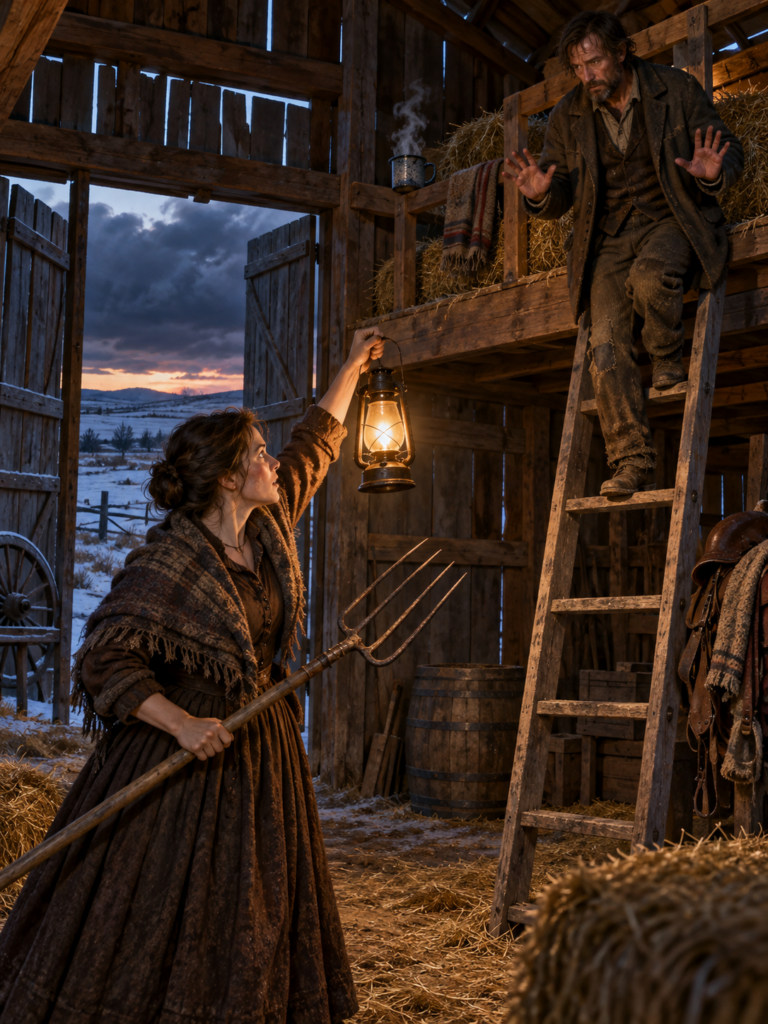
One morning, Josie stood inside the barn holding an oil lantern.
It was not yet fully daylight.
Above her, the hayloft was quiet.
She looked toward the railing where, months earlier, she had discovered a steaming cup of coffee.
She remembered how frightened she had been.
How firmly she had held the pitchfork.
How impossible it had seemed that her eighteen-dollar homestead could contain one more problem.
Then footsteps sounded behind her.
“Looking for something?”
She turned.
Eli stood in the doorway carrying two tin cups.
Steam rose from both.
Josie smiled.
“I was remembering the first evening.”
“When you threatened to put a pitchfork through me?”
“I did no such thing.”
“You held it remarkably close.”
“You were hiding in my barn.”
“I was.”
“And drinking coffee.”
“That too.”
She stepped closer.
He handed her a cup.
For a moment, she looked down at it.
The first steaming cup had meant that someone had entered her life without permission.
This one had been brought by a man she had invited to stay.
A simple difference.
An enormous one.
She lifted the coffee.
“Thank you.”
Eli smiled.
“There’s something else I wanted to show you.”
He led her outside.
Beyond the barn, the cottonwood moved gently in the morning breeze.
The grave beneath it was neat.
The cross stood straight.
And in the farmhouse window, a lantern glowed against the fading dark.
Josie looked at the light.
“You lit it.”
Eli nodded.
“Thought it might be worth keeping.”
She considered the old inscription.
She kept the lamp burning.
Agnes had once left a light for people trying to find their way across the prairie.
Now that light belonged to a household that had nearly been destroyed by dishonesty, fear, and silence.
Yet somehow, it had endured.
Josie rested her head lightly against Eli’s shoulder.
He slipped his arm around her, waiting until she settled comfortably beside him.
Neither spoke for a while.
They watched the first sunlight touch the roof they had repaired together.
They listened to the chickens begin their noisy demands for breakfast.
And then Josie laughed softly.
“What?” Eli asked.
“I paid eighteen dollars for a broken house.”
“And got a great deal more trouble than you expected.”
“Yes.”
She turned toward him.
“But I think I finally understand something.”
“What’s that?”
“A home isn’t valuable because someone powerful wants to take it.”
Eli waited.
“It’s valuable because of the life the people inside choose to build.”
He looked at her for a long moment.
Then he kissed her gently.
It was not a promise that hardship would never return.
There would be difficult winters.
Uncertain harvests.
More repairs.
More arguments.
More days when money was scarce and the wind seemed determined to pull Nebraska apart.
But there would also be honest work.
Shared meals.
Laughter.
And a door neither had to fear opening.
Josie took Eli’s hand and led him toward the house.
On the porch railing, two tin cups rested beside one another, their steam rising into the cool morning air.
Behind them, the barn stood where it always had.
Beyond it, Agnes Voss rested beneath the cottonwood.
And in the kitchen window, the lantern continued burning.
Not because anyone was lost anymore.
But because they had finally found their way home.

