
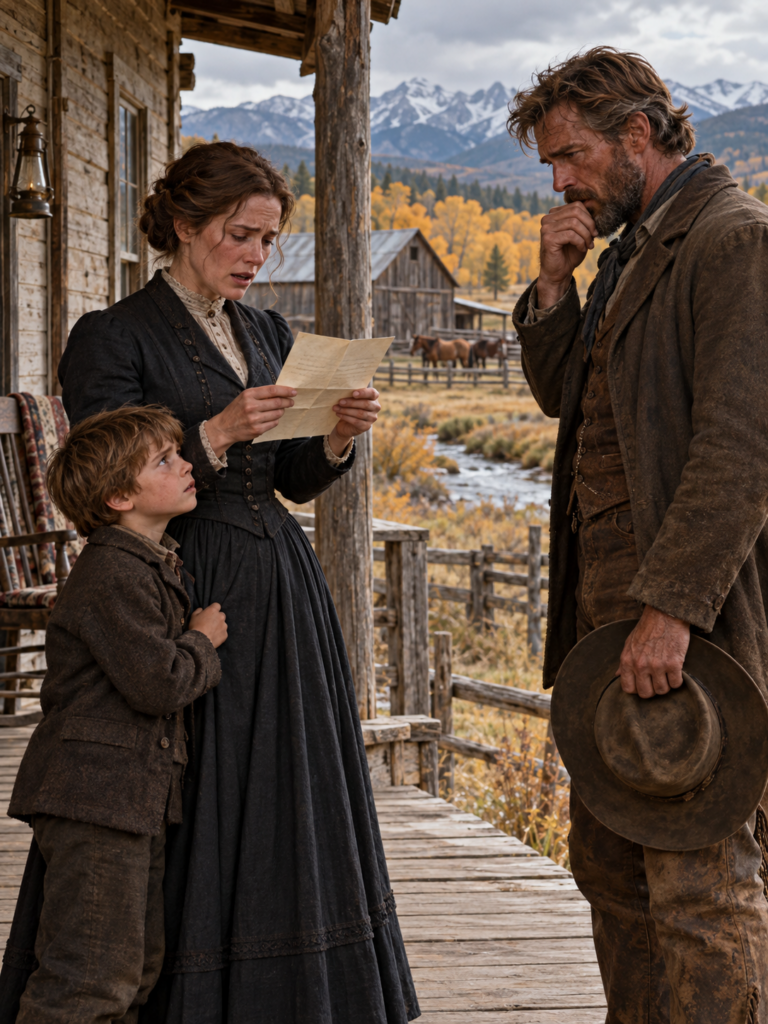
The lock released beneath Ruth’s fingers with a reluctant metallic snap.
She lifted the curved wooden cover.
Inside were ledgers, folded bills, shipping records, and a tobacco tin filled with small receipts.
Four years of business.
Four years during which Elias Hale had depended upon another man’s eyes.
She drew out the newest ledger.
“May I take these to the kitchen table?”
“Every last one.”
Elias stood behind her, listening to the paper rustle.
“Dan Wick told me the ranch was losing money. Said prices were poor and feed costs had risen. I borrowed the seven hundred to carry us through.”
Ruth turned the first page.
The handwriting was neat.
Almost unnaturally neat.
“Who entered these figures?”
“Wick.”
“Who checked them?”
A silence followed.
“Nobody else.”
Ruth carried the ledger to the lamp.
Cyrus fetched another chair while Wesley climbed onto the bench with a slate.
The boy had been taught his figures by his mother, and Ruth gave him a few sums to occupy him.
As the evening deepened, she compared shipping receipts with recorded payments.
The first year appeared correct.
In the second, forty dollars could not be accounted for.
The third showed a larger discrepancy.
By midnight, Ruth had found enough mismatched entries to make her hands cold.
She stopped calculating.
“Elias, these accounts don’t agree.”
He stood beside the stove.
“How badly?”
“I can’t tell you the full amount until I’ve checked everything.”
“Then check it.”
She glanced toward his face.
“Will you believe what I find?”
His expression tightened.
“I’ll believe what you can show me.”
Ruth returned to the papers.
She wanted that to be enough.
Yet she knew how easily a woman without a respectable recommendation could be accused of altering figures herself.
The following morning, Elias came into the kitchen and found her still sitting beside the lamp.
“You haven’t slept.”
“Not much.”
“Miss Allison—”
“Ruth,” she said.
He stopped.
She looked up.
“If we’re to spend the winter in the same household, you may call me Ruth.”
After a moment, he nodded.
“Then you may call me Elias.”
She tapped the ledger.
“I’ve checked each discrepancy three times.”
He pulled out a chair.
“Tell me.”
Ruth explained the shipping records first.
Then the amounts entered by Wick.
Then the sums that should have appeared in the ranch ledger.
Elias listened with his palms flat against the table.
She reached the final page.
“Over four years, the difference is four hundred and twelve dollars.”
The kettle began to hiss.
Elias did not move.
“Four hundred and twelve?”
“Yes.”
“Money the buyers paid?”
“According to these original receipts.”
“And Wick recorded less.”
“Exactly.”
Elias lowered his head.
Ruth waited.
Then he asked the question she had feared.
“How do I know your figures are right?”
The words struck harder than she expected.
She set down her pencil.
“You don’t.”
He raised his face.
She continued carefully.
“That’s the difficulty when someone else must read your accounts. But you can have the figures checked by an independent person. You should.”
“I wasn’t accusing you.”
“You were questioning whether you could trust me.”
“Ruth—”
“And you have every right to ask for proof. But I won’t pretend it doesn’t hurt.”
She rose.
“I’ll see to Wesley.”
Before she reached the door, Elias spoke.
“Wait.”
He called the boy into the kitchen and asked him to read several figures from the original receipts.
Wesley did so carefully.
They matched Ruth’s entries.
When the child returned to his breakfast, Elias sat quietly for a long time.
Then he said, “I asked you for the whole truth and made you regret giving it.”
Ruth looked at him.
“Yes.”
“I’m sorry.”
The apology surprised her.
Men had apologized to her before, usually when they wanted a quarrel finished without changing anything.
Elias did not ask her to stop being hurt.
He simply accepted that he had caused it.
“I’ll have another person verify the books,” he said. “And I’ll make sure you know the result.”
“That would be sensible.”
His mouth shifted.
“Seems I need sensible people around me.”
Ruth almost smiled.
That afternoon, Elias examined the sticking door of her upstairs room.
He asked permission to remove it from its hinges.
When she agreed, he worked carefully with a file, relying on touch to locate the swollen edge.
By evening, the door opened and closed smoothly.
Ruth tested the latch twice.
It was a small repair.
But she understood what it meant.
He had listened when she told him something was wrong.
Then he had put it right.
Still, the seven-hundred-dollar note remained.
There were less than three weeks before November first.
The cattle in Elias’s lower pasture were ready to sell, but the stockyards at Medicine Bow lay eighteen miles away.
A drive would require Cyrus, Ruth, and whatever help Elias could manage.
No one could guarantee good weather.
Nor could they guarantee a fair buyer.
That evening, Elias spread his hand across the kitchen table.
“There’s one way to raise the money before the note comes due.”
Ruth looked up.
“The cattle?”
“One hundred and forty head.”
“Can they bring enough?”
“If the weight is recorded fairly.”
She considered the accounts beneath her hand.
“Then we’d better make certain it is.”
Elias turned toward her voice.
“You’ve never driven cattle.”
“No.”
“And you don’t ride especially well.”
“Also true.”
“Ruth, this won’t be easy.”
She looked at Wesley sleeping near the stove.
Then at the ledgers that had nearly cost Elias his ranch.
“I didn’t come here expecting easy.”
Elias stood quietly.
At last, he reached for the cattle tally and placed it on the table before her.
“Then help me work out what we can safely take.”
Ruth opened her notebook.
But as she began copying the figures, Elias spoke again.
“Before we go, there’s something you need to understand about Augustus Teague.”
Her pencil stopped.
Elias turned his clouded eyes toward the dark window.
“He doesn’t just hold my note.”
He paused.
“He wants the creek. And I’ve begun to think Dan Wick helped him arrange this from the start.”
Ruth held the pencil above her notebook.
“Then we must assume the loan wasn’t an ordinary business arrangement.”
Elias nodded slowly.
“Augustus Teague owns the Double T Ranch. His cattle have been short of water since summer.”
“And your creek still runs?”
“Even in a dry year.”
She looked toward the window.
The stream crossed Hale land before continuing through the lower valley. She had seen it from the porch that first afternoon, narrow and pale beneath the October sky.
“Has Mr. Teague ever asked permission to water his cattle there?”
“Never asked me directly.”
“But he purchased your debt.”
“Yes.”
“And your former foreman went to work for him.”
Elias’s jaw tightened.
“I can’t prove those things are connected.”
“Then we must be careful to distinguish what we know from what we suspect.”
He looked toward her voice.
“You’re beginning to sound like a lawyer.”
“My father was a bookkeeper. He taught me that a suspicion doesn’t belong in the final column until you have evidence.”
“Sounds like a wise man.”
“He was.”
Ruth lowered her eyes.
For a moment, she pictured her father at his desk, explaining figures to a little girl who preferred numbers to embroidery.
He had taught her to add before she could read a novel.
After his death, those lessons had helped keep her employed.
They had also made her useful to a man whose own books had been turned against him.
But usefulness was not the same as safety.
She knew that better than anyone.
The next morning, Elias gathered Cyrus and Ruth around the kitchen table.
They reviewed the cattle count, the available feed, the route to Medicine Bow, and the time remaining before payment.
The old hand, Cyrus Bell, had worked cattle most of his life.
He listened while Elias explained the plan.
“One hundred and forty head,” Cyrus repeated. “That’s a fair number for the hands we’ve got.”
“We’ll take the wagon,” Elias answered. “And move them steady.”
Cyrus glanced toward Ruth.
“Miss Allison riding?”
“At the rear,” she said before Elias could answer.
The older man raised his eyebrows.
“Ever worked a drive?”
“No.”
“Then you’ll learn quickly.”
“I intend to.”
Wesley sat at the table, tracing a multiplication problem.
“What about me?”
Ruth looked at him.
“You’ll stay where Cyrus or I can see you. Your first duty is to obey instructions.”
The boy frowned.
“I can help.”
“You can. But not by putting yourself in danger.”
Elias smiled slightly.
“Good rule for all of us.”
They spent the following days preparing.
Ruth learned to keep her horse at a sensible distance from the cattle.
Cyrus explained how animals moved when startled.
Elias listened to her questions and corrected her when necessary, but never mocked her inexperience.
His impaired sight changed how he worked, not whether he could work.
He knew the land through years of use.
He could recognize the approach of a creek crossing from the sound beneath the wind.
He knew where the trail narrowed and where cattle were likely to scatter.
Still, he depended upon clear spoken reports from the others.
Ruth learned to describe what she saw rather than assume he already knew.
“The bay heifer is drifting toward the fence.”
“How far?”
“About twenty yards from Cyrus.”
“Tell Cyrus, then. I’ll hold the line here.”
They developed a rhythm.
Not one in which Ruth became Elias’s eyes while he merely waited.
One in which each contributed knowledge the others needed.
By October twenty-sixth, the cattle were ready.
They started before dawn beneath a low gray sky.
Elias rode his steady mare, Bess.
Cyrus worked the flank.
Ruth kept behind the herd while another experienced hand helped hold the opposite side.
Wesley remained with the supply wagon under the adults’ supervision.
The first miles were difficult.
Dust coated Ruth’s face.
Her back began aching before breakfast.
Twice she had to turn an animal away from the wrong trail.
Once she misjudged the distance between her horse and a steer and received a sharp warning from Cyrus.
By noon, she understood why cattle work wore men down.
And why Elias took so much care with the animals.
The trouble came in the afternoon.
Clouds moved down from Elk Mountain.
The wind changed direction.
Elias noticed first.
“Weather’s turning.”
Ruth glanced west.
A hard white line approached across the hills.
Cyrus called from the flank.
“We need lower ground.”
Elias guided Bess toward the sheltered route he knew.
The storm struck before they reached it.
Wind drove snow sideways through the moving herd.
The cattle bunched together.
Ruth could barely distinguish one animal from another.
Her horse tossed its head.
She tightened her grip.
“Elias!”
His voice reached her through the wind.
“Keep talking, Ruth! Let them hear you!”
She tried calling ordinary commands.
The wind swallowed them.
Then, without quite deciding to, she began singing.
It was an old Methodist hymn her mother had sung while preparing supper.
Ruth had never possessed a particularly beautiful voice.
That afternoon, she sang loudly enough to make her throat ache.
The nearby cattle began settling.
The sound gave them a steady human presence amid the strange wind.
Ruth continued until Cyrus had the rear animals moving toward the sheltered hollow.
Elias directed the leading cattle into the protected ground.
By the time the herd was safely gathered, snow clung to his eyebrows and the shoulders of his coat.
He rode beside her.
“Miss Allison!”
She turned.
“Yes?”
“Your singing’s dreadful!”
Ruth stared.
Then she laughed.
“I know!”
His grin widened.
“Keep doing it!”
That evening, they made camp in the shelter of the terrain.
The cattle were settled as securely as circumstances allowed.
Ruth sat near the fire, warming hands that had gone painfully stiff.
Elias lowered himself beside her.
For a time, they said nothing.
Then he held his hands toward the flames.
“Never thought I’d be grateful for bad weather.”
“Grateful?”
“Couldn’t see any less than the rest of you for a while.”
Ruth laughed again.
The sound surprised her.
She had spent months guarding every expression, afraid someone might mistake warmth for weakness.
Elias did not seem to expect anything from her laughter.
He was simply glad to hear it.
Their hands met near the fire.
Neither moved away immediately.
“Ruth?”
“Yes?”
“Thank you for coming.”
She looked at him.
“You couldn’t have managed without the cattle drive.”
“I meant something else.”
Her heart gave an uncomfortable little movement.
Before she could answer, Cyrus approached with news that the animals were settled.
The moment passed.
But Ruth remembered it.
They reached Medicine Bow with the herd tired but sound.
At the stockyards, a commission agent named Lyle Crane handled the weighing.
He was acquainted with Augustus Teague.
Ruth knew that because Elias had told her before they arrived.
She stood beside the scale clerk with her pencil and notebook.
The animals were weighed in groups.
Crane called the figures.
Ruth wrote each one.
When the final group passed through, Crane announced the total.
“Twenty-two thousand, four hundred and fifty pounds.”
Ruth added her column again.
Then a third time.
“Mr. Crane?”
He looked up impatiently.
“Yes, ma’am?”
“My figures don’t agree with yours.”
“The scale doesn’t lie.”
“No. But someone can make a mistake adding what it shows.”
A few men nearby stopped talking.
Crane’s face hardened.
“Are you questioning my business?”
“I’m asking you to check your total.”
She held out her figures.
“My sum is twenty-four thousand, three hundred pounds.”
Crane snatched the paper.
“You must’ve copied something wrong.”
“Then show me where.”
Elias approached.
He stood beside Ruth, his face turned slightly toward Crane’s voice.
“Miss Allison manages my accounts,” he said. “I’d appreciate a proper check.”
Crane examined the tickets.
His expression changed.
One entry had been understated.
Others required correction.
At last, he returned to the desk and prepared a revised draft.
The corrected sale brought eight hundred and three dollars.
Fifty-eight dollars more than the figure originally offered.
Ruth watched the agent write the amount.
“Eight hundred and three,” she repeated.
Elias turned toward her.
“That right?”
“It is.”
“Then we’ll take it.”
After allowing for the debt and interest, they would have enough to settle the note and keep a modest reserve for winter feed.
For the first time since reading the lawyer’s letter, Ruth felt some of the tightness leave her chest.
The ranch might survive.
But there was another problem she had not yet confronted.
Her own name.
On October thirtieth, Ruth entered Dunning’s store to purchase flour and lamp oil.
Wesley walked beside her.
Two women stood near the stove.
They fell silent when she approached.
Mrs. Dunning wrapped the flour.
“Cash only, Miss Allison.”
Ruth frowned.
“I’ve always paid cash.”
“Then I expect you’ll have no objection.”
The words were cold.
One of the women near the stove spoke loudly.
“Dan Wick says there’s a woman from Cheyenne working out at Hale’s place. Says she was dismissed for stealing silver.”
Ruth’s fingers went numb.
She knew the story.
She had lived inside it for months.
A family named Marlow had employed her to manage household accounts.
Their son Harlan had cornered her in a storeroom one evening.
She had struck his arm with an iron ladle to make him let her pass.
Later, silver disappeared from the house.
Harlan had debts in Denver.
Ruth suspected he had sold the valuables himself.
But she could not prove it.
His father accused her, dismissed her, and withheld two months of wages.
He threatened to involve the authorities if she protested.
Ruth had left without a recommendation.
Now Dan Wick had carried the accusation to Medicine Bow.
She paid for the flour.
She thanked Mrs. Dunning.
And she walked outside before her hands began shaking.
Wesley looked up.
“Aunt Ruth?”
“Yes?”
“What’s a thief?”
She closed her eyes briefly.
“Someone who takes what doesn’t belong to them.”
“You’re not one.”
She looked down at him.
The certainty in his face nearly broke her.
“No, darling. I’m not.”
That evening, she told Elias everything.
About the storeroom.
About Harlan Marlow.
About the missing silver.
About being dismissed without pay.
Elias listened without interrupting.
When she finished, the lamp hissed softly between them.
“I don’t care what they say in Cheyenne,” he answered.
“You will care when Teague’s lawyer repeats it in the bank.”
“Let him.”
“You don’t understand.”
Her voice sharpened.
“You’ve trusted me with your books. I’ve corrected your accounts. I’ve handled the draft that will save your ranch.”
She drew a breath.
“All Mr. Teague needs to do is convince people I’m a dishonest woman taking advantage of a man who can’t read his own papers.”
Elias sat back.
“Then we’ll face him together.”
Ruth looked at him.
“I have nothing to offer you, Elias.”
He turned toward her voice.
“What?”
“No respectable name. No references. No family standing that will make people believe me.”
“Ruth—”
“I’m a burden you cannot afford.”
“That’s pride talking.”
Her eyes flashed.
“So is your refusal to understand how the world treats women without protection.”
He opened his mouth.
Then closed it.
For once, Elias Hale had no answer.
Ruth took the lamp and went upstairs.
Before dawn, she made her decision.
She packed her carpetbag.
She wrapped Wesley in his quilt.
And she left the ranch before Elias woke.
On the kitchen table she placed the corrected ledger, the sorted receipts, and a folded letter.
She had checked the figures one final time.
Everything balanced.
The ranch had the money to settle its debt.
Elias could hire another reader.
She told herself that leaving was the most useful thing she could do.
But as the wagon carried her toward Medicine Bow, she discovered that doing what seemed useful could hurt terribly.
Elias found the letter while making coffee.
He felt its edges beneath his fingers.
He knew it was Ruth’s handwriting.
He could not read a word.
Cyrus could not help him.
Wesley was gone.
For several minutes, Elias stood in the kitchen holding the only letter he had ever wanted desperately to read.
Then he put on his coat.
He saddled Bess.
And for the first time in four years, he rode into town intending to tell someone openly that he could no longer see well enough to read.
He stopped at the schoolhouse.
Miss Abbott was sweeping the floor.
“Ma’am,” he said from the doorway, “I need a favor.”
She approached.
“What is it, Mr. Hale?”
He held out the paper.
“I need this read aloud. I can’t read it myself.”
She accepted the letter without comment.
Then she began.
Ruth had written that the accounts were accurate.
The receipt box was organized.
The money for the note was sufficient.
She had suggested a reliable young woman who might read his future correspondence.
Then came the final lines.
She regretted leaving before November first.
And perhaps, she wrote, she had been wrong to think that she possessed something he needed.
She wished she had something more to give.
Elias gripped the doorframe.
Miss Abbott lowered the paper.
“Mr. Hale?”
He swallowed.
“Thank you.”
Then he turned toward Bess.
The eastbound train was due at four.
He knew Ruth would not have many other choices.
He rode hard.
When he reached the station, the platform was crowded.
He could not see individual faces.
But he heard Wesley arguing with a porter.
“That isn’t our bag!”
Elias followed the boy’s voice.
Then he heard Ruth.
“Wesley, come here.”
He stopped a few steps away.
“Ruth.”
She turned.
“Elias?”
He removed his hat.
“I had Miss Abbott read your letter.”
Her face tightened.
“You shouldn’t have come.”
“I know what I said badly.”
“Elias—”
“When you first arrived, I told you that you had everything I needed. I meant you could read my letters. That was true then.”
He took a breath.
“But Dan Wick could read. He read better than most men I know.”
Ruth stood very still.
“What he couldn’t do was tell me the truth when it cost him something.”
Elias faced her voice.
“You found money missing from my accounts and told me before breakfast. You stood beside me when the cattle were weighed. You made me ask for proof instead of being ashamed of needing help.”
His voice grew rough.
“I don’t need somebody to lend me a pair of eyes. I’ve learned to manage without seeing much.”
He paused.
“I need someone who will tell me the truth. Someone whose company I want when the day’s work is done.”
Ruth’s eyes filled.
“Elias, people will laugh at you for trusting me.”
“Then I’ll tell them what I know.”
“At the bank?”
“Especially there.”
He extended his hand, palm upward.
“Come back if you want to, Ruth. Not because you owe me. Not because I need a reader. Because I’d like you and Wesley to be there.”
The train whistle sounded in the distance.
Ruth looked at her ticket.
Then at Wesley.
Then at the man standing before her.
She stepped forward and placed her hand in his.
“I’ll ask for a refund,” she whispered.
Elias’s fingers closed gently around hers.
Wesley immediately brightened.
“Can I keep the ticket stub?”
For the first time that morning, Ruth laughed.
“Yes, darling.”
The train arrived.
Passengers hurried aboard.
But Ruth remained on the platform beside Elias Hale.
And together, they turned toward the ranch they still had to save.
They turned away from the arriving train as its whistle echoed through Medicine Bow.
Ruth kept her hand in Elias’s.
For several steps, neither spoke.
Then Wesley hurried ahead, clutching the unused ticket stub as though it were a prize.
Elias stopped beside Bess.
“Are you certain, Ruth?”
She looked at him.
“About coming back?”
“Yes.”
“I’m certain I want to help you finish this.”
He nodded.
“That’s enough.”
She hesitated.
“And afterward?”
“We’ll decide afterward.”
It was the answer she needed.
Not a promise made from desperation.
Not a bargain struck because one of them feared losing the other.
Just permission to finish what they had begun and discover, honestly, whether there was something more.
They returned to the ranch before dark.
Cyrus was waiting near the porch.
When he heard Ruth’s voice, he smiled beneath his gray mustache.
“Thought we’d lost our cook.”
Ruth gave him a stern look.
“Your cooking wasn’t much worse than mine.”
“That’s why I was worried.”
Wesley laughed.
For the first time since leaving Cheyenne, the sound of ordinary conversation felt like something Ruth could trust.
But the bank appointment remained.
On the morning of November first, they traveled to Rawlins.
The eight-hundred-and-three-dollar draft was secured inside Ruth’s coat.
The tobacco tin containing the original cattle receipts rested in her carpetbag.
The corrected ledger lay wrapped in cloth.
Elias carried the loan documents.
Before leaving, Ruth had read every page to him again.
The principal was seven hundred dollars.
Interest and charges brought the amount due to seven hundred and thirty-five.
They had enough.
But enough money would not guarantee a fair settlement if Augustus Teague controlled the conversation.
Elias understood that now.
And he intended to speak for himself.
The bank stood on a busy street behind a brick front and heavy doors.
Inside, polished brass rails separated customers from the counters.
A clock ticked above the office doorway.
Mr. Hollis, the banker, greeted Elias courteously.
Augustus Teague was already waiting.
He was a broad man in an expensive coat, with the satisfied expression of someone who expected the day’s business to proceed exactly as arranged.
Beside him stood his attorney, Mr. Bell.
Near the wall, Dan Wick held his hat in both hands.
Ruth noticed the former foreman’s expression immediately.
He did not look like a man expecting to celebrate.
He looked as though he hoped nobody would ask him a question.
“Mr. Hale,” Teague said pleasantly. “Glad you could come.”
Elias faced the voice.
“Morning.”
“I trust you’ve considered your position.”
“I have.”
Teague smiled.
“Then perhaps we’ll settle this with little difficulty.”
Elias placed the bank draft on the counter.
“Eight hundred and three dollars. The note calls for seven hundred and thirty-five, including interest.”
Mr. Hollis examined the draft.
“That appears sufficient.”
Teague’s smile weakened slightly.
His attorney stepped forward.
“Then we simply require Mr. Hale’s signature on the satisfaction document.”
He placed a paper beside the draft.
Elias did not reach for it.
“Miss Allison will read it aloud.”
The attorney hesitated.
“Surely that’s unnecessary.”
“It is necessary to me.”
Teague glanced toward Ruth.
“Mr. Hale, I understand you’ve had some difficulty with this woman.”
Ruth felt the familiar coldness settle in her stomach.
Here it came.
The accusation.
The humiliation.
The story from Cheyenne.
The attorney cleared his throat.
“We’ve received information that Miss Allison was dismissed from a previous position over missing household valuables.”
The room became quiet.
Ruth stood straighter.
“I was dismissed,” she said. “That part is true.”
Mr. Bell looked satisfied.
“Then you acknowledge—”
“I acknowledge that I was accused after refusing the advances of my employer’s son. Silver disappeared afterward. I was not permitted a fair inquiry, and I received no wages for my final two months.”
She took a breath.
“I cannot prove who took the silver. But I did not.”
Teague gave a short laugh.
“An unfortunate tale.”
“Yes,” Ruth answered. “It was.”
Then she placed the corrected ledger on the counter.
“But that has nothing to do with whether these cattle accounts are accurate. Mr. Hollis can examine every original receipt and compare it with the entries I prepared.”
The banker looked at the documents.
“I intend to.”
Elias spoke.
“Ruth has managed my accounts honestly. I know because the figures can be checked.”
Teague’s attorney leaned forward.
“Mr. Hale, given your unfortunate condition, perhaps you don’t fully understand—”
“I understand my condition perfectly.”
Elias’s voice remained calm.
“I have limited sight. That doesn’t make me incapable of conducting business.”
The attorney stopped.
Elias continued.
“I trusted Dan Wick with my papers. He misrepresented the terms of my loan.”
Wick shifted near the wall.
“He also handled accounts that don’t agree with the original receipts.”
Teague looked toward the former foreman.
“This is becoming a spectacle.”
“Then we should finish it properly,” Elias answered.
He turned toward Ruth.
“Read the paper, please.”
She lifted the proposed acknowledgment.
The opening paragraphs appeared routine.
Payment of the outstanding debt.
Release of the secured obligation.
Statements concerning the land.
Then she reached a clause near the bottom.
Her voice slowed.
“And furthermore, the undersigned Elias Hale grants to Augustus Teague and his successors perpetual use of the waters of Hale Creek for the watering of livestock—”
She stopped.
The bank grew silent.
Elias stood very still.
“What did that say?”
Ruth read the clause again.
Word for word.
Mr. Hollis extended his hand.
“Let me see that.”
She passed him the document.
The banker read it once.
Then again.
His expression hardened.
“Mr. Bell, this isn’t merely an acknowledgment of payment.”
The attorney adjusted his cuffs.
“Standard provisions.”
“Not in this bank.”
Mr. Hollis laid the paper flat.
“This grants a permanent interest in the water supply. It has no proper place in an ordinary release of a paid note.”
Teague’s face darkened.
“My cattle need water.”
Elias turned toward the sound of his voice.
“Then you should have asked me.”
Teague stared.
“Asked you?”
“Yes.”
“You know what happened last summer. My wells nearly dried. Eighty head lost.”
“I know.”
“Then you know why I need that creek.”
Elias rested one hand on the counter.
“I might have agreed to reasonable use for a fair price.”
Teague said nothing.
“But you didn’t ask. You bought my debt, hired the man who handled my papers, and waited for me to sign something I couldn’t read.”
The silence lengthened.
Then Elias said, “That’s not how neighbors ought to conduct business.”
Mr. Hollis removed the disputed document.
He prepared a straightforward receipt showing the note paid in full, without a transfer of water rights.
Ruth read it aloud twice.
This time, every sentence concerned the actual debt.
Elias signed.
The banker witnessed the payment.
Seven hundred and thirty-five dollars extinguished the obligation.
The ranch remained Elias Hale’s.
The creek remained under his lawful control.
And Augustus Teague no longer held the threat of foreclosure over him.
But Elias was not finished.
He opened the tobacco tin.
Inside lay four years of shipping receipts.
He placed them beside the ledger.
“Mr. Hollis, I’d appreciate your examining these.”
The banker frowned.
“For what purpose?”
“Dan Wick kept my accounts.”
Elias paused.
“The original receipts show four hundred and twelve dollars more in payments than he recorded.”
Wick’s face drained of color.
“That’s ridiculous.”
“Then the records should settle it.”
Ruth looked at Elias.
He had used almost the same words she had spoken while examining the accounts.
But this time he did not need her to speak for him.
He had chosen the facts.
And he was prepared to stand behind them.
Mr. Hollis examined the receipts.
He checked the ledger.
Then he summoned an assistant to verify several entries independently.
As the figures were compared, Wick began edging toward the door.
“Mr. Wick,” the banker called.
The former foreman stopped.
“I suggest you remain until we’ve finished.”
Wick looked toward Teague.
The wealthy rancher avoided his eyes.
After a long examination, Mr. Hollis closed the ledger.
“These discrepancies require a formal investigation.”
He looked at Elias.
“Your bookkeeper’s work appears exceptionally careful.”
Ruth felt heat rise in her face.
“Thank you, sir.”
“If you ever require a recommendation for accounting work, Miss Allison, you may refer inquiries to this bank.”
For several seconds, she could not speak.
A recommendation.
Not a favor offered out of pity.
Not a gentleman generously overlooking her reputation.
A professional acknowledgment based upon work she had completed.
She lowered her head.
“I would appreciate that very much.”
The banker arranged for the relevant records to be preserved and for the sheriff to be notified.
What penalties Wick might eventually face would depend upon further examination.
But his ability to conceal the missing money behind Elias’s impaired vision had ended.
Teague left without the creek rights he had expected.
The attorney departed with him.
And when Ruth and Elias stepped outside, the November wind struck their faces.
Elias raised his chin toward it.
“Did I do all right?”
Ruth looked at him.
“You told them the truth.”
“Felt like stepping off a roof.”
“You sounded perfectly steady.”
He laughed.
“Then I’m glad you were there.”
She took his arm.
“So am I.”
They stood together on the bank steps.
Behind them lay the documents that had nearly cost Elias his ranch.
Ahead lay a winter neither could pretend would be easy.
But for the first time, they faced it without a secret standing between them.
The return to Medicine Bow was quiet.
Wesley fell asleep in the wagon, his head against Ruth’s shoulder.
Elias sat beside her, holding the reins while she described the road.
The light was fading.
She watched his face as they traveled.
There was still cloudiness in his eyes.
The bank’s decision had not repaired his sight.
Nor had it erased the difficulty of living with a condition that grew worse.
But something in his expression had changed.
He no longer seemed determined to conceal every limitation.
And Ruth no longer felt she must prove herself useful enough to deserve a place in the world.
When they reached the ranch, Cyrus met them by the barn.
“Well?”
Elias stepped down.
“Paid.”
The old man stopped.
“All of it?”
“Every cent.”
Cyrus removed his hat.
For a long moment, he looked toward the creek.
Then he said, “That’s good.”
There were no speeches.
No celebration elaborate enough to make winter disappear.
But that evening, Ruth cooked supper while Elias repaired a loose hinge on the kitchen door.
Wesley read aloud from a schoolbook.
Cyrus listened beside the stove.
And the ranch house sounded different.
Not because it had suddenly become wealthy.
Because no one inside was waiting for a stranger to take it away.
Winter came early.
Snow settled deep around the outbuildings.
The rope between the house and barn became important when drifts obscured familiar paths.
Cyrus and Elias worked to keep the cattle fed.
Ruth managed the food stores, household accounts, and ordinary chores, learning what the ranch demanded and where additional help was necessary.
Wesley attended school whenever travel conditions allowed.
On other days, he practiced reading at the kitchen table.
Elias listened with an attention that made the boy sit straighter.
At first, Wesley read haltingly.
He stumbled over long words.
He mixed up letters.
But he persisted.
One evening, after finishing a page without help, he looked toward Elias.
“Did I do it right?”
Elias smiled.
“Every word sounded clear to me.”
Wesley beamed.
“Then tomorrow I’ll read two pages.”
“Suppose I’ll have to make time for them.”
“You can listen while you fix my boot.”
Elias laughed.
“That sounds fair.”
The little boy had lost his mother only months earlier.
Ruth knew no amount of security could erase that grief.
Some nights Wesley still woke calling for her.
Sometimes he asked questions Ruth couldn’t answer.
But at the ranch, he was no longer afraid that every new attachment would vanish without warning.
Elias never tried to replace the boy’s mother.
He simply became a dependable adult who listened, taught, and kept his word.
For Ruth, that was enough.
In January, a man from Teague’s ranch arrived at the porch.
His hat was dusted with snow.
“Our wells are freezing over,” he explained. “Mr. Teague wants to know whether Hale Creek can be used for watering part of the herd.”
Elias stood beside Ruth.
She looked at him.
He did not appear angry.
He appeared thoughtful.
“How many cattle?”
The man answered.
“Then we’ll make an agreement,” Elias said. “Limited use. Fair payment. No permanent claim.”
He turned toward Ruth.
“Will you write it down?”
She nodded.
Together, they set clear terms.
Fifty cents per head for the agreed use.
No hidden provisions.
No transfer of ownership.
Ruth read the terms aloud.
Twice.
The man listened.
Then signed.
Elias shook his hand.
It was the first time Ruth had seen him turn a conflict over the creek into an arrangement both ranches could accept.
After the visitor left, she looked at him.
“You could have refused.”
“Could have.”
“After what Teague tried?”
Elias nodded.
“Doesn’t mean his cattle ought to suffer for it.”
Ruth smiled.
“That’s a generous view.”
“Not altogether. His payment will buy feed.”
She laughed.
“There’s the rancher I know.”
He reached for her hand.
And this time, neither pretended the gesture was accidental.
As the months passed, their relationship changed through ordinary work.
Ruth learned where Elias preferred certain objects and why those arrangements mattered.
When something needed moving, she told him.
When he required help with a task, he asked rather than pretending he could manage what had become unsafe.
They disagreed occasionally.
Once, Elias grew irritated when Ruth rearranged supplies without warning.
She reminded him that the kitchen was also her workplace.
He apologized for speaking harshly.
They then agreed upon a system that preserved safe routes and familiar locations while allowing her to manage the household efficiently.
Another time, Ruth attempted to handle too much work alone.
Elias found her still sewing beside the lamp long after midnight.
“You’ve been at that since supper.”
“I want to finish.”
“You’ll tire yourself sick.”
She looked up.
“That’s my decision.”
“It is.”
He paused.
“But I’d rather you didn’t think earning your place means never resting.”
Ruth lowered the cloth.
Those words struck something tender.
For years, she had believed that if she stopped being useful, she would become disposable.
She had worked through exhaustion in Cheyenne.
She had accepted unfair treatment because she feared losing employment.
Even at the ranch, after proving her competence, she sometimes caught herself counting every meal as something she must earn back.
Elias sat across from her.
“You’ve done more than enough today.”
She looked toward the sewing.
“There’s still work.”
“There always will be.”
He held out his hand.
“Come sit by the stove a while.”
She did.
And for once, she allowed unfinished work to remain unfinished.
By late winter, the two of them had reached an understanding that had little to do with her original employment agreement.
Ruth was no longer merely keeping house.
She managed the ranch accounts, corresponded with buyers, and received fair compensation for that work.
Elias consulted her on matters involving figures and contracts.
She consulted him on ranch operations and the practical needs of the property.
They were not equal because they performed identical tasks.
They were equal because each had a voice in decisions affecting their shared lives.
There was affection, certainly.
The kind that appeared when Elias saved the warmest place by the stove for her after a cold afternoon.
Or when Ruth quietly took his worn boots to the cobbler and refused to let him postpone repairs until Christmas.
Or when he learned to recognize her footsteps across the yard without counting them aloud.
But neither was ready to turn affection into an obligation.
Ruth had her nephew to consider.
She needed assurance that her livelihood would remain secure even if their feelings changed.
Elias needed to know that she wanted him for himself rather than because his ranch offered shelter.
So they talked.
Not all at once.
Not in grand speeches.
Over coffee.
During walks along the porch.
Beside the stove after Wesley had gone to bed.
Elias told her about his father.
The older man had lost his sight when Elias was fifteen.
For nine years, he had depended upon his family for assistance with ordinary tasks.
Elias remembered the way his father thanked them for every meal, every guided step, every small act of care.
“I hated hearing him apologize for needing us,” Elias admitted.
Ruth sat quietly.
“He’d been strong all his life. Worked horses. Raised sons. Then he began acting as though there wasn’t anything worthwhile left in him.”
She looked toward Elias.
“And you were afraid the same thing would happen to you.”
He nodded.
“I thought if people knew how little I could see, they’d stop treating me like a rancher.”
“Some might have.”
“Yes.”
“But hiding it made you depend on a man who used your secrecy against you.”
Elias sighed.
“That’s the truth of it.”
Ruth touched his hand.
“Needing assistance isn’t the same as surrendering your judgment.”
He turned toward her voice.
“No,” he said. “I know that now.”
In return, Ruth spoke of her own fear.
She told him how the accusation in Cheyenne had changed her.
How quickly friends had disappeared.
How employers who once praised her work suddenly treated her as suspicious.
How frightening it had been to become responsible for Wesley when she had little money and nowhere secure to live.
“I thought if I became useful enough, nobody could send us away,” she said.
Elias listened.
“But you shouldn’t have had to prove yourself worthy of ordinary decency.”
Her eyes filled.
“No.”
He turned his hand beneath hers.
“I can’t change what happened to you.”
“I know.”
“But I can promise I’ll never use your need for shelter against you.”
Ruth looked at him for a long time.
Then she leaned forward and kissed his cheek.
He grew very still.
She smiled.
“That wasn’t payment for the room, Elias.”
His mouth curved.
“Good.”
“It was because I wanted to.”
“Then I hope you might want to again.”
She laughed and kissed him once more.
Spring did not arrive quickly in Medicine Bow.
The snow lingered along the shaded fences.
The creek ran dark beneath broken edges of ice.
And the cattle emerged from winter thinner than Elias would have preferred, though most remained in good condition.
They worked steadily.
Feed stores were counted.
Fences inspected.
Accounts updated.
Ruth began showing Wesley how to make neat ledger entries.
Elias taught him the practical signs that revealed when a horse was uneasy.
Cyrus watched these lessons with quiet amusement.
“Boy’s getting an education in everything but idleness,” he observed.
Wesley looked up from his slate.
“What’s idleness?”
“Something I used to enjoy before the two of you came here,” Cyrus answered.
They laughed.
By then, the ranch house had become livelier than Elias remembered it being in years.
He no longer spent entire evenings listening to the stove and imagining the life passing beyond his windows.
There were books being read aloud.
There were questions.
There were the sounds of Wesley learning, Ruth working, Cyrus complaining about the biscuits, and animals moving outside.
Yet Elias did not mistake activity for happiness.
The deeper change lay in something quieter.
When Ruth entered a room, he felt no need to pretend he could see her.
When he asked her to read a letter, he no longer heard his father’s embarrassed apologies in his own voice.
And when she disagreed with him, he understood that she was speaking as someone who intended to remain honest, not someone trying to diminish him.
One evening after the last heavy snowfall, Ruth carried a pail from the barn toward the house.
The sky was clear.
Stars glittered above the fields.
The snow reflected enough light to make the yard seem blue.
At the porch stood a single lantern.
Elias had begun hanging it there every evening.
He claimed it was for the hands returning from the outbuildings.
Ruth suspected otherwise.
She paused at the edge of the yard.
Across the snow, the light illuminated the porch railing and the familiar figure beside it.
Elias stood with one hand resting on the post.
He turned before she spoke.
“Seventeen steps from the pump,” he called.
Ruth smiled.
“Nineteen from the barn.”
He tilted his head.
“You been counting?”
“I thought I might as well learn.”
“You don’t need to count for me.”
“I know.”
She approached.
“How did you know it was me?”
“Your footsteps.”
“That simple?”
“Been listening to them for months.”
She reached the bottom step.
Elias extended his hand.
She took it.
He guided her onto the porch, not because she needed help climbing two steps, but because both of them wanted the contact.
The lantern burned steadily beside them.
Ruth placed the pail near the door.
For a time, they listened to the quiet sounds of the ranch.
Wesley was in the barn telling the cat a complicated story.
Cyrus was putting away tools.
The creek murmured beneath its thinning ice.
Elias turned toward Ruth.
“You’ve been quiet tonight.”
“Thinking.”
“About what?”
She looked across the snow.
“When I arrived here, I was certain you would turn me away.”
“I nearly frightened you instead.”
“You did frighten me.”
His expression changed.
“Did I?”
“That first afternoon. When you told me I had everything you needed.”
Elias sighed.
“I remember.”
“I thought you were asking for something I couldn’t safely give.”
“I know.”
She glanced toward him.
“Then I discovered you needed someone to read a letter.”
“That was certainly part of it.”
“And afterward, I thought if the work stopped, you’d have no reason to keep me.”
Elias shook his head.
“Ruth.”
She continued.
“I’ve spent most of my life measuring what I was worth by how much I could do for other people.”
He listened.
“If I managed the books correctly, I was valuable. If I kept a house properly, I was useful. If I could feed Wesley and keep us sheltered, I had accomplished something.”
Her voice softened.
“But I never knew what would remain of me if I failed at any of those things.”
Elias held her hand a little more firmly.
“You’d still be Ruth.”
Tears gathered in her eyes.
He turned his face toward her.
“I’ve known men who could see perfectly and never noticed the harm they did.”
She looked at him.
“I’ve known people who offered help because they expected obedience afterward.”
“I don’t want your obedience.”
“I know that now.”
He smiled faintly.
“You’ve made that clear enough.”
Ruth laughed through her tears.
Then she grew serious.
“Elias, what do you want from me?”
He considered the question.
Not because he was uncertain.
Because he wanted to answer honestly.
“I want you to keep the accounts if that’s work you wish to do.”
She waited.
“I want Wesley to keep learning. I want him to have a place here where he knows he’s welcome.”
Her expression softened.
“And I want you to stay because you like being here. Because you like me.”
He paused.
“Not because you believe you haven’t another choice.”
Ruth looked at the lantern.
The light trembled in the cold air but did not go out.
She thought of Cheyenne.
Of the missing silver.
Of the months without work.
Of Wesley’s small hand gripping hers on the day they arrived.
Then she thought of the train platform.
Elias standing before her, admitting his blindness to a stranger because he needed to read her farewell letter.
The bank.
The corrected accounts.
The first evening he had asked whether she wanted to sit beside the stove instead of working until midnight.
So many ordinary moments.
Each one had taught her something.
Not that love could rescue a woman from the necessity of making her own life.
But that it could exist beside that life without taking it away.
“I do like being here,” she said softly.
Elias smiled.
“Glad to hear it.”
“And I like you.”
“Even better.”
She laughed.
Then she raised her hand to his face.
His eyes remained clouded.
She knew they would likely never see her clearly again.
But he recognized her voice, her touch, her manner of moving through the house.
He understood what made her angry.
What frightened her.
What work mattered to her.
And he had learned not to confuse helping her with deciding for her.
“Elias,” she whispered, “I still don’t know what I have to offer you.”
He turned toward her.
For one fleeting instant, the lantern light caught his gray eyes in such a way that she almost imagined he could see her.
Then he smiled.
“You’re mistaken, Ruth.”
She held her breath.
“You have everything I need.”
The words were the same ones he had spoken on that first cold afternoon.
But their meaning had changed.
Then, he had needed someone who could read.
Now, he was speaking to a woman whose company he loved, whose judgment he respected, and whose future he wanted to share without claiming authority over it.
Ruth rested her forehead against his.
“And you have something I need, too.”
“What’s that?”
She smiled.
“A place where the truth is welcome.”
He kissed her gently.
When they parted, the lantern still burned beside them.
Inside the house, Wesley called for his aunt to hear the new page he had mastered.
Ruth laughed.
“Seems we’re needed.”
Elias took her hand.
“Then we’d best go inside.”
They entered together.
The two coffee cups waited on the kitchen table in their usual places, positioned where Elias could find them without searching.
Wesley held his book open.
Cyrus complained that the biscuits were getting cold.
And Ruth, who had once arrived believing she had nothing worthwhile to offer, sat among people who no longer required her to prove her value every day.
She still worked.
She still kept accounts.
She still watched carefully over Wesley.
But she also allowed herself to be loved.
Elias, who had once hidden his fading sight as though it made him less of a man, no longer measured his strength by how little help he required.
He measured it by the promises he kept, the choices he made, and the respect he offered those who shared his life.
The ranch remained theirs to care for through good seasons and difficult ones.
The creek continued running through the lower pasture.
The lantern continued burning on the porch.
And on evenings when Ruth returned late from the barn, Elias still recognized her approaching footsteps before she reached the steps.
He would extend his hand.
She would take it.
Not because either needed to be rescued.
But because both had freely chosen someone to walk beside.
And in that little ranch house outside Medicine Bow, the simple words once spoken between two desperate strangers became a promise neither had to fear.
She had something to offer.
So did he.
And what they built together was worth far more than either had first imagined.

