
PART 2
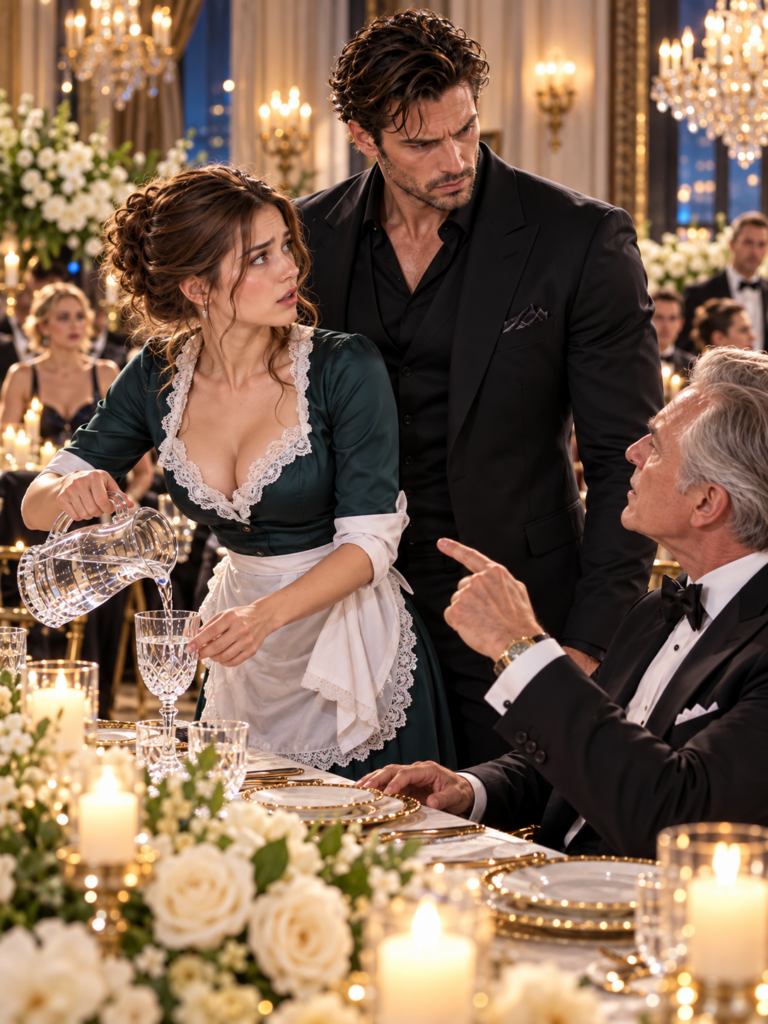
Salvatore Vitiello’s cane struck the marble floor with a sharp metallic crack.
No one moved.
The sound seemed to remain beneath Bellori’s chandeliers long after the cane stopped rolling.
I looked from it to the old man’s face.
A moment earlier, Salvatore had been irritated, imperious, almost amused by everyone’s discomfort. Now the color had drained from his cheeks.
“What did you say?” he asked.
His English was suddenly perfect.
I swallowed.
“My great-grandmother’s name was Lucia Moretti.”
Salvatore closed his eyes.
Not dramatically. Not as though he had been struck.
It was quieter than that.
He simply stood there with one hand pressed against the edge of the table and breathed slowly through his nose.
Mateo bent and picked up the cane.
“Papa?”
Salvatore opened his eyes.
“You knew?” he asked his son.
Mateo’s expression tightened.
“No.”
The old man looked at me again.
“Her full name.”
I glanced toward my manager, Mr. Bellori, who appeared to be reconsidering every decision that had led him to this evening.
“Lucia Elena Moretti,” I said. “She married an American named Daniel Reed after she came here.”
Salvatore sat down.
He did not reach for his cane.
Mateo placed it carefully beside his chair.
Around the table, the other members of the Vitiello family remained silent. There were six of them besides Mateo and Salvatore—two women in elegant dark dresses, three men ranging from their thirties to their sixties, and an older woman with silver hair who had spent most of the evening watching everyone with calm, unsettling attention.
It was that woman who spoke first.
“Lucia had green eyes.”
I turned.
“So do you,” she said.
Mine were more gray than green, depending on the light, but I didn’t correct her.
Salvatore’s hand tightened around his napkin.
“When did she die?”
“Eleven years ago.”
He looked down.
Something changed in his face then.
Not grief exactly.
Regret.
The kind that had been waiting somewhere for a very long time.
I suddenly felt intrusive, although I was the one standing beside their table holding a water pitcher.
“I should finish serving dinner.”
“No.”
The word came from Mateo.
Not harshly.
But everyone heard it.
He met my gaze.
“Please sit down.”
I stared at him.
“I’m working.”
“I know.”
“That usually means I don’t sit with customers.”
One corner of the older silver-haired woman’s mouth moved.
Mateo almost smiled too, but Salvatore spoke before he could.
“Sit,” he said, then stopped.
His voice softened.
“Please.”
The second word startled me more than the first.
I set the pitcher on the service table.
Mr. Bellori found his voice.
“Tessa, you can take a few minutes.”
I almost laughed.
Three minutes earlier, he had looked ready to fire me for understanding Sicilian.
Now he looked prepared to give me paid leave until retirement.
I pulled out the empty chair at the far end of the table.
Mateo shook his head.
“Here.”
The chair beside him.
Of course.
I sat.
Every instinct I had spent six years developing told me that accepting a seat at this table was a terrible idea.
I had survived adulthood by keeping my life small and manageable.
Rent.
Tuition.
Bus schedule.
Clinical rotations.
Two jobs during summer, one and a half during semesters.
I knew how much I owed on my electricity bill. I knew which laundromat machine stole quarters. I knew that if I worked the Friday double shift, I could afford the new pharmacology textbook without putting it on my credit card.
I did not know what to do with an elderly Sicilian man staring at me as if my dead great-grandmother had suddenly walked into Bellori.
Salvatore leaned toward me.
“Lucia raised you?”
“For a while.”
“Your mother?”
“My mother worked nights when I was little. My great-grandmother lived with us.”
“What did Lucia tell you about Sicily?”
“Not much.”
That answer seemed to disappoint him.
“She cooked,” I continued. “She complained about American tomatoes. She kept rosemary growing in coffee cans by the kitchen window. She said nobody in Chicago knew how to make bread because everyone was always in a hurry.”
The silver-haired woman laughed quietly.
“That sounds like Lucia.”
Salvatore looked at her.
She ignored him and extended her hand toward me.
“I am Caterina.”
“His sister,” Mateo added.
Salvatore gave his son a displeased look.
Caterina appeared delighted by it.
“Yes,” she said. “His older and infinitely more patient sister.”
“You are eleven months older.”
“And the eleven months made all the difference.”
For the first time since I had spoken Sicilian, the room loosened.
Only slightly.
But enough to breathe.
Caterina asked, “Did Lucia ever speak about a village called Pietramare?”
The name meant nothing to me.
I shook my head.
“She rarely talked about before America.”
“Did she keep letters?”
“Maybe. My mother packed most of her belongings after she died.”
“Where?”
“In storage, I think.”
Salvatore looked toward Mateo.
I noticed the exchange immediately.
“No,” I said.
Mateo looked back at me.
“I didn’t say anything.”
“You were about to.”
His brows lifted.
“What was I about to say?”
“You were about to offer to have somebody find the storage unit, open it, catalog everything, translate the letters, and probably organize the boxes alphabetically.”
Caterina covered a smile with her wineglass.
Mateo leaned back.
“That is extremely specific.”
“I’ve met rich people before.”
“Have you?”
“I carry their plates eight hours a day.”
That almost-smile appeared again.
Then Salvatore surprised me.
He laughed.
It was not loud, but it changed him. For several seconds, the feared patriarch became simply an old man enjoying a joke.
“Lucia would have liked her,” Caterina said.
Salvatore’s amusement vanished.
“She would have.”
The certainty in his voice settled heavily over the table.
I looked at him.
“How did you know her?”
Nobody answered immediately.
Salvatore reached for the cane Mateo had placed beside him.
His thumb traced the silver handle.
“We grew up in the same village.”
“That’s all?”
“No.”
I waited.
Salvatore looked at me for a long moment.
Then he said, “But that is where I should begin.”
Dinner grew cold.
No one seemed to care.
Mr. Bellori quietly redirected the kitchen staff and told the other servers to remain near the bar unless called. Plates stayed beneath warming covers.
Salvatore spoke.
Pietramare, he explained, was a hillside village in western Sicily where stone houses climbed toward an old church and everyone knew which family had harvested which olive grove for generations.
His family had been comfortable.
Lucia’s had not.
Her father repaired fishing nets near the coast, and her mother sewed dresses for women who could afford fabric but not Palermo prices.
Yet according to Salvatore, Lucia had been the smartest person in their school.
“She corrected the priest,” he said.
Caterina nodded.
“Frequently.”
“She corrected everyone,” Salvatore muttered.
“What did she want to do?” I asked.
“Become a teacher.”
The answer made something ache inside me.
My great-grandmother had never mentioned that.
To me, she had simply been Nonna Lucia, although technically she was my mother’s grandmother. She had worn soft cardigans, smelled faintly of lavender and flour, and watched old game shows while shelling peas into a metal bowl.
I had never imagined her at seventeen with ambitions.
Salvatore continued.
His father had owned several warehouses and arranged shipments between Sicily and the mainland. After the war years, the family’s fortunes expanded. So did its influence.
He did not explain what kind.
I did not ask.
Lucia sometimes worked for Caterina, helping with bookkeeping.
“She was better with numbers than the men who were paid to keep the books,” Caterina said.
“That was not difficult,” Salvatore replied.
“She also read every newspaper she could find.”
“She had opinions about all of them.”
“She had opinions about everything.”
Again, that brief warmth passed between brother and sister.
Then I asked the obvious question.
“Why did she leave?”
Salvatore’s face changed.
Caterina answered instead.
“Because staying became impossible.”
The restaurant seemed very quiet.
“Because of your family?”
Caterina glanced at her brother.
“In part.”
Salvatore did not object.
I folded my hands on my lap.
“Did you hurt her?”
Mateo’s eyes shifted toward me.
Not in warning.
More like surprise that I had asked aloud.
Salvatore studied me.
“No.”
I believed he meant it.
But I also knew people could tell technically true answers while hiding entire worlds behind them.
“What happened?”
He stared at the tablecloth.
“Our father believed families should decide the future of their children.”
“And Lucia disagreed?”
“Lucia disagreed with almost everything my father believed.”
Despite myself, I smiled faintly.
Salvatore noticed.
“She refused a marriage her family had been pressured to accept.”
My smile disappeared.
“Who was she supposed to marry?”
“A local merchant’s son.”
“And you?”
Salvatore’s eyes lifted.
“I was supposed to marry someone else.”
That explained more than he had said.
Not everything.
But enough.
“You were in love with her.”
Across the table, one of Mateo’s cousins quietly looked down at his plate.
Caterina took a slow sip of water.
Salvatore did not answer for several seconds.
Then, very simply, he said, “Yes.”
The old chandelier above us hummed.
I thought of my great-grandmother humming while making pasta, flour on her forearms.
“You wanted to marry her?”
“I asked.”
“And?”
“She said no.”
That was not the answer I expected.
Even Mateo looked surprised.
Caterina frowned at her brother.
“You never told him?”
“Apparently not.”
Salvatore’s gaze remained on me.
“I believed I was offering Lucia freedom from the marriage my father wanted for her. She believed I was offering another version of the same cage.”
Something in me tightened.
That sounded like her.
Not because I remembered anything she had ever said about marriage.
Because I remembered being thirteen and furious that my mother would not let me quit school to work more hours after we fell behind on rent.
Lucia had placed both hands on my shoulders and said, Never choose a smaller life because somebody tells you it is safer.
At the time, I had been annoyed.
Years later, those words had followed me into nursing school.
“What happened after she refused?” I asked.
“She left.”
“For America?”
“Eventually.”
Salvatore’s voice lowered.
“She first went to Palermo with the help of a teacher. Then to Marseille. Then New York. We lost contact.”
Caterina looked at him sharply.
“You lost contact.”
He ignored her.
I caught the distinction.
“What does that mean?”
Caterina set down her glass.
“It means Lucia and I wrote letters.”
Salvatore turned.
“For how long?”
“Years.”
The old man stared at his sister.
“You told me she wanted no contact with this family.”
“She wanted no contact with Father.”
“You said—”
“I said what she asked me to say.”
Salvatore’s face hardened, but this was not anger directed outward. It was the expression of a man discovering that a truth he had carried for decades had been incomplete.
“Why?”
“Because you were married by then.”
His hand went still.
Caterina continued gently.
“And because Lucia was trying to build a life that belonged to her. She did not want to become a secret carried inside yours.”
No one spoke.
My chest tightened unexpectedly.
There was something deeply sad about two lives moving forward separately because that had been the kindest choice available.
I looked at Mateo.
He was watching his father.
For the first time since I had known him, Mateo did not look like a man who controlled rooms.
He looked like a son seeing his father become human.
“What happened to the letters?” I asked.
Caterina’s gaze returned to me.
“I kept mine.”
My pulse jumped.
“All of them?”
“Most.”
Salvatore whispered something in Sicilian.
His sister answered quietly.
I understood enough to realize he was asking why she had never told him.
Caterina replied that they had not been hers to give.
That answer seemed to hurt him.
But he nodded.
The evening resumed eventually.
Food arrived.
Conversation did too, although differently.
Nobody mentioned organized crime. Nobody threatened anyone. Nobody raised a voice.
Instead, I learned Mateo’s cousin Elena ran an architecture firm, his uncle Pietro collected terrible landscape paintings, and Caterina had recently developed an obsession with American crossword puzzles.
The Vitiellos, it turned out, argued about bread exactly like every Italian family I had ever known.
“You cannot call that bread,” Salvatore told Mateo after tasting Bellori’s rosemary focaccia.
Mateo sighed.
“We have covered this.”
“It is cake pretending to be bread.”
“It doesn’t contain sugar.”
“That is irrelevant.”
I found myself laughing.
Mateo looked at me.
Something softened in his expression.
That frightened me more than the stories about him.
Because stories were easy to keep at a distance.
A man quietly memorizing which tea I drank during long shifts was harder.
Near ten, while the others were finishing coffee, Mateo found me beside the service station.
“You disappeared.”
“I returned to my job.”
“My father wants to speak with you again.”
“I know.”
“You don’t have to.”
That surprised me.
I looked at him.
“You specifically requested me tonight.”
“Yes.”
“Why?”
He leaned against the counter, arms loosely folded.
“Because you don’t panic around my family.”
“Your manager information is outdated.”
“Mine?”
“You look like someone who has employees responsible for knowing things.”
“I do.”
“I’m panicking very efficiently.”
His mouth curved.
Then I said, “That’s not an answer.”
Mateo’s expression settled.
“No.”
He glanced toward Table Four.
“My father has been difficult since arriving from Sicily. He dislikes strangers, dislikes restaurants he doesn’t know, dislikes most of Chicago, and yesterday told my cousin’s chef that oregano was evidence of moral decline.”
I stared.
“He said that?”
“In much stronger language.”
A laugh escaped me.
Mateo continued.
“You were the only server here who never treated me differently after learning my name.”
“I treated you differently.”
“How?”
“I charged you for the sparkling water instead of assuming you’d complain.”
He smiled properly this time.
It changed his whole face.
Then the smile faded.
“And because you reminded me of someone.”
My amusement disappeared.
“Who?”
“My grandmother.”
I blinked.
“Your mother’s mother?”
“My father’s wife.”
Something about that felt significant.
“What was she like?”
“Practical. Impatient. Completely unimpressed by men who believed silence made them mysterious.”
I raised an eyebrow.
“That sounds difficult for you.”
“Extremely.”
His gaze held mine.
“She died four years ago.”
“I’m sorry.”
He nodded once.
“She was the only person who could make my father reconsider himself without embarrassing him. I thought maybe…”
He stopped.
“You thought I could manage your father?”
“When I say it aloud, it sounds unfair.”
“It is unfair.”
“Yes.”
“Also strange.”
“Yes.”
“And you didn’t know about Lucia?”
“No.”
I believed him.
“Then why did your father ask my great-grandmother’s name?”
Mateo looked back toward the table.
“Because when you spoke to him, you used an expression almost no one uses anymore.”
“Diu vi binidica?”
He nodded.
“His mother said it that way. So did people from Pietramare. He must have heard something familiar in your pronunciation.”
I thought about that.
Language as inheritance.
Not money.
Not property.
A sound passed from one woman to a little girl in a Chicago kitchen, waiting decades to return to the ears of an old man beneath a chandelier.
Mateo reached into his pocket.
He placed a small business card on the counter.
No dramatic flourish.
Just his name and a number.
“What’s this?”
“My personal number.”
“I guessed from your name being printed on it.”
“If you want to see Caterina’s letters, call me.”
“Why would I call you instead of her?”
“Because my aunt refuses to use a mobile phone manufactured after 2011.”
From the dining room, Caterina called, “I heard that.”
Mateo did not turn.
“You were supposed to.”
I picked up the card.
The paper was heavier than necessary.
Of course it was.
“I’m not promising anything.”
“I know.”
“And if I call, it’s because of Lucia.”
“I know that too.”
Our eyes met.
There were a thousand things hidden behind his calm expression.
For once, I decided not to guess at any of them.
The Vitiellos left shortly after eleven.
Salvatore paused beside me near the entrance.
Without his coat, with his shoulders slightly bowed, he looked older than seventy-six.
“I insulted you.”
I almost thought I had misunderstood him.
“Yes.”
“In my language.”
“Yes.”
“Thinking you could not understand.”
“Yes.”
Behind him, Mateo closed his eyes briefly.
Salvatore looked annoyed.
“Must you agree every time?”
“You’re apologizing. I’m trying not to interrupt.”
Caterina laughed behind him.
The old man’s lips twitched.
Then he became serious.
“I was rude because I did not want to be here. That does not excuse it.”
“No.”
“There you go again.”
“I’m sorry.”
“You are not.”
“No.”
This time he did smile.
Then he said softly, “Lucia would have answered the same way.”
He placed his hand over the silver head of his cane.
“If you wish to know about her, my sister has letters.”
“I might.”
Salvatore nodded.
“Do not do it for me.”
That mattered.
More than I expected.
“I won’t.”
After they left, Bellori erupted.
Not loudly.
Nobody at Bellori ever erupted loudly when the Vitiello family was within ten miles.
But every employee who had pretended not to listen suddenly found reasons to pass through my section.
Rosa, the bartender, cornered me while polishing glasses.
“You sat down.”
“They asked me to.”
“You sat at the table.”
“I noticed.”
“With Mateo.”
“There were other people there.”
“Not according to everyone’s imagination.”
I groaned.
“Please don’t start.”
She leaned toward me.
“What did they want?”
“My great-grandmother knew his father.”
Rosa froze.
“Oh.”
“It’s not whatever you’re thinking.”
“I was thinking your great-grandmother knew his father.”
“You were thinking something dramatic.”
“I work in a restaurant. Drama is our dental plan.”
I laughed despite myself.
Then Mr. Bellori approached.
“Tessa.”
I braced.
“Yes?”
“You handled tonight very well.”
That was manager language for I nearly had a cardiac event, but nobody sued us.
“Thank you.”
He hesitated.
“Take tomorrow night off.”
“I can’t afford to.”
“With pay.”
I stared.
“Why?”
“Because you have worked eleven days without a full day off.”
“You approved those shifts.”
“Yes, and I am experiencing personal growth.”
Rosa snorted.
Mr. Bellori glared at her.
I accepted the day.
At home, I found my mother awake at the kitchen table.
We shared a small apartment in Rogers Park, although “shared” had become theoretical since I was rarely there.
My mother, Marianne, worked nights as a respiratory therapist at a rehabilitation hospital. She was fifty-three, perpetually tired, and capable of repairing almost any household appliance with a butter knife and stubbornness.
She was wearing faded blue scrubs and eating cereal.
“You’re early.”
“It’s midnight.”
“For you.”
I dropped my bag on a chair.
“Do you know the name Salvatore Vitiello?”
Her spoon stopped halfway to her mouth.
That was all.
But I saw it.
“What?”
She slowly lowered the spoon.
“Why?”
My heartbeat changed.
“Do you know him?”
She stared at me.
I thought of Salvatore’s cane striking marble.
Caterina’s letters.
My mother’s expression was not surprise.
It was recognition.
“Mom.”
She pushed the cereal away.
“Where did you hear that name?”
“At work.”
“Tessa.”
“His family had dinner at Bellori.”
Her face went pale.
“He was there?”
“Yes.”
She stood abruptly and walked toward the sink.
I followed.
“He knew Nonna Lucia.”
My mother gripped the counter.
For several seconds, she said nothing.
Then she closed her eyes.
“I wondered if this would happen someday.”
A strange coldness moved through me.
“What would happen?”
She turned.
There was guilt in her face.
Not fear.
Guilt.
“Tessa, before your great-grandmother died, she made me promise something.”
“What?”
“That if anyone named Vitiello ever came looking for her, I was not to tell them where she lived.”
I stared at her.
“Why?”
“I don’t know.”
“You never asked?”
“Of course I asked.”
“And?”
“She said some doors were closed for good reasons.”
“That’s it?”
“No.”
My mother walked to the cabinet above the refrigerator.
From the back, behind old tax folders and appliance manuals, she pulled down a small metal cash box.
I had seen it a hundred times.
I thought it contained birth certificates.
She placed it on the table.
“My grandmother gave me this three days before she died.”
She opened it.
Inside were documents tied with blue ribbon.
A rosary.
A faded photograph.
And an envelope with my name written across the front.
TESSA.
My great-grandmother’s handwriting.
I stopped breathing.
“She wrote me a letter?”
My mother nodded.
“Why didn’t you give it to me?”
“Because she told me not to.”
Anger arrived before I could stop it.
“She’s been dead eleven years.”
“I know.”
“When were you planning to tell me?”
My mother’s eyes filled, but she didn’t look away.
“When you turned thirty.”
“I’m twenty-seven.”
“I know.”
“That’s three more years.”
“I can count.”
I pushed the chair back.
“This is unbelievable.”
“Tessa—”
“No. You don’t get to use my name like that.”
She flinched.
I immediately hated myself for it.
But I was too angry to apologize yet.
“What’s in the letter?”
“I don’t know.”
“You never opened it?”
“It wasn’t mine.”
“Then why wait until thirty?”
“Because she told me you needed to have chosen your own life before you opened it.”
I stared at her.
“That makes no sense.”
“It didn’t make sense to me either.”
I looked down at the envelope.
My name had been written by a woman whose hands I remembered better than I remembered her voice.
“Give it to me.”
My mother hesitated.
“Mom.”
She slid the envelope across the table.
I picked it up.
It was heavier than a normal letter.
Something besides paper was inside.
I opened it carefully.
A small brass key fell onto the table.
Then three folded pages.
My hands trembled as I opened the first.
The letter began in English.
My sweet Tessa,
If you are reading this before your thirtieth birthday, then either your mother has finally stopped listening to me, which I doubt, or the past has found you before I expected it to.
I looked up.
My mother covered her mouth.
Neither of us spoke.
I continued.
There are things I chose not to tell you because a child deserves stories that help her grow, not burdens she cannot carry. When you became a young woman, I still stayed silent because I wanted your choices to belong to you.
My throat tightened.
If you have met Salvatore Vitiello, know this first: he was once my dearest friend. He was also part of a world I decided not to belong to.
I kept reading.
Do not hate him for my leaving. That choice was mine.
The next paragraph had been written more shakily.
But there is something the Vitiello family never knew.
My eyes stopped.
My mother whispered, “What?”
I read the line again.
Then the next.
When I left Sicily, I carried with me evidence that changed the future of two families. I did not steal it, though some may have believed I did. Caterina knew part of the truth. Salvatore knew none of it.
I stared at the brass key on the table.
The final lines were shorter.
The key belongs to a box kept under the name Elena Moretti at St. Catherine’s Community Bank. If that bank still exists, what is inside will explain why I left—and why I never went back.
Before you open it, ask yourself one question:
Are you trying to understand my life, or are you trying to let my life decide yours?
Those are not the same thing.
I love you beyond every ocean.
Nonna Lucia
The kitchen clock ticked.
My mother lowered herself into the chair.
“What evidence?”
“I don’t know.”
“Tessa…”
I turned the brass key between my fingers.
Stamped into its side was a number.
I suddenly remembered something Salvatore had said.
Lucia had gone first to Palermo.
Then Marseille.
Then New York.
But my great-grandmother’s immigration documents, at least the ones I had seen in school projects, said she arrived in Chicago directly after staying with relatives in Boston.
Two versions of one life.
Two histories.
And somewhere inside a bank box that had apparently been waiting for decades was the reason.
My phone vibrated.
Unknown number.
I almost ignored it.
Then I remembered Mateo’s card was still inside my apron.
The message contained only one sentence.
My aunt found Lucia’s last letter to her.
A second message appeared.
There is something in it about a key.
I looked at the brass key resting in my palm.
And for the first time that night, I understood that my great-grandmother had not merely left Sicily.
She had left instructions.
Instructions that had somehow waited until Salvatore Vitiello walked into my restaurant and heard her voice inside mine.
PART 3
I did not answer Mateo that night.
Not because I was trying to be mysterious.
I was exhausted, angry with my mother, confused by my great-grandmother, and painfully aware that I had a seven-thirty nursing lecture in the morning.
Mystery, I discovered, was much less romantic when it interfered with sleep.
At one fifteen, I finally put Lucia’s letter back into its envelope.
My mother remained at the kitchen table.
“You’re furious with me.”
“Yes.”
She nodded.
“That’s fair.”
That made it harder to stay furious.
I rubbed my forehead.
“You kept this from me for eleven years.”
“I kept a promise.”
“To someone who was dead.”
“To someone who trusted me while she was alive.”
I looked at her.
My mother rarely spoke sentimentally about Lucia.
Not because she had not loved her.
Because love in our family generally appeared as repaired faucets, packed lunches, and someone leaving twenty dollars beside the microwave without admitting who had put it there.
“What if she was wrong?” I asked.
My mother’s mouth tightened.
“About waiting?”
“About any of it.”
“She often was.”
That startled a laugh out of me.
Mom smiled faintly.
“She was stubborn. She could hold a grudge against a grocery store for changing the brand of canned tomatoes. Being dead didn’t make her perfect.”
My anger loosened another inch.
“Why thirty?”
“I asked her that.”
“What did she say?”
“That by thirty you would know the difference between needing rescue and wanting answers.”
I looked down.
That sounded exactly like Lucia.
“She thought I needed rescuing?”
“She thought everyone did at twenty.”
“I’m twenty-seven.”
“She would have rounded down when it suited her argument.”
We sat there quietly.
Then my mother said, “I should have told you there was a letter.”
I looked up.
“I was afraid that if I told you but refused to give it to you, you would spend years wondering.”
“So you decided to let me spend years not knowing there was anything to wonder about.”
“When you put it that way…”
“It sounds bad.”
“It does.”
I sighed.
“You should have trusted me.”
“Yes.”
No excuses.
No defense.
Just yes.
That helped too.
“I’m still angry.”
“You can be.”
“I might be angry tomorrow.”
“I’ll probably still be your mother tomorrow.”
“Unfortunate.”
“Terrible luck.”
I reached across the table.
She took my hand.
Nothing was fixed.
But not everything had to be fixed in one conversation.
The next morning, I attended lecture on four hours of sleep.
By noon, I had nearly written Salvatore Vitiello in a section of my notes labeled cardiac output.
My friend Jasmine noticed.
She nudged me with her elbow.
“You’ve been staring at the same diagram for ten minutes.”
“I’m learning.”
“You drew an olive branch next to the aorta.”
I looked down.
I had.
Jasmine leaned closer.
“Is this about Table Four?”
I turned sharply.
“How do you know about Table Four?”
“You have mentioned a mysterious man who tips fifty percent and notices when you limp.”
“I never called him mysterious.”
“You didn’t need to.”
“He’s not important.”
Jasmine stared at me.
I stared back.
She waited.
I lasted six seconds.
“Fine.”
She smiled.
“Lunch.”
We sat outside with sandwiches between classes.
I told her the least impossible version.
My great-grandmother had known the family of one of Bellori’s customers in Sicily. There were old letters. My mother had kept a sealed envelope for years. There was a bank key.
I omitted the Vitiello name.
Jasmine listened seriously.
When I finished, she said, “Open the box.”
“That’s your advice?”
“Yes.”
“No thoughtful speech about respecting the dead?”
“Tessa, your dead great-grandmother gave you a key.”
“Technically she gave my mother a letter containing a key.”
“That is the most nurse answer imaginable.”
I unwrapped my sandwich.
“What if opening it causes problems?”
“What kind?”
“I don’t know.”
“Then you’re scared of an imaginary category.”
I hated when she did that.
Jasmine took a bite.
“Also, you don’t have to decide what anything means just because you learn what happened.”
That sounded uncomfortably similar to Lucia’s letter.
“Did my great-grandmother contact you?”
“Only about the olive branch.”
After class, I finally called Mateo.
He answered on the second ring.
“Tessa.”
“You knew it was me?”
“You gave Bellori your number for scheduling. His office still uses a fax machine, so I assumed the database was not highly secure.”
“That is concerning.”
“I’m joking.”
“You say jokes like legal testimony.”
A pause.
Then, “I’ve been told.”
I stepped beneath the awning outside campus.
Wind lifted loose strands of my hair.
“You said Caterina found a letter.”
“Yes.”
“What did it say about a key?”
“Not enough.”
“That sounds convenient.”
“It says, ‘If Tessa ever comes asking, tell her the key is hers, not Salvatore’s.’”
I went still.
“She used my name?”
“Yes.”
“That letter is how old?”
“Ten years.”
My skin prickled.
Lucia had expected this.
Maybe not exactly.
But somehow she had imagined a future in which I stood between her past and the Vitiellos.
“What else?”
“There’s a reference to a bank.”
“St. Catherine’s?”
Silence.
Then Mateo said, “You have the key.”
It was not a question.
“Yes.”
“Do you know what’s in the box?”
“No.”
“My aunt doesn’t either.”
“Does your father?”
“No.”
Another pause.
Then Mateo said, “He knows about the letter now.”
“How did that go?”
“Do you want the polite version?”
“Yes.”
“He is currently reconsidering several decades of his understanding of events.”
I almost smiled.
“Meaning?”
“He hasn’t spoken to Caterina since breakfast.”
“That sounds healthy.”
“They’re having lunch together.”
“Oh.”
“In my family, silent resentment and pasta often coexist.”
That was the first time he had referred to his family without careful distance.
It made him sound younger.
“Mateo.”
“Yes?”
“If I open the box, I don’t want half your family arriving.”
“They won’t.”
“I’m serious.”
“So am I.”
“I don’t want lawyers.”
“Understood.”
“Or security.”
“Understood.”
“Or anyone acting like whatever is inside automatically belongs to your father.”
There was a longer silence.
Then Mateo said, “It doesn’t.”
I hadn’t expected such a clear answer.
“It belonged to Lucia. Now the key belongs to you.”
“What if the contents involve your family?”
“That still doesn’t make them ours.”
I pressed my lips together.
“Thank you.”
“For what?”
“For answering like a normal person.”
“I’m trying something new.”
I laughed.
His voice warmed.
“Do you want me there?”
The question caught me.
“At the bank?”
“Yes.”
“No.”
“Okay.”
No argument.
No persuasion.
Just okay.
I realized I had been preparing to defend the decision.
“Caterina?”
“If you want her.”
“I don’t know yet.”
“That’s also allowed.”
I looked across the street at buses moving through traffic.
“Why are you being so reasonable?”
“You sound suspicious.”
“I am.”
“Tessa.”
“Yes?”
“My father spent most of his life making decisions before anyone around him had time to consider what they wanted. He has admitted, recently, that this may not have produced the loyalty he thought it did.”
“Recently meaning last night?”
“Last night accelerated the curriculum.”
I smiled.
Then his voice became quieter.
“I don’t want to repeat his mistakes.”
That sentence stayed with me.
The bank still existed.
Barely.
St. Catherine’s Community Bank had been absorbed by a larger institution years earlier, but the original branch remained on Devon Avenue under a new name.
The next afternoon, my mother and I went together.
That surprised both of us.
At breakfast, she had asked whether I wanted company.
I had almost said no.
Then I remembered Lucia’s question.
Was I trying to understand her life or let it decide mine?
Understanding did not require isolation.
So I said yes.
The bank manager was a patient woman named Mrs. Alvarez who spent twenty minutes navigating archival records.
“Elena Moretti,” she repeated. “You have identification showing family relationship?”
I handed over Lucia’s death certificate, my mother’s birth certificate, my grandmother’s, mine, and the documents the bank had requested.
Mrs. Alvarez reviewed them.
“This box hasn’t been accessed since 2002.”
My mother looked at me.
“That was the year Nonna got sick.”
I nodded.
The bank’s key was brought from a locked cabinet.
Mine fit the second lock.
Box 214 slid free.
It was longer than I expected.
Mrs. Alvarez led us into a private viewing room and left us alone.
For several seconds, neither Mom nor I touched it.
Then she said, “You open it.”
Inside were three bundles of documents, photographs wrapped in tissue, a velvet pouch, and a narrow wooden case.
No cash.
No jewels.
No hidden fortune.
I was relieved.
Money would have complicated everything.
The first document was a property deed in Italian.
The second bundle contained letters.
The third held notebooks filled with Lucia’s handwriting.
My mother picked up a photograph.
A young woman stood beside a stone wall beneath a bright Sicilian sky.
Lucia.
I knew her immediately, although I had never seen her young.
She could not have been older than twenty.
Beside her stood Caterina.
And Salvatore.
His hair was dark. His shoulders were narrow. He was smiling.
Actually smiling.
Not the restrained expression I had seen at Bellori.
The unguarded smile of someone who did not yet know which parts of himself he would lose.
Behind the photograph, Lucia had written:
Pietramare, summer 1968. Before everyone began deciding everything.
My mother laughed softly.
“That was her.”
We spent nearly two hours sorting.
The notebooks were not diaries.
They were financial records.
Dates.
Shipment numbers.
Property transfers.
Loans.
Names.
I understood almost none of it.
But one detail appeared repeatedly.
Casa Serena.
“What’s that?” my mother asked.
I searched through the papers.
The deed provided the answer.
Casa Serena was a property outside Pietramare.
Originally owned by Lucia’s maternal aunt.
Then transferred, somehow, into a holding company controlled by Salvatore’s father.
At the bottom, attached to the deed, was another legal document dated six years later.
It transferred the property back.
To Lucia.
My mother frowned.
“Why would she hide a house in a Chicago bank?”
“I don’t think the house is the important part.”
I opened the narrow wooden case.
Inside was a fountain pen.
Nothing else.
The velvet pouch contained a medal from a teachers’ association.
That made me pause.
“She became a teacher?” I asked.
Mom shook her head.
“Not that I know of.”
Then I found a letter beneath the photographs.
It was addressed to Caterina but never mailed.
I read it aloud.
Dear Cat,
Salvatore believes I left because I was afraid of his father. I was, but that was not the reason.
I left because I discovered what happened to Casa Serena.
I stopped.
Mom leaned closer.
I continued.
My aunt did not sell it. She signed papers she could not read because Antonio Vitiello told her they concerned debt relief. By the time I learned the truth, the land had passed through three companies.
Antonio.
Salvatore’s father.
Your brother found out before I left. He confronted his father and forced the land returned to me. He never told you because he believed doing one decent thing did not deserve praise.
That complicated my understanding immediately.
Salvatore had helped Lucia.
Then why had she stayed away?
The letter continued.
What Salvatore did not know was that I copied the old ledgers before Antonio burned them.
My mother whispered, “The notebooks.”
I nodded.
The ledgers proved more than what happened to my aunt. They showed dozens of families had lost property the same way.
I looked at the boxes of numbers.
Not violence.
Not secret treasure.
Records.
Paper.
The kind of quiet theft that could reshape generations without anyone raising a weapon.
Lucia had found proof.
She had left Sicily carrying copies.
According to the letter, she planned to send them to a magistrate in Palermo.
But then something changed.
I received word that Antonio was ill. Salvatore had begun undoing what he could. Families were quietly being repaid or having property returned. If I sent the ledgers publicly, innocent employees and relatives would be dragged into years of investigation for decisions they did not make.
I stopped reading.
My mother waited.
I turned the page.
So I made a choice I still do not know was correct.
I sent copies to Caterina and kept mine. I told her that if the restitution stopped, she should use them.
“But Caterina said she only knew part of the truth,” Mom said.
I searched the remaining papers.
There were receipts.
Property records.
Letters from Sicily.
One from Caterina, dated 1978.
Lucia,
All seventeen claims you identified have now been settled. Three families refused money and received land instead. Two heirs could not be located. Salvatore says he will continue searching.
Seventeen families.
Not dozens.
Not an empire.
A finite wrong, documented and gradually corrected.
I felt strange.
I had expected a revelation that would make everything clear.
Instead I had found people making imperfect choices.
Lucia hiding evidence.
Salvatore correcting his father’s wrongdoing but never knowing Lucia had watched from across an ocean.
Caterina acting as a bridge between them.
Nobody entirely innocent.
Nobody simply guilty.
My mother sat back.
“So why keep all this?”
I reached for Lucia’s final notebook.
Near the last page, the financial entries ended.
Her handwriting changed.
There was a list of names.
Seventeen families.
Beside each was a date.
Most had check marks.
Two did not.
Rossi.
Ferraro.
At the bottom Lucia had written:
Two remain.
I frowned.
A folded document was tucked behind the page.
I opened it.
It was much newer.
A letter from Caterina.
Lucia, I found the Ferraro granddaughter. Salvatore completed the settlement personally. That leaves Rossi.
One name remained.
My mother looked at me.
“What happened to them?”
I did not know.
But beneath the letter was something else.
An American address.
Chicago.
I stared.
The Rossi family had apparently emigrated.
And according to Lucia’s notes, their descendants had lived less than four miles from us.
A phone number was written beneath the address.
Disconnected, probably.
But the surname beside it made my stomach drop for an entirely different reason.
Rosa Rossi.
The same Rosa who had worked beside me at Bellori for three years.
I sat very still.
My mother looked at the paper.
“Do you know her?”
“Maybe.”
That night, I did not tell Rosa.
I told myself I needed to confirm first.
There could be hundreds of Rossis.
The address could belong to a different family.
Lucia’s notes were old.
I also did not call Mateo immediately.
Instead, Mom and I took the documents home and made copies.
Then I contacted a legal aid office through my university.
I did not use the Vitiello name.
I simply asked what someone should do after finding historical property and restitution records involving another family.
The attorney I spoke with, Priya Desai, was cautious.
“First, don’t promise anyone anything,” she told me.
“Good. I have nothing to promise.”
“Second, preserve the originals.”
“Done.”
“Third, verify whether the claims are legally active before involving people emotionally.”
That sentence struck me.
Before involving people emotionally.
Exactly.
Truth could be kind.
But timing mattered.
Two days passed.
Mateo did not pressure me.
He sent one message.
My aunt says you may take whatever time you need.
I replied:
Your father?
He answered:
My father is discovering patience against his will.
I laughed in the middle of pharmacology lab.
Jasmine asked why.
I lied badly.
By Friday, Priya helped me trace the Rossi records.
The family Lucia had listed left Sicily in 1971.
Their son, Carlo, settled in Chicago.
Carlo had one daughter.
Rosalia.
Rosa.
I stared at the screen.
The birth year matched.
I had served tables beside the granddaughter of the final family in my great-grandmother’s notebook.
That evening at Bellori, Rosa was cutting lemons when I arrived.
“You look weird.”
“Thank you.”
“Not bad weird. Secret weird.”
“Is that different?”
“Very.”
I tied my apron.
For twenty minutes, I tried to act normally.
I failed.
Finally, during a quiet stretch, Rosa cornered me in the supply hallway.
“Tell me.”
“Tell you what?”
“You have looked at me fourteen times since clocking in.”
“I have not.”
“Fifteen.”
I exhaled.
“Do you know where your family in Sicily came from?”
She blinked.
“That is not what I expected.”
“Do you?”
“Near Trapani, I think.”
“Pietramare?”
Her face changed.
“How do you know that?”
There it was.
My stomach tightened.
“Rosa, I found some old records.”
“What records?”
“My great-grandmother knew your grandfather’s family.”
She laughed once, uncertainly.
“Okay.”
“She had documents about land.”
Rosa stopped smiling.
I chose every next word carefully.
“I don’t know what it means legally. I spoke to an attorney because I didn’t want to bring you something that turned out to be nonsense.”
“You talked to an attorney before talking to me?”
“Yes.”
Her expression hardened.
“That feels strange.”
“I know.”
“Why would you do that?”
“Because I didn’t want to hand you a seventy-year-old family problem without knowing whether it was real.”
Rosa folded her arms.
“What kind of problem?”
I explained.
Not all of it.
Enough.
Her great-grandfather had lost an olive grove and farmhouse through a deceptive property transfer. Salvatore’s father had been responsible. Lucia documented it. Later, Salvatore apparently tried to return or compensate the affected families.
Rosa listened without interruption.
When I finished, she looked at the floor.
“My grandfather hated olive oil.”
I blinked.
“What?”
“He cooked everything in butter.”
“That’s your response?”
“I don’t know what my response is supposed to be.”
“There isn’t one.”
She looked at me.
For the first time, I realized she was frightened.
Not of the Vitiellos.
Of learning that something she had believed ordinary about her family might have roots she never knew.
“My dad never talked about Sicily,” she said.
“We don’t have to do anything tonight.”
“Does Mateo know?”
“No.”
“You kept something from Mateo Vitiello?”
“That sounds more dramatic than it is.”
“It really doesn’t.”
She sat on a stack of unopened wine crates.
I sat beside her.
For a while, we said nothing.
Then Rosa asked, “Do you think they owe me money?”
“I have no idea.”
“What do you think I should do?”
“I think you should decide after you have facts.”
She nodded slowly.
“That sounded very nursing student.”
“I’m becoming unbearable.”
“You were halfway there already.”
I bumped her shoulder.
She leaned against mine.
Three days later, we met Priya together.
The legal situation was anticlimactic.
The original property had been sold decades earlier by later owners. Statutes, transfers, settlements, and cross-border records made any legal claim uncertain and probably impractical.
But Caterina’s letter referenced a restitution fund established by Salvatore.
Money had been reserved for the Rossi descendants.
It had never been claimed.
That made things different.
I finally called Mateo.
He arrived at Bellori before opening.
Alone.
I appreciated that.
Rosa sat with me in a booth.
Mateo took one look at our faces and removed his coat.
“What happened?”
I slid Lucia’s copy of the Rossi page across the table.
He read.
His expression changed.
“My father has been looking for this family.”
“For how long?” Rosa asked.
Mateo looked at her.
“Decades.”
Rosa swallowed.
“He knew my grandfather?”
“Not personally, according to what I’ve been told.”
“What does he want?”
“To complete a promise.”
“That sounds vague.”
“It is.”
Mateo sat opposite us.
“There is money in trust.”
Rosa’s posture stiffened.
“I don’t want charity.”
“It isn’t charity.”
“That’s exactly what rich people call money they give someone so they feel better.”
Mateo did not react defensively.
“You may be right about some people.”
Rosa seemed almost disappointed he had not argued.
He continued.
“My father believes the money belongs to your family because his father benefited from taking something that was not his.”
“That sounds like guilt.”
“It is guilt.”
The directness silenced all of us.
Mateo folded his hands.
“But guilt and obligation can exist together.”
Rosa looked at me.
I said nothing.
This choice had to be hers.
Finally, she asked, “How much?”
Mateo told her.
Rosa stared.
Then laughed.
Not because it was funny.
Because sometimes the body had nowhere else to put shock.
“That’s ridiculous.”
“It has been invested for years.”
“I make forty-three thousand dollars.”
“I don’t think your salary changes the history.”
She looked away.
Mateo said, “You do not have to accept it.”
“Then what happens?”
“It remains in trust.”
“For your family?”
“No. For yours.”
That seemed to matter.
Rosa asked for time.
Mateo nodded.
“No one will contact you unless you ask.”
After he left, Rosa stared at the door.
“He’s not what I expected.”
“I know.”
She looked at me.
“That sounded dangerous.”
“It wasn’t.”
“Tessa.”
“Stop.”
She grinned weakly.
For the first time since the bank, things seemed to settle.
Lucia’s mystery had become less a secret than an unfinished piece of bookkeeping.
A wrong.
An attempted repair.
One missing family.
I began to think that was the whole story.
Then Caterina called me.
Not Mateo.
Me.
From a landline.
Naturally.
“Tessa?”
“Yes.”
“You have found the Rossi family.”
“How do you know?”
“My nephew tells me nothing useful, which means something important happened.”
I smiled.
“That logic is terrifying.”
“It is why I survive family dinners.”
Her voice became serious.
“There is another thing.”
My stomach dropped.
“About Rosa?”
“No.”
“About Lucia?”
“Yes.”
I closed my textbook.
“What?”
“When your great-grandmother left Sicily, Salvatore believed she left alone.”
I waited.
“She did not.”
The room became strangely still.
“With who?”
Caterina hesitated.
That frightened me more than if she had answered immediately.
“With my cousin Anna.”
I frowned.
“I’ve never heard that name.”
“You would not have.”
“Why?”
“Because Anna disappeared from family records after 1969.”
I sat straighter.
“Disappeared how?”
“She changed her name in America.”
“To what?”
Caterina inhaled.
“Reed.”
My skin went cold.
My great-grandmother married Daniel Reed.
My mother’s family name.
My name before my mother remarried.
“Tessa,” Caterina said gently, “Daniel Reed was not Lucia’s husband when she first arrived.”
I could barely speak.
“What are you saying?”
“I am saying the story you were told about how your family began in America is incomplete.”
I thought of the photographs in the bank box.
Lucia.
Caterina.
Salvatore.
All those carefully preserved papers.
“Who was Anna?”
Caterina was silent for so long I thought the call had dropped.
Then she said, “Anna Vitiello was my youngest sister.”
Everything inside me went quiet.
I looked toward my bedroom doorway, where my mother was folding laundry.
She saw my face.
“What?”
I lowered the phone.
“Mom.”
She came closer.
“What happened?”
I barely recognized my own voice.
“Lucia didn’t come to America alone.”
My mother frowned.
“Who came with her?”
I looked at the family tree I had drawn earlier while sorting dates.
Lucia Moretti.
Daniel Reed.
Their daughter—my grandmother, Ellen.
A blank space suddenly appeared where certainty had always been.
Then Caterina said the sentence that turned that blank space into a question I could not ignore.
“Before you assume anything,” she warned, “Anna was not your grandfather.”
I closed my eyes.
“That wasn’t what I was assuming.”
“Good.”
“Then why does this matter?”
Caterina’s voice softened.
“Because Anna was the person Lucia spent the rest of her life protecting.”
And according to the next document Caterina had found, the name Anna Vitiello appeared on my grandmother’s original birth certificate.
Not as the mother.
As the person who had signed it.
As guardian.

