
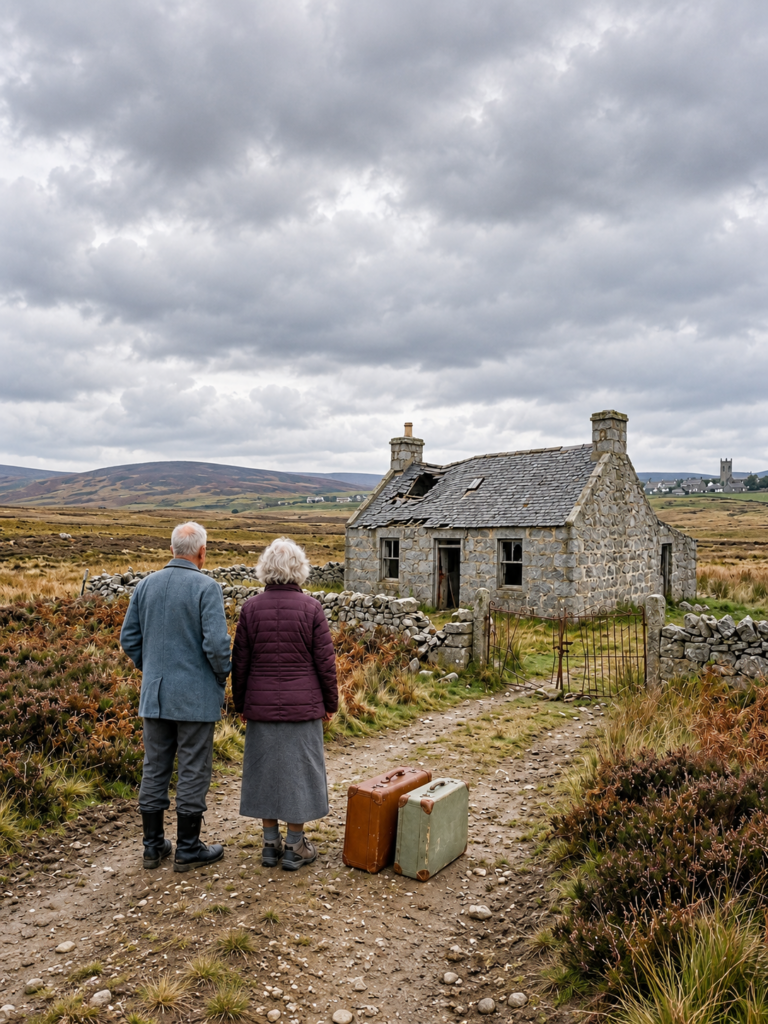
everyone laughed when the elderly couple spent $11 on a condemned stone cottage—until their dog found what the forgotten mason had sealed behind the wall
Part 1
The county clerk opened the bidding at ten dollars.
Nobody raised a hand.
A cold Tuesday wind swept across the courthouse steps, carrying the smell of wet leaves and quarry dust through the fifteen people who had bothered to attend the auction. Most had come for the previous lot, a repossessed boat trailer that sold for sixty dollars.
Lot Eleven interested no one.
“One-point-one acres off Old County Road,” the clerk read from his clipboard. “Stone dwelling. Structure condemned. Sold as is. Buyer assumes all liability.”
Someone near the front laughed.
“That’s the Pasco place.”
Another voice answered, “Roof’s practically in the cellar.”
Royce Tindall turned around so the crowd could see his smile.
Royce ran one of the largest construction companies in the county. He built subdivisions, sat on the county council, owned enough equipment to reshape a hillside before breakfast, and dressed like a man who had long ago stopped worrying about the price of anything.
“A bulldozer’s the only thing that property needs,” he said.
More laughter.
At the back of the crowd stood Hollis Coyle, seventy-four years old, with both hands pushed into the pockets of a work coat polished smooth at the elbows.
Beside him stood his wife, Naen.
She was seventy-one, small and gray-haired, with a face that had once been soft and was now sharpened by several years of disappointment.
Her right hand rested inside her coat pocket.
Her thumb rubbed automatically across a smooth river stone she had carried for half a century.
The clerk checked his watch.
“Ten dollars. Anybody?”
Silence.
“If there are no bids, the county retains the parcel.”
Naen raised her hand.
Not high.
Only to her shoulder.
“Eleven.”
The clerk looked up.
“What?”
“Eleven dollars.”
The courthouse steps went quiet.
Then Royce laughed.
“Eleven?”
He looked around at the others.
“We’ve got eleven dollars for a pile of rocks. Anybody want to go twelve and save these good people from themselves?”
The laughter came harder this time.
Hollis felt it.
He had spent his entire working life around men like Royce.
Hollis had laid brick.
Built fireplaces.
Repaired retaining walls.
Restored foundations.
He had spent summers forty feet up scaffolding and winters kneeling in mud while homeowners complained about what masonry cost.
He was always the man with the trowel.
The man called around back.
The man offered coffee in a paper cup while the owner drank from china inside.
You built the wall.
Someone else received compliments for the house.
At seventy-four, ridicule no longer wounded Hollis the way it once had.
But he felt it land on Naen.
He moved one large hand to the middle of her back.
She did not turn.
“Eleven going once,” the clerk said.
A few people still smiled.
“Eleven going twice.”
No one bid.
“Sold.”
The clerk slapped the clipboard against his thigh.
That was the gavel.
That was all.
For eleven dollars, Hollis and Naen Coyle became owners of a condemned stone cottage everybody else wanted demolished.
Inside the courthouse, Naen signed three forms.
She handed over one worn ten-dollar bill and one worn single.
The clerk gave her a brass key tied to dirty string.
He also gave her a yellow notice containing the words UNSAFE FOR OCCUPANCY in capital letters.
“You folks have somewhere else to stay?” he asked.
He was not mocking them.
That almost made the question worse.
Naen put the key into her pocket beside the river stone.
“We have somewhere now.”
Twenty minutes later, Hollis’s blue pickup rattled out of town.
It had 248,000 miles on it and an engine that required persuasion each morning.
Naen sat holding the key.
For several miles she said nothing.
Then she laughed softly.
Hollis glanced over.
“What?”
“Eleven dollars.”
“That’s what they charged.”
“It’s the first thing in three years nobody can tell us isn’t ours.”
Hollis looked back at the road.
That sentence contained more than eleven dollars.
Three years earlier, they had owned a small white house with a deep front porch and a maple tree Naen had planted when their oldest daughter was born.
The kitchen was yellow.
Naen had painted it herself.
They had raised three children there.
Hosted Christmas there.
Held Thanksgiving dinners large enough that folding tables ran into the living room.
Hollis had expected to die in that house.
Then their middle son Garrett came to them with a business plan.
Touchless car washes.
Three locations.
Computer-controlled systems.
Low staffing costs.
He needed investors.
Not really investors, he explained.
Partners.
The bank only needed to see family assets behind the project.
Their name on some papers.
A little money.
Temporary.
Hollis distrusted it.
Naen saw Garrett’s face.
Their son was forty-four then, but mothers can sometimes see the twelve-year-old beneath a grown man’s fear.
They signed.
The first location struggled.
Then equipment failed.
Then permits delayed the second site.
Then interest grew.
Garrett refinanced.
Then asked for more.
The little investment became savings.
Savings became a second mortgage.
The second mortgage became the house.
By the time the business collapsed, Hollis and Naen owned a pickup, the contents of a storage unit, some clothes, and whatever could not be repossessed.
Garrett stopped calling.
Not because he hated them.
That almost would have been easier.
He was ashamed.
And shame, Hollis had learned, could make a man disappear faster than cruelty.
Their daughter in Phoenix sent Christmas cards and occasionally money they refused.
Their youngest son called twice a year and always seemed to be running to another appointment.
For several months Hollis and Naen stayed with people.
A cousin.
A church couple.
Then a cheap motel.
Eventually the pickup became more dependable than anyone’s spare room.
That was how two people who had worked for more than fifty years ended up washing themselves in gas-station restrooms and sleeping behind a discount store.
And that was why an eleven-dollar ruin felt like wealth.
The old county road climbed between wooded quarry hills.
Naen stared through the window.
“I used to know this road.”
“When?”
“When I was a girl.”
“You never told me.”
“You never asked.”
Hollis glanced at her.
After fifty-two years of marriage, that sentence could still surprise him.
The asphalt ended.
Gravel began.
Then they saw the cottage.
Even Hollis was silent.
Half the roof was gone.
The remaining rafters rose against the sky like exposed ribs.
Blackberry vines crowded the windows.
There was no glass in most of them.
A birch tree had taken root through the front step.
The chimney leaned just enough to make any sensible person nervous.
Naen stared.
“Well.”
Hollis nodded.
“Well.”
They sat another minute.
Then Hollis opened his door.
His knees immediately objected.
He ignored them.
He walked through wet grass to the front wall.
Naen watched him.
Hollis had been touching stone since he was sixteen.
His uncle taught him by slapping his hand away whenever he reached for the wrong piece.
Stone had weight.
Direction.
Grain.
A good mason did not merely stack it.
He listened to what each piece wanted to do.
Hollis placed his palm against the cottage.
Cold limestone.
Uncut fieldstone from the surrounding hills.
At first glance, ordinary.
Then he looked closer.
The joints were remarkably tight.
Large stones sat low.
Smaller stones transitioned upward.
Weight transferred cleanly.
Corners remained almost perfectly plumb after decades of freeze and thaw.
Mortar had deteriorated in places, yet the wall had hardly moved.
Hollis forgot his knees.
Forgot the roof.
Forgot the courthouse laughter.
“Naen.”
She climbed out.
“Come here.”
She stopped beside him.
“It’s awful.”
“The roof is awful.”
“That seems significant.”
“Look at the wall.”
Naen looked.
She saw gray rocks.
Hollis ran his fingers along one course.
“Whoever built this knew stone.”
“So do you.”
“No.”
He shook his head.
“I know stone. This man understood it.”
“You’re saying he was better than you?”
“I’m saying if you gave me another lifetime, I’d still have to think before trying this.”
Naen looked at her husband instead.
His voice had changed.
For the first time since they lost the house, he sounded interested in something instead of merely surviving it.
Hollis stepped back.
“Somebody built this to last a hundred winters.”
Naen studied the broken cottage again.
“Then I suppose we should try not to ruin his record.”
That was when they saw the dog.
He stood at the corner of the house.
Large.
Gray.
Thin enough that his ribs showed beneath his coat.
His muzzle was white with age.
He did not bark.
He watched.
Hollis raised one hand.
“Easy.”
The dog did not move.
Naen returned to the truck.
Their food consisted mostly of bread, canned beans, two apples, and something Hollis insisted was cheese.
She tore the heel from the loaf.
“Naen.”
“What?”
“That’s breakfast.”
“We’ll survive.”
“You don’t know if he bites.”
“He doesn’t know if we bite.”
She placed bread and water on a flat stone halfway between them and the dog.
Then she backed away.
They waited.
Ten minutes.
Twenty.
Nearly an hour.
Finally, the dog approached.
Ate the bread.
Drank.
Retreated.
By evening he had moved closer.
Naen watched him settle beneath the leaning gate.
“If he stays, he needs a name.”
“He came with the property.”
“That isn’t a name.”
Hollis looked at his gray coat.
“Moss.”
One ear moved.
Naen smiled.
“I think he accepts.”
That first night, Hollis and Naen cleared the driest corner of the cottage.
They swept out leaves.
Spread their bedroll on the stone floor.
Hung a tarp where one window should have been.
Naen placed two enamel cups on the mantel.
It was almost nothing.
Yet when Hollis saw them side by side, something in his chest eased.
Moss lay across the doorway facing outward.
Nobody asked him.
He simply took the position.
After Naen fell asleep, Hollis carried the lantern around the room.
He inspected the fireplace.
The hearth was enormous.
Stone jambs.
Hand-dressed lintel.
Chimney still true.
Then he noticed something carved near the bottom corner.
A bird.
No larger than his thumb.
Round body.
Tail lifted.
Tiny feathers marked with astonishing precision.
A wren.
Hollis crouched.
He had seen that bird before.
Somewhere.
He could not remember where.
Behind him, Naen slept with her hand inside her coat pocket.
Her fingers rested around the river stone.
On its surface, worn almost smooth after fifty years beneath her thumb, was the faint shape of the same little bird.
Neither of them knew it.
Not yet.
Then Moss rose.
He crossed the room.
Stopped at the far wall.
A collapsed oak shelf and broken plaster blocked one corner.
The dog lowered himself.
His nose pointed toward the stone.
A low sound came from his chest.
Not a growl.
Not fear.
Wanting.
“What is it?” Hollis whispered.
Moss stared at the wall.
Hollis lifted the lantern.
The dog would not move.
Naen’s sleepy voice came from behind him.
“Whatever it is has waited this long.”
Hollis looked toward her.
“Meaning?”
“Meaning don’t pull a wall apart in the dark at seventy-four years old.”
He grunted.
She closed her eyes.
“Come to bed.”
Hollis obeyed.
But before sleeping, he looked once more toward Moss.
The dog remained facing the wall.
And Hollis thought:
There is something back there.
Part 2
The wall had to wait.
A house without half its roof had its own priorities.
Hollis cut young birch poles and bridged the worst opening.
He stretched heavy tarp across them.
It looked terrible.
It also kept out rain.
He climbed onto the roof only once before Naen threatened to hit him with his own cane.
After that, he worked from ladders and made Garrett’s absence feel more obvious than either of them wanted to admit.
They cleared the chimney.
Repaired the hearth.
Sealed one room against wind.
Naen made the cottage a home using things so small they would have looked meaningless anywhere else.
A folded cloth on the table.
The two enamel cups.
Three wildflowers in a jar.
A quilt over the window.
A pot of beans simmering over real fire.
By the fourth night, Moss slept inside.
No announcement was made.
The dog simply moved closer to the hearth, turned three circles, and lay down.
Naen looked at Hollis.
Hollis looked at Naen.
Neither said anything.
Moss had made his decision.
People began driving past.
The cottage sat close enough to Old County Road that visitors could slow almost to a stop.
Some stared.
Others laughed.
Teenagers came after dark one Saturday and threw a bottle against the gate.
Glass broke.
Moss barked until their truck disappeared.
Naen swept up the pieces the next morning.
“They’ll get tired.”
“People rarely get tired of feeling superior.”
“Hollis.”
“What?”
“Your old age has made you cheerful.”
A week later, Royce Tindall arrived.
His truck cost more than Hollis and Naen’s last house had when they bought it.
He drove directly across the grass and parked near the cottage.
Moss stood in the doorway.
Royce smiled.
“Mr. and Mrs. Coyle.”
Hollis continued repointing mortar.
“Royce.”
“I had to see it.”
“You saw it at auction.”
“Not with residents.”
Hollis’s trowel moved.
Royce crouched beside him.
“I’m actually here to help.”
“That sounds expensive.”
Royce chuckled.
“You two made your point.”
“What point?”
“Independence. Pride. Whatever this is.”
He gestured toward the cottage.
“Now I’ll give you two thousand dollars.”
Hollis stopped.
Naen stood inside the doorway.
Two thousand dollars.
It might as well have been twenty thousand.
They had less than one hundred dollars left after supplies.
Two thousand meant a motel through winter.
Food.
Medicine.
A repair to the truck.
Royce continued.
“Cash. Today.”
Hollis set down the trowel.
“For eleven-dollar property?”
“I’m being generous.”
“Why?”
Royce’s smile remained.
“I told you.”
“No. You told me what you want me to believe.”
Something hardened behind Royce’s eyes.
Hollis pointed toward the ground.
“What is this lot to you?”
Royce stood.
“It’s an eyesore.”
“That’s not worth two thousand.”
Royce sighed.
“All right.”
The friendliness disappeared.
“I’m developing the tract beyond here.”
Naen stepped closer.
“The old county-home field?”
“Yes.”
“Into what?”
“Houses. Retail along the road.”
Royce looked at the cottage.
“This is the last privately owned piece that complicates the entrance.”
“So you want it.”
“I need it cleaned up.”
Hollis nodded.
“That sounds more honest.”
Royce’s jaw tightened.
“Take the check.”
“No.”
“Hollis.”
“No.”
Royce looked toward the roof.
“You understand the county condemned this structure.”
“I read the paper.”
“Condemnation can become demolition.”
There it was.
The threat arrived calmly.
Like professional advice.
Royce adjusted his coat.
“I’m trying to keep this friendly.”
Hollis stood.
His back hurt.
His knees hurt.
He was seven inches shorter than Royce.
He still looked directly at him.
“We’re not selling.”
Royce laughed once.
Short.
“You will.”
His truck tore two muddy tracks through the grass as he left.
The next morning Hollis drove into town for mortar.
He stopped at Vera’s Diner because the front step was cracked and the sight offended him.
Inside smelled like coffee, bacon grease, and pie.
A woman behind the counter looked up.
She was around Hollis’s age.
Gray hair.
Reading glasses pushed onto her head.
Dish towel over one shoulder.
“You’re one of the rock people.”
Hollis paused.
“I suppose.”
“Sit.”
“I’m only—”
“Sit.”
She poured coffee.
Then eggs appeared.
Hollis reached for his wallet.
She waved him away.
“You look like you slept in a quarry.”
“Close.”
Her name was Vera.
She had run the diner since her husband died.
She had also lived in the county her entire life.
When Hollis mentioned the Pasco cottage, Vera stopped pouring coffee.
“Jory Pasco.”
“You knew him?”
“Knew of him.”
“Who was he?”
Vera sat across from Hollis.
“Came from Cornwall before the war. Quarry man. Stoneworker.”
Hollis leaned forward.
“I knew it.”
“Knew what?”
“The walls.”
Vera smiled slightly.
“He built half the stone this town still stands on.”
“The cottage?”
“Sure. But also the bank steps. Church cornerstone. War memorial. Retaining wall behind the school.”
Hollis stared.
“Nobody talks about him.”
“That’s because nobody liked him.”
“Why?”
“He was strange.”
“That all?”
Vera shrugged.
“Foreign accent. Lived alone. Never joined much. Children were scared of him because their parents were. You know towns.”
Hollis did.
“He carved a bird.”
Vera’s expression changed.
“A wren?”
“Yes.”
She smiled.
“That was Pasco’s mark. Put it on everything.”
Hollis thought about the chimney.
“If you find his wren on stone, my husband used to say, you could lean your life against it.”
Hollis drove from the diner to the town square.
The war memorial stood in dead winter grass.
He walked around its base.
Bent down.
There.
A wren.
Tiny.
Almost invisible.
He went to the bank.
Same bird.
Church.
Same bird.
One forgotten mason had built pieces of the town everyone trusted.
And the town had let his house collapse.
Hollis drove home angry.
Not dramatic anger.
Something quieter.
He knew what it meant to be useful to people who never bothered knowing you.
When he arrived, Naen was gone.
He found her twenty minutes later at the fence behind their property.
Beyond it stretched the old county-home field.
Low humps ran beneath long grass.
Rows.
No markers.
Hollis knew what the place had been.
The county poorhouse had stood nearby decades ago.
People with nowhere else to go ended up there.
The elderly.
The sick.
The destitute.
Strangers taken off trains.
Children.
Those who died without relatives able to pay for burial went into the field.
Unmarked.
Naen stood holding the fence.
“You all right?”
“Yes.”
“Cold.”
“I know.”
She kept staring.
Hollis waited.
After fifty-two years, he knew which silences belonged to him.
This one did not.
She returned to the cottage without explanation.
Moss continued scratching at the back wall.
Every morning.
Every night.
He pressed his nose to a gap near the floor.
Hollis felt cold air coming from somewhere beyond the stones.
Finally, when the roof was covered and the chimney safe, he moved the fallen shelf.
Naen held the lantern.
Moss stood so close Hollis could feel the dog’s breath.
Hollis cleared plaster.
Then leaves.
Then touched the wall.
His fingers moved over the joints.
Stopped.
“Wrong.”
“What?”
“This section.”
It looked identical.
But the mortar around a rectangular area was softer.
Newer than the rest.
Hollis pressed.
The stones moved.
Naen lifted the lantern.
“It’s a door.”
“Dressed like a wall.”
Hollis carefully picked away mortar.
Course by course.
The disguised stone panel swung inward.
Behind it stood a plain wooden door.
A wren had been carved at chest height.
Naen made a small sound.
Hollis placed his hand on the wood.
“Pasco.”
The door had swollen shut.
He pushed.
Nothing.
Again.
The frame groaned.
Moss barked.
Third try.
The door tore loose.
Cold air rolled over them.
Hollis lifted the lantern.
The hidden room contained a stoneworker’s workshop.
Bench.
Chisels.
Mallets.
Points.
Mauls.
Grindstone.
Everything arranged neatly beneath years of dust.
Stone chips covered the floor.
Then Hollis raised the lantern higher.
His breath stopped.
Along the back wall stood headstones.
Rows of them.
Dozens.
Maybe more than a hundred.
Each carved from local limestone.
Each bearing a name.
Naen stepped beside him.
“What is this?”
Hollis approached the nearest.
ELIZA HALDANE.
Dates beneath.
A small wren at the bottom.
Another stone.
CONSTANCE WHIRL.
Another.
A child’s stone.
Another.
Another.
Some finished.
Some half-carved.
Others blank except for Pasco’s wren.
On the workbench lay a thick black ledger.
Hollis opened it.
The first page read:
Begun in the spring of my sixtieth year.
I will get to as many as I am given time for.
A stone is just a way of saying somebody was here and somebody is sorry they are gone.
Naen sat slowly.
Hollis turned pages.
Names.
Dates.
County record numbers.
Notes.
Drowned in spring flood.
No people came.
Died at the home during fever winter.
Infant, three days.
Unknown traveler off rail line.
Hollis looked toward the rows of stones.
“The field.”
Naen did not move.
“The county-home field.”
He understood.
Pasco had been making grave markers.
For people who had none.
He had gone through county death records, found their names, learned what little he could about their lives, and carved stones.
Without payment.
Without recognition.
Without anyone apparently knowing.
For years.
Maybe decades.
Pasco had died before finishing.
The stones remained sealed in darkness.
Naen stood near a small marker.
Her face had changed.
“Naen?”
She reached into her pocket.
Removed the river stone.
Hollis had seen it countless times.
Never closely.
She placed it in his hand.
On its worn face was a tiny carved wren.
Hollis looked at her.
She was crying before she spoke.
“You remember the baby.”
His chest tightened.
They had been nineteen.
She had come early.
A girl.
Four days.
Neither had spoken about her in years.
Not because she no longer mattered.
Because some griefs become structural.
Like a beam hidden inside a house.
You stop looking at it.
But it holds everything.
“We couldn’t afford the church cemetery,” Naen said.
Hollis nodded.
“The county buried her.”
“In that field.”
He closed his eyes.
Naen continued.
“I went back that spring.”
He had never known.
“I tried to find where they put her.”
Her voice thinned.
“There were no markers. Just grass. I couldn’t remember which place.”
Hollis sat beside her.
“I thought I’d lost her twice.”
She pointed to the river stone.
“I found that sitting on one patch of dirt.”
“The bird.”
“Yes.”
“Pasco?”
“For fifty years I never knew.”
She looked around the workshop.
“The man everyone called a hermit went out there and left a stone on our daughter’s grave so she wouldn’t have nothing.”
Hollis looked at the rows.
The names.
The wrens.
“He couldn’t save any of them.”
Naen wiped her face.
“No.”
“He just wouldn’t let them be nobody.”
Moss lowered himself onto Naen’s feet.
Hollis closed the ledger.
“Then we finish what he started.”
Part 3
They did not sleep.
They built the fire high.
Sat on the floor.
Read names until morning.
Naen recognized some.
Orin Tuck.
An old man with both legs amputated who had lived at the county home when Naen worked there at nineteen.
He used to wait near the kitchen because she gave him burnt bread ends.
“I never knew he was a soldier.”
Pasco had.
His note said:
Old soldier. No people came.
There was a laundry woman Naen remembered.
A boiler tender.
Two children from the fever summer.
People Naen had once passed in hallways and then forgotten when they disappeared.
Pasco had remembered.
Hundreds of names filled the ledger.
More than he had finished carving.
“We have to put them out there,” Naen said.
“We will.”
But the next day Hollis drove to the county office.
The clerk pulled up the old poorhouse parcel.
Her face tightened.
“You should talk to Planning.”
“Why?”
“The land was rezoned.”
“When?”
“Last winter.”
“For what?”
“Residential and commercial development.”
Hollis stared.
“People are buried there.”
“There are no recorded marked graves.”
“That doesn’t mean there are no graves.”
“I know.”
“Then how is it development land?”
She lowered her voice.
“The county position is that the burial area was never formally surveyed as a cemetery.”
“Who owns it?”
She turned the screen.
TINDALL DEVELOPMENT GROUP.
Hollis felt something cold settle inside him.
“When do they clear?”
“Permit’s already issued.”
“When?”
“After next Thursday’s council meeting.”
Hollis drove home.
Before he finished explaining, a county enforcement vehicle arrived.
The inspector was apologetic.
That made no difference.
He handed Hollis an orange demolition notice.
The cottage remained officially condemned.
The county council would confirm demolition at the same meeting approving the final development clearing.
Contractor:
Tindall Construction.
Hollis read it twice.
The inspector nailed another copy to the birch tree.
“You’ve got until Thursday to remove personal property.”
“This house has stood longer than you’ve been alive.”
“I know, sir.”
“These walls are sound.”
“I’m not the engineer.”
“Then bring me the engineer.”
“I’m sorry.”
The inspector drove away.
Hollis stood holding the paper.
Naen read it.
Behind them, more than a hundred stones waited inside Pasco’s hidden workshop.
“What do we do?” Hollis asked.
Naen looked toward the road.
“Bring them out.”
“We can’t put them in the field.”
“No.”
“Not yet.”
“Then put them where people can see them.”
Hollis dropped the pickup’s tailgate.
The first stone weighed nearly a hundred pounds.
His knees shook.
He carried it anyway.
Naen packed straw around each marker.
Moss followed every trip.
By noon, eleven stones stood in the front yard facing Old County Road.
The next day there were twenty-seven.
Then forty-three.
Cars slowed.
But now people did not laugh.
They stopped.
Got out.
Read names.
Vera arrived wearing her diner apron.
She walked between the markers.
Then stopped.
“Cade Sutter.”
She covered her mouth.
“He swept the church.”
Naen checked the ledger.
Vera nodded.
“He slept in the back room. Did that for years.”
She touched the stone.
“One spring he stopped coming.”
Her eyes filled.
“I never asked where he went.”
Naen pointed toward the field.
“He’s been there.”
Vera rolled up her sleeves.
“What needs carrying?”
That was how it began.
A reporter from the county newspaper arrived.
Young woman.
Camera.
Notebook.
She expected a quirky human-interest story about the elderly couple who bought the eleven-dollar ruin.
Then Hollis showed her Pasco’s workshop.
She stopped taking notes for several minutes.
The story ran Friday.
OLD MASON’S SECRET ROOM HOLDS NAMES OF COUNTY’S FORGOTTEN DEAD.
By Saturday, strangers arrived.
A man drove two hours because his grandmother once mentioned a brother who died at the county home.
He walked among the stones in the rain.
Found the name.
Then knelt.
He stayed there so long that Naen eventually brought him coffee and left without speaking.
An eighty-six-year-old woman recognized the names of children lost during the fever summer.
A retired teacher found an uncle.
Flowers began appearing.
Someone left lilacs with a note.
I am sorry we never came looking.
No signature.
Then, six days before the council meeting, a sedan stopped at the gate.
A man climbed out.
Hollis knew the walk before he recognized the face.
Garrett.
Their son had gained weight.
His hair was gray at the temples.
Behind him stood a thirteen-year-old girl.
Sadi.
Their granddaughter.
Hollis had not seen her for eighteen months.
Garrett stayed outside the gate.
“Dad.”
Hollis said nothing.
Naen came from the cottage.
Garrett’s face broke.
She walked to him.
Put both arms around her son.
He bent around his mother like a man struck in the stomach.
“I saw the newspaper.”
Naen held him.
“I didn’t know where you were.”
Hollis’s jaw tightened.
“You could have called.”
“I know.”
“Your mother kept the number.”
“I know.”
Garrett looked at the cottage.
“You’re living here.”
“Yes.”
“Because of me.”
Hollis looked at his son.
Garrett’s shame had become a prison he built himself and then blamed himself for living inside.
“I took your house.”
“The bank took the house.”
“Because I put it in danger.”
“Yes.”
Garrett flinched.
Hollis continued.
“I was angry.”
“You should be.”
“I still am sometimes.”
Garrett nodded.
“But I didn’t sit awake counting money.”
Hollis stepped closer.
“I sat awake counting how long it had been since I heard my son’s voice.”
Garrett looked up.
“The money was money.”
Hollis put his hand on the back of Garrett’s neck.
“You were the part I wanted back.”
Garrett began crying.
Sadi stood awkwardly near the car.
Then she pointed toward the yard.
“Grandpa?”
“Yes?”
“Are those all graves?”
“Grave markers.”
“For who?”
“People nobody marked.”
Sadi walked closer.
She knelt beside one.
Touched the little wren.
“One guy made all these?”
“As many as he could.”
“Why?”
Hollis thought.
“So they wouldn’t disappear.”
Sadi stood.
“And somebody’s going to bulldoze where they’re buried?”
“That’s the plan.”
Her expression hardened.
“Well, that’s stupid.”
Garrett wiped his eyes.
“Sadi.”
“What? It is.”
Hollis laughed for the first time in days.
Garrett stayed.
He rented a room in town.
Every morning, he and Sadi came to the cottage.
Father and son carried stones.
Some weighed too much for Hollis alone.
Together, they could manage.
They did not talk about the failed business much.
They talked about leverage.
Weight.
Balance.
How to carry stone without destroying your back.
The language Hollis knew.
One afternoon Garrett asked, “Why would Pasco do this for people he never knew?”
Hollis rested his end of a marker.
“Because they were owed it.”
“Owed what?”
“A name.”
Garrett looked at the carved face.
“No one thanked him.”
“Being thanked wasn’t the point.”
Garrett nodded.
After that he handled every stone more carefully.
Sadi cleaned chisels.
Oiled wooden handles.
Copied names.
Within three days she knew where most finished markers stood.
Then Thursday arrived.
The council chamber usually had twelve empty folding chairs.
That night it overflowed.
People stood in the hallway.
Vera closed the diner.
The newspaper reporter came.
Families came.
Strangers came.
Royce Tindall sat at the head table.
He looked less comfortable than usual.
He moved through routine business quickly.
Then reached the development item.
“The county has an approved clearing plan for the former county-home tract, together with removal of an unsafe neighboring structure.”
Hollis stood.
Royce frowned.
“I’d like the town to see what it is voting to bulldoze.”
Garrett helped him carry a stone down the aisle.
They placed it on the council table.
One hundred pounds of limestone hit wood with a sound everyone felt.
Hollis turned toward the room.
“This is one name.”
He held up Pasco’s ledger.
“There are more than three hundred.”
Nobody moved.
“A man named Jory Pasco spent the last years of his life carving stones for people this county buried without markers.”
He pointed toward the windows.
“The poor. The sick. Children. Strangers. Men and women who died at the county home with nobody able to pay for cemetery ground.”
Royce shifted.
Hollis continued.
“Pasco found their names.”
“He wrote down where they were buried.”
“He carved as many stones as his hands had time to make.”
“And then he died.”
Naen stood.
She opened the ledger.
Then she began reading.
Slowly.
One name at a time.
Cade Sutter.
Orin Tuck.
Seven children from the fever summer.
A woman in the back began crying.
A man stood suddenly.
“That was my grandfather’s brother.”
Another voice:
“I remember that name.”
Then another.
“My mother talked about her.”
Names rose into the room.
People who had vanished from memory were suddenly relatives again.
Neighbors.
Workers.
Veterans.
Children.
Royce sat rigidly.
Naen stopped.
She picked up one small stone they had brought.
Child-sized.
She carried it to Royce.
“This one belongs to your family.”
Royce stared at the name.
ABIGAIL TINDALL.
A single year.
A wren.
Royce went pale.
“My mother…”
His voice failed.
He touched the stone.
“She had a baby before me.”
Naen nodded.
“She mentioned it once.”
Royce’s fingers remained on the limestone.
“We never knew where…”
“She’s in that field.”
Royce closed his eyes.
Naen’s voice was gentle.
“Pasco knew.”
Royce looked at her.
“He found the record when nobody else was looking.”
Naen paused.
“My daughter is in that field too.”
Royce stared.
“You would have paved your sister under a parking lot.”
She did not say it cruelly.
That made it land harder.
“You wouldn’t even have known enough to be sorry.”
Nobody made the demolition motion.
Instead, another council member moved to suspend all clearing.
A cemetery survey would begin immediately.
The motion passed.
Royce abstained.
He sat with Abigail’s stone in both hands.
The condemned-cottage order was suspended pending structural review.
Hollis closed his eyes.
For the first time in weeks, he could breathe.
They had bought the cottage for eleven dollars.
People had called them fools.
Now an entire county was silent because the fools had carried its forgotten dead into the room.
Part 4
Hollis should have slept that night.
He did not.
After Garrett took Sadi back to town, Naen went to bed exhausted.
Moss settled across the doorway.
Hollis carried Pasco’s ledger to the workbench.
There was one name he had avoided searching for.
His daughter.
Their first child.
Four days in January.
For decades, Hollis had allowed Naen to carry most of the visible grief.
He had told himself that was because she needed space.
The harder truth was that Hollis did not know how to touch it without breaking himself open.
He turned pages.
Slowly.
Then his finger stopped.
COYLE, INFANT DAUGHTER.
The winter year.
County-home burial row.
Hollis leaned closer.
Pasco had added a note.
Mother could not be found to ask the name. Name taken from county home record.
Then two words:
STONE CUT.
Hollis whispered into the empty room.
“Oh.”
He read it again.
STONE CUT.
Pasco had finished her marker.
Somewhere among the stones already outside or still in the workshop was his daughter’s name.
At dawn, Hollis made coffee.
He sat beside Naen.
She opened her eyes.
“You’re up early.”
“I found her.”
Naen went still.
“In the book.”
She sat.
“He found her name.”
Hollis showed her.
Naen read.
Her hand moved to her mouth.
Then Hollis pointed at the final words.
“Stone cut.”
For several seconds she did not understand.
Then she did.
“It exists?”
“Somewhere.”
Naen was out of bed before finishing her coffee.
They walked into the cold morning still wearing coats over their nightclothes.
Rows of markers filled the yard.
Hollis started left.
Naen right.
Moss walked between them.
They read every name.
Slowly.
Not skipping any.
The sun rose.
The stones brightened.
One row.
Then another.
Then another.
Naen began shaking.
“What if it isn’t here?”
“It is.”
“What if the stone broke?”
“We’ll make another.”
“That isn’t the same.”
“No.”
Hollis refused to lie.
They continued.
Near the end of the final row, he stopped.
A small marker.
Barely to his knee.
He dropped onto both knees without thinking about pain.
“Naen.”
She came around.
On the stone was the name they had given their daughter.
Della Coyle.
Naen stared.
For fifty-two years she had carried that name almost entirely inside herself.
Now it existed in stone.
Beneath it were the dates.
Four days apart.
At the bottom:
Pasco’s wren.
Naen sank beside Hollis.
She touched the D.
Then the E.
Then every letter.
A sound left her that Hollis had never heard in all their marriage.
It was grief.
But grief moving outward instead of deeper in.
“A stranger knew her name.”
Hollis put one arm around her.
“He found it.”
“I never told him.”
“No.”
“He cared enough to find it.”
“Yes.”
Naen took the river stone from her pocket.
The tiny worn wren.
She placed it beneath Della’s marker.
“There.”
She pressed her fingers to it.
“Now you have both.”
Spring brought the cemetery survey.
Ground-penetrating equipment identified burial disturbances.
Pasco’s ledger supplied rows.
Numbers.
Names.
His records were astonishingly careful.
Hollis walked beside the survey team.
He read subtle changes in the ground the way he read stone.
Together, dead man and living man reconstructed the cemetery.
Then the town came to carry markers.
Not ten people.
Not fifty.
Hundreds over several weekends.
Garrett.
Sadi.
Vera.
Families.
High-school students.
Church members.
People who had laughed at the auction.
Some came ashamed.
Nobody demanded apologies.
There was work.
Work was enough.
They placed markers one at a time.
Where stone stood, a name returned.
One elderly woman knelt beside the grave of a brother she had lost at six years old.
She spent nearly an hour telling him what happened after he died.
Marriages.
Children.
Grandchildren.
Who moved west.
Who stayed.
Who became difficult.
Who turned out kind.
She caught him up on eighty years of family history.
Two farmers who had feuded over a boundary fence for decades ended up carrying one marker together.
After setting it, they shook hands.
Neither mentioned the fence.
Sadi brought water to workers.
Then she began watching Hollis repair damaged stones.
“Teach me.”
“What?”
“The letters.”
Hollis looked at her thirteen-year-old hands.
“You’ll ruin some stone.”
“I’ll practice.”
“It takes years.”
“I’m thirteen. I have years.”
He could not argue with that.
He set a scrap piece of limestone on Pasco’s bench.
Showed her how to hold the chisel.
“Not tight.”
“It’s going to move.”
“Let it.”
“That makes no sense.”
“Neither does forcing stone.”
She frowned.
Hollis guided her hand.
“Listen to the strike.”
She hit.
Too hard.
The edge chipped.
Sadi grimaced.
“I ruined it.”
“No. You learned one thing.”
“What?”
“Don’t hit that hard.”
The next strike was better.
By summer, the cottage roof was replaced.
Not by charity exactly.
People donated slate.
Garrett did labor.
Hollis supervised.
Local carpenters repaired rafters.
An engineer inspected Pasco’s walls.
His conclusion was almost insulting in its simplicity.
The stone structure was sound.
The condemnation order was lifted after repairs.
Royce Tindall did something nobody expected.
He moved his development.
The cemetery remained untouched.
Months later, Hollis learned Royce had quietly paid for a low dry-stone wall around its perimeter.
He never put his company sign on it.
Never announced the donation.
The mason told Hollis.
“Royce said not to tell.”
“Then why are you telling me?”
“Because secrets are wasted on me.”
Hollis walked the wall.
Good work.
Not Pasco’s.
But good.
Royce appeared one afternoon.
They stood at the cemetery gate.
“My sister is over there.”
Hollis nodded.
“I know.”
“My mother was ninety when she died.”
Royce looked toward Abigail’s small marker.
“She carried that baby her whole life and said her name maybe twice.”
“People do that.”
“I thought not speaking meant forgetting.”
“No.”
Royce looked at Hollis.
“I was going to destroy it.”
“Yes.”
There was no point lying.
“I didn’t know.”
“No.”
Royce looked down.
“Does that matter?”
Hollis took time before answering.
“Yes.”
Royce seemed surprised.
“But once you know, it matters what you do next.”
Royce nodded.
That was all.
People said Royce had changed.
Hollis was unsure people changed as completely as stories liked to claim.
But he had watched the man leave a council meeting carrying his infant sister’s marker against his chest.
Some knowledge creates a door inside a person.
Once opened, it does not always close again.
Garrett stayed too.
At first he returned every morning because guilt told him to.
Later he returned because he wanted to.
He and Hollis repaired the cottage together.
Garrett was not a mason.
He was impatient.
Used too much mortar.
Set stones before understanding them.
Hollis corrected him.
Sometimes sharply.
One afternoon, Garrett threw down his gloves.
“Nothing I do is right.”
Hollis stared.
“That isn’t true.”
“You have corrected every stone I touched.”
“Because they were wrong.”
Garrett laughed bitterly.
“There it is.”
Hollis understood too late that they were no longer discussing masonry.
Garrett continued.
“I ruined the business. Lost your house. Stopped calling. Now I come back, and I can’t even put a rock in a wall.”
Hollis looked at the half-finished section.
“Come here.”
Garrett did not move.
“Come here.”
He stepped closer.
Hollis removed one stone Garrett had placed.
Turned it.
Reset it.
It settled perfectly.
“Same stone.”
Garrett stared.
“It wasn’t bad.”
“No.”
“Just wrong position.”
Hollis wiped mortar from his hand.
“People are like that sometimes.”
Garrett looked at him.
“You trying to make me feel better?”
“No. I’m trying to teach you masonry.”
Garrett laughed despite himself.
Then cried.
Hollis pretended not to notice until his son was ready.
By autumn, the hidden workshop was active again.
Not as a museum.
As a workshop.
That mattered to Hollis.
Pasco’s tools were cleaned.
The grindstone turned.
Unfinished names from the ledger became stones.
Hollis carved.
Sadi learned.
Garrett rough-cut slabs.
Families sometimes came to help with their own relatives’ markers.
A young woman arrived carrying a baby.
“My father died at the county home when I was little.”
Naen searched.
Found his name.
Pasco had not lived long enough to carve his stone.
His note said:
Quiet man. No people came.
Naen turned the ledger toward the woman.
“He has people now.”
Hollis carved the marker the following week.
When it was time to cut the wren, he placed the chisel in the daughter’s hand.
Her baby watched from a basket.
That was how Pasco’s work continued.
One name.
Then another.
The people being found became people who helped find someone else.
Part 5
Thanksgiving returned to the Coyle family in the stone cottage.
The table barely fit.
Vera brought three pies and refused to go home afterward.
Their daughter flew in from Phoenix.
Their youngest son drove six hours.
Garrett carved the turkey badly.
Sadi told him so.
Moss patrolled beneath the table.
Naen sat at one end.
Hollis at the other.
For a moment Hollis remembered Thanksgiving in the yellow kitchen.
Children small.
His parents alive.
Naen’s mother complaining about gravy.
Della absent even then but somehow always part of the count.
That family did not exist anymore.
Too much time had passed.
Too many people had died.
Too many mistakes had been made.
But another family sat around the table.
Blood.
Friends.
People who had left.
People who returned.
Vera, who had known them less than a year and behaved as if she had been assigned to them at birth.
Moss, asleep beneath Sadi’s chair.
Outside, down Old County Road, Pasco’s cemetery stood beneath the first light snow.
Every marker carried a name.
Naen lifted her glass.
“I don’t give speeches.”
Everybody laughed because this was untrue.
She ignored them.
“I spent a long time thinking home was the yellow house.”
Garrett lowered his eyes.
Naen saw.
“Don’t.”
He looked up.
“That house mattered.”
She continued.
“Losing it hurt.”
Then she looked around.
“But a building can disappear and the things you thought belonged only inside it can turn up somewhere else.”
Her eyes moved to Hollis.
“To Garrett.”
“To the children.”
“To Vera.”
“Sometimes in a place with half a roof.”
Vera raised her glass.
“And terrible plumbing.”
Laughter.
Naen smiled.
“The plumbing is improving.”
Later that winter, a city reporter came to write a longer story.
She sat with Naen on the new porch.
The cemetery lay visible through bare trees.
The reporter asked the question everyone eventually asked.
“Are you angry?”
Naen thought.
“At whom?”
“Your son. The town. The county. Mr. Tindall. Everyone who laughed.”
Naen rubbed her thumb across her pocket.
The river stone no longer lived there.
It rested at Della’s grave now.
Her pocket sometimes felt strangely empty.
“We paid eleven dollars for the first thing in years that was truly ours.”
The reporter waited.
“We came here because nobody wanted the house.”
Naen looked toward the workshop.
Hollis and Garrett were carrying a blank slab.
Sadi stood at the bench working on the curve of a tiny stone bird.
“And it turned out to be full of names nobody wanted either.”
The reporter wrote.
Naen continued.
“I spent most of my life thinking family meant the people you were born to.”
She looked toward the cemetery.
“I was wrong.”
“What does it mean?”
Naen smiled.
“Family is whoever bothers to carve your name when there is nothing in it for them.”
The reporter stopped writing.
Naen’s eyes watered.
“A man I never met found my dead baby when I couldn’t.”
“He gave her a mark so she would not disappear.”
“Then fifty years later his dog—or maybe our dog, depending who you ask—led us back to what he left unfinished.”
She laughed softly.
“We came here thinking we were the forgotten ones.”
“And a dead stranger taught us there doesn’t have to be such a thing.”
The story traveled far beyond the county.
Visitors came.
Most walked quietly through the field.
Some searched for names.
Others came simply because the idea of forgotten people receiving stones touched something they carried privately.
Hollis disliked attention.
Whenever someone called him the man who saved the cemetery, he corrected them.
“Pasco saved it.”
“But you found the stones.”
“The dog found the room.”
“Then Moss saved it.”
Hollis considered.
“That sounds closer.”
Moss grew older.
He had already been old when they arrived.
Now his muzzle became almost completely white.
His hips stiffened.
He followed Hollis to the cemetery every evening but stopped halfway to rest.
Hollis waited.
Neither old man appreciated being rushed.
One summer evening, Hollis walked among the graves with Moss beside him.
He read names as he went.
Cade Sutter.
The church sweeper.
Seven children from the fever summer.
Orin Tuck.
Soldier.
No people came.
The unknown railway traveler Pasco had assigned the date he was found because no one knew the date he was born.
Then Hollis reached Della.
The little river stone remained at the marker’s base.
Rain had darkened it.
The worn wren was barely visible.
Hollis crouched.
Placed one hand on top of his daughter’s marker.
Same hand he had placed against Pasco’s cottage wall the first morning.
That day, his hands had told him a master built the house.
Now they told him something else.
Stone lasted.
Not forever.
Nothing lasted forever.
But long enough to carry something forward.
Hollis looked across the cemetery.
Hundreds of markers stood in rows.
Each had Pasco’s wren.
Some cut by Pasco.
Some by Hollis.
A few now cut by Sadi.
There were differences if you knew where to look.
Pasco’s birds were extraordinarily precise.
Hollis’s slightly heavier.
Sadi’s earliest ones cautious.
Her newer ones cleaner.
Hollis loved those differences.
It meant the work was alive.
Later that year, Sadi asked the question Hollis had expected.
“Why a wren?”
They stood in the workshop.
“I don’t know.”
“You never found out?”
“Vera didn’t know.”
“Pasco didn’t write it?”
“Not that we found.”
Sadi frowned.
“That bothers me.”
“It used to bother me.”
“Not anymore?”
Hollis shook his head.
“Maybe some things don’t need explaining.”
She looked at a finished bird.
“They’re tiny.”
“Yes.”
“Not like eagles.”
“No.”
“People put eagles on monuments.”
“People like impressive birds.”
Sadi smiled.
“Wrens are ordinary.”
Hollis picked up a chisel.
“Maybe that was his point.”
Years passed.
Garrett never rebuilt the car-wash business.
He found work with a local contractor.
Then gradually began helping Hollis restore old stone buildings.
He discovered he was good at it once he stopped trying to be fast.
Their daughter returned from Phoenix more often.
Their youngest son called every Sunday.
Nothing erased what happened.
The lost house stayed lost.
Money was not magically restored.
Naen never pretended the years of abandonment had not hurt.
Forgiveness did not mean deciding the wound had been imaginary.
It meant refusing to build the rest of life entirely around the wound.
The Pasco cottage changed too.
A slate roof replaced the tarp.
Windows returned.
The chimney drew clean.
Blackberry vines were cut back.
Naen planted herbs along the southern wall.
Garrett repaired the gate.
Sadi carved a small wren into the new oak latch.
The eleven-dollar cottage became one of the most photographed buildings in the county.
Hollis found this hilarious.
“Everyone wanted it bulldozed.”
Naen looked at another car parked near the road.
“Now they want pictures.”
“Should charge a dollar.”
“You would hide when they came.”
“That is not relevant.”
One autumn, the historical society asked permission to place a plaque on the cottage.
Hollis refused the first draft.
It said:
HOME OF HOLLIS AND NAEN COYLE, DISCOVERERS OF THE PASCO CEMETERY STONES.
“No.”
The society director looked confused.
“What is wrong?”
“We discovered a door.”
“That led to the stones.”
“Pasco made them.”
“Yes.”
“He found the names.”
“Yes.”
“He mapped the graves.”
“Yes.”
“He spent twenty years doing the work.”
The director understood.
They changed the plaque.
JORY PASCO’S COTTAGE AND WORKSHOP
STONE MASON
REMEMBERER OF THE FORGOTTEN
CONTINUED BY THOSE WHO CAME AFTER
Hollis approved.
When he reached eighty, his hands began betraying him.
Not completely.
Just enough.
Fine lettering became harder.
His grip tired.
One afternoon he ruined an S.
He stared at it for five minutes.
Sadi, now nineteen, stood beside him.
“You can fix it.”
“I know.”
“You taught me how.”
“I know.”
“Then why are you mad?”
Hollis looked at his hand.
“Because it used to do exactly what I told it.”
Sadi understood more than he expected.
She picked up the chisel.
“Show me.”
“You know how.”
“Show me anyway.”
Hollis placed his hand over hers.
Together they corrected the letter.
That evening, he told Naen.
“I think I’m done with the fine carving.”
She looked at his hands.
“Probably.”
“You could argue.”
“You hate when I lie.”
“I do.”
He sat beside her.
“What am I supposed to do now?”
Naen looked toward the workshop.
“Teach.”
He groaned.
“That sounds worse.”
“You have spent sixty-four years correcting people.”
“When you say it like that…”
“You’ve been training for this your entire life.”
So Hollis taught.
Young masons came.
High-school students.
Retired men.
Women who had been told masonry was not work for them.
Hollis did not care who held the chisel if they listened to stone.
He showed them Pasco’s walls.
“Look.”
They looked.
“No. Look.”
He made them find weight paths.
Corners.
Joints.
The way uncut stones fit.
“You cannot fake forty years in a wall,” he told them.
“Bad work eventually tells on you.”
Sometimes he spoke of more than masonry.
He rarely explained when.
Royce Tindall grew quieter with age.
His development was built farther from the cemetery.
The dry-stone wall around the graves became one of the prettiest pieces of masonry in the county.
Royce never admitted paying for it publicly.
After his death, his children confirmed it.
On the cemetery side of the wall, near Abigail’s grave, workers later found a small wren carved into one stone.
Hollis had not made it.
Neither had Sadi.
Nobody knew who did.
Naen believed Royce hired the mason to add it.
Hollis preferred not knowing.
Vera eventually retired from the diner.
For exactly seventeen days.
Then she began working three mornings a week because retirement, she said, was “an organized effort to bore old women to death.”
Moss died on a warm April night.
He was asleep by the cottage door.
Naen found him at sunrise.
Hollis buried him beside the stone wall near the path to the cemetery.
Sadi carved his marker.
MOSS
FOUND THE DOOR
KEPT THE HOUSE
At the bottom she carved a wren.
Hollis stood behind her.
“Pasco might object.”
“To putting his mark on a dog?”
“Yes.”
Sadi brushed stone dust away.
“Then he can come complain.”
Hollis laughed until he had to sit.
Naen lived long enough to see Sadi become a professional stone carver.
Her granddaughter opened a small workshop in the restored cottage after Hollis could no longer work daily.
She never removed Pasco’s bench.
She used it.
His tools hung beside hers.
His worn mallet.
Her pneumatic equipment.
Old beside new.
Not competing.
Continuing.
Years after the auction, a schoolteacher brought children to the cemetery.
One boy raised his hand.
“Why did Mr. Pasco make gravestones if nobody paid him?”
Sadi looked toward her grandfather.
Hollis sat beneath a tree with his cane.
He gestured for her to answer.
She thought.
“Because a person’s value doesn’t depend on whether somebody can afford to prove they mattered.”
The children became quiet.
One girl pointed toward the markers.
“Did he know all these people?”
“No.”
“Then why did he care?”
Sadi looked at the hundreds of names.
“Maybe he thought being forgotten was something people could prevent.”
Hollis smiled.
That was close enough.
On the anniversary of the cottage purchase, Naen sometimes brought out the old auction paperwork.
Eleven dollars.
The receipt remained absurd.
People asked whether they felt lucky.
Naen always answered carefully.
Luck had not been losing their savings.
Luck had not been sleeping in a truck.
Luck had not been Garrett’s shame.
Luck had not been Della dying after four days.
Luck was too simple a word for a life.
But she did believe something had happened when she raised her hand at the auction.
She had not bought a miracle.
She had bought responsibility.
A roof.
A wall.
A dog.
A dead man’s unfinished promise.
Hundreds of names.
A second chance with her son.
A grave for her daughter.
A place where Hollis became himself again.
All for eleven dollars.
One evening, near sunset, Hollis walked to Della’s stone alone.
His steps were slow.
The quarry hills were turning gold.
He placed his hand on the limestone.
Cold.
True.
Like Pasco’s cottage wall all those years earlier.
Around him stood the names the county had once called unrecorded ground.
No longer.
The church sweeper had a stone.
The soldier had a stone.
The fever children had stones.
Abigail Tindall had one.
Della Coyle had one.
Moss waited beneath his own marker near the cottage.
Beyond the cemetery, Hollis could see one lit window.
Naen was making supper.
Garrett’s truck sat outside.
Sadi was finishing another marker in the workshop.
Hollis looked at his daughter’s name.
For most of his life he thought dignity was something a person protected for himself.
Age had taught him differently.
Sometimes dignity was what you protected for people who could no longer protect it themselves.
A forgotten mason from Cornwall had understood that.
He had carved names for people who could never thank him.
He had signed each stone with a bird so small a person had to kneel to see it.
Then he died before finishing.
Years passed.
His cottage collapsed.
The county forgot him.
The field waited for bulldozers.
And then two old people everyone considered finished bought his house because eleven dollars was all the future they could afford.
A dog found the wall.
A wife found the man who had remembered her baby.
A father found his son again.
A granddaughter learned the chisel.
A town found its dead.
Hollis rubbed his thumb across the top of Della’s stone.
“A man who builds a wall right doesn’t need his name on it,” he whispered.
Pasco’s wren caught the last light.
Hollis stood.
Whistled out of habit for a dog who had been gone several years.
For half a second, he expected Moss to come.
Then he smiled at himself.
He turned toward the cottage.
Behind him, the cemetery settled into evening.
Hundreds of stones stood quietly beneath the darkening sky.
Every one carried a name.
Every one said the same thing without needing the words carved anywhere.
Somebody was here.
Somebody mattered.
And somebody remembered.


