
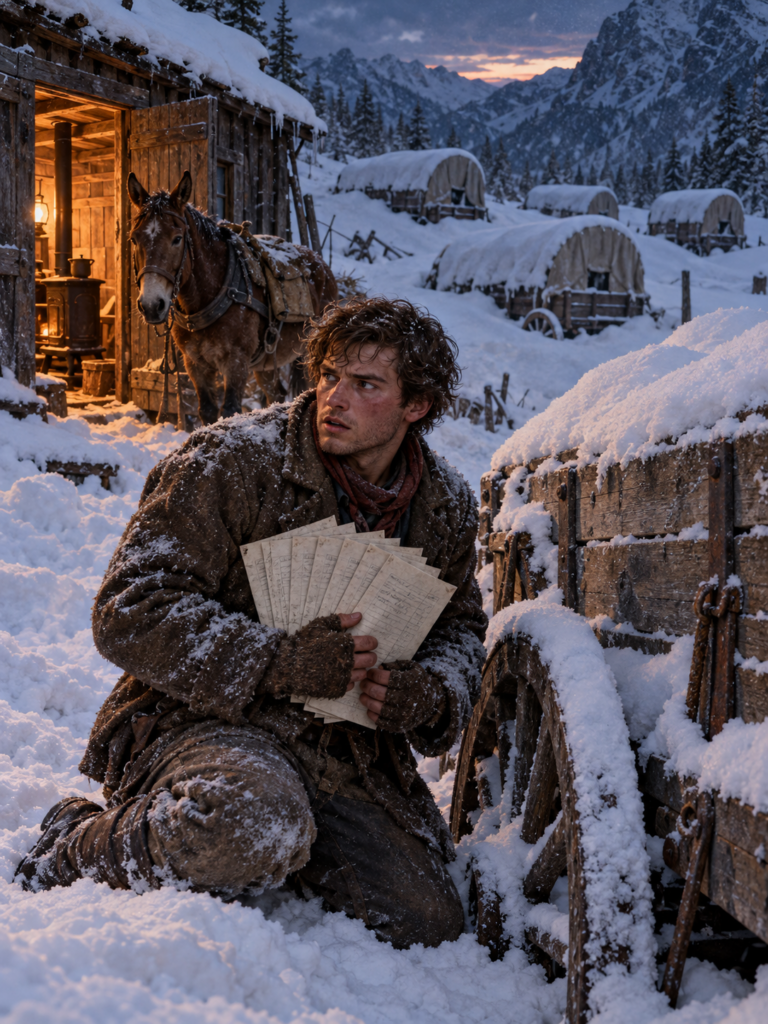
Samuel pushed through the snow toward the eastern edge of the bench, searching the dark line of spruce trees for one larger than the rest.
He found it less than fifty yards from the shack.
Its lower branches sagged under snow.
Beneath them, sheltered from the hardest wind, stones had been stacked into a low, careful mound.
Samuel stopped.
At the head of the grave stood a narrow piece of wagon board driven into the frozen ground.
Micah Reed.
Fifteen years old.
December 9.
Samuel removed his hat.
Until that moment, the seven tally sheets had still been evidence.
The grave made them testimony.
Someone had taken time in hunger and cold to mark the boy’s name when survival itself was becoming uncertain.
Samuel stood there until the light almost disappeared.
He knew nothing about Micah beyond what Pearlman had written.
A cough.
A place nearest the stove.
An extra blanket.
Broth given to him first.
Then a grave beneath stones because the mountain would not let them dig.
That was enough.
Samuel went back to the shack in darkness.
He fed his mule, melted snow, ate a little bacon and hard bread, and slept with Pearlman’s pages beneath his coat.
Before dawn he woke with a decision already made.
He could not search nine miles toward Elk Creek alone while keeping his mule fit enough to return through the pass.
The surviving teamsters might be dead.
They might also have reached the timber camp exactly as Pearlman had intended.
Either way, Samuel possessed the one thing the valley needed first.
Proof.
He banked the stove.
Swept the shack.
Patched gaps in the wall where the chinking had fallen away.
Then he closed the door and started down Martin Pass.
Coming down was slower.
The crust betrayed him repeatedly, holding his weight for two or three steps before dropping him thigh-deep.
He conserved the mule’s strength.
He conserved his own.
The pages against his ribs seemed heavier than the supplies he had not touched.
On the second evening he reached the final fence line above Willowbottom.
By the afternoon of the third day, the McCrae ranch appeared below him.
No one cheered when he entered the yard.
At first, no one seemed to understand what they were seeing.
A young man.
One tired mule.
No freight.
Ward McCrae came onto the porch.
Samuel stopped below him, took off his hat, and pulled the oilcloth bundle from his coat.
He laid the seven pages along the porch rail.
Then the leather sack.
Then the note explaining the forty-two dollars.
Ward’s eyes moved from the money to Samuel.
“The wagons are there,” Samuel said.
Ward said nothing.
“Four of them. Covered and tied. Nothing gone except food they ate to stay alive. They wrote down every bit.”
Ward’s face changed.
Samuel placed one finger on the final sheet.
“Micah Reed died at the shack.”
The older man’s jaw tightened.
“They buried him properly. Pearlman, Dow, and Vetter left on the tenth for Elk Creek. Vetter was sick. The other two meant to carry him.”
Ward picked up the first page.
He read it standing.
Then the last.
Then, without speaking, he sat on the porch bench and began again from the beginning.
Samuel waited.
A ranch hand crossed the yard, slowed, and stopped.
Another emerged from the barn.
By the time Ward finished, six men had gathered within hearing distance.
Among them stood the foreman who had said no honest driver abandoned four wagons.
Ward folded the final page carefully.
“Get every man who can ride,” he said.
The foreman blinked.
Ward looked at him.
“And send somebody around the south flank to Elk Creek.”
The foreman moved at once.
Samuel reached for the papers.
Ward kept one hand on them.
“Leave these.”
Samuel looked at him.
Ward’s voice lowered.
“You rode up there because the rest of us had already decided what happened.”
Samuel said nothing.
Ward looked toward the men in the yard.
“Now we’re going to find out what happened to the men we judged.”
Samuel glanced at the road leading south toward Elk Creek.
Somewhere beyond the ridge, an answer still waited.
And if Pearlman and Jim Dow were alive, Willowbottom would have to face them.
Samuel put his hat back on.
“I’m riding with the search.”
Ward looked at the exhaustion in his face.
“No.”
Samuel met his eyes.
“I brought their word down. I’m not stopping before I know whether the men who wrote it lived.”
Ward held Samuel’s gaze for several seconds.
Then he shook his head.
“You’ll do more good here.”
Samuel’s expression did not change.
Ward tapped the seven sheets.
“You know the trail. You know Pearlman’s account. But you’ve just spent eight days going into that country and back. If I send you straight out again tired, I’m using a man badly.”
That language Samuel understood.
Not kindness.
Not authority for its own sake.
Work.
Judgment.
The sort Halvor Bench had respected.
Samuel glanced toward the mule he had brought down from the pass. The little animal stood with her head low, one hind leg resting.
She had earned rest too.
“All right,” he said.
Before sunrise the next morning, six men rode north with pack animals, axes, shovels, blankets, food, and instructions to reach the line shack if weather allowed.
Another rider took the longer southern route toward Elk Creek.
Samuel watched both parties leave.
Waiting turned out to be harder than climbing.
The story spread through Willowbottom before noon.
By afternoon, the store was crowded.
Men who had repeated the theft rumor now wanted to know exactly what Samuel had seen.
He refused to improve the story for them.
He did not call the storm monstrous.
He did not describe Pearlman as heroic.
He did not speculate about what the three men had endured after leaving the shack.
He simply said what he knew.
Four wagons remained above Elk Creek.
The freight was intact.
A little flour had been consumed and tallied.
Micah Reed was buried beneath the large spruce east of the line shack.
Pearlman, Jim Dow, and Harl Vetter had left on foot on December 10.
That was all.
The foreman who had first accused them stood near the rear of the store.
Samuel saw him but did not address him.
The man looked older than he had a week earlier.
A woman asked, “Did they really leave their wages?”
Samuel nodded.
“All of them?”
“Forty-two dollars remained.”
“For their families?”
“That’s what Pearlman wrote.”
The room became quiet.
Samuel understood then that truth did not always arrive dramatically.
Sometimes it arrived as an amount of money no starving man had taken.
Sometimes as the exact weight of flour a desperate man intended to repay.
Sometimes as a grave marked for a boy nobody expected to find until spring.
The next three days passed slowly.
Samuel repaired harness.
Checked the small brown mule’s hoof twice daily.
Slept badly.
On the fourth afternoon, a rider appeared on the south road.
Somebody saw him first from the store porch.
Within minutes half the settlement seemed to know.
Samuel came out of the livery while the rider was still crossing the last field.
The man’s horse was white with dried sweat.
Ward McCrae arrived from the ranch not long after.
They gathered in the store.
The rider removed his gloves.
“Elk Creek has them.”
Samuel’s shoulders loosened before he could stop them.
“Pearlman?”
“Alive.”
“Dow?”
“Alive.”
Samuel asked the next question more quietly.
“Harl Vetter?”
The rider shook his head.
Nobody spoke.
Then he told them.
On December 11, one day after leaving the line shack, Aught Pearlman and Jim Dow had staggered into Elk Creek timber camp carrying Harl Vetter between them.
Nine miles.
In winter.
With Harl too sick to walk.
The timber men had taken them inside.
Harl had died three days later.
December 14.
They had buried him in the camp cemetery.
Pearlman and Dow had survived.
When their strength returned, they tried twice to find a route back to the freight.
Both attempts failed because the creek had opened in places where unstable ice and water made passage impossible.
Samuel listened without interrupting.
The accusation that had ruled Willowbottom for months collapsed completely.
The teamsters had not escaped with the valley’s goods.
They had nearly died protecting them.
Then, after reaching safety, they had tried to return.
Ward McCrae stood beside the store counter with Pearlman’s final tally sheet in his hand.
“We have owed those two men an apology for four months,” he said.
His voice was not loud.
It did not need to be.
“And we’ll pay it.”
His eyes went to Samuel.
“Tell them.”
Samuel frowned slightly.
Ward nodded toward the gathering crowd.
“You found the wagons. You found the papers. Tell them what happened.”
Samuel would have preferred another trip through the pass.
He knew mountains.
Rooms full of watching people were harder.
But Halvor’s compass sat in Samuel’s pocket.
And Halvor had taught him something beyond trails and mules.
A man’s word about what he saw in the mountains was the one thing he brought back that mattered.
Samuel walked behind the counter.
Ward laid the seven sheets before him.
The leather wage sack sat beside them.
Samuel looked around.
Men filled the aisles.
Some stood near sacks of flour and barrels of salt.
Others crowded the doorway.
The foreman was there again.
So was a woman Samuel recognized as kin to Micah Reed.
Samuel put both hands on the counter.
“The first page was written November sixteenth,” he began.
He told it plainly.
The freight train had been trapped because the notch became impassable.
The men moved the wagons against the line shack and secured the loads.
They rationed mule grain.
They ate first from damaged freight rather than open goods belonging to people in Willowbottom.
They checked the pass repeatedly.
Each time it was worse.
Micah became sick.
They kept him warm.
One mule died.
They used what they could and wasted nothing.
Micah died on December 9.
The woman near the back lowered her head.
Samuel continued.
The men buried the boy.
Harl Vetter became ill.
Food and grain ran low.
Pearlman and Dow decided to attempt Elk Creek.
They left the wagons covered and the account behind.
Samuel picked up the final page.
His voice became quieter.
“They wrote that the goods belonged to the people here.”
He paused.
“And they wrote that they stayed with the load as long as they could.”
Nobody shifted.
Nobody whispered.
Samuel pointed to the wage sack.
“They left this too.”
The foreman removed his hat.
Samuel looked at him only briefly.
There was no satisfaction in it.
A wrong story had been corrected.
That did not make the months it had been believed disappear.
The woman related to Micah sat on a flour barrel and began crying openly.
Samuel came around the counter.
He did not know what comfort to offer.
So he did not offer false words.
He simply stood nearby.
After a moment she asked, “Was his grave decent?”
“Yes, ma’am.”
“You saw it?”
“I stood beside it.”
“His name was there?”
“Yes.”
She closed her eyes.
“Thank you.”
Those two words hit Samuel harder than all the praise he had received since returning.
He had not gone for praise.
He had gone because something about the accusation had felt wrong.
And because a dead old teamster had taught him that the mountain did not care what people believed.
Tracks were tracks.
Weather was weather.
A wagon either stood beneath the snow or it did not.
By evening the crowd dispersed.
The foreman remained.
Samuel was preparing to leave when the man approached.
“I said they ran.”
Samuel looked at him.
“I know.”
“I said it like I knew.”
Samuel waited.
The foreman swallowed.
“I didn’t.”
There was no answer that could improve that truth.
So Samuel gave him none.
The man nodded once and walked out.
Near midnight, Samuel lay awake in the bunk house listening to the building settle in the cold.
For the first time since returning, he thought not about the four wagons but about Pearlman himself.
A man Samuel knew mostly through signatures.
A man who had carefully recorded boots, mule injuries, flour weight, sickness, wages.
A man who had written for whoever came after.
That last part stayed with Samuel.
Whoever comes.
Pearlman had not known anyone would.
He had written anyway.
Weeks later, when the first serious thaw darkened the south-facing slopes, word came that Pearlman and Jim Dow intended to return to Willowbottom as soon as the routes opened.
Samuel began watching the pass every morning.
Not because he needed proof anymore.
Because he wanted to meet the man whose pages had brought four reputations back from the dead.
Spring reached the valley before it reached the mountains.
Creeks swelled.
Mud swallowed wagon wheels.
Aspens showed the first pale hint of leaves.
Then one afternoon somebody shouted from outside the store.
Two riders were coming north.
Samuel stepped onto the porch.
The first man was lean and weathered, with shoulders narrower than Samuel had imagined.
The second rode with one leg stiff.
Neither looked like a thief.
Neither looked like a legend.
They looked tired.
Human.
Aught Pearlman reined in before the store.
His eyes moved across the faces waiting for him.
Then they found Samuel.
Pearlman dismounted slowly.
“You Weaver?”
“Yes.”
Pearlman studied him.
“You found the shack.”
Samuel nodded.
“And the wagons.”
“Yes.”
“And Micah.”
“Yes.”
Pearlman looked away for one second.
When he faced Samuel again, something in his expression had changed.
“My pages?”
“Safe.”
“The money?”
“Safe too.”
Pearlman exhaled.
Then he asked the question Samuel had not expected.
“Did they believe you?”
Samuel looked past Pearlman toward the men gathered outside the store.
“They did after they read what you wrote.”
Pearlman’s mouth tightened.
“After.”
It was not accusation exactly.
It was weariness.
Samuel understood the difference.
Ward McCrae stepped down from the porch.
He removed his hat.
That gesture passed through the crowd. Other hats came off.
Ward stopped in front of Pearlman and Jim Dow.
“I spoke wrongly about you.”
Pearlman looked at him.
Ward continued.
“I repeated things I had no right to call facts. Men working for me repeated them because I did. That part belongs to me.”
Samuel watched Pearlman closely.
This was not the scene people in Willowbottom had imagined.
No speech.
No triumphant forgiveness.
Pearlman merely said, “All right.”
Ward nodded.
“It isn’t all right.”
Pearlman’s eyes lifted.
Ward’s voice remained steady.
“But it’s true. And you deserved to hear me say it.”
That landed differently.
Pearlman gave one small nod.
Jim Dow stood beside him with both hands resting over the saddle horn.
“What about Micah’s people?” he asked.
“They know,” Samuel said.
Jim’s face seemed to lose some private tension.
“And Harl’s widow?”
“She’s in Fenton,” Ward said. “We haven’t touched the wage money.”
Pearlman turned to Samuel.
“You still have the sack?”
Samuel went inside.
He returned with the leather pouch and the seven sheets wrapped in blue-checked cloth.
Pearlman took the packet first.
For a long time he simply held it.
Samuel had imagined asking him a dozen questions.
What had the storm sounded like?
How sick had Micah been?
How had two exhausted men carried Harl nine miles?
Why write every detail when there was no certainty anyone would ever find it?
Standing there now, Samuel discovered most of those questions no longer needed asking.
The pages had already answered the important ones.
Pearlman unfolded the cloth.
His thumb ran once along the edge of the tally sheets.
“You kept them dry.”
“I tried.”
Pearlman almost smiled.
Then he handed them back.
Samuel frowned.
“They’re yours.”
“No.”
“You wrote them.”
“I wrote them for the man who came.”
Pearlman nodded toward Samuel.
“That was you.”
Samuel looked down at the sheets.
He had never thought of them as something he could own.
Pearlman seemed to read that on his face.
“Records belong where they’ll be remembered.”
Then he took the wage sack.
That money did not remain in Willowbottom.
Half eventually went to Micah Reed’s people.
The rest was taken to Harl Vetter’s widow in Fenton.
Pearlman insisted on carrying it himself.
Samuel rode beside him.
The journey south was easier than Martin Pass had been, but Pearlman spoke little.
Samuel did not force conversation.
At Fenton, Harl’s widow received them in a narrow house near the freight yards.
She was older than Samuel expected.
Small.
Straight-backed.
Pearlman placed Harl’s share of the wages on her kitchen table.
Then he told her exactly what happened.
No softening.
No embellishment.
He told her Harl had helped care for Micah.
That he had gone repeatedly toward the blocked notch.
That he became sick after the boy died.
That he had tried to walk out.
That when he could no longer walk, Pearlman and Jim carried him.
That he reached Elk Creek alive.
That he had been warm when he died.
The widow listened with both hands around a cup she never drank from.
When Pearlman finished, she asked, “Was he afraid?”
Pearlman took a long time before answering.
“Yes.”
Samuel looked at him.
Pearlman continued.
“So were we.”
Harl’s widow closed her eyes.
Pearlman said, “He kept going anyway.”
The woman nodded.
“That sounds like him.”
On the ride back, Samuel finally asked the question that had remained with him.
“Why did you tally the flour?”
Pearlman glanced sideways.
“Because it wasn’t ours.”
“You were starving.”
“It still wasn’t ours.”
Samuel considered that.
Pearlman looked toward the road ahead.
“A hungry man can owe for flour.”
He paused.
“A dead man can too.”
Samuel understood then why Halvor had trusted him.
Not because Pearlman was incapable of fear.
Not because he was harder than other men.
Because there were certain lines he had decided belonged to him whether anyone watched or not.
By late spring, Martin Pass opened enough for the recovery party.
Twelve men went up with fresh mules.
Samuel rode among them.
So did Pearlman.
The climb looked different without winter closing around them.
Snow still clung to shaded timber, but water ran openly along the trail.
Birds moved through the trees.
At the line shack, the four wagons emerged from the shrinking drifts exactly where Samuel had left them.
The tarps had held.
The ropes had held.
The freight had held.
Men worked for two days checking axles, replacing damaged leather, greasing wheels, sorting harness, and loading teams.
Samuel watched Pearlman step inside the shack alone.
After a moment, Samuel followed.
The stove stood cold.
The bunk remained against the wall.
The willow broom leaned behind the door.
Pearlman touched the bench where he had written the seven pages.
“Smaller than I remember,” he said.
Samuel understood that too.
Places where a man had been frightened often grew large inside memory.
Outside, Jim Dow called for Pearlman.
Before leaving, Pearlman looked toward the empty place beneath the bunk where the freight crate had stood.
“You found it quick?”
“Not right away.”
“Good.”
Samuel gave him a questioning look.
Pearlman’s mouth moved slightly.
“If you’d found everything too quick, you wouldn’t appreciate the work I put into hiding it.”
That was the first time Samuel heard him joke.
They went outside.
No one suggested leaving Micah’s grave as it was.
A proper stone had been brought up on a sledge.
Heavy enough that four men strained to move it.
Pearlman helped set it at the head of the grave.
Samuel held the level.
They adjusted the stone twice.
Pearlman stepped back.
Samuel studied the bubble.
“Good.”
Pearlman rested one hand on the stone.
For a moment the whole recovery party fell silent.
Then the work resumed.
The wagons came down slowly.
Where the road narrowed, men walked beside the wheels.
Where mud deepened, they doubled teams.
At the worst switchback Samuel took the lead string.
Pearlman watched him place the mules.
“You learned that from Halvor.”
Samuel glanced back.
“Most things I know about teams.”
Pearlman nodded.
“He was particular.”
“He was.”
“Mean about a bad pack knot.”
Samuel smiled.
“He was.”
Pearlman looked almost amused.
“Then he taught you right.”
When the first wagon finally rolled into Willowbottom, people came out of houses before anyone called them.
Children ran beside the road.
Women stood on porches.
Men left work unfinished.
There was no parade.
No band.
Nothing grand.
Just four wagons coming home.
That was enough.
Each parcel was delivered to the family whose name was written on it.
Flour.
Salt.
Coffee.
Lamp oil.
Muslin.
Nails.
Seed that would go into spring gardens weeks later than intended but still in time.
The only missing freight was the food the stranded men had consumed.
Ward McCrae replaced it from his own stores.
He did not ask Pearlman for payment.
Pearlman objected once.
Ward said, “You already paid enough.”
Pearlman let the matter end there.
Afterward, something changed for Samuel.
Not all at once.
No one gathered to announce it.
He noticed it in smaller ways.
Older ranchers stopped calling him the Weaver boy.
They called him Samuel.
Young hands sometimes called him Mr. Weaver.
When difficult wagon work came up, somebody asked whether Samuel was available.
When a rancher needed a man to cross questionable country, Samuel’s name entered the conversation before men ten years older.
Ward McCrae raised his wages by a third.
Samuel discovered it on payday.
He counted the coins twice.
“This is wrong.”
Ward did not look up from his ledger.
“No.”
“You paid too much.”
“I paid more.”
Samuel waited.
Ward finally looked at him.
“You brought back something this valley needed more than freight.”
Samuel felt uncomfortable immediately.
Ward saw it and spared him the rest.
He also gave Samuel the use of a small cabin at the north end of the ranch.
One room.
One stove.
One bunk.
One window facing the road that climbed toward Martin Pass.
Samuel moved in with very little.
Blankets.
Slicker.
Spare shirt.
A few tools.
Halvor Bench’s possessions.
The brass compass went on the shelf near the stove.
Beside it Samuel placed the folding knife with the bone handle.
Then he unpacked the rabbit-fur-lined gloves Halvor’s wife had sewn decades earlier.
Samuel had carried them for more than a year without wearing them.
For the first time, he unfolded them completely.
He drove two wooden pegs into the wall above the bunk and hung the gloves there.
Not hidden.
Not wrapped.
Visible.
Pearlman’s seven penciled pages went onto the shelf wrapped in the blue-checked cloth.
The leather wage sack eventually returned empty.
Samuel folded it flat beside them.
Those objects became, in time, the nearest thing his cabin had to decoration.
A compass.
A knife.
A pair of gloves.
Seven pages.
An empty money pouch.
None was valuable to anyone who measured value in the usual way.
Samuel understood otherwise.
The compass had belonged to a man who taught him how to read country.
The gloves had been made by a woman long dead for a husband who carried them for forty years because wearing them had never been the point.
The tally sheets had been written by another man in a frozen shack while a boy lay dying near the stove.
Pearlman had not known who would find them.
He had only believed that someone should know what happened.
That faith in an unknown witness stayed with Samuel.
So did something else.
How easily the valley had decided.
The supply train failed to arrive.
That was fact.
The men had vanished.
Fact.
From those two facts, people had built a third thing that was not fact at all.
They ran.
Then repetition hardened it.
Men said it at supper.
At the store.
In barns.
On porches.
Soon the story no longer sounded like suspicion.
It sounded like memory.
Samuel never forgot that.
Years later, when people brought him news about someone who was not present to answer, he developed a habit that irritated impatient men.
“How do you know?”
If the answer was that somebody had heard it from somebody else, Samuel waited.
If the evidence could be checked, he checked it.
If a trail existed, he followed it before deciding where it led.
People sometimes mistook that caution for silence.
It was not.
It was respect for how much damage certainty could do when certainty had never earned its name.
The foreman who had accused Pearlman never became Samuel’s enemy.
That would have been too simple.
He remained at the McCrae outfit.
He worked hard.
He also changed.
Samuel noticed that months later when a hired hand failed to return from a cattle drive on schedule.
Someone at supper suggested the man had taken his wages and gone.
The foreman set down his cup.
“You know that?”
The speaker shrugged.
“Seems likely.”
The foreman’s face tightened.
“Likely isn’t the same thing.”
Samuel said nothing.
He did not need to.
Truth had changed more than one man.
Winter returned.
Martin Pass whitened.
The road vanished beneath snow.
One evening Samuel sat in his cabin while the stove ticked softly.
Outside, the valley was black beyond the small window.
The road north could not be seen at all.
He looked at Halvor’s gloves hanging above the bunk.
Then the compass.
Then Pearlman’s pages.
His life was still modest.
He owned no ranch.
No large house.
No fine horse.
He was still only nineteen when he made the ride that people would remember.
But he no longer thought of himself as a boy waiting for older men to tell him what was true.
That may have been the greatest thing he brought down from Martin Pass.
Not the papers.
Not the money.
Not even the corrected story.
He had gone into the mountains because everyone else had settled on an answer that did not fit what he knew of one man.
He had come back understanding something harder.
Reputation could be buried by people who never meant to bury the truth.
Courage was sometimes nothing more dramatic than refusing to repeat what you had not proved.
And loyalty did not always mean defending somebody blindly.
Sometimes loyalty meant making the journey necessary to discover whether your faith in them was deserved.
Pearlman had deserved it.
So had Jim Dow.
So had Harl Vetter.
So had Micah Reed, whose name might otherwise have become a footnote to a vanished freight train.
The mountain had kept their story for months.
A sagging line shack held it.
Four snow-covered wagons confirmed it.
Seven penciled pages preserved it.
And one nineteen-year-old with a split-hoofed mule had been stubborn enough to go looking.
Samuel reached for the brass compass and turned it once in his hand.
The casing was worn smooth where Halvor’s fingers had touched it.
He remembered his old teacher telling him that a man’s word about what he saw in the mountains was the only thing he brought down that mattered.
Samuel had believed him then because Halvor was older and Samuel was young.
Now he believed him because he had tested the lesson himself.
He set the compass back on the shelf.
Outside, wind moved down from Martin Pass.
Samuel listened without fear.
The pass had not become safer.
Winter had not become kinder.
Men had not become incapable of saying cruel things about people they did not understand.
None of that had changed.
What had changed was Samuel.
The next time someone’s name was spoken wrongly, he knew what kind of man he wanted to be.
Not the loudest one in the room.
Not the quickest to decide.
The one willing to go far enough to know.
And if knowing required cold, distance, loneliness, or a trail everyone else had already abandoned, then he knew something else too.
Sometimes the truth waited where nobody wanted to look.
Someone still had to go and bring it home.

