
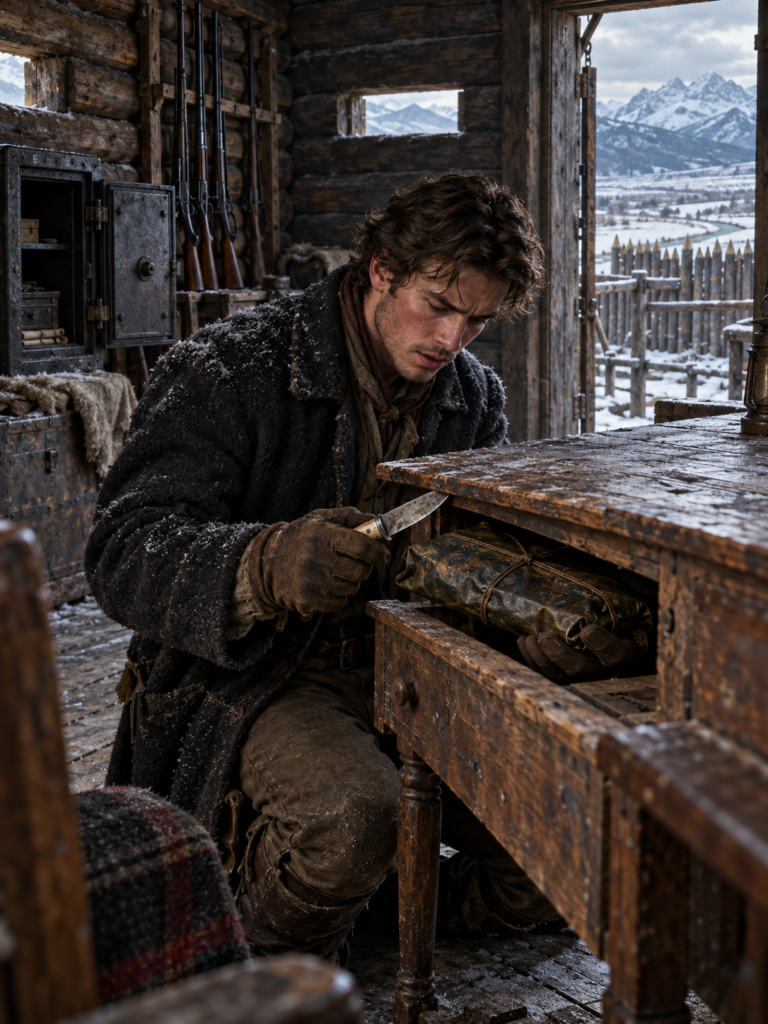
The packet slid free into Edward’s hands, heavier than folded paper had any right to be.
He remained on one knee beside the desk while gray mountain light crossed the blockhouse floor.
The oilcloth had been tied with an old leather lace. Beneath it lay waxed paper. Inside that was a small metal box and four sheets of Army stationery folded around it.
Edward opened the box first.
Gold flashed in the dim room.
He stared at the coins, then immediately looked toward the doorway although there was nobody within miles to see them.
Sixty-two dollars.
More money than he had carried into the mountains. More than enough to tempt a man into forgetting why he had come.
Edward set every coin back.
Underneath them lay a brass compass.
Two initials had been scratched into its lid.
J.H.
The last object in the box was folded linen.
Edward unfolded it across the desk.
His breathing changed.
Lines crossed the cloth in deliberate ink: ridge bearings, the spring, the creek, the mountain saddle.
And the fort.
In one corner was a date.
August 11, 1868.
Edward put both hands against the edge of the desk.
This was not an old man’s memory anymore.
It was a field survey.
He unfolded the letter.
The writer identified himself as Corporal John Hollis, once part of the small Army detachment stationed there. The post had been occupied from 1867 into 1868, then abandoned after the expected conflict never came.
Hollis had stayed behind through part of the final summer because a sick horse could not safely be moved.
While alone, he had surveyed the saddle.
Then he had hidden the survey, the compass, and the money.
Not for an heir.
Not for an officer.
For whoever eventually found the place for an honest reason.
Edward read the final condition twice.
Tell the truth about the place.
He sat motionless.
The money changed meaning first.
It was not buried treasure.
It was a test left by a stranger.
The fort changed meaning next.
Edward had believed he had come north to prove he was not a liar.
But the linen in front of him could do something far larger. Its bearings might protect two small ranches whose owners could not afford to fight speculators in court. It might keep the spring from becoming one man’s private leverage over an entire stretch of grazing country.
And it might prove that Howerin had been buying claims whose value depended on everyone accepting an empty space on a map as truth.
Edward folded the letter carefully.
He could ride straight back.
Instead, he stood.
A document hidden for decades deserved better than a careless story from an exhausted ranch hand.
He spent the remaining daylight walking the stockade and noting its condition. He counted timbers. Examined iron straps. Measured the yard by pacing it. He found the spring where Hollis had drawn it and checked the direction of the creek against the survey.
Everything matched.
That night Edward slept inside the barracks with the packet beneath his shirt.
The next morning he patched the worst section of the blockhouse roof with surviving shingles. He cleared debris from the parade ground. He cleaned the old stove enough to draw safely.
Not because repairs would strengthen the legal proof.
Because someone had kept this place long enough for him to find it.
Edward could keep it one more day.
On the third morning he stood outside the closed gate with the reins in one hand.
The survey, letter, compass, and gold were wrapped again against his chest. His crude feed-bill map rested beside them.
One map drawn from memory.
One drawn by a soldier who had actually stood here.
Down in the valley, men had already decided which one mattered.
Edward intended to make them look twice.
He placed his boot in the stirrup, mounted, and turned the bay toward the pass.
The bay stepped into the narrow cut toward the summit, and Edward kept one hand near his coat where the oilcloth packet rested against his chest.
Going down should have been easier.
It was not.
On the climb, failure had meant finding nothing.
Now failure could mean losing what he had found.
The weather had remained stable, but clouds had thickened along the northern peaks. Edward watched them while he rode. He rested the gelding before the steepest descent and walked beside him over loose shale, keeping the reins short enough to help without pulling at the horse’s mouth.
The packet seemed heavier with every mile.
Once, where the trail narrowed above a long scree slope, the gelding lost a hind step.
Edward moved toward the mountain instead of away from it, steadied the horse, waited until all four hooves found purchase, and continued without haste.
Owen Reed had taught him that panic usually created the accident a careful man was trying to prevent.
By dusk of the fourth day, the Barnett buildings appeared below him.
Smoke rose from the ranch house chimney.
Someone in the yard shouted.
Josiah Kerr came onto the porch holding a coffee cup.
He saw Edward.
Then he saw the horse.
Then the expression on Edward’s face.
“You found something.”
Edward dismounted.
He could have answered with the fort.
He could have told him about the gate, the barracks, the blockhouse, the old stove, the stockade still standing against forty winters.
Instead he reached inside his coat.
“A paper travels better than a story.”
He handed Josiah the linen survey.
Josiah carried it directly beneath the porch lamp.
Edward watched his eyes move across the ink.
The foreman’s coffee cup lowered slowly.
“Where’d this come from?”
“Hidden beneath a writing desk in the blockhouse.”
“The fort has a blockhouse?”
“It has almost everything.”
Josiah looked up.
For the first time since Edward had known him, the older man appeared unable to decide what to say.
He settled on the practical question.
“Can you find it again?”
“Yes.”
“Could another man?”
“If I showed him.”
Josiah looked back down at the survey.
“And the lines?”
“I checked the spring and creek against the ground. I checked the ridge bearings as well as I could without instruments.”
“You have an instrument.”
Edward took out the brass compass.
Josiah opened its lid.
“J.H.”
“John Hollis.”
“Who’s that?”
Edward handed him the letter.
Josiah read it in silence.
When he finished, he stepped to the porch rail and stood there long enough for Edward to hear men gathering near the bunkhouse behind him.
Nobody laughed.
Finally Josiah said, “We’re taking this to Peak.”
Harland Peak, keeper of the county land records, was known for two things: neat ledgers and distrust of anybody who tried to hurry him.
Edward considered that promising.
Two mornings later, he sat beside Josiah on the seat of a buckboard heading toward the county seat with the packet enclosed in a leather case.
Edward had slept badly.
Not because he doubted the fort.
He had touched its walls.
He doubted paper.
A forgotten structure in the mountains was one kind of truth.
A recognized structure on an official record was another.
The difference between them could decide who controlled the northern pasture.
At the land office, Harland Peak did not appear impressed by Edward, Josiah, the leather case, or the story that accompanied it.
He was fifty-one, thin, careful, and wore small spectacles low enough on his nose to make every visitor feel as though he were being measured for an error.
“You found this yourself?”
“Yes.”
“Where?”
Edward described the pass.
Peak unfolded the linen survey.
His manner changed by less than an inch.
But Edward noticed.
The clerk placed glass weights on the corners and brought out a county plat.
Then another.
He compared the drawn creek.
Checked the orientation of the saddle.
Copied one bearing onto scrap paper.
Compared another.
He stopped.
“Where did you say the spring sits?”
“North edge of the saddle. Creek runs south near the granite before disappearing under stone.”
Peak studied the plat.
Josiah remained silent.
Edward wished he would say something, then understood that Josiah was giving him the same respect Owen once had: allowing him to stand behind his own words.
Peak removed his spectacles.
“If this is genuine, it establishes prior survey work in the disputed quarter.”
Edward heard only one phrase.
If this is genuine.
“What would make it genuine?”
“A government provenance would help.”
Edward placed Hollis’s letter beside the survey.
Peak read it.
His face remained almost expressionless until he reached the signature.
Then he returned to the linen.
“John Hollis.”
Edward placed the compass beside it.
The scratched initials caught the window light.
Peak leaned closer.
“Anything else at the site?”
“Barracks. Stable. Blockhouse. Stockade. Army-pattern stove. Iron bunk frames. Old provisions. Horseshoes. Nails.”
“You disturbed them?”
“As little as I could.”
“Removed anything besides these?”
“The packet and what was inside it.”
“The money?”
Edward hesitated.
The question struck harder than he expected.
Peak had found the amount in the letter.
“Sixty-two dollars in gold.”
“Still with you?”
Edward took the tin from the leather case and placed it on the counter.
Peak looked at it but did not reach for the coins.
“You could have omitted that part.”
“It was in the packet.”
“That isn’t what I said.”
Edward met his eyes.
“Hollis asked whoever found it to tell the truth about the place.”
For the first time, Harland Peak smiled.
Barely.
“Good answer.”
But he still did not enter anything into the record.
Instead he went into the back room.
Edward waited.
Five minutes.
Ten.
Fifteen.
Josiah finally shifted beside him.
Edward said quietly, “If the survey doesn’t hold?”
“We still know the fort’s there.”
“That won’t help the north-bench claims.”
“No.”
That was the truth Edward had been avoiding.
His name could be cleared and the valley could still lose.
Peak returned carrying a ledger large enough to require both hands.
He set it down, opened it near the middle, and ran his finger over entries from years before Edward was born.
Then he stopped at a notation.
Not a fort.
A surveyor’s reference to a military trail intersecting a bearing near the northern divide.
Peak looked from that entry to Hollis’s linen.
He measured.
Checked again.
Then turned the county plat sideways.
Edward could feel his heartbeat in his palms.
Peak touched a point on the map.
“This bearing reaches your saddle.”
His finger moved.
“This one reaches the granite rise.”
Another.
“And this line accounts for the creek.”
Josiah released a breath.
Edward did not.
“What does that mean?”
Peak closed the measuring rule.
“It means the blank on our current map is not evidence that the land was never surveyed.”
He looked at Edward.
“It means the blank is a failure of the later record.”
The words settled slowly.
Howerin’s entire position rested on the opposite claim.
Peak drew a fresh sheet toward him.
Before writing, he asked Edward for a complete statement of how the packet had been discovered.
Edward gave it plainly.
The bunkhouse conversation.
His grandfather’s story.
The pass.
The stockade.
The desk.
The hidden oilcloth.
Peak interrupted only to establish sequence and location.
When it was finished, he pushed the statement across the counter.
“Read it before you sign.”
Edward did.
Every line.
Owen would have expected nothing less.
He signed.
Peak filed Hollis’s letter as an exhibit.
Then he opened the county record.
The nib of his pen hovered above the page.
Edward had imagined this moment for four days, but not the feeling that came with it.
He had expected triumph.
What he felt instead was responsibility.
Once Peak wrote the entry, the fort would cease to belong only to memory.
Men would ride there.
They would inspect it.
Argue over it.
Repair it or damage it.
Use it to win claims.
Possibly use Edward’s name while doing so.
Peak seemed to read the hesitation.
“Something wrong?”
Edward looked at the survey.
“No.”
Then he corrected himself.
“One thing.”
Peak waited.
“The spring.”
“What about it?”
“Three outfits use that water. Barnett’s and the two north-bench places. Whatever this does to the filings, nobody should turn proof of the survey into an excuse to close everybody else out.”
Josiah turned toward him.
Edward continued.
“That’s what started the fight. Not the fort. Water.”
Peak studied him for several seconds.
“The survey establishes evidence. It doesn’t give you authority over the final water determination.”
“I know.”
“Then why tell me?”
“Because if everybody remembers the land and forgets the spring, we’ll be back here with different papers.”
Josiah looked away, but Edward saw the corner of his mouth move.
Peak dipped the pen.
He entered the military post beneath its proper section and township.
Then he recorded the survey reference.
When the ink dried, he closed the ledger.
The blank space was gone.
Edward’s story had become part of the county record.
Within days, the speculators’ argument began collapsing.
Their claims had been purchased on the assumption that the northern quarter had never been surveyed. Hollis’s document proved otherwise, and Peak’s matching of the old bearings to the terrain gave the document context that could not be dismissed as a stray drawing.
The change moved through the valley faster than Edward’s humiliation had.
Men who had laughed now asked exactly where the walls stood.
One wanted to know how tall they were.
Another asked whether the stove still worked.
Somebody claimed he had always believed there had been an Army road through the high country.
Edward did not bother reminding him otherwise.
Howerin never came back to the Barnett corral.
Before the month ended, he sold the doubtful papers back at a loss to the two smaller holdings on the north bench and took the stage south.
Edward heard the news from Josiah.
“That ought to satisfy you,” the foreman said.
Edward was repairing a stirrup leather.
“It helps.”
Josiah waited.
“You don’t sound satisfied.”
Edward pulled the leather through the buckle.
“The fort’s still up there.”
“So?”
“Four stockade timbers are rotted through. Part of the roof was sagging. Stable sill will go next.”
Josiah stared at him.
“You rode all that way to save grazing land and came back worried about a door sill?”
Edward looked up.
“Somebody kept the place standing long enough for us to need it.”
That answer traveled too.
By the second snow, several men asked Edward to guide them up.
Among them was Amos Field, a sixty-four-year-old carpenter from the crossroads who arrived with more tools than clothes. Tom Reyes, the blacksmith, brought hand-cut nails and good iron. Josiah came despite claiming the ranch could not spare him.
Miriam Alder, a widowed freighter who understood better than most what mountain travel required, sent flour, beans, and wool blankets for the work party. Her message to Edward was simple: when he came down, he owed her one Sunday dinner, and that was the full price.
Edward took them through the pass.
When the fort appeared between the trees, every man stopped exactly where Edward had stopped.
Nobody needed to be told why.
Amos Field walked to the gate.
Touched the silvered timber.
Looked up at the walls.
“Well,” he said.
Josiah removed his hat.
Behind them, the others waited.
Edward crossed the parade ground toward the barracks, reached for the door he had first opened alone, and pushed it inward as the men followed him inside.
The barracks door swung against the wall, and for the first time in decades the room filled with the voices of men who had come not to abandon the post, but to keep it standing.
Amos Field inspected the roof before he accepted coffee.
Tom Reyes went directly to the gate hardware.
Josiah Kerr stood in the center of the room with his hat still in his hands and studied the iron bunks, the scarred table, and the Franklin stove Edward had cleaned.
“You stayed in here?”
“Two nights.”
“Alone?”
Edward nodded.
Josiah looked at him.
“You ever consider you might have more sense than courage?”
“Frequently.”
That earned the smallest laugh.
The work began the next morning.
Amos replaced four stockade timbers whose bases had softened beyond repair. He chose new pine carefully and complained whenever anyone tried to hurry him.
“A wall stood forty years,” he told Tom. “No reason to insult it with a six-month repair.”
Tom reset loose iron straps and worked the gate until the near leaf no longer dragged. He removed the damaged base of the fallen flagpole, fitted banded oak around the replacement, and set the pole upright again.
Edward worked beside both men.
He did not command them.
He watched.
Asked questions.
Carried timber.
Held iron.
Climbed onto the blockhouse roof and extended the patch he had begun alone.
At night they ate Miriam Alder’s beans at the barracks table.
Josiah said little.
On the third evening Edward found him outside near the flagpole, looking north where the spring emerged from the grass.
“Barnett wants you back,” Josiah said.
Edward waited.
“Four dollars more a month.”
“That’s generous.”
“You going to take it?”
Edward looked toward the stockade.
Three months earlier, the answer would have been immediate.
A permanent bunk.
Regular wages.
Work he knew.
A foreman he respected.
Men around him through winter.
For someone who had been moved from one household to another since childhood, those things had weight.
His mother had died when he was nine.
His father had followed before Edward reached fifteen.
His older brother Matthew inherited the family holding, married, and soon found Edward inconvenient to keep.
Then Owen Reed had taken him in.
Owen had never called it kindness.
He simply gave the boy work, food, a bed, and knowledge.
How to calm a nervous horse.
How to place a fence line.
How to read clouds along a ridge.
How to look twice.
Then Owen died too, and the property went to a distant cousin who sold everything within weeks.
Every place Edward had belonged had eventually become somebody else’s decision.
He looked again at the fort.
“Not sure yet.”
Josiah nodded.
He did not press.
That mattered.
The county’s water decision came before the deepest winter.
The two smaller north-bench holdings were confirmed in their grazing rights. The headwater spring was entered as common water for the three outfits that had historically used it.
Edward read the notice twice when Josiah brought it to him.
His own name appeared in the supporting record beside John Hollis’s.
That embarrassed him more than he expected.
“Should be his name first,” Edward said.
“It is.”
“I mean the important one.”
Josiah folded his arms.
“You found what he left.”
“He made the survey.”
“And you made somebody look at it.”
Edward had no answer to that.
Soon afterward, Harland Peak sent for him.
Edward rode to town expecting another question about the evidence.
Peak had something else waiting.
“The county needs someone responsible for the post.”
Edward thought he had misunderstood.
“Responsible how?”
“Caretaker.”
Peak described a small stipend. Nothing extravagant. There would also be grazing in the saddle sufficient for a horse or two. Edward would be expected to maintain the structures, keep casual visitors from stripping them, report serious deterioration, and protect the documentary connection between the physical site and the county record.
Edward stared at him.
“Why me?”
Peak gave him a look over his spectacles.
“You rode there when everyone else said it did not exist.”
“That doesn’t mean I know how to maintain an Army post.”
“You know horses. You know timber work. You know enough ironwork not to ruin what you cannot repair. Kerr says Reed trained you well.”
Edward looked down at his hands.
Peak continued.
“You also brought sixty-two dollars in gold into this office when you could easily have brought nothing but a survey.”
“Hollis said the finder could keep it.”
“I know.”
“Then that shouldn’t matter.”
“It does to me.”
Edward did not answer immediately.
He had learned to be suspicious of opportunities that sounded like rescue. Too often a man offering shelter expected obedience in return.
“What authority would the county have over me?”
Peak seemed pleased by the question.
“Specific duties only. Maintenance. Reporting. Preservation.”
“Could they remove me?”
“For failure to perform those duties.”
“Could Barnett tell me what to do?”
“No.”
“Howerin, if he came back?”
“Certainly not.”
“The post belongs to me?”
“No.”
Edward appreciated that answer too.
“It belongs to the county?”
“The land remains subject to the established record. Your role is caretaker, not owner.”
Edward thought of the cold barracks.
The spring.
The view down through the pines.
A place did not need to belong to him for his work there to belong to him.
“What about the gold?”
Peak leaned back.
“John Hollis left written permission for the finder to use it.”
Edward had considered buying cattle.
A better saddle.
Land, someday.
Instead he said, “Some of it ought to stay with the post.”
Peak studied him.
“That is your decision.”
Not an order.
Not a condition.
A decision.
Edward accepted the caretaker appointment.
When Mr. Barnett heard, he renewed the offer of Edward’s bunk and the wage increase anyway, saying the door would remain open if mountain life changed his mind.
Edward thanked him sincerely.
Then he declined.
There was no bitterness in it.
That surprised him most.
For weeks after being dismissed, he had imagined that proving the fort existed would make every old humiliation burn away.
It did not.
Being right could not restore his parents.
It did not bring Owen back.
It did not repair the years with Matthew.
It did not turn Barnett’s decision into a brave one.
But proof gave Edward something revenge never could.
Choice.
He no longer needed the bunkhouse to take him back in order to know he had deserved a place there.
That winter, people began calling the site Hollis Post.
Edward never proposed the name.
It simply appeared in conversation and stayed.
The first time he heard a rancher say, “Edward’s up at Hollis Post,” he turned instinctively to see whether another Edward had entered the store.
Miriam Alder laughed from behind a barrel of flour.
“You’ll get accustomed.”
“To what?”
“People knowing where to find you.”
She reminded him of the Sunday meal he still owed her.
Edward arrived the following week.
Her kitchen was warm, crowded, and practical. She asked no sentimental questions about dead relatives and did not tell him how fortunate he should feel.
She fed him roast chicken, potatoes, bread, and enough pie to make the ride back uncomfortable.
At the door she gave him a wrapped parcel.
“What’s this?”
“Food.”
“You already fed me.”
“For the mountain.”
“I can pay.”
“I didn’t ask you to.”
Edward hesitated.
Miriam raised one eyebrow.
“Learning to accept beans without turning them into a debt may be the next useful skill Owen Reed forgot to teach you.”
Edward almost smiled.
“He didn’t forget much.”
“Then consider it advanced instruction.”
He accepted the parcel.
Their exchange remained exactly what the valley needed from it: kindness without claim, generosity without ownership.
That distinction meant more to Edward than he could have explained.
As winter deepened, he settled into the fort.
The work was repetitive and therefore comforting.
Morning inspection.
Stove.
Horse.
Water.
Roof.
Gate.
Stable.
Evening inspection.
He named tools aloud when he set them down, the way Owen had taught him.
Hammer.
Awl.
Knife.
File.
Some evenings the wind struck the stockade so hard the entire structure seemed to inhale.
Edward would sit at the plank table and listen.
He learned the sounds that meant danger and those that only sounded dramatic.
Loose shingle.
Contracting timber.
Wind under the stable eave.
Snow slipping from the roof.
A place, he discovered, could be understood the same way as a horse: not through domination, but attention.
Late in February, after days of snow below the pass, strong winds swept the saddle nearly bare.
Edward walked his evening circuit.
Four out of every five stockade timbers remained original.
The replacements Amos had fitted stood pale beside them.
The gate hung true on its long strap hinges.
Tom’s banded-oak base held the flagpole upright.
Edward still had not raised a flag.
He had no authority to decide what banner should stand over an old Army post now serving an entirely different purpose. Perhaps the county would decide in spring.
Perhaps no flag was needed.
He had become increasingly comfortable with leaving some things unresolved until the right person had a right reason to answer them.
He checked the stable sill.
Noted water damage at the western corner.
Cleared the beginning of a squirrel nest from a blockhouse loophole.
Then he went inside the barracks.
The Franklin stove glowed behind him.
On the table lay two objects.
He had placed them there that morning while cleaning.
His grandfather’s bone-handled knife.
John Hollis’s brass compass.
The knife had a thin five-inch blade, sharpened through years of practical use. Its handle had yellowed with age and darkened where another man’s palm had once wrapped around it.
The compass bore only those scratched initials.
J.H.
Edward sat.
For a while he simply looked at them.
Two small objects carried by men who had never met each other.
One belonged to a grandfather who had once guided soldiers through high country and later told a boy about a place maps forgot.
The other belonged to a corporal who had remained alone at an abandoned post because a sick horse could not make the journey out.
Both men had left something behind.
Neither could have known what Edward would eventually become.
That thought led him unexpectedly to the letter.
John Hollis had written that he once lost a younger brother to fever at twelve.
He had wondered what the boy might have become.
Edward thought of his own mother.
His father.
Owen.
The losses had always seemed separate before, like cabins standing far apart across a valley.
Now he saw something connecting them.
People died without getting to finish the work they had begun in others.
Sometimes the work remained anyway.
A habit.
A sentence.
A map.
A method for setting down tools.
A story told once and remembered years later.
Edward placed his hand between the knife and compass.
The men who had mocked him no longer mattered as much as he had once believed they would.
Howerin had gone south.
Barnett had offered him his job back.
The bunkhouse hands no longer called the fort imaginary.
Those were satisfying facts.
They were not the reason Edward stayed.
He stayed because every morning he could open a gate that had stood closed for decades and know exactly why it remained standing.
He stayed because the spring below the fort now belonged on the record instead of inside somebody’s speculation.
He stayed because two small ranches had kept their grazing.
He stayed because a forgotten corporal’s lines had been returned to the map.
And because for the first time since he was a child, Edward occupied a place that could not disappear merely because another household changed its mind about him.
The county could replace its caretaker someday.
Edward understood that.
Nothing lasted by possession alone.
But while the duty was his, the choice to remain was his too.
That was enough.
Spring approached slowly.
Men began writing to the county about riding up once the snow cleared. Harland Peak wanted a formal inventory. Amos promised to return with timber for the stable sill. Tom Reyes intended to inspect every iron fitting he had not reached before winter.
Josiah sent word from Barnett’s place that calving had begun early.
Miriam sent another parcel and no invoice.
One envelope came from Edward’s brother Matthew.
Edward recognized the handwriting badly enough that he nearly set it aside unopened.
He eventually read it at the plank table.
Matthew had heard what happened.
He wrote awkwardly, without apology at first, about the ranch and his wife and the winter.
Near the end came one sentence admitting that Edward had been sent away too easily.
Edward read that line several times.
He did not mistake it for repair.
An admission was not a rebuilt relationship.
Still, it was more than silence.
Edward took out paper.
He did not forgive four years in a paragraph.
He did not punish Matthew either.
He wrote that he was well.
He described Hollis Post.
He said the road would be passable by late spring.
Then he added that if Matthew wanted to see it, he could ride up when the weather settled.
Edward stopped there.
An invitation was not surrender.
A door could open without becoming a trap.
He folded the letter.
Outside, wind moved through the stockade.
Edward rose and added a piece of split pine to the stove.
Then he returned to the table and picked up the compass.
The needle trembled.
Settled.
North.
The same direction it would have pointed for John Hollis decades earlier.
The same direction Edward had ridden while almost everyone below insisted there was nothing worth finding.
He closed the brass case.
Next he picked up his grandfather’s knife and tested the edge lightly against his thumbnail.
Still sharp.
He placed both objects back on the oilcloth.
The knife had helped him free the packet.
The compass had helped prove the packet belonged to the country around it.
But neither object had made his choice for him.
That had been his.
At twenty-three, Edward Hol had ridden away from a ranch where men thought employment gave them authority over the truth he was allowed to tell.
He had gone into the mountains with forty-one dollars, three days of food, a memory, and a rough map drawn on the back of a feed bill.
He had returned with something stronger than vindication.
He had returned with evidence.
That evidence changed the official record.
The record broke the speculators’ claim.
The broken claim protected the north-bench ranches.
The water became common rather than private leverage.
The fort gained a name again.
And Edward, who had spent much of his life living wherever another person permitted him to remain, was given responsibility for preserving the place because he had been the one man willing to test paper against ground.
He walked outside before dark.
Cold air met him immediately.
The western sky burned gold above the divide.
Edward crossed the parade ground and stopped beside the upright flagpole.
Months earlier, a young pine had grown near its fallen base.
He had cut it out during his first days there.
The stump remained, low and pale in the grass.
He put one boot on it and looked toward the pass.
From here, the trail was difficult to see.
That pleased him.
Not everything invisible from a distance was imaginary.
He thought of the first time he had crossed the saddle and noticed one straight line between the trees.
He had needed three looks.
That was the lesson beneath all the others.
Not that old stories were always true.
They were not.
Not that maps were always false.
Most were useful.
Not that powerful men always lied or poor men always saw clearly.
Life was not simple enough for that.
The lesson was smaller and harder.
Look twice.
Compare the claim with the ground.
Ask who benefits from an empty space.
Do not confuse ridicule with evidence.
Do not confuse authority with accuracy.
And when the truth finally appears, do more with it than prove somebody wrong.
Edward turned toward the gate.
One hinge needed oil before night.
He fetched the small can from the stable.
As he worked, the sun dropped behind the ridge and cold blue shadow moved across the stockade.
He opened the gate.
Closed it.
Listened.
No drag.
No complaint from the hinge.
Edward rested his palm against the weathered timber.
The wall had stood before he was born.
With care, it might stand after he was gone.
He found comfort in that.
Then he dropped the oak bar into its brackets, checked it once, and walked back across the quiet yard toward the barracks.
Behind him, above the pines, Hollis Post remained exactly where a dead man had said it was.
And this time, it was on the map.

