
Walter caught up as Matty reached the first rise above the cabin, but she did not slow until the wet ground gave way to stone.
“What are you looking for?”
“A line.”
She climbed another twenty yards.
Walter followed, irritated by how easily she had turned his own land into a question he could not answer.
Matty stopped beside a cedar growing crooked from the slope.
She crouched.
At its base, nearly swallowed by moss, stood a squared stone no higher than Walter’s boot.
A shallow mark had been chiseled into its face.
Matty rubbed the dirt away.
“My father used these.”
Walter stared at the mark.
“Boundary?”
“Survey reference.”
“You remember that from when you were a child?”
“I remember his notebooks.”
There was no pride in her answer. Only certainty.
Walter looked downhill toward the cabin and the shining wet flat.
“What does it mean?”
“Nothing by itself.”
“That isn’t why you ran up here.”
Matty stood.
The wind pulled loose strands of hair across her cheek.
“My father kept copies of difficult surveys. Places where the land didn’t match what owners believed they had.”
Walter’s stomach tightened.
“My deed says twenty acres.”
“I’m not saying it doesn’t.”
“You’re saying something.”
“I’m saying Ivy Redfern knew this land better than the people who sold it after she left.”
That much he already knew.
Then Matty added, “And she wrote about the spring like she expected whoever came after her to need that knowledge.”
Walter looked toward the hollow below.
The ground everyone had called worthless suddenly seemed full of decisions made before he arrived.
“You think she hid the money for somebody particular?”
“I don’t know.”
“She said whoever came after.”
“Yes.”
“So I came after.”
Matty met his eyes.
“Yes.”
It should have ended there.
It did not.
She looked again at the marker.
“My father died with boxes of field books in my mother’s attic.”
Walter’s first instinct was immediate.
“We should get them.”
Matty’s eyebrows lifted.
“We?”
Walter heard himself.
A command where no command belonged.
He corrected it.
“Would you look?”
Her expression softened by one degree.
“Yes.”
They walked back toward the cabin.
At the doorless opening, Walter hesitated.
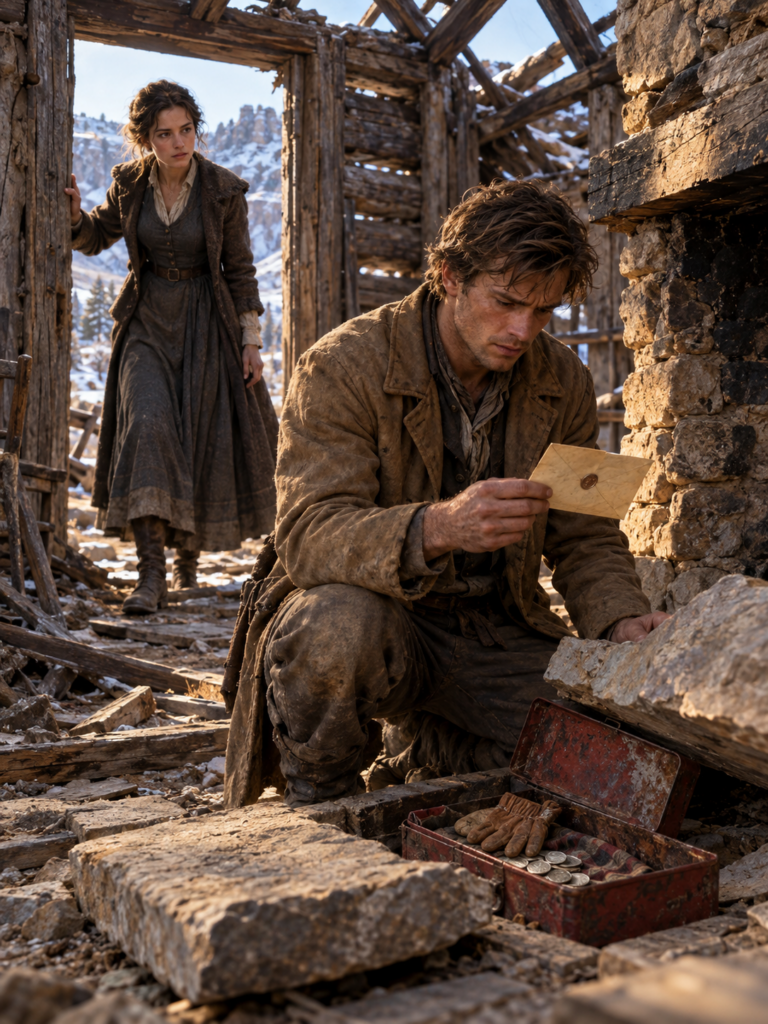
Then he returned to the hearth and opened the red tin.
Matty stayed where she was.
Walter counted the money while she watched from a distance.
One hundred eighty-seven dollars.
Enough to transform his start.
Enough to make suspicion easy.
He wrapped the coins again.
“You’re not going to town with that,” Matty said.
Walter looked up.
There it was again—that unexpected certainty.
“Why not?”
“Because by supper every porch in Pine Flat will know the boy they wouldn’t sell to found a fortune under his chimney.”
“One hundred eighty-seven dollars isn’t a fortune.”
“To a man who had forty-one yesterday, people will call it one.”
Walter knew she was right.
“What would you do?”
Matty considered the question seriously.
“Spend only what makes sense. Keep Ivy’s letter safe. And before you let anybody convince you that money is the important thing she left, find out why that survey marker is there.”
Walter glanced at the box.
The coins had dazzled him when he opened it.
Now they seemed almost secondary.
“What about the locket?”
Matty came closer.
Walter unfolded the blue cloth.
The broken chain lay across his palm.
Matty did not touch it.
Nor did she touch the child’s glove.
Her expression changed when she saw that.
“She wrote she had no children living,” Walter said.
Matty’s eyes remained on the glove.
“That doesn’t mean she never had one.”
The little object made the cabin quieter.
Walter thought of his mother dying when he was nine.
Of Rucker burying three children before Walter ever came to his farm.
Love, he had learned, did not become smaller merely because the person was gone.
Matty looked at him.
“You should keep those with the letter.”
“I was going to.”
“I know.”
The simple confidence unsettled him.
Outside, late light spread gold across the slope Ivy had called good ground.
Walter stepped into the yard.
Matty followed.
“You’ll come back?” he asked.
The question escaped before he could make it sound casual.
Matty looked toward Pine Flat six miles away.
“With the survey books.”
Walter nodded.
That was practical.
Safe.
Then she added, “And the sourdough. You really cannot live on potatoes.”
He almost smiled.
She did.
For one suspended second the ruined cabin felt less empty than it had that morning.
Then Matty’s attention shifted over his shoulder.
Her smile disappeared.
Walter turned.
At the crest of the wagon track stood a rider.
Mercer Ash from the feed store.
The same man who had told Walter for eleven days that nobody in Pine Flat was selling.
Mercer sat motionless in the saddle, staring not at Walter—
but at the open red tin beside the displaced hearthstone.
Matty spoke quietly.
“Close it.”
Walter crossed the room in three strides.
Before his hand reached the lid, Mercer dismounted and started toward the cabin.
Walter dropped the tin lid shut just as Mercer Ash stepped through the gap where the cabin door would someday hang.
Mercer’s gaze moved from Walter to Matty, then to the shifted hearthstone.
“Didn’t know you had company.”
Walter stood between him and the tin.
“Didn’t know I needed permission.”
Mercer gave a thin smile.
“No offense meant.”
Matty remained beside the hearth.
Walter noticed she had placed one boot casually over the edge of the blue cloth containing the locket and glove.
It was such a small movement Mercer never seemed to see it.
Walter did.
For the first time, he understood what Rucker had meant when he said some people helped by carrying a load and others helped by noticing which load needed carrying.
Mercer glanced around the ruined cabin.
“Looks better already.”
“I cleared it.”
“So I see.”
His eyes returned to the hearthstone.
“What was under there?”
Walter answered before Matty could.
“Dirt.”
Mercer’s smile sharpened.
“That red box grow in dirt?”
The silence after that was different.
Walter had spent years learning to work without pride interfering. But he had also spent his entire young life watching men with property assume they were owed answers from men without it.
This was his ground.
His cabin.
His hearth.
“You rode six miles to ask what I found under my own floor?”
Mercer shrugged.
“People talk.”
“Nobody knew there was anything to talk about.”
That landed.
Mercer’s gaze flickered toward Matty.
Walter saw the calculation.
Matty saw it too.
She spoke before Mercer could.
“I came to see whether Mr. Marsh needed books for the winter.”
Mercer looked at the clear July sky.
“Winter’s some distance off.”
“So is town.”
Her voice was mild.
Walter nearly smiled again.
Mercer pushed his hat back.
“I only wondered whether Prine mentioned the old Redfern stories.”
“What stories?” Walter asked.
Mercer hesitated.
That hesitation told Walter more than a quick answer would have.
“Nothing worth repeating.”
“You rode here to mention something not worth repeating?”
Matty folded her arms.
Mercer glanced at her with open annoyance now.
Then he said, “Folks used to say Ivy buried money.”
Walter kept his expression still.
“Folks who?”
“Old folks.”
“Names?”
Mercer’s mouth tightened.
“I don’t remember.”
“You remember well enough to ride out.”
The power of the conversation shifted.
Walter felt it.
Mercer felt it too.
“I’m trying to save you trouble, boy.”
Walter’s jaw hardened.
“Call me Walter.”
Mercer stared at him.
Then gave another shallow shrug.
“If you found something that belonged to the Redferns, there may be questions of ownership.”
Walter looked at the deed inside his shirt.
He had no idea whether that was true.
Mercer knew he did not.
And there was the threat—not violence, not yet even a claim. Simply doubt placed deliberately into the hands of a man who had fought too hard to own anything.
Matty spoke.
“If there were Redfern heirs, why did nobody mention them when Otis Prine inherited the parcel from his aunt?”
Mercer turned toward her.
“How would you know how he inherited it?”
“Everybody in town knows.”
Walter did not correct her.
Mercer’s gaze narrowed.
Matty had invented nothing important. She had only used Mercer’s assumption that a schoolteacher heard every family story in Pine Flat.
It worked.
He stepped back toward the doorway.
“Just be careful.”
“I have been,” Walter said.
Mercer mounted and rode away.
Neither Walter nor Matty moved until he disappeared beyond the rise.
Then Walter turned.
“You lied.”
“So did you.”
“I said there was dirt.”
“There was.”
He stared at her.
Matty’s mouth twitched.
Walter laughed before he could stop himself.
It came out rusty.
Surprising.
The sound startled them both.
Then his face sobered.
“He knew.”
“He suspected.”
“He came too fast.”
“Yes.”
Walter looked at the tin.
An hour earlier, one hundred eighty-seven dollars had seemed like salvation.
Now it felt like bait.
“I should take it to the bank.”
Matty shook her head.
“No.”
“You just told me not to carry it around.”
“And Mercer just told you he may challenge whether it belongs to you.”
“So?”
“So if you deposit every coin tomorrow, you announce what you found before you know what Ivy intended legally.”
Walter’s irritation returned.
“You telling me what to do?”
“No.”
Matty met his eyes.
“I’m telling you what I would do. You asked me that once today. You can stop asking any time.”
The rebuke was calm enough to hurt.
Walter looked away.
Rucker had never told him that owning land would require learning how not to defend himself against every hand extended toward him.
He took a breath.
“What would you do?”
Matty’s shoulders eased.
“Hide the box somewhere else. Keep the letter with you. Tomorrow I’ll find Father’s notebooks.”
“You shouldn’t be involved if Mercer starts talking.”
“That is my decision.”
Walter looked at her.
The words were not angry.
That made them harder to dismiss.
He nodded once.
“All right.”
Matty left before sunset.
Walter watched her walk the first quarter mile, then forced himself back to work.
He moved the tin from beneath the hearth to a dry cavity behind a loose stone in the chimney base, one he could reach only by removing two fitted rocks in sequence.
Then he slept with Ivy’s letter inside his shirt and Rucker’s knife beneath his hand.
At dawn he began rebuilding the north wall.
By noon, his shoulders burned.
By evening, two courses stood.
The next day he cut a dead cottonwood.
The day after that he repaired the ridgepole.
He worked because work kept questions from becoming fear.
On Saturday, he saw a figure crossing the flat.
Matty carried a jar wrapped in a towel and a leather-bound notebook pressed to her ribs.
Walter set down the axe.
“You found it.”
“I found six.”
She entered the cabin and placed the sourdough on his new shelf.
Then she opened the notebook.
Her father’s handwriting filled the pages with measurements, bearings, sketches, and remarks.
Matty turned several leaves.
“There.”
A crude map showed the north end of Pine Flat.
Walter recognized the creek.
The road.
The bowl.
And a small square marked REDFERN.
A dotted line ran from the spring up the slope.
Beside it, Matty’s father had written a short note.
“Read it.”
She did.
“Reliable flow even in late August. Redfern widow requests road line remain east of springhead.”
Walter frowned.
“Why?”
Matty turned the page.
The next sketch showed the proposed wagon road cutting directly across Walter’s property.
Then another line, corrected eastward.
“She stopped them from running the road through the spring.”
Walter looked out toward the wet flat.
“So she protected the water.”
“Yes.”
“That’s all?”
Matty’s fingertip remained on the page.
“No.”
Below the survey was another notation.
She read more slowly.
“Cabin occupied. Widow intends permanent improvement. Six terraces marked above dwelling.”
Walter stared toward the slope.
The terraces were gone beneath brush and erosion now.
But Ivy had begun them.
Long before she wrote the letter.
“She wasn’t guessing.”
“No.”
Matty looked at him.
“She had already proved the land could work.”
That was the first major answer.
The parcel had not been abandoned because it was worthless.
Its best features had simply been forgotten.
Walter felt something rise in him—not triumph, exactly.
Recognition.
Ivy had looked at difficult ground and refused the judgment of easier men.
The same thing he was trying to do.
He opened her letter again.
At the bottom, beneath the sentence he had read many times, was the date.
Matty compared it with her father’s book.
“She wrote this four months after the survey.”
Walter leaned over the table.
Their shoulders nearly touched.
Neither moved away.
Then Matty pointed to a faint notation he had overlooked.
A name.
J. Redfern.
Walter frowned.
“Ivy said John was dead.”
“He was.”
“Then why is his name here?”
Matty studied the page.
“It may be an older notation copied forward.”
“May be?”
“I won’t pretend certainty because you want certainty.”
Walter looked at her.
There it was again.
The thing he was beginning to understand he trusted most about her.
She would not make him comfortable by pretending to know what she did not.
He sat back.
“My father used to do that,” Matty said quietly.
“Pretend?”
“No. Refuse to.”
For the first time, her voice carried something softer.
“He lost work over it.”
Walter waited.
“My mother hated that. Said honesty was an expensive habit for a man with a family.”
“Was she wrong?”
Matty looked through the open doorway.
“No.”
The answer surprised him.
Then she added, “But I never wished he’d been cheaper.”
Walter understood more than he could say.
He reached toward the notebook at the same moment she did.
Their fingers touched.
Matty stilled.
So did Walter.
It was nothing.
Skin against skin.
Yet neither of them had reached carelessly.
Walter withdrew first.
Not because he wanted to.
Because wanting something did not make it his.
Matty watched him.
Something unspoken passed between them and remained there.
Then hoofbeats sounded outside.
This time Walter recognized the rider.
Purcell Hines.
The old farmer came down the rise on his swaybacked bay carrying a smoked ham wrapped in cheesecloth.
He stayed the night.
The next morning, after Walter showed him Ivy’s letter but not the coins, Purcell walked the flat and nodded toward the wettest hummocks.
“That’s a spring.”
Walter glanced at Matty.
She did not look triumphant.
That pleased him.
Purcell showed him how to open the seep with a bevel-cut spade so the walls would not collapse.
By sunset, clear water had gathered in a hole the size of a wagon bed.
Walter knelt and drank from his cupped hand.
Cold.
Clean.
Real.
Matty stood at the edge.
Nobody in Pine Flat could call the ground worthless now without lying.
But that evening, Purcell gave Walter the warning Mercer had not.
“Ivy left because her brother sent for her,” the old man said. “But people talked about that place for years.”
“About money?”
Purcell nodded.
“Never knew whether there was truth to it.”
“Who talked?”
Purcell looked toward town.
“Mercer’s father, for one.”
Walter went still.
Matty’s eyes met his.
Purcell continued.
“Old Ash helped settle some abandoned parcels after the Redferns were gone. Always claimed Ivy took everything worth taking.”
Walter thought of Mercer appearing the very afternoon he opened the hearth.
The coins were no longer the central mystery.
The question was how Mercer had known where to look.
Walter rose.
“I’m going to town.”
Matty stepped in front of him.
“To accuse him of what?”
“Knowing about the box.”
“You can’t prove that.”
“He knew enough.”
“And if you confront him without proof, he’ll know exactly what you don’t know.”
Walter’s anger flared.
“So I do nothing?”
“No.”
Matty held out her father’s survey book.
“You do what the men who refused you never expected you to do.”
“What’s that?”
“Wait until you have more than pride.”
Walter stared at her.
He hated the advice because Rucker Bell would have given him the same.
Then Matty pointed toward the map.
“Otis Prine inherited this parcel through his aunt. If Mercer’s father handled old land transfers, the courthouse ledger may show exactly how the Redfern property passed.”
Walter looked toward Pine Flat.
Then at Matty.
“You’re coming?”
She shook her head.
“No.”
He frowned.
“My school term begins Monday. I have work of my own.”
Walter felt the disappointment before he could hide it.
Matty saw that too.
She closed the notebook.
“I can care what happens here without abandoning what belongs to me.”
Walter nodded slowly.
The words lodged somewhere deep.
“All right.”
She started down the slope.
After ten steps she turned.
“And Walter?”
“Yes?”
“If you find something at the courthouse, don’t decide for me whether I should know it.”
He understood exactly what she meant.
Not just Mercer.
Not just the land.
Them.
Walter placed one hand over Ivy’s letter inside his shirt.
“I won’t.”
For the first time, Matty trusted his promise enough to turn her back and keep walking.
The next morning Walter rode into Pine Flat on a borrowed mule beside Purcell Hines.
At the courthouse he opened the oldest property ledger the clerk would give him.
He traced the Redfern parcel backward.
Otis Prine’s aunt.
A tax transfer.
Ivy Redfern.
John Redfern.
Then one line beneath John’s name stopped him cold.
A notation in faded ink showed an easement reserved across the parcel—not for a road, but for water access.
And beside the easement was the signature of Mercer Ash’s father.
Walter read the line twice.
Then a third time.
The clerk leaned over his shoulder.
“Something wrong?”
Walter pointed to the entry.
“What does that mean?”
The clerk adjusted his spectacles.
“Means somebody retained water access when the parcel transferred.”
“Who?”
“Doesn’t say here.”
“Then where?”
The clerk pointed toward a shelf of older instruments.
“If the paper survived, there.”
Walter spent the next two hours opening brittle folders.
Purcell waited on a bench without hurrying him.
Near noon Walter found it.
The easement was not a claim on Ivy’s spring.
It was nearly the opposite.
Years earlier, when John Redfern still lived, several neighboring stockmen had wanted guaranteed access to the creek crossing below the property during dry months. John had agreed to a narrow route along the boundary.
After his death, Ivy had petitioned to move that route because the proposed county road threatened the springhead.
Matty’s father’s survey had documented the change.
Mercer Ash’s father had witnessed it.
There was no hidden ownership.
No forgotten heir with a claim to Walter’s water.
No legal trap buried beneath the land.
But attached to the final instrument was a handwritten affidavit.
Walter recognized Ivy’s name immediately.
In it she declared that anything remaining inside the dwelling after her departure was intentionally abandoned to the next lawful owner of the parcel.
Walter sat down.
That sentence answered the question Mercer had planted.
The money was his.
The locket was his to preserve.
The child’s glove was his to protect.
Not because he had found them first.
Because Ivy had deliberately left them for whoever came after.
Purcell read over his shoulder.
“Well.”
Walter looked at him.
It was exactly the same word August Renner would later use when Walter repaid his loan.
But this time it sounded almost like laughter.
Walter folded a certified copy of the affidavit and paid the clerk from the few coins he still possessed.
Then he went to the feed store.
Mercer Ash stood behind the counter.
Walter placed the courthouse copy between them.
Mercer read it.
His face changed.
Not much.
Enough.
“My father told me there might’ve been money,” he said.
Walter waited.
Mercer looked toward the door as if hoping a customer might interrupt.
None did.
“He helped with the transfer after Ivy left. She told him she’d left something in the cabin.”
“You knew where?”
“No.”
“Did your father?”
Mercer hesitated.
“I think so.”
Walter felt heat rise under his collar.
“You told me nobody was selling.”
“That had nothing to do with this.”
“You knew Prine wanted rid of the Redfern place.”
Mercer said nothing.
Walter understood.
For eleven days, Mercer had watched him ask for land.
He had watched owners refuse.
He had known Otis Prine had a parcel he wanted to sell.
Yet Mercer had not offered it.
Maybe because he considered Walter too young.
Maybe because he considered the land too poor.
Maybe because some childhood story about Ivy’s hidden money had made the place interesting only when another man finally bought it.
Walter could not prove more than that.
And Matty’s voice returned to him.
Do not pretend certainty because you want certainty.
“What did you think was under there?” Walter asked.
Mercer rubbed a thumb along the counter.
“My father said Ivy was strange about that cabin. Wouldn’t let anybody move the hearthstone when they helped her pack.”
“That’s all?”
“That’s all.”
Walter believed he was hearing something close to the truth.
Not because Mercer had earned trust.
Because the answer was ordinary enough to be credible.
Walter picked up the affidavit.
Mercer spoke before he turned away.
“You going to tell people?”
Walter looked back.
“Tell them what?”
“That I knew.”
Walter considered him.
The old anger was present, but it no longer controlled the decision.
“I’m going to tell people what belongs to me when there’s reason to.”
Mercer’s shoulders eased too quickly.
Walter added, “And what belongs to somebody else when there’s reason to.”
Then he left.
He did not expose Mercer around town.
He did not threaten him.
He did not need to.
What mattered was that Mercer could no longer use uncertainty to make Walter smaller.
The land was Walter’s.
So was the truth.
That afternoon he spent almost all the money he had brought with him on tools: nails, a crosscut saw, an axe, shovel, mattock, wire, oakum, and seed potatoes.
He paid partly in Ivy’s silver dollars.
Mercer counted every one.
Neither man mentioned where they had come from.
Walter carried the load home in two trips because he still had no horse.
The walk gave him time to think.
Not about Mercer.
About Matty.
He had promised he would not decide for her what she ought to know.
On Sunday afternoon she arrived with a book under her arm.
By then Walter had repaired another section of wall.
He handed her the affidavit before she even set down the sourdough jar she had come to collect.
Matty read it standing beside the hearth.
When she finished, she looked up.
“So the box was meant for you.”
“For whoever owned the place next.”
“That happens to be you.”
“Yes.”
“And Mercer?”
Walter told her everything.
He did not make himself look wiser than he had been.
He admitted the anger.
Admitted he had nearly confronted Mercer without proof.
Admitted Purcell’s warning had made him want to ride into town immediately.
Matty listened.
“What stopped you?”
“You.”
Her gaze lifted.
Walter shook his head.
“Not because you told me what to do.”
“Good.”
“Because you reminded me not knowing something isn’t the same as knowing the worst.”
Matty closed the affidavit.
“My father would’ve liked that sentence.”
“Did he say it?”
“No.”
“Then don’t give it to him.”
That earned him her full smile.
It transformed her face.
Walter found himself staring.
Matty noticed.
For once, neither looked away immediately.
The attraction between them had been building in such small pieces Walter had not known what to call it: her walking six miles with sourdough, the pressure of her fingers against his over the survey book, the way she stood beside evidence without reaching for what was not hers, the certainty in her voice when she insisted her work mattered too.
Now he knew.
Wanting her frightened him because every person he had loved had disappeared by death, distance, or drink.
His mother.
Rucker.
His brother Thomas.
Even his father, long before the man was actually dead.
Walter had learned to survive by needing little.
Land was safer than people.
Land did not leave.
Matty placed the affidavit on the table.
“You’re doing it again.”
“What?”
“Going somewhere by yourself.”
“I’m standing right here.”
“No. You’re six miles away in your head.”
Walter looked toward the open doorway.
“I don’t know how to do this.”
“The cabin?”
“No.”
The word remained between them.
Matty’s expression softened, but she did not rescue him from saying more.
Walter appreciated that almost painfully.
“I spent nine years working beside Rucker,” he said. “He could go a whole day without ten sentences. That suited me. I knew what he meant anyway.”
“And people who aren’t Rucker?”
“I keep expecting them to take something.”
Matty glanced at the hidden hearth cavity.
“You thought I would.”
“The first day.”
“I know.”
“I was wrong.”
“Yes.”
Walter almost laughed.
“No mercy?”
“Not where accuracy will do.”
He looked at her.
“That’s expensive.”
“So I’ve heard.”
This time they both smiled.
Walter stepped closer, then stopped before the distance between them vanished.
Matty watched the restraint.
He wanted to touch her.
He wanted even more not to assume permission.
“May I?”
Her eyes held his.
Then she reached first.
Not for a kiss.
For his hand.
Walter looked down at their joined fingers.
It was a quieter thing than desire and more dangerous.
Because he could imagine keeping it.
Matty squeezed once.
“You may.”
He kissed her carefully.
No promise followed.
No declaration.
When they parted, Matty picked up her book.
“I still have school tomorrow.”
Walter nodded.
“And I still have a roof missing.”
“So we both have work.”
“Yes.”
That became the shape of what came next.
Not Matty abandoning her school for Walter’s farm.
Not Walter imagining that one kiss made her part of his property.
She taught.
He built.
On Saturdays she sometimes walked out.
On Sundays, when weather allowed, he walked her home.
They learned each other in labor rather than speeches.
Walter rebuilt the cabin with sound logs salvaged from the collapse. He repaired the ridgepole, laid cedar shakes over the rafters, hung a door on leather hinges, and preserved the stone chimney exactly where Ivy had built it.
Purcell Hines helped open the spring until it became a pond clear to the bottom.
Ada Merrow brought bees.
Nils Burger traded a plowshare for help with fence.
Job Halverson delivered shingles he called firewood.
And Pine Flat, which had refused Walter politely for nearly two weeks, began helping him just as quietly.
Walter accepted carefully.
At first, too carefully.
When Nils offered the broken-boiler stove, Walter tried to pay.
Nils became offended.
Matty heard about it and laughed until she had to sit down.
“What was I supposed to do?”
“Say thank you.”
“I did.”
“After arguing for twenty minutes.”
“I didn’t want to owe him.”
Matty looked at him across the new plank table.
“Walter, there is a difference between owing somebody your freedom and accepting that people care whether you freeze.”
He said nothing.
That distinction took him longer to learn than rebuilding the wall.
By spring the slope behind the cabin showed six terraces.
Walter built them where Ivy’s letter said afternoon sun would hold longest.
Matty helped him mark the first line with stakes but refused to let him claim she had built the terraces.
“You swung the mattock,” she said.
“You found your father’s survey.”
“That told us where the old ones were.”
“Exactly.”
She gave him the look that meant he was trying to win a debate by stubbornness.
He was beginning to enjoy that look.
Beans climbed poles on the upper benches.
Squash spread broad leaves over the lower.
Potatoes grew near the pond.
The ground Pine Flat had called unusable began producing food precisely because Walter stopped demanding that it behave like easier land.
That lesson reached farther than farming.
The first time Walter asked Matty whether she intended to keep teaching after marriage, he heard the assumption buried in the question before she answered.
Her eyes cooled.
“Whose marriage?”
Walter nearly swallowed his tongue.
“I didn’t mean—”
“I know exactly what you meant.”
He could have defended himself.
Instead he did something the younger Walter would not have known how to do.
He considered why she was angry.
Then he said, “I asked the wrong question.”
Matty waited.
“If you ever married,” he tried again, “would you want to keep teaching?”
“Yes.”
Walter nodded.
“Then anybody asking you otherwise would be a fool.”
“Anybody?”
He met her gaze.
“Especially me.”
Her expression changed.
No grand reconciliation.
Just recognition that he had listened.
Months later, when the schoolhouse stove cracked during the second winter, Walter loaded his own stove onto Nils Burger’s stone boat and hauled it into town.
Matty discovered it only when he appeared in her classroom carrying one end with Nils.
“You’ll freeze.”
“I have the chimney.”
“You have a stone chimney and two quilts.”
“Three.”
“You own two.”
“Purcell brought one.”
The children were listening openly.
Matty lowered her voice.
“You did not have to do this.”
Walter set the stove down.
“I know.”
That answer mattered.
He was not buying affection.
He was not creating debt.
He was giving warmth because he could.
When the children returned, Matty wrote Walter’s name on the blackboard and told them whose stove was keeping the room warm.
He stood awkwardly beside the door while the older children read it aloud.
He would have preferred facing a winter storm.
Matty knew.
She enjoyed every second.
By the second summer Walter owned eight hogs, twenty laying hens, and a red roan mare he bought from Ford Whitaker.
Ford came to the fence himself.
“I misjudged this ground,” he said.
Walter waited.
Ford shifted.
“And you.”
Walter could have reminded him about the porch rail.
The nephew from Illinois.
The careful refusal disguised as concern.
Instead Walter asked, “How much for the mare?”
“Eighteen.”
Walter paid eighteen.
That surprised Ford more than anger would have.
Pine Flat started calling the place the Redfern again.
Walter liked that.
The name belonged to someone who had understood the land before him.
He never renamed it Marsh Farm.
Ownership, he had learned, did not require erasing who came before.
The red tin remained hidden but no longer secret from Matty.
Walter spent some of Ivy’s money on tools and stock, but not recklessly.
The child’s glove stayed wrapped beside the locket.
He never discovered whether it had belonged to a child Ivy had buried or one she had prepared for and never held.
Her letter did not say.
Walter refused to invent an answer.
Some grief deserved the dignity of remaining exactly as its owner had left it.
In the third winter, snow covered the terraces in long white shelves.
Walter sat at his plank table eating beans and bread made from Matty’s sourdough starter.
The stove ticked.
Wind moved along the ridge.
On the shelf above the bunk sat Ivy’s tin cup, horn spoon, and blue bottle.
Beside them stood his mother’s Bible.
The empty tobacco tin.
And Rucker’s Barlow knife.
Walter took the tobacco tin down.
Inside was the single coin he had kept from his earliest wages.
He set it on the table.
Then he placed Ivy’s child’s glove beside it.
Rucker’s knife followed.
Three objects.
Three kinds of inheritance.
Money earned.
Love given.
Grief preserved.
A knock sounded at the door.
Walter smiled before he opened it.
Matty stood outside with snow on her shoulders and a book tucked beneath her coat.
“You walked in this?”
“The road is clear.”
“You could’ve sent word.”
“I could’ve.”
He stepped aside.
She entered because she chose to.
That distinction had become sacred to him.
Matty removed her gloves and warmed her hands near the stove.
Then she noticed the objects on the table.
Walter told her what he had been thinking.
About Ivy.
Rucker.
His mother.
About all the people who had left something behind.
Matty sat opposite him.
“And what are you leaving?”
Walter looked around the cabin.
At the roof tight enough to hold a candle flame steady.
At the floor he had laid.
At the window beside which Matty read while he repaired harness.
“At first I thought the answer was land.”
“And now?”
He considered.
“A place where nobody has to prove they deserve to stand in the doorway.”
Matty’s eyes grew bright.
Not tears exactly.
Something near them.
Walter reached across the table.
Stopped.
Waited.
Matty placed her hand in his.
“I’ve been thinking about the spring,” she said.
Walter smiled.
“That sounds dangerous.”
“The school needs a summer garden.”
He listened.
“If the older students came out once a week, they could learn measuring from the terraces. Soil work. Water flow. Bookkeeping.”
Walter’s first thought was practical.
Children trampling seedlings.
Tools left in rain.
Time lost from work.
Then he looked at Ivy’s glove.
At Rucker’s knife.
At Matty’s hand.
Rucker had taught a boy who was not his son.
Ivy had left savings for an owner she would never meet.
The Redfern had survived because people had given knowledge forward.
“How many students?”
Matty smiled slowly.
“Is that a yes?”
“It’s a question.”
“Fifteen.”
Walter groaned.
“Maybe twelve.”
“You just lost three children because you groaned?”
“They’ll come back if they know how to use a hoe.”
“You are impossible.”
“So I’ve heard.”
She squeezed his hand.
Walter looked at her.
There had been a time when he believed a deed was the thing that would finally make him safe.
He had been partly right.
Ownership mattered.
The land beneath his boots was his.
No landlord could take his father’s debt from it.
No nephew could arrive from Missouri and sell it out from under him.
But safety had become something larger than possession.
It was Matty keeping her profession because it belonged to her.
It was Walter learning not to make choices for her in the name of protecting what he loved.
It was her telling him the truth even when comfort would have been cheaper.
It was him opening his hand without expecting what entered it to remain by force.
“Matty.”
She looked up.
“I don’t want you to give up the school.”
“I know.”
“I don’t want you to live here because you think I need somebody to make bread.”
“I definitely don’t think that.”
“I can make bread.”
“You can make an object containing flour.”
Walter narrowed his eyes.
She laughed.
He waited until she quieted.
“I want a life with you,” he said.
No speech about forever.
No claim.
Just the plainest truth he possessed.
Matty studied him for a long moment.
Then she looked around the cabin that had once been open to the sky.
“If I say yes, I keep teaching.”
“Yes.”
“And decisions about this place that affect me become ours.”
“Yes.”
“And when you are afraid, you tell me. You do not turn fear into orders.”
Walter felt the truth of that land exactly where it needed to.
“Yes.”
“And I get one terrace for the school garden.”
He frowned.
“One?”
“Two.”
“That moved the wrong direction.”
“Three.”
Walter laughed.
Then Matty did.
And when he kissed her, neither of them mistook it for the agreement itself.
The agreement had already been made in choices.
The following spring, twelve schoolchildren came out to the Redfern with measuring cords, notebooks, and more enthusiasm than skill.
Walter taught them to set stakes.
Matty taught them to calculate grade.
Purcell Hines sat beneath a cottonwood pretending not to supervise.
Nils Burger arrived with two hoes nobody had asked for.
Ada Merrow brought honey.
Ford Whitaker brought the red roan’s first foal to show the children.
Mercer Ash came once with a sack of nails.
Walter looked at him for a long second.
Then accepted them.
Not forgiveness exactly.
Not friendship.
But a refusal to spend the rest of his life guarding a wound.
Years later, the original survey marker still stood beside the cedar.
Walter never moved it.
The hearthstone remained too.
He reset it in front of Ivy’s chimney, but he did not hide the red tin beneath it again.
Instead, he and Matty kept Ivy’s letter, the locket, and the child’s glove in a small wooden box on the shelf beside Hannah Marsh’s Bible and Rucker Bell’s knife.
When children asked about them, Walter told the truth.
A widow had loved difficult ground.
An old man had loved a boy who was not his blood.
A mother had saved coins inside a Bible.
A schoolteacher had looked at a survey marker and refused to pretend she knew more than she did.
And a young man with forty-one dollars had once mistaken ownership for the end of being alone.
It had only been the beginning of learning how to belong without possessing.
On certain winter nights, after Matty finished grading lessons and Walter finished the farm ledger, they sat beside the stove listening to the wind move over the ridge.
The roof held.
The pond stayed clear.
The terraces rested beneath snow.
Sometimes Walter took Rucker’s knife from the shelf and opened it.
Click.
The old familiar sound.
For years it had been the closest thing he possessed to the voice of a man who had believed in him.
Now Matty would glance up from her papers.
“You thinking?”
“Trying not to.”
“Any luck?”
“None.”
She would smile and return to her work.
And Walter would close the blade.
Click.
Then he would look around the room.
At Ivy Redfern’s chimney.
At his mother’s Bible.
At Matty’s books.
At the life that had grown from a parcel everybody else had judged too wet, too steep, too inconvenient, too poor to bother with.
Walter Marsh had been twenty-three when Pine Flat’s landowners told him to wait until he had a wife, a father, a co-signer, or a more respectable name behind him.
He had none of those things.
He had forty-one dollars.
A bone-handled knife.
A dead man’s lessons.
And enough stubbornness to walk six miles toward ground nobody wanted.
The parcel did not make him rich.
What it gave him was harder to price.
Water hidden beneath mud.
Good soil hidden beneath slope.
A dead woman’s faith in a stranger.
Neighbors who learned to see him differently.
A woman who loved him without surrendering herself to do it.
And the knowledge that the people who refuse to value something are not always the people qualified to measure its worth.
One evening, long after the first school garden had been harvested, Walter stood at the edge of the pond while Matty came down from the terraces.
She slipped her hand into his.
Across the water, the rebuilt cabin glowed gold against the darkening ridge.
Walter thought of the first night he had slept on the bare hearthstone under an open sky, the Barlow knife resting on his chest because it was the nearest thing he had to company.
He thought of Ivy’s final hope.
I hope you are young.
I hope you have time.
He had been young.
And somehow, against everything he had believed then, time had not merely given him more things to own.
It had taught him what could only be shared.
Matty rested her shoulder lightly against his.
Walter did not hold tighter.
He simply held on as long as she held back.
Behind them, beneath the roof he had raised with his own hands, Rucker’s knife rested beside Ivy’s letter.
The hearthstone lay where it had always belonged.
And the ground nobody wanted was no longer waiting for someone to discover its worth.
It was home.

