
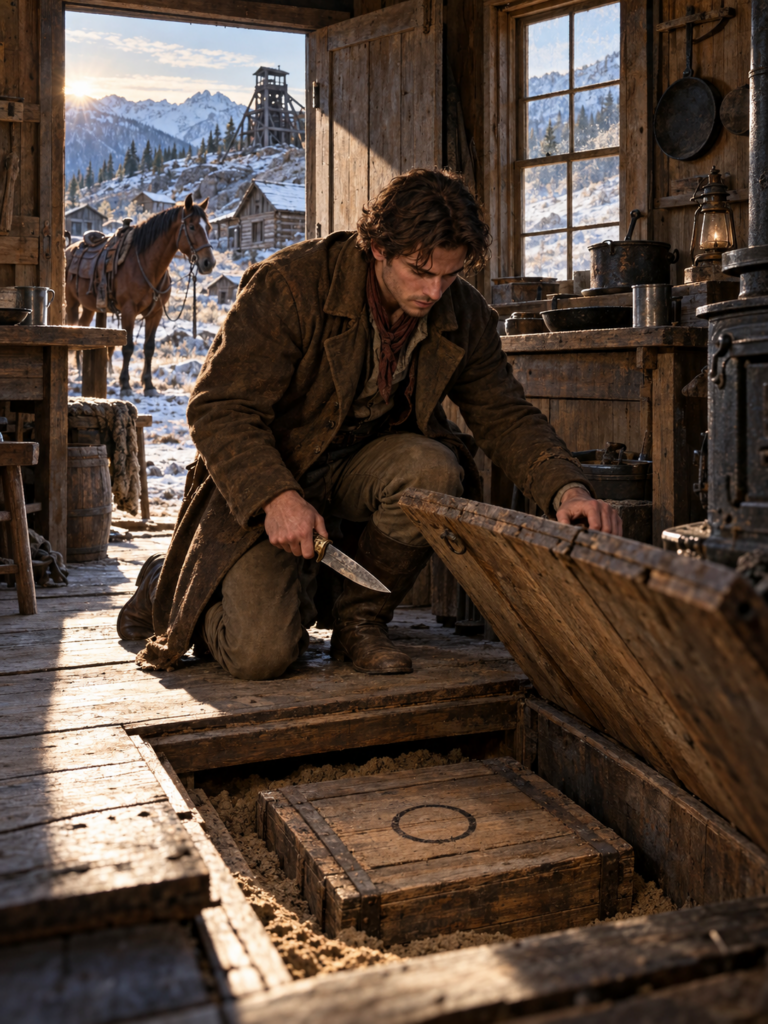
Thomas tightened both arms around the crate and ran for the cookhouse as the first snow struck sideways across the bowl.
Within an hour the ridge vanished.
By full dark, Hollow Creek had disappeared behind white driven almost horizontal by the wind.
Thomas abandoned his small sleeping cabin and moved everything essential into the cookhouse.
Food.
Blanket.
Lantern.
The crate.
He brought Old Roe into the sheltered lean-to along the outer wall, where the horse could stand out of the worst of the storm.
Then Thomas built the old range hotter than he had dared before.
The stovepipe began to draw.
Warmth spread slowly through the long room.
He placed the hidden crate beneath the counter where it had waited for ninety winters.
There was something right about returning it there.
The wind worsened.
One loose roof shingle ripped free sometime after midnight.
Thomas heard it vanish.
He sat near the stove with his father’s knife on the table and a tin cup warming between his hands.
Then he heard another sound.
He lifted his head.
Nothing.
Wind hammered the wall.
Thomas waited.
There.
Not timber.
Not an animal.
A human voice.
Weak.
Somewhere outside toward the trace.
Thomas stood.
Opening that door blindly would be foolish.
Walking into mountain snow without a return line would be worse.
He took the rope from Old Roe’s stall.
One end he tied hard around the cookhouse doorpost.
The other he looped around his own waist before taking up the lantern.
He opened the door.
Snow hit his face hard enough to make him turn away.
Thomas lowered the light and followed the rope outward.
Ten paces.
Twenty.
Thirty.
At forty he saw movement.
A man was on his knees.
One arm held a small boy against him.
The child hung slack.
The man raised his head.
His beard was white with ice.
His eyes had the empty terror of someone who had already imagined his son dying.
Thomas reached them.
“Can you stand?”
The man tried.
Failed.
Thomas put the lantern down.
He lifted the boy first.
The child weighed frighteningly little.
Then Thomas got the man upright and closed his numb fingers around the rope.
“Don’t let go.”
The stranger nodded.
“Hand over hand.”
Thomas took the boy against his chest and started back.
The rope became the only road in the world.
Behind him, the man moved one step at a time.
Inside the cookhouse, Thomas stripped the boy’s wet outer coat away and wrapped him in his wool blanket.
That was not enough.
His eyes went to the crate.
The oiled canvas around the ledger had kept ninety winters of damp away.
Thomas pulled it free.
He wrapped that around the boy too.
The trust’s first use under his care would not be protecting old paper.
It would be protecting a living child.
Thomas put the father near the stove.
Removed his wet boots.
Placed warm water in his hands.
Worked the boy’s blue fingers gently until color began to return.
For a long time, nothing happened.
Then the boy moved.
His eyelids opened.
“Papa.”
The father bowed his head.
Thomas looked away.
Some time later the man began shaking violently.
Thomas knew enough to recognize that as improvement.
He fed the stove.
When the stranger finally spoke, his voice was barely there.
“We were crossing from the south slope.”
Thomas nodded.
“Sheep.”
The man looked toward the sleeping boy.
“Storm caught us early.”
“You’re here.”
The stranger looked around.
Cabins outside.
Range.
Tables.
The old beams.
“What is this place?”
Thomas thought about the ledger beneath the counter.
Four dead men’s wages.
Twenty-two miners voting to leave shelter behind for someone they could never know.
He looked at the sleeping child wrapped partly in that ninety-year-old canvas.
“A camp,” Thomas said.
Then he added the part that mattered.
“It was left standing on purpose.”
The man closed his eyes.
Thomas sat beside the boy.
Outside, the mountain spent the rest of the night trying to erase Hollow Creek again.
Inside, the stove burned.
The child breathed.
And Thomas understood that the dead miners’ first request might not be the most important thing they had left him.
They had preserved a place where strangers could live.
By morning, Thomas knew he would not treat Hollow Creek as property alone.
Whatever happened with the deed, the wages, or the mountain, he would keep that part of their intention intact.
By morning the wind had weakened enough for Thomas to see the nearest cabins again.
Snow covered the bowl in clean white slopes.
Smoke rose straight from the cookhouse pipe.
The boy woke hungry.
That pleased Thomas more than any discovery he had made in the camp.
He found an old pot whose bottom remained sound and cooked oats.
The father ate slowly.
The boy did not.
His name was Wren.
His father was Halloran.
They had been moving forty ewes across the southern slope when the storm overtook them.
The flock scattered somewhere below the saddle.
Halloran told Thomas this with surprising calm.
He had already measured what almost happened to his son against everything else.
Sheep had become a smaller loss.
“We would have died,” Halloran said.
Thomas handed Wren another spoonful.
“You didn’t.”
Halloran looked at him for a long time.
On the ninth morning, the trace was safe enough for one man to descend.
Wren was still weak.
Halloran insisted on going alone.
“My wife will think us dead.”
Thomas offered him one of the old coins.
Halloran stared at it.
“What’s that?”
“Money.”
“I know money.”
Thomas almost smiled.
“For the road.”
Halloran pushed his hand away.
“You already gave us the road.”
He accepted bread instead.
And part of Thomas’s rope.
He left Wren behind with Thomas and started toward Cinder Pass.
The boy remained another week.
He followed Thomas everywhere.
Stable.
Cabins.
Cookhouse.
Slope below the shaft house.
He asked what each tool was for.
Why doors sagged.
Why nails rusted.
Why Old Roe had one white hair growing from the middle of his forehead.
On the fourth day he found the hollow-circle mark cut beneath a bench.
“What’s this?”
Thomas looked at it.
“The mark of the men who lived here.”
“Are they dead?”
“Yes.”
“All of them?”
Thomas considered.
“Probably.”
Wren traced the symbol with one finger.
“Then why leave their mark?”
Thomas looked around the camp.
“So somebody would know they were here.”
That answer stayed with him.
Because it was exactly what the ledger had done.
When the wagon finally climbed into the bowl, Wren saw it first.
He ran.
Halloran drove.
A woman in a gray shawl sat beside him.
She jumped down before the brake was properly set.
Wren reached her at the same moment.
She folded around him.
Thomas turned away and began unloading supplies to give them privacy.
There was flour.
Salt.
Pork.
Canvas.
Nails.
Another stove.
Thomas frowned.
Halloran came beside him.
“What is all this?”
“Cinder Pass.”
Thomas looked at him.
“Town heard what happened.”
Two riders had accompanied the wagon.
One was the butcher who had called Hollow Creek a graveyard.
The other was the boy Thomas remembered standing in the road with a hoop.
Neither laughed now.
The butcher inspected the repaired cabin hinge.
The swept cookhouse boards.
Old Roe eating peacefully beneath the lean-to.
Eventually he faced Thomas.
“I said something when you passed my doorway.”
Thomas remembered.
“You bought yourself a graveyard.”
The butcher stared at the ground.
“I was wrong.”
Thomas shrugged.
“It’s forgotten.”
The man shook his head.
“No.”
Thomas waited.
“It isn’t. But thank you for offering.”
That impressed Thomas more than an apology without memory would have.
Halloran and his family left before dark.
The butcher and the boy rode with them.
For the first time since Thomas climbed into the bowl, Hollow Creek felt connected to something below.
Two weeks later another rider appeared.
Ridge Palmer.
He came alone.
No polished confidence.
No gold ring.
He dismounted and stood staring.
“You’re still here.”
Thomas was mending the stable roof.
“Yes.”
Palmer walked toward the cookhouse.
He looked around the camp as though seeing evidence against his own certainty.
“I sold you a graveyard for two dollars.”
“That’s what you said.”
“That’s what I believed.”
Thomas climbed down.
Palmer removed his hat.
“I’ve been in that land office forty years.”
Thomas waited.
“I never came up here once.”
That was the confession.
Not fraud.
Ignorance hardened into confidence.
Thomas understood it.
People in Cinder Pass had inherited a story about Hollow Creek.
Nobody had checked whether the story matched the place.
Palmer looked toward the shaft house.
“What did you find?”
Thomas studied him.
That question mattered.
He could show the crate.
The ledger.
The coins.
But he still did not know how much authority the old trust carried.
And the money belonged neither to him nor Palmer.
“Enough to know the place was closed deliberately.”
Palmer did not push.
Instead he surprised Thomas.
“When the thaw comes, come to the office.”
“Why?”
“We’ll make the transfer clean.”
“It’s already signed.”
“I know.”
Palmer put his hat back on.
“But I want the county record clear enough that some clerk after me can’t decide a two-dollar deed is easier to undo than explain.”
Thomas nodded.
“I’ll come.”
Palmer left without seeing the crate.
That mattered too.
Winter settled fully.
Thomas learned the camp.
Which roofs leaked.
Which chimney drew best.
Which cabin caught the morning sun.
Which part of the creek froze first.
He did not attempt the shaft.
The ledger had already told him the vein was exhausted.
He had no interest in proving dead miners wrong simply because later men wanted gold.
Instead he repaired.
Preserved.
Waited.
During the first week of thaw, a woman arrived from the county seat.
Miss Ide.
Gray at the temples.
Spectacles on a black cord.
A leather satchel full of documents.
She took one look at the camp and asked to see the original ledger.
Thomas brought it.
Then the sealed tin paper.
Then the wage sack.
Miss Ide read every page.
Slowly.
No praise.
No speculation.
When she finished, she weighed the coins on a small brass scale.
Then she looked at Thomas.
“You interpreted this correctly.”
“The trust?”
“Yes.”
“Is it legal?”
She considered.
“Legal is a broad word after ninety years.”
Thomas sat across from her.
“What does that mean?”
“It means the company ceased to exist. The county eventually took title for unpaid taxes. The dead men named here left no recorded estates that I can find from the documents I brought.”
Thomas looked at the money.
“So nobody owns it?”
Miss Ide corrected him immediately.
“That is not what the ledger says.”
Thomas met her eyes.
She touched the final page.
“It says the wages were owed.”
He nodded.
“A debt can survive the organization that incurred it.”
“For ninety years?”
“Perhaps not enforceably.”
She paused.
“But morally?”
Thomas understood.
Miss Ide copied four names.
Then the towns each man had come from.
Two towns still existed.
Two had disappeared.
“For the existing towns, we can search church books, census rolls, old probate records.”
“And if we find family?”
“You deliver what can reasonably be identified as theirs.”
Thomas looked at the other two names.
“And these?”
“A stone.”
He frowned.
Miss Ide folded her spectacles.
“A properly marked grave or memorial. Something that puts the name back into the world.”
She rested a hand on the ledger.
“A man cannot spend wages after ninety years.”
“No.”
“But a forgotten man can still be named.”
That line stayed with Thomas.
Miss Ide wrote everything he needed.
When she finished, Thomas thanked her.
She replied, “Thank you, Mr. Brooks.”
He looked down.
He was not accustomed to adults saying his name that way.
Not boy.
Not fool.
Not owner of a two-dollar graveyard.
Mr. Brooks.
By late spring people began climbing to Hollow Creek for reasons other than curiosity.
A carpenter arrived with his son.
They rehung doors.
A woman brought vegetable seed and showed Thomas where the cookhouse wall held enough sun for a garden.
Halloran came back with tools.
The butcher sent preserved meat.
Nobody tried to take over.
That mattered to Thomas.
The camp remained his responsibility.
Help did not erase that.
One afternoon Thomas went down to Cinder Pass and found the elder in the black coat sitting near the same last board of the plank walk.
Thomas stopped before him.
“I found what was left.”
The old man raised his eyes.
Thomas told him.
The ledger.
The vote to close the mine.
The wages.
The trust.
The mark.
The sentence at the bottom.
The elder listened with his eyes closed.
When Thomas finished, the man opened them.
“Then it was not left in vain.”
He tapped his stick once.
Thomas wanted to ask how he knew.
Who had told him.
Whether his father had known the same story.
But the old man had already turned.
Thomas let him go.
Some knowledge arrived without complete explanation.
The important part was what it asked of you afterward.
By midsummer, two families had been found.
The search was imperfect.
Names changed.
Records disappeared.
But there was enough to connect descendants to two of the dead miners.
Thomas used the old wages as Miss Ide advised.
For the remaining two men, there was nobody identifiable left to receive anything.
So Thomas commissioned stones.
One would go in a churchyard below.
The other he decided to place at Hollow Creek.
Then the carpenter’s son came to him carrying a rubbing of an old inscription.
“Mr. Brooks?”
Thomas looked up.
“I found something under the stable sill.”
He unfolded the paper.
A name.
One of the four dead miners.
Thomas stared at it.
The same name as the man whose kin nobody could trace.
Beneath it was the hollow-circle mark.
And below that, one short cut line.
Thomas went to the stable.
Together they lifted a warped section of flooring.
Below it was not another treasure.
Not another ledger.
A tool roll.
Pick.
Hammer.
Wedges.
All marked with the same name.
Thomas sat back on his heels.
The man had not simply worked here.
His tools had remained exactly where he left them.
The camp itself had become the only place still carrying his life.
Thomas changed his plan.
That man’s memorial would not go in an unrelated churchyard.
It would stand here.
Where he had worked.
Where his name had survived.
That choice meant Thomas would have to decide something larger.
Was Hollow Creek simply a property he owned?
Or had ownership itself become the wrong word?
By the end of summer, he knew the answer.
He returned to Palmer’s office carrying the deed.
Palmer looked uneasy.
“You giving it back?”
“No.”
Thomas laid it on the desk.
“I want the record changed.”
Palmer frowned.
“To what?”
Thomas looked through the window toward the road leading up the mountain.
“So no man after me can sell everything separately.”
Palmer sat very still.
“The camp stays whole.”
“As what?”
Thomas thought of the storm.
Wren sleeping beside the stove.
The hidden wages.
The repaired cabins.
“A working refuge.”
Palmer stared at him.
“You know what land is worth if somebody finds mineral up there again?”
“Yes.”
“And you still want restrictions?”
“Yes.”
Palmer leaned back.
Months earlier he might have laughed.
This time he pulled the county ledger toward him.
“Then we’ll need Miss Ide.”
Thomas sat down.
“I figured we would.”
Miss Ide returned in August.
The three of them worked around Palmer’s scarred desk for most of a day.
Thomas refused to surrender ownership entirely.
Hollow Creek was where he intended to live.
That mattered.
Stewardship, he had learned, did not require erasing himself.
It required accepting that possession had limits.
The revised record stated that the camp structures, cookhouse, stable, and marked memorial ground were to remain together while Thomas held the property.
Future transfer would carry the same restriction unless a court determined the structures unsafe.
The cookhouse could continue functioning as emergency shelter.
Thomas retained the right to farm the bowl, repair buildings, use timber responsibly, keep livestock, and live there.
He also retained the right to refuse anyone attempting to reopen the old shaft without proper assessment.
Palmer raised an eyebrow when Thomas insisted on that clause.
“You don’t trust miners?”
Thomas looked at him.
“I trust the ledger.”
The mine had closed because the vein failed.
He saw no reason to let wishful men destroy the place trying to prove history inconvenient.
Palmer nodded.
“Fair.”
They signed.
Thomas paid filing fees that cost many times the deed itself.
He did not resent it.
The two-dollar purchase had been an accident of neglect.
Keeping Hollow Creek required intention.
Before the end of summer, Thomas completed the final obligation from the crate.
Two of the four miners received memorial stones in the towns tied to their families.
One man’s name was cut into a churchyard marker where distant kin still lived.
Another portion of the old wages went to descendants after Miss Ide traced the line through a daughter whose married name had nearly erased the connection.
The remaining two had no recoverable family.
One memorial was placed in the low country named in the ledger.
The last stayed at Hollow Creek.
Thomas chose a patch of thick grass near the edge of the bowl where the wind moved steadily off the ridge.
The carpenter’s son cut the name.
Thomas supplied the dates.
Beneath them, after long thought, he added only the hollow circle crossed by a line.
Nothing more.
No claim of heroism.
No invented story.
Just identity.
Work.
Place.
On the evening they set that stone, Thomas stood alone beside it.
Old Roe grazed nearby.
The shaft house cast a long shadow.
Thomas thought of his own father.
Three months after the burial, grief had changed.
At first it had been mostly absence.
A chair.
A coat.
A voice he kept expecting.
Then anger.
Why had his father left debt?
Why had he spoken of Hollow Creek while feverish instead of telling Thomas something useful?
Now Thomas wondered whether he had misunderstood that too.
His father had not given him instructions.
Only a direction.
Perhaps he had once heard enough about Hollow Creek to know the camp deserved another witness.
Perhaps not.
Thomas could not prove it.
So he stopped trying to build certainty from fragments.
That was one lesson Cinder Pass had taught him.
A story repeated for ninety years could still be wrong.
That evening he walked to the ridge above the bowl.
Summer had softened the camp.
Grass stood green where winter snow had lain.
The cookhouse garden had begun going to seed.
Cabin doors hung square.
Smoke rose thinly from one chimney.
The old shaft house remained untouched.
Thomas sat on a sun-warmed stone.
From there he could see nearly everything the miners had left.
And everything that had happened since.
He remembered arriving on foot beside Old Roe with forty-one dollars.
Ridge Palmer laughing at the deed.
Men on porches predicting Thomas would run back down by Sunday.
The boy with the hoop saying nobody came back from Hollow Creek.
The old man warning that what remained had been left intentionally.
Thomas had thought then that finding something valuable might justify the two dollars.
Gold.
Tools.
Ore.
Land.
He smiled faintly now at how small that idea seemed.
The camp’s value had never been hidden underground.
It was in the fact that twenty-two men facing failure had chosen not to destroy what they could no longer use.
They had swept rooms.
Turned cups upside down.
Closed stoves.
Barred stores.
Preserved wages belonging to dead companions.
They left buildings standing for strangers.
They could not know about Halloran.
Could not know Wren.
Could not know a broke twenty-year-old named Thomas Brooks would arrive ninety winters later after burying his father and losing his home.
They simply acted as though whoever came later mattered.
Thomas had never possessed enough property to think much about inheritance.
Now he understood it differently.
Inheritance was not always what someone handed directly to you.
Sometimes it was responsibility waiting for whoever happened to arrive next.
The first snow came early that autumn.
Not a killing storm.
Just enough to whiten the rooflines.
Thomas was replacing a latch when he heard hooves.
Halloran appeared first.
Behind him rode Wren.
The boy jumped down before the horse fully stopped.
“Mr. Brooks!”
Thomas looked toward Halloran.
“You letting him do that now?”
“I lost the argument.”
Wren held something behind his back.
Then brought it forward.
A small wooden sign.
The hollow-circle mark was carved into it.
Thomas stared.
“What’s that for?”
“The cookhouse.”
“No.”
Wren’s face fell.
Thomas crouched.
“Not outside.”
The boy blinked.
“Why?”
“Because somebody passing through doesn’t need a mystery.”
Thomas took the board.
“If people need shelter, the sign should say shelter.”
Wren considered this.
Then nodded.
Thomas handed the carving back.
“But put that one inside.”
Wren brightened immediately.
Halloran smiled.
They stayed for supper.
The next spring, Hollow Creek received its first traveler who did not know Thomas personally.
A freight man caught in rain.
He saw smoke.
Found the cookhouse open.
Thomas gave him coffee and a dry place to sleep.
No payment.
Months later that same man returned with a box of nails.
The exchange repeated in different forms.
A ranch hand left lamp oil.
A widow sent dried apples after her sons sheltered there during a storm.
The butcher from Cinder Pass occasionally sent preserved meat without a note.
Thomas knew who sent it anyway.
He never turned Hollow Creek into an inn.
Never advertised it.
Never allowed curiosity seekers to treat the cabins as entertainment.
When men asked to tour the old shaft, he refused.
When someone offered him good money for the ledger, he refused that too.
Miss Ide helped arrange for it to be copied.
The copy went to the county archive.
The original returned to Hollow Creek.
Not hidden beneath the floor anymore.
Thomas placed it inside a dry cabinet in the cookhouse.
The wage sack returned beside it after the final obligation was fulfilled.
Empty.
He kept that emptiness visible.
It meant the debt had finally traveled where it needed to go.
Years passed.
Ridge Palmer retired.
Before leaving the land office, he rode up once more.
He was slower climbing down from the saddle.
Thomas met him near the cookhouse.
Palmer looked around.
“You know, I still tell people I sold this place for two dollars.”
Thomas smiled.
“You did.”
“Makes me sound like an idiot.”
“You were.”
Palmer laughed.
A real laugh this time.
“I suppose I earned that.”
They sat outside with coffee.
After a while Palmer said, “I thought land was paperwork for most of my life.”
Thomas waited.
“Boundaries. Taxes. Transfers.”
He looked at the cabins.
“Turns out paper is the easiest part.”
Thomas nodded.
When Palmer left, he did not ask for forgiveness again.
He had already changed the part of himself that mattered.
The former butcher changed too.
So did the people who had laughed from the porches.
Not into saints.
Just into people less certain of stories they had not checked.
That was enough.
The elder in black never climbed to Hollow Creek.
Thomas visited him only once more.
Same plank walk.
Same stick.
Older face.
Thomas told him the camp was legally protected.
The elder listened.
Then Thomas said, “I never asked how you knew.”
“Knew what?”
“That it was left deliberately.”
The old man looked toward the mountains.
“My grandfather’s grandfather came down from there.”
Thomas felt something settle into place.
“One of the twenty-two?”
The elder nodded.
“He told his children the camp was shut properly. That nobody ran. Nobody vanished.”
“Why didn’t Cinder Pass know?”
“People remember exciting things better than careful things.”
Thomas almost laughed.
That explained ninety years.
The elder continued.
“By my father’s time, it was just an old sentence.”
“What sentence?”
The man looked at Thomas.
“What was left there was left on purpose.”
Thomas understood.
Not a secret society.
Not a legend guarded through generations.
Just one surviving sentence.
Passed long enough for the rest of the story to disappear.
That made it more powerful, not less.
Thomas thanked him.
The elder tapped his stick once against the plank.
“Then it was not left in vain.”
Those were the last words Thomas ever heard him speak.
He died the following winter.
Thomas attended the burial.
Afterward, he returned alone to Hollow Creek.
He took the freight trace slowly.
Near the place where the pines had grown through the old wheel ruts, he stopped.
A broken wagon axle still leaned against a tree.
Thomas had passed it on his first climb without touching it.
Now he noticed the hollow-circle mark cut near one end.
He laughed softly.
The signs had always been there.
He simply had not known how to read them.
That lesson became part of how Thomas lived.
He stopped assuming silence meant emptiness.
Stopped mistaking age for uselessness.
Stopped believing possession automatically gave him the right to consume.
When Hollow Creek needed timber, he cut carefully.
When roofs failed, he repaired them.
When a cabin became unsafe, he rebuilt from the original stones.
When travelers came, he decided whether they needed help before worrying whether they had earned it.
But he maintained boundaries.
Men who arrived drunk and destructive were sent down.
Prospectors trying to open the shaft without permission were turned away.
Once, three investors came from the low country offering Thomas more money than he had ever seen.
They wanted the old mine.
They had maps suggesting another vein might lie beneath the ridge.
Thomas listened.
Then asked what would happen to the cookhouse.
They said it could be moved.
The cabins?
Cleared.
The memorial stones?
Relocated respectfully.
Thomas folded their papers.
“No.”
One investor smiled.
“Mr. Brooks, everyone has a number.”
Thomas looked toward the stone bearing the forgotten miner’s name.
“No.”
They increased the offer.
Thomas did not.
That evening, he opened the old ledger.
He reread the closing entry.
The vein had turned.
The camp closed by vote.
Cabins left standing.
Stores protected.
Wages preserved.
He understood then that stewardship had never meant freezing Hollow Creek in 1834.
Things could change.
They already had.
A vegetable garden grew where none existed before.
The lean-to had been rebuilt.
The cookhouse served living travelers.
What mattered was preserving the purpose underneath the wood.
A place left useful.
A debt remembered.
Human beings treated as more valuable than whatever might remain below them.
Years after Thomas arrived, Wren returned as a grown man.
He had become a carpenter.
Thomas recognized him first by the way he climbed off his horse too quickly.
“Still doing that?”
Wren laughed.
“Still complaining?”
He carried tools.
Thomas looked at them.
“What broke?”
“Nothing.”
“Then why are you here?”
Wren glanced toward the western cabins.
“I came to build.”
Together they repaired two structures that had reached the end of what patching could accomplish.
Wren preserved the old dimensions.
Reused sound timber.
Cut replacement pieces.
Inside one wall, they found a folded scrap of paper too ruined to read.
No treasure.
They returned it to the new wall anyway.
Thomas thought that was right.
At supper, Wren pointed toward the hollow-circle carving he had made as a child.
Still hanging inside the cookhouse.
“I thought that was terribly important.”
“It was.”
“It’s crooked.”
“So was the camp.”
Wren smiled.
“Do you regret staying?”
Thomas looked around.
“No.”
“Never?”
Thomas considered.
“Plenty of days I regretted specific roofs.”
Wren laughed.
Thomas added, “But not staying.”
By then Thomas no longer resembled the exhausted young man who had walked into Cinder Pass behind Old Roe.
Old Roe himself was long gone.
Thomas buried the gelding on the edge of the bowl beneath the pines.
No grand marker.
Just a flat stone.
The same horse that had carried almost everything Thomas owned into Hollow Creek had spent the rest of his life grazing there.
That seemed enough.
On the anniversary of Thomas’s first arrival, he sometimes climbed the ridge at sunset.
Not every year.
Ritual could become performance if a man was not careful.
But often enough.
From the high stone he could see the shape of his life.
The cookhouse.
Cabins.
Stable.
Garden.
Memorials.
Smoke.
Sometimes travelers.
Sometimes no one.
The shaft house remained black against evening.
Finished.
That mattered too.
Not every closed thing needed reopening.
On one such evening, long after Cinder Pass had stopped calling Hollow Creek a graveyard, Thomas carried the original two-dollar deed up with him.
The paper had become fragile.
Miss Ide’s replacement record was stronger.
Legally, this old sheet mattered little now.
Thomas unfolded it.
Ridge Palmer’s old signature.
Faded boundaries.
A camp nobody wanted.
Two dollars.
He smiled.
He had once thought those two dollars bought cabins, tools, land, and whatever the mountain had not eaten.
He understood now that money had simply placed him where a decision waited.
Below, the cookhouse door stood open.
A kettle steamed.
A traveler’s horse was tied near the stable.
The garden had browned toward autumn.
The marker stones caught the last amber light.
Thomas thought of his father.
Halloran.
Wren.
Miss Ide.
Palmer.
The butcher.
The nameless hands that had swept cabins before leaving in 1834.
Twenty-two men voting to close a failed mine properly instead of stripping everything and walking away.
Four dead workers whose wages had waited through ninety winters for someone to remember the debt.
And one sentence that survived when almost everything else had been forgotten.
What is left here is left on purpose.
Thomas folded the deed.
He said aloud, to nobody he could see:
“I didn’t buy a camp.”
The evening wind moved through the grass.
Thomas looked down at the smoke rising from the place he had spent years repairing, defending, and sharing.
“I was left one to keep.”
Then he stood.
The ridge had begun turning cold.
He walked down toward the cookhouse.
Halfway there he saw the traveler step onto the porch.
The man looked uncertain, unsure whether he had permission to enter.
Thomas raised one hand.
“Door’s open.”
The traveler nodded gratefully and went inside.
Thomas slowed.
Ninety years earlier, men who expected never to return had left those doors for someone else.
Thomas had once believed he was the someone else.
Now he knew better.
He had only been one of them.
The camp had belonged to hands before his.
It would belong to hands after.
His responsibility was not to possess Hollow Creek forever.
Only to make sure that when his own time came to walk down the mountain, what he left behind would still mean what the first miners had intended.
Shelter.
Memory.
Names.
A place worth finding.
Thomas entered the cookhouse and closed the door against the evening cold.
Lantern light filled the square window.
Above Hollow Creek, the first stars appeared over the ridge.
And for another night, the camp remained exactly what it had been left to become.
Useful.

