
Joseph half slid, half ran through the firs with the rope striking his leg.
The draw had become a gray torrent.
A wagon lay on its side between two rock shelves, one wheel turning uselessly above the water.
A woman was trapped against the upstream shelf.
She held a small boy against her chest.
The current had already reached her hips.
“Don’t move!” Joseph shouted.
“I can’t!”
The fear in her voice answered everything.
Joseph drove the axe into the exposed roots of a fir, tested the hold, and looped his rope around the trunk.
He tied the knot twice.
Then he wrapped the free end around himself and stepped into the water.
Cold crushed the breath from his chest.
The current struck sideways.
Joseph leaned against it.
One step.
Then another.
The woman’s eyes never left him.
The boy had stopped crying.
That frightened Joseph more.
He reached the rock shelf.
“Put your arm through.”
The woman obeyed.
Joseph widened the rope loop and brought it around both mother and child.
“Whatever happens, hold him inside this.”
She nodded.
“What about you?”
“Hold him.”
Joseph worked back along the rope.
His boots slipped twice.
The second time his knee struck stone hard enough to numb his leg.
He kept moving.
At the tree he braced both feet and hauled.
The current pulled the woman from the shelf.
For half a second she disappeared to the shoulders.
Joseph hauled harder.
The rope cut into his palms.
Then she came forward.
The boy remained against her.
Joseph reached them.
Dragged them behind the fir trunk.
The woman collapsed.
Joseph lifted the boy.
Four years old, perhaps.
Cold.
Breathing.
Alive.
“Can you walk?” Joseph asked her.
She tried to stand.
Failed.
Joseph put the boy on one hip and wrapped his other arm around her waist.
“There’s shelter above.”
“What shelter?”
“A cabin.”
They climbed.
Rain struck before they reached the flat.
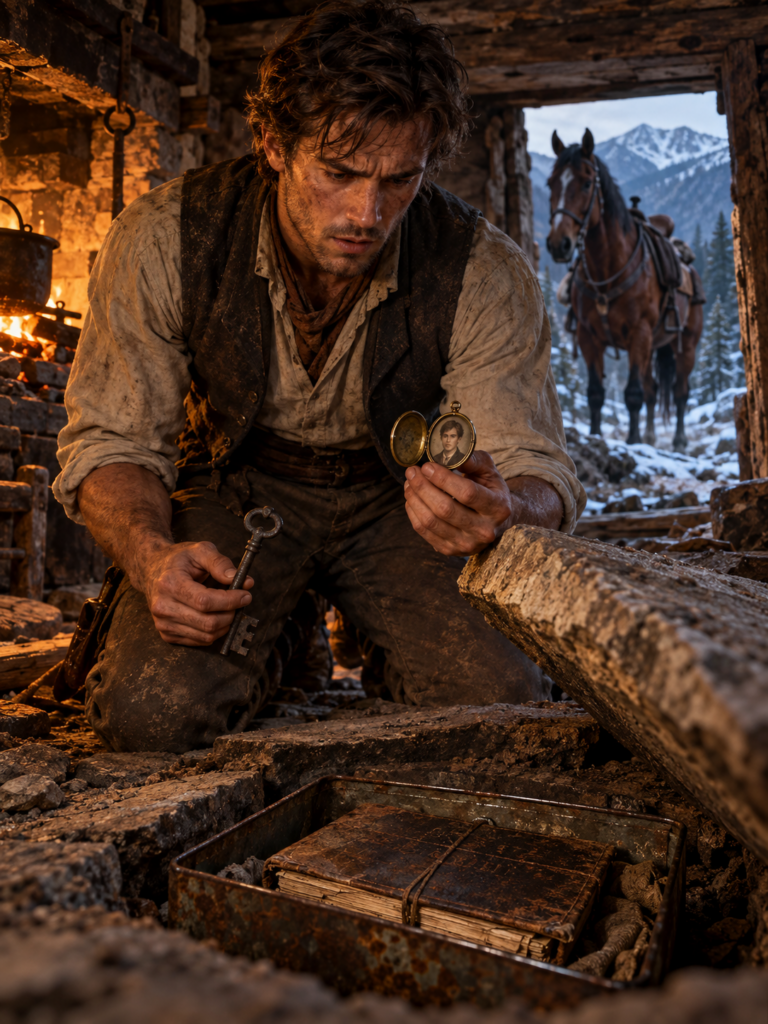
Joseph brought them through the hidden passage.
The woman stared when the buried room opened around them.
Joseph had no time to explain.
He built a fire in the stone hearth.
Smoke rose cleanly through a flue hidden inside the mountain.
Another piece of the mystery.
Whoever built this place had expected it to endure burial, neglect, perhaps even discovery decades later.
Joseph wrapped his saddle blanket around the child.
He gave the woman his coat.
Only when both stopped shaking badly did she speak.
“My husband went ahead to Timber Pass.”
“For help?”
“The brake failed. He went to find a wheelwright.”
Joseph looked at the storm.
“He’ll come.”
“You don’t know that.”
“No.”
The honesty startled her.
Joseph added, “But he knows where you were. And there’s only one old trail.”
She nodded.
The boy drank from Joseph’s canteen.
His eyes wandered toward the hearth.
“What’s that?”
Joseph followed his gaze.
The brass locket lay where he had left it beside the ledger.
He closed it.
“Something I found.”
The woman did not ask further.
Night settled outside.
Rain hammered the buried roof.
Joseph sat beside the fire with the iron key in his pocket and the ledger on his knee.
Hours earlier he had believed the greatest question on this mountain concerned himself.
Who was the man in the portrait?
Why had Boon raised him?
Why had the town accusation been allowed to stand?
Now a woman and child slept safely ten feet away because the hidden cabin had survived.
The mystery had become more complicated.
Whatever else the unknown builder had done, he had built well enough to save strangers fifty years later.
At dawn voices came from the trail.
The husband reached the opening first.
He was soaked, white-faced, and calling his wife’s name.
Joseph lowered the axe when he saw his expression.
“They’re alive.”
The man pushed through.
Behind him came a wheelwright and two men from Timber Pass.
One of those men had laughed from the saloon porch two days before.
Now he would not look directly at Joseph.
The husband dropped beside his wife and son.
The wheelwright walked the room slowly.
He ran one hand across the doorframe.
Examined the pegged joints.
Looked up the chimney.
“Who built this?”
Joseph touched the locket in his pocket.
“I’m trying to find out.”
The wheelwright shook his head.
“Fifty winters under a mountain, and the flue still draws.”
One of the town men cleared his throat.
“We should bring the clerk.”
Joseph looked at him.
The man flushed.
“We should bring everybody who needs to see this.”
Joseph thought of the ledger.
Then of the town that had decided what he was without evidence.
“No,” Joseph said.
The man stiffened.
Joseph continued.
“Bring the clerk.”
He lifted the ledger from the hearth.
“And bring him before the story gets there ahead of the proof.”
By afternoon, boots that had avoided this trail for fifty years were climbing toward the buried cabin.
At their front came the county clerk carrying a leather satchel.
Behind him came a doctor.
And farther back, without his hat and without the laughter he had worn on the saloon porch, came Cal Rusk.
Joseph stood at the cabin entrance watching them approach.
He had spent five years imagining the day Timber Pass might finally have to listen to him.
Now the evidence lay waiting beneath his hand.
And he realized with sudden clarity that proving the town wrong was no longer enough.
The ledger might clear his name.
But it might also reveal why his own father had let him leave believing he had been condemned by the only man whose belief truly mattered.
Joseph stepped aside.
“Come in.”
The county clerk entered first.
Joseph watched him notice the construction.
The squared logs.
The pegs.
The hidden entrance.
Then the clerk saw the ledger waiting on the table.
His face changed.
Not dramatically.
Just enough.
Joseph noticed.
“You know what that is.”
The clerk removed his spectacles.
“I know what it resembles.”
“That wasn’t what I asked.”
Cal Rusk shifted near the entrance.
The doctor knelt beside the rescued boy.
The wheelwright stood near the hearth, running a thumb over the joinery as if the building itself were giving testimony.
The clerk sat.
“May I?”
Joseph pushed the ledger toward him.
“You came to read it.”
The clerk opened the first page.
His expression tightened.
Joseph said nothing.
That was another skill exile had given him.
A man who feared silence filled it.
A man who understood silence could make another person carry his own words into it.
The clerk turned one page.
Then another.
“These entries go back twenty-three years.”
“I know.”
“Payments to your father.”
“I know.”
The clerk looked at the locket.
Joseph had placed it beside the ledger.
“Where did you find these?”
“Under the hearthstone.”
“And the key?”
“Inside the wall.”
“Your father told you?”
“He told me to walk the trail.”
The clerk removed his glasses again.
Cal finally spoke.
“This got something to do with what happened five years ago?”
Joseph looked at him.
“You tell me.”
Cal’s jaw tightened.
“I came up because they said you pulled a woman and boy out of the wash.”
“That’s why you climbed?”
A flush climbed Cal’s neck.
“I climbed because—”
He stopped.
Joseph waited.
Cal looked toward the rescued family.
Then toward the ledger.
“Because I was wrong.”
“About what?”
“You.”
Joseph held his gaze.
“That answer came quickly.”
Cal took the blow without anger.
“I’ve had five years to think slower.”
The clerk interrupted.
“Joseph.”
Something in his tone shifted the room.
He had reached the final pages.
“Sit down.”
“No.”
The clerk sighed.
“Your father held legal title to the trail easement.”
Joseph frowned.
“The estate paper says abandoned.”
“Because it effectively was.”
“And the cabin?”
The clerk looked around.
“No assessed structure. No registered habitation after the slide.”
“Who owned it?”
“That is more complicated.”
Joseph felt his patience thin.
“Make it less complicated.”
The clerk turned the ledger toward him.
The initials from the cabin appeared several times.
E.M.
Beside them was a full name.
Elias Mercer.
Joseph looked at the locket.
“That’s him?”
“Yes.”
“You knew him?”
The clerk hesitated.
“I knew of him.”
“How?”
“He came through Timber Pass many years ago. Carpenter. Timber contractor. Survey hand when there was work.”
“And my mother?”
Another pause.
Joseph’s voice hardened.
“You will not do what this town did five years ago. You will not decide silence is easier for me.”
The clerk looked up.
“You’re right.”
That simple admission took some heat from Joseph’s anger without cooling it.
The clerk continued.
“Your mother knew Mercer before she married Boon.”
Joseph’s hand tightened on the chair back.
“How well?”
“Well enough that you were born seven months after the wedding.”
Cal looked away.
The wheelwright stopped examining the wall.
Joseph stared at the clerk.
“My father knew.”
“Yes.”
The word landed quietly.
Joseph had imagined this answer since opening the locket.
Hearing it still cut.
“Boon knew I wasn’t his son.”
“He knew before he married her.”
Joseph had not imagined that.
The floor seemed less stable beneath him.
“Then why?”
“Because he loved your mother.”
The clerk spoke carefully now.
“She was already carrying you. Elias Mercer was working a mountain contract. There had been an accident. People believed he was dead.”
Joseph looked toward the locket.
“He wasn’t.”
“No.”
“When did he come back?”
“After you were born.”
The ledger suddenly made sense.
Payments.
For the boy.
For boots.
Medicine.
School.
Joseph’s voice dropped.
“Why didn’t he take me?”
The clerk looked toward the timber walls.
“Perhaps these pages answer that better than I can.”
Joseph took the ledger.
Near the middle, an entry written in the same precise hand as the accounts stretched longer than the others.
Boon refuses money beyond Joseph’s keeping.
Says a father is the man who stays through fever.
I told him blood still owes.
He told me duty is not ownership.
Joseph stopped.
Read it again.
Boon had known.
And had not been paid to tolerate another man’s child.
He had argued with Elias about what being a father meant.
Something in Joseph’s chest shifted painfully.
The clerk said, “Boon took the payments because your mother wanted something set aside for you. Not because he was hired.”
Joseph turned another page.
Payments became smaller after his mother’s death.
Then less frequent.
Eventually, the entries stopped.
“What happened to Mercer?”
“No one knows exactly.”
“He built this.”
“Yes.”
“For me.”
“That’s what the ledger says.”
Joseph looked around.
The mountain had buried the cabin before he had ever known it existed.
“The slide?”
“Year you were born.”
“Then how could he keep paying afterward?”
“The cabin was damaged, not fully lost. The trail remained usable for a time. Mercer eventually left the region.”
“Where?”
The clerk shook his head.
“The record does not say.”
Joseph hated the uncertainty.
Then he remembered something.
“My father’s letter.”
He took it from his waistcoat.
The name he had refused to speak was there.
Elias Mercer.
Below it:
Walk it, son. What was sealed will open for you.
In the margin were the initials E.M.
Joseph placed the page beside the ledger.
“Why wait until he died?”
The clerk’s face tightened.
“That question belongs to Boon.”
“He’s dead.”
“Yes.”
“So I’m asking you.”
“I don’t know.”
Joseph turned away.
The answer was honest.
He had asked for honesty.
That did not make it satisfying.
The doctor finished examining the boy.
“He’s sound.”
The woman looked at Joseph.
“So am I because of him.”
Cal’s eyes dropped.
Joseph felt embarrassment rather than pride.
He had not pulled them from the flood so Timber Pass would admire him.
He had heard a child.
He had possessed a rope.
That was all.
The clerk continued reading.
At last he closed the ledger.
“The payments are lawful. The trail easement passed through Boon. The cabin and surrounding parcel appear to have been held in trust informally, but these instruments support your claim. I’ll verify the registry.”
“Don’t tell me what supports it. Tell me what’s true.”
The clerk nodded.
“The ground is yours.”
Joseph looked toward the buried doorway.
“And the cabin?”
“Yours.”
“The trail?”
“Yours to reopen and maintain.”
Cal let out a breath.
Joseph looked at him.
The older man shifted.
“I said something to you before you rode up.”
“I remember.”
“I said your father found nothing.”
Joseph waited.
Cal swallowed.
“I was wrong about him too.”
That mattered more.
Joseph said, “You were wrong about him before today.”
Cal nodded slowly.
“Yes.”
“You just didn’t know it.”
“No.”
“And five years ago?”
Cal’s face tightened.
The theft accusation returned to the room.
Nobody needed it explained.
Joseph had carried it into every silence since coming home.
Cal rubbed one hand over his mouth.
“I saw you behind Whitcomb’s.”
“You saw me leave the alley.”
“I saw you near it.”
“There’s a difference.”
“I know that now.”
“You knew it then.”
Cal looked at him.
Joseph stepped closer.
“You told people I had the cashbox.”
“I thought—”
“You did not see a box.”
“No.”
“You did not see me enter the store.”
“No.”
“You did not see me break the lock.”
“No.”
Joseph’s voice stayed quiet.
That quiet made Cal pale.
“You saw a boy you already didn’t like behind a building where money disappeared, and you turned what you thought into what you said you knew.”
“Yes.”
The word barely came out.
Joseph’s hands were steady.
For five years he had imagined striking Cal.
Now the idea felt strangely small.
“What happened to the money?”
Cal looked toward the clerk.
The clerk answered.
“Never recovered.”
“So nothing up here proves who took it.”
“No.”
Joseph absorbed that.
The cabin proved something about his birth.
The ledger proved something about Boon.
The rescue proved something about Joseph’s present character.
None of it proved who stole Whitcomb’s cashbox.
He looked at Cal.
“You cannot clear me of a crime by deciding I’m a better man today.”
Cal flinched.
“That’s not what—”
“It is exactly what people will do.”
Joseph faced the clerk.
“They’ll say I rescued a boy, so I could not have stolen money five years ago.”
The doctor rose.
“You object to being believed?”
“I object to being judged by another story instead of evidence.”
Nobody spoke.
Joseph continued.
“I was innocent then even if I had become a bad man afterward.”
The clerk slowly nodded.
“And I would still deserve proof now even if I had never pulled anyone from that water.”
“Yes.”
“That matters.”
“Yes.”
The wheelwright gave a low sound of agreement.
Cal stared at Joseph.
“What do you want from me?”
Joseph thought about it.
Five years of imagining this moment had produced many possible answers.
An apology.
Public confession.
Humiliation.
Joseph discovered none felt sufficient.
“Tell exactly what you saw.”
Cal frowned.
“That’s all?”
“To everybody you told more than that.”
Understanding entered his face.
“You want me to say I lied.”
“I want you to say where the truth ended and your certainty began.”
Cal lowered his head.
“All right.”
The storm cleared by evening.
The rescued family stayed another night.
Joseph sat outside the buried cabin while Timber Pass’s lamps appeared far below.
The clerk joined him.
For several minutes neither spoke.
Then the clerk said, “Your father came to my office after you were driven out.”
Joseph’s body went still.
“When?”
“Next morning.”
“What did he say?”
“He asked whether a charge had been filed.”
Joseph waited.
“There wasn’t enough evidence.”
“I knew that.”
“He asked whether he could force the town to let you stay.”
Joseph turned.
“What?”
The clerk looked ashamed.
“I told him no law could make neighbors welcome a man.”
Joseph’s throat tightened.
“What did he do?”
“Sat in the chair where you sat yesterday.”
The clerk’s voice softened.
“He asked where you had gone.”
“Why didn’t he come after me?”
“I don’t know.”
The answer hurt all over again.
Then the clerk added, “But he asked me every year whether you had written for county records, land notices, anything.”
Joseph stared at the valley.
“He knew where to send his letter.”
“Yes.”
“He could’ve sent one before.”
“Yes.”
The clerk did not defend him.
That helped.
Joseph understood then that Boon could have loved him and still failed him.
Both could be true.
The ledger did not erase the silence at the doorway.
The final letter did not return five lost years.
Love could explain a wound without canceling it.
Joseph looked toward the churchyard far below.
“I’ll go tomorrow.”
“To his grave?”
“Yes.”
The clerk stood.
Then stopped.
“One more thing.”
Joseph looked up.
“The patch east of the churchyard.”
“What about it?”
“Your father refused three offers for it.”
“It’s scrub.”
“Yes.”
“Why?”
The clerk gave a tired smile.
“You’ll have to ask a dead man.”
Joseph almost smiled back.
Almost.
The next morning, he rode Ash down the reopened trail.
The woman and child followed in their repaired wagon.
Her husband walked beside the lead team.
At the edge of Timber Pass, people were waiting.
Nobody laughed.
Joseph did not mistake silence for repentance.
He rode straight through town.
Straight to the churchyard.
He found Boon’s marker beneath a bent pine.
For a long time Joseph stood with his hat in his hand.
Then he put his palm on the stone.
“You knew.”
Wind moved through the grass.
“You should’ve told me.”
Nothing answered.
Joseph breathed slowly.
“You should’ve come after me.”
Still nothing.
He closed his eyes.
“But you stayed when another man could’ve claimed blood meant more.”
His fingers pressed against the cold stone.
“I didn’t know that.”
The anger remained.
So did gratitude.
Neither removed the other.
Joseph took his father’s last letter from his waistcoat.
He did not leave it at the grave.
It belonged to him now.
He folded it carefully.
Then he walked back toward town.
Cal Rusk was waiting outside the saloon.
So were twenty other people.
Joseph stopped.
Cal stepped from the porch.
Five years earlier he had used the height of that porch to speak over Joseph.
This time he stepped into the road and stood level with him.
“I said Joseph Boon stole Whitcomb’s cashbox.”
People watched.
Cal’s voice nearly failed.
He continued.
“I did not see him steal it.”
The town remained still.
“I saw him behind the store. I saw him leave the alley. I saw nothing in his hands. I saw no broken lock. I saw no cashbox.”
Joseph watched faces change.
Cal said, “I told what I suspected like it was what I knew.”
Then he looked directly at Joseph.
“That was a lie.”
No applause followed.
Joseph was grateful.
Some truths should not be celebrated merely because they arrived late.
Cal swallowed.
“I’m sorry.”
Joseph nodded once.
He did not say it was enough.
It was not.
But it was true.
That was a beginning.
Then the county clerk came out carrying a leather satchel.
“Joseph.”
He held a document.
“I checked the registry.”
Joseph took it.
The cabin parcel.
Trail access.
The scrub ground beside the churchyard.
All tied to Boon’s estate.
But one notation near the bottom made Joseph look twice.
An old survey reference linked the scrub parcel to the mountain claim.
He looked at the clerk.
“What does this mean?”
“It means your father didn’t leave you two worthless pieces of land.”
The clerk pointed toward the mountain.
“He left you the two ends of the same road.”
Joseph looked from the paper to the north ridge.
The old trail began beside the churchyard land and ended at the buried cabin.
What the estate inventory had described as separate worthless holdings were, in fact, one connected corridor.
His father had preserved the approach.
The realization did not arrive like triumph.
It arrived like another question.
“Why?”
The clerk adjusted his spectacles.
“I found an older plat.”
He opened his satchel and removed a second sheet.
The line of the trail was faint but visible.
Once, decades earlier, it had been planned as an access road toward timber leases beyond the ridge.
The slide had ended that.
Later roads went elsewhere.
“Boon kept both ends from being absorbed by neighboring claims,” the clerk said.
“For me?”
“I can’t prove motive.”
Joseph almost laughed.
For once, the clerk had learned exactly the lesson Joseph wanted.
“Good.”
The clerk looked confused.
Joseph folded the papers.
“Thank you.”
He spent the next weeks on the mountain.
Not because Timber Pass suddenly welcomed him.
Some people did.
Some merely became polite.
Some avoided him because apology required more courage than silence.
Joseph learned not to demand a uniform ending from an entire town.
He reopened the trail a little at a time.
The wheelwright came up voluntarily and helped shore the passage.
The doctor brought salve for Joseph’s torn hands.
The rescued boy’s father hauled tools.
The boy himself arrived once sitting proudly beside his mother in the wagon and carried a wooden peg Joseph allowed him to hammer into a new frame.
Cal Rusk did not come.
Joseph noticed.
He also discovered he did not need him to.
The old man from the trail never returned either.
But one morning Joseph found something leaning against the new doorframe.
An ash walking stick.
The bark had been removed.
The wood was smooth.
The top bore no name.
Joseph picked it up.
He remembered the old man’s sentence.
Mountain keeps what the town throws away.
When it gives something back, it gives back the reason too.
Joseph set the stick inside the door.
He never learned the old man’s name.
That felt right.
Some gifts carried enough identity in the act itself.
As more of the slide was cleared, the cabin gave up its shape.
The downhill wall had survived nearly whole.
The roof needed rebuilding.
The hearth remained sound.
One afternoon Joseph uncovered a second window opening that had been sealed from inside before the slide.
Another deliberate preparation.
Elias Mercer had expected the mountain to close around the place.
Or feared it might.
Joseph studied the construction.
“He knew.”
The wheelwright looked over.
“Knew what?”
“That the slope was unstable.”
“Likely.”
“Then why build here?”
The older man considered the cabin.
“Men build for the country they have, not the country they wish they had.”
“That doesn’t answer me.”
“No.”
The wheelwright smiled faintly.
“Maybe he thought he could hold it.”
Joseph looked at the thick logs.
The braced passage.
The hidden key.
The sealed hearth.
Elias had not held back the mountain.
But he had anticipated loss.
He had designed a way for something to survive it.
Joseph thought of Boon.
A man who had failed to tell his son the truth while alive, then left a letter pointing toward where he had hidden it.
Different men.
Same flaw, perhaps.
Both had tried to protect by withholding.
Neither had asked the person being protected whether ignorance was the protection he wanted.
Joseph did not romanticize that anymore.
He understood motive.
He did not excuse cost.
That distinction became central to everything he rebuilt.
When the clerk brought the final ownership documents up the trail, Joseph read every line before signing.
The clerk waited.
“You don’t trust me.”
Joseph dipped the pen.
“I trust paper I’ve read.”
The clerk smiled.
“Fair.”
The cabin became legally his.
So did the trail.
So did the scrub parcel near the churchyard.
Joseph had no intention of farming that ground.
Instead he fenced only enough to keep wandering livestock from knocking over the trail marker.
The rest remained open.
People began walking the route.
At first out of curiosity.
Then for practical reasons.
The old track shaved miles from certain trips once Joseph repaired the dangerous switchbacks.
He did not charge tolls.
Cal Rusk eventually came up in early autumn.
Joseph was resetting a corner post when Ash raised his head toward the trail.
Cal approached alone.
No tools.
No bottle.
No audience.
Joseph continued tamping dirt.
Cal stopped ten feet away.
“I should’ve come sooner.”
Joseph set the tamper down.
“You came now.”
Cal looked toward the cabin.
“Can I see it?”
Joseph considered.
“This isn’t a public monument.”
“I know.”
“Why do you want to?”
Cal swallowed.
“Because I spent five years telling people what I thought your life meant.”
Joseph waited.
“I’d like to see what it actually was.”
That answer earned him something.
Not forgiveness.
Permission.
Joseph led him inside.
He showed Cal the hidden panel.
The key cavity.
The hearthstone.
The brass locket.
The ledger remained in Joseph’s hands.
Cal stared at Elias Mercer’s portrait.
“He looks like you.”
“Yes.”
“Your father knew?”
“Yes.”
“And still raised you?”
Joseph’s expression hardened.
Cal corrected himself.
“No. Wrong question.”
Joseph said nothing.
Cal tried again.
“Boon was your father.”
“Yes.”
“Mercer was your blood.”
“Yes.”
Cal nodded.
The distinction settled.
Joseph appreciated that he did not complicate it further.
They stood before the hearth.
Cal finally said, “I thought finding all this would make you less angry.”
“It didn’t.”
Cal looked at him.
Joseph continued.
“It made me more accurate.”
“What does that mean?”
“It means I know what I’m angry about now.”
Joseph touched the ledger.
“I was angry because I believed my father thought I was guilty.”
Cal lowered his eyes.
“He didn’t?”
“I don’t think he did.”
“That better?”
“In one way.”
Joseph walked toward the doorway.
“In another way, it means he let me leave without telling me.”
Cal followed.
“He may have thought you needed distance.”
“Maybe.”
“He may have been ashamed.”
“Maybe.”
“He may—”
Joseph turned.
“Do not make excuses for dead men because silence makes you uncomfortable.”
Cal stopped.
Joseph’s voice stayed even.
“I can love my father and say he failed me.”
After a moment Cal nodded.
“Yes.”
“I can be grateful he protected this land and still wish he had ridden after me.”
“Yes.”
“I can know why you accused me and still say what you did was wrong.”
Cal took that one more slowly.
“Yes.”
Joseph picked up the tamper again.
Cal looked toward town.
“What would make it right?”
“Nothing.”
Cal’s expression fell.
Joseph continued.
“You can make what comes next better.”
Cal looked back.
“How?”
Joseph gestured toward the trail.
“Next time this town wants certainty because certainty feels good, remember what yours cost.”
Cal absorbed that.
Then he left.
Joseph went back to the post.
Winter approached.
Ash grew a thicker coat.
Joseph began sleeping in the cabin more often than in town.
Eventually he stopped renting the room above the eating house entirely.
Timber Pass remained below him.
Close enough to see at night.
Far enough that silence returned after sunset.
He kept the ledger beneath the hearthstone.
Not because he wanted to hide it.
Because that was where the builders had intended it to survive.
The locket stayed with it.
So did the key when Joseph was home.
When he traveled, he wore the key on a leather cord.
Months after the flood, a letter came from the family Joseph had rescued.
Inside it was a scrap of paper.
Two charcoal letters drawn by the little boy.
J.
B.
Joseph stared at them.
His own initials.
Uneven.
Careful.
He smiled.
Then he placed the scrap beneath the hearthstone with the older records.
The box had once contained proof of a secret parentage.
Now it held proof of something Joseph considered more important.
A child remembered the man who pulled him from water.
Not because Joseph owned that memory.
Because one life had touched another and both continued afterward.
The cabin changed.
It was no longer merely inheritance.
No longer merely evidence.
It became shelter.
Travelers occasionally stopped when weather turned bad.
Joseph did not ask for payment.
He remembered too clearly what it felt like to have nowhere that wanted him.
But he established one rule.
Anyone who slept under his roof respected everyone else beneath it.
No drunken threats.
No accusations offered as fact.
No man deciding another man’s worth because he had the louder voice.
It was an unusual rule for a mountain cabin.
Joseph enforced it quietly.
He rarely needed to twice.
One winter evening, a young laborer arrived after dark.
The man had been dismissed from a timber crew after being accused of stealing a tool.
Joseph gave him stew.
The young man ate too fast.
Then, perhaps recognizing Joseph’s name, he said, “You believe me?”
Joseph sat across the table.
“I don’t know you.”
The young man’s face fell.
Joseph continued.
“I believe you deserve not to be declared guilty because somebody says it loudly.”
The man looked up.
“That’s different.”
“Yes.”
Joseph pushed another piece of bread toward him.
“Different matters.”
That night, long after the traveler slept, Joseph opened Boon’s last letter again.
The paper had softened at the folds.
Walk it, son.
What was sealed will open for you.
For years Joseph had treated the words as instruction.
Now they sounded like apology.
Too small.
Too late.
Still real.
He began writing a reply he could never send.
Father,
You should have told me.
He stopped.
Then continued.
I needed to know you believed me.
I needed you to ride after me.
I understand some of what you were protecting. I do not understand all of it.
He looked toward the fire.
I know now that understanding a man is not the same as excusing him.
That sentence surprised Joseph.
He left it.
He wrote about Elias Mercer.
About the cabin.
The flood.
The boy.
The trail.
Then:
You were my father.
Mercer gave me blood and something built with his hands.
You gave me years.
I wish you had also given me the truth while I could answer you.
Joseph folded the letter.
He did not put it beneath the hearthstone.
He carried it to the churchyard the next morning.
Snow lay between the graves.
He brushed Boon’s marker clean.
Then he read the letter aloud.
Not loudly.
The dead did not require volume.
When he finished, he placed the paper at the base of the stone.
Wind moved it.
Joseph caught it.
He almost laughed.
Even now the mountain seemed unwilling to let paper lie loose.
He put the letter back in his coat instead.
Some things did not need burial.
On the way out of the churchyard he noticed a man standing beside the gate.
The former stable boy.
Older now by a year.
He looked uncertain.
“Mr. Boon?”
“Joseph’s fine.”
The young man nodded.
“My father was there.”
“When?”
“The night they ran you out.”
Joseph waited.
“He didn’t shout.”
“I remember.”
The boy looked uncomfortable.
“He also didn’t stop them.”
Joseph said nothing.
“He talks about it now.”
“Does he?”
“He says he was waiting for somebody else to speak first.”
Joseph looked toward town.
“That’s how crowds stay crowds.”
The young man nodded.
Then offered something Joseph had not expected.
“Your horse can stable free whenever you’re down.”
Joseph looked at him.
“I can pay.”
“I know.”
Joseph remembered another lesson.
A gift did not always create debt.
Sometimes refusing one denied someone the chance to act differently.
“All right,” he said.
The young man smiled faintly.
“Good.”
Joseph returned to the mountain.
Spring opened the trail.
The stream fell clear.
Wildflowers came along the exposed slope where the slide had scarred the earth.
Ash grazed in the fir flat.
Joseph rebuilt the cabin door with the wheelwright’s help.
He cut a flat stone for the threshold.
One evening, after setting it, he sat outside while sunset turned the ridge amber.
Timber Pass lit its lamps below.
The ash walking stick stood inside the doorway.
The key rested against Joseph’s chest.
He looked at the chiseled initials on the original corner log.
E.M.
Elias Mercer.
The man whose face resembled his.
Joseph had tried for months to decide what word belonged to him.
Father?
No.
Not in the way Joseph understood it.
Stranger?
Not entirely.
Benefactor?
Too clean.
Elias had left money.
A cabin.
A road.
A secret.
He had also left Boon to carry the consequences of that secret.
Joseph finally accepted that no single word was required.
People could occupy complicated places in a life.
The important thing was not forcing them into simpler shapes for comfort.
Ash came down through the firs and stopped behind him.
The horse blew softly.
Joseph smiled without turning.
“About time.”
Ash lowered his head to graze.
Joseph sat until the first star appeared.
Then hoofbeats came up the trail.
He looked over.
Cal Rusk emerged from the trees leading another horse.
A boy of perhaps sixteen sat on it.
His hands were bound loosely in front.
Joseph stood immediately.
“What’s this?”
Cal looked uncomfortable.
“Caught him behind Whitcomb’s store.”
Joseph went very still.
The boy’s face was pale.
Cal continued quickly.
“A window was broken. Cash missing.”
The scene seemed almost cruel in its symmetry.
Joseph looked at the boy.
“What did you see?”
Cal blinked.
“What?”
“What did you see?”
Cal took a breath.
“The boy was in the alley.”
“What was in his hands?”
“Nothing.”
“Did you see him break the window?”
“No.”
“Did you see him enter?”
“No.”
“Did you search him?”
“Yes.”
“Find money?”
“No.”
Joseph looked at Cal.
For several seconds the only sound was Ash grazing.
Then Cal dismounted.
He untied the boy’s hands.
“I brought him here because I knew I was doing it again.”
Joseph said nothing.
Cal rubbed both palms over his face.
“I got halfway to the sheriff and heard myself telling the story. Every sentence got a little more certain.”
The boy stared between them.
Cal continued.
“So I stopped.”
Joseph stepped toward the boy.
“What’s your name?”
“Eli Garner.”
“Why were you behind the store?”
“My dog ran under the steps.”
“You have a dog?”
The boy whistled.
A scruffy black animal emerged from the trees thirty yards back.
Cal closed his eyes.
Joseph almost smiled.
Almost.
“Take him home,” Joseph said.
Cal nodded.
Then Joseph added, “And tomorrow you tell Whitcomb exactly what you saw.”
“I will.”
“Not what you think.”
“I know.”
Cal mounted.
The boy hesitated.
“You’re Joseph Boon?”
“Yes.”
“My mother said you stole from that store.”
Cal flinched.
Joseph looked at the boy.
“I didn’t.”
The boy glanced at Cal.
“He says that now too.”
Joseph nodded.
“That matters more than pretending he never said otherwise.”
Cal met Joseph’s eyes.
Then they rode down the trail.
Joseph remained standing.
For the first time he understood what repair looked like when it was real.
It was not a perfect apology.
Not a speech.
Not public shame.
It was a man interrupting his own worst habit before it ruined somebody else.
Changed behavior.
That was worth more than regret.
By the end of the second year the trail was open enough for pack animals.
Timber Pass began using it again.
Joseph never removed the old marker.
He repaired it.
The path that had once led only to a buried secret became a working route.
The cabin became known as Boon House, though Joseph resisted the name at first.
“It was Mercer’s,” he told the clerk.
The clerk shrugged.
“Now it’s yours.”
Joseph looked at the hearth.
“No.”
The clerk raised an eyebrow.
Joseph remembered the flooded woman.
The child.
The travelers.
The accused young laborer.
The old man’s walking stick.
“A house isn’t just who owns it.”
The clerk waited.
Joseph said, “A house is what you keep for the next one coming.”
The clerk smiled.
“That sounds like something somebody should write down.”
“No.”
Joseph looked toward the open door.
“Some things can stay spoken.”
Years later, people in Timber Pass told the story differently.
Some claimed Joseph had discovered gold.
He had not.
Some claimed Elias Mercer had been a rich outlaw.
There was no evidence of that.
Some claimed Boon had known the identity of Whitcomb’s real thief.
He had not left proof of it.
Joseph corrected those stories whenever he heard them.
Truth had been bent around his life once already.
He would not let a flattering lie replace a cruel one.
What remained was enough.
A young man had been falsely accused.
His father had failed to defend him publicly.
His father had also raised him knowingly and preserved an inheritance another man had built.
Elias Mercer had been Joseph’s biological father.
Boon had been his father in every daily sense.
Both men had withheld truths Joseph deserved.
Both had left things that helped him later.
None of those facts canceled the others.
Joseph learned to live without forcing them to.
One late-autumn evening, he climbed down to Timber Pass and stopped at the churchyard.
Boon’s grave was clean.
Someone else had cleared the pine needles.
Joseph did not ask who.
He rested his hand on the stone.
“I’m all right.”
It was the first time he had said that aloud there.
Then he corrected himself.
“I’m better.”
That was more accurate.
He rode back before dark.
Ash was older now, but the bay still climbed steadily.
At the place where Joseph had once met the old man carving the ash sapling, he stopped.
The flat stone remained.
Nothing else.
Joseph dismounted and sat for a while.
The mountain keeps what the town throws away.
Joseph finally understood the sentence.
The mountain had not preserved his innocence.
He had always possessed that.
It had preserved evidence.
A cabin.
A ledger.
A portrait.
A road.
But the reason was larger.
Joseph had needed more than proof that others were wrong.
He had needed to learn what he himself would do once the power of judgment came into his hands.
Would he become another man who confused suspicion with certainty?
Would he turn pain into permission?
Would he punish people for what their fathers had done?
Would he use truth as a weapon merely because lies had once been used against him?
He had answers now.
Not perfect ones.
But lived ones.
Joseph mounted Ash again.
At the cabin, a lantern burned beside the doorway.
A traveler had arrived before him.
An elderly woman stood with a pack mule and apologized for using the hearth.
Joseph dismounted.
“You don’t apologize for a fire in cold weather.”
“I didn’t know whose house it was.”
Joseph looked at the cabin.
The exposed original logs.
The repaired roof.
The stone hearth.
The hidden box below it.
Then at the trail descending toward Timber Pass.
“It’s mine on paper.”
The woman waited.
Joseph took her mule’s lead.
“But tonight it’s a house you reached before dark.”
He settled the animal.
Inside, he added wood to the fire.
Later, after the traveler slept, Joseph lifted the hearthstone.
He opened the tin.
Elias Mercer’s ledger lay inside.
The locket.
The little charcoal scrap with J and B.
Joseph added one more item.
The key.
He no longer needed to wear it.
The door it opened had been open for years.
He laid the iron key beside the ledger and closed the box.
Then he reset the hearthstone.
Outside, the ridge was silver beneath moonlight.
Joseph stood in the doorway.
Five years earlier Timber Pass had sent him away carrying shame that did not belong to him.
When he returned, he believed the mountain would give him proof strong enough to make the town kneel.
Instead it had given him something less theatrical and more useful.
Evidence.
Complexity.
A chance to distinguish truth from vindication.
His father had loved him and failed him.
His biological father had provided for him and remained absent.
Cal Rusk had harmed him and later changed.
The town had followed a lie, then slowly learned to live with the consequences.
Joseph had rescued two people, but that rescue did not prove his earlier innocence.
Only evidence—and the absence of evidence against him—could speak to that.
That distinction became the foundation of the life he built.
He never married himself to Timber Pass’s approval.
He did not need everyone to like him.
He needed the freedom to live without their old lie governing his choices.
And that freedom was finally his.
Ash breathed behind him in the dark.
Far below, Timber Pass glowed between the pines.
Joseph rested one hand on the doorframe Elias Mercer had squared half a century earlier.
Then he looked at the open trail his father had preserved.
A road from the town that had thrown him away to the house the mountain had kept.
He thought of Boon.
Of Elias.
Of the frightened woman in the flood.
Of the boy with charcoal on his fingers.
Of young Eli Garner standing accused behind the same store where Joseph’s life had once been broken by certainty.
The mountain had given the reason back.
Not so Joseph could prove himself better than everyone who had wronged him.
So he could choose not to become them.
He stepped inside.
The door remained open behind him.
And high above Timber Pass, where a buried cabin had once held fifty years of silence, a light stayed burning for whoever came next.

