
Part 1
Isabella Ki stood in the gallery storeroom with the phone pressed so hard to her ear that her knuckles went white. The line had gone quiet eleven seconds ago. Not disconnected. Quiet. Then it died.
Her sister Lucia had landed at O’Hare at three in the afternoon. She had called from the taxi stand at 3:41. “The driver is pulling up,” she had said, voice bright with the end of a long flight and the beginning of three weeks in Chicago. Then the silence. Then nothing.
Isabella had waited by the phone for twenty-one days. She had told no one. Her parents were dead. Her uncle was a priest in Bergamo who still wrote her letters on thin airmail paper and believed she worked at a respectable gallery and lived a quiet life. There was no one else.
On the twenty-second day Marcus Carrera walked into the Raldi Gallery alone. He bought a small landscape she had been trying to sell for two years and paid cash. While she wrapped it he set a photograph on the counter beside her hands.
Lucia. In a different room. Clean clothes. A hot meal in front of her. Alive.
“I took her from the Vitelli house in Elmwood Park,” he said. His voice was low, almost kind. “She’s somewhere safe. She’ll stay somewhere safe. If you miss one drop, she goes back. If you speak to Dante, she goes back in pieces.”
He had told her the price. Envelopes. Whatever he asked for, whenever he asked, delivered to the back of Dante Moretti’s private bathroom so that neither of them would ever be seen with the other.
Isabella had loved Dante on the days she was allowed to. Thirteen months of cream wool and crushed-violet perfume and the small gold cross her mother had given her at her first communion. Thirteen months of never pressing for anything because pressing would have given him a reason to look too closely. She had learned the difference between a real Macchiaioli and a convincing forgery at twenty paces. She had learned how to smile at the right moments and stay silent at the right ones. She had never flinched when his men came into the room.
She had also learned that a woman who never pressed for anything in his world was either very smart or very dangerous. Marcus had needed her to be both.
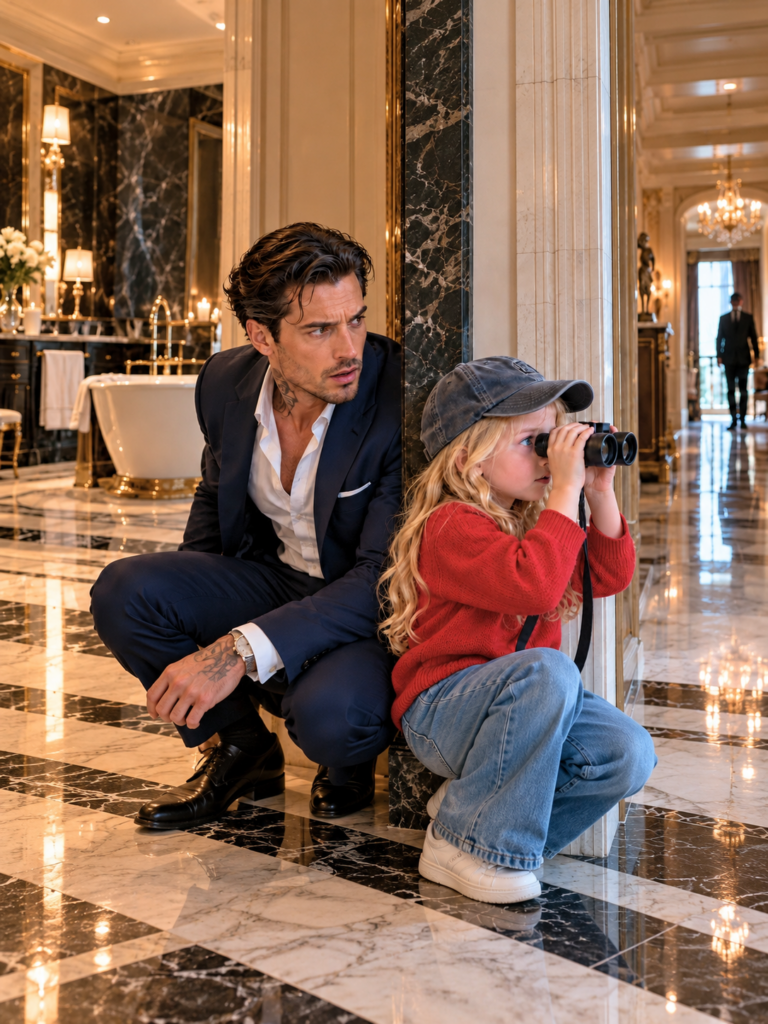
The night Dante came home early from the Vitelli meeting, rain turning Chicago into a sheet of broken glass, Isabella was already upstairs with a glass of wine and a biography of Caravaggio open in her lap. She did not hear the small bare feet on the back stairs. She did not hear the bathroom door click shut. She did not know that a five-year-old girl in a plastic deerstalker two sizes too big had been watching her for three days.
Dante stopped in the doorway of his private bathroom with blood drying beneath his left cuff. The child rose from behind the white porcelain toilet, finger pressed to her lips.
“Shh. Uncle Dante. I’m spying on a bad guy.”
He had seen her twice in nine months, both times at the far end of the kitchen when he had come down for coffee at an unusual hour. The housekeeper’s daughter. Elena Rossi’s little girl. Sophie.
He crouched until his face was level with hers. His knee cracked against the cold marble. “Tell me about this bad guy.”
Sophie leaned closer. The plastic magnifying glass swung against her chest. “It’s your girlfriend. Isabella. The pretty one with the red lipstick. She’s the bad guy.”
Dante did not laugh. The muscle along his jaw tightened once. He kept his voice light. “Isabella is a very nice lady. She brings you chocolate sometimes, doesn’t she? The orange kind.”
“I don’t eat it. Mommy says never eat candy from someone you don’t trust.”
“And you don’t trust Isabella.”
“No.”
She said it the way she might have said she didn’t like broccoli. Simple. Certain.
He rested one forearm across his knee. The thin smear of blood on his cuff had turned brown. “Tell me what you’ve seen.”
“She comes in here. When you’re gone. At night mostly. She brings an envelope. A skinny one. She comes in with it. She goes out without it. She hides it before she leaves.” Sophie turned her head and pointed with absolute seriousness at the back of the toilet. “Right there.”
Dante stood. He held out one hand. “Come, little girl. Let’s find your mother.”
In the kitchen Elena’s face went white when she saw them. She dropped to her knees, hands trembling on Sophie’s shoulders. “I’m so sorry, Mr. Moretti. She was supposed to be in bed.”
“No one is in trouble,” Dante said. He crouched again. “I don’t want her in my private rooms. Not the bathroom, not the bedroom, not the office. Can you make sure she understands that?”
Elena nodded, not understanding. He understood enough for both of them.
He did not sleep. He lay on his back in the center of a bed designed for two and turned the child’s words over the way he turned a coin between his fingers at the card table. A five-year-old could lie. Children lied about broken vases and stolen cookies. But a child did not invent a lover slipping into a private bathroom with a sealed envelope and leaving empty-handed. A child did not count to six on her fingers and then correct herself. A child reported what she had seen.
By four in the morning the seed in his chest had grown roots. By seven he had shaved, dressed in a charcoal suit, and poured his second espresso. He told Marcus he needed the plane that evening for a meeting in Detroit he had already canceled. He wanted the house quiet. The staff could stand down.
Marcus studied him for half a second longer than a man studies his oldest friend. “Done.”
Isabella came down at eight in cream wool and the small gold cross. She kissed the corner of his mouth and tasted like coffee and crushed violets. “You’re leaving.”
“Detroit. One night, possibly two. Miss me quietly.”
He left at ten. Two miles past the gates the car pulled into a service road behind a sheet-metal warehouse. Dante stepped into a second unmarked sedan. Raphael drove him in silence to a brownstone on the north side that no one in the organization knew he owned.
On the third floor, behind two steel doors and a biometric lock, four monitors showed every camera inside the Moretti estate. They watched for four hours. Nothing happened. At 3:47 Isabella walked up the main staircase. She looked once left, once right, once at the ceiling where no camera was visible. She went into the private bathroom. She was inside for four minutes and twelve seconds. When she came out her hands were empty.
Dante stood. Something cold moved down the length of his spine.
He returned through the service gate at the back of the estate. He left the car two hundred yards from the kitchen door, took the gardener’s path along the frozen hedges, and let himself in through the pantry. The staff had been dismissed. Isabella was in the east sunroom with a glass of wine and the Caravaggio biography.
He unlocked the private bathroom door and stepped inside. He checked the cabinet above the sink, the drawers beneath it, the linen closet, the curved underside of the tub. Nothing. Then he looked at the toilet.
He got down on his knees on the cold marble floor of his own bathroom. He lowered himself until his cheek was almost against the tile and angled the flashlight on his phone into the shadowed hollow where the porcelain curved away from the wall. The light caught something matte. A square, taped with four strips of pale beige surgical tape to the underside of the tank.
The small white envelope dropped into his palm as softly as a bird.
Inside were a black solid-state drive no larger than a matchbox, the serial number scratched off, and six photographs taken with a long lens. The first was a shot of himself stepping out of a black sedan in front of the shipping office at the Calumet terminal. The angle was wrong for a tourist. The angle was wrong for a journalist. The angle was correct for one thing only.
He slipped the envelope into the inside pocket of his jacket and walked out. Raphael drove him back to the brownstone. Dante plugged the drive into an air-gapped laptop. A single folder appeared. A full roster of his lieutenants. Home addresses. Daily routes. The schools their children attended. Six safe houses. Three locations of meetings scheduled for the next ten days. A shipping manifest for the following Tuesday. Container number, dock, crew, the thirty-eight-minute gap between the Port Authority sweep and the arrival of his own men.
And then the thing that made him sit down. The access codes to the armory at Pier 22. Four hundred weapons. The organization’s reserve. The kind of reserve that decided wars.
Someone was going to hit the Tuesday shipment and take the armory in the same night.
Raphael stood behind him and said nothing. Dante closed the folder. “We put it back,” he said. “Tonight. Exactly where it was. Four strips of tape. The same angle. And then we watch who comes to collect it.”
They returned at 9:47. Isabella had gone upstairs. In the private bathroom Dante knelt one more time and pressed the envelope against the porcelain. Raphael opened a small black case. Inside, nested in gray foam, were a pinhole camera, a directional microphone, and a relay transmitter. He lifted the medicine-cabinet mirror off its brackets without a sound.
The next morning Sophie was sitting on the third step from the bottom, eating toast with both hands. The plastic magnifying glass hung from the shoelace around her neck. Dante sat beside her two stairs above.
“Sophie. Can I ask you one more thing about the bad-guy case?”
She sat up very straight. She picked up the magnifying glass and held it to one eye. “Okay.”
“The envelopes. Does anyone come to get them after she leaves?”
“One time. Only one time that I saw. A man. Big. Really big. Bigger than you. Not fat big. Shoulders big. And he had a silver watch. Shiny. Not the little round kind. The big heavy kind with a face like a plate. He came in the back way. He went in the bathroom. He came out with it. He put it inside his jacket. He walked out the kitchen door.”
Dante’s hand resting on his knee did not move. Marcus Carrera wore a silver watch on his left wrist. It had belonged to his father.
He sat on the stairs for another thirty seconds without speaking. Inside his chest something that had taken twenty-three years to build began, very quietly, to crack.
He watched the footage that afternoon. Isabella kneeling behind the toilet in cream wool. Two hours and six minutes later a tall man in a black overcoat coming through the service door. Broad shoulders. A heavy silver watch. Inside for one minute and forty-four seconds. Out with a small white envelope sliding into the breast of his overcoat.
Dante poured himself three fingers of Macallan in the library. He had not touched whiskey in five years. He drank it standing in the quiet. Then he walked to the east sunroom.
Isabella looked up when his shadow fell across her lap. She smiled the way she always smiled. The gold cross caught the late-morning light at her throat.
“You’re home early.”
“The Detroit meeting canceled. Come downstairs. I want to show you something in the library.”
He closed the double doors behind them and turned the brass key in the lock. He laid a manila folder open on the leather blotter. Six glossy photographs. The scratched drive sealed inside a clear evidence sleeve. One still from the footage: Isabella kneeling, her hand reaching up into the shadowed hollow.
She looked down at the photographs for a long time. She did not touch them. The color left her face in a single slow wave. Her knees folded and she sat because her body had decided she could not continue to stand.
A full minute passed. The clock on the mantel ticked.
“Say it,” Dante said.
She lifted her eyes. They were full of something he had never seen in them before. Not fear of him. Not shame. Something older.
“He has my sister.”
Part 2
Her name was Lucia. Twenty-two. Finishing her thesis on the Macchiaioli in Florence. She had been coming for three weeks. She never arrived.
The photograph had come the next morning through Isabella’s mail slot. Lucia in a dark room, hands tied, a copy of the Tribune from that morning on her lap, the Vitelli crest stamped on the back in red ink. They had made no demand. Not that day. Not the day after. Not for three weeks. Then Marcus had come to the gallery.
He had bought her off the Vitelli for a hundred thousand dollars and a promise. He had told her the price. The envelopes. If she missed one drop, her sister went back. If she spoke to Dante, her sister went back in pieces.
“Why not kill you both?” Dante asked.
“Because he needed me close to you. He needed someone you would never suspect to feed him what you said in your sleep.”
“How long have you been copying the drives?”
“Four months. In the gallery storeroom. Inside the frame of a Fattori landscape I keep behind the restoration curtain. A second drive. Every file I have given him. Every conversation I could record. His voice on three of them.”
Dante looked at her for the first time since the Palmer House. He saw the woman who had never pressed for anything. He saw the woman who had been drowning for a long time in private.
“Where is the second drive?”
“In the gallery. Behind the Fattori.”
“Can you get it today? Without being seen?”
“Yes.”
“Then go.”
She left through the service door. She was back inside two hours with a canvas satchel of groceries. Beneath a wrapped loaf of bread and a jar of San Marzano tomatoes she drew out a flat black drive identical to the first. Dante plugged it into the air-gapped laptop. Three audio files. He opened the most recent.
Marcus’s voice came through clean and close. “Tuesday night. The window is thirty-eight minutes. Your people take the dock. My people take the armory. Moretti rides to the port himself because the shipment is his. He will not send a deputy. One car. Two in the car. We do it on the service road behind the sheet-metal warehouse.”
A second voice answered. Older. Heavier. The accent from the hills above Palermo. Vitelli.
Dante closed the file. He looked at Isabella standing by the desk with her hands folded tightly in front of her.
“You are going to walk out of this library,” he said. “And tonight you are going to put another envelope behind my toilet exactly like every other envelope. Exactly on time. You are going to smile at Marcus when you pass him in the hallway. You are going to kiss me at breakfast. You are going to pour wine for the two of us at dinner the way you poured it yesterday.”
“Yes.”
“And when the night of the ambush comes, you will do one thing and only one thing. You will stay in this house.”
Her eyes shone but did not spill. “I understand.”
“Your sister comes home, Isabella. I give you my word.”
“I know.”
She did not thank him. She did not need to.
At 4:42 Elena knocked on the library door. Three light taps. Her face was the color of old paper. Sophie had seen a man standing by the door to the staff wing that morning. Long black coat. Shiny shoes. Short black hair. A little beard at the point of his chin. Not Marcus. Smaller. A Vitelli man already walking the staff corridor of Dante’s own house.
They left at eleven that night. Elena carried one small suitcase. Sophie carried the deerstalker in both hands as if it were made of glass. Raphael brought the unmarked sedan to the service gate without headlights.
Sophie looked up at Dante from the gravel. “But my case isn’t closed. The bad guy is still here. The detective doesn’t leave until the case is closed. That’s the rule.”
“Who told you that rule?”
“The cartoon.”
Dante crouched. He lifted the plastic magnifying glass from around her neck. “Detective Rossi. I am taking your badge. Not forever. Three days. Four at the most. The chief detective does not go into the field during the final phase of a dangerous investigation. That is a different rule from the cartoon. That is the rule in real cases.”
She stared at him. “Is that true?”
“On my word. And when the case is closed I will come to the safe house myself. I will put this back around your neck myself. And I will tell you everything you solved.”
“Everything?”
“Every single thing.”
She placed the deerstalker carefully on his head. “Then you have to wear this while you’re in the field. That’s the rule.”
He slipped the magnifying glass into the inside pocket of his overcoat right above his heart. He lifted her into the back seat. Elena climbed in beside her. The car pulled away toward Evanston. Dante stood on the gravel in a thirty-thousand-dollar overcoat and a plastic deerstalker hat and watched the taillights until they were gone.
He built the false manifest himself. Container number RMU4471. Dock 19. A warehouse on 21st in Blue Island. Window of unloading, four in the morning. Thirty-eight minutes. Access codes scrambled from the real ones at Pier 22 by a formula only he and Raphael knew. He printed two pages, folded them inside a plain white envelope, and sealed the flap with four strips of pale beige surgical tape.
Isabella was waiting in the library. She wore cream silk, the gold cross, red lipstick newly applied. She looked at the envelope in his hand and did not reach for it.
“Tomorrow at 3:47,” he said. “The same angle. The same four pieces of tape. Do not rush. Do not slow down. If Marcus is in the house, do not change a single step of what you would have done last week.”
“Yes.”
“And after?”
“After, I pour you wine at seven. I kiss the corner of your mouth. I ask you about the Castellano meeting. I go to bed at 10:30 with a book.”
“The Caravaggio?”
“The Caravaggio.”
He gave her the envelope.
The next afternoon at 3:47 she walked up the main staircase in cream wool and the gold cross and knelt beside the toilet for one minute and thirty-eight seconds exactly. At 6:01 Marcus let himself in through the service door. He was inside for one minute and forty-four seconds. He came out with the envelope sliding into the breast of his overcoat. The silver watch caught the hallway light.
Raphael watched him go. Then he began to move. Four phone calls. By midnight twenty-eight of Dante’s most reliable men were in position in a two-block perimeter around the warehouse at 21st and Blue Island. Snipers on three rooftops. Three cars on the alleys. Nico in the bakery doorway with a radio.
At 3:52 in the morning nine Vitelli men pulled up in two SUVs behind the shuttered bakery. They never reached the door.
At the same hour, in the wine cellar of the Moretti estate, Dante set a small black speaker on top of a dusty bottle of 1982 Barolo. Marcus stood six feet away between two stone pillars, hands loose at his sides.
“You wanted me down here at four in the morning for what exactly?”
“A conversation.”
“I was asleep.”
“No. You weren’t.”
Dante tapped the speaker. The cellar filled with Marcus’s own voice. The thirty-eight-minute window. The dock. The armory. The service road behind the sheet-metal warehouse. The heavier voice answering. And the woman. The woman finished the same night. Her sister goes back. No loose ends.
Marcus’s hand moved to the inside of his jacket.
“Don’t,” Dante said.
The pistol came out faster than anything a man of his size should have been able to produce. The first round went past Dante’s left ear and chipped a scallop out of the stone pillar behind him. They came together between the pillars. Elbow. Forehead. Blood warm across the stone. The cellar door burst open. Raphael came down the steps three at a time with a shotgun low across his hip. The sound of the pump sliding was the only sound Marcus Carrera had ever been afraid of.
Marcus sank slowly onto the cold stone floor. Blood ran from his nose and dripped from his chin. Raphael kept the shotgun where it was. Dante crouched at a careful distance.
“Why?”
Marcus laughed once, short and bitter. “Twenty-three years, Dante. Because for twenty-three years I have stood one step behind your right shoulder. I pulled you out of the water in Miami. I took the bullet in Cicero. I buried three of your enemies myself. And when the table was set there was always one chair at the head and one chair to the right. And the chair to the right has my name carved into it in stone. You never asked. I asked. In every way a man asks without opening his mouth. You never heard. Vitelli heard. He offered me the south side. The yards. The Pilsen distribution. A seat of my own. A crew of my own. A name of my own. I would have taken half of what you built and let you keep the other half. He said no. He wanted it clean. He wanted you under the dirt. And Lucia was my idea. The Vitelli took her at O’Hare. Three days later I bought her off him. He thought I was being sentimental. I was shopping for a lever. Isabella Ki was already in your bed. I needed her hands clean enough for you to never look twice and dirty enough for me to pull.”
“Where is she?”
“The farmhouse off Route 31. Outside Elgin. The gray barn with the red roof. Two men. One at the door. One in the kitchen. They rotate at six in the morning. A woman who brings food. She doesn’t speak English. She leaves at ten.”
Dante stood. “Take him to the second basement under the gatehouse. Hold him there until I return. You know the rules.”
“I know the rules.”
He crossed the main hall and gave two addresses, two coordinates, and three names to the only four men in the organization he had chosen six years ago and never once reconsidered. By sunrise three cars rolled east on Route 31 with their headlights off and a folded blanket in the back seat for a twenty-two-year-old woman who had not seen the sky in six months.
Lucia was in a small upstairs room at the back of the house. Wool cardigan two sizes too large. Jeans someone had bought for her at a Walmart in September. She had lost perhaps fifteen pounds. Her hair had been cut short with kitchen scissors. When the door opened and the man in the dark coat said, “Lucia. Your sister sent us,” in Italian, in the accent of the hills above Verona, she sat down on the edge of the narrow bed and cried without a sound for ninety seconds. Then she stood and walked to the car on her own two feet.
Isabella was waiting in the library when the car pulled up at 9:14 in the morning. She had not slept. She came down the front steps still in cream silk from the night before, no coat, the gold cross swinging at her throat. When Lucia stepped out of the back seat the two sisters met in the gravel drive and did not speak for a very long time. Isabella’s hands moved over her sister’s face, her shoulders, her hair, as if she were reading a letter in the dark. Lucia pressed her forehead into Isabella’s collarbone. The sound that came out of her was not loud. It did not need to be.
Dante stood on the steps of his house and watched. He did not go down.
An hour later in the library, with Lucia upstairs in a hot bath, Isabella stood at the long window with her back to the room.
“You can stay,” Dante said. “Here in this house. In this life. For as long as you want it. Or you can go. Both of you. Anywhere. I will arrange it. Papers. Money. A new address no one in this city will ever find.”
She turned. Her eyes were dry. “Milan. She has a professor there who was waiting for her thesis. I have a cousin with a spare room near the Navigli. There is a small gallery on Via that has been asking me to come back for two years.”
“Then Milan.”
She crossed the room. She stopped one step short of him. “Dante. I did love you. On the days I was allowed to.”
“I know.”
She touched the lapel of his jacket once, very lightly, where the plastic magnifying glass sat in the inside pocket above his heart. Then she walked past him and up the stairs to her sister.
Part 3
By noon Raphael stood in the center of the library in a dark suit without a tie. “Second in command,” Dante said. “Effective now.”
Raphael bowed his head once. Neither of them said Marcus’s name again.
The safe house in Evanston was a small white colonial behind a hedge of frozen boxwood. Dante arrived at four in the afternoon. He had not changed his shirt. He had slept perhaps ninety minutes on the couch in the library. In the inside pocket of his overcoat sat a scratched plastic magnifying glass on a shoelace.
He rang the bell. The door opened before the second chime. A small blonde head stuck out at the level of his belt buckle. Oversized blue cardigan. Pink pajamas with white rabbits. No deerstalker. The deerstalker had been on his own head in the car and he had carried it in his hand up the front path.
“Uncle Dante.”
“Little girl. Did you solve the case?”
He crouched on the welcome mat. “Detective Rossi. The case is closed.”
Her eyes went enormous. “All of it?”
“All of it. The bad guy with the silver watch is in a place he will not come out of. The pretty lady with the red lipstick turned out to be a good lady who was helping her sister. The sister is home. The envelopes are gone. The toilet is just a toilet again.”
He drew the magnifying glass from his pocket and slipped the shoelace carefully over her head. “By the authority vested in me by nobody in particular, I am promoting you from detective to chief detective. Effective immediately.”
“Chief? Chief of the whole thing?”
“Of the whole thing.” He lifted the deerstalker and set it on her head. It slid immediately over her left ear. “If the chief detective would permit it, I would be honored to serve as her assistant. On one condition.”
“What condition?”
“You may never again hide behind my toilet.”
She thought about this for a very long time. Then she nodded once with absolute solemnity and extended her small right hand. He shook it. Her whole hand fit inside the first joint of his thumb.
Elena stood in the doorway behind her daughter with both hands pressed against her mouth. Dante rose.
“Elena. I am asking you to come back to the house as head of staff. Triple your current salary. A proper apartment on the second floor of the east wing. School fees paid through university for Sophie. Wherever she chooses to go.”
Elena’s shoulders began to shake. She stepped forward and put her arms around him for one single second, the way a sister might. Then she stepped back, wiped her eyes with the heel of her hand, and nodded. That was enough.
Isabella and Lucia left for Milan three days later. Dante arranged the papers himself. He stood on the steps again while the car pulled away. Isabella looked back once. She did not wave. She touched the gold cross at her throat and then turned her face toward the road.
He did not call her. He did not write. He told himself the work was finished. The armory was secure. The Tuesday shipment had moved under different men at a different hour. Marcus was in the second basement under the gatehouse. The Vitelli who had walked the staff corridor was found face-down in the Chicago River with his pockets empty and his shoes still shiny.
Two weeks later the small gallery on Via wrote to say they had received Isabella’s inquiry and were pleased to offer her the position she had been offered two years earlier. Dante read the letter once and set it aside.
On the twenty-third day he flew to Milan.
He did not announce himself. He stood across the street from the gallery at closing and watched the lights go out one by one. When she stepped onto the sidewalk with a canvas portfolio under one arm and the gold cross catching the last of the evening light, he crossed the street.
She stopped. For a moment neither of them spoke. The street was narrow. A scooter passed. Somewhere a window opened and the smell of tomatoes and garlic drifted out.
“I told you I would arrange papers,” he said. “I did not say I would stay away.”
“You didn’t have to come.”
“I know.”
She studied his face the way she had once studied a landscape she was not certain was real. “Lucia is with the professor. She is writing again. She eats. She sleeps. She still wakes up at three in the morning and checks the lock on the door. But she is writing.”
“Good.”
“Why are you here, Dante?”
“Because on the days you were allowed to love me, I was allowed to love you back. I did not know the difference until a five-year-old girl told me you were the bad guy and then told me the truth about the man I trusted with my life. I would like to know what it feels like when no one is forcing either of us.”
She was quiet for a long time. Then she shifted the portfolio to her other arm and held out her hand. He took it. Her fingers were cold. He closed his around them and felt the small, steady pulse at her wrist.
They walked. Not toward the gallery. Not toward the airport. Toward the Navigli, where the lights on the water made the canal look like a long, broken mirror. She told him about the Fattori landscape she had used to hide the second drive. He told her about the plastic deerstalker hat Sophie had made him wear. She laughed once, soft and surprised, the sound of a woman who had not expected to laugh again so soon.
At the corner she stopped. She turned to face him. The gold cross rose and fell with her breath.
“I am not coming back to Chicago,” she said. “Not to that house. Not to that life. Not even for you.”
“I know.”
“But I would like to know what it feels like too. When no one is forcing either of us.”
He lifted her hand and pressed his mouth to the inside of her wrist, just above the pulse. Then he let go. “Then we start here. With dinner. With a walk. With whatever you decide comes next. And if you decide nothing comes next, I will fly home tomorrow and I will not call you again.”
She looked at him for a long moment. Then she nodded once, the way Sophie had nodded when she accepted the condition about the toilet. Absolute. Certain.
“Dinner,” she said. “And then we will see.”
They walked on. The canal lights trembled on the water. Behind them the gallery was dark. Ahead of them the street opened onto a small square where a man was setting out tables for the evening service. Dante held the door. Isabella stepped through. For the first time in thirteen months she did not look over her shoulder to see who might be watching. She simply walked in, and he followed.

