
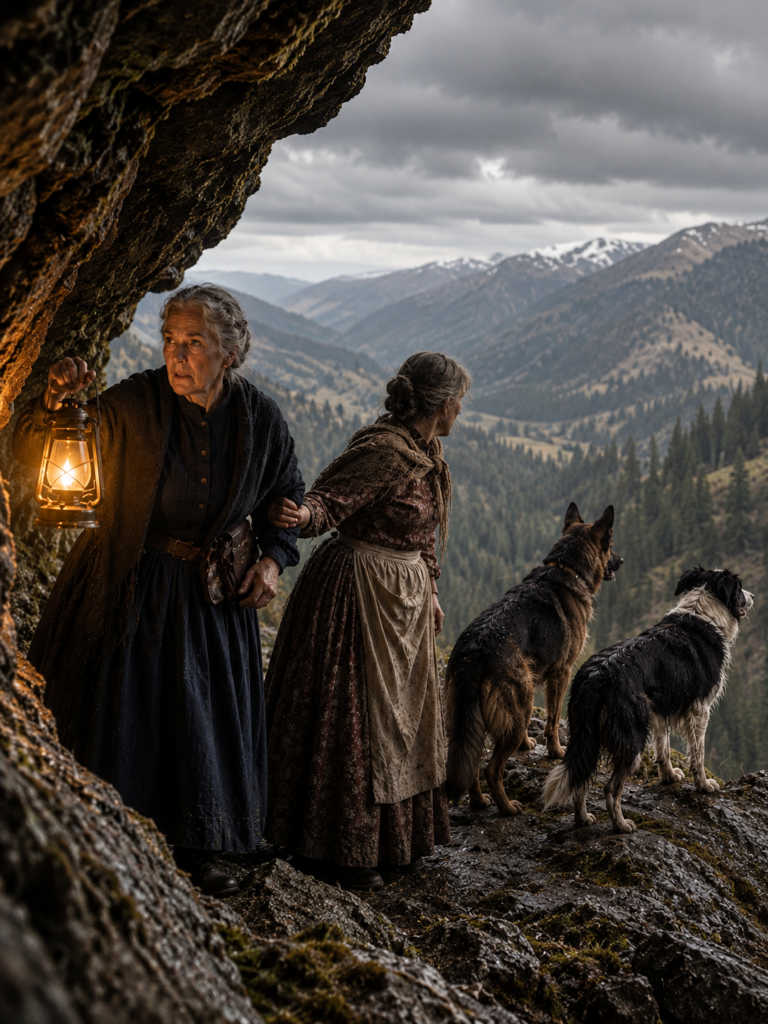
two widows betrayed by their sons fled into a wyoming storm and fifty feet inside a cave they found the secret that gave them back the land no man had let them keep
Part 1
Margaret Oliver sat at her own kitchen table and watched her son slide the paper across the wood the way a man slides something he has already decided will not be refused. The paper was still warm from being carried in his coat. Outside, the late October wind pushed against the ranch house windows and made the old glass rattle in its frames. She had not lit the stove yet. The coffee in her mug had gone cold while she waited for Bradley and Sandra to finish saying the things they had practiced on the drive over.
Bradley cleared his throat. “It’s for the best, Mother. You can’t run the place alone. Sandra and I looked into it. A proper home in town where you’ll be looked after.”
Margaret kept her hands flat on the table. She was sixty-eight years old and her fingers still carried the calluses from four winters of fence work after her husband Oliver had taken sick. “I’ve run this place alone since your father took sick, four winters now.”
“That’s exactly the trouble,” Bradley said, and the kindness in his voice made it worse. He spoke as though her survival were evidence against her rather than the only proof that the ranch still stood. Sandra stood near the door with her coat still buttoned. She never sat during these conversations. Standing meant she could leave the responsibility of the words standing, too, untouched, someone else’s furniture.
“We’ve already spoken to the land agent,” Sandra said. “The sale will cover your care for years.”
Margaret looked at the paper. Her late husband’s signature was there beside the old survey lines. Forty years of fence mending and cattle branding reduced to two columns of numbers and a buyer’s mark. She could still see Oliver’s hand in the way the O was formed. He had signed it the winter before he died, when he still believed the ranch would pass the way land was supposed to pass, from one set of hands that knew it to the next.
“You’ve already spoken to the land agent before you spoke to me.”
Neither of them answered. The silence did the answering for them. Outside, the wind found a loose shingle and worried at it. Margaret listened to the sound and remembered the first winter she and Oliver had spent in this kitchen, how he had heated bricks on the stove and carried them to bed wrapped in an old flour sack, how he had said the house would outlast them both if they kept the roof tight. She had believed him. She had kept the roof tight.
She packed one trunk. She took her husband’s compass, a shawl her mother had knitted the year Margaret turned twenty, and nothing else that could be called sentiment. Sentiment, she had learned in the three weeks since Oliver was buried, was the first thing families took from you once they decided you could no longer be trusted with your own life. She left the photographs on the wall. She left the quilt Oliver’s mother had pieced. She left the coffee mug he had used every morning until the morning he could not lift it. When Bradley offered to help her carry the trunk to the wagon, she told him she would manage. She had managed the cattle and the fences and the accounts. A trunk was nothing.
Two valleys over, Mary Ann Foster stood in her own doorway while her husband’s brother Carl’s lawyer explained, in a reasonable voice, why the land she had worked beside Frank for thirty-two years had never legally belonged to her. Frank had died the autumn before. Carl had waited exactly long enough to seem decent before the papers arrived. The old family deed named the land as belonging to male heirs of the Foster line, a clause no one had bothered to mention while Frank was alive to argue it.
“The land was never legally yours to keep, Mrs. Foster,” the lawyer said, not unkindly, the way men say cruel things while believing themselves reasonable. “It reverts to Carl as next of kin.”
Mary Ann had signed nothing. She had also, in the end, been given no choice. The sheriff’s own signature was already at the bottom of the eviction notice dated for the coming Friday. She looked past the lawyer at the barn where Frank had kept the tools he would not let anyone else touch. She thought of the way he had stood in that doorway the week before he died and told her the place would be hers to do with as she saw fit. He had said it like a man who believed the law would honor what a husband said at his own kitchen table.
She left with a mule, a wagon half loaded with what furniture would fit, and an old sheepdog named Scout who had refused, from the moment the wagon was hitched, to walk anywhere but directly beside her. Scout kept his shoulder against her skirt as she drove out of the yard. Behind them the house stood empty, the door still open because Mary Ann had not been able to make herself close it. She told herself she would come back for the rest later. She already knew she would not.
Part 2
They met at a crossroads trading post three days later, the kind of place where anyone traveling with no clear destination eventually stopped because everyone traveling with no clear destination ends up needing supplies they had not planned for. Margaret was tying down a loose strap on her own wagon when she heard a voice she had not heard in forty years say her name like a question that already knew its answer.
“Margaret Ollie, is that you? Well, you look like you’ve had the same kind of week I have.”
Mary Ann Foster stood beside a wagon whose canvas cover was patched in two places. Her mule stood with its head low. Scout and Margaret’s old shepherd Milo circled each other once, twice, then decided within minutes that they were now traveling together. Margaret straightened slowly. Her back had stiffened on the wagon seat. She studied the woman in front of her and saw the girl she had known in a town neither of them lived near anymore, before marriage and distance and other people’s lives had quietly filed the friendship away as something from before.
“Mary Ann,” she said. “I didn’t expect to see you this far west.”
“I didn’t expect to be this far west.” Mary Ann’s voice was steady, but her hands on the mule’s bridle were not. “Carl took the place. Said the deed never meant it for me.”
Margaret nodded once. She did not need the rest of the story. She had heard enough versions of it in the last month to recognize the shape. “Bradley and Sandra sold mine out from under me. Said I’d be looked after in town.”
They stood in the trading post yard with two wagons, two dogs, and two women who had each spent three weeks being told, in different words by different families, that they could no longer be trusted to manage what they had spent a lifetime managing. The trading post owner’s wife came out with a pot of coffee and two tin cups. Neither woman sat. They drank standing up, the way people do when they are not sure the ground will still be under them if they stop moving.
“We always said we’d end up on a porch together someday,” Margaret said. “Didn’t picture it starting like this.”
“Didn’t picture it happening at all,” Mary Ann said.
Neither of them had anywhere in particular to go. For the first time in either of their lives, that felt less like a loss and more like the first honest freedom either had been handed in years. They bought what supplies the trading post had that would keep: cornmeal, salt, coffee, a second lantern, a coil of rope. Margaret paid for half of it with the small amount of cash she had taken from the kitchen tin. Mary Ann paid for the other half with the last of the money Frank had kept in the biscuit tin behind the stove. They did not discuss how long the money would last. They already knew.
They traveled together for four days, following old logging roads west into country neither of them knew. It was the only country their families had not already staked a claim to an opinion about. The roads were rutted and soft in places from the last rain. At night they camped where the trees broke enough to allow a fire. Margaret cooked. Mary Ann tended the animals. The dogs slept between the two bedrolls as if they had always done so. On the third evening Mary Ann told Margaret about the way Frank used to whistle when he repaired fence, the same three notes over and over until the wire held. Margaret told her about the winter Oliver had walked three miles in a blizzard to bring home the medicine the doctor said she needed, and how he had not mentioned the cold once when he came through the door. They did not cry. They had both already done their crying in kitchens where no one was watching.
On the fifth day the sky turned the particular gray that means snow is coming whether you are ready or not. They kept moving because stopping meant deciding where to stop, and neither of them had decided yet.
Part 3
The storm caught them the way storms in that country always seemed to, suddenly and completely, without the courtesy of warning. One moment the sky was merely gray and heavy, the kind of gray that promised nothing more than a cold afternoon. The next, the wind had turned and the first flakes came sideways instead of down, driven so hard they stung like gravel against exposed skin. Wind flattened the pines sideways, bending trunks that looked as though they had stood through worse and would stand through this too, though Margaret found herself less certain of that with every gust.
The temperature dropped fast enough that both women could feel it happening in real time, could feel their own breath start freezing on the wool wrapped across their mouths. The mule pulling Mary Ann’s wagon stumbled twice on ice hidden beneath fresh snow, and the second time it went down hard enough that Mary Ann was out of the wagon seat and at its head before she had even decided to move, murmuring low and steady the way Frank used to, hands finding the bridle by memory more than sight.
“Easy. Easy now. Nobody’s in a hurry that badly.”
The mule found its feet again, but slower this time, favoring one leg just slightly, just enough that both women understood without saying it that the animal would not manage many more miles like this. Margaret’s own team fared little better. Her horses’ heads hung low against the wind, ears pinned flat, walking now more from habit than will. Both dogs pressed close against the women’s legs at every stop, refusing to range ahead the way dogs usually did. Scout, in particular, kept circling back toward Mary Ann’s skirts, nosing at her hand, an insistence that had nothing playful left in it. Milo stayed nearer the tree line, ears up, watching something neither woman could see yet through the white.
Visibility dropped to a few wagon lengths in every direction. Margaret called out to Mary Ann, and even that close the wind tore half the words away before they landed.
“We’re losing the road.”
“There isn’t a road to lose anymore,” Mary Ann called back. “There’s just snow now, all the way down.”
Neither woman said what they were both thinking, that a storm like this, in country this unfamiliar, with animals already faltering, was exactly the kind of afternoon that made the newspapers back home, usually as a small notice near the back page, the kind families read over breakfast and shook their heads at before moving on to something less unpleasant.
“We can’t keep moving in this,” Margaret shouted over the wind.
“We can’t stop either,” Mary Ann shouted back. “Nothing to stop under.”
It was Scout who found it, barking suddenly and urgently at a break in the rock face nearly invisible through the blowing snow, high above the narrow ravine where they had finally been forced to leave the wagons behind. Milo was already scrambling up the slope after him before either woman had fully understood what they were looking at.
“Might be nothing,” Margaret said.
“Might be somewhere the wind can’t reach,” Mary Ann said. “I’ll take somewhere the wind can’t reach any day.”
The climb took the last of both women’s strength. Loose stones slid beneath boots not made for climbing. Twice Mary Ann reached back and steadied Margaret before she lost her footing entirely. The dogs never stopped urging them upward, circling back again and again as though herding two stubborn old women toward shelter neither could quite believe was real until they were standing inside it. The wind vanished the moment they crossed the entrance. The silence after days of roaring felt almost like a held breath finally released.
They built what fire they could from the dry branches trapped under the rocky overhang near the mouth of the cave and ate what little cornmeal remained between them, split evenly without either woman arguing about her share because women who have spent a lifetime giving up their share for someone else eventually stop noticing they are still doing it. The dogs lay close to the fire, steam rising from their coats. Outside, the storm continued, but it could no longer reach them. Margaret stretched her hands toward the flames and felt the heat begin to work its way back into her fingers. Mary Ann sat with her back against the stone and closed her eyes for the first time in three days. Neither of them spoke. There was nothing left to say that the fire and the silence had not already answered.
Part 4
It was the next morning, once the worst of the storm had passed, that Mary Ann went looking for dry wood deeper in the cave and found herself calling Margaret’s name in a voice that made both dogs’ ears come up sharp. Half buried beneath a shelf of stone sat an iron-cornered chest heavier than either woman expected. The rust on its lock was undisturbed for what looked like decades. It took a tire iron and both of their combined strength to break the lock free.
Inside lay a leather journal, a hand-drawn map, and a small bundle of seed packets, each one labeled in a careful, patient hand that clearly expected someone, someday, to need them. The journal’s cover bore one name pressed into the leather: Constance Ayers.
Margaret opened it first. The first line stopped them both cold.
If you are reading this, then you are very likely a woman who has been told she cannot manage on her own. I was told the same. This is what I found instead.
Mary Ann read the rest aloud by the firelight, her voice steady even as the story unfolded around them like it had been waiting forty years for exactly this audience. Constance Ayers had come west in 1874 with a husband who left the following spring for a richer claim two counties over and a younger wife to go with it, leaving Constance a homestead claim she had no legal standing at the time to hold alone. She would have lost it entirely. The land office did not, in those years, look kindly on unmarried women holding claims, had not a neighboring widow, Delphine Marsh, arrived at her door one morning with a wagon, a milk cow, and a proposition.
Two women filing together, sharing labor and risk equally, could hold what neither could hold separately, and no law on the books said outright that they could not try. They were not sisters. They were not married to one another. They were, according to Constance’s own careful accounting, simply two women who had decided that surviving on their own terms beat depending on men who had already proven, each in his own way, that he could not be depended on.
“They just decided to do it,” Margaret said quietly.
“It’s not like they had any other choice,” Mary Ann said.
The map inside the chest marked a spring beyond the eastern ridge, a stand of dead pine, ground sheltered from the worst of the northern wind. The same careful notes a woman might have left, except this time addressed deliberately to whichever woman eventually needed them. The following morning they followed Constance’s map exactly as written. The spring was there, clear and unfrozen, precisely where the ink promised it would be. Nearby, half swallowed by moss and drifted snow, they found the low outline of a foundation. Stones laid by hand, laid to last, laid by two women with no one but each other to answer to.
They spent the better part of a week clearing it, stone by stone, the same stones Constance and Delphine had once set in place. Margaret’s hands blistered. Mary Ann’s back ached in ways she did not mention out loud. Neither woman complained, because rebuilding a hundred-year-old foundation, it turned out, was doing something else besides restoring stone. It was rebuilding the exact kind of trust that neither of their own families had thought either woman still had use for. At night they sat by the fire and read more of the journal. Constance had written about the first winter, about the cow going dry, about Delphine teaching her how to split kindling so the pieces caught on the first match. She had written about the day the land office clerk had looked at both signatures and said nothing, only stamped the paper and slid it back across the counter as if the act of two women holding land together was something that could be made ordinary by silence.
It was Milo who found the second container, digging at a corner of the old foundation with the same single-minded urgency he had shown at the cave entrance. Locked, buried deeper and more deliberately than the first, this one held something different: a formal land claim witnessed and sealed by a territorial surveyor alongside a separate letter in an angrier, unfamiliar hand. Delphine’s brother, it turned out, had tried for years after both women’s deaths to have the claim overturned, arguing in increasingly bitter letters that no woman’s signature, let alone two, ought to stand unchallenged on a land deed in a territory that had not yet decided women’s signatures counted for much at all.
The claim had never been overturned. It had simply been buried, filed, forgotten, and then quietly buried again along with the two women who had earned it and the family member who could not stand that they had. Mary Ann read the last page twice before she spoke.
“Sounds familiar,” she said.
Margaret rode out at first light three days later. The survey papers, the map, and Constance’s journal were packed carefully into her saddlebag. She left Mary Ann behind with both dogs and a garden already half planted from Constance’s decades-old seed packets. The ride to the land office took four days. The roads were still soft in places from the storm, but the snow had melted enough that a horse could manage. Margaret said little when she returned, only reached into her coat and placed a single folded document into Mary Ann’s waiting hands.
Part 5
The territorial seal stood bright against the paper. Beneath it, two names, Constance Ayers and Delphine Marsh, formally, permanently, and finally recognized as the rightful owners of record, a full forty years after either woman had died still wondering if the claim would hold. Beneath that, in fresh ink, a second filing, the same quarter section registered now to Margaret Ollie and Mary Ann Foster in their own names, answerable to no husband, no son, and no brother-in-law’s lawyer.
Neither woman said much. The wind moved softly through the pines. Somewhere behind them the dogs had already claimed the porch as their own. Mary Ann held the paper with both hands as if it might change its mind if she loosened her grip. Margaret stood beside her and looked at the foundation they had cleared, at the garden already showing green where the seeds had taken, at the spring that had not frozen even when the temperature dropped again the night before.
No apology ever came from Bradley or from Carl. Neither man ever saw the valley, the spring, or the deed. Their absence in the story’s ending was, in its own way, the only justice either woman needed. The land and the name on it had simply stopped requiring their permission at all.
They spent the next years the way Constance and Delphine had spent theirs: fixing what needed fixing, planting what would grow, keeping the roof tight against weather that did not care whose name was on the paper. Mary Ann learned to split kindling the way Delphine had taught Constance. Margaret learned the names of the birds that nested in the dead pine beyond the ridge. On quiet evenings they sat on the porch the dogs had claimed and read the journals by the last of the light. They added their own pages when there was something worth writing down: the year the garden produced more potatoes than they could eat, the winter a neighbor from two ridges over stopped to ask if they needed anything and stayed long enough to help reset a fence post, the morning they both woke and realized neither of them had thought about the sons or the brothers or the lawyers in more than a month.
Years later a traveler passing through on the western trail would find four journals resting side by side near an old stone hearth. Constance’s, Delphine’s, and two more beside them. The newest ink barely faded, ending in a line that read almost exactly like the first.
If you are reading this, you are very likely a woman who has been told she cannot manage on her own. Let this valley be what you find out instead.
Outside, an old weathered marker still faces the trail. Four names are carved into it in two different centuries by two different hands. Beneath them, one line.
They did not wait for permission.


