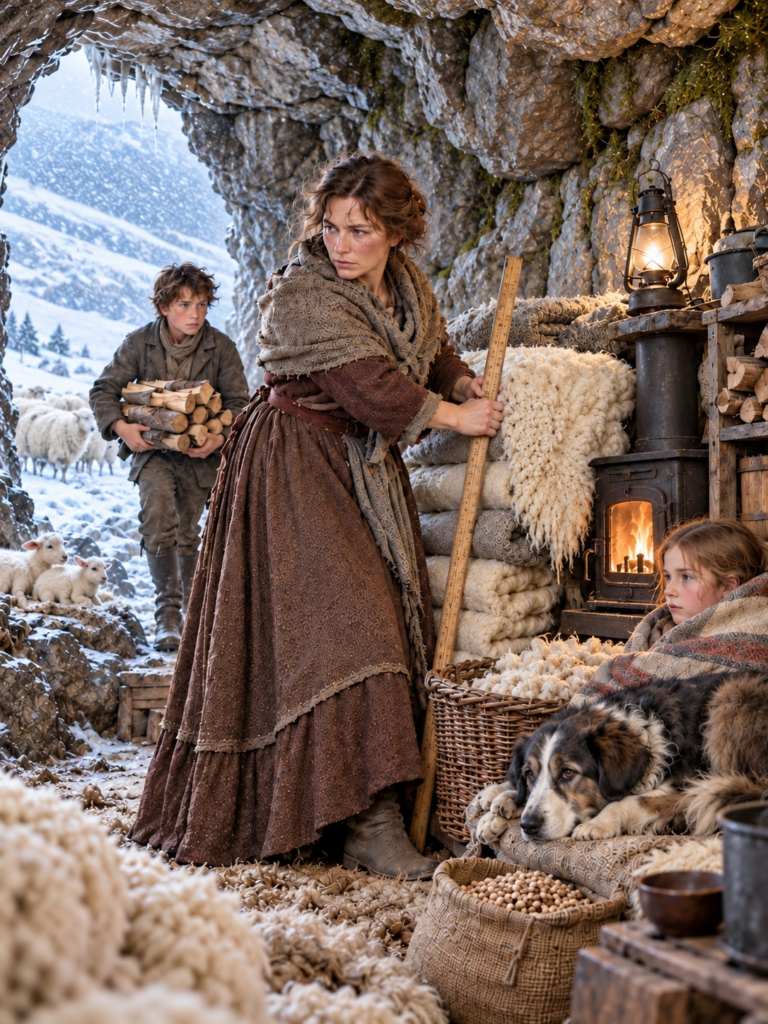
widow whitlock followed the sheep to a forgotten hillside crack and packed it with wool and firewood before the seventeen day blizzard that buried every cabin in the valley
Part 1
Nora Whitlock stood in the open doorway of the cabin with the lantern held low, watching the sheep refuse the pen. All fourteen of them lined the fence that ran along the northern edge of the yard, their bodies pressed shoulder to shoulder, faces turned toward the dark seam in the hillside. Their breath rose in thin white threads and vanished. Finn sat in the frozen grass between the house and the fence, ears pricked, refusing the warmth of the kitchen even when she called him twice. The dog had never ignored her before.
The cold had already settled deep. It bit through the soles of her boots and climbed the backs of her legs. Inside the cabin the stove still held a low fire, and May was wrapped in the red wool blanket on the cot near the wall, the one Jonah had always said was too thin for true northern weather. Eli stood at the window with his hands in the pockets of his father’s old coat, the sleeves too long on his wrists. He was thirteen and had stopped asking when they would move the sheep. He already knew the answer his mother would give if he asked again.
Nora could have forced them. She had driven sheep through worse since Jonah died the winter before, when the fever took him in three days and left the woodpile half-finished and the roof still leaking in the northeast corner. She had learned the hard work of a farm without a man beside her: mending fences alone, calving one ewe in the dark while the other children slept, walking the ridge road to the trading post with a sack of wool that no longer brought what it used to. Forcing the flock would have been one more hard thing. Instead she set the lantern on the step, crossed the yard, and climbed the slope where the sheep were staring.
The crack was narrow, barely wider than her shoulders at the entrance, and the stone around it was cold enough to sting through her gloves. She had walked past it a hundred times in summer when the grass grew high and the sheep grazed the slope without interest. Tonight the animals stood quiet. That quiet troubled her more than panic would have. Frightened sheep ran. These sheep waited.
Eli followed her with a coil of rope over one shoulder. He did not speak until they were both inside the first few feet of the opening.
“They won’t go in the pen,” he said.
“I know.”
“Finn won’t come either.”
“I know that too.”
The chamber opened behind the crack. The ceiling rose high enough that neither of them had to duck once they were past the entrance. The floor was dry stone. Nora held the lantern near the ground and watched the flame bend, not toward the outside, but toward a thin gap above the doorway where air moved in a steady thread. She had expected the sour smell of damp earth and dripping water. What she found was dry air and the faint mineral scent of old rock. She pressed her palm flat against the wall. The stone was cold, but not the killing cold of the open wind.
By the time they walked back down the slope, the sky had lightened enough to show the first hard edge of dawn. May was standing in the doorway of the cabin with the blanket still around her shoulders. She was seven. She had asked only once, the night before, whether the storm the man at the trading post had spoken of would be as long as he said. Nora had not answered. The writer from the post had repeated an old trapper’s warning three days earlier: the rivers north of the valley had frozen a month early, the birds had left in a single morning, and the storm coming south might hold the valley for seventeen days. Most of the people who heard it had laughed. Nora had not laughed. She had two children, a woodpile that would not last half that time if the cold came hard, and no husband left to cut more.
Silas rode over before full light. He was Jonah’s younger brother, broader through the shoulders, slower to speak, and the only man in the valley who still checked her roof and her wood without being asked. He swung down from the horse and looked at the bales of wool she had already begun carrying toward the slope.
“What are you doing?”
“Moving them.”
“To a crack in the hill.”
“Yes.”
He studied the opening, then her face. She saw the calculation in his eyes: grief, exhaustion, the kind of decision a widow might make when the nights got too long and the money got too short. He had expected panic. What he found was Nora on her knees inside the chamber with one palm against the stone, feeling the thin current of air move past her fingers.
“A cabin was built for people,” he said. “That crack can fill with damp. It can ice over. It can bury its only door under snow and leave you and the children inside with no way out.”
Nora stood. Her knees ached from the cold stone. “I know what a cabin is for. I also know what the woodpile will do if the cold lasts seventeen days.”
Silas looked at Eli, who had carried another bale up the slope and set it just inside the entrance. The boy met his uncle’s eyes and did not look away.
“You have enough wood for a week if you keep the stove low,” Silas said. “Maybe ten days if you are careful. After that you burn the furniture or you walk to the post and hope someone still has a fire.”
“I have already counted.”
He was quiet for a moment. The wind moved across the frozen grass and rattled the loose shutter on the barn. “Jonah used to say that part of the hill breathed different in winter. I thought he meant the wind. I never asked him.”
Nora turned the old measuring stick in her hands. Eli had found it that morning behind a shelf in the barn, polished smooth by years of use. She had not held it since the week after the funeral. “He said it to me once. I never asked either.”
Silas stayed long enough to help her move three more bales. He did not try to stop her again. When he rode away the sheep were still gathered at the fence, and the first true light was turning the frost on the grass the color of old iron.
Part 2
Nora measured the chamber with the stick the way Jonah had taught her to measure a fleece. She marked the length and the width on the barn wall with a piece of charcoal, then walked back down and counted what remained of the wood. The numbers were ugly. Inside the cabin the stove would eat the pile faster than she could cut more, and the ridge road would be closed long before she could reach the post. The chamber offered a different arithmetic. Stone blocked wind. Wool slowed the loss of heat. A small fire might last longer underground than a large fire fighting open drafts. It was not proof. It was a question she had only days left to answer.
She carried the iron stove up the slope the next morning with Eli on the other end of the poles. The stove was small, meant for a line shack, not a house. They set it on flat stones near the back wall and built a low barrier of rock across the entrance, leaving one narrow gap above it. Nora lit a small fire with three sticks and watched the smoke. It rose, curled against the ceiling, then slipped through the gap and vanished outside. She pressed folded wool against the northern wall and left the chamber for an hour. When she returned the stone behind the wool felt less bitterly cold than the exposed wall beside it.
May stayed near the cabin with Finn. The girl wrapped herself in the red blanket and sat on the step, watching her mother and brother carry bales and boards up the slope. She did not ask to help. She was old enough to understand that the work was serious and young enough to believe her mother could still solve what the cold was bringing.
On the fifth night of testing, May coughed before dawn. Nora reached for a wool blanket she had left near the entrance of the chamber and her hand came away damp. The patch was wider than her palm. Wet wool meant lost insulation. Lost insulation meant more fire. More fire meant less wood. She pulled the damp section aside and pressed her fingers to the cold seam behind it.
Eli watched from the barrier. “Does this mean we stop?”
“No,” Nora said. “It means we found where it fails.”
She spent the next day on her knees with a candle in one hand and her palm against the rock. The wet wool had not come from a spring or a dripping ceiling. A narrow seam above the entrance had allowed cold air to creep inward all night, carrying enough moisture to settle into the fibers. If one seam existed, others could exist too. She searched every foot of stone. Twice she nearly stopped, convinced she was wasting hours she no longer had. A mistake found before the storm was still a mistake that could be corrected.
By afternoon she had found two more hidden seams high along the entrance wall. Eli dug clay from the frozen edge of the stream bed. Nora gathered moss from the shaded side of the ridge. Together they packed the mixture into each opening until the seams were sealed. They left only one gap untouched, the narrow space above the barrier where the smoke had escaped during the first test. Then Eli suggested moving two of the youngest lambs into the outer chamber instead of leaving them in the exposed pen. The lambs would add only modest warmth, but even modest warmth was heat the firewood would not have to create.
They brought the lambs inside. The chamber smelled of wool, moss, smoke, hay, and living breath. The bales stayed dry. Nora tested the draft again. Smoke climbed steadily upward and out through the single gap. Food was stacked on dry boards above the stone floor. Firewood rested on more boards so it would not draw damp from the rock. Wool covered the coldest wall. The seams that had betrayed her were sealed. She still did not know whether the shelter would survive seventeen days, but it was no longer a guess. It was a system built from the failures she had already found.
Silas came again on the last clear morning. He stood at the bottom of the slope and watched her carry the final water containers up the path.
“If the entrance ices shut you will be sealed inside,” he said.
“I know.”
“If the smoke backs up you will choke.”
“I know that too.”
He looked past her at the barrier of stone and moss. “Jonah would have done the same thing. He would have hated it. But he would have done it.”
Nora set the last container down and straightened. Her back ached. “Then I will hate it too, if I have to. But I will not leave the children in a cabin that runs out of wood while the hill is still breathing.”
The sky that afternoon turned the color of old iron. There was no time left for another test.
Part 3
The wind arrived before the snow. It tore a shutter from a barn two farms away and flattened the dead grass along the fences. By the time the first flakes began to fall sideways, Nora had already wrapped May in every spare wool blanket until the girl could barely move. Eli carried the dried meat, the oats, and the candles. Nora took the water containers and Jonah’s tools. Finn followed them uphill without being called. Behind them the cabin vanished into the blowing snow.
Inside the chamber the difference was immediate. The storm still existed, but the stone changed its voice. Outside the wind screamed against timber and shingles. Inside it became a deep pressure, distant and steady. Nora lit the small fire. Smoke climbed cleanly toward the opening. For several hours she allowed herself to believe the worst uncertainty was behind them.
Then Finn began to bark.
At first she thought the dog had heard the sheep. Eli lifted his head. Someone was shouting outside. Nora pulled back the entrance covering and saw four shapes stumbling through knee-deep snow. Lydia Mercer, her husband Grant, and their two children. Somewhere between their farm and the trading post they had lost the road completely. In the whiteout they had wandered until the dim orange glow from the shelter gave them something to follow.
Lydia was the same woman who had laughed at the shelter days earlier when Nora carried the first bales past the trading post. Now her youngest child could barely stand. Nora looked behind her. The food had been measured for three people. The wood had been measured for three. The wool, the water, the air, and the space had all been planned for one family. Outside the wind erased the Mercers’ footprints almost as soon as they made them. There was no useful calculation left to make.
Nora stepped aside. “Bring the children in.”
Seven people now depended on a shelter designed for three. Every additional body meant less food, more moisture, and less margin for error. Nora recalculated everything while Grant and Lydia pulled the children out of their wet coats. The children slept deepest inside near the warmest section of the northern wall. Finn curled beside them when the chamber grew quiet. The adults stayed closer to the entrance. The two lambs remained in the outer chamber, their breath adding a thin layer of warmth the fire did not have to supply.
The first rule was simple. No fire larger than necessary. The second was harder. Nobody ate because fear made the hours feel longer. They ate when Nora said it was time. On the third day snow sealed much of the outer entrance, forcing Eli and Grant to dig a narrow breathing channel from inside. On the fourth, smoke began hanging lower until Nora cleared ice near the ventilation gap. Every solved problem created another reason to stay awake. Still the shelter held.
Lydia stopped apologizing on the fifth day and began helping May keep the younger children calm. Grant reinforced a loose section of the barrier with more stone. Eli checked the smoke path every few hours and reported the draft still rising clean. By the ninth day the storm had developed a rhythm. Hours of shrieking wind were followed by heavy silence. Then the wind returned as if the valley itself were breathing in long, uneven pulls. The two families learned to live by those breaths. During the calms they gathered packed snow near the entrance and melted it in small batches over the fire. During the violent hours they spoke quietly and listened to trees break beyond the stone.
Nora counted the remaining wood each evening. Enough remained. If the pattern held, they might survive. That thought frightened her because confidence had already betrayed her once, the night the wool went damp and she nearly decided the chamber was a mistake. She kept the fire small. She kept the children warm. She did not allow herself to believe the worst was over.
Part 4
Three nights later the valley inhaled from a direction it had not used before, and the shelter began breathing the wrong way. Nora woke because the chamber smelled wrong. Dampness. She sat up and saw the flame bending toward the sleeping families instead of toward the entrance. For eleven nights warm air had risen through the ventilation gap while colder air entered low around the barrier. The movement had become familiar. Now the wind had shifted from north to northeast, striking the hillside at an angle the entrance barrier had never been built to handle.
Nora felt the pressure change before she understood it. The steady upward draft faltered. Then it reversed. Cold, wet air pushed through the gap. Smoke rolled along the ceiling and settled lower. May coughed once, then again. Finn lifted his head and moved closer to the children. He did not leave May’s side.
Grant moved toward the stone barrier. “If we open it the smoke can clear.”
Nora knew the cost. Opening the entrance might release the smoke, but it could also let the storm pour inside, stripping away the heat they had fought twelve days to preserve. She had trusted the system. Now the system was failing in a way she had not tested.
“Trust it,” she said. “Change the fire and wait for the wind to shift again.”
Grant stared at her. “No proof.”
“No guarantee either,” Nora said. “Eleven nights taught me how it breathes. Tonight it is breathing backward.”
She knelt beside the fire and moved it farther from the entrance. Then she folded a piece of hide and narrowed the ventilation gap above the barrier by half. Grant said nothing. She wrapped more wool around May and placed one hand against the child’s chest. Outside the northeast wind hammered the ridge. Inside everyone watched the smoke.
One minute passed. Then ten. The draft did not correct itself. The wind held, and for the first time since entering the shelter Nora had nothing left to test quickly enough. She watched May breathe and counted every slow rise. The reversal lasted six hours. Nora measured those hours by May’s breathing. She did not sleep. The fire stayed low in its new position. The folded hide remained wedged above the barrier. Smoke lingered beneath the ceiling, thin enough to see through, thick enough to make each breath deliberate.
Grant sat beside the barrier, ready to pull it apart if Nora gave the word. Lydia held her youngest child beneath layered wool. Eli stared at the flame. Finn lay awake beside May, ears raised whenever the wind struck the stone. Outside the northeast wind hit the hillside in long bursts. Dust sifted from a crack overhead. The lambs shifted in the outer chamber and pressed closer together. May coughed again. Nora touched her forehead. Warm. Too warm, perhaps, or only warmer than Nora’s frozen fingers. She could no longer tell.
An hour before dawn the sound outside changed. Not silence. Something weaker. The flame stopped leaning sideways. Eli noticed first. A thread of smoke lifted from the coals, paused beneath the ceiling, then bent toward the narrowed opening. Another followed. May’s breathing slowed. Grant removed one hand from the barrier. The wind weakened, shifted, and returned toward the northern pattern that had dominated the storm. Smoke began drawing outward. The chamber cleared slowly, revealing wet stone, dark wool, exhausted faces, and red coals.
Nora leaned back against the wall. No one celebrated. They simply remained where they were and listened. For the first time in six hours every breath moved in the right direction. But the damp wool near the entrance was colder now. The wood pile was smaller, and morning had not ended the storm. It had only returned their shelter to them.
Day fourteen passed beneath a constant low roar. Day fifteen brought cold so deep that frost formed near the entrance even with the fire burning. Day sixteen arrived with almost no change, and that sameness felt worse than violence. The children stopped asking when they could leave. Nora stopped counting the hours and began counting only the wood that remained and the breaths that still rose and fell.
Part 5
On the seventeenth morning Nora woke to silence. At first she thought something had happened to her hearing. No wind. No snow scraping stone. No trees breaking. Only sleeping children breathing, two lambs shifting, and the faint crackle of their smallest fire. Eli opened his eyes.
“Is it over?”
Nora did not answer. She removed the folded hide, eased the barrier open, and climbed toward daylight. The valley outside was white beyond recognition. Fence posts had vanished beneath snow. Roof lines were bent or buried. One barn had collapsed. Several chimneys were silent. Above the ridge, for the first time in seventeen days, the sky was clear.
Nora stepped into the snow. The cold cut sharply without the wind. Finn pushed past Eli, bounded into the drift, sank to his chest, then scrambled back. For the first time in days May laughed. Eli helped her through the opening. Lydia and Grant followed with their children. Seven people stood before the hillside crack, alive. Nobody spoke yet.
By mid-morning Silas reached them on foot. His horse could not cross the drifts. He had spent hours checking homes and calling names. When he saw Nora he stopped. His eyes moved from her to Eli and May, then to Lydia’s family, then back to the crude barrier of earth, stone, moss, and wool. Days earlier he had warned that the shelter might become a stone box. Now he said nothing about being wrong. He simply crossed the remaining snow and embraced his sister-in-law. His coat was stiff with cold. He smelled of woodsmoke and the long walk.
“I checked every cabin I could reach,” he said against her shoulder. “Half of them are empty. The other half are burning furniture. I thought I would find you under your own roof or not at all.”
Nora stepped back. Her legs were weak. “The sheep would not go in the pen. I followed them.”
Silas looked at the dark opening behind her. “Jonah used to stand on this slope and say the hill breathed different. I thought he was talking to himself.”
“He was talking to me,” Nora said. “I just did not understand the sentence until the sheep showed me where to look.”
Behind them the chamber looked dark, rough, and ordinary. Nothing about it looked miraculous. In the years that followed, people in the valley remembered the hillside crack differently. Some said the sheep had known before anyone else. Some said Jonah had understood the hill and left Nora the answer. Others called it luck. Nora rejected all three explanations when people asked how she had known the shelter would hold. She had not known. She had noticed. The sheep gave her a reason to look. Jonah’s old remark gave her a reason to stay. The trapper’s warning gave her a reason to hurry. Everything after that came from what the chamber showed her: damp wool, moving smoke, cold seams, dry stone, two lambs breathing in the outer chamber, a second family standing at the entrance in a whiteout, a wind from the northeast bending the flame the wrong way.
None of those things had felt like an answer while they were happening. They had felt like problems. That was the point. The shelter survived because Nora kept changing it before the storm forced a final decision. The stone never created warmth. It never defeated winter. It only slowed how quickly the valley could take warmth away. For seventeen days that difference was enough. Enough for Eli to step into daylight. Enough for May’s cough to weaken. Enough for Lydia’s children to return home. Enough for two families to walk out of a place everyone else had dismissed as useless.
Years later the crack was still there. No monument marked it. No sign explained what happened. In summer the grass grew across the slope and the sheep wandered past it without stopping. To anyone who did not know the story it was only a dark seam in ordinary stone. The valley remembered long after winter. Nora remembered every damp seam, every reversed draft, every hour she had measured by the rise and fall of a child’s chest. She had not trusted the cabin. She had trusted the work of noticing what failed and changing it while there was still time. That was the only answer the hill had ever offered her, and it had been enough.