Part 1
The boy stood at the edge of the gravel road with everything he owned in a faded blue canvas bag.
Behind him, the farmhouse door slammed shut.
Nobody came after him.
Nobody called his name.
And nobody seemed to care that an eleven-year-old child had just been told to leave the only home he had ever known.
His name was Ivan Ellis, though everyone who had ever loved him called him Vanya.
The afternoon sun hung low over the fields of northern Minnesota. Dust drifted across the road, settling on his worn sneakers and the knees of his jeans. A cold October wind moved through the birch trees surrounding his family’s farm.
Vanya turned around one last time.
The white farmhouse stood exactly where it always had, with its sagging porch, rusted mailbox, and crooked wooden fence. The kitchen window was open, and he could hear dishes clattering inside.
Someone was preparing supper.
His stomach tightened.
Only an hour earlier, he had been washing potatoes at that same kitchen sink.
Now he was standing outside, wondering whether he would ever be allowed through that door again.
“Please,” he whispered, although there was nobody near enough to hear him. “I’ll work harder.”
He had already said those words to his uncle.
They hadn’t made any difference.
His father, Samuel Ellis, had died the previous winter after a long illness. Before that, life had been difficult but good. Samuel had farmed sixty acres of stubborn land, repaired machinery for neighboring farmers, and somehow always found enough time to sit beside his son at supper.
Sometimes there wasn’t much food.
Sometimes the furnace broke and they slept under extra blankets.
But there had always been laughter.
And there had always been love.
Vanya remembered his father coming inside after a long day repairing fences, his hands cracked and rough, his boots muddy.
“Come here, little man,” Samuel would say.
Then he would lift Vanya onto the kitchen counter and ask him to explain whatever adventure he’d had that day.
His mother had died when Vanya was four. His father rarely spoke about losing her, but every Sunday he placed fresh flowers beside her photograph.
After Samuel became ill, his younger brother Raymond and Raymond’s wife, Claire, moved into the farmhouse.
They said they were coming to help.
At first, Vanya believed them.
Raymond paid the electric bill when Samuel couldn’t work. Claire cooked and kept track of the medicine. For a while, the house seemed almost normal.
But after the funeral, things changed.
His father’s chair disappeared from the kitchen.
His mother’s photographs were taken down.
Vanya’s bedroom became a storage room, and he was told to sleep on a narrow cot beside the laundry area.
Then came the complaints.
“That boy eats more than he earns.”
“Why isn’t he outside helping?”
“He’s old enough to stop acting like a baby.”
Vanya tried.
He woke before sunrise to collect eggs and carry firewood. He fed the chickens, cleaned the rabbit cages, and pulled weeds from the garden. When Raymond needed tools, Vanya ran for them. When Claire complained about the floor, he swept it again.
But nothing seemed sufficient.
One morning, Claire accused him of stealing money from her purse.
He hadn’t.
Raymond called him a liar anyway.
And that afternoon, after an argument about groceries and overdue bills, his uncle stood at the kitchen doorway and pointed toward the road.
“Pack your things.”
Vanya thought he had misunderstood.
“Where am I going?”
“Anywhere you like.”
“But Uncle Raymond—”
“We can’t keep feeding you forever. You’re not our responsibility anymore.”
Vanya’s eyes filled with tears.
“I can help more. I can take care of the chickens every morning. I won’t ask for anything.”
Claire stood behind her husband with her arms folded.
“Enough of this crying.”
Vanya looked from one adult to the other.
“Where am I supposed to sleep?”
Raymond didn’t answer.
Instead, he picked up the blue canvas bag containing Vanya’s clothing and dropped it on the porch.
“Go on.”
And that was how the boy found himself walking down the gravel road as evening approached.
At first, he hoped someone would come looking for him.
Perhaps Raymond would feel sorry.
Perhaps Claire would open the door and call him back.
But after the farmhouse disappeared behind the trees, Vanya understood that nobody was coming.
He kept walking.
The road wound through harvested fields, patches of woodland, and abandoned homesteads. Occasionally a truck passed, its tires throwing dust into the air.
Vanya stepped into the ditch each time.
He was afraid someone might recognize him and take him back.
Hours passed.
His water bottle became empty.
His feet began to hurt.
The small sandwich he’d eaten at noon was all the food he’d had that day.
As the sun lowered, the temperature dropped.
He pulled his thin jacket tighter and tried not to think about the approaching darkness.
Once, he sat on a fallen tree beside the road and buried his face in his hands.
“Dad,” he whispered, “what am I supposed to do?”
Only the wind answered.
He sat there until he could no longer feel his fingers.
Then he stood and continued walking.
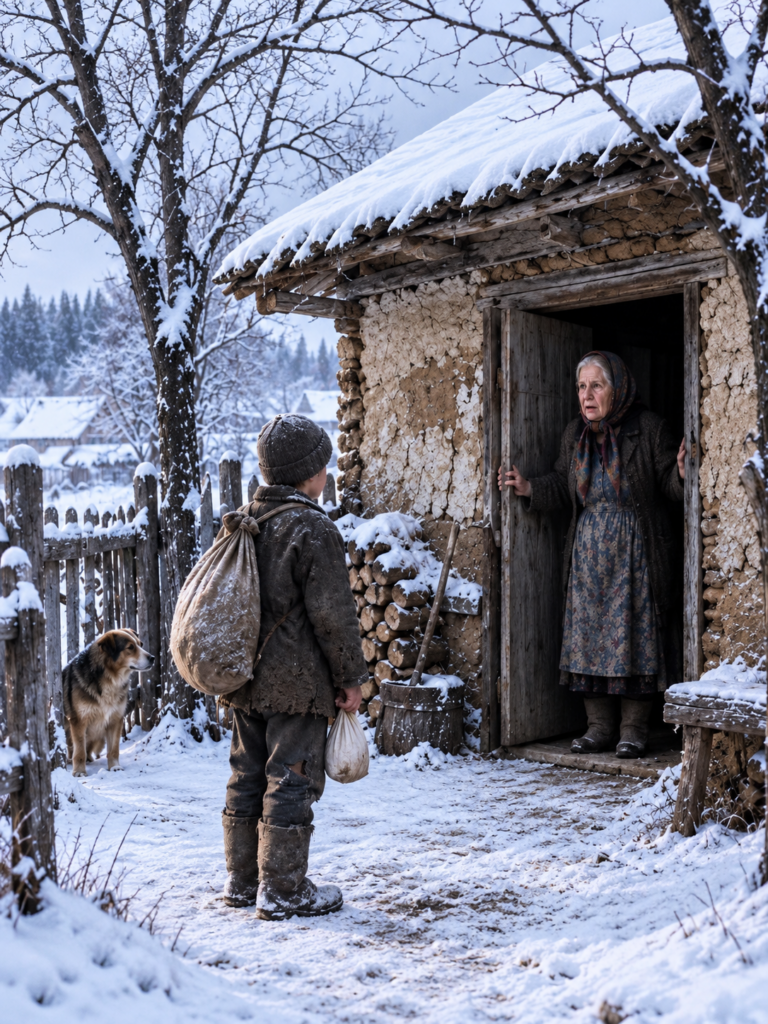
A little farther down the road, beyond a stand of birch trees, he saw a light.
It came from a small farmhouse set back behind an old wooden fence.
The house was painted pale yellow, although years of sun and winter weather had faded much of the color. A narrow chimney released a thin stream of smoke. Beside the house stood a weathered barn, a chicken coop, and a vegetable garden nearly empty for the season.
An old pickup truck rested beneath a lean-to.
It wasn’t a beautiful place.
The porch steps needed repairing. One section of fence leaned sideways. The barn roof had lost several shingles.
But there was smoke coming from the chimney.
And light glowing through the kitchen window.
Someone lived there.
Vanya stopped at the gate.
He knew he wasn’t supposed to enter strangers’ property.
His father had taught him that.
But he also knew what would happen if he spent the night outside wearing only his thin jacket.
His hands trembled as he opened the gate.
The hinges squealed.
He walked slowly toward the porch.
Before he reached the steps, the front door opened.
An elderly woman stood in the doorway.
She was small and slightly stooped, with silver-white hair pinned behind her head. She wore a faded blue dress beneath a thick knitted cardigan, and a flour-dusted apron was tied around her waist.
Her name was Antonina Hart.
She was seventy-four years old.
For nearly fifty years, she had lived on that little farm with her husband, Edwin.
Since his death nine years earlier, she had lived there alone.
Antonina had been preparing supper when she heard the gate.
At first, she assumed it was a neighbor stopping by.
Then she saw the child standing beside her porch.
His face was dirty.
His eyes were swollen.
His shoes were dusty, and one lace had broken.
But what troubled her most wasn’t his appearance.
It was the way he stood.
His shoulders were drawn inward, as though he were trying to make himself smaller.
His hands gripped the bag so tightly that his knuckles had turned white.
And when Antonina stepped onto the porch, the boy immediately moved backward.
“I’m sorry,” he said.
Antonina studied him.
“Sorry for what, sweetheart?”
“For coming here.”
She glanced toward the empty road.
“Are you lost?”
Vanya swallowed.
He wanted to say yes.
Lost sounded better than unwanted.
Instead, he shook his head.
“Do your folks know you’re out here?”
The question made his chin tremble.
He looked down at his sneakers.
For a long moment, he couldn’t speak.
Then he lifted his face toward the elderly woman.
“Ma’am?”
“Yes, honey?”
His voice broke.
“Could you take care of me?”
Antonina stopped breathing for a moment.
The boy continued quickly, frightened that she might refuse before he could explain.
“I don’t need much. I can work. I know how to collect eggs and carry water. I can sweep and wash dishes. I won’t make trouble.”
His words came faster.
“I can sleep in the barn if there’s no room inside.”
The old woman’s expression changed.
“In the barn?”
He nodded.
“I just need somewhere to stay tonight.”
Antonina stepped down from the porch.
“What’s your name, sweetheart?”
“Vanya.”
“And how old are you?”
“Eleven.”
“Eleven,” she repeated softly.
She looked at the road again.
There were no parents walking behind him.
No car pulling into the driveway.
No adult coming to explain why a child had arrived alone at her home just before dark.
“Have you eaten anything?”
Vanya hesitated.
“A sandwich.”
“When?”
“At lunchtime.”
Antonina looked toward the kitchen, where a pot of chicken stew was warming on the stove.
Then she looked back at the little boy.
“Well, Vanya, we can’t have a proper conversation while you’re standing out here freezing.”
She opened the door wider.
“Come inside.”
The boy stared at her.
“Really?”
“Really.”
“But I don’t have any money.”
Antonina’s eyes softened.
“Neither did the last hungry person who came to my door.”
“Who was that?”
“My husband, back in 1958.”
For the first time that afternoon, the smallest hint of curiosity appeared in Vanya’s expression.
Antonina smiled.
“He eventually married me, so I suppose I made a fairly serious mistake feeding him.”
The boy almost smiled.
Almost.
Then he followed her inside.
The kitchen was warm.
A woodstove crackled beside the wall. An old refrigerator hummed in the corner. Framed photographs lined a wooden shelf above the table.
The smell of chicken stew, onions, and fresh bread filled the room.
Vanya stood near the door, afraid to touch anything.
Antonina pulled out a chair.
“Sit down.”
He obeyed.
She set a bowl of stew in front of him, along with a thick slice of buttered bread.
Vanya looked at the food.
“Is all this for me?”
“Unless the chickens have learned to use spoons.”
He picked up the spoon.
At first, he ate carefully.
Then hunger overcame his manners.
He began taking quick, desperate mouthfuls, stopping only long enough to swallow.
Antonina watched without interrupting.
She had lived long enough to recognize hunger.
She had also lived long enough to recognize the fear of having food taken away.
When Vanya finished, he looked embarrassed.
“I’m sorry I ate so fast.”
“Would you like another bowl?”
He stared at her.
“Can I?”
“Of course.”
She filled his bowl again.
This time, he ate more slowly.
When he finished, Antonina placed a cup of warm milk beside him.
Then she sat across the table.
“Now,” she said gently, “would you like to tell me what happened?”
Vanya stared into his cup.
“My dad died.”
Antonina’s smile faded.
“I’m sorry.”
“My uncle and aunt live at our house now.”
He paused.
“They said they couldn’t keep me.”
The old woman remained silent.
“They told me to leave.”
Antonina felt a sharp pain beneath her ribs.
“Today?”
Vanya nodded.
“Did they tell you where to go?”
“No.”
“Did they give you money? A telephone number? Anything?”
He shook his head.
Then he whispered something that stayed with Antonina for the rest of her life.
“I think they were happier after I left.”
Outside, the wind rattled the kitchen window.
Antonina reached across the table and rested her hand beside his.
She didn’t tell him everything would be fine.
She didn’t promise that nobody would ever hurt him again.
She knew life was too complicated for promises like that.
Instead, she said something much simpler.
“Well, they were wrong to send you out alone.”
Vanya looked up.
“Am I in trouble?”
“No, sweetheart.”
“Are you going to make me leave?”
Antonina looked toward the darkening window.
“Not tonight.”
She stood, collected his empty bowl, and walked toward the stove.
“Tonight, you’re going to have a warm bed. And tomorrow, we’re going to find out how to make sure you’re safe.”
Vanya lowered his eyes.
A tear fell into his lap.
He wiped it away before she could see.
But Antonina saw.
She simply pretended she hadn’t.
Because sometimes, she knew, kindness meant allowing someone to cry without making them explain why.
Part 2
The spare bedroom hadn’t been used in months.
Antonina opened the door and switched on a small bedside lamp.
The room contained a narrow iron bed, a wooden dresser, and a faded quilt with blue and yellow squares. A small window overlooked the backyard, where the old barn stood beneath a line of trees.
“These sheets are clean,” Antonina said. “And there’s another blanket in the dresser if you get cold.”
Vanya remained in the doorway.
“Whose room is it?”
“Used to be for guests.”
He looked at the bed.
“Can I really sleep there?”
“That’s what beds are usually for.”
He didn’t laugh.
Instead, he placed his bag carefully beside the dresser.
Antonina noticed that he kept glancing toward the door.
“Something worrying you?”
Vanya hesitated.
“Do I have to get up before sunrise?”
“Not unless you particularly enjoy being awake before the chickens.”
“Should I feed them?”
“We’ll talk about chores another day.”
He looked confused.
“But I should do something.”
Antonina understood.
The child believed shelter had to be earned.
“Vanya, listen to me.”
He raised his eyes.
“You don’t have to work for your supper here.”
His face tightened.
“But—”
“No buts. Every child deserves food and a safe place to sleep.”
He looked down again.
Antonina turned toward the doorway.
“Sleep well, sweetheart.”
She was almost gone when she heard him.
“Mrs. Hart?”
“Yes?”
“Would you mind leaving the door open?”
She returned and adjusted the door until it stood halfway open.
“Like that?”
He nodded.
“Thank you.”
Antonina left the hallway lamp burning.
Long after the house grew quiet, Vanya remained awake.
He stared at the ceiling and listened to unfamiliar sounds.
The ticking of a clock.
The faint creak of floorboards.
The wind moving around the corners of the house.
Every time a vehicle passed somewhere in the distance, he sat up, afraid Raymond had come to collect him.
He didn’t know what would happen tomorrow.
He didn’t know whether Antonina would change her mind.
He didn’t even know whether his uncle and aunt had noticed that he hadn’t returned.
But for the first time in months, his stomach was full.
And nobody had shouted at him before bedtime.
Eventually, exhaustion carried him into sleep.
Downstairs, Antonina sat alone at the kitchen table.
In front of her lay an old photograph of Edwin.
Her husband stood beside a tractor, smiling beneath the brim of his battered straw hat. His left hand rested on the tractor seat. His right hand held the edge of a rolled-up fence blueprint.
Antonina touched the photograph.
“Well, Eddie,” she whispered, “looks like we’ve got company.”
She tried to smile.
Then her expression changed.
She had helped neighbors through bad harvests, blizzards, hospital stays, and funerals.
But this was different.
An abandoned child was sleeping upstairs.
And somewhere down the road, people who should have protected him had sent him away.
Antonina knew she couldn’t simply keep the boy without telling anyone.
He needed proper protection.
He needed school, medical care, and adults who could be held accountable.
Most of all, he needed to know that his future would not depend on whether one elderly woman could keep a promise by herself.
She decided to call the county office in the morning.
But before going to bed, she checked the woodstove one last time.
Then she climbed the stairs.
Vanya had fallen asleep with one hand wrapped around the strap of his canvas bag.
Antonina stood quietly in the doorway.
The sight made her heart ache.
She stepped closer, gently pulled the quilt up over his shoulder, and left the room.
That night, she slept very little.
At dawn, the rooster began crowing.
Antonina was already awake.
She filled the kettle, stirred the stove, and began preparing breakfast.
Outside, frost whitened the grass.
The first cold mornings of autumn had arrived early that year, and she knew the season ahead would not be easy.
The farmhouse needed repairs.
The barn roof leaked near the eastern wall.
Her savings were small, and winter heating bills always worried her.
There were nights when she wondered whether she should sell the place and move into a little apartment in town.
But every time she considered leaving, she remembered Edwin building the front porch with his own hands.
She remembered planting the apple trees together.
She remembered the long evenings when they sat outside listening to crickets and watching the sunset.
The farm wasn’t worth much money.
But nearly every corner held a memory.
Now, perhaps, it might become a place where someone new could make a few good memories.
Around seven, Vanya appeared in the kitchen.
His hair was rumpled.
His clothes were the same ones he’d worn the day before.
He stood silently beside the doorway.
Antonina turned around.
“Good morning.”
He looked surprised.
“Good morning.”
“Sleep all right?”
“Yes, ma’am.”
“Then come eat.”
She placed scrambled eggs, toast, and a little homemade apple jam on the table.
Vanya sat down carefully.
After a few bites, he looked toward the back window.
“Your chickens are awake.”
“They usually are.”
“I could feed them.”
“After breakfast, if you’d like.”
His expression brightened.
“I know how.”
Antonina smiled.
“I believe you.”
They finished eating together.
Then Antonina handed him one of Edwin’s old flannel jackets.
It was much too large.
The sleeves hung past his hands, and the hem reached nearly to his knees.
Vanya looked down at himself.
“It’s huge.”
“Good. There’s room to grow.”
He laughed.
It was a small laugh, but it was real.
Antonina held that sound in her heart.
Outside, the farm seemed different in daylight.
The barn leaned slightly beneath its weathered roof. A narrow path led to the chicken coop. Behind the house, an old vegetable patch contained the last stubborn cabbages of the season.
Vanya walked toward the chickens.
He opened the feed container, measured out a small portion, and scattered it across the ground.
The birds rushed forward.
One particularly bold brown hen pecked his shoelace.
“Hey!” he exclaimed.
Antonina chuckled.
“That’s Martha. She thinks everything belongs to her.”
Vanya knelt beside the bird.
“Martha, that’s my shoe.”
The hen pecked again.
He laughed harder.
For a little while, he seemed exactly what he was supposed to be.
A boy.
Not an unwanted burden.
Not a worker trying to justify his existence.
Just an eleven-year-old child laughing at a ridiculous chicken.
But later that morning, Antonina made the telephone call she had been dreading.
She contacted the county child protection office and explained what had happened.
A caseworker named Marlene Brooks arrived that afternoon with Deputy Harris, a middle-aged sheriff’s deputy who had known Antonina for years.
Vanya saw the county vehicle pull into the driveway.
His expression changed immediately.
He dropped the small bucket he was carrying.
“Are they here for me?”
Antonina set down her garden gloves.
“They’re here to help us figure things out.”
“Will they make me go back?”
“I won’t promise something I can’t decide alone,” she said. “But I’ll make sure they hear what happened.”
The boy’s breathing quickened.
“I don’t want to go back.”
Antonina knelt beside him.
“Then that’s something important you need to tell them.”
Marlene was patient.
She sat with Vanya at the kitchen table while Antonina made tea.
She asked about his father, his relatives, his school, and the day he’d been told to leave.
At first, he answered with only one or two words.
Then she asked whether he’d felt safe at home.
Vanya stared at his hands.
“I used to.”
“Before your father died?”
He nodded.
“And afterward?”
The boy’s lips trembled.
“Sometimes my uncle got angry.”
Marlene waited.
“He said I was too expensive.”
“What did you think he meant?”
Vanya looked toward Antonina.
“That I cost too much to keep.”
Nobody spoke for several seconds.
Then Marlene asked what had happened when Raymond told him to leave.
Vanya repeated the words as closely as he could remember.
When he finished, Marlene closed her notebook.
“You did the right thing telling us.”
“Am I going to jail?”
The question startled her.
“Of course not.”
“My uncle said people go to jail for bothering other families.”
Marlene’s face softened.
“Needing help isn’t a crime, Vanya.”
That afternoon, the county began arranging emergency protection for him.
Marlene explained that Antonina’s home would need safety checks and approval before any longer-term placement could be considered. There would be interviews, paperwork, and decisions made by a court.
Nothing could be settled simply because everyone wished it so.
Antonina understood.
She signed the initial documents, agreed to the checks, and made it clear that she was willing to care for the boy if the proper arrangements could be made.
Marlene inspected the spare bedroom and the kitchen.
Deputy Harris examined the exterior doors and asked about the furnace.
Antonina answered every question.
When Marlene explained that the county might need a temporary alternative if her home couldn’t be approved, Antonina’s stomach tightened.
Vanya sat silently on the stairs, listening.
Finally, Antonina asked, “Is there anything I can do to help him remain somewhere familiar while you sort this out?”
Marlene looked toward the boy.
“We’ll do everything we can to avoid another unnecessary disruption.”
That wasn’t a promise.
But it was enough to begin with.
The following days brought interviews, a home inspection, and a trip to the county office. After reviewing the immediate circumstances and with temporary authorization in place, the county allowed Vanya to remain with Antonina while the investigation continued.
He still feared being sent away.
At breakfast, he asked whether he was allowed another slice of toast.
Before using the bathroom, he asked permission.
When he accidentally knocked a spoon off the table, he apologized three times.
Antonina never scolded him.
She simply picked up the spoon and handed him another.
One evening, while they were washing dishes together, Vanya dropped a ceramic mug.
It shattered on the kitchen floor.
His face went white.
“I’m sorry! I’m sorry!”
He dropped to his knees and began gathering the broken pieces with his bare hands.
Antonina hurried toward him.
“Stop, sweetheart. You’ll cut yourself.”
“I’ll pay for it!”
“Vanya—”
“I can work extra. Please don’t make me leave.”
Antonina froze.
Then she gently took his hands away from the broken pieces.
“Look at me.”
He couldn’t.
“Vanya.”
Slowly, he raised his face.
“It was a mug.”
He started crying.
“I didn’t mean to break it.”
“I know.”
“I’ll be more careful.”
Antonina wrapped her arms around him.
For a moment, his body remained stiff.
Then he leaned against her and sobbed.
Not the quiet tears he’d shed at the table.
Not the frightened crying he’d tried so hard to hide.
These were deep, exhausted sobs from a child who had spent too many months believing that one mistake could cost him everything.
Antonina held him until his breathing slowed.
Then she said, “You know what Edwin used to tell me whenever something broke?”
Vanya shook his head.
“He’d say, ‘Well, Nina, I guess it’s a good thing we aren’t made of crockery.'”
Vanya sniffled.
“Why?”
“Because we’d all be in pieces by now.”
A weak smile appeared.
Antonina brushed the hair away from his forehead.
“Things can be replaced, sweetheart. People can’t.”
That night, after Vanya went to bed, Antonina swept the last tiny fragments of the mug from beneath the table.
She found herself crying.
Not because of the broken pottery.
But because she was beginning to understand just how deeply the boy had been hurt.
And because the more she loved him, the more frightened she became of losing him.
Part 3
By the second week of November, winter had begun pressing against the little farm.
The mornings were bitterly cold. Thin ice formed around the edges of the chicken waterers, and the fields beyond the fence turned brown and hard.
Antonina had lived through seventy-four Minnesota winters.
She knew how quickly a beautiful autumn afternoon could become a dangerous night.
She also knew her farm was growing old alongside her.
The barn roof needed patching before the first heavy snowfall. The chicken coop required new insulation, and several fence posts had begun rotting near the ground.
Before Vanya arrived, she had planned to manage only the repairs she could afford.
Now she had another person to consider.
One morning, she found him standing beside the barn with a hammer in his hand.
“What are you doing, young man?”
“Fixing the fence.”
She looked at the loose board beside him.
“Who told you to do that?”
“Nobody.”
“Then why are you doing it?”
Vanya shrugged.
“It needs fixing.”
Antonina approached him.
“Do you know how?”
He nodded.
“Dad taught me.”
He picked up the board, positioned it against the post, and began driving a nail into the wood.
His first strike missed.
His second bent the nail.
He frowned.
Antonina watched quietly.
“Your father teach you what to do when a nail bends?”
Vanya considered.
“He said to pull it out and start over.”
“Sounds like a sensible man.”
Vanya carefully removed the nail.
“He was.”
The words hung between them.
Antonina didn’t rush to fill the silence.
After a moment, the boy spoke again.
“He used to let me help with the tractor.”
“Did he?”
“He said I couldn’t drive until I was older, but I could hold the flashlight.”
Antonina smiled.
“That sounds like an important job.”
“It was.”
Vanya looked toward the distant fields.
“Sometimes he’d let me sit beside him while he worked. We didn’t even have to talk.”
His expression changed.
“I miss that.”
Antonina placed a hand on his shoulder.
“I imagine you do.”
The boy swallowed.
“Sometimes I can’t remember exactly what his voice sounded like.”
Antonina felt her throat tighten.
“That happens, sweetheart.”
“I’m scared I’ll forget him.”
She looked toward the house.
“Come with me.”
Inside, she took an old wooden box from the bedroom closet.
It contained photographs, letters, and small keepsakes from her marriage.
She opened it on the kitchen table.
There was Edwin standing beside their first tractor.
Edwin fishing in a frozen lake.
Edwin repairing the porch.
Edwin holding a newborn calf.
Vanya studied the photographs.
“Was he your husband?”
“Yes.”
“Did he die?”
“Nine years ago.”
“Do you still miss him?”
Antonina looked at the photograph in her hands.
“Every day.”
“Does it ever stop hurting?”
She thought carefully before answering.
“The hurt changes. In the beginning, it feels like there’s nothing else in the world. Later, you find room for other things again. But love doesn’t disappear.”
Vanya touched one of the photographs.
“Even when somebody dies?”
“Especially then, sometimes.”
He remained quiet.
Then Antonina gave him a small notebook.
“Why don’t you write down everything you remember about your father? His favorite sayings. The things he taught you. Even little things that don’t seem important.”
Vanya opened it.
“What if I spell something wrong?”
“Then you’ll have a notebook with spelling mistakes.”
He smiled.
“That’s all?”
“That’s all.”
That evening, Vanya wrote his first page.
My dad smelled like sawdust and coffee.
He could fix almost anything.
He used to sing badly when he washed dishes.
He always said a man should be careful with his promises.
He called me his little man.
When Antonina read the page at his invitation, she had to turn toward the window to hide her tears.
The following weeks brought small improvements.
Vanya returned to school after arrangements were made with the county and the local district.
His teacher, Mrs. Fletcher, noticed that he was quiet around other children but eager to learn.
He struggled with mathematics.
He loved reading.
And whenever the class studied agriculture or local history, he raised his hand with surprising confidence.
At home, Antonina helped him with spelling while he taught her how to use the old tablet her niece had sent years earlier.
They made an unlikely pair.
She taught him how to bake biscuits, store root vegetables, and recognize an approaching snowstorm from the clouds.
He taught her how to enlarge the letters on the tablet screen and find photographs of unusual chicken breeds.
Sometimes he would read aloud while she mended clothing beside the stove.
Sometimes they played cards.
And sometimes they sat without speaking, listening to the wind.
But Vanya’s fear had not disappeared.
Whenever a car slowed near the gate, he stopped whatever he was doing.
Whenever the telephone rang, he glanced toward Antonina.
And on nights when the wind shook the windows, he sometimes woke from dreams in which Raymond was standing beside his bed, ordering him to leave.
Antonina never told him to forget.
She simply reminded him where he was.
One December morning, the first serious storm arrived.
Heavy snow began falling before sunrise.
By noon, the road had nearly disappeared beneath drifting white banks.
Antonina had checked the barn the previous evening, but a sudden gust had loosened a section of the old roof.
When she went outside to inspect it, she discovered snow blowing through a gap above the feed storage area.
The bags of grain were getting wet.
Worse, the barn door had been forced partly open, allowing the wind to sweep directly into the enclosure where she kept two goats.
Antonina tried pulling the door shut.
The swollen wood refused to move.
She pushed harder.
Pain shot through her right knee.
For a moment, she gripped the doorframe, breathing through the sharp ache.
Vanya came running from the house.
“Mrs. Hart!”
“I’m all right.”
But she wasn’t.
Her knee had troubled her for years, and the cold made it worse.
Vanya looked at the loose door.
“I can help.”
“Go back inside. It’s too cold.”
“But the goats—”
“Vanya.”
He stopped.
She could see the conflict on his face.
He wanted to obey.
But he also understood the danger.
“Please,” he said. “Dad showed me how to brace a door.”
Antonina looked at the heavy snow gathering around the barn.
Then she nodded.
“All right. But we’ll do it together, and neither of us is climbing onto that roof.”
They worked slowly.
Vanya fetched a length of timber from the tool shed while Antonina found a heavy iron bracket.
Together, they cleared snow from the doorway and positioned the timber against the weakened frame.
Vanya held it steady while Antonina secured the bracket.
Then they moved the damp feed bags away from the leak and covered them with a tarpaulin.
It wasn’t a permanent repair.
But it would protect the animals until the storm passed.
When they finally returned to the house, their cheeks were red and their boots were packed with snow.
Antonina sank into a kitchen chair.
Vanya immediately brought her a blanket.
“Your knee hurts.”
“A little.”
“Should I call someone?”
“Not yet.”
He looked worried.
She reached for his hand.
“You did good work today.”
Vanya stared at her.
“Really?”
“Really.”
He sat across from her.
For several seconds, he remained silent.
Then he asked, “Can I tell you something?”
“Anything.”
“When my dad was sick, I used to think that if I worked hard enough, he’d get better.”
Antonina’s heart sank.
“I thought maybe God would see me helping and let him stay.”
He looked down.
“But he died anyway.”
Antonina squeezed his hand.
“Vanya, your father’s illness wasn’t something you could fix.”
“I know.”
“Do you?”
He didn’t answer.
She moved her chair closer.
“Sometimes bad things happen even when people have done everything right. That doesn’t mean they failed.”
The boy’s eyes filled.
“I couldn’t save him.”
“No, sweetheart. You couldn’t.”
A tear rolled down his cheek.
Antonina gently brushed it away.
“But I think you gave him something very precious while he was alive.”
“What?”
“A son who loved him.”
Vanya began crying.
Antonina held him as the storm battered the windows.
Outside, the snow continued falling.
Inside, beside the warm stove, an old widow and a fatherless boy shared the kind of grief that could never be completely explained.
Something changed after that day.
Vanya still helped around the farm, but he no longer rushed to prove his worth every morning.
Sometimes he played in the snow.
Sometimes he read for hours.
Sometimes he laughed at Martha the chicken or complained about mathematics.
Antonina treasured those complaints.
They were ordinary.
And ordinary childhood was something the boy had nearly lost.
A few days before Christmas, Vanya surprised her with a small wooden sign.
He had made it from a piece of scrap lumber.
The letters were uneven, and the paint had run slightly down one side.
It read:
hart family farm
Antonina stood in the kitchen holding it.
“Where did you get this?”
“I made it.”
“I can see that.”
“I thought we could hang it by the gate.”
She smiled.
“Why there?”
Vanya looked nervous.
“Because people might want to know whose farm this is.”
Antonina studied him.
“Whose farm do you think it is?”
He swallowed.
“Yours.”
She knelt carefully beside him.
“And who lives here?”
He looked at the floor.
“You.”
“Anyone else?”
His eyes rose slowly.
“Me?”
Antonina smiled.
“Yes, sweetheart. You.”
He threw his arms around her.
For the first time since his father’s death, Vanya allowed himself to imagine a future that wasn’t filled with fear.
But neither of them knew that someone else had begun asking questions about the boy.
And before winter was over, the people who had sent him away would come looking for him.
Part 4
The first warning came on a Thursday afternoon.
Antonina was folding laundry when the telephone rang.
Marlene Brooks was calling from the county office.
“Mrs. Hart, I wanted to let you know we’ve had contact from Vanya’s uncle.”
Antonina sat down slowly.
“Raymond?”
“Yes.”
“What does he want?”
“He says he’s concerned about the boy and wants him returned to the family.”
Antonina looked toward the window.
Outside, Vanya was clearing snow from the porch steps with a small shovel.
“Concerned,” she repeated.
Marlene paused.
“The investigation is still open. His uncle has been informed that any decisions about Vanya’s placement have to go through the proper process.”
“Does Vanya know?”
“Not yet. I wanted to speak with you first.”
Antonina closed her eyes.
She had known this possibility existed.
Still, hearing the words made her stomach tighten.
“What happens now?”
“There may be a hearing. We’ll need to review his uncle’s circumstances and the concerns about the abandonment. The court will also consider Vanya’s safety and well-being.”
Antonina looked at the boy outside.
He was attempting to build a snowman beside the porch.
One of the goats had escaped its enclosure earlier and was now watching him through the fence.
Vanya seemed happy.
It was such a simple thing.
An eleven-year-old boy playing in the snow.
And Antonina suddenly felt fierce anger toward the adults who had made happiness so difficult for him.
“Mrs. Hart?” Marlene asked.
“I’m here.”
“I know you’ve become attached to him.”
Antonina’s throat tightened.
“Attached isn’t quite the word.”
There was a pause.
“I understand.”
“No,” Antonina said gently. “I don’t think you do.”
She watched Vanya throw a snowball toward the empty field.
“He came here asking whether anyone could take care of him. Do you know what it does to a person to hear a child ask that?”
Marlene remained silent.
Antonina continued.
“He didn’t ask for toys. He didn’t ask for money. He offered to sleep in my barn.”
Her voice trembled.
“And now the people who sent him away want him back.”
“I know this is difficult.”
Antonina took a deep breath.
“I’ll cooperate with whatever the court requires. But I want that boy protected.”
“That’s our priority, too.”
After the call, Antonina sat at the kitchen table for a long time.
She wanted to tell Vanya immediately.
But she knew the news would frighten him.
That evening, after supper, she invited him to sit beside her.
“Vanya, there’s something we need to talk about.”
He looked up from his book.
“Am I in trouble?”
“No.”
He relaxed slightly.
“Your uncle has contacted the county.”
The boy went completely still.
“What?”
“He says he wants you to come back.”
The book slipped from Vanya’s hands.
He stared at her.
“No.”
“Sweetheart—”
“No, I don’t want to.”
Antonina moved closer.
“Listen to me.”
His breathing quickened.
“Did I do something wrong?”
“Nothing.”
“Then why?”
Antonina took both his hands.
“Because grown-ups sometimes make decisions for reasons children don’t understand. And sometimes those decisions are wrong.”
Vanya shook his head.
“He doesn’t want me.”
“He’s saying something different now.”
The boy began crying.
“He told me to leave. He said I wasn’t his problem.”
“I know.”
“He closed the door.”
Antonina held him.
For several minutes, he couldn’t speak.
Then he whispered, “Please don’t send me back.”
She tightened her arms around him.
“I am going to do everything I properly can to keep you safe.”
“But what if they make me?”
“We’ll face that together.”
Vanya buried his face against her shoulder.
Antonina stared across the kitchen at the old photograph of Edwin.
For the first time in years, she wished desperately that her husband were still alive.
Not because she needed him to make a decision.
She already knew what she believed was right.
But because carrying the fear alone was exhausting.
Over the following weeks, the county continued investigating.
Marlene interviewed teachers, neighbors, and the adults who had lived in Samuel Ellis’s farmhouse.
Deputy Harris reviewed the earlier report.
Vanya met privately with a child welfare worker who explained that his feelings mattered and that the adults responsible for his protection needed to hear them.
Meanwhile, Antonina made preparations of her own.
She gathered records showing that she had provided food, clothing, school transportation, and medical care.
She arranged for the remaining repairs required for a longer placement.
She even asked an attorney in town to explain the guardianship process.
The lawyer, Margaret Collins, had known Edwin and Antonina for more than thirty years.
She came to the farmhouse one Saturday afternoon.
Antonina brought out coffee and homemade biscuits.
Margaret reviewed the documents spread across the table.
“You’re doing the right things, Nina.”
Antonina frowned.
“Then why am I so frightened?”
Margaret removed her glasses.
“Because you love him.”
Antonina looked away.
“At my age, that doesn’t seem very sensible.”
“Love rarely asks whether the timing is sensible.”
Antonina gave a tired smile.
Margaret continued.
“There are practical issues. Your age isn’t automatically disqualifying, but they will look at your health, your finances, the condition of the house, and what support you have.”
“I know.”
“And if a relative wants custody, the court has to examine that carefully.”
Antonina folded her hands.
“What about what happened to him?”
“That matters very much.”
She glanced toward the stairway.
“And what the boy wants?”
“His wishes can be considered, although they won’t be the only factor.”
Antonina nodded slowly.
Margaret reached across the table.
“Nina, you’ve already given him something nobody can take away.”
“What?”
“The knowledge that somebody believed he was worth protecting.”
Antonina looked toward the empty chair beside the stove.
“I just wish believing were enough.”
One evening, she found Vanya sitting on the porch steps.
He was holding the notebook she had given him.
“Cold out here,” she said.
He nodded.
She sat beside him, pulling her cardigan tighter.
After a moment, she noticed a folded sheet of paper tucked between the pages.
“What’s that?”
Vanya hesitated.
“A letter.”
“To whom?”
“My uncle.”
Antonina didn’t ask to read it.
Instead, she waited.
Finally, Vanya unfolded the page.
“I was trying to explain why I don’t want to go back.”
His voice trembled.
“I wrote that I wasn’t trying to be bad. And that I really did work hard.”
Antonina closed her eyes briefly.
He continued.
“I thought if I explained everything, maybe he’d understand.”
She turned toward him.
“Vanya, you don’t have to convince anyone that you deserved to be treated kindly.”
“But maybe he thinks I didn’t try.”
“Then he’s mistaken.”
The boy stared at the letter.
“Do you think he ever loved me?”
Antonina searched for words.
She didn’t want to lie.
“I can’t tell you what was in his heart.”
Vanya nodded sadly.
“But I can tell you this,” she added. “Whatever he felt, he failed to take care of you the way you needed.”
He folded the paper.
“Does that mean I shouldn’t forgive him?”
“That’s something only you can decide.”
“What would you do?”
Antonina looked across the frozen fields.
“I’d try not to let anger turn me into somebody I didn’t want to become.”
She paused.
“But forgiveness doesn’t mean pretending something never happened. And it doesn’t mean putting yourself back where you’re unsafe.”
Vanya considered her words.
Then he leaned against her shoulder.
They sat together until the porch light flickered on.
The next morning, Antonina received another telephone call.
This time, it was Deputy Harris.
“Mrs. Hart, I wanted to give you a heads-up. Raymond Ellis has been making inquiries around town. He may try contacting you directly.”
Antonina looked toward the barn.
“Is he allowed to?”
“He can ask to speak with you. But he’s been told not to attempt to remove Vanya or interfere with the placement.”
“Understood.”
“And Nina?”
“Yes?”
“If he shows up and things get heated, call me.”
Antonina gave a quiet sigh.
“I don’t intend to get heated.”
“I know you don’t.”
After hanging up, she went outside.
Vanya was beside the barn, tightening a loose fence board.
The wind was gentle that morning.
The sky was clear.
For the first time in several days, the sun had warmed the old wooden siding enough to release the smell of damp timber.
Antonina watched the boy work.
His movements reminded her of Edwin.
Not because the two resembled each other physically.
But because Vanya approached each task with the same careful determination.
He wanted to do things properly.
He wanted to be useful.
He wanted to belong.
“Vanya,” she called.
He looked up.
“Yes, Grandma Antonina?”
She smiled.
He had begun calling her that a few weeks earlier.
The first time, he’d done it accidentally.
Then he’d turned bright red and apologized.
Antonina had told him she liked it.
Now he used the name naturally.
“Come inside in a few minutes,” she said. “I’ve got some biscuits ready.”
“Okay!”
She turned back toward the house.
That was when she heard it.
The sound of an engine approaching along the county road.
At first, she thought it was a neighbor.
Then a dark pickup truck appeared beyond the birch trees.
Vanya lifted his head.
The truck slowed.
Dust and loose gravel scattered beneath its tires.
It stopped directly outside the wooden gate.
The driver’s door opened.
A broad-shouldered man stepped out wearing work boots, a dark jacket, and a baseball cap.
Antonina had never met him.
But she recognized his face from the photographs Marlene had shown her.
Raymond Ellis.
Vanya dropped the hammer.
His face turned pale.
“Grandma,” he whispered.
Antonina walked slowly toward the gate.
Raymond looked past her toward the boy.
“There he is.”
He gave a short, humorless smile.
“Well, Vanya. Looks like you’ve had yourself a nice little vacation.”
The boy didn’t move.
Raymond opened the gate.
“Come on, son. Get your things.”
Antonina stepped into his path.
“Mr. Ellis?”
He looked down at her.
“Who are you?”
“My name is Antonina Hart.”
Raymond glanced impatiently toward the barn.
“Well, Mrs. Hart, I appreciate you looking after him. But he’s coming home.”
Antonina stood still.
Behind her, Vanya began trembling.
And in that quiet farmyard, beneath the cold Minnesota sky, the boy’s future suddenly seemed to hang on what happened next.
Part 5
Antonina had faced blizzards that buried her fences, droughts that ruined her garden, and hospital corridors where doctors delivered news that changed her life forever.
She had buried her parents.
She had buried her husband.
She had watched neighbors lose farms that had been in their families for generations.
She knew what fear felt like.
But standing at that gate, looking into Raymond Ellis’s impatient face, she discovered something stronger.
The determination to protect a child who had finally begun to feel safe.
“Mr. Ellis,” she said calmly, “you aren’t taking Vanya anywhere today.”
Raymond frowned.
“Excuse me?”
“The county has arranged his placement here. If you want to change that, you need to speak with them.”
Raymond shook his head.
“I’m his uncle.”
“I understand.”
“He’s family.”
“I understand that, too.”
“Then what’s the problem?”
Antonina looked toward Vanya.
The boy stood beside the barn, motionless.
The joy she’d seen in him earlier that morning had vanished.
He looked exactly like the frightened child who had first appeared at her door.
“The problem,” Antonina said, “is that you sent an eleven-year-old boy down a country road with nowhere to go.”
Raymond’s jaw tightened.
“You don’t know what happened.”
“Then explain it.”
He glanced toward the boy.
“He was difficult.”
Antonina said nothing.
“We had bills. The farm wasn’t making money. We couldn’t handle everything.”
“That sounds like a hard situation.”
Raymond seemed surprised by her answer.
“It was.”
“But it doesn’t explain leaving a child alone.”
He looked away.
“Things got out of hand.”
Antonina studied him.
For the first time, she saw something beyond his anger.
There was embarrassment.
There was frustration.
And perhaps there was shame.
But there was also the stubborn pride of a man who had spent months refusing to admit that he’d done something terribly wrong.
Raymond cleared his throat.
“Look, I came to get him. I don’t want trouble.”
“Neither do I.”
“Then tell him to get in the truck.”
Antonina’s expression hardened.
“No.”
Raymond took a step forward.
“Lady, don’t interfere in family business.”
Antonina didn’t move.
“Mr. Ellis, caring for a child is not simply family business. It’s a responsibility.”
He opened his mouth to respond.
She continued.
“And your nephew isn’t a sack of grain you can leave beside the road and collect whenever it suits you.”
The words struck him.
For a moment, he had no answer.
Then he raised his voice.
“Vanya! Come here!”
The boy flinched.
Antonina turned toward him.
“Sweetheart, stay where you feel comfortable.”
Raymond glared at her.
“You’re turning him against us.”
Antonina shook her head.
“I haven’t needed to say anything against you.”
“Then why won’t he come?”
The old woman looked him directly in the eyes.
“Why don’t you ask him?”
Raymond turned.
“Vanya!”
The boy’s hands were shaking.
“Come on. We’re going home.”
Vanya looked toward Antonina.
She stood quietly beside the gate.
She didn’t tell him what to say.
She didn’t demand that he be brave.
She simply waited.
The boy remembered the long gravel road.
The cold evening.
The hunger.
The sound of the farmhouse door closing behind him.
Then he remembered something else.
A warm bowl of stew.
A clean bed.
A woman who had told him he didn’t need to work for his supper.
And the words she’d repeated whenever he made a mistake.
You belong here.
Vanya took one slow step forward.
Then another.
Raymond extended his hand impatiently.
“Let’s go.”
The boy stopped several feet away.
His voice trembled.
“I don’t want to.”
Raymond blinked.
“What?”
Vanya swallowed.
“I don’t want to go back.”
“Don’t start this nonsense.”
The boy’s eyes filled with tears.
“You told me to leave.”
Raymond looked away.
“That was different.”
“You said I wasn’t your problem.”
“Vanya—”
“You wouldn’t let me stay.”
Raymond’s face flushed.
“We were having a bad day.”
The boy shook his head.
“It wasn’t just one day.”
The farmyard fell silent.
Vanya continued.
“I tried to help. I fed the chickens. I carried wood. I cleaned the kitchen. I did everything you asked.”
His voice cracked.
“But you kept saying I wasn’t good enough.”
Raymond stared at him.
Vanya wiped his eyes.
“I thought if I worked harder, maybe you’d like me.”
Antonina felt tears gathering, but she remained still.
The boy took a deep breath.
“When you told me to leave, I thought maybe I deserved it.”
Raymond opened his mouth.
Nothing came out.
Vanya looked toward the little farmhouse.
“Grandma Antonina says I don’t have to earn a place at the table.”
His uncle followed his gaze.
For the first time, Raymond seemed to notice the signs of the life the boy had built.
The repaired fence.
The small shovel leaning against the porch.
The wooden sign hanging beside the gate.
hart family farm.
Raymond looked at Antonina.
“He’s calling you Grandma?”
She nodded.
“Yes.”
The man lowered his head.
For several moments, nobody spoke.
Finally, Raymond said, “Vanya, I didn’t think you’d go so far.”
The boy stared at him.
“You told me to go.”
Raymond rubbed his forehead.
“I know.”
“You didn’t come after me.”
His uncle looked down.
“I know.”
There was no dramatic confession.
No sudden transformation.
Just a man standing on a gravel driveway, slowly confronting the damage caused by his own actions.
At last, he said quietly, “I’m sorry.”
Vanya didn’t answer.
Raymond looked toward Antonina.
“I made a mistake.”
She regarded him carefully.
“Yes, you did.”
He swallowed.
“A terrible one.”
Antonina nodded.
“But an apology doesn’t settle what happens next. That’s for the proper authorities to decide.”
Raymond looked toward the road.
“I suppose I should go.”
“That would be best for today.”
He stood another moment, then returned to his truck.
Before climbing inside, he looked back at Vanya.
“I hope someday you can forgive me.”
Vanya held the old woman’s hand.
“I don’t know.”
Raymond nodded slowly.
“That’s fair.”
He got into the truck.
The engine started.
Gravel crunched beneath the tires as the vehicle pulled away.
Vanya watched until it disappeared beyond the birch trees.
Only then did he begin crying.
Antonina knelt as carefully as her aching knees allowed.
The boy ran into her arms.
“He left,” he sobbed.
“Yes, sweetheart.”
“He’s really gone?”
“For today, yes.”
“Did I do something bad?”
Antonina pulled back enough to look at him.
“No.”
“But I told him I didn’t want to go.”
“You told him how you felt.”
The boy wiped his face.
“Was that wrong?”
“No, Vanya.”
She placed her hands on his shoulders.
“You were honest, and you were brave.”
He leaned against her again.
For a long time, they stayed beside the gate.
The wind moved gently through the trees.
Somewhere near the barn, Martha the chicken began making a tremendous amount of noise.
Eventually, Antonina smiled.
“I think Martha wants her supper.”
Vanya gave a weak laugh.
“She’s always hungry.”
“Then we’d better go feed her.”
Together, they walked back toward the farmhouse.
But the matter wasn’t finished.
Antonina called Marlene and reported Raymond’s visit. The county spoke with him and reminded him that he couldn’t remove the child or arrange an unsupervised return.
Over the following weeks, the investigation continued.
Raymond and Claire were interviewed again.
School records were reviewed.
The circumstances of Vanya’s abandonment were documented.
The county also looked closely at Antonina’s situation.
A seventy-four-year-old widow caring for an eleven-year-old child was not a decision anyone wanted to make carelessly.
Her health mattered.
Her ability to provide stability mattered.
The farmhouse’s condition mattered.
And the availability of support mattered.
Antonina worked steadily to address every concern.
Neighboring farmers helped repair the barn roof. Margaret Collins guided her through the legal paperwork, and the county arranged assessments and services for Vanya.
Mrs. Fletcher wrote about the progress he’d made at school.
Deputy Harris provided his account of the initial report.
And Marlene documented the boy’s growing sense of safety and the bond he’d formed with Antonina.
It wasn’t quick.
It wasn’t simple.
Some nights, Antonina lay awake worrying that a single failed inspection or unfavorable decision might change everything.
Vanya noticed.
One evening, he found her sitting beside the stove, studying a pile of documents.
“Grandma?”
She looked up.
“Yes?”
“Are we going to be okay?”
Antonina set down her glasses.
“I believe we’re doing everything we can.”
He stood beside her chair.
“What if that’s not enough?”
She considered the question.
Then she opened her arms.
Vanya sat beside her.
“Do you remember what your father taught you about fixing fences?”
He nodded.
“If the nail bends, pull it out and start again.”
“That’s right.”
She smiled gently.
“Sometimes that’s what life asks us to do. Keep trying, even when something doesn’t work the first time.”
Vanya leaned against her.
“I want to stay here.”
Antonina kissed the top of his head.
“I know, sweetheart.”
Weeks later, the day of the court hearing arrived.
The sky was pale gray.
A thin layer of fresh snow covered the courthouse steps.
Antonina wore her best navy dress, the one she’d bought for Edwin’s retirement dinner many years earlier.
Vanya wore a clean white shirt beneath a dark sweater.
Before they left the farmhouse, Antonina noticed him standing beside the kitchen table.
“Everything all right?”
He nodded.
Then he shook his head.
“I’m scared.”
“So am I.”
He looked surprised.
“You are?”
“Very.”
He studied her.
“But you always know what to do.”
Antonina laughed softly.
“Oh, sweetheart. I’ve spent most of my life figuring things out as I went along.”
He thought about that.
Then he reached for her hand.
“I guess we can be scared together.”
Antonina squeezed his fingers.
“I think that’s a fine idea.”
At the hearing, the adults presented their information.
The county explained its findings.
Raymond and Claire were present.
Raymond looked older than Vanya remembered.
His shoulders were slumped, and he avoided the boy’s eyes.
When asked about the day Vanya had been told to leave, Raymond admitted that he’d ordered him out of the house.
He acknowledged that he hadn’t arranged a safe place for the child to go.
Claire cried quietly.
Neither offered a convincing explanation for why they had failed to protect him.
The judge listened carefully.
Then the court heard from the professionals who had worked with Vanya.
They described his distress after the abandonment, his progress in school, and the stability he had found at Antonina’s farm.
Antonina answered questions about her health, her home, and her willingness to care for him.
She didn’t pretend to be younger than she was.
She didn’t claim to have endless money or perfect health.
She explained her plans for transportation, medical appointments, school, and assistance from trusted neighbors if she became ill.
Finally, through the appropriate arrangements for hearing a child’s views, Vanya was given an opportunity to explain what he wanted.
He looked toward Antonina.
Her face was pale.
Her hands were folded tightly in her lap.
But she smiled at him.
The boy took a breath.
“I want to stay with Grandma Antonina.”
He paused.
“She feeds me even when I don’t do my chores.”
A few people smiled gently.
Vanya continued.
“When I make mistakes, she doesn’t yell.”
His voice began to shake.
“And when I wake up scared, she tells me I’m safe.”
He looked down.
“I know she’s not my real grandmother.”
Then he lifted his head.
“But she feels like my family.”
Antonina covered her mouth with one trembling hand.
Vanya looked toward Raymond.
“I don’t hate my uncle.”
The man lowered his eyes.
“But I don’t want to live somewhere I’m afraid all the time.”
The room grew quiet.
Vanya finished softly.
“I just want to go home.”
The final decision did not depend on those words alone.
It followed the investigation, the court’s review, and the arrangements needed to protect the boy.
But when the judge approved a guardianship arrangement allowing Antonina to become Vanya’s legal guardian, the old woman bowed her head and wept.
She had spent months afraid to believe this day could come.
Now it had.
Outside the courthouse, Vanya looked up at her.
“Grandma?”
“Yes, sweetheart?”
“Does this mean I can stay?”
Antonina knelt beside him despite the pain in her knees.
“It means we’re going home together.”
“Forever?”
She held his face gently.
“As long as I can care for you, I will. And we’ve made sure there are other good people who will help us, too.”
Vanya wrapped his arms around her.
“I love you, Grandma.”
Antonina closed her eyes.
For nine years after Edwin’s death, she had lived in a house that often felt painfully silent.
She had grown accustomed to eating alone.
To hearing only her own footsteps in the hallway.
To looking across the kitchen table at an empty chair.
Now, standing outside the courthouse with snow falling around them, she realized that something she thought she’d lost forever had returned.
Not her old life.
Not Edwin.
Not the years that had passed.
Something new.
A reason to come home smiling.
That spring, the little farm began changing.
With help from neighbors, Antonina repaired the porch and replaced the worst section of the barn roof.
Vanya planted beans, carrots, and potatoes beside her garden.
The chickens continued causing trouble.
Martha remained convinced that every shoelace in the county belonged to her.
And in the kitchen, the chair across from Antonina was no longer empty.
Vanya continued attending school.
He made friends.
He learned to ride a bicycle along the gravel road.
Sometimes he still had nightmares.
Sometimes memories of his uncle’s words returned unexpectedly.
But when they did, he had someone to talk to.
Antonina didn’t expect his wounds to disappear simply because the court had made a decision.
Healing required time.
And time was something she was determined to give him.
One Sunday afternoon in late May, Vanya asked whether they could visit his father’s grave.
Antonina drove him to the small cemetery outside town.
The grass was bright green, and fresh leaves moved gently in the trees.
Vanya carried a little bundle of flowers from the garden.
He knelt beside Samuel Ellis’s headstone.
For a while, he said nothing.
Then he began speaking softly.
“Hi, Dad.”
Antonina stood a short distance away.
“I wanted to tell you something.”
The boy placed the flowers on the grave.
“I found somebody.”
His voice trembled.
“Her name is Grandma Antonina.”
He wiped his eyes.
“She’s nice, Dad. Really nice.”
The wind stirred the grass.
“She has chickens. One of them is mean.”
Antonina smiled through her tears.
“And she makes biscuits like you used to.”
Vanya looked down.
“I still miss you.”
He took a deep breath.
“But I’m okay now.”
For a moment, he seemed to struggle with something.
Then he whispered, “I thought you might be worried about me.”
Antonina turned her face away.
The boy rested one hand gently on the headstone.
“You don’t have to worry anymore, Dad.”
When he finally stood, Antonina held out her hand.
He took it.
Together, they walked back toward the truck.
That evening, the sunset spread gold and orange across the fields.
Antonina sat on the porch while Vanya worked beside the gate.
He had taken down the wooden sign he’d made months earlier.
Now he was sanding it smooth.
“What are you doing to our sign?” Antonina called.
“Making it better!”
She watched him paint carefully.
When he finished, he carried the sign to the porch.
The letters were straighter this time.
The paint was a brighter blue.
And beneath the original words, he had added a second line.
hart family farm
grandma antonina and vanya
Antonina read it twice.
Then she looked at the boy.
“Do you like it?” he asked nervously.
She couldn’t speak at first.
Finally, she nodded.
“I love it.”
Vanya grinned.
“Then let’s hang it up.”
They carried the sign to the gate together.
Antonina held it steady while Vanya fastened the screws.
When the last screw was tightened, he stepped back to admire his work.
The farmhouse stood behind them.
The porch had been repaired.
The vegetable garden was growing.
Smoke drifted gently from the chimney.
And beyond the old fence, the same gravel road stretched away through the fields.
It was the road Vanya had walked on the worst day of his life.
The road where he’d been hungry, frightened, and completely alone.
Antonina followed his gaze.
“What are you thinking about, sweetheart?”
Vanya looked toward the distant bend.
“I remember walking down that road.”
She took his hand.
“So do I.”
“I thought nobody wanted me.”
Antonina squeezed his fingers.
The boy looked up at her.
“But I was wrong.”
Her eyes filled with tears.
“Yes, sweetheart.”
He smiled.
“I think this road brought me home.”
Antonina pulled him close.
The evening breeze moved through the birch trees, and the old farmhouse stood peaceful beneath the fading light.
Nothing about their lives had become perfect.
There were still bills to pay.
Fences to repair.
Cold winters to survive.
And memories that would sometimes hurt.
But inside that modest house, there was a place for two people who had once believed they might spend the rest of their lives alone.
There would be supper at the kitchen table.
Laughter over burnt biscuits.
Homework beside the stove.
Stories about those they had lost.
And the quiet certainty that neither had to face tomorrow without someone who cared.
Years later, when Vanya was old enough to understand how much that first meeting had changed his life, he would remember one particular moment.
Not the courthouse.
Not the day his uncle drove away.
Not even the first time Antonina called him family.
He would remember standing on that porch as an exhausted little boy, holding his belongings in a canvas bag.
He would remember an elderly woman looking at him with kind eyes.
And he would remember asking the question that had taken every ounce of courage he possessed.
“Could you take care of me?”
Antonina hadn’t asked whether he could pay.
She hadn’t demanded that he prove himself useful.
She hadn’t told him that his problems were too complicated.
She had simply opened her door.
And because she did, a frightened child discovered that being abandoned did not make him worthless.
An elderly widow discovered that growing old did not mean her life had nothing left to give.
And a quiet little farmhouse became a home again.
Sometimes the greatest gift a person can offer isn’t money, land, or anything that can be bought.
Sometimes it’s a warm meal when someone is hungry.
A safe bed when someone is frightened.
A hand to hold when the future seems uncertain.
And sometimes, when a lonely child stands at your door believing the whole world has rejected him, the greatest thing you can say is simply:
“Come inside, sweetheart. There’s room for you here.”