
Part 1
The day nineteen-year-old Rose Harding spent her last three silver dollars on a dead man’s cabin, nearly every man in Redemption Gulch laughed at her.
The richest man in town laughed the loudest.
“Three dollars?” Silas Croft shouted from the front of the auction crowd. “Girl, you just paid good money for forty acres of rocks, rotten logs, and a dead man’s ghost!”
Laughter rolled across the dusty clearing.
Rose stood alone beside the auction wagon, clutching the empty leather pouch that had held everything she owned.
Her faded blue calico dress hung loosely on her thin frame. Her boots were worn almost through at the heels, and a long scratch marked her cheek where a branch had caught her during the journey into town.
She hadn’t eaten a proper meal in two days.
But she kept her chin raised.
Because for the first time since her parents died, she owned something.
Even if everyone believed it was worthless.
The auctioneer, a heavyset man with a red face and a booming voice, raised his wooden gavel.
“Sold! Forty acres in the Rattlesnake Mountains, including the old Blackwood trapping lodge, to Miss Rose Harding for three dollars!”
The gavel struck the wagon bed.
And just like that, the last of her mother’s money was gone.
Rose looked toward the mountains rising beyond the settlement.
Their distant peaks were already touched with early autumn snow.
Somewhere up there stood a cabin that hadn’t been occupied in years.
A cabin belonging to a trapper named Silas Blackwood, who had vanished into the wilderness so long ago that most townspeople assumed he was dead.
Nobody wanted his property.
Nobody except Silas Croft, who had offered one dollar for its timber rights.
And Rose, who needed somewhere to live.
She hadn’t always been desperate.
Two years earlier, Rose had lived with her parents on a small farm east of Cheyenne.
It wasn’t a prosperous farm, but it was theirs.
Her father, Samuel Harding, had cleared the land himself, digging stones from the soil and building a two-room house with timber hauled by wagon from the foothills.
Her mother, Martha, kept chickens, planted vegetables, and sewed clothing for neighbors whenever the household needed extra money.
Rose had grown up working beside them.
She knew how to milk a cow before she was ten.
She could mend a fence, sharpen an axe, harness a mule, and bake bread in a woodstove.
Her father used to say she had been born with more determination than most grown men.
“You’re going to make somebody a fine wife someday, Rosie,” he would tease.
She would wrinkle her nose.
“Maybe I’ll just keep my own farm.”
He always laughed.
“Well, that would suit me too.”
On summer evenings, the three of them ate supper on the porch while meadowlarks called across the fields.
Those were the memories Rose carried most carefully.
The smell of fresh bread.
Her father’s rough hand resting on her shoulder.
Her mother’s voice singing softly as she hung washing beneath the cottonwoods.
Then came the drought.
For two summers, rain failed to arrive when the crops needed it.
The creek shrank to muddy pools.
Corn withered in the fields.
The garden yielded barely enough to feed them.
Her father borrowed money to buy seed and keep the farm operating.
When the next harvest failed, he borrowed again.
He told Rose not to worry.
“Land doesn’t forget how to grow,” he said. “We just have to hold on until the rain comes back.”
But the rain didn’t come.
Fever struck the surrounding settlements that spring.
Samuel fell ill after helping a neighbor carry a sick child home through a cold storm.
Within a week, he was too weak to leave his bed.
Rose and Martha sat beside him through long nights, changing damp cloths and listening to his breathing grow increasingly shallow.
One morning, he called Rose to him.
“Remember what I taught you about choosing land?”
She nodded through her tears.
“Good soil. Water nearby. High ground to break the wind.”
He smiled faintly.
“That’s my girl.”
Then his eyes closed.
He died before sunrise.
Rose buried him beside the little orchard he had planted when she was born.
That summer, Martha became sick.
At first, she insisted it was exhaustion.
She still rose before dawn.
Still cooked meals.
Still sat at the kitchen table trying to balance the farm accounts.
But her cough worsened.
She grew pale.
And by August, she could barely cross the room without stopping to rest.
Rose sold the remaining chickens to pay for medicine.
Then she sold her mother’s sewing machine.
Then the last milk cow.
Nothing helped.
On a quiet September evening, Martha called her daughter to the bedside.
“Bring me your blue dress, sweetheart.”
Rose obeyed.
Her mother turned the hem inside out and carefully unpicked a few stitches.
Three silver dollars slipped into her palm.
Rose stared.
“Ma?”
“I put those away when you were little.”
Her mother’s hand trembled.
“They were supposed to help you buy something pretty for your wedding.”
“Don’t talk like that.”
Martha closed Rose’s fingers around the coins.
“Promise me you’ll use them when you need them.”
Rose began crying.
“I need you.”
Her mother smiled sadly.
“Oh, my darling girl.”
She drew Rose closer.
“You’ve got more strength in you than you know.”
Three days later, she was gone.
The bank came before winter.
A man in a black coat explained that the farm’s debts exceeded what Rose could pay.
He was polite.
That somehow made it worse.
He sat at her father’s kitchen table and described foreclosure as though he were discussing the weather.
“We can give you ten days to remove your personal belongings.”
Rose stared at him.
“My parents are buried here.”
The banker lowered his eyes.
“I’m sorry, Miss Harding.”
“Then let me stay.”
“I don’t have the authority.”
She looked around the kitchen.
The shelves her father had built.
The curtains her mother had sewn.
The little table where they had eaten together every evening.
“Where am I supposed to go?”
He folded the papers.
“I truly don’t know.”
Ten days later, Rose walked away from the farm carrying a canvas bundle of clothes, her mother’s Bible, a needle case, and the three silver dollars.
She never looked back.
Not because she didn’t want to.
Because she knew that if she turned around, she might not find the strength to keep walking.
For nearly three weeks, she traveled west.
Sometimes she rode in the back of freight wagons.
Sometimes she walked.
She mended torn canvas, washed pots, and repaired clothing in exchange for bread and occasional shelter.
The nights grew colder.
The settlements grew farther apart.
By the time she reached Redemption Gulch in Wyoming Territory, her boots were splitting and her stomach felt permanently hollow.
She had intended to look for work.
Perhaps at a boarding house.
Perhaps on a ranch.
But as she passed the sheriff’s office, she noticed a paper nailed to the outside wall.
COUNTY TAX SALE — PROPERTIES OFFERED AT PUBLIC AUCTION.
Most parcels were far beyond her means.
Then she saw the last entry.
Blackwood property. Forty acres. Existing structure. Upper Miller Creek Valley. No maintained access road.
She asked an elderly man standing nearby about it.
He snorted.
“Old Blackwood’s place? That trapper disappeared years back. Folks reckon the mountain finished him.”
“Does the cabin still stand?”
“Maybe. If the snow hasn’t crushed it.”
“Is there water?”
“Creek runs down the valley. Spring up near the lodge, from what I heard.”
Rose stared toward the mountains.
A place with water.
And shelter from the wind.
Her father’s advice returned to her.
Find good ground, Rosie. The rest is just work.
An hour later, she stood among the auction crowd.
Silas Croft offered one dollar.
Rose offered two.
Croft, amused by the ragged girl challenging him, raised the price to two dollars and fifty cents.
Then Rose spoke again.
“Three dollars.”
That was everything.
Croft could have paid a hundred times more.
But he didn’t.
He was accustomed to being obeyed, and the girl’s stubbornness irritated him.
He waved a dismissive hand.
“Let her have it.”
Now the auction was over, and Rose stood inside the county clerk’s office while a thin man with spectacles prepared her paperwork.
He counted her three coins.
Then pushed a document toward her.
“Your tax-sale deed, Miss Harding. The transfer is recorded, subject to the ordinary county requirements.”
She touched the place where her name appeared.
Rose Harding.
For the first time in months, her name was attached to something besides grief and unpaid debts.
The clerk looked at her carefully.
“There’s something you should understand.”
“Yes, sir?”
“There’s no wagon road past Miller Creek. You’ll be walking the final five miles.”
“I understand.”
“And if that cabin’s gone, the county won’t rebuild it for you.”
Rose folded the document.
“I understand that too.”
Outside, Croft was waiting.
He was a large man with an expensive vest, polished boots, and a silver watch chain.
He looked down at her.
“You’ve made a foolish mistake.”
Rose remained silent.
“That mountain isn’t fit for a girl alone.”
She tightened her grip on the paper.
“I didn’t buy it to please you, Mr. Croft.”
His smile disappeared.
For a moment, he looked genuinely surprised.
Then his eyes narrowed.
“Winter will settle the matter.”
He walked away.
Rose stood watching him.
She wasn’t frightened of his money.
She was frightened that he might be right.
But she had nowhere else to go.
And she had already paid her last three dollars.
Part 2
The first person in Redemption Gulch to show Rose kindness was an old liveryman named Jed Mercer.
His stable stood at the eastern edge of town, with a crooked sign hanging above the doors and the smell of hay drifting into the street.
Jed was sixty-three, bent through the shoulders, with a gray beard and hands permanently stained by harness oil.
He listened while Rose explained that she had purchased the Blackwood property and needed some way to carry her belongings into the mountains.
Then he looked toward the back of the stable.
“I’ve got a mule.”
Rose followed his gaze.
In a small pen stood an aging brown mule with one cloudy eye and ears that seemed too large for his head.
“Name’s Jasper,” Jed said. “He’s old, stubborn, and doesn’t care much for strangers.”
Rose approached the fence.
The mule turned his good eye toward her.
“Hello, Jasper.”
He twitched one ear.
“How much?” she asked.
“Ten dollars.”
Rose lowered her eyes.
“I don’t have ten dollars.”
“What do you have?”
“Nothing.”
Jed studied her.
“Nothing?”
She swallowed.
“I spent my last three dollars on the land.”
For a long moment, the old man said nothing.
Then he leaned against the gate.
“Can you sew?”
“Yes, sir.”
“Repair harness?”
“My father taught me.”
“Cook?”
“Yes.”
“Then I reckon you’re not entirely without resources.”
He opened the pen.
“You take Jasper. Bring him back healthy when you can, and we’ll work out what you owe me.”
Rose stared at him.
“You’re trusting me?”
Jed shrugged.
“Somebody ought to.”
Her eyes filled unexpectedly.
She looked away before he could see.
“Thank you.”
“Don’t thank me yet. The miserable creature bites if you pull his ears.”
Jasper snorted.
Jed grinned.
“See? He knows I’m talking about him.”
The liveryman also provided a small sack of oats, an old lead rope, and directions through Miller Creek Valley.
He had a worn pack saddle Rose could use.
When she asked about food, he rummaged in a storage cupboard and handed her a small sack of flour and a strip of salt pork.
“You can settle for these later.”
“Mr. Mercer—”
“Don’t argue with an old man. It wastes daylight.”
That evening, Rose slept in a corner of the stable beneath a borrowed blanket.
Before dawn, she was awake.
She packed her canvas bundle, the food, her mother’s Bible, a small axe, and the few supplies Jed had provided.
Then she led Jasper toward the eastern road.
Redemption Gulch lay quiet behind them.
Most windows were still dark.
Smoke rose from only a few chimneys.
Rose stopped once at the edge of town.
She looked back toward the buildings.
Somewhere behind her were people who had laughed at her.
People who thought she would fail.
She wondered whether any of them would care if she never returned.
Then she turned toward the mountains.
“Come on, Jasper.”
The mule followed.
For the first several hours, the road crossed open country where sagebrush grew among scattered grasses.
Beyond the valley, pine-covered slopes rose against the sky.
Rose walked beside Jasper, occasionally resting one hand on his neck.
The mule traveled slowly but steadily.
His hooves found secure ground even where loose stones covered the trail.
By noon, the road narrowed beside Miller Creek.
Rose stopped to let Jasper drink.
She sat on a rock and ate a small piece of salt pork with a scrap of hard bread.
It wasn’t enough to satisfy her hunger.
But she had learned to make little last.
She thought of her father’s farm.
The kitchen garden where she had planted beans every spring.
Her mother’s chickens scratching beneath the porch.
The orchard her father had promised would someday produce enough apples to sell in town.
All of it belonged to strangers now.
Rose wiped her hands against her dress.
She didn’t want to think about the farm.
But the memories followed her everywhere.
A sound in the creek reminded her of her father washing his hands at the pump.
The smell of crushed pine needles reminded her of Christmas wreaths her mother used to make.
Even Jasper’s slow breathing reminded her of the old mule they had owned when she was little.
By late afternoon, the wagon road ended at a tangle of willows.
Beyond it, a narrow track climbed sharply into the mountains.
Rose studied the route.
“Well, Jasper. This must be our road.”
The mule lowered his head as though he disagreed.
She almost smiled.
“Don’t look at me. You’re the mountain expert.”
They climbed.
The trail wound between pines and rocky outcrops.
At several places, Rose had to unload part of Jasper’s burden to help him negotiate fallen timber.
Once, he refused to cross a narrow section of loose ground.
Rose pulled gently on the rope.
He planted all four feet.
“Please.”
The mule didn’t move.
Rose tried again.
Nothing.
Finally, she stepped forward and examined the ground.
Beneath the loose gravel, the edge of the path had partially collapsed.
A steep drop lay just beyond it.
She looked back at Jasper.
“You saw that, didn’t you?”
The mule flicked an ear.
Rose led him around the dangerous section.
“All right. Maybe you’re smarter than I am.”
As the afternoon faded, the air became colder.
The high peaks were already casting long shadows across the valley.
Rose’s legs trembled from exhaustion.
Her shoulders ached beneath the weight of her bundle.
She had walked farther than she believed possible.
Still there was no cabin.
No clearing.
No sign that anyone had ever lived on the mountain.
She stopped beside a large ponderosa pine and leaned against its trunk.
For one awful moment, she wondered whether the property existed at all.
Perhaps the county had sold her land nobody had bothered to survey properly.
Perhaps the trapper’s lodge had collapsed years earlier.
Perhaps she had thrown away her mother’s last gift on nothing.
She looked toward Jasper.
The mule was patiently chewing a mouthful of grass.
“You don’t seem worried.”
He continued chewing.
Rose laughed weakly.
Then she pushed herself upright.
“Well, I suppose there’s no sense stopping now.”
They climbed another half mile.
The trail curved around a ridge.
And suddenly the trees opened.
Rose stopped.
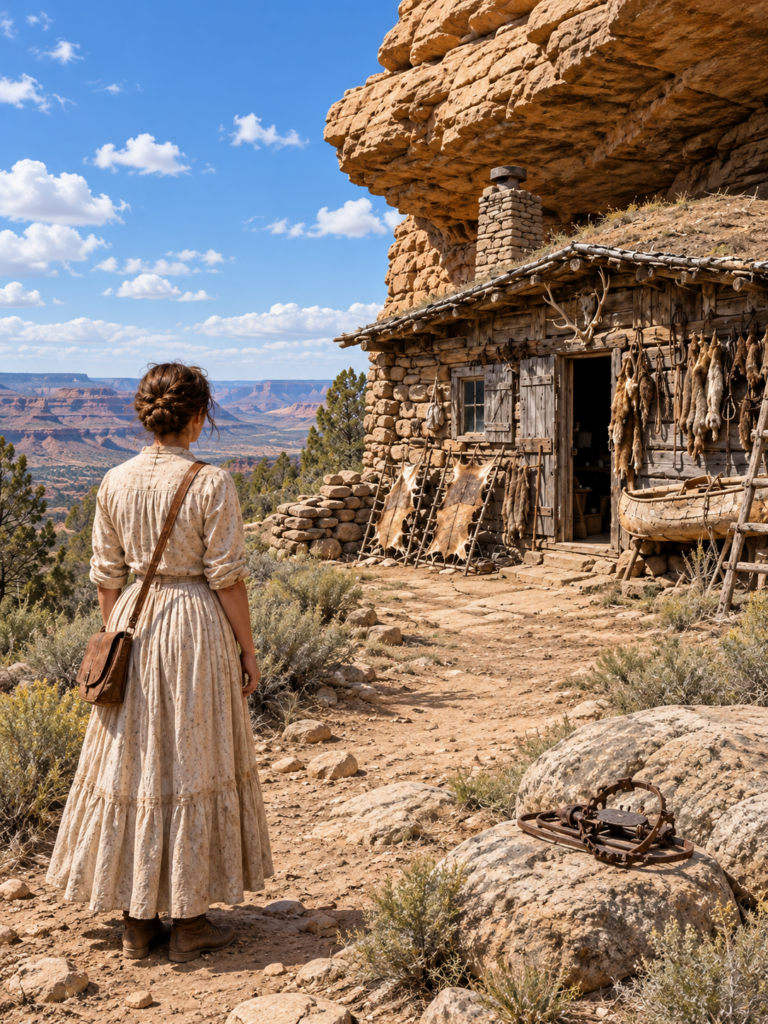
Across a small clearing stood the cabin.
It was perched on a rocky ledge overlooking the valley, surrounded by tall pines.
The roof sagged sharply near the center.
Part of the porch had collapsed.
One shutter hung crookedly beside a dark window.
The stone chimney leaned toward the slope, its upper stones darkened by old smoke.
The logs were gray with age.
Weeds grew through the steps.
The whole building seemed to be holding itself upright through stubbornness alone.
Rose stared.
Her chest tightened.
“Oh, no.”
She had expected hardship.
She had expected an old, neglected building.
But this looked like something winter should have finished long ago.
She took several steps toward it.
A rotten porch board crumbled beneath her boot.
She jumped backward.
Jasper snorted behind her.
Rose turned away.
For a moment, she couldn’t look at the cabin.
Silas Croft had been right.
She had spent her final three dollars on a ruin.
Her mother had saved those coins for years.
Her father had worked his whole life to teach her how to survive.
And she had taken everything they left her and gambled it on a dead man’s broken house.
She sank onto a fallen log.
Her face crumpled.
Then the tears came.
She cried for her parents.
For the farm.
For the nights she had slept hungry beside strangers’ wagons.
For the humiliation at the auction.
And for the terrible possibility that she had finally run out of roads.
She covered her face.
“I tried, Papa.”
The words came out broken.
“I really tried.”
A moment later, something warm pressed against her shoulder.
She looked up.
Jasper had lowered his head beside her.
His soft nose rested against her arm.
Rose stared at the animal.
Then she gave a small, exhausted laugh.
“You don’t care what the house looks like, do you?”
The mule breathed heavily.
“I suppose you just want supper.”
She wiped her eyes.
“Well, so do I.”
She stood.
The sun was dropping behind the ridge.
There was no time to sit mourning what couldn’t be changed.
First, she had to get Jasper watered and fed.
Then she needed somewhere safe to sleep.
She examined the cabin carefully before entering.
The porch was dangerous, so she approached from the side.
The front door hung crooked on one hinge.
She pushed it gently.
It swung inward with a long wooden groan.
Inside was a single large room.
A stone hearth occupied one wall.
A rough table stood near the window.
There was a bed frame, a chair, several shelves, and a dark doorway leading into a small pantry.
Dust covered everything.
But something about the room surprised her.
It wasn’t the smell of rot.
Beneath the dust was a faint clean scent of pine resin and dried herbs.
The table stood straight.
The shelves were orderly.
Even the old tin cup beside the hearth rested neatly on a folded cloth.
Rose moved closer.
She touched the tabletop.
Someone had cared for this place.
Someone had built it to last.
But the roof beams above her worried her.
A section near the ridge had sagged badly.
She didn’t trust it.
Not tonight.
She carried her blanket outside and made a small camp near the doorway, sheltered from the worst wind by the cabin wall.
She tethered Jasper where he could reach grass and gave him a little oats.
Then she ate a thin piece of salt pork and drank water from her canteen.
Night came quickly.
The mountains grew black against the stars.
An owl called somewhere in the trees.
Rose wrapped herself tightly in the blanket.
She could hear Jasper shifting nearby.
Every unfamiliar sound made her open her eyes.
The rustle of brush.
The crack of a twig.
The distant howl of a coyote.
She had never spent a night so far from other people.
At home, even during the loneliest months after her parents died, there had been familiar walls around her.
Here, she had nothing but a dying fire and an old mule.
She lay awake thinking about her mother’s last words.
You’ve got more strength in you than you know.
Rose wanted desperately to believe her.
Just before dawn, she whispered into the darkness.
“Please let there be something worth saving here.”
The mountain gave no answer.
But when the first light appeared, Rose discovered something behind the cabin that made her stop.
There was a spring.
Cold, clear water flowed steadily between two moss-covered stones.
A narrow channel guided the overflow away from the building.
The channel was lined with carefully placed flat rocks.
It had survived years of rain, snow, and neglect.
Rose knelt and dipped her hands into the water.
She drank.
Then she looked back toward the cabin.
A man who built such a channel understood this land.
He had known where winter snow would collect.
Where spring runoff would travel.
Where the wind would strike hardest.
Perhaps the building wasn’t quite as hopeless as it looked.
Rose rose to her feet.
She faced the ruined lodge.
“All right, Mr. Blackwood.”
Her voice was steadier now.
“Let’s see what you left me to work with.”
Part 3
By the end of her first week on Blackwood Mountain, Rose Harding had learned three things.
The nights were colder than anyone in Redemption Gulch had warned her.
An old mule could be a better companion than a hundred laughing townspeople.
And a person who wanted to survive couldn’t afford to spend much time feeling sorry for herself.
Every morning, she rose before sunrise.
She washed her face in the freezing spring water, fed Jasper, and studied the mountain for signs of changing weather.
Then she worked until her hands were too sore to hold an axe.
Her first concern was the roof.
She examined the cabin’s timbers and discovered that although some roof members had failed, the thick log walls and much of the original framing remained remarkably solid.
The trapper had used large, carefully fitted logs.
The corners were notched so tightly that many had barely shifted despite years of harsh weather.
Rose remembered watching her father repair a barn after a spring storm.
He had shown her how to test damaged beams and warned her never to trust a roof simply because it hadn’t fallen yet.
“Wood tells the truth if you know how to listen,” he’d said.
Rose wasn’t sure she knew enough.
But she knew more than nothing.
She began by clearing fallen branches and rotten boards from around the building.
Behind the cabin, she found a collapsed lean-to.
Beneath its broken roof lay an enormous woodpile.
The logs had been stacked by length and thickness.
Small kindling occupied one section.
Larger pieces stood in carefully arranged rows.
Much of the outer wood had rotted, but the inner stacks remained dry.
Rose stared at the arrangement.
Most abandoned homesteads she had seen contained scattered rubbish and broken equipment.
This was different.
Whoever had last worked here had put things away as though preparing for a hard winter.
She carried several pieces of dry wood to her campsite.
Then she found the axe.
It was embedded in a chopping stump near the lean-to.
At first, Rose expected the blade to be ruined.
But someone had wrapped its head in leather coated with grease.
When she removed the wrapping, clean steel appeared underneath.
The edge was sharp.
The handle was smooth.
Rose balanced the axe in her hands.
“Well, Mr. Blackwood,” she murmured, “you certainly knew how to care for your tools.”
Over the next three days, she repaired the safest sections of the roof.
Using the axe and a small saw from the cabin’s tool chest, she cut and shaped replacement timbers.
She worked from a secure ladder and braced the damaged areas before moving beneath them.
Jasper helped drag small logs into position using the pack harness.
The work was slow.
Twice, the mule refused to move.
Once, he pulled so stubbornly that Rose lost her footing and landed in the dirt.
She sat there for several seconds, furious.
Then Jasper turned his head and looked at her.
“Oh, don’t you start,” she said.
The mule flicked an ear.
Rose burst out laughing.
It was the first genuine laugh she’d had since her mother died.
The sound startled her.
She looked around the empty clearing.
Then she laughed again.
There was nobody there to hear her.
Nobody to tell her she was foolish.
Nobody to remind her how poor she was.
For a brief moment, the mountain didn’t feel lonely.
It felt peaceful.
By the eighth day, the worst opening in the roof was covered with newly split cedar shakes.
Rose still had repairs to finish, but she could now sleep inside without fearing that the damaged section would collapse above her.
She moved her blanket onto the old bed frame.
That night, she lit a small, carefully tended fire after clearing the chimney and confirming it drew properly.
The warmth spread slowly through the room.
Rose sat in front of the hearth with a tin cup of hot water.
She watched the flames move across the stone.
And she cried again.
This time, not from despair.
From relief.
She had a roof.
A door.
Water.
A place to sleep.
It wasn’t much.
But it was more than she had possessed a week earlier.
As the days passed, she began exploring the cabin’s contents.
The trapper had left nearly everything behind.
A chest near the bed contained wool blankets, a heavy winter coat, and several shirts.
The garments were old and dusty but could be cleaned and repaired.
Another chest held tools.
Chisels.
A drawknife.
A whetstone.
A hand drill.
A small hammer.
A set of files wrapped in oiled cloth.
Rose examined each one.
Her father had owned tools like these.
He used to become irritated when hired hands left them outside in the rain.
“A good tool is a promise,” he would say. “Take care of it, and it’ll take care of you.”
Silas Blackwood seemed to have believed the same thing.
Along one wall hung cleaned animal traps and lengths of carefully coiled rope.
Snowshoes leaned in a corner.
Several soft deer and beaver hides rested on a high shelf.
In the pantry, Rose found sealed tin containers holding salt, beans, coffee, and other old provisions.
She inspected each carefully.
Some were spoiled or doubtful and had to be discarded.
Others, particularly the salt, remained useful.
The dry beans provided a cautious supplement to the food she had carried from town.
She discovered bundles of dried herbs tied with string.
Each had a small wooden label.
Mint.
Yarrow.
Willow bark.
Wild sage.
She recognized several from her mother’s garden.
That discovery brought fresh pain.
Martha Harding had taught Rose to dry herbs every autumn, hanging them beneath the kitchen rafters until the leaves became brittle.
Rose could still see her mother standing on a wooden stool, tying bundles with worn cotton thread.
“If you put away a little of summer,” she’d say, “winter doesn’t seem quite so long.”
Now Rose stood in a stranger’s pantry holding a bundle of dried mint.
And the memory was so strong she had to sit down.
She missed ordinary things most.
Not birthdays or holidays.
She missed hearing her father cough outside the door before coming in for supper.
She missed her mother’s footsteps in the kitchen.
She missed being able to say something aloud and know another person would answer.
Jasper had become her audience.
While she worked, she talked to him.
She told him about her parents.
About the farm.
About the little orchard her father had planted.
Sometimes she told him about the auction.
“Silas Croft said I wouldn’t last until snow,” she remarked one afternoon while repairing the cabin wall.
Jasper continued eating grass.
“What do you think?”
The mule looked up.
Rose smiled.
“I agree. He’s a disagreeable man.”
But not every day ended with laughter.
One evening, dark clouds gathered without warning.
A hard mountain rain began shortly after sunset.
Rose had repaired most of the roof, but a narrow gap remained near the chimney.
Water entered through it.
At first, it was only a drip.
Then a steady trickle.
Within an hour, a small puddle spread across the floor.
Rose fetched buckets.
She dragged her bedding away from the wet area.
She climbed into the shallow attic space from a secure section and placed additional coverings over the opening.
But rain continued finding its way inside.
She worked until midnight, soaked and shivering.
When the storm finally passed, the room smelled of wet wood.
Her fire had gone out.
Her blanket was damp.
And she had used nearly all her remaining dry kindling.
Rose sat on the floor beside the hearth.
She was trembling from cold and exhaustion.
For the first time since arriving, she seriously considered walking back to town.
Perhaps she could find work washing dishes.
Perhaps Jed would let her sleep in the stable again.
Perhaps she could sell the land to Croft and recover enough money for food.
She pictured his face.
The mocking smile.
The way the auction crowd had laughed.
Then she imagined what returning would mean.
Another place lost.
Another home abandoned.
Another piece of her parents’ faith in her surrendered to fear.
Rose covered her face.
“I don’t know how much more I can do.”
The cabin was silent.
She remained there until the cold forced her to move.
Then she rose.
She found dry kindling beneath the protected woodpile.
She rebuilt the fire.
She wrung out her blanket and hung it near the hearth.
And when dawn came, she went outside and repaired the leaking section of roof.
She did it slowly.
Methodically.
Without anger.
Because her father had been right about one thing.
Good land was worth working for.
And this place had water, shelter, wood, and ground that might support a garden.
The rest was work.
By the second week, Rose had made real progress.
The roof no longer leaked.
The chimney stood securely.
The door closed properly.
She had repaired the worst cracks between the logs with clay and dried grass.
And she had begun setting aside supplies for winter.
But one part of the cabin continued troubling her.
It was a heavy foundation log beside the hearth.
Rose had noticed it while repairing the wall.
Unlike the surrounding timbers, it shifted slightly when she pressed against one end.
At first, she assumed the wood had loosened with age.
But there was no visible rot.
The log appeared sound.
Its ends fitted perfectly against the other timbers.
And there was something peculiar about the narrow seam along its upper edge.
Rose returned to it one afternoon with a lantern.
She ran her fingers along the wood.
Pressed gently.
The log moved.
Only a fraction of an inch.
But it moved.
She stepped back.
A man as careful as Silas Blackwood would not have left a foundation log loose without reason.
She fetched a small pry bar from the tool chest.
Then hesitated.
If the log supported part of the wall, moving it might damage the cabin.
She examined the adjoining timbers.
There were signs that the section had been deliberately fitted into a separate frame.
Not a structural support.
Something else.
She carefully tested the seam.
The log shifted inward.
Then stopped.
Rose lowered the pry bar.
Her heart began beating faster.
Whatever this was, it had been built into the wall on purpose.
She thought about opening it immediately.
But the afternoon light was fading, and a sharp wind had begun coming down the valley.
She needed to bring Jasper into the sheltered enclosure she had built and cover the remaining dry wood.
The hidden compartment could wait one night.
Outside, she glanced toward the mountains.
A pale line of cloud lay across the highest peaks.
It looked strangely like snow.
Rose tightened her coat.
Winter was approaching.
And whatever secret Silas Blackwood had left inside his cabin would have to wait until she was certain she could survive it.
Part 4
The first snow came earlier than anyone in Redemption Gulch expected.
It began as a few pale flakes drifting between the pines.
Rose was splitting firewood behind the cabin when one landed on her sleeve.
She looked up.
The sky had turned an ugly shade of purple-gray.
A cold wind moved through the clearing.
Jasper lifted his head from the hay and gave a nervous snort.
Rose set down the axe.
She had seen storms arrive quickly on the plains.
But mountain weather was different.
Clouds could gather behind a ridge without warning.
Wind could shift direction in minutes.
And snow could make a familiar trail disappear.
She carried the last armful of split wood beneath the lean-to and checked Jasper’s shelter.
The little enclosure was crude but sturdy, with a low roof and walls lined with pine boughs to break the wind.
She gave him extra hay.
Then she hurried inside.
By sunset, the snow had become a blizzard.
The cabin shook beneath the force of the wind.
Powdery snow swept across the clearing and gathered against the door.
Rose lit her lantern and added wood to the hearth.
The flames leaped upward.
For a moment, she stood listening.
The repaired roof creaked but held.
The chimney drew steadily.
No water entered through the ceiling.
Rose rested one hand against the nearest log wall.
She had worked on this cabin until her fingers blistered and her shoulders burned.
Now the mountain was testing every repair she’d made.
She put a pot of beans on the fire.
Then brought her mother’s Bible to the table.
The leather cover had become worn and soft.
Inside the front page, Martha Harding had written Rose’s name when she was born.
Beneath it were the dates of her parents’ marriage and Rose’s baptism.
Rose ran her finger across the handwriting.
The last time she’d held the Bible in their farmhouse, she’d been packing to leave.
She remembered standing in her mother’s empty bedroom, deciding which possessions she could carry.
There had been dresses in the wardrobe.
A quilt on the bed.
A wooden box of letters.
She couldn’t take everything.
So she took the Bible.
And the needle case.
And a little portrait of her parents wrapped in cloth.
Everything else remained behind.
Rose closed the book.
The wind struck the cabin with a sudden roar.
She looked toward the window.
Nothing was visible beyond the whirling snow.
She said a quiet prayer.
Not for money.
Not for happiness.
Only that the roof would hold until morning.
Then she heard something.
At first, she thought it was a branch scraping against the wall.
She listened.
The sound came again.
A faint cry.
Rose stood.
“Hello?”
The wind swallowed her voice.
She moved toward the door.
Another sound reached her.
This time, unmistakably human.
Someone was shouting outside.
Rose grabbed her heavy coat.
Then she hesitated.
Going into that storm was dangerous.
If she lost sight of the cabin, she might never find her way back.
She knew that.
But somebody was out there.
Somebody who might freeze before morning.
Rose wrapped a rope around her waist and secured the other end to a strong timber near the doorway.
She took the lantern, shielded its glass against the wind, and opened the door.
Snow blew into the room.
The cold struck her face like a slap.
“HELLO!”
A weak answer came from somewhere beyond the clearing.
Rose followed the sound, moving carefully through knee-deep drifts while keeping the rope clear behind her.
The lantern flame flickered wildly.
Then she saw a dark shape near a boulder.
Three people.
A man.
A woman.
And a small boy.
The man was kneeling beside the others, trying to shield them from the wind.
When he saw the lantern, he raised one trembling hand.
“Help!”
Rose struggled toward them.
The woman was shaking violently.
The child looked barely conscious.
“There’s a cabin!” Rose shouted. “Not far!”
The man grabbed her sleeve.
“Our horse went lame. We thought we could reach the town.”
“You can’t make it tonight.”
He looked desperately toward the ridge.
“My wife—she can’t feel her hands.”
Rose touched the woman’s shoulder.
“Can you stand?”
The woman nodded weakly.
“Good. We’re getting you warm.”
The man introduced himself as Daniel Evans, a traveling preacher bound for a congregation in the next valley.
His wife was Sarah.
Their son, Thomas, was seven.
They had underestimated the distance between settlements and tried to continue on foot after leaving their injured horse in a sheltered hollow farther down the trail.
Then the storm arrived.
Rose helped Sarah to her feet.
Daniel lifted Thomas into his arms.
Holding to the rope, they followed Rose through the darkness.
The journey back seemed much longer than the distance she’d traveled.
Sarah stumbled repeatedly.
Thomas barely spoke.
Daniel’s breathing grew ragged.
But at last, the cabin appeared through the snow.
Rose pushed open the door.
Warm air rushed toward them.
Sarah began crying.
“Oh, thank God.”
Rose hurried them inside.
She closed the door, secured it, and helped the family remove their frozen outer clothing.
She wrapped Sarah and Thomas in the clean, dry blankets she’d found in Blackwood’s chest and placed them near the hearth.
Daniel sat beside his son, rubbing warmth back into his own hands.
Rose ladled hot bean soup into tin bowls.
“Eat slowly,” she instructed.
Thomas stared at the food.
“Is this your house?”
Rose paused.
“Yes.”
“Do you live here all by yourself?”
She glanced toward the door.
“Not entirely. I’ve got a mule.”
The boy managed a small smile.
“What’s his name?”
“Jasper.”
“Is he nice?”
“Depends what you ask him to do.”
Thomas gave a weak laugh.
Sarah looked up at Rose.
“How old are you, dear?”
“Nineteen.”
The woman stared.
“Nineteen?”
Rose nodded.
“And you live up here alone?”
“I do.”
Daniel lowered his bowl.
“How did you come by this place?”
Rose hesitated.
Then told them.
About the farm.
Her parents.
The bank.
The auction.
The three silver dollars.
And the town’s laughter.
When she finished, Sarah reached for her hand.
“My dear girl.”
Rose looked down.
“I didn’t know what else to do.”
Daniel surveyed the room.
The repaired roof.
The neatly stacked firewood.
The warm hearth.
The supplies carefully arranged along the walls.
“You’ve done more than many grown men could’ve managed,” he said.
Rose shook her head.
“I still have a great deal to learn.”
“That doesn’t diminish what you’ve already done.”
His words embarrassed her.
She had grown used to people questioning her judgment.
She didn’t know how to respond when someone respected it.
For three days, the storm continued.
The Evans family remained inside the cabin.
Rose shared her food, water, and blankets.
Daniel helped bring additional firewood through the sheltered entrance when the wind briefly eased.
Sarah repaired a torn section of Rose’s winter coat.
Thomas entertained himself by drawing pictures in the dust beside the hearth.
But the storm brought new problems.
The food supply dwindled faster than Rose had planned.
The woodpile grew smaller.
And on the second night, a fierce gust loosened a section of roof covering near the chimney.
Snow began entering through the gap.
Rose heard it strike the floor.
Her heart sank.
She fetched a lantern and examined the damage from inside the attic.
One of the outer shakes had worked loose.
If the wind tore away the surrounding section, the roof might fail.
Daniel climbed up beside her.
“We need to secure it.”
Rose nodded.
“But not from outside in this wind.”
They reinforced the inner section with spare boards and kept the area beneath it clear.
For hours, the roof creaked above them.
Rose sat awake beside the fire.
Every sound made her tense.
Every hard gust brought back the memory of arriving at the cabin and seeing the roof sagging toward the ground.
What if all her work had been insufficient?
What if the building collapsed with four people inside?
She looked toward the sleeping Evans family.
Thomas lay curled beside his mother.
Daniel had fallen asleep sitting upright in the chair.
They had trusted her.
She had brought them here because she believed she could keep them safe.
Now she was responsible for more than herself.
Shortly before dawn, Daniel woke and found Rose still sitting beside the hearth.
“You haven’t slept.”
“I couldn’t.”
He looked toward the ceiling.
“Still worried?”
She nodded.
Daniel pulled the other chair closer.
“Sometimes a man thinks faith means never being frightened.”
Rose looked at him.
“What does it mean?”
He considered.
“Sometimes it means doing what’s necessary while you’re frightened.”
She stared into the fire.
“My father used to say something like that.”
“What was he like?”
Rose smiled sadly.
“Stubborn. Kind. Terrible at singing.”
Daniel chuckled.
“He sounds like a good man.”
“He was.”
She was quiet for a moment.
Then whispered, “I don’t think he’d have wanted me to end up alone on a mountain.”
Daniel didn’t answer immediately.
Finally, he said, “Perhaps he would’ve wanted you somewhere you could become the person he taught you to be.”
Rose looked up.
For the first time, she considered that possibility.
The storm began weakening the following afternoon.
By morning, the sky had cleared.
Sunlight struck the snow-covered valley.
The world looked impossibly beautiful.
Every pine branch carried white powder.
The distant ridges shone beneath a deep blue sky.
Daniel stepped outside and stood in the clearing.
Then he turned toward Rose.
“If you hadn’t heard us, we wouldn’t be standing here.”
She shook her head.
“The cabin saved you.”
“No,” he said gently. “A cabin doesn’t open its own door.”
Sarah embraced her before they left.
Thomas insisted on shaking her hand like a grown man.
“I’ll come back to see Jasper,” he promised.
Rose smiled.
“I think he’d like that.”
After arranging the safest route down the mountain, the family departed as soon as conditions allowed.
Rose watched them until they disappeared among the trees.
Then she returned inside.
The cabin felt strangely empty.
For three days, it had been filled with voices.
Laughter.
Questions.
The sound of a child’s footsteps.
Now there was only the crackling fire.
Rose sat at the table.
She hadn’t realized how much she missed having people around.
She thought of the Evans family telling their congregation about the strange girl living on Blackwood Mountain.
Would they remember her kindness?
Would anyone believe them?
She didn’t know.
But she hoped they reached town safely.
Then her eyes moved toward the hearth.
The loose foundation log was still there.
She had almost forgotten it during the storm.
Rose rose, fetched the small pry bar, and knelt beside the wall.
She carefully examined the seams.
Then pressed the tool into the narrow opening.
The wood shifted.
She pulled again.
With a low creak, the entire section swung inward.
It wasn’t a loose log at all.
It was a cleverly disguised door.
Behind it lay a hollow compartment.
Rose raised her lantern.
Inside was a metal box wrapped in an old piece of cloth.
She reached in and carefully drew it out.
The box was surprisingly heavy.
She placed it on the table.
For a moment, she simply stared.
The old trapper had hidden something inside the very wall of his home.
Something he had protected behind a secret panel.
Rose lifted the lid.
Inside lay a leather-bound journal, a small oilskin pouch, and a smooth gray riverstone.
There were no gold coins.
No jewelry.
No obvious fortune.
But a folded piece of paper rested beneath the journal.
On its outside was written:
To the one who comes after me.
Rose touched the words.
Then lifted the letter.
And began to read.
Part 5
The letter began with a sentence Rose Harding would remember for the rest of her life.
If you are reading this, then you have found my home. I hope you need it as much as I once did.
Rose moved her chair closer to the fire.
The handwriting was strong and deliberate, though the ink had faded.
My name is Silas Blackwood.
The people in Redemption Gulch may tell you I died on this mountain. Perhaps by the time you read these words, they will be right.
But I did not abandon this cabin. I left it prepared for someone who might one day have nowhere else to go.
Rose stopped reading.
She looked around the room.
The tools.
The carefully stored provisions.
The sound roof beams beneath their layer of dust.
The wood stacked beneath the lean-to.
Suddenly, those things seemed different.
Not forgotten possessions.
A deliberate gift.
She returned to the letter.
Blackwood wrote that he had once lived in the East with a wife named Eleanor and a little daughter, Grace.
He had worked as a carpenter before joining a westbound wagon party in search of a better life.
But disease swept through their settlement.
Within eleven days, both Eleanor and Grace were dead.
Blackwood buried them beneath a stand of cottonwoods.
Then he sold nearly everything he owned and traveled west alone.
He had arrived in the Rattlesnake Mountains carrying little more than his tools, a rifle, and a grief so deep he no longer cared whether he survived.
I thought the mountain would finish me, he wrote.
Instead, it gave me work to do.
He described building the cabin one log at a time.
The first winter had nearly killed him.
He had misjudged the weather and run short of food.
But he survived.
In spring, he planted a small garden.
He trapped enough animals to trade for supplies.
He discovered the spring near the cabin and built the stone channel that still carried water away from the foundation.
Year by year, he made the place stronger.
And somewhere along the way, he began wanting to live again.
Rose’s tears fell onto the paper.
She understood him.
The loneliness.
The terrible silence after losing everyone who mattered.
The desperate need to find something useful to do with the days that remained.
The letter continued.
I have grown old now, and the winters have become hard on my bones. I have no living family to receive what I built.
I have arranged my affairs as best I can and paid the taxes forward while I was able. After that, I expect the county may one day offer this place for sale.
I cannot choose who will buy it.
But I can choose what I leave behind.
Rose covered her mouth.
The tools are for working.
The wood is for warmth.
The preserved stores are for hard beginnings.
The journal is for learning what this mountain can give, and what it can take away.
And the seeds are for the spring that comes after the winter.
If you came here because the world left you nowhere else, please do not think yourself worthless.
You are standing in a place built by a man who once believed the same thing about himself.
At the bottom, Blackwood had written:
May this home shelter you as it sheltered me. And when someone else comes to your door in need, remember what it gave you.
Silas Blackwood.
Rose lowered the letter.
For several minutes, she sat without moving.
Then she reached into the oilskin pouch.
Inside were carefully folded seed packets.
Beans.
Carrots.
Squash.
High-altitude corn.
A larger packet contained mixed wildflower seeds for bees.
She examined the writing, the dates, and the careful instructions about planting times.
Not every old seed would necessarily grow, she knew.
But Blackwood had left something more valuable than a guaranteed harvest.
He had left knowledge.
She opened the journal.
Page after page described the mountain.
Where trout could be found in the creek.
Which slopes held the deepest snow.
Where deer traveled in autumn.
Which sheltered ground remained workable after early frost.
How to recognize approaching storms.
How to protect the garden from hungry animals.
How to repair the roof before winter.
The entries had been written across decades.
Rose turned pages until she found a final note.
The smooth riverstone belonged to Grace.
She found it beside a creek when she was six and told me it was a little piece of the mountain that would fit in her pocket.
I carried it for the years she was gone.
Now I leave it here, in the hope that someone who has lost a family will know they are not the first to begin again.
Rose took the stone from the box.
It fitted perfectly inside her palm.
She held it against her heart.
And finally allowed herself to weep.
For her father.
For her mother.
For Eleanor and Grace Blackwood.
For the lonely trapper who had spent his life building a refuge for someone he would never meet.
She had thought she was buying the remains of a dead man’s life.
Instead, she had found the last kindness of a man who understood what it meant to lose everything.
In the weeks that followed, news of the Evans family’s rescue reached Redemption Gulch.
Daniel Evans told the story at the church.
Sarah spoke of the warm cabin, the shared blankets, and the young woman who had come through the blizzard with a lantern.
Thomas told everyone about Jasper.
People who had laughed at the auction began speaking of Rose with respect.
Jed Mercer heard the story and shook his head.
“That girl climbed a mountain with three dollars and more courage than half this town.”
Dr. Miller, the town physician, rode up the trail when the weather improved.
He found Rose splitting wood outside the cabin.
The roof was sound.
Smoke rose steadily from the chimney.
Jasper stood beside the shed, looking entirely satisfied with life.
Inside, everything was clean and orderly.
Dr. Miller examined Rose’s hands, asked about her health, and accepted a cup of coffee.
“You’ve made yourself a fine home,” he said.
Rose glanced around.
“Mr. Blackwood did most of the hard work.”
“And you kept it from falling apart.”
Before leaving, the doctor gave her a package.
Inside was warm wool cloth, a new needle, and thread.
“From the Evans family.”
Rose touched the cloth.
“And Jed says your debt for Jasper is settled.”
She looked up.
“But I promised to pay him.”
The doctor smiled.
“Apparently he considers the mule well placed.”
Rose lowered her eyes.
For months, she’d feared becoming dependent on the kindness of strangers.
Now she understood that accepting kindness didn’t mean surrendering dignity.
It meant having a chance to offer the same kindness someday.
That spring, Silas Croft rode up the mountain.
Rose saw him approaching through the trees.
He stopped his horse at the edge of the clearing.
For a moment, she expected another insult.
Perhaps an offer to buy the timber.
Perhaps a warning that she had no business living alone.
But Croft said nothing.
He studied the repaired roof.
The clean windows.
The stacked firewood.
The little fenced garden Rose had begun preparing beside the spring.
Then he looked at the cabin.
For the first time, he seemed to see something besides marketable lumber.
Rose stood on the porch.
“Good afternoon, Mr. Croft.”
He touched the brim of his hat.
“Miss Harding.”
His voice was quieter than she remembered.
He looked toward Jasper.
“Looks like you’ve made a go of it.”
“I’m trying.”
Croft nodded.
He remained there another moment.
Then turned his horse and rode away.
He never bothered her again.
Rose watched him disappear among the trees.
She felt no desire to humiliate him.
His laughter had hurt.
But his opinion no longer controlled her future.
The cabin was hers.
And she no longer needed anyone’s permission to belong there.
When the last spring snow melted, Rose began planting the garden.
She tested the old seeds Blackwood had left, carefully separating those that showed signs of life.
Some failed.
Others sprouted.
She supplemented them with fresh seed obtained through trade in town.
Soon, rows of beans and vegetables appeared in the dark mountain soil.
She planted the wildflower mix beside the spring.
By early summer, small blossoms dotted the clearing.
Bees moved among them in the sunlight.
Jasper grazed nearby.
One evening, Rose stood on the porch she had rebuilt, looking across the valley.
The mountains glowed gold beneath the setting sun.
The creek ran clear.
The cabin smelled of fresh pine, coffee, and woodsmoke.
She carried the little gray riverstone in her pocket.
Sometimes, when loneliness returned, she took it out and held it.
Not because she believed it possessed any magic.
Because it reminded her that people could leave love behind in ordinary things.
A stone.
A letter.
An axe kept sharp.
A pile of dry firewood.
A door that could still open after years of silence.
Rose thought about the three silver dollars her mother had sewn into her dress.
She had once believed spending them meant losing the last thing Martha Harding had left her.
Now she understood.
Those coins had carried her to the place where she could begin again.
Her father had taught her how to work the land.
Her mother had taught her to endure hardship without losing kindness.
And Silas Blackwood, a stranger she had never met, had left her a home where those lessons could finally become a life.
Rose rested her hand against the porch railing.
Below her, the valley lay peaceful in the evening light.
Jasper approached and nudged her shoulder.
She smiled and scratched behind his ears.
“We made it, old fellow.”
The mule gave a satisfied sigh.
Rose looked toward the distant mountains.
Then she spoke softly, as though the old trapper might somehow hear her.
“Thank you, Mr. Blackwood.”
She closed her fingers around the riverstone.
“You didn’t just leave me a cabin.”
Her eyes filled, but she was smiling.
“You left me a chance.”
And in the little mountain home that everyone else had called worthless, Rose Harding finally understood that losing everything did not mean her story was over.
Sometimes it meant the life she was meant to build had only just begun.


