
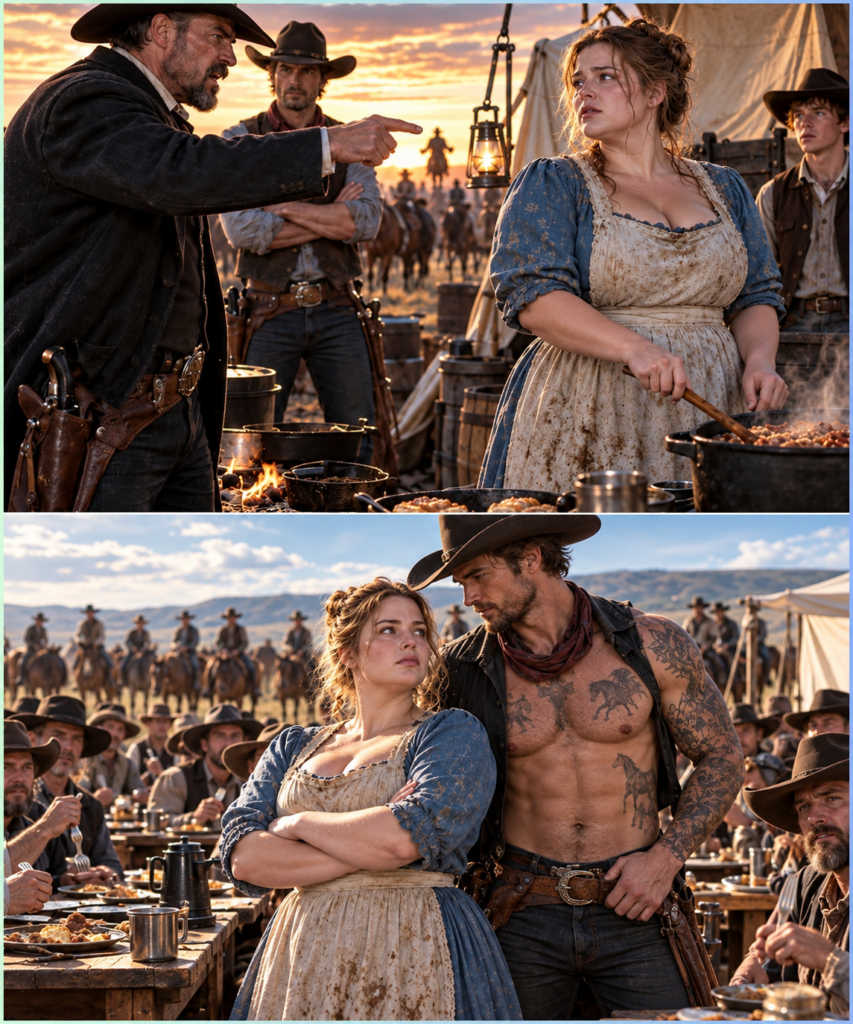
“What would you have done?”
“Worried.”
“Exactly.”
He stared at her.
Maggie returned to slicing onions.
“You are a difficult woman.”
“You employ a hundred difficult men. I doubt I’m special.”
He walked away laughing.
That was the first time.
Later came the storm.
Rain slammed into the plains sideways, turning camp into mud within minutes.
Maggie’s fire died.
She rebuilt it.
It died again.
She rebuilt it again.
The third time she shielded the coals with an overturned iron pan until they caught.
At nearly two in the morning, riders began returning from the herd soaked to the skin.
They found coffee waiting.
They found hot beans and beef.
They found dry blankets near the wagon because Maggie had moved them under canvas before the storm.
Cole came in last.
His hat dripped onto his shoulders.
His hands were stiff from cold.
Maggie handed him coffee.
“You stayed awake?”
“So did you.”
“I own the cattle.”
“They ride them.”
He glanced toward the exhausted cowboys eating near the fire.
“And you?”
“I feed the people who ride them.”
Cole wrapped both hands around the cup.
Something changed between them that night.
Nothing improper.
Nothing spoken.
Just a quiet recognition that each had seen the other under pressure and liked what they had seen.
Afterward, Cole began taking supper near her wagon.
Sometimes he talked.
Sometimes he simply sat.
Maggie discovered that his father had died when Cole was twenty-three, leaving the cattle business heavily indebted.
Silas, his father’s older brother, had saved it.
That rescue had a price.
Silas had never demanded repayment directly.
He had simply remained.
In every negotiation.
Every purchase.
Every major decision.
“You owe him,” Maggie said one evening.
“Yes.”
“That can become an expensive word.”
Cole glanced at her.
“You always talk like that?”
“Only when people are paying me.”
“You’re off duty.”
“Then consider it free advice.”
He smiled.
It happened too easily.
That smile.
Those evenings.
The comfort of his presence.
Maggie did not trust easy things.
She had buried too many of them.
So when Silas Whitaker arrived at camp during the ninth week of the drive, Maggie recognized danger before he ever spoke harshly to her.
Silas was fifty-nine, silver-haired, well dressed, and careful.
He was not a fool.
That made him more dangerous than a cruel man.
Cruel men could often be predicted.
Intelligent men who believed they were being reasonable could justify almost anything.
He spent three days observing camp.
On the fourth, he noticed cowboys asking Maggie which crew should eat first.
On the fifth, he watched Levi consult her about reorganizing two supply wagons.
On the sixth, he heard Cole ask whether Noah was ready for a more difficult herd rotation.
On the seventh, Silas approached Maggie while she kneaded biscuit dough.
“You’ve made yourself important here.”
She looked up.
“I’ve made breakfast.”
His smile was thin.
“Men seem to seek your opinion.”
“Men seek coffee too.”
“I’m speaking seriously.”
“So am I.”
Silas studied her.
“You know Cole is expected to marry?”
Her hands stopped for half a second.
Then continued kneading.
“No.”
“Eleanor Voss. Her family owns grazing land and rail interests we need.”
“Then I hope they enjoy each other.”
Silas’s eyes sharpened.
“You misunderstand.”
“I don’t think I do.”
“You are an employee.”
“Yes.”
“And Cole is the head of this company.”
“Yes.”
“Good. Then we understand each other.”
Maggie wiped flour from her fingers.
“I understood my position before you rode into camp, Mr. Whitaker.”
Silas nodded pleasantly.
“I’m glad.”
That night Maggie avoided Cole.
The next evening too.
On the third evening he cornered her beside the water barrels.
“What did my uncle say?”
“Ask your uncle.”
“I’m asking you.”
“He explained your future.”
Cole’s jaw tightened.
“My future?”
“Apparently it owns railroad shares.”
“Eleanor and I are not engaged.”
“Does she know that?”
“Yes.”
“Does your uncle?”
“Yes.”
“Then he has a remarkable commitment to fiction.”
“Maggie.”
She faced him.
“This is exactly why I don’t let easy things stay easy.”
“What does that mean?”
“It means you sit by my fire. You tell me things. You let me start believing I’m being treated like something other than hired hands.”
“You are.”
“And yet I am still hired hands.”
His face changed.
“I’ve never treated you that way.”
“No. Your uncle just reminded me that you have the luxury of forgetting I am.”
She walked away.
Cole did not follow.
The next afternoon, trouble broke out between two crews over a missing saddle blanket.
The dispute had little to do with the blanket.
The Texas riders thought the hired Kansas men were arrogant.
The Kansas riders thought the Texans treated outsiders like thieves.
After nine hot weeks, both sides were ready to make a small insult carry the weight of every previous one.
Maggie heard shouting.
She walked behind the supply wagon, reached beneath a canvas tarp, and pulled out the missing blanket.
“I moved this after the storm because it was soaked.”
Forty angry men went silent.
She handed it to its owner.
“If you’re going to punch somebody, at least make sure he stole something first.”
A few men laughed.
The tension cracked.
The argument ended.
Silas saw all of it.
That evening, he spoke to Cole behind his tent.
Maggie did not hear the first half.
She heard enough of the second.
“She is not a foreman.”
“No one said she was.”
“The men listen to her like one.”
“Because she has good judgment.”
“She is a cook.”
“She is the reason half these men haven’t killed each other.”
“That is exactly the problem.”
Maggie froze behind the wagon.
Cole’s voice hardened.
“How is competence a problem?”
“Because boundaries matter.”
“To you.”
“To business.”
“No. To control.”
Silence.
Then Silas said something quieter.
Maggie could not hear it.
Cole answered, “Eleanor has nothing to do with this.”
That was enough.
Maggie walked away.
The next morning she did her job.
That afternoon she did her job.
At supper she served beef stew.
When the last man had been fed, Silas approached Cole near the center fire.
Several foremen were present.
So were dozens of riders.
Silas held a folded paper.
“The rail contract has changed. We cannot afford distractions in the final stretch.”
Cole stared at him.
“What distractions?”
Silas’s eyes moved briefly toward Maggie.
Then back.
“Have her wagon cleared before sunrise.”
Nobody spoke.
Cole went completely still.
“Silas.”
“The decision is made.”
“It isn’t your decision.”
“I control fifty-one percent of Whitaker holdings until your father’s debt is retired. Read the agreement.”
Cole’s face lost color.
Silas continued.
“A replacement cook is available at Caldwell Station.”
Maggie waited.
One second.
Two.
Three.
She waited for Cole to say something that would matter.
He said, “We’ll discuss this privately.”
Something inside her closed.
Not broke.
Closed.
Maggie set down the spoon.
“No need.”
Cole turned.
“Maggie.”
She looked at Silas.
“I assume I’m paid through tonight.”
“Of course.”
“And Noah?”
“His position is unaffected.”
“No,” Noah said immediately.
She turned.
He had stood up.
“Noah.”
“I’m leaving.”
“You are not.”
“They throw you out, I go too.”
“You earned your place with the herd.”
“I don’t care.”
“I do.”
“Maggie—”
“You stay.”
The whole camp was listening now.
Her voice softened.
“You wanted a life that wasn’t built around my kitchen. Don’t throw it away because somebody insulted me.”
Noah’s eyes filled with helpless anger.
She turned before hers could do the same.
Then she packed.
Near dawn, Maggie harnessed the small gray horse assigned to her supply wagon.
Levi appeared first.
He carried an envelope.
“Your wages.”
She took it.
“There’s extra.”
“I didn’t earn extra.”
“You earned more than this.”
“Then the company should have paid me sooner.”
Levi almost smiled.
She removed the additional bills and handed them back.
After him came Clay Mercer.
Then Amos Dyer.
Then Billy Carter.
Then twenty more.
Nobody knew what to say.
So most of them said nothing.
Maggie preferred that.
Noah stood beside her wagon looking miserable.
“You’ll write?”
“Yes.”
“You swear?”
“No. I intend to.”
“Maggie.”
She touched his cheek.
“Ride smart. Listen to Levi. Stop trying to impress men who were idiots at seventeen too.”
“They weren’t all idiots.”
“Every man is an idiot at seventeen.”
Levi coughed.
“Some of us continued longer.”
That got a laugh from Noah.
Maggie climbed onto the wagon seat.
Then she noticed something strange.
Nobody was eating.
The breakfast fire burned.
Coffee boiled.
The assistant cook Silas had ordered to prepare breakfast had produced bacon, beans, and biscuits.
Nearly two hundred riders stood around camp.
Not one held a plate.
Silas walked from his tent.
“What is this?”
Nobody answered.
“Breakfast is ready.”
Still nothing.
Silas looked at Levi.
“Get your men fed. We move in forty minutes.”
Levi took off his hat.
“With respect, sir, I can tell men where to ride.”
He looked toward the silent camp.
“I don’t tell grown men when to pick up a fork.”
Silas’s mouth tightened.
“This is childish.”
Clay Mercer stepped forward.
Clay was forty-six and had worked cattle since he was twelve.
“No, sir.”
He looked toward Maggie.
“It’s breakfast.”
Silas stared at him.
Clay continued.
“Breakfast is when the person who stayed awake until two in the morning waiting for your night riders makes sure nobody starts the day empty.”
Another cowboy spoke.
“Breakfast is when somebody knows Jenkins needs less salt because of his heart.”
Another voice.
“And when Billy gets two biscuits because he’s still growing.”
Laughter moved softly through the group.
Billy turned red.
Then Amos Dyer raised his tin cup.
“Breakfast is when a woman saves the soft bread because an old fool can’t chew.”
Silas looked from face to face.
“This is a cattle company, not a church congregation.”
“No,” Levi said.
“That’s why you should understand.”
Silas’s gaze sharpened.
“Understand what?”
“These men aren’t worshipping Maggie Reed.”
Levi nodded toward them.
“They’re accounting.”
Maggie felt tears threaten.
She hated them for it.
Silas turned toward Cole.
“End this.”
Cole looked at the untouched food.
Then at Maggie.
Then at his uncle.
“We move when the crews are ready.”
Silas stepped closer.
“You are allowing employees to dictate management.”
“No.”
Cole’s voice was quiet.
“I’m watching management discover what it failed to value.”
Maggie closed her eyes for one moment.
Too late.
Beautiful words.
Too late.
She climbed onto the wagon.
“Maggie,” Cole called.
She looked down.
His expression was raw enough that she almost hated him for that too.
“I should have stopped him last night.”
“Yes.”
“I was trying to find a way around the ownership agreement.”
“You had one.”
“What?”
“Your mouth.”
That landed.
Around them, no one moved.
Cole nodded slowly.
“You’re right.”
“I know.”
She gathered the reins.
Behind her, Levi called to the riders.
“Mount up!”
Maggie turned sharply.
Men began moving toward their horses.
Silas looked almost relieved.
Then Clay Mercer walked past the breakfast table without touching his plate.
So did Amos.
So did Billy.
Then fifty men.
Then a hundred.
Then nearly two hundred.
They would do their jobs.
They would not abandon the herd.
They would not sacrifice wages their families needed.
But not one of them ate.
It was not a strike.
It was not rebellion.
It was something Silas Whitaker understood far less.
Respect.
Maggie drove east without looking back.
She made it almost half a mile before she started crying.
The Whitaker outfit did not collapse without Maggie.
Reality was rarely kind enough to make lessons that obvious.
The replacement cook was competent.
He served edible food.
He kept regular hours.
And everything slowly got worse.
Night riders missed hot meals.
Crews began arguing over who had eaten first.
Food waste increased.
A feverish cowboy worked two extra days because nobody noticed he had stopped eating.
A small disagreement between crews became a fistfight.
None of it was dramatic enough to blame on one missing woman.
Together, it became undeniable.
Cole saw it.
Silas refused to.
“She was efficient,” Silas said.
“She was more than efficient.”
“She cooked.”
“She managed people.”
“She had no authority.”
“That was the remarkable part.”
Meanwhile, Maggie reached the small town of Dawson Crossing with enough wages to survive perhaps six months if she was careful.
She rented a room above a blacksmith’s shop.
Then she rented the empty storefront beside it.
The sign over the previous business still read MILLER’S DRY GOODS.
Maggie covered the words with paint.
REED’S EATING HOUSE
On the first morning she served twelve breakfasts.
On the second, seventeen.
By the second week, freight drivers had begun timing their routes to stop there.
She was exhausted.
She was independent.
And some nights, after closing, she sat alone beside the stove and missed two hundred loud men she had once prayed would stop complaining.
She also missed Cole.
That angered her most.
Three weeks after she left the drive, heavy storms hit the hills west of Dawson Crossing.
Maggie stood outside her restaurant before sunrise watching muddy water race beneath the bridge.
A freight driver named Sam Peters stopped beside her.
“River’s rising.”
“Not this one.”
She looked west.
“The North Fork.”
Sam frowned.
“How would you know?”
“I crossed it three weeks ago.”
“So?”
“So that drainage basin above it holds water after a storm, then releases fast.”
She calculated distance.
Then remembered the Whitaker schedule.
Her stomach tightened.
“They’ll be at North Fork today.”
“Who?”
Maggie was already inside grabbing her coat.
“The biggest collection of stubborn fools in three counties.”
She borrowed Sam’s horse.
Two hours later, she reached North Fork.
The herd was gathered on the southern bank.
Thousands of cattle shifted restlessly.
Cole, Levi, and several crew bosses stood near the crossing.
Silas was arguing.
“We are already behind schedule.”
“The current’s wrong,” Cole said.
“We crossed deeper water in May.”
“Not with this much debris.”
Maggie rode straight toward them.
Cole saw her first.
For a second, every calculation disappeared from his face.
“Maggie?”
“The water’s going higher.”
Silas stared.
“You again.”
She ignored him.
“Cole, the basin west of here drains into two creeks above this fork. Last night’s storm hit both.”
“How long?”
“The surge should arrive within two hours.”
Silas scoffed.
“You are a cook.”
Maggie looked at him.
“I was.”
Then she pointed upstream.
“See that log?”
They watched a tree trunk spin through the current.
“Twenty minutes ago, the water wasn’t carrying trees that size. The current underneath is already changing.”
Levi looked at Cole.
“She’s right.”
Silas stepped forward.
“Every lost day costs thousands.”
Cole stared at the water.
Maggie said nothing else.
This decision was not hers.
That mattered.
She had spent her whole life being useful enough that other people used her judgment while keeping the authority for themselves.
She would not do that now.
Cole turned to Levi.
“Pull everyone back.”
Silas exploded.
“Cole.”
“We cross tomorrow.”
“You will destroy the schedule.”
“Then I’ll explain the schedule.”
“To investors?”
“To anyone who asks.”
“You are risking this company over a woman’s guess.”
Cole faced him.
“No.”
His voice carried across the bank.
“I am delaying a crossing because the evidence says the river is dangerous.”
He looked at Maggie.
“And because Maggie Reed has earned the right to have her judgment heard without someone pretending her dress changes the quality of her eyes.”
Nobody spoke.
Two hours later, the river rose nearly three feet.
The center current became violent enough to sweep trees downstream like sticks.
If the herd had entered on schedule, men and cattle would have been trapped midstream.
Silas stood on the bank watching brown water tear through the crossing.
For the first time since Maggie had known him, he had nothing to say.
That evening Cole came to her fire.
Not the company fire.
Hers.
Maggie had made coffee from supplies in her saddlebag.
He sat across from her.
“You saved lives.”
“I gave you information.”
“You rode two hours to give it.”
“I didn’t want Noah drowned.”
Cole almost smiled.
“Of course.”
Silence settled.
Then he said, “I’m sorry.”
She looked into the fire.
“I know.”
“I don’t mean for my uncle.”
“Good.”
“I mean for me.”
That made her look at him.
“I thought if I argued privately, solved the ownership problem, and reversed the decision later, that would be enough.”
“It wouldn’t.”
“I know.”
“You know now.”
“Yes.”
The fire snapped.
Cole leaned forward.
“I was raised to believe power meant controlling the outcome.”
Maggie said nothing.
“I think I’m learning that sometimes it means deciding what you’re willing to lose before you let somebody else make you smaller.”
She studied him.
“What are you willing to lose?”
“My uncle’s approval.”
“That’s not nothing.”
“No.”
“The rail agreement?”
“If necessary.”
“The company?”
His answer took longer.
“I hope not.”
“Hope isn’t an answer.”
“No.”
He met her eyes.
“If the choice becomes owning my father’s company under someone else’s conscience or building something smaller under mine, I’ll build smaller.”
Maggie believed he meant it.
She did not yet know whether he could live it.
Those were different things.
So she poured him coffee.
Nothing more.
The drive reached the Kansas railhead eleven days later.
The cattle sold well.
Very well.
Cole used part of the profit to retire the last of his father’s debt to Silas.
Then he did something Silas had not expected.
He divided their partnership.
Commercially.
Legally.
Permanently.
They did not scream.
Men like Silas and Cole rarely needed to.
Their final argument happened in a hotel room with ledgers between them.
“You’re throwing away leverage,” Silas said.
“I’m buying independence.”
“At an absurd price.”
“Possibly.”
“This is because of her.”
Cole shook his head.
“No. She made me notice the problem.”
Silas looked toward the window.
After a while he asked, “Do you love her?”
“Yes.”
Silas sighed.
“I suppose your father would have understood that.”
Cole’s eyes softened.
“You think so?”
“He married your mother against everyone’s advice.”
“That worked out.”
“For them.”
Silas gathered his papers.
At the door, he paused.
“I was wrong to fire her publicly.”
Cole waited.
Silas looked irritated by the effort required for the next sentence.
“I may have been wrong to fire her at all.”
For Silas Whitaker, it was practically poetry.
Cole smiled.
“Careful, Uncle. Humility might kill you.”
“Don’t be ridiculous.”
Maggie was kneading biscuit dough at Reed’s Eating House when Cole walked in three weeks later.
She looked up.
He removed his hat.
“You’re blocking the doorway.”
He moved.
“You look well.”
“I charge for compliments after breakfast.”
“I’ll buy breakfast.”
“Twenty cents.”
“Expensive.”
“Leave.”
He smiled.
She hated that the smile still worked.
He sat at the counter.
Maggie put eggs, bacon, potatoes, and two biscuits in front of him.
Cole ate half before speaking again.
“I came with an offer.”
Her expression cooled immediately.
He raised one hand.
“Business.”
“That is usually when men tell me not to worry.”
“Then worry.”
That surprised a laugh out of her.
Cole placed a folded paper on the counter.
Maggie did not touch it.
“What is it?”
“A contract.”
“For?”
“Whitaker Cattle needs a permanent provisioning manager.”
“No.”
“You didn’t read it.”
“I own this place.”
“I know.”
“Then why would I leave it?”
“You wouldn’t.”
She narrowed her eyes.
Cole continued.
“We have eight drives planned next year. I want Reed’s Eating House to supply four regional camps and train the cooks.”
Maggie stared at him.
“You’re serious.”
“Unfortunately.”
“Why me?”
“You know why.”
“Say it.”
He took a breath.
“Because you can cook, but that is the least valuable thing you do.”
Her face changed.
“You understand logistics. You understand waste. You understand exhausted men before they understand themselves. You can walk into a camp and see ten problems nobody else has named.”
He tapped the contract.
“I want to pay for that judgment.”
Maggie picked up the paper.
She read every line.
Twice.
“No exclusivity.”
“Correct.”
“I choose my assistants.”
“Yes.”
“I can refuse a route.”
“Yes.”
“My recipes remain mine.”
Cole blinked.
“I didn’t know recipes were legally—”
“They are now.”
He nodded solemnly.
“Your recipes remain yours.”
She kept reading.
Then stopped.
“This amount is too high.”
“No.”
“It’s nearly what a foreman earns.”
“Yes.”
“I’m not a foreman.”
“No.”
“Then why?”
“Because I’m done paying people according to what their title allows me to notice.”
Maggie stared at him for a long time.
Then she signed.
Cole did not celebrate.
That helped.
He stood.
“There is one more matter.”
“What?”
“I would like to have supper with you.”
“We just signed a business agreement.”
“Which is why I waited until afterward.”
“That is suspiciously intelligent.”
“I’ve had a difficult year.”
Maggie folded the contract.
“One supper.”
“I’ll take it.”
“And Cole?”
“Yes?”
“If you ever allow someone to fire me from my own restaurant, I’ll shoot you.”
He smiled.
“That seems fair.”
A year later, Reed’s Eating House had expanded into the building next door.
Noah, now eighteen, worked cattle full-time and arrived whenever he could with ridiculous stories and torn shirts.
Levi Grant became one of Maggie’s first supply clients.
Amos Dyer still demanded soft biscuits.
Billy Carter had grown three inches and insisted it was because Maggie fed him properly.
Clay Mercer’s knee finally became bad enough that he accepted lighter work.
Maggie hired him to manage deliveries.
Cole came through town often.
Then more often.
Then often enough that people stopped pretending not to notice.
He never asked her to give up the restaurant.
He never offered to rescue her.
He simply showed up.
When a stove broke, he helped replace it.
When it worked, he still came.
When Maggie was busy, he waited.
When she was angry, he listened.
When she had nothing useful to offer him at all, he stayed anyway.
That was what eventually convinced her.
Not one grand declaration.
Accumulated evidence.
Two years after Silas Whitaker had ordered her wagon emptied, Maggie married Cole beneath a cottonwood tree behind Reed’s Eating House.
There were no chandeliers.
No wealthy investors.
No railroad families.
There was beef roasting over three pits.
Coffee in blackened pots.
Long wooden tables.
And riders.
So many riders that horses filled the field behind the restaurant.
Maggie stood on the porch in a simple cream dress and stared.
“Cole.”
He looked innocent.
“What?”
“How many people did you invite?”
“A reasonable number.”
Levi appeared beside them.
“Two hundred and twelve.”
Maggie turned slowly toward her husband.
“You invited the entire cattle drive?”
“Not exactly.”
Cole pointed toward the road.
“They invited themselves.”
Amos Dyer lifted his cup.
“We heard there was food.”
Someone shouted, “We came to see if the biscuits improved!”
Laughter broke across the yard.
Maggie put her hands on her hips.
“Those biscuits were fine.”
“They were black!”
“Only underneath!”
The laughter grew louder.
Then Clay Mercer climbed onto a wagon bed.
He raised his tin cup.
The yard became quiet.
“Two years ago,” he said, “a rich man thought he could measure a woman by the job he had hired her to do.”
Maggie glanced toward Silas.
Yes.
Silas was there too.
Older.
Quieter.
He met her eyes and gave the smallest nod.
Clay continued.
“Turns out we were all making the same mistake.”
He looked at Maggie.
“We thought Maggie Reed fed us.”
His voice softened.
“She did more than that.”
Around the yard, weathered men lowered their eyes.
“She saw us when we were tired. She noticed when we were sick. She remembered who had somebody waiting at home and who didn’t. She understood that a man can be hungry with a full plate in front of him.”
Clay lifted his cup higher.
“When they threw her out, we thought refusing breakfast was how we could stand with her.”
He smiled.
“Turns out she never needed two hundred men to stand for her.”
Maggie’s eyes burned.
“She needed one person to stop deciding she had to earn the right to stand at all.”
Silence held for one heartbeat.
Then Cole reached for Maggie’s hand.
Not to claim it.
Just to hold it.
Maggie looked at the tables.
At Noah laughing with Levi.
At Amos tearing a soft biscuit in half.
At Clay leaning carefully against the wagon.
At Silas Whitaker sitting among ordinary working men without expecting a special chair.
At Cole beside her.
She thought about four dollars and eighteen cents.
About the boardinghouse kitchen.
About the first burned biscuits.
About rain.
About the river.
About a wagon packed before sunrise.
About two hundred untouched breakfasts.
Most of all, she thought about the woman she had been back then.
A woman who believed every place in the world had a price, and the price was usefulness.
Work harder.
Notice more.
Need less.
Become indispensable.
Then perhaps people would let you stay.
Maggie understood something now she had not understood then.
Being needed could get a person hired.
Being useful could make them valuable.
Being exceptional could make them difficult to replace.
But none of those things were the same as being loved.
Love was the person who stayed when your usefulness ended.
Respect was the person who listened before disaster forced them to.
Dignity was knowing that even if neither appeared, you still did not have to beg for a chair at someone else’s table.
Maggie squeezed Cole’s hand.
Then she looked at two hundred hungry cowboys waiting for wedding supper.
“All right,” she called.
“Everybody eat before I change my mind.”
Two hundred men reached for their plates at once.
Cole laughed.
Maggie laughed with him.
And for the first time in her life, she did not wonder what she had done to earn the moment.
She simply let herself have it.
THE END

