Part 1
Elsie Marlow had eight days to leave the only home she had ever known.
Eight days to pack twenty-one years of memories into whatever she could carry. Eight days to walk away from the barn her father had built, the kitchen where her mother had taught her to make biscuits, and the two wooden crosses standing beneath the cottonwood trees.
And according to the lawyer sitting across her kitchen table, there was nothing she could do about it.
“I’m afraid the property was never legally transferred into your mother’s name, Miss Marlow.”
Elsie stared at the papers spread across the worn oak table.
“That can’t be right.”
The lawyer, Alden Pierce, adjusted his spectacles.
“The county records are quite clear.”
“My father bought this land.”
“I’m not disputing what your family believed.”
“My mother paid taxes on it for twenty years.”
“I understand.”
“No,” Elsie said, her voice trembling. “I don’t believe you do.”
Outside the window, a cold Colorado wind pushed through the nearly empty pasture. The old barn leaned slightly toward the east. A loose board knocked against its frame with every gust.
Elsie knew that sound. She had heard it since childhood.
Her father had always promised to fix that board.
He never got the chance.
Amos Marlow had died in a winter accident when Elsie was nine. A wagon axle broke on an icy mountain road, sending him and his team down a steep embankment.
Neighbors brought him home beneath a canvas sheet.
Elsie remembered standing on the front porch while her mother walked toward the wagon.
Augusta Marlow had not screamed.
She had simply placed one hand against the canvas, closed her eyes, and whispered, “Oh, Amos.”
Then she turned toward her daughter.
And somehow, despite everything that had just happened, she found the strength to open her arms.
That was how Elsie remembered her mother.
A woman who could lose nearly everything and still find something left to give.
For the next twelve years, Augusta kept Pine Hollow Ranch alive through drought, bitter winters, falling cattle prices, and a debt that never seemed to grow smaller.
She repaired fences herself. She delivered calves beneath lantern light. She stretched flour through bad months and wore the same winter coat for fourteen years.
When Elsie grew old enough, she worked beside her.
Together they turned hay, hauled water, patched the roof, and rode the fence line on an aging bay mare named Daisy.
The ranch was never prosperous.
But it was theirs.
Then Augusta became ill.
At first, she called it a stubborn cough.
She insisted that she needed nothing more than warm tea and a few days away from the cold.
But the cough deepened. Her breathing grew difficult. Eventually, climbing the stairs became more than she could manage.
The doctor came from town and left behind bottles of medicine and a bill that made Elsie’s hands shake.
Seventeen cattle went to auction that autumn.
When the money ran out, Elsie sold Daisy.
She remembered standing beside the corral while the buyer led the mare away.
Daisy kept turning her head, confused by the unfamiliar hand holding her reins.
Elsie whispered, “Be good, girl.”
She waited until the wagon disappeared over the ridge before she cried.
Then came the hardest sale.
Her father’s buckboard.
Amos had built it with his own hands the summer before Elsie turned six.
He had painted the wheels dark green because Augusta said brown wheels looked like a funeral procession.
Elsie could still remember falling asleep beneath her father’s coat as the wagon rolled home from church.
Selling it felt like losing him a second time.
But she signed the paper anyway.
She would have sold the roof above their heads if she believed it could buy Augusta another year.
It bought them six weeks.
On the final night, snow drifted against the farmhouse windows.
Augusta lay propped against two pillows, her cheeks hollow and her once-strong hands thin beneath the quilt.
Elsie sat beside her, holding a cup of water.
“Ma, would you like some?”
Augusta shook her head.
“Come closer, sweetheart.”
Elsie leaned forward.
Her mother reached beneath the pillow and drew out a small silver thimble.
It was scratched and worn smooth in places, with a tiny dent near the rim.
Elsie recognized it immediately.
Augusta had used that thimble for as long as she could remember.
She had worn it while sewing school dresses, patching work shirts, and repairing the heavy quilt that covered their bed every winter.
“Take this,” Augusta whispered.
Elsie tried to smile.
“Ma, you’ll need it when you’re better.”
Her mother looked at her with an expression Elsie could not understand.
“Listen carefully.”
“I’m listening.”
“If anyone ever tells you this land was never ours, don’t believe them.”
Elsie frowned.
“Why would anyone say that?”
Augusta’s fingers tightened around hers.
“Promise me.”
“I promise.”
“Not every paper tells the truth. And not every man carrying one is honest.”
A cough interrupted her.
Elsie helped her sit forward until it passed.
When Augusta finally settled against the pillows, she looked exhausted.
“There are things I should have told you.”
“Then tell me now.”
But Augusta only brushed a strand of hair away from her daughter’s face.
“You have your father’s courage,” she whispered. “And you have more of mine than you know.”
By morning, she was gone.
For fourteen months afterward, Elsie had believed her mother’s strange warning was nothing more than the troubled thought of a dying woman.
Until Alden Pierce appeared at the ranch.
Now, sitting across from him, she understood that Augusta had been afraid of something very real.
“Who is claiming my home?” Elsie asked.
Pierce straightened the documents.
“Mr. Lucian Reddick.”
Elsie recognized the surname.
Reddick was a distant relative on her mother’s side, a man Augusta had mentioned only a handful of times.
“He has no right to this place.”
“He has presented an older family claim. The deed establishing your father’s ownership cannot be found in the county records.”
“So because someone lost a piece of paper, I lose my home?”
Pierce did not answer immediately.
“Unless you can establish a valid chain of ownership before the transfer proceeds, your claim is vulnerable.”
Elsie looked down at her hands.
They were rough from years of work.
There was a small scar across her left thumb from the winter she had repaired the stove pipe. Her nails were clean but short, and her palms carried the hard calluses of someone who had never known an easy living.
Those hands had worked this land since she was a child.
Yet somehow, a stranger with a leather briefcase could make everything they had done disappear.
“How long?”
“Eight days.”
She looked up.
“Eight?”
“I’m sorry.”
“And if I refuse?”
“The sheriff may be directed to remove you.”
Elsie turned toward the window.
Beyond the pasture, beneath two towering cottonwood trees, stood her parents’ graves.
“Would he let me visit them?”
Pierce followed her gaze.
Something uncomfortable crossed his face.
“That would be a matter for the new owner.”
Elsie felt something inside her crack.
She had buried her mother beneath those trees herself.
She had chosen the place because Augusta loved the way the leaves turned gold in October.
And now she might have to ask a stranger’s permission just to kneel beside her grave.
Before leaving, Pierce placed a formal notice on the table.
“Mr. Reddick would prefer an orderly transfer.”
Elsie looked at the lawyer.
“Did he know my mother?”
Pierce hesitated.
“He knew of her.”
“That isn’t what I asked.”
But he closed his briefcase.
“Good day, Miss Marlow.”
She watched his black automobile disappear down the road.
Only then did she take the silver thimble from her pocket.
She placed it in the middle of the kitchen table beside the eviction notice.
Eight days.
Eight dollars and fifteen cents.
No cattle worth selling.
No horse.
No wagon.
No mother to tell her what to do.
Elsie sat in the chair where Augusta once rested after long days in the field.
Then she bowed her head and wept.
Not because she feared poverty.
She had lived with poverty her entire life.
She wept because she had promised her mother she would protect the ranch.
And now she did not know how to keep that promise.
Long after the sun disappeared, she remained at the table.
Finally, she wiped her cheeks and picked up the thimble.
“If anyone ever tells you this land was never ours, don’t believe them.”
Augusta had known.
Elsie was certain of it.
The next morning, she packed a loaf of bread, two apples, an old blanket, and every family document she could find into a canvas bag.
She locked the farmhouse door and started down the long road toward town.
Somewhere in the county records office, there had to be an answer.
She had walked nearly seven miles when the birds stopped singing.
And the western sky turned a sickly shade of green.
Part 2
The silence frightened Elsie before the clouds did.
Pine Hollow Basin was never truly quiet.
Even on still mornings, there were meadowlarks in the grass, insects beneath the sagebrush, wind moving through dry stems, and cattle calling from distant pastures.
Now there was nothing.
Elsie stopped on the dirt road and looked west.
Dark clouds piled above the foothills, their lower edges hanging heavy and green-gray.
She remembered her father’s voice.
Never wait to find out what a storm intends to do. Get yourself under something solid.
A low rumble rolled across the basin.
At first, Elsie thought it was thunder.
Then the sound grew deeper.
Longer.
Like a freight train moving across the open prairie.
She turned toward home.
Seven miles.
She would never make it.
The nearest occupied ranch lay several miles east. The road ahead offered nothing but open pasture.
Then she remembered the old Tate property.
Zebulon Tate had died six years earlier.
His farmhouse had since collapsed, and weeds had swallowed most of the outbuildings.
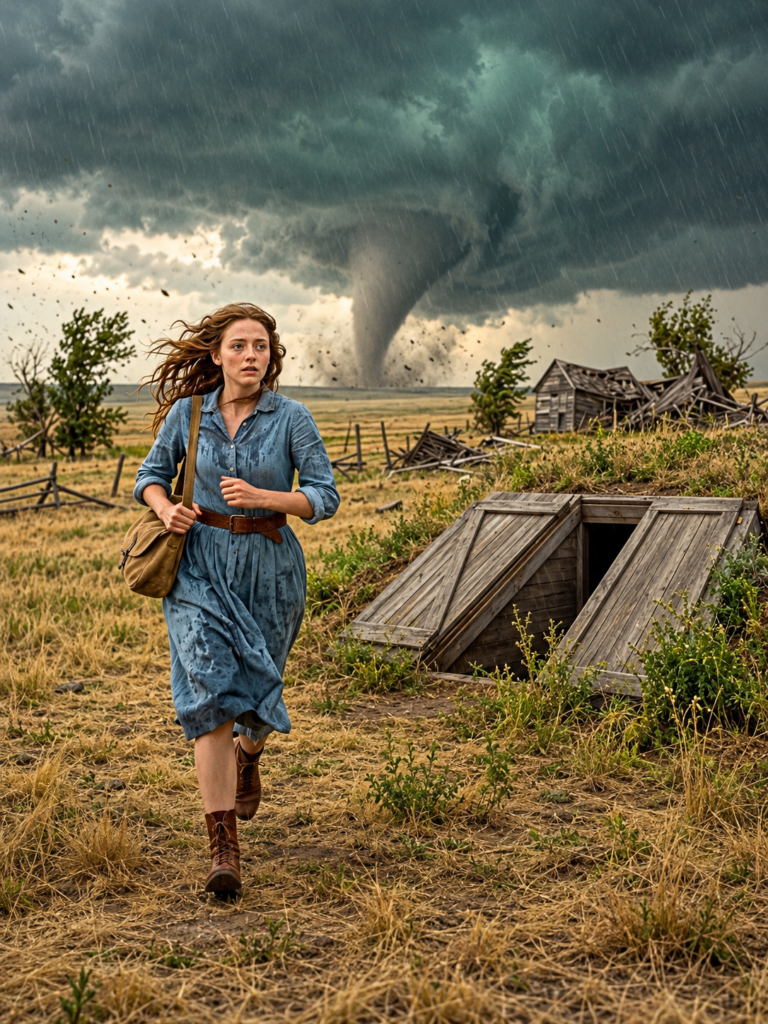
But beneath a low hill behind the house stood a storm cellar.
Elsie had seen it once when Augusta brought food to Zebulon during his final winter.
The old man had been an odd fellow, suspicious of strangers and proud of his underground shelter.
“Storms can’t steal what they can’t reach,” he had told her.
Elsie left the road and ran.
The wind struck so suddenly that it nearly knocked her sideways.
Dust rose in twisting sheets.
Her skirt tangled around her knees, and the canvas bag slammed painfully against her hip.
Behind her, a dark funnel began dropping beneath the clouds.
She did not turn to study it.
She ran harder.
Rain arrived in violent bursts.
The abandoned Tate farmhouse appeared through the blowing dust, its broken roof sagging over an empty doorway.
Elsie scrambled past a fallen fence and climbed the low rise behind it.
Where was the cellar?
She saw the doors almost too late.
Two broad wooden panels lay nearly hidden beneath weeds and dead grass.
She dropped to her knees, grabbed the iron handle, and pulled.
Nothing happened.
The wood had swollen after years of weather.
She braced one boot against the frame.
“Come on!”
The wind tore at her hair.
Something struck the ground behind her with a tremendous crash.
She pulled again.
The door lifted several inches.
Elsie shoved her shoulder beneath it and forced it open enough to squeeze through.
She tumbled down the narrow steps, struck her knee against stone, and dragged the door shut overhead.
Seconds later, the world seemed to explode.
The cellar walls shook.
Dirt streamed from the ceiling.
Something enormous struck the doors, sending a shower of dust across the steps.
Elsie crawled into the far corner and curled beneath her blanket.
The roar was unlike anything she had ever heard.
She imagined the farmhouse being torn apart above her.
The barn at home.
The cottonwoods.
The two graves.
“Oh, please,” she whispered.
She did not know whether she was praying for her own life or for the little ranch she had left behind.
For several minutes, there was nothing but the terrible noise.
Then a heavy crash sounded overhead.
One of the ceiling beams creaked.
Elsie pressed herself against the stone wall, expecting it to collapse.
Her right hand slid across the packed-earth floor.
And touched wood.
At first, she thought it was a fallen board.
She moved her hand again.
Three narrow planks lay across the earth near the rear wall.
They were partly covered with dirt, but their edges were unusually straight.
Elsie frowned.
Zebulon Tate had been a meticulous man.
Even as a child, she remembered him stopping people at his front gate to tell them not to step on his flower beds.
Why would he leave three crooked boards in the floor of his shelter?
Another violent gust shook the doors.
Elsie waited, holding her breath.
Eventually, the roar began to drift eastward.
The cellar still trembled, but the worst of the wind seemed to be passing.
She crawled toward the boards.
One lifted easily.
Beneath it lay a rusted iron ring.
Elsie stared.
She cleared the remaining dirt away, hooked both hands around the ring, and pulled.
A square wooden hatch rose from the floor.
Below it, a narrow staircase disappeared into darkness.
For a long moment, Elsie could only stare.
She had lived in Pine Hollow all her life.
She had visited this property.
Yet she had never known there was another room beneath the storm cellar.
A faint smell of cedar rose from below.
Her first instinct was to close the hatch.
A hidden room on an abandoned ranch was no place for a young woman alone.
But then she remembered the lawyer’s hesitation when she asked about Lucian Reddick.
And her mother’s final warning.
Elsie searched a nearby shelf until she found a tin of old matches.
Several were damp.
The fourth caught.
Shielding the flame, she descended.
The lower room was small, perhaps twelve feet square, with cedar boards along the walls and a packed clay floor.
There was an old wooden chest against one wall.
Beside it stood a metal cashbox and several bundles wrapped in oilcloth.
No water had reached the room.
Everything looked carefully preserved.
Someone had taken considerable trouble to hide it.
Elsie knelt beside the chest.
She struck another match and lifted the lid.
Inside lay folded letters, tax receipts, property records, and a small Bible with a cracked leather cover.
She lifted the first bundle.
The paper smelled old but remained dry.
She unfolded a document and held it close to the matchlight.
Halfway down the page, she saw a familiar name.
Amos Marlow.
Her father’s name.
Elsie went very still.
She unfolded another page.
Augusta Marlow.
Then she found a yellowed envelope tucked between two land records.
Across its front, in handwriting she would have recognized anywhere, were two words.
For Elsie.
The match burned dangerously close to her fingers.
She dropped it and struck another.
“Ma?”
The word escaped her lips before she could stop it.
She knew that handwriting.
She had seen it on grocery lists, church donation envelopes, birthday cards, and notes left beside her breakfast.
Her mother’s hand had written those words.
And her mother had hidden them beneath an abandoned storm cellar.
Elsie sat back on her heels.
Above her, thunder rolled across the damaged valley.
Her hands trembled as she opened the envelope.
The letter was dated nearly three years earlier.
Long before Augusta became bedridden.
Long before Elsie sold the cattle, the horse, and her father’s wagon.
She began reading.
My darling Elsie,
If you are holding this letter, I fear they have finally come for the land.
Elsie felt the air leave her lungs.
There are things I have not told you. I hoped you might never need to know them. But if someone claims that Pine Hollow never belonged to your father and me, you must not accept it simply because he wears a fine coat or brings papers with official seals.
Her eyes blurred.
She wiped them with her sleeve and continued.
Your father bought this property honestly. We signed the papers before witnesses. We paid our taxes. We built our home. No one gave us this land, and no one has the right to steal it.
Some years ago, certain documents began disappearing from the county office. Questions were raised about our marriage and the original deed. A man named Lucian Reddick began asking questions he had no good reason to ask.
Elsie looked toward the staircase.
Lucian Reddick.
The very man who now claimed her home.
She read faster.
I began keeping copies of everything. Zebulon Tate helped me because I no longer trusted the courthouse to protect what was ours. He told me this room would remain dry and hidden.
Do not let anyone know about these papers until you understand what they prove.
Elsie’s breath trembled.
For fourteen months, she had thought Augusta had died worrying about medical bills and the burden she was leaving her daughter.
Now she understood that her mother had been carrying another fear entirely.
Someone had been trying to take Pine Hollow long before Augusta became sick.
Elsie searched through the chest.
She found old property tax receipts.
A certificate confirming her parents’ marriage.
A copy of an early land-transfer record.
And a small notebook filled with Augusta’s careful handwriting.
Dates.
Names.
Parcel numbers.
Notes about visits to the county office.
Conversations with neighbors.
A list of documents Augusta had requested and never received.
Elsie opened the metal cashbox.
Inside were forty-three dollars, two small keys, and a folded piece of blue cloth.
She stared at the money.
Forty-three dollars.
Augusta must have hidden it years earlier.
It was more than five times everything Elsie had left.
But there was something more important than money in the box.
A small sealed envelope.
On the front Augusta had written:
Open this only when you understand why the deed disappeared.
Elsie turned it over.
The seal remained unbroken.
She wanted desperately to open it.
Instead, she looked again at her mother’s letter.
Read everything. Ask questions. Trust slowly.
She swallowed and set the envelope aside.
The tornado had passed.
Water dripped somewhere above her.
The world outside had changed, but Elsie barely noticed.
She continued reading Augusta’s letter until she reached the final paragraph.
My sweet girl, if you have found this room, I am probably no longer there to stand beside you. I am sorry for that more than words can say.
But I want you to remember something.
You do not have to solve every problem at once.
When you are frightened, do the next necessary thing.
Then do the one after that.
Elsie pressed the letter against her chest.
For a long time, she sat in that little underground room and cried.
She had thought her mother was gone.
Yet here, beneath the earth, Augusta had left her a voice to follow.
And an unfinished fight.
When Elsie finally climbed back into the storm cellar, daylight filtered through the damaged doors.
She pushed them open.
The landscape beyond looked wounded.
Fence posts lay scattered across the grass.
A section of roof rested in a field where no building stood.
A cottonwood had been snapped in half.
Far to the east, the black storm continued its retreat across the basin.
Elsie stood in the wet grass with the papers wrapped beneath her coat.
She was cold, bruised, exhausted, and frightened.
But she was no longer empty-handed.
Her mother had left her a beginning.
And somewhere inside those documents was the truth someone had tried to bury.
Part 3
Elsie reached Pine Hollow town shortly before sunset.
She had walked through mud, climbed over fallen fences, and crossed a shallow creek swollen by stormwater.
Her left knee throbbed where she had struck the cellar steps.
The canvas bag cut into her shoulder.
Several times she stopped to rest, afraid she would collapse before reaching town.
But every time she considered turning back, she heard her mother’s words.
Do the next necessary thing.
The county courthouse stood at the center of town, a squat stone building with tall windows and a clock that had not kept accurate time in years.
Elsie climbed the steps.
The doors were locked.
She tried them twice.
Then she leaned against the stone wall and closed her eyes.
Another day gone.
Seven days remained before she could lose everything.
“Miss Marlow?”
She turned.
An elderly man stood beside the building carrying a broom.
His white hair was neatly combed, and his sleeves were rolled above his elbows.
“Harlan Webb?”
He smiled faintly.
“Been a few years since anyone called me anything but old Harlan.”
Elsie knew him.
He had worked in the county records office for more than thirty years before retiring.
As a child, she had sometimes accompanied Augusta to town and watched him search enormous ledgers for property entries.
He had always offered her a peppermint.
Now he looked at her muddy dress and bruised hands.
“Mercy, child. Were you caught in that storm?”
“Yes, sir.”
“Anybody hurt?”
“Not that I know of.”
He leaned his broom against the wall.
“Your mother’s girl, aren’t you?”
Elsie nodded.
Something in his expression softened.
“Augusta was a good woman.”
The kindness nearly undid her.
Elsie swallowed.
“Mr. Webb, do you still know how to read the old property books?”
He raised an eyebrow.
“Reckon I haven’t forgotten everything.”
She hesitated.
Then she remembered the letter.
Ask questions.
“Would you look at something for me?”
She drew one of the documents from her bag.
Harlan adjusted his glasses.
At first, he studied it without speaking.
Then his face changed.
“Where did you get this?”
“It belonged to my parents.”
“That isn’t quite what I asked.”
Elsie looked at the dark courthouse windows.
“My mother hid it.”
Harlan read the first page again.
Then he looked at her.
“Come back at eight tomorrow morning. I’ll speak to the clerk.”
“Can this save my home?”
The old man considered his answer.
“It might.”
That single word carried Elsie through the night.
The pastor’s wife, Mrs. Bell, found her sitting beneath the courthouse awning after dark.
When Elsie explained what had happened, the woman led her to the church, brought her a bowl of hot stew, and made up a narrow bed in the Sunday school room.
Elsie had not eaten properly since the previous morning.
She finished the stew so quickly that Mrs. Bell quietly placed another slice of bread beside her.
“You should have come to us sooner,” she said.
Elsie stared down at the bowl.
“I didn’t want anyone thinking I was begging.”
Mrs. Bell sat beside her.
“Your mother brought supper to my house every evening for two weeks after my husband broke his hip. Did she ever ask for anything in return?”
“No, ma’am.”
“Then perhaps you ought to let somebody return the favor.”
Elsie’s eyes filled.
She looked away before the tears could fall.
That night she slept beneath a patchwork quilt while rain tapped softly against the church windows.
For the first time in days, she was warm.
But before dawn, she woke with a sudden fear.
What if the lawyer had already arranged to take the ranch?
What if Lucian Reddick was even then walking through her home, opening her mother’s cupboards and deciding which belongings to throw away?
She sat upright.
Her hands were shaking.
The silver thimble lay in her palm.
Elsie closed her fingers around it.
One necessary thing.
Then another.
At eight o’clock, she returned to the courthouse.
Harlan was waiting beside a younger clerk named Thomas Reed.
Thomas appeared uncertain about allowing a retired records keeper into the archive, but Harlan spoke with the authority of a man who had spent half his life in the building.
“We’re looking for the original Marlow transfer,” he explained.
Thomas led them into a dusty room lined with books and wooden cabinets.
The search began.
They examined tax ledgers.
Marriage indexes.
Survey records.
Old transaction registers.
For three hours, nothing matched the paper Augusta had preserved.
Elsie could feel hope slipping away.
She was hungry again.
Her knee hurt.
The room smelled of dust and old leather.
At last, she lowered herself into a chair.
“Maybe it’s gone.”
Harlan did not look up.
“Maybe.”
“Maybe somebody destroyed it.”
“Could be.”
She pressed her fingertips against her forehead.
“Then what’s the point?”
Harlan closed the ledger.
“Miss Elsie, I’ve watched men lose cases because the truth was against them. I’ve also watched good people lose because they quit looking for the proof.”
He tapped the thick book.
“Your mother didn’t quit. I don’t reckon she’d want you to, either.”
Elsie looked at the familiar handwriting in Augusta’s notebook.
She stood.
“What do we look at next?”
For the first time that morning, Harlan smiled.
They continued.
Shortly before noon, Harlan stopped turning pages.
“Well, now.”
Elsie hurried around the table.
His finger rested beside an entry dated more than twenty years earlier.
Amos Marlow.
Purchase of acreage along Pine Hollow Creek.
The parcel number matched the document found in the storm cellar.
There was a reference to a deed filed the same week.
But when Thomas searched for the corresponding document, the folder was empty.
Elsie’s heart sank.
“So we’re right back where we started.”
“No,” Harlan said.
He tapped the entry.
“This proves the county received a transfer bearing your father’s name. The deed is missing, but the record of its filing is still here.”
“Is that enough?”
“Not by itself.”
“Then what else?”
He pointed toward a narrow column.
“Witnesses.”
There were two names.
One had faded beyond recognition.
The other was barely legible.
Elsie leaned closer.
She traced the letters with her finger.
Mercer.
She had seen that name before.
Her breath quickened.
“Wait.”
She opened the canvas bag and took out the bundle of letters tied with blue thread.
Her mother had kept it near the bottom of the chest.
Elsie untied the thread.
There were four letters inside.
On the final envelope was a name.
Elias Mercer.
She held it beside the ledger.
The signatures matched.
Harlan removed his glasses.
“Well, I’ll be.”
The letter was old, but the ink remained readable.
Elias Mercer described witnessing Amos purchase Pine Hollow Ranch.
He mentioned the payment, the original deed, and the county officer who accepted it.
At the bottom was an address near Red Creek, eighteen miles north of town.
Elsie looked at Harlan.
“Is he still alive?”
“Last I heard.”
“How old is he?”
“Eighty-four, maybe eighty-five.”
“Then I need to find him.”
Harlan glanced at her muddy boots.
“How do you intend to travel eighteen miles?”
“I’ll walk.”
“You most certainly will not.”
“I don’t have a horse.”
“I noticed.”
“And I can’t afford to hire a wagon.”
Harlan studied her for a moment.
Then he reached into his coat pocket and withdrew a ring of keys.
“My old truck is parked behind the feed store.”
Elsie stared.
“Mr. Webb—”
“It pulls to the right, the engine makes a noise like a bucket of nails, and the passenger door won’t open from the inside.”
He placed a key in her hand.
“But it’ll get you to Red Creek.”
She looked at the key.
“I can’t take your truck.”
“You aren’t taking it. You’re borrowing it.”
“What if something happens?”
“Then we’ll both have a story to tell.”
Elsie laughed through her tears.
It was the first time she had laughed since the lawyer arrived.
The journey north was slow.
The truck coughed and rattled over washed-out roads.
More than once, Elsie stopped to move fallen branches.
At a narrow bridge, she climbed out and examined the wooden planks before trusting the truck’s weight to them.
By late afternoon, she reached the Mercer farm.
The house stood beside a grove of tall trees, with a windmill turning slowly above a cattle trough.
An elderly man opened the door.
His back was bent, but his eyes remained sharp.
“Yes?”
“Mr. Elias Mercer?”
“That’s me.”
“My name is Elsie Marlow.”
The old man’s expression changed.
“Marlow?”
“Amos and Augusta Marlow were my parents.”
For several seconds, he said nothing.
Then he stepped aside.
“Come in, child.”
The farmhouse smelled of coffee, stove polish, and old pine boards.
Elias lowered himself carefully into a chair while Elsie explained the lawyer’s visit.
She showed him the documents.
The land record.
The letter.
The missing deed reference.
Elias listened without interrupting.
Finally, he took off his glasses and rubbed his eyes.
“I remember that day.”
Elsie leaned forward.
“You do?”
“Your father came wearing his good brown jacket. Your mother had a little blue ribbon tied around her hair.”
He smiled faintly.
“She was laughing because Amos had counted the purchase money three times before handing it over.”
Elsie’s throat tightened.
Her father had always counted money twice.
Three times when he was nervous.
“He bought the ranch fairly,” Elias continued. “I stood there and watched him sign the papers.”
“Would you tell a judge?”
The old man looked toward the window.
His smile faded.
“I’m not sure I could make the journey.”
Elsie felt her hope collapse.
Elias noticed.
“It’s not that I don’t want to help. My legs aren’t good, and the road near Red Creek nearly killed me the last time I tried to travel in a storm.”
Elsie looked down.
A week earlier, she might have accepted that as the end of the road.
But Augusta’s words returned.
Ask questions.
She raised her head.
“Mr. Mercer, could you give a written statement?”
He considered it.
“I suppose.”
“What if a notary came here?”
Elias nodded slowly.
“That I could manage.”
Elsie nearly smiled.
“Then I’ll find one.”
Before she left, the old man caught her hand.
“There’s something else you ought to know.”
She stopped.
“Your mother came here years ago.”
Elsie stared.
“Ma?”
“She asked me to write down everything I remembered about the purchase.”
“Why?”
Elias sighed.
“She said somebody had been asking questions about the deed. Said a man from Denver had offered to buy her property for far less than it was worth.”
“Lucian Reddick?”
The old man’s expression darkened.
“I believe that was his name.”
Elsie felt a cold weight settle in her stomach.
Her mother had known more than she had written.
And someone had been trying to push her family off Pine Hollow for years.
Part 4
By the time Elsie returned to town, darkness had fallen.
Harlan met her outside the feed store.
“Did you find him?”
“Yes.”
“And?”
“He remembers everything.”
Harlan’s face brightened.
“Will he testify?”
“He can’t travel. But he’ll give a sworn statement if we find a notary willing to go to his house.”
The old man thought for a moment.
“There’s a fellow named Samuel Price who handles land documents for farmers north of here. I’ll speak to him first thing in the morning.”
Elsie handed back the truck key.
Harlan waved it away.
“Keep it until this is settled.”
“Mr. Webb, you’ve already done too much.”
He looked at her firmly.
“Your mother helped my wife through the worst winter of our lives. She sat beside Clara’s bed when the fever wouldn’t break, and she never once asked whether we could pay her.”
He cleared his throat.
“I’m not doing too much, Elsie. I’m doing what should’ve been done a long time ago.”
That night, Elsie returned to Pine Hollow Ranch.
She needed clean clothes, food, and another look at Augusta’s hidden papers.
As she approached the farmhouse, she noticed automobile tracks in the mud.
Fresh tracks.
She stopped.
The front door was closed.
But the small gate beside the barn stood open.
Elsie had latched it before leaving.
She moved carefully toward the house.
Inside, the kitchen looked undisturbed.
Yet the drawer beneath the table was partly open.
Someone had been searching.
She checked the shelf where her mother kept old correspondence.
Several envelopes were scattered across the floor.
The little box containing Amos’s army photographs lay upside down.
Elsie’s heart pounded.
Nothing valuable had been taken.
Not the clock.
Not the silver spoons.
Not even the small amount of money hidden in the flour tin.
Whoever entered the house had not come to steal ordinary possessions.
They had been looking for papers.
Elsie locked the door and pushed a chair beneath the handle.
Then she sat at the kitchen table with a lantern burning beside her.
For the first time, she understood why Augusta had hidden her records away from the ranch.
The danger was not simply that a lawyer might produce the wrong documents.
Someone was willing to search her home to keep the correct ones from appearing.
She opened Augusta’s notebook.
Near the back was an entry she had overlooked.
Lucian came again. Offered cash if we would leave before the survey. Said the old boundaries were no longer worth arguing over.
Another entry followed.
He is not acting alone. There is someone in the county office helping him. I cannot yet prove who.
Elsie stared at the page.
Someone in the courthouse.
She thought of Thomas Reed.
Of the empty deed folder.
Of the way Pierce had avoided answering her question about Lucian.
But suspicion was not proof.
She kept reading.
A later entry described a second visit.
Lucian became angry when I refused. Said it would be easier for everyone if Amos’s old papers vanished entirely. I told him a missing paper does not change what a man paid for honestly.
Elsie turned the page.
If anything happens to the deed, the truth can still be found. I have saved the dates, the witness names, and the original parcel references.
Beneath that sentence, Augusta had written something else.
The reason they want Pine Hollow lies beneath the western ridge.
Elsie looked up.
The western ridge rose beyond the far pasture.
It was rough country, mostly scrub grass and stone.
Her father had once grazed cattle there during a dry summer, but the ground was too poor for regular use.
Why would anyone want it?
She searched the remaining notes.
There were references to a land survey.
A mining company.
A proposed railroad spur.
And several parcels near Pine Hollow Creek.
She remembered a notice posted at the feed store months earlier about a private company purchasing land in the basin.
At the time, she had paid little attention.
She had been too busy trying to keep the ranch running.
Now the pieces began to fit together.
Pine Hollow might be worth more than anyone had told her.
But Augusta’s instructions were clear.
Read everything. Trust slowly.
Elsie took out the sealed envelope from the hidden room.
Open this only when you understand why the deed disappeared.
Her hands shook as she broke the seal.
Inside was a short note and an old folded survey map.
The note read:
Elsie, if you have reached this point, you will have learned that the missing deed is not an accident.
Lucian wants the western ridge. The railroad company once studied a route through our property, and later men examined the ground for mineral deposits. Whether either plan succeeds, he believes the land may become valuable.
But there is something more serious.
Years ago, a clerk in the county office agreed to alter the records so Lucian could challenge our ownership. Zebulon learned of it from a man who had worked beside the clerk.
I could never prove everything. I kept what I could, knowing that one day someone honest might help you finish the work.
The name of that clerk is in the enclosed papers.
Elsie unfolded a final sheet.
There was a name.
A date.
And a notation showing an unauthorized alteration to the property index.
She read it twice.
Then a third time.
The name belonged to a man who had once worked in the county records department and later accepted employment with Lucian Reddick’s business interests.
It was the first direct clue connecting the disappearance of the deed to Lucian’s claim.
Elsie placed both hands flat on the table.
This was bigger than a missing paper.
Someone had deliberately tried to erase her parents’ ownership.
And her mother had spent years gathering the evidence to stop them.
A knock sounded at the front door.
Elsie froze.
It came again.
Three deliberate knocks.
“Miss Marlow?”
She recognized the voice.
Alden Pierce.
She remained seated.
“Miss Marlow, I know you’re inside.”
Elsie stood slowly.
“What do you want?”
“I’d like to discuss an arrangement.”
“It’s late.”
“I won’t take much of your time.”
Elsie moved toward the door but left the chair braced beneath the handle.
“Then speak from there.”
Pierce sighed.
“Mr. Reddick is prepared to offer you two hundred dollars if you surrender possession immediately.”
Elsie’s stomach tightened.
Two hundred dollars.
More money than she had seen in one place since selling the cattle.
It could pay overdue bills.
It could buy a horse.
It could give her a chance to begin again somewhere else.
Pierce continued.
“You’re a young woman, Miss Marlow. You could make a fresh start without the expense of litigation.”
Elsie looked around the kitchen.
The patched curtains.
The stove her father had installed.
The marks on the doorframe where Augusta measured her height every birthday.
“Why would Mr. Reddick pay me if he already owns the ranch?”
Silence.
Then Pierce replied, “To avoid a dispute.”
“Is he afraid of one?”
“I’m trying to help you.”
“Then tell me why he’s so interested in my western ridge.”
A long pause followed.
“How did you hear about that?”
Elsie gripped the silver thimble.
“My mother was a careful woman, Mr. Pierce.”
The lawyer’s voice hardened.
“You should consider what you’re risking.”
“I’m considering it.”
“Tomorrow may be too late.”
Elsie looked toward the window.
Beyond the darkness stood the graves of her parents.
“Then I suppose I’d better get started early.”
She listened as Pierce walked away.
A car door closed.
An engine started.
Only when the sound faded did she allow herself to sit down.
Her whole body trembled.
Not from weakness.
From the knowledge that she had just refused the only easy way out.
For a long time, she stared at the two hundred dollars she might have had.
Then she picked up Augusta’s notebook and returned to her work.
The next morning, Harlan arrived before sunrise.
Elsie showed him the opened envelope.
He read the notes in silence.
When he reached the clerk’s name, his face went pale.
“I remember him.”
“You knew him?”
“We worked in the same building.”
“Would he have been able to remove a deed?”
Harlan closed the paper.
“He had access.”
Elsie’s heart quickened.
“Then we can prove it.”
“Not yet.”
“But—”
“Access isn’t proof. And your mother’s notes, important as they are, need independent support.”
Elsie pressed her lips together.
She was beginning to understand how difficult justice could be.
Knowing the truth was one thing.
Proving it was another.
Harlan studied the papers again.
“There’s a county index number here. I want to check it against the archive register.”
“Will Thomas help?”
“I’ll ask him to bring the books. That way everything stays in plain sight.”
That afternoon, Samuel Price traveled to Red Creek and took Elias Mercer’s sworn statement.
Elias identified the original signatures and described witnessing Amos purchase the land.
Meanwhile, Harlan and Thomas searched the older county indexes.
They discovered that the original deed had been entered correctly when Amos bought Pine Hollow.
A later alteration had changed the reference to a different family claim.
The original deed folder remained missing.
But an older duplicate index preserved the first entry.
Harlan compared the dates.
The alteration occurred during the same period Lucian had begun approaching Augusta about selling the ranch.
He looked at Elsie across the archive table.
“This is no longer simply your mother’s word against his.”
Elsie felt her pulse quicken.
“What happens now?”
“We bring everything before the county judge.”
“And if he doesn’t believe us?”
Harlan folded his hands.
“Then we find another way to make the truth heard.”
Elsie looked at the stack of papers.
The marriage certificate.
The tax receipts.
The land-transfer entry.
The witness statement.
The duplicate index.
And Augusta’s careful notebook.
For the first time, her mother’s work had become something other people could see.
Something they could test.
Something they could no longer dismiss as the frightened memories of a dying woman.
But the hearing would determine whether any of it was enough.
That evening, Elsie returned home and stood beneath the cottonwoods.
She knelt beside Augusta’s grave.
“Ma,” she whispered, “I found what you left.”
The leaves stirred overhead.
“I don’t know if I can finish it.”
Her voice broke.
“I wish you were here.”
She waited in the gathering darkness.
There was no answer.
Only the wind moving through the trees.
Then Elsie remembered the woman who had risen before dawn every winter to break ice from the cattle trough.
The woman who had buried her husband and still found a way to raise her daughter.
The woman who had hidden papers in a secret room because she feared the truth might otherwise disappear.
Elsie wiped her cheeks.
“I’ll do the next necessary thing.”
She stood.
Tomorrow, she would face Lucian Reddick.
And she would do it carrying twenty years of her parents’ lives in a worn canvas bag.
Part 5
The courthouse was crowded when Elsie arrived.
Harlan walked beside her, carrying the thickest of the county ledgers.
Thomas Reed followed with the duplicate property index.
Samuel Price had delivered Elias Mercer’s sworn statement the previous afternoon.
And waiting on the benches were several people from Pine Hollow.
Mrs. Bell.
The feed store owner.
An elderly rancher who remembered helping Amos build the first fence.
Two women Augusta had cared for during difficult winters.
Elsie stopped at the doorway.
“Why are they here?”
Harlan smiled.
“Seems your mother made quite a few friends.”
Across the room, Lucian Reddick sat beside Alden Pierce.
He was a distinguished-looking man with silver hair and a dark tailored suit.
He showed no surprise when Elsie entered.
If anything, he seemed mildly irritated.
As though she were an inconvenience that should already have been settled.
“Miss Marlow,” he said when she approached.
“Mr. Reddick.”
“I understand you’ve found some old family documents.”
“I have.”
He smiled faintly.
“Old papers can be terribly misleading.”
“So can new ones.”
His smile disappeared.
Pierce rose.
“I suggest we allow the court to consider the evidence.”
Elsie sat beside Harlan.
Her knees felt weak.
She slipped the silver thimble into her palm beneath the table.
The hearing began.
Pierce presented Lucian’s claim first.
He explained the missing deed, the irregularities in the title, and the alleged failure to establish Augusta’s lawful inheritance.
He spoke confidently.
He used words Elsie barely understood.
At times, he sounded so certain that she felt the same helplessness she had experienced in her kitchen.
Then Harlan leaned toward her.
“Remember what we’ve found.”
Elsie nodded.
When the judge invited her to speak, she stood.
“My name is Elsie Marlow. My father bought Pine Hollow Ranch more than twenty years ago. My parents lived there, paid taxes there, and raised me there.”
Pierce rose.
“Miss Marlow, no one disputes that your family occupied the property.”
Elsie looked at him.
“We didn’t just occupy it.”
She placed the old land-transfer record on the table.
“My father purchased it.”
Harlan submitted the corresponding county ledger entry.
Thomas Reed presented the duplicate index, explaining how its original reference differed from the later version.
Then came the marriage certificate.
The church register.
The tax receipts.
Elias Mercer’s sworn statement.
Document by document, the picture became clearer.
Amos Marlow had bought the property.
Augusta Marlow had been his lawful wife.
The family had paid taxes continuously.
And someone had altered the county records after the original transfer.
Pierce argued that the missing deed created uncertainty.
Harlan agreed that the original document had not been recovered.
But he explained that the independent records consistently supported the Marlow ownership.
When the judge asked about the altered index, Thomas described the discrepancy.
The courtroom grew quiet.
Lucian shifted in his chair.
Then the judge examined Augusta’s notebook.
“Mrs. Marlow appears to have maintained an extensive record of her efforts to resolve these discrepancies.”
Elsie swallowed.
“Yes, sir.”
“Why did she not bring these matters before the court herself?”
Elsie thought of her mother’s hands.
Of the medicine bottles beside the bed.
Of the winter they sold Daisy.
“She was trying to keep the ranch going,” Elsie answered. “Then she became ill. She was afraid the papers would disappear before anybody listened.”
The judge studied the notebook for a long time.
He then asked Pierce to explain the basis for Lucian’s supposedly superior claim in light of the older county records.
Pierce offered a technical explanation.
But the chain no longer fit.
The dates contradicted one another.
The surviving witness supported Amos.
The duplicate index pointed toward the missing deed.
And Augusta’s records showed that Lucian had attempted to purchase the ranch years before claiming it had always belonged to his family.
The judge called a recess.
Elsie walked outside because she could no longer bear the waiting.
She sat on the courthouse steps, her hands trembling.
Harlan joined her.
“You did well.”
“I thought I was going to be sick.”
“Courage doesn’t mean your stomach behaves.”
She gave a small laugh.
Then her expression darkened.
“What if they still take it?”
Harlan looked toward the street.
“Then you’ll know you didn’t give it away.”
Elsie stared at the thimble in her palm.
“I used to think Ma could do anything.”
“She was a remarkable woman.”
“I thought I was nothing like her.”
Harlan turned toward her.
“Your mother collected the papers. But she couldn’t come here today.”
Elsie said nothing.
“You drove eighteen miles to find a witness. You persuaded a man who couldn’t travel to give a statement. You stood in front of a judge and told the truth while powerful men tried to make you doubt yourself.”
He placed a hand over hers.
“Seems to me Augusta raised exactly the daughter she meant to.”
Elsie lowered her head.
For the first time, she understood that her mother’s final gift had not been a secret room or a bundle of papers.
It had been the chance to discover her own strength.
When the hearing resumed, the judge returned to the bench.
He explained that the assembled records established a consistent chain of ownership in favor of the Marlow family.
The altered index and missing deed had created confusion, but they did not erase the supporting evidence.
The court recognized Elsie’s lawful claim to Pine Hollow Ranch and rejected Lucian Reddick’s competing claim.
An investigation into the alteration of the county records would continue separately.
For a moment, Elsie did not understand.
The words seemed to hang in the air.
Then she felt Harlan’s hand touch her shoulder.
“Elsie.”
She looked at him.
“You’ve kept your home.”
Her breath caught.
The ranch.
The barn.
The kitchen.
The two graves beneath the cottonwoods.
She could keep them.
She covered her mouth with both hands.
Across the room, Lucian Reddick stood.
His face had grown pale.
He gathered his papers without looking at her.
For weeks, Elsie had imagined what she might say if she ever faced him after winning.
She thought she might demand an apology.
She thought she might ask why he had tried to destroy everything her parents built.
But watching him walk toward the door, she felt something unexpected.
She no longer needed anything from him.
His defeat could not bring back her father.
It could not give Augusta another spring.
It could not restore Daisy or the old buckboard.
But he could no longer take their home.
And that was enough.
Outside, Mrs. Bell embraced her.
Several neighbors shook her hand.
The feed store owner promised to help repair the storm-damaged fences.
One farmer offered a young heifer to begin rebuilding the herd.
Another said he had spare lumber for the barn.
Elsie tried to protest.
“You’ve all already done so much.”
Mrs. Bell smiled.
“Your mother spent twenty years helping people in this valley. Perhaps it’s time Pine Hollow helped her daughter.”
Elsie cried then.
Not with the helpless grief she had felt after the eviction notice arrived.
These were tears of relief.
And belonging.
That evening, she returned to the ranch.
The sun was setting behind the western ridge.
Golden light stretched across the damaged fields.
The barn still leaned.
The fences still needed repairing.
There were weeds in the garden and unpaid bills beside the stove.
Nothing had magically become easy.
But the front door was hers to open.
The kitchen was hers to sit in.
And the little patch of earth beneath the cottonwoods would remain in her care.
Elsie carried two small bunches of wildflowers across the pasture.
She knelt beside her father’s grave first.
“I kept it, Pa.”
Her voice broke.
“I know I haven’t done much with it yet. But I kept it.”
She placed the flowers beneath his wooden cross.
Then she moved to Augusta.
For a long time, she said nothing.
She simply sat in the grass, turning the silver thimble between her fingers.
Finally, she whispered, “You knew.”
The wind stirred the leaves overhead.
“You knew somebody would come for the ranch.”
Her eyes filled.
“And you knew I’d be frightened.”
She laughed softly through her tears.
“I was, Ma. I was so frightened.”
She thought of the tornado.
The dark cellar.
The hidden staircase.
The letter with her name written across the front.
The long road to Red Creek.
The courthouse.
The trembling in her hands as she stood before the judge.
“I wanted you to tell me what to do,” she whispered.
Then she looked toward the farmhouse.
“But you already had.”
Elsie sat there until the last light faded.
The next morning, she rose before dawn.
She put on her father’s old work coat and carried a hammer to the barn.
The loose board still knocked against the frame.
She climbed the ladder, pulled the damaged nails, and fixed it properly.
It took less than an hour.
When she climbed down, she stood for a moment listening.
The wind blew.
But the board remained still.
For the first time in years, the barn was quiet.
Elsie smiled.
One necessary thing.
Then another.
Over the following months, the ranch slowly returned to life.
Neighbors helped rebuild the fences.
Harlan brought tools from his shed.
Mrs. Bell planted vegetables beside the kitchen.
The young heifer grew stronger, and by autumn Elsie had saved enough to purchase two more cattle.
She never became wealthy.
There were still difficult winters.
Still bills.
Still mornings when the work seemed larger than one person could manage.
But she no longer believed that asking for help was the same as admitting defeat.
The following spring, she planted two young cottonwoods near her parents’ graves.
One for Amos.
One for Augusta.
Years passed.
Pine Hollow Ranch remained a modest place.
The farmhouse was repainted.
The barn received a new roof.
The pasture fences stood straight again.
And the little silver thimble rested in a wooden box beside Augusta’s Bible.
Elsie never sold it.
Sometimes, when a neighbor’s daughter came to visit, Elsie would take out the thimble and tell her how an old woman had hidden a letter beneath a storm cellar floor.
The children always wanted to hear about the tornado.
They wanted to know how loud it had been, whether Elsie had feared she would die, and what treasures she had found below the ground.
Elsie would smile.
“There wasn’t much treasure down there,” she would say.
“Just some old papers, a little money, and a letter from my mother.”
The children would look disappointed.
Then Elsie would hold up the silver thimble.
“But I’ll tell you something. I went into that cellar believing I had lost everything.”
She would look toward the cottonwoods beyond the window.
“And I came out knowing that the people we love can leave us more than land or money.”
One little girl once asked, “What did your mother leave you?”
Elsie thought for a moment.
Then she answered.
“She left me the courage to keep going when I couldn’t see how things would turn out.”
Outside, the old cottonwoods swayed in the afternoon breeze.
Beside them, the two younger trees had taken root.
And every time the wind moved through their leaves, Elsie remembered the words that had carried her through the darkest days of her life.
Do the next necessary thing.
Then do the one after that.
Because sometimes the greatest inheritance a mother can leave her child is not a house, a farm, or a fortune.
It is the strength to stand alone when the world turns against her.
The wisdom to recognize those who are willing to help.
And the courage to protect the things that love has built.
Elsie Marlow had entered an abandoned storm cellar with eight dollars and fifteen cents and almost no hope left.
What she found beneath the earth did more than save Pine Hollow Ranch.
It taught her that her mother’s love had never truly left the land.
It had been waiting there all along.
And now, at last, Elsie knew how to carry it forward.