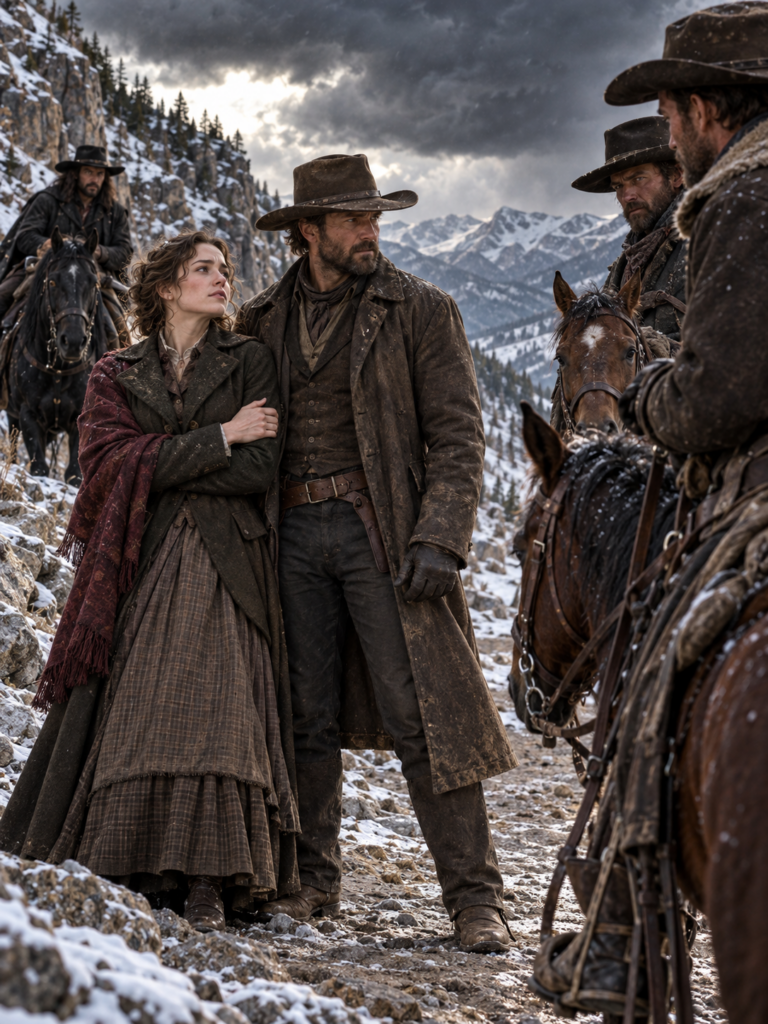
The gust swept loose snow across the hoofprints, and Caleb crouched to examine what remained.
Norah stood beside his horse, listening for the sound of approaching riders.
“Are they Silas’s men?”
“Can’t tell.”
“Are the tracks fresh?”
“Fresh enough.”
He straightened, looking toward the darkening timber.
The narrow trail curved downhill, away from Stonegate Pass. Whoever had ridden through before them might have been searching for shelter. They might also have been waiting for her.
Norah tightened her grip on her coat.
“We should go another way.”
“Not without knowing where it leads.”
“You know these mountains.”
“I know enough not to promise a safe road where I haven’t got one.”
Snow gathered on his shoulders.
Caleb looked at her boots, then at the horse.
“How far can you walk?”
“As far as necessary.”
“That wasn’t my question.”
She drew herself upright.
“I’m tired. My feet hurt. But I can keep walking.”
“Good. Tell me before that changes.”
He offered her the reins while he examined the trail ahead.
Norah accepted them.
The horse lowered its head beside her, breathing white into the cold air.
For the first time since leaving Red Hollow, she held something useful instead of merely following someone else’s instructions.
When Caleb returned, he pointed downhill.
“The cabin’s below the ridge. We can reach it before the trail gets worse if we keep moving.”
“And the riders?”
“We’ll mind them if we meet them.”
Norah looked back toward the road.
“Silas won’t stop looking.”
“Then we’ll need more than a story about being engaged.”
The truth of that frightened her more than the snow.
She had believed that crossing Stonegate would end her troubles. Beyond the pass, Silas’s influence might be weaker, and she could seek help examining her father’s affairs.
But now the mountain itself had closed around them.
And the stranger who had saved her from discovery had no idea how much danger he had accepted.
“Caleb, you can leave me at the cabin.”
He stopped.
“This isn’t your fight,” she continued.
“We’re halfway into a mountain storm.”
“I mean Silas.”
“So do I.”
There was no possessive declaration in his answer. No promise of violence.
Only a plain refusal to abandon someone to a danger he understood well enough.
They descended carefully.
Caleb led the horse where the footing was uncertain, and Norah followed close behind.
Twice she stumbled.
Once she caught herself without help.
The second time, Caleb offered his arm.
She accepted it.
By the time the line cabin appeared among the trees, her fingers were stiff and her dress was damp around the hem.
Caleb opened the door and checked the little building before inviting her inside.
A rough table stood beside the wall.
There was a hearth, a narrow sleeping place, and a wooden chest.
It was plainly a shelter used by men working cattle in the warmer months, not a home prepared for winter visitors.
But it had a roof, walls, and firewood.
Caleb set about making a fire.
Norah remained near the doorway until he noticed.
“You can close that,” he said.
She hesitated.
He understood.
“You don’t know me.”
“No.”
“There’s dry clothing in the chest. Men’s things, but better than wet ones. I’ll see to the horse while you change.”
“And if I decide I want the door open?”
“Then leave it open.”
He stepped outside.
Norah watched him go.
Only after his footsteps moved toward the shelter beside the cabin did she close the door.
She found a heavy shirt and trousers in the chest, changed her damp clothes, and hung them where they might dry.
Then she reached into the lining of her traveling bag.
Her fingers touched the folded survey she had carried from her father’s belongings.
She had almost left it behind.
Instead, she drew it out and spread the worn paper across the table.
The lines and measurements were familiar, but she had never understood why her father had guarded it so carefully.
Near the mountain ridge lay a marked parcel she had assumed held little value.
Her father’s handwriting appeared along one edge.
Before she could study it further, footsteps sounded outside.
Norah folded the survey halfway, then stopped.
If she wanted Caleb’s help, she could not keep every part of her trouble hidden.
She flattened the paper again.
When he knocked, she called for him to enter.
Caleb stepped inside, snow on his coat.
Norah turned the survey toward him.
“Before we go any farther,” she said, “there’s something about my father’s land you need to see.”
Caleb approached the table and looked down at the paper Norah had placed before him.
The survey was old enough to show wear along its folds, but the boundary lines remained visible.
He removed his hat.
“Your father’s?”
“Yes. He kept it among his private papers.”
“What’s troubling you about it?”
Norah pointed toward Stonegate Ridge.
“This is the land Silas says he means to protect through our marriage. He claims my father owed him a debt large enough to swallow nearly everything.”
“How large?”
“Eight thousand dollars.”
Caleb looked up.
“That’s considerable money.”
“Far more than Father ever spoke of owing.”
“Have you seen the original account?”
“No. Only what Silas showed me.”
Caleb did not immediately respond.
Norah heard the fire beginning to catch behind them.
She studied his expression.
“You think I should have demanded the records sooner.”
“I think a man asking for your land and your hand ought to be willing to explain his figures.”
“That wasn’t the sort of answer Silas allowed.”
Caleb pulled back from the table.
“Then perhaps that’s where we begin.”
Norah felt an unexpected sting behind her eyes.
All afternoon, she had expected this stranger to question her judgment.
Why had she agreed to the wedding?
Why hadn’t she left sooner?
Why had she trusted Silas at all?
Instead, Caleb had asked about the evidence.
She lowered herself onto the bench.
“My father died last spring. Afterward, Silas came with papers claiming debts I hadn’t known existed. I knew some money was owed. Father had never pretended otherwise. But Silas kept adding amounts I couldn’t account for.”
“And offered marriage?”
“He said he’d forgive everything if I became his wife.”
Caleb looked toward the fire.
“Convenient arrangement.”
“For him.”
“Not for you.”
Norah shook her head.
“No.”
She had once thought herself capable of managing her father’s property, but grief and pressure had worn away her certainty.
Silas had made each choice seem smaller until marriage appeared to be the only one remaining.
Then, on the morning of the ceremony, she had packed the survey, a few belongings, and enough courage to run.
Caleb set a pot near the fire.
“We’ll eat first.”
“Then?”
“Then we look at what your father left you.”
It was the first promise that had sounded like help rather than another bargain.
***
That night, Norah ate a simple meal beside the hearth.
She tasted the food and glanced at Caleb.
“This needs salt.”
“I was hoping nearly freezing would lower your standards.”
“It did.”
He waited.
“Not quite that far.”
A surprised laugh escaped him.
Norah smiled into her cup.
For several minutes, the cabin no longer felt like a place where two strangers had taken refuge from a mountain storm.
It felt almost companionable.
Caleb gave her the narrow sleeping place and settled near the hearth.
She protested once.
He answered that he was accustomed to rougher nights during cattle drives.
He also made clear that she could wake him if she needed anything.
Norah slept in the dry borrowed clothing, listening to the wind move around the cabin.
At dawn, Caleb stepped outside to inspect the weather.
When he returned, his face told her enough.
“Stonegate?”
“Still closed.”
“How long?”
“Hard to say. Could be weeks before the route is fit for a wagon.”
Norah stared at him.
Weeks.
Silas would have weeks to strengthen his claim, spread whatever story suited him, and search for her.
Caleb saw her expression.
“My ranch is below this stretch of mountain. We’ll have proper shelter there.”
“You live alone?”
“Most days.”
She considered the offer.
“I can pay for provisions when I have access to my money.”
“You don’t need to settle accounts this morning.”
“I’d rather know the terms.”
He regarded her seriously.
“You’ll have a room that locks from the inside. Food and shelter aren’t being traded for anything. When travel is possible, I’ll help you arrange it.”
“And if I decide to leave sooner?”
“We’ll discuss the road and the risks. The choice remains yours.”
Norah nodded.
“Then I’ll come.”
They waited until travel was safe enough, then made their way down from the line cabin.
The ride was slow.
Caleb watched the footing and rested the horse when necessary.
Norah said little, partly from weariness and partly because she was beginning to understand what a difference there was between a man directing her movements and one making sure she knew her choices.
***
Caleb’s ranch house was larger than Norah had expected.
It had the sturdy simplicity of a working home, with rooms that showed years of careful maintenance.
The furniture was plain but sound.
Tools hung neatly where Caleb needed them.
The kitchen was orderly.
Yet the house felt strangely quiet.
“It’s bigger inside,” she remarked.
“It wasn’t built for one person.”
He led her toward a room that had clearly been kept in good condition despite little recent use.
“My sister stayed here before she married.”
Norah looked at the bed, the small table, and the door.
“It’s more than I expected.”
“The lock works from inside.”
She tested it.
Caleb waited in the hallway.
“There are supplies in the kitchen,” he said. “You can tell me if there’s something you need.”
Norah turned.
“What work needs doing?”
“None that belongs to you.”
“Then I’ll find something I can do by choice.”
“You don’t owe me labor.”
“And I don’t owe myself idleness.”
A corner of his mouth lifted.
“Always this stubborn?”
“Since birth.”
“Who taught you?”
“My father. He believed daughters had hands too.”
Over the following days, Norah made herself useful without accepting the role of servant.
She helped prepare meals, sorted provisions, and found places where her ability to organize records and household supplies could make work easier.
Caleb continued tending the ranch.
He did not assume she understood cattle or horses simply because she wanted to help.
When she asked to learn, he showed her what he knew.
One morning, they worked with a nervous mare.
Caleb demonstrated how to approach without crowding the animal.
Norah watched carefully and followed his instructions, speaking softly as the mare settled.
“You’ve got a steady hand,” Caleb said.
“You sound surprised.”
“I meant it as praise.”
“Then you can say thank you when I help.”
He smiled.
“Thank you.”
Their ease together grew through such ordinary exchanges.
Not because Norah had forgotten Silas.
Not because Caleb had forgotten the danger.
But because every day offered some evidence that they could disagree without fear.
And every task completed together made the ranch feel a little less like a stranger’s house.
***
One evening, Norah found Caleb standing beside an old photograph.
A woman was pictured there, her expression composed and gentle.
Norah waited before speaking.
“Your wife?”
Caleb nodded.
“Anna.”
He remained silent so long that Norah wondered whether she had asked too much.
Then he added, “Four winters ago.”
“I’m sorry.”
“So am I.”
The simplicity of his answer stopped her.
She understood at last why the house seemed built for voices that were no longer there.
Caleb had lost his wife.
His sister had married and moved away.
The rooms remained, but the people who once filled them did not.
“You don’t speak much about her,” Norah said.
“I don’t speak much about anything.”
“That’s what people say?”
“Mostly.”
She studied him.
“I think some things still hurt when you name them.”
Caleb turned the photograph slightly toward the lamp.
“Yes,” he said.
Norah did not ask him to put it away.
She did not tell him to forget Anna.
She sat beside him, and when he was ready, he told her a little about the years they had shared.
Nothing in his words suggested that his marriage had been unhappy.
That mattered to Norah.
She did not want to be welcomed into a life only because a man had an empty room.
And Caleb, she was beginning to believe, would never ask her to become someone else’s replacement.
***
The discovery came several days later.
Norah was examining her father’s survey at the kitchen table when Caleb entered carrying a small bundle of ranch accounts.
She had been studying the same markings for hours.
“Caleb,” she said, “look at this.”
He set down the accounts.
Alongside the boundary lines, her father had written a warning.
If Crow comes for the land, protect Stonegate Spring.
Caleb read it twice.
“Stonegate Spring?”
“Do you know it?”
He examined the ridge on the survey.
“I know the country. Show me the full boundary.”
Norah traced the line.
Caleb followed it with one finger.
His expression changed.
“Your father’s property reaches much farther toward the pass than I realized.”
“Is that important?”
“Very.”
He took another look at the survey.
“The spring lies near the cattle route through Stonegate. Reliable water matters when animals are being moved across country like that.”
Norah stared at him.
“Silas owns ranches west of the pass.”
“He’s been acquiring more land out there.”
“For two years,” she whispered.
Caleb nodded.
“He could make great use of that water.”
The room seemed suddenly colder.
Norah remembered Silas speaking about the future.
About improvements.
About his plans for property that was not yet his.
She had thought he wanted her father’s land because it would secure an old debt.
Now a different possibility stood before her.
“He never wanted to marry me for myself.”
Caleb said nothing.
“He wanted the spring.”
“That’s what it looks like.”
“And marriage would give him a way to press his claim over the land.”
Caleb pulled out a chair.
“We need proof of the debt before we make accusations.”
Norah sat slowly.
Her father’s handwriting blurred for a moment.
The warning was real.
The survey was real.
Silas’s land purchases were real.
But suspicion alone would not defeat a man who claimed written accounts justified everything he had done.
Norah reached for the small packet of receipts she had carried with her.
“Father kept records.”
“Good.”
“If Silas changed the debt, there may be another account somewhere.”
“Where were the original transactions kept?”
“The bank ledger in Red Hollow.”
Caleb looked toward the window.
Snow still lay along the higher road.
“Then that’s where the answer may be.”
“We’ll have to go back.”
“Not through Stonegate while it’s closed.”
Norah clenched her jaw.
“I’ve spent enough time running.”
Caleb met her eyes.
“Then we’ll wait until travel is possible and go after the evidence properly.”
She wanted to argue.
Instead, she unfolded another receipt.
She could work while they waited.
She could compare the figures.
She could prepare questions no one had allowed her to ask before.
And she would not face Silas Crow as a frightened bride this time.
***
The days that followed changed the atmosphere of Caleb’s ranch.
Norah arranged her father’s papers by date and amount.
She found a receipt carrying a number that corresponded to an entry reference in the larger account.
Caleb helped compare the documents without taking them away from her.
When she made a decision, he listened.
When he disagreed, he explained why.
Their work moved between the kitchen table and the daily tasks of the ranch.
One morning, she caught him smiling as she argued with a stubborn mare.
“What’s amusing?”
“You’ve been speaking to that horse like she’s a bank clerk who’s misplaced a receipt.”
“She’d probably be easier to reason with.”
Caleb laughed.
It was an unfamiliar sound in that quiet house.
Norah looked up.
“So you can laugh.”
“Occasionally.”
“I’ll remember that.”
He watched her a moment longer.
“You’ve made the house different.”
She straightened.
“Does that bother you?”
He considered his answer.
“More than I expected it not to.”
Their eyes met.
The moment lasted only a breath before Caleb turned back toward the stable.
But Norah carried his words with her all afternoon.
Then word reached them that Silas Crow had learned where she was staying.
Caleb spoke quietly.
“The Mercer ranch could shelter you if you’d rather be farther away.”
Norah looked at the papers spread across the table.
“I ran from Red Hollow. I’m not running from my own land too.”
“Norah—”
“If Silas comes, I want him to explain every number.”
Caleb looked at her for a long moment.
“Then we make certain someone besides us hears it.”
Soon afterward, they brought what they had to a local authority who could examine the dispute.
The response was discouraging but fair.
A survey could help establish the boundaries of Norah’s property.
Her father’s warning might explain why he had been suspicious.
But neither proved the debt had been altered.
They needed the original ledger entries, dates, and signatures.
Norah returned to the ranch with that answer burning in her mind.
She spread the receipts across the table once more.
Then she found it.
A number written on her father’s payment receipt matched the reference to an original ledger page.
Her father had known something was wrong before he died.
Somewhere in Red Hollow, the earlier figures still existed.
And if they could obtain them, Silas Crow would have to answer for the difference.
That evening, Caleb found her standing beside the table, holding the receipt.
“I know where we must look,” she said.
He read the number.
“Then we find someone who can bring us the original record.”
Norah nodded.
Beyond the window, the mountains remained impassable.
But for the first time since fleeing her wedding, she knew exactly what evidence she was seeking.
Then hoofbeats sounded outside.
Caleb moved to the window.
A rider had entered the yard.
And the man dismounting carried a leather packet from Red Hollow.
The rider lifted the leather packet from his saddle and looked toward the ranch house.
Caleb stepped onto the porch.
Norah followed, still holding her father’s receipt.
The visitor was a bank clerk from Red Hollow, a man who had worked with the accounts her father had kept.
He looked exhausted from the journey.
“Miss Vale?”
“I’m Norah Vale.”
He glanced toward Caleb.
“I was told you needed the original figures concerning your father’s debt.”
Norah’s heart began pounding.
“Were you able to find them?”
The clerk held the packet tighter.
“If Mr. Crow learns I brought these records here, I may lose my position.”
Caleb stepped aside.
“Then we’d better see that the journey serves some purpose.”
Norah did not move toward the packet immediately.
She had spent months watching Silas Crow produce figures she could neither verify nor challenge.
Now, with the original records finally within reach, she found herself afraid to open them.
“What do they show?” she asked.
The clerk looked directly at her.
“Your father’s original balance was twenty-four hundred dollars.”
Norah stood very still.
“Twenty-four hundred?”
“Yes, ma’am.”
“Silas claims eight thousand.”
“I know.”
Caleb’s expression sharpened.
The clerk continued.
“Charges were entered after your father’s death. They account for much of the increase. I have the dates and entries here.”
Norah took the packet.
Her hands trembled as she opened it.
Inside were copies of the relevant ledger entries, along with the clerk’s account of the original figures.
She placed them on the table just inside the doorway and compared them with her father’s receipts.
The numbers matched.
Her father’s handwriting identified payments that had not been properly reflected in Silas’s demand.
The additional charges had appeared later.
After her father was gone.
After Norah had been left to face the claim herself.
For months, Silas had spoken of eight thousand dollars as though the amount were beyond dispute.
He had used it to threaten her property.
Then he had offered to erase it in exchange for marriage.
Now she had evidence showing that the demand had been inflated.
Norah lowered herself into a chair.
“He knew.”
Caleb stood beside the table.
“What do you mean?”
“Father knew there was something wrong. That’s why he kept the receipts. That’s why he wrote the warning about the spring.”
She touched the familiar handwriting.
Her father had not been able to finish what he had begun.
But he had left behind enough for her to continue.
The clerk cleared his throat.
“These records don’t settle every question about the property. The charges will have to be examined by the proper authorities.”
“I understand,” Norah said.
But she was not disappointed.
For the first time, the truth was no longer confined to her memory of conversations with Silas.
It had numbers.
Dates.
Entries.
Documents another person could inspect.
She gathered the papers into a careful stack.
“Will you stand by what you’ve brought?”
The clerk hesitated.
Norah waited.
“I’ll stand by the original entries,” he finally answered.
“Thank you.”
He looked relieved and frightened at once.
Caleb offered him food and a place to rest before the return journey.
Norah remained at the table, comparing each figure once more.
When Caleb came back into the room, she looked up.
“He claimed more than three times the original balance.”
Caleb nodded.
“And the charges after your father’s death need explaining.”
Norah folded her hands.
“Silas wasn’t trying to save my property.”
“No.”
“He wanted to control it.”
Caleb’s eyes went to the survey.
“Stonegate Spring.”
“Yes.”
For the first time, Norah could see the entire shape of Silas Crow’s plan.
The land west of the pass.
The need for reliable water.
Her father’s property reaching toward the spring.
The exaggerated debt.
The proposed marriage that would place her future and her property under Silas’s influence.
The pieces did not yet constitute a final legal judgment.
But they explained why Silas had been so determined that the wedding take place.
He had not been offering to rescue her from financial ruin.
He had been trying to profit from the fear of it.
***
That evening, Norah and Caleb sat together in the kitchen.
The ledger records lay beside the survey.
A lamp burned between them.
Norah had spent hours comparing the entries, and her eyes were tired.
Caleb closed his own account book.
“You ought to rest.”
“I’ve spent enough time resting while other people decided what should happen to me.”
“Working yourself past reason won’t make the figures any clearer.”
She looked at him.
“Are you ordering me to bed?”
“No. Advising you to sleep before you mistake a three for an eight.”
She smiled despite herself.
“Your advice has improved since Stonegate.”
“I’ve had a difficult woman teaching me.”
“Difficult?”
“Very.”
Norah folded the paper in front of her.
“Then you should be thankful.”
“I am.”
His answer came so quietly that her smile faded.
Caleb was looking at her, not at the ledger.
For a moment, the house seemed unusually still.
Norah remembered their first meeting on the mountain road.
She had seized his sleeve.
Asked him to lie.
Asked him to become, for a few dangerous minutes, a man who had already chosen her.
She had expected nothing from him beyond a chance to escape.
Instead, he had given her shelter.
A room with a lock.
The freedom to work or remain a guest.
The right to ask questions.
And the patience to let her own answers matter.
But the arrangement between them had never been romantic.
He had not asked her to stay.
Not in the way that mattered now.
Norah looked toward the hallway.
“Caleb, when this is over, what do you intend to do?”
“About what?”
“The ranch. Your life.”
He leaned back.
“Keep the cattle fed. Repair what needs repairing. Try not to let the weather ruin everything.”
“You know what I mean.”
He was quiet.
Then he glanced toward the photograph of Anna standing on the shelf.
“For four years, I’ve mostly tried to keep the place running.”
“Without changing anything?”
“Some things change whether a man wishes them to or not.”
“And some things need a little help.”
He looked at her again.
Norah wanted to ask more.
But the sound of horses in the yard interrupted them.
Caleb rose.
Norah went to the window.
Several riders were approaching the house.
At their head rode Silas Crow.
***
Silas dismounted with the confidence of a man who had never expected anyone to challenge him successfully.
He wore a dark coat and carried himself as though he had arrived to collect something already belonging to him.
Caleb stepped onto the porch.
Norah remained just inside the doorway.
“Mr. Hart,” Silas called, “you’ve caused me considerable inconvenience.”
“You rode a long way to tell me.”
Silas ignored the remark.
“Send Norah outside. This is a family matter.”
Caleb did not move.
“She isn’t your family.”
“She was supposed to become my wife.”
“Supposed to isn’t the same as chose to.”
Silas’s jaw tightened.
“Don’t interfere in matters you don’t understand.”
Norah opened the door fully.
“If you came for me, Silas, speak to me.”
He turned.
For a moment, the familiar expression returned to his face: a mixture of impatience and certainty that she would eventually obey.
“Finally,” he said.
Norah stepped onto the porch.
Caleb remained nearby but did not place himself between them.
Silas looked her over.
“You’ve caused a great deal of unnecessary trouble.”
“I declined to marry you.”
“You agreed to the arrangement.”
“I agreed under the weight of a debt you refused to explain honestly.”
“Your father’s debt remains unpaid.”
“Then explain the amount.”
Silas’s eyes narrowed.
“We’ve discussed this.”
“You’ve told me a figure. That’s not the same as explaining it.”
“Eight thousand dollars. Marriage would settle it and protect your property.”
Norah held his gaze.
“My property? Or the cattle route you want through Stonegate?”
Silas’s expression changed.
Only slightly.
But she saw it.
And she knew he understood.
“My father knew you wanted Stonegate Spring,” she continued.
“Your father is dead.”
“He left records.”
“A dead man’s warning proves nothing.”
“No,” Norah said. “But the original bank entries may prove considerably more.”
Silas glanced toward Caleb.
“What have you been telling her?”
“She’s been reading her own papers,” Caleb answered.
Norah stepped forward.
“My father’s original balance was twenty-four hundred dollars. You claimed eight thousand.”
Silas’s eyes hardened.
“There were additional expenses.”
“Entered after my father died.”
“Legitimate charges.”
“Then you can explain each one before someone authorized to examine them.”
A voice sounded behind the riders.
“That’s exactly what will be required.”
The local official who had previously examined Norah’s preliminary evidence had arrived with the bank clerk.
The records had been brought forward for review, and the new figures raised questions too serious to dismiss as a misunderstanding.
The official approached the porch.
“Mr. Crow, Miss Vale has produced records showing a substantial difference between the original balance and the amount you demanded.”
Silas turned sharply.
“This is private business.”
“Not when the claim is being used to press a dispute over property.”
The clerk stood beside the official, pale but determined.
He confirmed the ledger entries and dates.
Norah watched Silas’s expression as each figure was read.
The original debt had not vanished.
That was important.
She was not asking to be excused from a genuine obligation merely because she disliked the man claiming it.
She wanted the true amount established.
And she wanted the added charges examined.
At last, the official addressed them both.
“The contested claim will not be enforced on these figures as presented. Miss Vale retains possession of her property while the records receive formal review.”
Silas stared at him.
“You cannot settle this here.”
“Nor am I pretending to. The full matter belongs before the proper court. But these discrepancies must be answered.”
The answer was not an instant judgment on every dollar.
Nor did it make Silas harmless forever.
Yet it stopped him from treating his inflated demand as an unquestionable fact.
Norah felt the weight of the last several months begin to lift.
Silas looked at her.
“This isn’t finished.”
She stepped down from the porch.
“For the accounts, perhaps not.”
Her voice was steady.
“But the marriage is finished. It was finished the moment I chose not to marry you.”
Silas said nothing.
“And whatever debt is genuinely owed will be handled as a debt. Not as a price for my hand.”
The official turned toward Silas, indicating that the disputed records would need further examination.
Silas’s men waited beside their horses.
There was no gunfight.
No dramatic last-minute rescue.
Only a powerful man confronted with evidence he had not expected Norah Vale to possess.
At last, Silas mounted.
He gave her one final, angry look before turning his horse away.
Norah watched until the riders disappeared along the road.
Then she looked at Caleb.
He had remained beside the porch throughout, close enough to help if needed but careful not to speak over her.
“You didn’t say very much,” she observed.
“You were doing well enough without me.”
She laughed once, shakily.
Then she pressed a hand against the porch rail.
Caleb noticed.
“Are you all right?”
“I think so.”
He offered his arm.
She took it.
But this time, she was not pretending.
***
The days following Silas’s departure felt strangely unfamiliar.
The immediate threat of being taken back to the wedding was gone.
The original ledger records were available for formal examination.
Norah’s claim to her father’s property remained intact pending resolution of the disputed debt.
She had work ahead of her.
Questions to answer.
Accounts to settle.
Decisions to make concerning Stonegate Spring and the land she intended to keep.
But she had something she had almost forgotten was possible.
A future that belonged to her.
One afternoon, she stood beside the kitchen window while Caleb checked the weather outside.
The snow along the lower roads was gradually retreating.
Stonegate Pass remained closed, but that would not last forever.
Caleb entered with his gloves in one hand.
“The route should open once the remaining snow clears.”
Norah nodded.
“I suppose it will.”
“When you’re ready to travel, I’ll have the wagon prepared.”
She turned.
“That’s all?”
He looked uncertain.
“What else should I say?”
Norah felt the old fear return, though it had nothing to do with Silas Crow.
For weeks, she had been living in Caleb’s house.
She knew where he kept his tools.
She knew how he liked his morning coffee.
She knew when he was troubled by a restless animal and when he was quietly amused by her stubbornness.
She knew how his face changed when he spoke of Anna.
She knew that he could be patient even when he was worried.
And she had begun to recognize the peculiar happiness of hearing him come through the door at the end of the day.
Now he was speaking about her departure as though it were merely another journey to arrange.
“Caleb, are you eager for me to go?”
He looked startled.
“No.”
“Then why do you sound as though you’ve been planning it?”
He set his gloves on the table.
“Because you came here trying to escape a man who wanted to decide your life for you.”
“That doesn’t answer my question.”
“I won’t become another man telling you where to stay.”
Norah took a step toward him.
“I’m not asking you to tell me.”
He remained silent.
“I’m asking what you want.”
Caleb looked toward the hall, toward the rooms that had stood so quiet before her arrival.
“For four years,” he said at last, “I thought quiet was easier.”
Norah waited.
“I kept the ranch. I kept the house. I did the work. Anna was gone, and I didn’t know what else there was to do.”
His voice roughened slightly.
“Then you arrived asking me to pretend I meant to marry you.”
She smiled faintly.
“A rather unreasonable request.”
“Considerably.”
“You agreed.”
“I did.”
“Why?”
“Because you were frightened and needed help.”
It was the answer she expected.
Then he continued.
“But that’s not why I want you here now.”
Norah’s breath caught.
Caleb took a step closer, leaving enough space for her to turn away.
“You’ve made this house feel lived in again. Not because you cook or work or keep the accounts in better order than I do.”
She raised an eyebrow.
“I do keep them in better order.”
“Yes,” he admitted. “You do.”
She smiled.
“But I’d miss you even if you never touched another ledger.”
Her smile faded into something softer.
“I would miss you too.”
Caleb looked at her for a long moment.
“I loved Anna,” he said.
“I know.”
“I won’t pretend otherwise.”
“I wouldn’t ask you to.”
“And I don’t want you to stay because you think you owe me something.”
Norah reached for his hand.
“Then there’s nothing standing between us except what we choose.”
He closed his fingers around hers.
“I suppose that’s so.”
For the first time since the day they met, neither was hiding behind the story of a convenient engagement.
***
As the pass gradually became fit for travel, Norah made her arrangements.
She would return to her father’s property and continue dealing with the disputed account.
She would make certain the water rights and boundaries were properly understood.
She would not surrender Stonegate Spring merely to avoid another difficult conversation.
Caleb offered practical help.
But he did not present his ranch as a substitute for her own land.
Norah appreciated that more than any declaration he might have made.
One morning, while they discussed what supplies she would need for the journey, Caleb noticed that she had moved her belongings from the guest room.
He looked into the now-neat room, then along the hallway.
“Norah?”
She appeared behind him.
“Yes?”
“I thought you were leaving.”
“I am.”
His face changed.
She continued before he could speak.
“I’m leaving the guest room.”
Caleb stared at her.
Norah held up the small parcel containing her belongings.
“I haven’t decided that my future must be spent somewhere else simply because I once intended to cross Stonegate.”
He stepped toward her.
“Are you certain?”
“I know my own mind.”
“I’ve noticed.”
She smiled.
Then she reached into her traveling bag.
From a small cloth wrapping, she brought out the ring that had been part of the false engagement’s appearance.
She held it in her palm.
“This one was pretend.”
Caleb looked down.
Norah’s voice softened.
“If I wear another ring from Caleb Hart, I want it to mean something.”
For a moment, he seemed unable to speak.
Then he took her hands.
“Norah Vale, when Stonegate opens, will you stay anyway?”
She looked into his eyes.
“Ask me properly.”
Caleb drew a breath.
He had faced storms, difficult cattle drives, hard winters, and the long silence of grief.
But this question seemed to require more courage than any of them.
“Will you marry me?”
Norah smiled through sudden tears.
“Yes.”
He did not pull her into his arms until she stepped toward him.
Then he held her gently, and she rested her forehead against his shoulder.
No bargain had been struck.
No debt had been erased in exchange for a wedding.
Neither of them was seeking shelter from the other.
They were two people who knew something of loss, fear, and the cost of having their lives changed.
And they had chosen each other freely.
***
Their wedding came after the false engagement had become a truth neither had expected.
The unresolved financial matters did not disappear simply because Norah married.
Her father’s property remained hers to defend, and the disputed debt continued through its proper review.
Caleb did not claim ownership of Stonegate Spring.
Norah did not abandon her responsibilities.
Together, they planned how to manage the ranch and her land without allowing one person’s work or wishes to swallow the other’s.
She would continue keeping accounts and making decisions about the property her father had left.
Caleb would continue caring for the ranch he had spent years building.
They would share the labor they could, ask for help where necessary, and speak plainly about decisions that affected them both.
Their marriage was not a reward Caleb received for rescuing her.
Nor was it a debt Norah owed him for his kindness.
It was a promise made after she had regained the freedom to refuse.
That difference mattered.
On an evening after the wedding, they stood outside the ranch house watching the last light settle over the distant mountains.
Stonegate Pass was open again.
Travelers could cross the route that had nearly trapped them in a snowstorm.
Norah remembered the day she had first seen Caleb beside the road.
She had been frightened, exhausted, and unsure whether the next man she met would help her or deliver her to Silas Crow.
She had caught Caleb’s sleeve and asked him to pretend.
He had offered his arm.
Then he had given her something more important than the appearance of protection.
He had given her room to choose.
Caleb looked toward the mountains.
“Thinking about Stonegate?”
“Yes.”
“Do you regret asking a stranger to pretend he was your intended husband?”
She smiled.
“I regret that I nearly fell down the mountain trying to keep up with him.”
“You told me you could walk as far as necessary.”
“I could.”
He laughed.
She slipped her hand into his.
“And I don’t regret the rest.”
The evening breeze moved across the yard.
Behind them stood a house that had once felt too large and too quiet for one man.
Ahead lay two properties, much work, and an uncertain but freely chosen future.
Norah turned toward Caleb.
“You know, there’s something peculiar about that day.”
“Only one thing?”
“I asked you to pretend until we crossed the pass.”
He smiled.
“And we never crossed it together.”
“No.”
She looked toward the open road.
“By the time it was safe to go, I’d already found what I was looking for.”
Caleb drew her closer.
“And what was that?”
Norah studied the man who had once been a stranger.
“Not someone to save me from making choices.”
She squeezed his hand.
“Someone who would stand beside me while I made them.”
Caleb kissed her gently.
When they turned toward the house, Norah walked at his side, just as she had on the mountain road.
But this time, there were no pursuers.
No false names.
No pretend engagement.
And no man waiting at the other end of the journey to tell her what her future must be.
She had asked a lonely rancher to pretend he loved her until they crossed Stonegate Pass.
By the time the road finally opened, he had learned to speak of love without fear.
And she had learned that choosing a home did not mean surrendering the freedom she had fought so hard to keep.
The promise that began as a desperate lie on a snowy mountain road had become something neither of them needed to pretend anymore.