
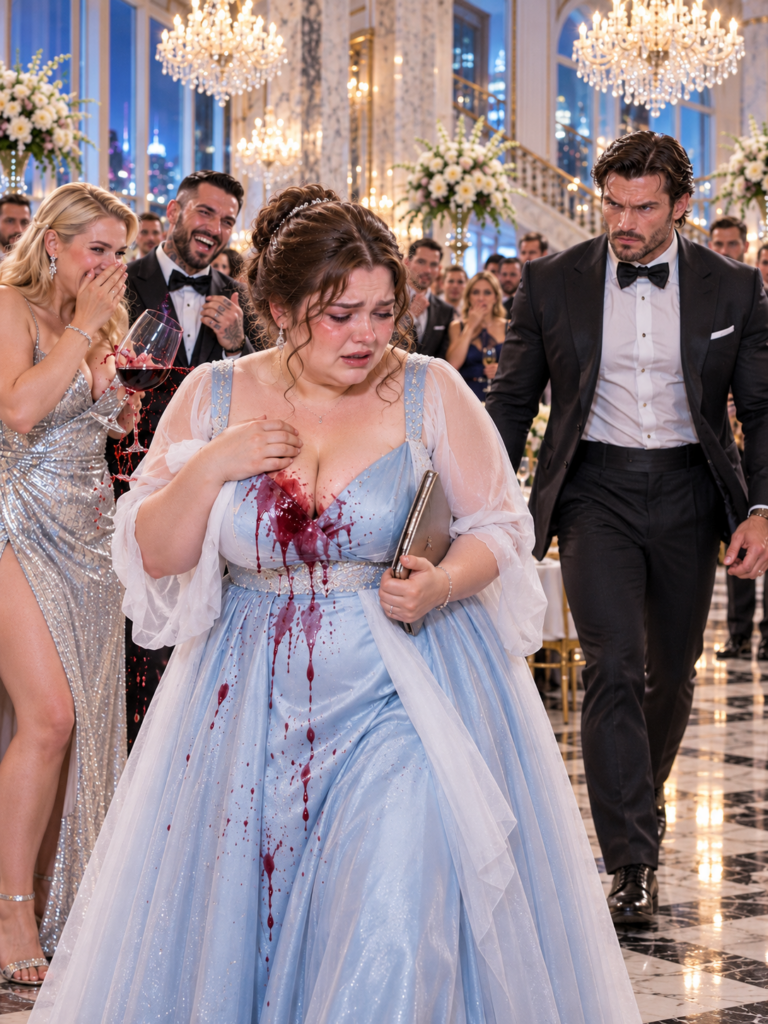
She Was Drenched in Wine at His Gala for Taking Up Too Much Space—Then the Mafia Boss Took Her Hand Before Everyone
Part 1
The silence hit the great hall of the Waldorf Astoria like a physical thing.
Hundreds of New York’s most careful predators watched red wine drip from Chelsea Hilliard’s emerald velvet dress. The cruel little laugh of a public-relations executive bounced once off the crystal and died. Chelsea closed her eyes and prayed the marble would open. It did not. Heavy, familiar footsteps cut through the murmurs instead.
Matteo Romano, the man the city called a union leader when it wanted to stay alive, ignored the elites. He walked straight to her, extended a scarred hand, and said, low enough that only she was meant to hear it, “Shall we go?”
Six hours earlier she had still believed she could survive the night by staying small.
Fluorescent lights hummed in the Romano Enterprises penthouse, sterile over the Manhattan skyline. Chelsea adjusted the waistband of her custom size-22 pencil skirt and did not sigh. The fabric was expensive, cut by a quiet dressmaker in Little Italy, and it still pulled when she sat longer than six hours. Chelsea always sat longer than six hours. Her thick fingers moved over the matte black tablet, the digital ledger clean under her hands.
To the outside world, Romano Enterprises was an aggressive, legitimate real-estate and logistics company. To the FBI it was the polished face of the Romano family. To Matteo Romano, thirty-eight, broad as a heavyweight and quiet as a verdict, newly seated after his father’s heart attack, Chelsea was the reason the empire had not collapsed into a war of cousins.
She was fat. She had taken the word apart years ago and kept the parts that were simply true: soft arms, heavy thighs, a belly no shapewear fully hid, a body that occupied a room whether a room had invited it or not. In the underworld the women near the throne were expected to be ornamental, narrow, silent, hung with diamonds. Chelsea, one hundred and eighteen kilos of accountant and nerve, was the anomaly they could not fire. Her brilliance made her indispensable. Her size made her easy to dismiss. She had learned to let them dismiss her. It kept the knives aimed at someone prettier.
The mahogany doors opened. The temperature dropped.
Matteo entered like weather. Dark hair precise, jaw shadowed, the faint smell of bergamot and cigar and something metallic she never asked about. He did not say good morning. He never did.
“Status of the port shipments.”
“The union delegates cleared the docks at four,” Chelsea said. Her voice stayed professional. She handed him the manifest. Her hand brushed his knuckles. She pulled back at once. She would have sworn his eyes followed the movement. “Naples containers are in the Brooklyn warehouse. The Cayman shell has already processed the olive-oil payments. Clean. Untraceable.”
He read. His jaw tightened. “And the Luccheses?”
“They’re pushing in Queens.” She turned the map. “They’re also overextended on a commercial loan with Chase. If you buy the debt through the subsidiary, you don’t need a bullet. You own them on paper.”
Matteo looked up. The look always made her aware of the space she took, of the blouse taut over her chest. It was not the displeasure she got from other men. It was attention, complete and inconvenient.
“You’re a terrifying woman, Chelsea.”
“I’m an accountant, Mr. Romano.”
“You’re my chief of staff.” His tone left no seam for argument. “Which brings me to Friday. The winter solstice gala at the Waldorf.”
Her heart misstepped. The gala was old money poured into the same room as darker money. The Luccheses would be there. So would the Russians, and the politicians Matteo paid to stay bored.
“I’ve sent your itinerary,” she said. “Driver at seven. PR will handle the press. And—”
“You’re coming with me.”
She froze. “Excuse me?”
“You heard me.” He crossed to the bar and poured two fingers of Scotch. “This isn’t a party. I’ll be signing the Lucchese acquisition in the private lounge at ten. I need my architect in the room when I take their empire apart.”
“I don’t attend social events. I work from the shadows. That was the agreement. I can sit on a secure line. I don’t belong at the Waldorf.”
He paused, glass halfway up. “You belong exactly where I tell you. You’ll be beside me. Charge the dress. The jewelry. The stylist. Company card.”
“It isn’t the money,” she whispered. Heat climbed her neck. It was the reality of her body in a room full of sharks. It was the fact that she was in love with a man who had never asked her for anything but numbers, and that the beautiful empty women who occupied the edges of his life would be there to watch her fail at being one of them.
“Friday,” he said. “Seven. Be ready.”
He finished the whiskey, set the glass down, and left her with the terrifying prospect of being seen.
Wednesday brought an icy downpour she barely noticed. She had spent two days calling every luxury room from Fifth Avenue to SoHo. The answers arrived wrapped in polite venom. We only carry to a European forty-two. Custom would take six weeks. Perhaps a department store, ma’am.
In a perfumed fitting room on Madison Avenue she stared at herself in a black taffeta gown the desperate clerk had found in the back. It looked like a luxury garbage bag. It hid every curve, hung wrong over her breasts, and made her wide and shapeless. She blinked the sting out of her eyes. Crying over fabric was a luxury she did not invoice.
“It’s certainly modest, Miss Hilliard,” the clerk offered.
“It looks like a shroud. Help me out of it.”
The velvet curtain snapped back.
“Oh. I thought this room was empty.”
Chiara Edgerton stood in the doorway in a Burberry coat and red-soled boots, effortless and size nothing. She ran public relations for the legitimate subsidiaries. She had also decided, publicly and privately, that she was the next Mrs. Romano. She was beautiful, ruthless, and frightened of Chelsea’s influence, a fear she hid under comments about Chelsea’s weight.
Her eyes traveled the taffeta. The smile arrived slowly.
“Chelsea. What are you doing here? I didn’t know administrative staff were invited Friday. Or are you coordinating the waitstaff uniforms?”
Heat rose up Chelsea’s throat. She crossed her arms. “I’ll be attending as Mr. Romano’s chief of staff. It’s a working night.”
“Right. Work.” Chiara stepped in uninvited. “Black taffeta. A bit maternal. Although for your size the goal is probably to blend with the curtains, so you don’t embarrass him in front of the Luccheses.”
“I’ll look for something else.”
“My dress is a Vera Wang slip. Matteo approved the expense. He likes his women to set the trend. But you—you’re his little beast of burden. Sweet of him to let you play dress-up. Try not to break the antique chairs. The Plaza had to reinforce seating last year. I’m sure the Waldorf would appreciate a warning.”
She left on the smile.
Chelsea’s hands shook so badly she could barely get the zipper down. The cruelty was not new. Today it landed because some part of her believed it. He needed her mind. He would never want the rest.
Three hours later, wrung out, she found a small vintage shop in the Village. The owner, an older Italian woman named Rosa, took one look at her and locked the door.
“You have a beautiful body,” Rosa said. “You need architecture, not a tent.”
The dress was emerald velvet. A structured bodice. A sweetheart neckline. Long sleeves. A skirt that held her hips and then eased toward the floor. In the mirror Chelsea did not look thin. She looked plump, soft, substantial, and majestic, like a Renaissance painting that had decided to attend a war.
“Take it,” Rosa said. “Whoever made you cry, put this on and make them bleed.”
That night she was still at headquarters, the box under her desk, the building empty except for the servers. The door clicked. Matteo stood there with his tie loose and a whiskey he did not seem to want. He ignored the guest chairs and leaned on her desk, close enough that she smelled oak and smoke.
“You’re still here.”
“Finishing the Lucchese contracts.”
His eyes went to the box, then to the faint red at the rims of her eyes. A muscle jumped in his cheek.
“Did you find what you needed?”
“Yes, Mr. Romano.”
“Good.” He extended a hand. For a second she thought he would touch her face. His knuckles only grazed the desk. “You’re the most valuable person in this organization. Do you understand? Don’t let the parasites convince you otherwise.”
He did not wait for an answer. He walked into the corridor and left her breathless, confused, and afraid of the hope opening under her ribs.
Friday night the Waldorf was a roaring hell of wealth. Gold silk. White flowers. Vivaldi from a balcony. Neutral ground for men who were never neutral. Chelsea stood near a marble column with her tablet like a shield, half hidden, the emerald dress giving her a posture she had not known she owned. Her hair was up. Her mouth was dark red. The valet had stuttered when she stepped out of the Mercedes. Inside the room the stutter died.
The women were angles and diamonds. Chelsea was a mountain of velvet. She heard the tables near the ice sculpture.
Is that his secretary. My God, she’s enormous. I heard she handles the offshore accounts. I suppose she eats the profits. Why would he bring her. It’s a disgrace.
She kept her eyes on the map. Lucchese bosses near the bar. Matteo across the room with a senator, late from a dock breach, not yet looking for her.
“Hiding. How predictable.”
Chiara appeared in silver silk, champagne in hand, eyes too bright. Leonardo, a Romano capo with a brutal reputation and a thin mind, stood on one side. A Lucchese lieutenant stood on the other. Both of them looked at Chelsea as if she were a joke they had been promised.
“I’m watching the perimeter,” Chelsea said. “Bloomberg wants a comment on the merger. You should be at the press table.”
“To hell with Bloomberg.” Chiara looked her up and down. “You really tried. You squeezed into that velvet sausage and thought tonight he’d finally see you. It’s pathetic.”
“Stay away from me.”
Leonardo laughed. Gin and cheap cologne. “The boss keeps you because you can use a calculator, not because he wants a beached whale at his charity night. You’re scaring the investors.”
Someone nearby laughed. The sound broke like glass. Chelsea stepped back. Her thigh met the balustrade.
“Leave me alone.”
“Or what?” Chiara said. “You’ll sit on us?”
Her eyes flicked to Leonardo. Chelsea saw it. She always saw the small things. That was the job.
Leonardo bumped a waiter. The tray tipped. Six glasses of Cabernet exploded across Chelsea’s chest, her neck, the pale skin above the bodice. Glass scattered over her shoes. The velvet drank the wine and clung. Silence fell so hard the quartet faltered. Fifty pairs of eyes found the heavy, soaked, humiliated woman in the wreckage of the only dress that had ever made her feel like she belonged in a painting.
Chiara covered her mouth. Her eyes danced. “Oh my God. I’m so sorry. But red isn’t your color. It makes you look even wider.”
Chelsea could not breathe. Hot tears finally won. She looked down at the ruined velvet and felt the sob catch.
“What is happening here?”
The voice did not rise. It did not need to. The crowd parted as if the air had been pulled out of the hall. Matteo came through the gap with his face set in a fury so complete it looked like calm. He stopped a meter from her. His eyes took in the glass, the wine, the shake in her hands, the tablet she had not dropped.
Chiara laughed, thin and wrong. “Darling, a clumsy waiter. Chelsea got in the way. Shame about the dress.”
“Chiara.”
One word. Her mouth shut.
He turned to Leonardo, who had begun to sweat through his tuxedo, and then to the Lucchese lieutenant behind him.
“Leo. You served my father fifteen years. You have sat at my table. You know the rule about my inner circle.”
“Boss, the waiter tripped—”
Matteo’s hand closed on his throat. The room gasped, the clean society kind of gasp, from people who funded brutality and preferred not to see it. He did not lift the man for show. He held him long enough for the whisper to carry.
“I saw your shoulder. I saw you signal her. I saw you humiliate the woman who built the books that pay for the food on your table.”
He shoved. Leonardo hit a serving table. Caviar and crystal went down. The capo stayed on his knees and did not look up.
Matteo looked at Chiara. Her earrings shook.
“You’re finished. Clearance revoked. The car is company. The Tribeca lease is mine. Midnight to be out. If I find you in this city at dawn, Leo can earn his way back by explaining the rules to you. Do you understand?”
She nodded, crying through her makeup, and crawled backward out of the circle. He did not watch her go.
Chelsea closed her eyes. She waited to be sent home. A nuisance. A stain on the evening.
Instead she heard expensive cloth. He had taken off his jacket. He set it over her shoulders with a care that did not match the last two minutes. Bergamot and tobacco closed around her. His thumb wiped a drop of wine from her neck. The touch went through her like a fault line.
“Look at me.”
“I’m sorry,” she whispered. “I ruined the—”
“Never apologize for the sins of smaller people.”
He did not look at the reporters. He did not look at the Lucchese bosses. He took her hand, her soft, shaking, wine-damp hand, and brought her knuckles to his mouth. The kiss was slow. Deliberate. A murmur moved through the ballroom, the sound of a room revising a woman.
“Shall we go?”
He did not wait. He led her through the center of the Waldorf, jacket on her shoulders, fingers locked with hers. The crowd opened. Chelsea kept her head up because if she lowered it she would disappear, and he had just made disappearance impossible.
In the elevator she finally breathed.
“They’ll say you did that for the papers,” she said.
“Let them.” His jaw was still tight. “You’re not going back down there without me. Not tonight. Not in that dress. Not ever like that again.”
The doors opened on the private floor. His men were already in the hall. Somewhere below, a gala was trying to remember how to be a gala. Chelsea stood in his jacket, soaked to the skin, claimed in front of every enemy he had, and understood that the danger had not ended when he took her hand.
It had only agreed to wait until the door closed.
Part 2
The presidential suite was quiet in the way money is quiet. A fire worked in the marble hearth. The lock clicked. His security stayed in the hall.
The adrenaline left her all at once. Chelsea sank onto the velvet sofa and stared at the ruined hem. She pulled his jacket tighter, as if wool could undo a ballroom.
Matteo poured a Macallan and did not drink it. He crouched in front of her and pressed the glass into her cold hands.
“Drink.”
She took a sip. The burn brought her back a little. His shirt was open at the throat. The holster was visible now that the jacket was on her. She looked at the amber and not at him.
“I need to go home. The acquisition documents are on the tablet. I can send them. You can still close.”
He took the glass and set it down. “Stop working for five seconds. Look at me.”
She could not. The shame was too heavy.
“I don’t belong there. I told you. I’m not like those women. I’m fat. I’m clumsy. I take up too much space. Chiara was right. I’m the secretary you let play dress-up.”
“If you repeat one word of what that woman said, I will end her career in every city that still has a newspaper.” The violence in his voice made her flinch. He moved closer, until his chest met her knees, and framed her face in his hands. “Do you think I brought you out of the shadows because I wanted a secretary beside me? Do you think I bought a tailor’s shop in Little Italy so your skirts would meet a dress code? Do you think I come to your office at two in the morning for manifests I could read alone?”
Her breath went shallow.
“I don’t understand.”
“You’re brilliant. Your mind is a weapon.” His thumb traced her jaw. “It is not what has kept me awake for two years. It’s you. All of you. The way you command a room without raising your voice. The way you look in those skirts. The way your skin changes when I get too close.”
“Matteo.” His name left her like a confession.
“I see how you hide behind the tablet. Behind the desk. You are not a problem the room has to solve. You are the reason I stay in the room. Every narrow, hungry woman they put in front of me bores me. You are the only one who has ever made me want.”
Tears came again. Not the ballroom kind. The relief kind, huge and unwelcome and true. The armor she had built around her body cracked along the seams.
He drew her up. He was strong enough that the lift did not become a negotiation with her weight. She ended against his chest. He slid the jacket from her shoulders and looked at the wine-dark velvet clinging to her breasts and hips. Where she saw disaster, he looked at her as if the dress had finally told the truth.
“There’s more,” he said, and showed her the phone.
Target intercepted near the service elevators. Cloning device. Syringe. Lucchese lieutenant in the basement.
Chelsea frowned. “A cloning device?”
“The wine wasn’t only Chiara being jealous. She’s an idiot. Useful to anyone who knows what she hates. The lieutenant used her. Humiliation was the point. A woman publicly shamed runs for a bathroom, alone, away from security. They were waiting by the service elevators. Sedate you. Clone the tablet. Take the Cayman keys. Leave you in an alley and call it a mugging.”
Cold moved down her spine. “You knew.”
“I knew they would move tonight. I let you come because I needed to see how they would try to peel you off me. My men were on the exits. You were not meant to be in real danger.” His forehead rested against hers. “Then the wine hit you. I saw your face. I stopped thinking. I was supposed to wait. Let them take the hallway. Catch them with the device and own the commission’s permission to finish their leadership tonight. I didn’t care about the recording. I would have burned the city before I let you stand in that shame for one more second.”
She sobbed and put her arms around his neck. His heart was a hard, frantic knock against her chest. He kissed her. Salt, Cabernet, two years of not touching. She kissed him back with a hunger that surprised her, and his hands mapped her waist and the wideness of her hips as if those were the coordinates he had been missing.
When they broke apart he said, “They die by morning. And tomorrow we go to Little Italy. A hundred velvet dresses. You don’t hide in my empire again. You stand in it.”
His phone buzzed against the bar. He listened, and the man who had kissed her closed back into the other one.
“Keep him in the service corridors. I’m coming down.” He touched her cheek. “Stay here. My men are outside. I’m going to have a conversation with the Lucchese lieutenant. When I come back, the war is over.”
“No.”
The word stopped him.
Chelsea stood. Her legs still shook. She picked up the tablet, wiped wine from the screen, and unlocked it. The numbers came back like oxygen.
“If you go down there and break him open, you start a war Don Carmine can sell to the commission as self-defense. The task force out of Foley Square is already on the port dispute. A dead lieutenant in the basement of the Waldorf gives them probable cause to freeze the Chase accounts and put warrants on the yards. He tried to take me. I know. He does not get a bullet for it. He gets ruined. I want the Luccheses on their knees before sunrise, and I want it done in a way the feds cannot photograph.”
Matteo stared at her. The stained dress. The burning eyes. The mind that had built the books under his throne.
A slow, dangerous smile. “Show me.”
The basement was concrete and laundry steam and a soundproofed room full of banquet chairs. Dominic Lucchese was zip-tied to a steel chair, lip split, eyes still arrogant. He had prepared himself for Matteo’s temper. He had not prepared for the woman in the ruined velvet to walk in beside him with a glowing screen.
“You think my father lets this go?” Dominic spat. “The commission will strip your territory.”
Matteo said nothing. He set a folding chair in front of the prisoner and nodded Chelsea into it. He stood behind her, hands on her shoulders, an announcement.
“You brought a cloner,” Chelsea said. “You wanted the offshore keys.”
“I don’t know what you’re talking about, sweetheart. Your boss doesn’t pay you enough for a dress that fits.”
Matteo’s fingers dug in. Chelsea covered one of his hands with hers and felt the violence pause.
“While you were aiming a drunk publicist at me, I was running the gap. You didn’t guess the protocols. Someone gave them to you. That bypass code is proprietary. Three people have it. Me. Matteo. His uncle, Arthur Romano.”
Dominic’s smile slipped.
“Arthur hates me,” Chelsea said. “He thinks a woman’s place is silent and narrow. He certainly thinks a woman my size has no business on the family ledger. He made a deal. He gives you the protocols. You clone the drive. Matteo’s infrastructure goes dark. Arthur steps in to save the family and splits Queens with your father as the fee.”
“You can’t prove that.”
“I don’t need a courtroom. When your device pinged my network, the handshake mirrored. You left the back door open.” She turned the tablet. Routing numbers. Shells. Credit Suisse. Construction pensions washed through unions for thirty years. “Your father’s empire. Every dirty penny. Every clean dollar.”
Dominic thrashed. “That’s isolated.”
“Nothing is isolated when I have the door.” Her finger hovered. She did not press it. Not yet. She looked up at Matteo. “If I do this, their captains don’t get paid. The mortgages fail by Monday. Carmine’s own men will eat him before we touch him. Arthur’s personal accounts are already flagged to the IRS criminal division. Anonymous. Frozen by morning. Twenty years of lawyers, if he’s lucky. No alley. No basement. Paper.”
“You wanted paper,” Matteo said quietly.
“I wanted not to become the reason you start a war you can’t finish clean. This is my choice. Not yours.”
He was silent for a beat. Then he bent and kissed the top of her head, once, in front of the man who had tried to have her dragged into an alley.
“Do it.”
She tapped the screen.
Dominic screamed as the numbers fell. Chelsea locked the tablet and met his eyes. The ballroom fear was gone. What remained was colder and cleaner.
“You wanted my books,” she said. “I took yours.”
Matteo told his head of security to cut the ties.
“Let him walk out. Let him explain to his father why the empire vanished. He will not survive his own people. That is no longer our hand on him.”
In the private elevator Chelsea rested her head on Matteo’s shoulder. Her dress was ruined. Her hands were steady.
“And if Arthur runs?” she asked.
“Then he runs poor, and federal. You made sure of both.” He pulled her in and kissed her as the doors closed. The kiss was different from the suite. Less desperation. More recognition.
The doors opened on the private floor. His consiglieri was waiting, pale, with a second phone.
“Boss. Arthur isn’t at the house. He cleaned the safe an hour ago. And he didn’t only give them the bypass.” The man swallowed. “He told Carmine the acquisition signing was a trap. Carmine isn’t coming to the lounge at ten. He’s coming for her. He thinks if he takes the woman who holds the keys, the transfer reverses.”
Matteo’s arm tightened around her.
Chelsea looked at the tablet, then at the man who had covered her shame with his jacket and had been ready to burn a legal victory for the sake of her face.
“Then we don’t go back to the suite,” she said. “We go to the lounge early. And this time, if they want me, they can try it where I can see them coming.”
Part 3
The private lounge was all walnut and low light, set for a signing that the other side no longer intended to honor. Chelsea changed in the adjoining bath into a black coat from the suite closet, belted hard over the wet velvet, hair down, wine still faint at her collarbone. She refused a cleaner dress. She wanted them to see what they had done and what it had failed to do.
Matteo stood at the window with his jacket back on. “You can still leave. My car is in the alley. This part isn’t your debt.”
“You already tried to make my life easier with power,” she said. “I’m not a hallway you get to clear. If Carmine is coming for the keys, the keys should be in the room, awake, and angry.”
He almost smiled. “Terrifying woman.”
“Accountant.”
“Chief of staff.” A beat. “If we live through the next hour, I’m going to have to find a better title.”
Carmine Lucchese arrived with two men and no paperwork. He was older than his son, softer in the body, harder in the eyes. He looked at Chelsea the way men had looked at her all her life, and then he looked again, because she was not hiding behind the column.
“You drained us,” he said.
“Your son tried to clone my drive and have me dumped in an alley,” Chelsea said. “Arthur sold him the code. I took the money back through the door they opened. If your captains haven’t called you yet, they will.”
“You’ll reverse it.”
“No.”
Carmine’s gaze cut to Matteo. “You let a woman speak for the family.”
“I let the woman who built the books explain what she did with them,” Matteo said. “You can threaten me. You’ve been doing it badly for months. You don’t threaten her again.”
“Then we do this the old way.”
“The old way gets you a task force in the shipyards by Monday,” Chelsea said. “The new way is this. Your debt to Chase is already in our subsidiary. Your pensions are gone because your lieutenant pinged my server. Arthur will be in federal custody or running from it by dawn. You can spend the night hunting me, and lose the men who were only loyal to a paycheck. Or you can sit down, sign the territorial cession we were already going to make you sign, and keep a stipend large enough to leave New York. Not a throne. A exit.”
One of Carmine’s men shifted. The calculation was already in the room, ugly and practical. Carmine stared at her for a long moment.
“Arthur said you were a clerk.”
“Arthur can’t read a balance sheet,” Chelsea said. “That’s why he needed me ruined instead of answered.”
Carmine signed. Not because he was noble. Because his phone had begun to buzz and he had finally understood which weapon had been used on him. Matteo did not touch him. He watched Chelsea slide the copies into a folder and seal it. When Carmine left, the lounge felt larger.
Matteo exhaled. “You didn’t need me.”
“I needed you not to shoot him before the phone rang,” she said. “That’s a kind of need. Don’t get proud.”
He laughed, short and wrecked, and then the laugh faded into something more careful. “In the suite I told you what I wanted. You kissed me. That was adrenaline and wine and a man who should have asked sooner. I’m asking now, without a ballroom and without a gun in the hall. Not because you saved the accounts. Because it’s you. If you want the car instead, you take the car. The job remains. The tailor remains. Nothing you decide tonight buys your safety. You already have that.”
Chelsea looked at her hands. The velvet cuffs were stiff with Cabernet. She thought of the taffeta shroud, of Chiara’s smile, of Rosa saying architecture, not a tent. She thought of two years of two a.m. manifests and a man who had bought a dressmaker’s shop rather than say what he meant.
“I’m not going to be your ornament,” she said. “I won’t shrink for your rooms. I won’t pretend the books are yours just because the name on the door is. If you want me, you want the woman who takes the chair and the woman who takes up the space. Both. In public.”
“Yes.”
“And you don’t avenge me by becoming the thing I just refused to be.”
“Yes.”
She stepped in. “Then take me home. Not the suite. Home. And in the morning we see Rosa. I’m not wearing this wine to my own life.”
He kissed her there, in the empty lounge, slower than the suite, certain as a signature. No one applauded. No one needed to.
Chiara was gone from the city by dawn, the lease dark, the PR firm already drafting a resignation that mentioned health. Leonardo was removed from the table and the docks. Arthur’s accounts froze before breakfast. Dominic did not survive the explanation he carried back to his own captains. Chelsea did not ask for the details. She had chosen the door she could live with. The rest belonged to men who had built their loyalty on money she had emptied.
Six months later Le Bernardin was closed for a private lunch, the sidewalk quietly held by Romano security. Inside, union heads and a few very committed politicians waited to pay respects to the ruler of the East Coast.
The doors opened.
For the first time in the history of the family, the boss did not enter first. Matteo walked half a step behind, his hand at the base of Chelsea’s spine. She wore a white silk suit Rosa had cut for her alone, the jacket fitted at the waist and honest over the hips, trousers breaking clean over her heels. An emerald-cut diamond sat on her left hand. She was not the secretary behind a tablet. She was the architect of the new map.
When the Luccheses collapsed and Arthur’s indictment landed, the underworld panicked, then understood. Matteo Romano had not ended his enemies with bullets. His wife had ended them with a keyboard.
The men stood as she reached the head of the table. Not courtesy. Fear, and the respect fear earns when it is accurate.
“Gentlemen,” Chelsea said, and sat. Matteo took the chair at her right. “We’re here to discuss the port. Romano Enterprises has absorbed the old Lucchese routes. I’ve prepared the new terms. They are not a negotiation. They are a map. Read them before you pretend otherwise.”
Dossiers went down the table. Matteo leaned in, thumb brushing the silk at her shoulder.
“They’re terrified of you,” he murmured.
“They should be. I know where they hide the money.”
He laughed, low, a sound that belonged to her. Territory did not interest him. The woman beside him did. The one who had taken a wine-stained dress and turned it into a jurisdiction.
That night, on the balcony above Central Park, Chelsea held sparkling water and let the summer air lift her hair. The years of hiding her body had not vanished. They had been answered. Matteo came up behind her and kissed the place below her ear, hands resting over the softness of her stomach as if it were a country he had no interest in conquering.
“What are you thinking about?”
“A black taffeta dress,” she said. “And how glad I am that it looked like a garbage bag.”
He turned her. Moonlight caught the ring and lost to her smile.
“You could wear a garbage bag,” he said, “and I would still rather walk through a room beside you than own it without you.”
He kissed her under the wide Manhattan dark. She kissed him back, the man who had seen her in the shadow of a column, taken her hand in front of the wolves, and then—this was the part she kept—asked. She was fat. She was brilliant. She was the most dangerous woman in New York, and in his arms, with the city blinking beneath them like a ledger she knew how to read, she had never felt more entirely herself.


