
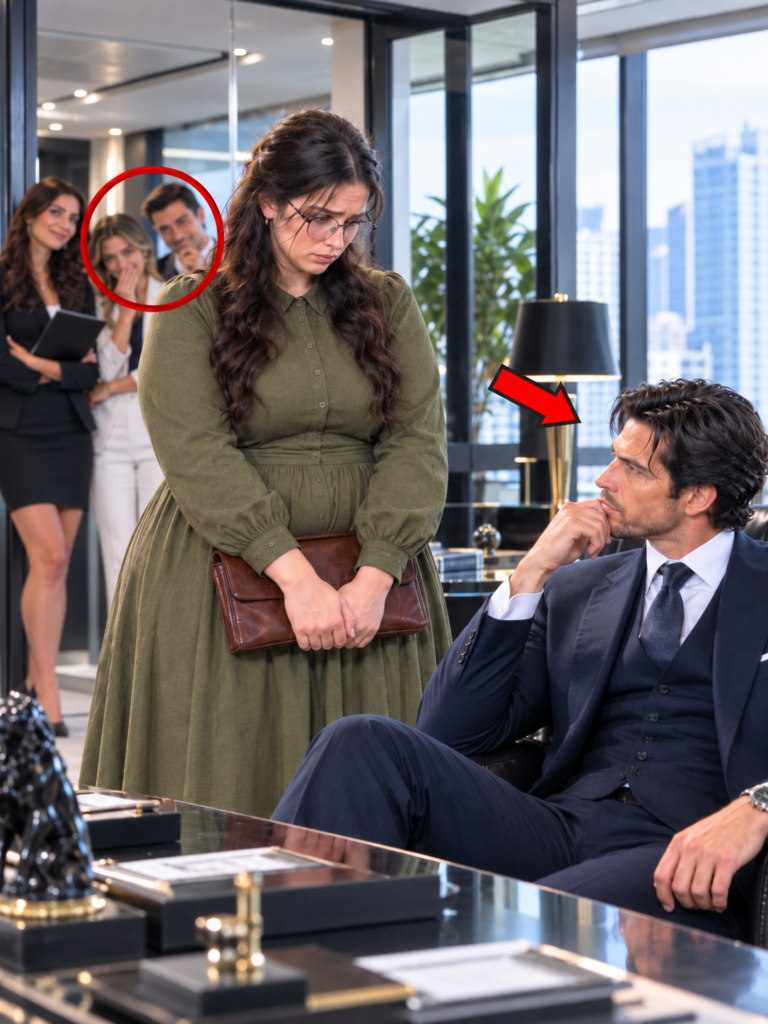
Send the Curvy Girl in the Homemade Dress, He’ll Turn Her Down Anyway, They Laughed… Until the Mafia Boss Closed the Door and Claimed Her
Part 1
“Send the curvy one. He’s going to turn her down anyway.”
Madison said it between bursts of laughter, loud enough for the frosted glass to carry every word. No sympathy. No lowering of her voice. To the women outside the records room, Emily Rivera was a joke that had finally become useful.
Emily heard all of it.
She stood with an open supplier folder in her hands and heat climbing from her throat to her ears. The olive-green dress her grandmother had sewn in December pulled gently across her full bust and the soft curve of her waist. Isabelle had cut it for the body Emily actually had, not the body Charlotte offices preferred. Tiny buttons. Careful seams. A skirt that moved when she walked. On the farm outside Asheville, people noticed the stitching. On the twenty-third floor of Harrison Coffee’s downtown tower, they noticed everything else.
Rachel from accounting had already forwarded the group-chat picture by accident. Someone had edited Emily’s face onto a cruel caption: The girl who milks goats finally made it to the 23rd floor. Under it, rows of capital letters. Haha. Then a second message. Oh my God. Sorry. That wasn’t meant for you.
Somehow that had made it worse.
Emily set her phone face down. Four years in records. Four years of contracts, invoices, harvest letters, coffee stains in the corners of pages nobody else bothered to read. She knew the western Carolina files by heart. She also knew her father’s name sat on the proposed cuts.
Hope Valley Farm. Joseph Rivera. Supplier since 1997.
Forty-two mountain families. One vote. Friday.
Her father’s voice note from that morning still lived in her chest. Folks at the cooperative say the company is reviewing contracts. Now that Mr. Robert passed, his son wants changes. Don’t worry about us.
Don’t worry was what Joseph said when there was absolutely something to worry about.
Outside, Patricia’s voice rose. “Mr. Harrison needs someone who knows the western contracts line by line. Those were his exact words. You do not want to walk into his office unprepared today.”
Silence. Then Madison again, playful, already performing for the chat.
“I know. Send the curvy one. She knows all those farm contracts, doesn’t she? He’s going to turn her down anyway.”
Laughter. Someone added, “Poor man. He’s already grieving and now you want to do that to him.”
Ethan stepped into records a minute later with his hands in his pockets and half a smile. “Hey, Emily. Patricia wants to know if you can meet with Mr. Harrison. You know those files, right?”
Behind him, Madison and two others waited with a phone already raised.
Emily wanted to say no. She wanted to tell him to send someone whose body did not make a hallway laugh. Then she saw the handwriting on the finance cover in her mind. Proposed cuts. 42 suppliers.
If someone was going to explain those pages to Daniel Harrison before Friday, it had to be someone who understood they were not numbers. They were land. Baskets. Her great-grandfather’s first coffee tree. Her father’s voice.
“Yes,” she said. Her voice came out steadier than she felt. “I have them.”
She pulled the thick brown binder from the drawer. Then, without fully knowing why, she took the small paper bag Mr. Dawson had dropped at reception that morning. Twine. Her mother’s round handwriting. New harvest, sweetheart, so you don’t forget what home tastes like.
She tucked the coffee between the binder and her chest, pushed her glasses higher, and stepped into the hallway.
The laughter thinned. It did not stop. A camera clicked. Someone whispered, “She’ll be back crying in two minutes.”
Emily counted her steps the way she used to on the dark path behind the farmhouse. One. Two. Three. The marble reflected the olive dress, the full line of her hips, the dark curls slipping from the clip. For the first time in a long while she did not look away from that reflection. She was still not brave enough to stare. She also did not hide.
Daniel Harrison’s door stood partly open.
Patricia nodded her toward it, the nod of a woman abandoning a problem. Beyond the glass, downtown Charlotte shone. A black desk. No papers. One white cup, full, cold, untouched. Daniel sat deep in the leather chair, one hand against his chin, staring at the city as if he had been waiting for something that refused to arrive.
“Come in.”
His voice was quiet. He turned.
Emily tightened her grip on the binder. The bag crinkled. She took the first step inside and waited for the dismissal that would send her back to the hallway.
He did not dismiss her.
He looked at her face. Not the dress. Not the soft body Madison had turned into a punchline. Not a scan from head to toe, searching for the joke. He looked at her the way a man looked when every person who had entered his office for three weeks had been performing, and this one was not.
Emily’s eyes were red. Her hands trembled. She had heard the laughter. She had come anyway.
Daniel Harrison had buried his father ninety-four days ago and taken the chair Robert never meant to leave empty so soon. On paper he was the new chief executive of Harrison Coffee. In the rooms that mattered, he was the Harrison heir, the man the old mountain routes, the port men, and the quiet Charlotte families still answered to when a shipment went missing or a rival tried to buy a cooperative out from under a funeral. He had spent years overseas refusing that life. Grief had dragged him back into it.
Since the funeral, every visitor had arrived with five seconds of sympathy and a request. Board members. Managers. Men who smiled while measuring whether the son was weaker than the father.
Emily Rivera was frightened, and she was not pretending otherwise.
That was what silenced him.
“Good morning, Mr. Harrison. I’m Emily Rivera from records. I was told you needed the western North Carolina supplier contracts.”
A laugh leaked from the hallway.
Daniel’s eyes cut to the door. The sound died. He crossed the office without a word and shut it. Footsteps retreated.
“Please sit.”
She sat on the edge of the chair. The bag slipped. Twine loosened. The smell rose at once. Fresh roast. Smoke. Brown sugar. Rain-wet wood.
Emily reached for it, embarrassed. Daniel had gone still.
He was eight the last time coffee had smelled like that. December. An old farmhouse porch. Fog. His father laughing with growers while Daniel ran between rows and stained his fingers red on ripe cherries. Then boarding school. Then the years they did not speak. Then a phone call. Robert Harrison dead at this desk, a half-finished cup beside him.
Ninety-four days without a sip. The smell had been a closed throat. This time it loosened something.
“Where is that from?”
“Near Asheville. I’m sorry. I shouldn’t have brought it. My mother roasted it.”
“Your mother.”
Emily drew a breath. She had rehearsed this while they laughed behind her.
“My father owns Hope Valley Farm. It’s one of the forty-two suppliers on the proposed cuts. I wanted you to know that before I opened a page. I don’t want you thinking I came in here pretending to be neutral.”
He said nothing.
“They sent me because no one else knows these contracts as well as I do. That part is true. But I also know what they mean to the people who signed them. Upstairs, these are dates and prices. To the families, they’re land.” She folded her hands so they would stop shaking. “If you’d rather have someone else after hearing that, I understand.”
For a long moment he only looked at her. No one in the building had told him the truth that fast. Not the men who called him boss when they wanted a signature. Not the men who called him kid when they thought he wasn’t listening.
“No,” he said. “Stay. Explain it.”
She opened the binder. At first she measured every word. Then she sounded the way she did at cooperative meetings, reading fine print for older farmers who could no longer see the small letters. The forty-two farms were not separate suppliers. They ran through three mountain cooperatives. Most of the agreements went back to 1997, signed by his father. Fair-price provisions sat in the margins in Robert’s own hand. Letters. Harvest photographs. Visit logs nobody had reread in years.
Then she laid down the finance report. Smaller farms cost more per pound. Production was less consistent. That part was true. The report did not say where the coffee went.
She had built the next section herself on slow afternoons, matching invoices to shipping records. The premium mountain line came almost entirely from those forty-two farms. Shade-grown. High elevation. Certifications tied to the land itself. The specialty buyers’ contracts required origin. Page forty.
Daniel read it once. Then again.
For three weeks his senior men had given him charts designed around a conclusion already chosen. No one had shown him page forty.
“Who else knows this?”
“No one has asked.”
“You built this yourself.”
“I like understanding what I file.”
He looked at the cold cup. Then at the paper bag.
“Could we make this instead?”
She blinked. “Your mother’s coffee,” he said. “If you don’t mind.”
He called Patricia for hot water and the French press. Patricia looked at the bag, at Emily, at her boss, and left without a word. Shadows moved beyond the glass and vanished.
While they waited, Emily told him about the first tree at the edge of the property, the rust that had nearly wiped the crop, her father who hated texting and sent voice notes long enough to shrink the miles. She did not mention the chat. She did not have to. He had heard the hallway.
When the water came, she made the coffee. He did not know how. She did. Grounds by sight. Patience. The office filled with the smell of home.
Daniel lifted the cup with both hands and closed his eyes before the first sip. Ninety-four days. A porch. His father. A thing he had abandoned, waiting on the same desk where Robert had spent his last morning.
“My father used to take me into the mountains,” he said softly. “I haven’t thought about that in a long time.”
She did not say she was sorry. She had learned how little those words sometimes did.
He set the cup down and checked his calendar. “The board wants to vote Friday. Richard Baron is going to present that finance report as if it’s the whole truth. I’m not signing anything until I see it myself.” He looked at her. “Could you take me to the farms?”
Emily stopped breathing.
“I want to talk to the growers. And to your father. You know the contracts. You know the families. And you’re the only person in this building who has told me the truth since I arrived.”
She thought of the chat. Of page forty. Of forty-two farms that could die in a conference room.
“Yes,” she said. “That works.”
Nearly an hour after she had entered, she stepped back into the hallway. The bag was half empty. The floor went silent. Madison lowered her phone. Ethan stared as if he did not recognize her. Emily walked past them without dropping her head.
At the conference doorway, Richard Baron watched until the records door closed. Then he lowered his voice into his phone.
“Who is that woman from records? Find out everything by tomorrow.”
They left at six the next morning. No driver. A gray SUV. Emily wore the blue checked dress Isabelle had made for her curves, a denim jacket, her hair in a braid down her back. She had stood in front of discounted black trousers the night before and put them back. She was going home. She did not need to dress like someone else to do it.
Past Gastonia, Daniel broke the silence. “How long since you’ve been home?”
“December. You?”
“Two years.” His hands tightened on the wheel. “My father wanted me in the company. I wanted almost anything except that. We said things people shouldn’t say. The last time we spoke, someone hung up. I don’t remember who. That’s the part that makes me angriest.”
She told him about her father and grandfather fighting for years over a strip of land until one Sunday they sat on the porch and drank coffee. No apology anybody heard.
“Sometimes that’s how things get fixed,” she said. “Not with words.”
His grip loosened.
Her phone buzzed. The chat had forty new messages. Madison: Has everyone seen who Grandma went on a road trip with?
Emily turned the screen down. Daniel noticed and did not ask.
West of Hendersonville she cracked the window. Wet earth. Woodsmoke. Ripe cherries. Fog poured over the ridges. Coffee rows appeared under shade trees. Daniel slowed without seeming to notice. Emily sat straighter. She pointed out the cooperative house, her old school, Mrs. Turner’s store that still ran groceries on credit, the tree she had fallen from at nine. Here, no one had taught her to make herself smaller.
Hope Valley waited at the end of the gravel road. A skinny dog nearly knocked her down. Her mother hugged her crooked. Grandma Isabelle grabbed the braid.
“You’re too skinny,” Isabelle announced. “Don’t they feed you in Charlotte?”
Emily laughed. Both women turned toward Daniel. Her mother offered a handshake and no smile. Joseph stayed in his porch chair, work hat on, heavy hands resting on his knees.
“So. You’re the man who’s going to cut us off.”
“Dad.”
“Let him answer.”
Daniel removed his sunglasses and climbed the steps. “I haven’t decided anything yet, Mr. Rivera. I came because I want to see what the reports don’t show. And I want to hear what you have to say, if you’ll let me.”
Joseph studied him. “Your father came every December. Never missed. You never came.”
“I know.”
“Why now?”
“Because I can’t ask him anymore.”
Something in Joseph’s face shifted. He stood. “Better put more food on the table.”
They ate beans, cornbread, pickled peppers, chicken soup set in front of Daniel without a question. Isabelle asked if he was married. He nearly choked. She asked why he had terrible circles under his eyes. He answered every one of her questions, even laughed when she told him he needed more sunlight.
After lunch Joseph brought out a chipped blue enamel mug.
“This was your father’s. Every time he came, this was the only one he used. Nobody else drinks from it.”
Daniel held it with both hands.
“You don’t know what he did when the rust came through in 2013.” Joseph’s voice stayed low. “Half the plants dying. Neighbors selling. Banks gone. Buyers gone. Your father was the only one who stayed. Advanced payment on three harvests. Brought specialists. Paid for resistant plants out of his own pocket and spread them across all forty-two farms. The board didn’t want it. He told them if these mountains disappeared, the company would lose more than coffee. He hated being thanked. Said it was just business.”
Emily had known pieces. Not this.
“Last December he sat on that porch with this cup,” Joseph said. “Already looked tired. He said, Joe, I’m afraid I’m going to die before I bring my son back here. I want him to see what we built.” Joseph cleared his throat. “I told him there was time. There wasn’t.”
Daniel’s shoulders shook. He did not hide it. Emily rested her hand on the table near his, not touching, close enough. Joseph stood, set one awkward hand on Daniel’s shoulder, and said, “Tomorrow. Six. I’ll take you to the fields. And somebody make sure he gets his coffee in that cup. It’s about time someone used it again.”
That night Emily carried two blankets to the porch. Fog swallowed the gate. Daniel held the mug.
“My whole life I thought he cared more about the company than me,” he said. “Now I find out he was trying to show me this.”
“You can still let him show you. Six tomorrow.”
Under the porch light, with fog behind her and her glasses faintly clouded, she looked more real to him than anyone he had met in years. He did not say it. He slept through until the rooster.
At six Joseph tossed him boots a size too large. Emily bit her lip at the sight of expensive trousers stuffed into them and a harvesting basket at her own waist. They walked rows that followed the land. Joseph showed him rust spots, resistant plants from 2014, mud Robert had worn to his knees because he would not go back to the house. Questions turned into stories. By the upper line they were talking like men who had known each other longer than a day.
At the cooperative, more than thirty growers waited. No friendly faces. Daniel did not give a speech.
“My name is Daniel Harrison. Robert Harrison was my father. I’m not here to make promises I can’t keep. I’m here to listen. Tell me what the paperwork doesn’t.”
Mrs. Harper spoke first. A son who left in 2013 and came home when the farm recovered. A young man who wanted agricultural school so he could return. A grower whose voice broke describing the money Robert had loaned to bury a wife, never asking for it back. In Charlotte each contract was a line. Here it was whether a son could come home.
Daniel wrote everything down. He did not check his phone.
“So what are you going to do?” Mrs. Harper asked.
He closed the notebook. “What my father would have done. Except this time I’m the one who does it.”
Applause started small and filled the metal building. Joseph, arms crossed in the doorway, gave one slow nod.
Near the scale, a dulled brass plaque read: To Robert Harrison, who stayed when others left. Blue Ridge Coffee Growers Cooperative, 2015.
Emily stood beside Daniel and said nothing. Sometimes silence was the right company.
That afternoon Isabelle taught him to roast in a cast-iron pan. He burned the first batch. She laughed without mercy. Emily’s mother stopped calling him Mr. Harrison. Joseph loaned him a flannel shirt. Emily watched from the kitchen doorway and felt something she was not ready to name. It was not his money. It was not the face the saleswomen ranked. It was the cheap plastic chairs. The way he answered Isabelle. The boots. The fact that since she had walked into his office, he had never looked at her the way the twenty-third floor did.
Not once.
He knew it when she laughed at him in the rows. He knew it when she slipped him growers’ names so he would not mix them up. He knew it when Isabelle announced that Emily looked much prettier here than in the pictures she sent from Charlotte, and Emily went red, and Daniel thought the old woman was right. In the city she apologized for taking up space. Here she didn’t. The full, warm, unhidden shape of her was simply Emily. That was what made her different.
Night. Porch. Blankets. The blue mug and a small ceramic cup.
She told him about the woman on the train who asked if her dress was a costume. After that she straightened her hair until a cheap iron burned the ends and the mirror stopped recognizing her. She stopped straightening. She never quite went back.
“I stayed somewhere in the middle,” she said. “Invisible. It was easier.”
He set the mug down. “You’re not invisible, Emily. You’re surrounded by people who don’t know how to see.”
The way he said her name landed closer than it should have.
He told her about the apartment, the car, the career, the girlfriend who had not lasted, and the funeral where everyone belonged to his father’s life and no one belonged to his.
“Well,” she said, “you’ve met your father’s people now. And it looks like they kind of like you.”
His phone rang. Patricia. His jaw tightened. He said almost nothing. When he hung up, the mountain cold seemed to settle into Emily’s bones.
“Richard moved the vote. Tomorrow. Thursday. Six o’clock. He says they’re moving forward with or without me.”
“Can he do that?”
“If he has the signatures. He does.”
Daniel stood. “We leave before sunrise.”
They barely slept. At five, flashlight in hand, Emily stopped him on the porch.
“There’s something I want to show you before we go.”
She led him to the far edge of the farm. The old tree stood alone, trunk thick and twisted, planted in 1931. Rust had taken almost half of it. Her father had wanted it cut. Robert had told him a tree like that did not get thrown away because it had been hurt. Even in the dim light, red cherries clustered among the leaves.
Dawn opened the fog. Emily turned and found Daniel closer than she expected.
“Whatever happens when we get back,” he said, “the day you walked into my office was the first day in months I didn’t want to end.”
He took her fogged glasses, folded them into the pocket of Joseph’s shirt, and kissed her slowly beside the tree her great-grandfather had planted. Careful. Certain. She laughed softly against his forehead when they parted. He handed the glasses back. They walked down holding hands and let go only at the porch.
Joseph was already there with two cups and a look that missed very little. He handed Daniel the blue mug.
“Take it. Your father won’t be needing it. I think you will.”
Isabelle blessed him and pressed biscuits into Emily’s hands. Her mother hugged them both and, when Emily wasn’t looking, slipped a bag of Hope Valley roast into Daniel’s backpack.
They had barely reached the highway when Emily’s phone buzzed. Human resources. Subject line in capitals. Urgent meeting. Conflict of interest investigation.
She was ordered to appear at two. Unauthorized trip with the CEO. Personal connection to a supplier under review. Until further notice, no access to those records.
She handed him the phone. His face hardened. Neither of them had to say where the complaint had come from.
On the speaker, Patricia’s voice was barely above a whisper. “Madison gave him everything. She’s been in Mr. Baron’s office since Tuesday. The attorney says if you defend her in the session, Richard will move to remove you from the vote. Personal conflict. He may have enough.”
Photographs from the garage. Joseph’s supplier profile. Screenshots. The ugly girl got him in less than an hour. What had been gossip was now evidence, arranged by a man who wanted the mountain contracts dead before the month ended.
Emily watched the ridges fall away and understood how easily the last two days could be made to look like the story Richard was telling. The conversations had been real. The kiss had been real. From the outside, it could look exactly like a trap.
They reached the tower at half past one. In the mirrored elevator she saw the wrinkled dress, the loose curls, dried soil on her boots. Daniel took her hand. She squeezed his fingers and let go before the doors opened.
The twenty-third floor went silent. Madison did not look up. Ethan did, and something like guilt crossed his face before he dropped his eyes.
The HR meeting lasted less than twenty minutes. The director read the complaint in an even voice. Emily answered without raising hers. Yes, her father was a supplier. Yes, she had traveled with Daniel. No, she had never hidden it. She had told him before she opened the first contract. No, she had not altered the data. Anyone could review it.
“While the investigation is pending, you’re suspended with pay. Badge on the table. Leave the building.”
Daniel was waiting. “This is ridiculous. I’ll take the trip. I’m going to the board.”
She pulled him into the stairwell and shut the door.
“If you defend me in there, Richard removes you from the vote. Then he wins. Those forty-two farms could lose everything today. My father’s too.” Her voice cracked. “Your father didn’t walk away in 2013 when they told him to. You can’t walk away now. Not even for me. You have the numbers. You have page forty. You heard them. If they see you defending me, I become the excuse he needs.”
He looked struck. “I’m not leaving you alone in this.”
“You’re not. I’m stepping aside. There’s a difference.” She straightened his lapel, a small familial gesture that surprised them both. “Win the vote. We’ll deal with everything else after.”
She left the binder on her desk, took a sweater, Isabelle’s photograph, and her mug, and walked out. A camera clicked. She did not turn. Ethan watched her go and felt shame settle into his stomach like a stone.
On Tuesday, while they were in the mountains, Richard had called Ethan in and ordered an alternative supply proposal. Large estates outside Hendersonville. All of them tied to Valley Ridge Agricultural Group. At lunch Ethan had heard Madison mention Richard’s son-in-law, Ridgeway, doing very well with mountain properties. That morning a forwarded chain had landed in Ethan’s inbox by accident. No corporate language. The mountain contracts needed to be gone by month’s end. The girl from records was the perfect excuse. Valley Ridge’s price per pound was higher. That would not matter if the numbers were presented correctly. After the signatures, the commission would be split.
Ethan printed the chain twice, saved a drive, and put it all in a yellow envelope. He remembered a Christmas party, barely anyone listening, Emily saying that when she missed home she went to a family café on Tryon Street.
He found her in the back, shopping bag at her feet, coffee untouched.
“What do you want, Ethan? Another picture?”
He sat. He pushed the envelope across. “I’m sorry. For Monday. For the chat. For all of it. I can’t undo it. Maybe I can fix this part.”
She read the first page. Then the second. The color left her face. Valley Ridge. The higher price. The commission. The sentence that called her the little girl from records.
The clock on the café wall said the vote was at six.
“If they see me walk in, it gets worse. I’m suspended. I don’t have a badge.”
Ethan unclipped his own. “Then use mine.”
She took it, pressed the envelope to her chest the way she had held the binder, left cash on the table, and ran.
Part 2
The security guard’s hand lifted and hesitated. Emily pressed Ethan’s badge to the reader. For one long second nothing happened. Then the light turned green.
She did not fix her glasses in the elevator. She did not smooth the blue checked dress clinging to her back. There wasn’t time, and for once she did not want to.
The doors opened on the twenty-fifth floor at 5:56. Patricia shot to her feet.
“They’re about to vote. Richard asked for a show of hands. Daniel got ten minutes. He presented page forty, the certifications, the specialty buyers. Richard said the analysis came from you and the board couldn’t trust anything prepared by the daughter of a supplier.” Patricia bit her lip, then opened the boardroom door. “Go. I never saw you.”
The room was long and cold. Nine leather chairs. Charlotte going gold beyond the glass. Richard stood with one hand on his chair, ready to call the vote. Daniel sat across from him with Emily’s brown binder open. When the door opened, relief and fear crossed his face before he could hide either.
Richard turned. “This employee is suspended. She has no business here. Call security.”
Emily stayed by the door. Her knees shook. Her voice did not.
“You’re right, Mr. Baron. I am suspended. That’s why I’m not here to defend myself.” She lifted the envelope. “I’m here to give the board something it needs to see before you vote.”
He laughed. “Then I’ll leave.”
“I need four minutes.”
“Nobody is giving you four minutes.”
On the left, Margaret Cole raised one hand. She had sat through the meeting with her arms crossed, the longest-serving member after Robert, and the only one who still remembered the years he drove into the mountains himself.
“I am,” Margaret said. “If what she has is false, the complaint against her becomes more serious. If it’s true, I’d rather know before we vote.” She nodded at Emily. “Go ahead.”
Daniel started to rise. Emily gave him one look, barely a blink. He stayed seated. If he moved to shield her, Richard would have the excuse he wanted.
She set one copy in front of Margaret and one beside her. “These are emails between Mr. Baron and his son-in-law. His son-in-law owns Valley Ridge Agricultural Group. They were accidentally forwarded to Ethan in sales. He brought them to me twenty minutes ago. He’s willing to testify.”
No one moved.
“This is the proposal to replace the forty-two family farms with properties his son-in-law controls. The price per pound is higher than what we pay now. This is the commission agreement.” Her voice tightened. “And this is where Mr. Baron says I was the perfect excuse. I never hid that my father is a supplier. I told Daniel before I opened the first contract. Mr. Baron never told the board who owned the replacement farms.”
Margaret read. Her expression hardened by the line. She passed the pages. They moved around the table.
“These emails are being taken out of context,” Richard said. “This woman is desperate. Suspended. She has every reason to fabricate this.”
Margaret did not look up. “Richard, these came from your corporate account. I can confirm whether they’re authentic in five minutes. Would you like us to wait?”
His mouth opened. Closed. For the first time anyone in that company could remember, Richard Baron had nothing to say.
Margaret entered his conflict into the minutes and moved that he be removed from the supplier vote and from any further decision on those contracts until the matter was investigated. The motion passed seven to one. Daniel abstained.
Richard buttoned his jacket and walked out without looking at anyone. Madison waited in the hallway with her phone. One glance at his face and she understood. She was gone before he reached the elevator.
Only then did Daniel stand.
“I move that we keep the contracts with all forty-two family farms,” he said. “And that we offer them a new five-year agreement under the same fair-price principles my father set in 1997. I want a technical program for the cooperatives so they can protect the farms, hold their certifications, and improve production without sacrificing quality. This is not charity. This specialty line is one of the most profitable parts of this company. These are the growers my father stood beside when everyone else told him to walk away. This time I’m standing with them.”
Not a single hand stayed down.
Before the meeting ended, Margaret removed her glasses and looked at Emily. “The complaint against you is dismissed. Human resources will return your badge in the morning. I also want a review of everyone involved in creating and circulating that complaint.” She glanced around the table. “This company has bought coffee from these families for nearly thirty years. Aside from Robert, almost no one in this building knows the growers by name. That needs to change. We need someone to lead producer relations. I think we already know who.”
Emily felt the floor shift. “Me?”
Margaret’s smile was small. “You were the only person who bothered to read page forty.”
By the time Emily left the boardroom, the twenty-third floor already knew. Ethan waited by the elevators. She hugged him before she could think better of it. He went stiff, then hugged her back. Madison was nowhere. The group chat, for the first time in four years, was silent. Emily opened it, looked at the quiet screen, and left the group without a word.
It should have been the end.
It was not.
Daniel found her in the break room after dark, the backpack from the trip on the counter. He took out a cloth filter, a small pot, and the bag her mother had hidden. “She told me to save it for when everything worked out.”
Emily laughed, eyes wet. “My mother is rarely wrong.”
He made the coffee the way he had watched it made at Hope Valley. A little too strong. The smell filled the room. Smoke, sugar, wet wood. Then he unwrapped the blue enamel mug from a kitchen towel, poured, and held it out with both hands.
“My father only drank from this when he stayed at your family’s farm. Your dad gave it to me because he thought I should use it. I think my father would want you to have it. You’re the reason I went back. You’re the reason I started drinking coffee again. Because of you, I finally understand him.”
She took the mug and could not speak.
He started a video call. The porch light glowed through fog. Joseph in his hat. Her mother and Isabelle crowded behind him.
“Patricia already called the cooperative,” Joseph said. “Five years, son. Your father would be proud.”
Daniel straightened the way he had on that first afternoon. “Mr. Rivera, I know people do things differently in Charlotte. I’d rather do this the way it’s done at your home.” He glanced at Emily, then back at the screen. “I’d like to ask your permission to date your daughter.”
Isabelle cried out and crossed herself twice. Emily’s mother covered her mouth. Joseph removed his hat.
“That’s not something you only ask me.” He nodded toward his daughter. “You ask her.”
Emily held the chipped mug in both hands, tears on her cheeks, laughing. “Yes. Of course.”
Isabelle shouted that it was about time. Joseph, for the first time since Daniel had met him, laughed.
After the call, Daniel wrapped his arms around her from behind. Their reflections sat in the glass. Wrinkled clothes. Blue checked dress. Crooked glasses. Loose curls. The mug between her hands. She studied the woman looking back and, for the first time since she had entered that building, liked her.
She raised the mug and drank. It tasted like home.
The quiet lasted until morning.
Emily returned for her badge and found Patricia pale outside Daniel’s office. “He wants you in there. Don’t speak until he tells you the room is clean.”
Daniel stood at the window. The blue mug sat on his desk beside a printed still from a garage camera. Not the one Richard had used. A wider frame. A man in a service jacket near the SUV the morning they left, phone angled toward the plates.
“Richard didn’t leave the city,” Daniel said. “He went to his son-in-law. Valley Ridge isn’t only a farm group. Ridgeway has been moving money for the Costa family out of Savannah. They’ve wanted the mountain certifications for two years. If the Harrison contracts die, they buy the distressed farms and put their own name on the origin. Last night someone tried to breach the cooperative’s drying records. This morning a truck that wasn’t ours was parked at the end of your father’s road.”
Emily’s stomach went cold. “Is my family—”
“I sent two men I trust before sunrise. Your father knows. He isn’t happy about it. He’s also not sending them away.” Daniel turned. The controlled calm he used on enemies was thinner this morning. “Richard is going to say I manufactured the emails. He’s going to say you seduced the heir of a company that still settles certain disputes the old way, and that the vote was coerced. The Costa people don’t need the board anymore if they can make the growers afraid to deliver.”
“What do you need from me?”
“The truth, in a room where Richard can’t edit it. And a choice.” He held her gaze. “I can keep you at a distance and call it protection. It will not work. They already have the photographs. The chat. The suspension letter. If you stay beside me publicly, you become a target they can use. If you disappear, they write the story without you. I won’t pretend those are good options.”
She thought of the old tree still bearing fruit. Of Joseph’s hat against his chest. Of Madison’s voice. Send the curvy one.
“I’m not disappearing,” she said. “And I’m not letting them use my body or my father as the excuse. Tell me what the room is.”
“Tomorrow night. The growers’ association is holding an emergency meeting at the processing house. Richard will be there with Ridgeway. He thinks the families will fold if they hear the company is unstable and the new boss is compromised by a records girl.” Daniel’s mouth tightened. “I want you there. Not behind me. Beside me. If you would rather not, say so now. I will still hold the contracts. I will still put men on that road. I will not trade you for a vote I already won.”
Emily looked at the mug. “Then stop asking like you’re offering me a hiding place. Ask like you mean it.”
Something in his face eased and sharpened at once. “Emily Rivera. Stand with me tomorrow in front of the people who actually grow this coffee. Let them hear the emails from you. Let Richard say what he wants about your dress and your size and your father where I can answer it. After that, if you want distance, you can have it. If you want to stay, you stay as yourself. Not as a strategy.”
“I’ll stand there,” she said. “Don’t you dare tell me to make myself smaller when I do.”
He nodded once. “I won’t.”
They drove west again before dawn. This time the SUV was followed at a distance by a second car Daniel did not bother to pretend was a coincidence. Emily watched the ridges rise and felt the fear, and under it a steadier thing. She had spent four years apologizing for the space her body took. She was done doing it on a road that led home.
Joseph met them at the gate with his hat on and a long look at the men who stayed by the vehicles. “If they’re here to stand, they can stand. If they’re here to scare my neighbors, they can leave.”
“They’re here so nobody mistakes this porch for an easy place to send a message,” Daniel said.
Joseph grunted. “Then they can drink coffee like everybody else.”
Inside, Isabelle took Emily’s face in both hands. “You look like you finally remembered whose granddaughter you are.” She glanced at Daniel. “And you look like a man who didn’t sleep. Good. Men who sleep through trouble are useless.”
The processing house filled by late afternoon. Growers. A few board members Margaret had insisted on bringing. Richard near the side wall in a clean jacket, Ridgeway beside him, smiling the way men smiled when they thought fear would do their talking. Madison was not there. Human resources had kept her in Charlotte. Her absence did not make the air kinder.
Mrs. Harper stood. “We heard the vote held. We also heard the company might still break it. So which is it?”
Daniel did not take the front alone. He waited until Emily was beside him, binder under her arm, blue dress bright against the metal walls.
“The vote held,” he said. “Five years. Fair price. Support for the certifications. What you’re hearing now is a man who lost a boardroom trying to win a valley.”
Richard’s voice carried. “What they’re hearing is a compromised executive who took a supplier’s daughter into the mountains, shut his door with her for an hour, and then let her wave stolen emails at a board that was too sentimental to check them. Look at her. Records. Homemade dress. A father on the list. You all know how this looks.”
A few heads turned. Emily felt the old heat. She did not step back.
“It looks like a man who needed an insult because the numbers wouldn’t hold,” she said. The room went quiet enough to hear the dryer fans. “My father is a supplier. I said so before I opened a contract. The emails are from Mr. Baron’s account. Valley Ridge would have charged more per pound and paid him a commission to bury that fact. If anyone here wants to read them, they’re on the table. If anyone wants to talk about my dress, they can do it after they’ve read page forty.”
Ridgeway laughed once. “Page forty won’t matter if your trucks don’t roll. Mountain roads get lonely.”
Daniel’s answer was quiet. “Say that again.”
Ridgeway did not.
Joseph stepped out of the doorway. “Anybody who thinks threatening a road is a business plan can get off this property. Robert Harrison stayed when the rust came. His son showed up and listened. That’s more than I can say for the fellow who wants to sell us to his kin.” He looked at Emily, then at the growers. “And if you’re wondering whether that girl knows what she’s holding, she used to read our contracts out loud when our eyes got bad. She didn’t get brave yesterday.”
Margaret, who had driven up without announcing it, lifted the printed chain. “I had the account verified this morning. They’re his. The commission language is his. The line about the woman from records is his. The board’s vote stands. Mr. Baron’s position does not.”
Richard looked at the room, at the plaque on the wall, at Daniel, and found no place left to put the story he had built. He left with Ridgeway. No one clapped. The silence was better.
That night on the porch, after the men had checked the road and Isabelle had forced soup on everyone, Emily sat with the blanket around her shoulders and her hands around the blue mug.
“He used my body as the joke so no one would look at his,” she said. “I knew that. Hearing it in front of my father was different.”
“Your father heard you answer it.” Daniel was quiet a moment. “So did I. I keep wanting to put myself between you and the room. You didn’t need that tonight. You needed the room.”
“I needed both,” she said. “Don’t turn it into you being unnecessary. I hate that speech.”
He almost smiled. “All right.”
She looked at the fog. “I’m still afraid. Not of you. Of how easy it is for them to make a woman like me into the reason a man lost his judgment. Curvy. Poor dress. Farm girl. They don’t even have to lie very hard. They just have to point.”
“Then let them point,” he said. “I’ll be standing where the point lands. Not because you’re a weakness. Because they were wrong about what they were looking at.” His voice dropped. “I wanted you when you walked in shaking and told me the truth. I wanted you in the rows. I wanted you when you told me to win the vote without you. That isn’t compromised judgment. That’s the first clear thing I’ve had since he died.”
She leaned her shoulder against his. He did not pull her closer than she allowed. The restraint felt like respect, which was its own kind of heat.
In the morning a county deputy Daniel had known through his father stopped at the gate. The truck at the end of the road was gone. Ridgeway had been picked up near Hendersonville on an old warrant Margaret’s lawyer had found in the verification stack, unpaid and suddenly interesting. Richard had booked a flight and not boarded it. For the moment, the valley was only a valley again.
Emily stood at the old tree before they left and set her palm on the twisted bark.
“Still here,” she said.
Daniel stood a step back, hands in his pockets, as if he understood the tree was not his to claim. “So are you.”
Part 3
Charlotte tried to return them to the old story.
The chat was dead, but the building was not kind. Eyes followed Emily from the elevator to the office Margaret had cleared for producer relations, a room with a window and a door that locked. Someone had left a printed still from the garage on her new desk. No note. Just the photograph of her in the blue dress, full-figured and unposed, walking beside Daniel toward the SUV.
She did not throw it away. She set it in the drawer. Evidence, if she needed it. Not a verdict.
Daniel came at noon with two cups and the look he wore when he had already made a decision and was giving her the chance to refuse it.
“Richard is downstairs,” he said. “He asked for a private meeting. I told him he could have a witnessed one. Margaret. The attorney. You, if you want it. He says he won’t speak if you’re in the room.”
“Then he can leave.”
“That’s what I thought you’d say.” A corner of his mouth moved. “There’s more. The Costa contact in Savannah sent word through a lawyer. They’ll drop any claim on the mountain lots if Harrison Coffee signs a neutrality letter and I step back from day-to-day control for ninety days. Richard goes quiet. No article. No leaked chat. No more photographs.”
Emily set her cup down. “And if you don’t?”
“They try to make the kiss, the trip, and your suspension into a scandal that spooks the specialty buyers. They don’t have the emails. Margaret does. They have enough gossip to hurt you on the way down.”
She was quiet. The offer was clean on its face and rotten underneath. Ninety days of Daniel gone, Richard unpunished, her name traded for peace.
“No,” she said.
“I already intended to refuse. I wanted you to hear it before I did.”
“Then let me be in the room when you refuse it. Not as the scandal. As the person who brought the emails. If they want to call that a conflict, they can say it to Margaret.”
The conference room on twenty-five was colder than the boardroom. Richard sat without his usual ease. The Savannah lawyer wore an expensive coat and a careful smile. Margaret had a folder. Daniel waited until Emily was seated before he spoke.
“We’re not signing a neutrality letter,” he said. “We’re not pausing the mountain contracts. We’re not trading a woman’s name for your client’s convenience. If you have a legal claim, file it. If you have a threat, you’ve already made it, and it’s on the record that you did.”
The lawyer looked at Emily as if she were a lever. “Miss Rivera, your continued role here is the exposure. A voluntary leave would calm the buyers. Mr. Harrison could keep the farms. Everyone walks away.”
Emily folded her hands on the table. She had spent years making herself easy to overlook. The dress Isabelle had sewn did not apologize for her waist or her bust or the space she took in the chair. She did not either.
“I told the truth about my father before I opened a file,” she said. “I brought emails your partner accidentally forwarded. I am not the exposure. The commission was. If the buyers need calm, they can read the five-year terms. I am not taking a leave so a man who called me an excuse can call it professionalism.”
Richard’s face tightened. “You think he wants you? A man in his position? He wanted a story he could tell himself about being his father. You’re convenient. Soft. Grateful. The minute this settles, he’ll remember what the room sees.”
Daniel did not raise his voice. “What the room sees is a woman who walked into a joke and came out with the truth. What I see is the person I’m asking to stay. Not for the contracts. Those are already signed. For me.” He looked at Richard. “You don’t get to narrate that. You lost the right when you put her name in an email next to a commission.”
Margaret closed her folder. “This meeting is over. Mr. Baron, your access to this building ends today. Counselor, your proposal is declined in writing. If your clients interfere with a delivery, a road, or an employee, we will treat it as what it is.”
The lawyer stood. Richard stayed a second longer, staring at Emily as if the insult might still land if he held it there. It did not. She met his eyes until he looked away first.
After the room emptied, Daniel remained by the window. The certainty he had used on Richard was gone. What was left was quieter.
“I meant it,” he said. “Not as a counter. Not for the buyers. I would still mean it if the contracts had failed and the only thing in the room was you telling me not to defend you because the farms mattered more. That was the moment I knew I wasn’t deciding out of grief or strategy.” He turned. “I love you. I don’t need a deal to say it. I need you to be free to say no.”
Emily felt the words land in the place that had flinched for four years whenever a hallway laughed. She did not rush to cover it.
“I spent a long time thinking love would require a smaller version of me,” she said. “Straighter hair. Quieter body. A dress that wasn’t made by somebody who knew my measurements because she loved me. You looked at the version that walked in scared and didn’t ask her to shrink. That’s why I believe you.” She stood, crossed the space, and set her hand on his chest, over the steadiness there. “I love you too. Not because you saved the farm. Because you listened, and because when I told you to walk into that vote without me, you hated it and you still did the right thing. I’m choosing you. Freely. As myself. If you want a future, it has to have room for my father, that tree, and the fact that I will not be decorative in it.”
“I don’t want decorative,” he said. “I want you.”
He kissed her there, in the cold conference room, with the city behind the glass and no audience left to perform for. Slower than the kiss by the tree. Less startled. She kissed him back with both hands in his jacket and the full warmth of her body against him, unafraid of the space she occupied. When they parted, he rested his forehead against hers.
“Come to dinner,” he said. “Not a restaurant where people stare. The break room, if you want. Or the porch, if you’ll let me drive you home again and ask your father properly, in person, for more than permission to date you.”
“Ask him for what?”
“For the chance to marry you when you’re ready. Not a contract. Not a shield. A life. He can say no. You can say not yet. I still want to ask in the place where my father drank from that mug.”
They drove west on a Friday when the vote was no longer a threat. Joseph was on the porch. Isabelle pretended not to watch from the kitchen and watched anyway. Daniel did not make a speech. He took his hat off, because Joseph had, and he said he loved Emily, that the contracts were not the reason, and that he was asking to be allowed to build a life with her if she wanted it.
Joseph looked at his daughter. “Well?”
“Yes,” Emily said. “Not today. Not for a headline. Yes.”
Joseph nodded, the same slow nod he had given in the processing house. “Then you can drink from the mug when you’re here. Both of you. And you can help with the next harvest instead of standing around in those boots looking expensive.”
Isabelle cried. Emily’s mother hugged Daniel before she hugged Emily, then scolded them both for not calling sooner.
That evening the family roasted a small batch in the cast-iron pan. Daniel burned nothing this time. Emily stood in the doorway in the olive dress, buttons strain-free, seams made for her, curls loose, glasses slipped down her nose. He looked at her the way he had in the office, directly, and then with something warmer than surprise.
“Stay there a second,” he said.
“Why?”
“Because I like the way you take up the room.”
She laughed, and did not step back.
Months later the specialty line carried the cooperative’s name beside Harrison’s, and the producer desk in Charlotte had a map with forty-two farms marked in Emily’s handwriting. Madison was gone. Ethan still could not quite meet her eyes, but he forwarded grower questions without the old smile. Richard did not return to the building. The Savannah lawyer stopped calling after a delivery arrived intact and a second warrant made the newspapers for reasons that had nothing to do with a dress.
On a December morning, fog thick on the porch, Daniel poured coffee into the chipped blue mug and passed it to Emily first. Joseph pretended to complain and did not take it back. The old tree at the edge of the property was heavy with red fruit. Emily drank, sweet smoke and rain-wet wood, and watched the man she had chosen lean on the rail in a borrowed flannel, no longer a stranger to the road.
No one in that valley laughed at her. She would not have needed them to stop. She had already decided the woman in the homemade dress was not a joke, not an excuse, and not a smaller version waiting to be allowed. She was the one who had told the truth. She was the one he had seen. She was home.


