
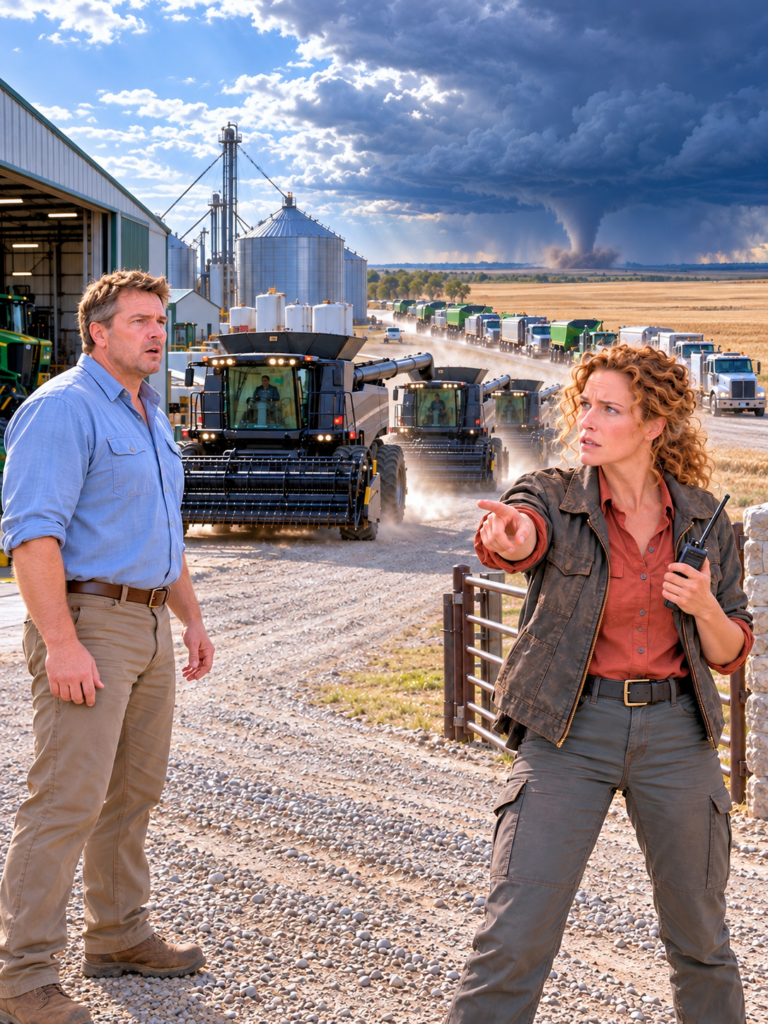
john deere told her twenty eight days the storm was three days out she bought the whole harvest company they said she could not afford and built a system that answered the small farms first
Part 1
The wheat stood heavy and gold across the three thousand acres, heads full enough that the stalks leaned a little in the wind that had come up out of the southwest. Rachel Carter walked the edge of the north quarter with the field map folded in her back pocket and listened to the sound the grain made when she ran her hand through it. It was a good sound. The kind that meant the numbers might finally move the right direction for once.
She had been running Carter Farms long before the title was hers. Nearly twenty years of planting schedules, spray windows, fuel burn rates, the slow fields that held water after a hard rain and the ones that dried too fast. She knew the debt number the way other people knew their own phone number because it sat under every decision she made. For most of those years the name on the dealer accounts and the bank lines had been Daniel’s. Her older brother had never been dishonest about it. He simply occupied the space tradition had always given him, and nobody in the county had thought to ask why.
When their father died the estate divided cleanly enough on paper. Daniel’s answer was to sell the bulk of the land, take the cash, and put it somewhere weather could not touch it. Rachel’s answer was different. She used every dollar she had saved, borrowed against what she could, and bought his share outright so the three thousand acres stayed in one piece. Daniel told her on the day the papers were signed that running a farm and owning one were two different things. He had not meant it as cruelty. He believed he was preparing her. She had looked past him at the land and thought about how many seasons she had already run it while his name sat on the accounts and did not change a single decision in the field.
This was the first season the name on everything was hers alone. The wheat had come in better than her projections. The forward contracts were strong enough that one clean harvest would let her pay down a real piece of the loan and start the next year from a place that was not entirely defensive. She had two John Deere combines, both older, both still serviceable if she treated them carefully. The plan was to run them through this season and upgrade afterward when the cash allowed it. Most reasonable plans do not account for a drivetrain failure on the primary machine in the first week of harvest.
She diagnosed what she could herself in the shop. The fault went deeper than the tools and parts she kept on hand. She drove into the dealership the next morning with the fault codes written on a notepad and the weather app already open on her phone. Douglas Mercer had managed the service schedules for eleven years. He pulled up the account on his screen, looked at the name that was no longer Daniel’s, and told her the earliest window was twenty-eight days out.
“I have a storm arriving in three days,” she said. “Three thousand acres.”
“We’ve got operations running thirty thousand acres waiting on this crew right now. I can’t pull them for a smaller account.”
“A loaner. A demo unit. Anything you can free up.”
“You’re not a priority customer, Miss Carter. That’s not going to change today.”
She stood with her hands on the edge of his desk and watched him look back at the screen. The weather alert sat bright on her phone. Seventy-two hours to the first rainbands. She did the math without needing paper. If the crew arrived when he said they would, the storm would already have come and gone twenty-five days earlier. The contracts she was counting on would pay out at a fraction of what she had planned, and the farm that was finally, fully hers would head into its second season in a hole she might not be able to climb out of.
“I see,” she said. “Twenty-eight days.”
“That’s the soonest we can get the parts.”
She did not argue. She did not raise her voice. She looked down at the phone for a moment, then met his eyes and said, “Then I’ll find another way.”
Douglas took that as the end of it. He had spent eleven years learning how to close a conversation with a farmer who would not accept the answer he had been given. What he missed was why she did not push back. Most people staring down crop loss with three days left either fight or fall apart. Rachel Carter did neither. She turned and walked out across the gravel lot to her truck, sat with the door open while the heat came off the lot, and looked at the forecast one more time. Then she started making calls.
Every custom harvesting crew within a reasonable radius was already committed. It was not a surprise. Every farmer in three counties had seen the same update, and the crews had filled their schedules within hours of it going live. She worked through every contact she had, then contacts of contacts, then cold calls to companies she had only heard of by name. The answers came back the same way each time. Booked. Running. Unavailable. At some point she stopped counting the calls and just kept going.
The last name on her list was Miller Custom Harvesting. She almost skipped it. She had heard that Frank Miller was winding things down and was not sure exactly what that meant. She called anyway. Frank picked up on the second ring and told her before she had finished explaining that he was not taking on any more work this season. She asked whether any of his equipment was available to rent. He said he did not rent anymore. She asked why, and there was a silence on the line long enough that she thought the call had dropped.
Then Frank said he was not renting because he was in the process of selling the company.
She assumed he meant the equipment. She asked about buying one combine, maybe two. Frank clarified he was not selling machines individually. He was selling everything. Massey Ferguson combines, tractors, grain carts, semi-trucks, a service truck, trailers, parts inventory, active customer contracts, and the right to bring on the crew of twelve men who had been running his operation together for years. He had a health issue that meant he needed to step back. He did not want to dismantle what he had built piece by piece. He wanted someone to take the whole thing or leave it.
Rachel asked for the number. It was more than she had in liquid capital. She told him that. Frank said that in that case she should keep working down her list, and she could hear in his voice that he was not being hard about it. He was just being honest about where things stood.
She looked at the field map spread across her passenger seat. The yellow and green blocks of three thousand acres of wheat that would either make this year or break it. She thought about Douglas Mercer’s expression when he said the word priority. She thought about the twenty-eight days. And then, for the first time since the combine had thrown its first fault code, she stopped thinking about finding someone to fix the machine.
Part 2
She drove out to Frank Miller’s place the next morning while the light was still thin. What she found was not a collection of aging equipment waiting to be liquidated. It was a fully functioning harvest business. Four Massey Ferguson Ideal combines in serviceable condition. Six tractors. Four grain carts. Six semi-trucks capable of moving grain from field to elevator without a single outside hire. A service truck stocked with parts and diagnostic tools. And a crew of twelve men who had spent multiple seasons learning how to move as one unit across large acreage. Frank had built something that could walk onto a field and begin harvesting within hours of arrival.
Rachel stood in the equipment yard and understood that she was not looking at machines. She was looking at time.
The financing structure Frank required was complicated enough that her bank’s first response was to tell her to step back and think it through. She would need to assume the remaining equipment loan, make an upfront payment, guarantee wages for the crew through the end of the season, and pay Frank the balance over time through a seller-carried note. Daniel drove out to the farm when he heard what she was considering. He was measured about it, which almost made it worse. He was not angry. He was concerned. And he laid out the math the way someone does when they have already decided the answer.
“You’re carrying debt on three thousand acres,” he said. They stood near the shop with the late light coming across the yard. “Adding a harvesting company’s equipment loan on top of that, days before a major storm, with no guarantee the operation generates revenue beyond your own fields. That’s exposure.”
The banker she had spoken to that morning had used a different phrase. Solving a three-day problem with a ten-year obligation. Rachel told the banker he was right about the timeline and wrong about what she was solving. She was not trying to fix a broken combine. She was trying to fix the condition that had put her in this position, which was that her entire operation depended on a service infrastructure that had already told her plainly she was not large enough to matter.
She sold the damaged John Deere, the one with the failed drivetrain, for its salvage value to generate upfront cash. She used her forward grain contracts as collateral for the remaining payment and negotiated the terms of the seller note with Frank directly. Frank had one non-negotiable condition. She kept the full crew employed through the end of the season. Rachel agreed without hesitation. She had already figured out that the twelve men who knew how to run that equipment together were worth more than the machines themselves.
The following morning the convoy pulled into Carter Farms. Daniel was standing near the shop when the first Ideal came down the road, followed by the second, then the third, then the fourth, with tractors, grain carts, semis, and the service truck filling in behind. He watched the line of equipment turn into the yard and asked Rachel if she had rented all of it.
“No,” she said.
He looked at her.
“I bought the company.”
He did not say anything for a long moment. She did not wait for him to find the words. She had less than sixty hours of usable harvest window left and four combines that needed to be in the field.
Part 3
She divided the three thousand acres into four zones and put a combine in each one. Grain carts ran fixed circuits between the combines and the waiting semis. The six trucks moved continuously between the fields and the elevator, emptying and returning without pause. Frank Miller stayed on site for three days to help with the transition, not because the sale required it, but because he had spent twenty-two years building that operation and he was not the kind of man who could hand it over and drive away while it was still mid-season.
By the end of the first day they had recovered most of the ground lost to the breakdown. Rachel ran a combine herself through the long afternoon hours. Somewhere in the steady rhythm of cutting through standing wheat she found herself thinking about what Frank had built. Not the machines, but the logic of the thing. The way twelve people who trusted each other could move across a landscape without wasted motion. There was something in that worth understanding.
On the second day the wind picked up and the weather service revised its forecast. The rainbands were accelerating, nearly eight hours ahead of the original estimate. Rachel kept the machines running through the night with only brief stops for fuel and inspection. Late that night she saw Frank sitting in the cab of the service truck with the door open, watching the field lights moving in the dark. He had no obligation left, but he stayed, and she understood that too. Some things do not end cleanly just because the legal structure says they should.
They reached the final field section with a few hours to spare and lost them almost immediately. A grain cart blew a tire. One of the semis would not turn over. The remaining three carts absorbed the load from the disabled one, and Rachel sent Frank’s service truck out to the semi while the combines kept cutting. The math was tight enough that nobody talked about what would happen if it did not work. Frank got the truck running. The last load of grain left the field just before the rain started.
In the weeks that followed, the county’s annual harvest dinner became something of a verdict. Douglas Mercer attended and shook her hand and told her she had found a way. She told him she had had to. Daniel found her before the evening ended and said three words he had not said to her in a long time. That he had been wrong. She accepted it and moved on because there was still more to do.
What she had not expected was the phone calls that started coming in the days after the dinner. A farmer with four hundred eighty acres said his dealer had quoted him nineteen days. A family operation running seven hundred acres had been told twenty-one. A widow managing nearly six hundred acres of dryland wheat had waited twenty-four days the previous season and watched her crop quality drop before anyone arrived. They were calling because they had heard Rachel now ran Miller’s old company, and they were calling because they had nowhere else to go.
Part 4
She listened to each of them, and as the calls kept coming she began to notice something that changed the shape of the entire story she had been telling herself. One of the crew members she had inherited from Frank was a man named Marcus Reed, who had spent years as a field technician for a major dealer before switching to custom harvesting. When Rachel mentioned the calls to Marcus, he asked her a question she had not thought to ask herself.
Had the dealer actually told her the parts were not available?
She thought back to her conversation with Douglas Mercer. He had never said the parts were not there. He had said twenty-eight days was the earliest available service window. Those were not the same thing. Marcus explained how dispatch priority worked inside the larger dealer network. Account spend. Fleet size. Total acreage under contract. Commercial relationship value. The biggest operations rose to the top of the queue automatically. Independent farms below a certain threshold could fall to the bottom regardless of urgency.
Rachel asked whether that included a situation where a crop was actively at risk. Marcus told her that harvest season was precisely when the system worked that way, because everyone needed help at the same time and the system had to rank them somehow. She had spent weeks believing she had been treated as low priority because she was new to the account, because she was carrying debt, because Daniel’s name was no longer on the file. The truth was simpler and wider than that. The system was not personal. It was structural. And it did not only happen to her.
Rachel renamed the company Carter Harvest and Field Service and started taking calls. One farm, then three, then seven. The work was straightforward at first. Finishing out harvest jobs that other crews could not reach in time. Running mobile service to equipment that had broken down midfield. But the larger idea was already forming. She was not trying to build another custom harvesting operation. She was trying to build the thing that had not existed when she needed it most. A service structured around when a farm actually needed help, not around how many acres it could claim on a dealer’s priority list.
The problem arrived in the form of a phone call from a corporate farm management group that had been one of Frank Miller’s largest accounts. They ran nearly eighteen thousand acres under management, and they wanted Rachel to formalize an exclusivity arrangement. First-call priority across the entire peak harvest window. Guaranteed fleet availability for their footprint before any other customer. It was, on paper, a significant revenue relationship. Nearly forty percent of the company’s projected annual income was tied to that single account.
Rachel understood what they were asking. She had lived on the other side of that arrangement. What they wanted her to build was the same system that had told her twenty-eight days. The same logic that had sent Douglas Mercer’s eyes back to his screen while she stood there with a storm on her phone. She told them she would not structure service that way. They terminated the contract within the week.
The bank’s reaction was quick and specific. The equipment loan Rachel had assumed from Frank carried a revenue covenant, and losing forty percent of projected income put her in breach of the threshold. The lender wanted a restructuring conversation. Daniel came out to the farm, and to his credit he was not there to say he had told her so. He had a practical proposal. Sell two of the four combines, retain just enough capacity to run Carter Farms’ own harvest, and close the outside service business before the debt structure became unmanageable. She would still have won the thing that mattered. Her land was intact. Her crop was in. Her first season as sole owner had not ended in failure. Nobody could take that from her.
Rachel held the phone that evening and almost made the call. She had Daniel’s number on the screen. She knew his proposal was reasonable. She also knew that if she sold the fleet, every farmer who had called her after the harvest dinner would be back to waiting. The widow with six hundred acres. The family running seven hundred. The man with four hundred eighty who had been quoted nineteen days. They would go back to the same queue, the same system, the same answer. The phone stayed in her hand, and she did not dial.
That same night Frank Miller called. He did not know she was sitting with that decision. He was calling to ask whether she planned to run the operation into the following season. The kind of question a man asks when he still thinks about something he spent twenty-two years building. Rachel told him she was not sure yet.
Frank was quiet for a moment, then said he had sold the business to her specifically because she was the first person who had called him and asked what the operation could do, not how many machines it had. He had built it to serve farmers who did not have other options. He had always hoped the person who took it over would understand that without needing it explained. Then he said good night and hung up.
Rachel put down the phone and sat with the quiet. Then she picked up her list of incoming calls and started planning a different kind of meeting.
Part 5
She invited every independent farmer who had contacted Carter Harvest in the weeks since the harvest dinner to come out to the machine shed. She did not pitch them on sentiment. She brought numbers. The model she laid out was called the harvest assurance program. An annual retainer priced low enough that a four-hundred-acre operation could carry it alongside everything else, in exchange for guaranteed priority dispatch, a pre-season equipment inspection, emergency response within a defined window, and backup harvesting capacity if their own machines went down.
The critical element, which she had written into the contract language rather than leaving as a verbal promise, was that priority would be assigned based on crop urgency. Maturity stage. Weather exposure. Acres remaining. Machine availability. Not on account size. A smaller farm with grain down in a rain event would move ahead of a larger farm that still had time to manage. That was the rule, and it was in writing.
She signed the first few members herself, working through the room one conversation at a time. The room was skeptical in the way that farmers are skeptical. Not hostile, just accustomed to being told things that did not hold when it actually mattered. The widow who had lost crop quality waiting twenty-four days the previous season stood up near the end of the evening and told the room what had happened to her wheat and what the delay had cost her. Then she signed. Others followed. By the time the shed cleared out that night, more than twenty operations had committed enough recurring revenue to satisfy the bank’s covenant threshold and give Carter Harvest the runway to reach the following season.
The program was tested the next summer in the worst possible way. A heat event compressed the regional harvest window and generated simultaneous emergency calls across the membership. Rachel worked the dispatch herself, ranking each situation against the criteria in the contract. One of the smallest farms in the program had a combine catch fire in the field. Not a breakdown. A fire. She pulled a crew and machine from a much larger operation that still had hours remaining before critical loss. The manager of the larger farm called her and listed his acreage. Rachel told him she knew exactly how many acres he was running, and that was precisely why she knew he could survive six hours. The smaller farmer could not. That story traveled.
The following season Carter Harvest added three crews, expanded the mobile service division, took on more than thirty member operations, and provided harvest support across more than twenty-five thousand acres outside of Carter Farms’ own three thousand. Two years after Douglas Mercer had looked at his screen and said the word priority, Rachel was running the largest independent harvest service operation in the county.
At the annual agricultural meeting that fall the program chair told the room the story that everyone already knew. The combine breakdown. The twenty-eight-day window. The storm. The convoy of Massey Fergusons rolling into Carter Farms at first light. The room laughed and applauded. Daniel sat in the audience and watched his sister receive an acknowledgement she had earned entirely without him. Frank Miller was there too, in a chair near the back, and he clapped in the steady, unhurried way of someone who had already known how the story ended.
Douglas Mercer was waiting for Rachel after she came off the stage. He had a proposal with him. Priority-one service designation for Carter Farms. Fleet discounts. Favorable financing terms. Referral work for Carter Harvest. The full weight of the dealership’s commercial relationship behind her name. He told her she had made her point.
She asked what point he thought that was.
He said she had proven they had underestimated her.
She told him that was never what any of it had been about.
He asked what it had been about then. Rachel looked past him to where the Carter Harvest service trucks were loading up in the parking lot. One heading to a five-hundred-acre operation across the county line. Another to a farm running more than four thousand acres in the opposite direction. She told him that no farmer should have to become important enough before someone decides their harvest matters. Then she told him her systems and his did not work the same way. She shook his hand, not cold, not warm, simply finished, and walked out to where her trucks were waiting.
A few days later Daniel came out to the farm alone. No agenda. No proposal. They stood at the edge of the land that had started everything, watching a Carter Harvest crew prepare to leave the yard for another job. Daniel brought up what he had said the day she signed the papers. That running a farm and owning one were two different things.
Rachel told him he had been right. He had not expected that. She told him she had always known how to run three thousand acres. What she had not known was what she wanted those three thousand acres to stand for. Daniel asked if she knew now. She said she did. He looked at what she had built and told her their father would have been proud.
She did not need that to confirm what she already knew, but she allowed herself to receive it. Not because she had finally proven him wrong, but because she no longer needed anyone to be wrong in order to know that she was right.
Two years before, Rachel Carter had stood in a dealership parking lot with a weather alert on her phone and a service manager’s answer still in her ears. Twenty-eight days. The storm was giving her three. She could not change either number, so she stopped trying to work within a system that had already told her where she ranked, and she built something outside of it entirely. She had bought Miller Custom Harvesting to save one harvest. She had turned it into Carter Harvest and Field Service to make sure other farmers did not have to do what she did. Did not have to find a way around a structure that should have worked for them in the first place.
The biggest thing she won was not the acreage, the contracts, or the moment Douglas Mercer came back with a better offer. It was simpler than any of that. She stopped waiting for a system built by someone else to decide whether her work was worth showing up for. John Deere gave her twenty-eight days. The storm gave her three. Rachel bought herself time. Then she built something that gave it back to everyone else.


