her father left her a worthless desert canyon while his greedy partner took everything—then she found the secret house hidden inside the mountain
Part 1
The day Clara Pendleton buried her father, she stood beside his grave in a borrowed black dress, wondering whether the man beneath the ground had ever truly loved her.
Two weeks later, she sat inside a Denver attorney’s office and discovered that Arthur Pendleton had apparently found one final way to disappoint her.
He had left nearly everything to the man she hated most.
And to his only daughter, he had left 512 acres of barren desert in southern Utah.
No house. No money. No farmland. Not even a dependable source of water.
Just a canyon filled with red rocks and dust.
Clara was thirty-two years old, nearly bankrupt, and three months away from losing her townhouse. The inheritance felt less like a gift than a final insult from a father who had spent seven years refusing to explain why he had pushed her out of his life.
She sat at the far end of a polished mahogany conference table while Richard Gable, her father’s longtime attorney, adjusted his glasses.
Across from her was Mitchell Caldwell.
Mitchell had been Arthur’s business partner for twenty-three years. His expensive charcoal suit, silver hair, and carefully folded hands made him look respectable. But Clara remembered the way he had spoken to her mother when she was still alive, with a pleasant smile that never reached his eyes.
He had always treated people according to what they could give him.
And now he was waiting to discover exactly how much Arthur had left behind.
Richard cleared his throat.
“To Mitchell Caldwell, I leave my remaining forty-nine percent ownership interest in Pendleton Caldwell Infrastructure, together with my commercial real estate holdings in Denver and Phoenix.”
Clara went completely still.
Her father’s engineering company was worth tens of millions of dollars.
Mitchell already possessed a majority stake. Now he would own Arthur’s remaining shares as well.
Richard continued reading.
“To my only daughter, Clara Juliet Pendleton, I leave the entirety of the property held under Apex Horizon Land LLC, consisting of approximately 512 acres in southern Utah, commonly known as Echo Ridge Canyon.”
He paused.
“I also leave her the brass compass she gave me in 1999, and the knowledge that some foundations are built to outlast the storms.”
Silence settled over the room.
Clara stared at the attorney.
“That’s all?”
Richard lowered his eyes.
“I’m afraid those are your father’s instructions.”
“A canyon?”
“Yes.”
“Where?”
“In Kane County, Utah.”
She let out a breath that sounded almost like laughter.
“My father owned apartment buildings, warehouses, commercial properties, an engineering company, and investment accounts. And he left me a canyon?”
Mitchell leaned forward.
“Clara, your father wasn’t well during his final years.”
She turned toward him.
“Don’t.”
“I’m only trying to help you understand.”
“Then explain why he gave you everything.”
Mitchell sighed.
“Your father trusted me to preserve the company. Unfortunately, he became obsessed with that desert property. He poured money into it when he should have been protecting his other investments.”
Clara remembered the last conversation she had with Arthur.
They had argued in his workshop.
He had been standing beside a drafting table, surrounded by geological maps, his shirt sleeves rolled up and his hands trembling from exhaustion.
She had accused him of abandoning their family after her mother’s death.
He had told her to leave Denver and never discuss his business with Mitchell.
She had demanded an explanation.
Arthur had only said, “There are things I cannot tell you yet.”
She walked away that afternoon.
Neither of them apologized.
Seven years later, a state trooper found Arthur’s overturned vehicle on a mountain road.
The official report called it a single-car accident.
Clara had never believed she would see him alive again, but she had imagined there would be time to repair what was broken.
Instead, there had been a coffin.
And now there was a canyon.
Mitchell took a document from his leather briefcase.
“I understand your financial situation is difficult.”
Clara’s stomach tightened.
“How would you know?”
“Your father was concerned about you.”
“Apparently not concerned enough to help.”
“I can offer you twenty thousand dollars for the Utah property. Cash. We can complete the transaction quickly.”
Richard looked up sharply.
“Mr. Caldwell, I believe Miss Pendleton should have an independent appraisal before considering any sale.”
Mitchell ignored him.
“Twenty thousand dollars could give you breathing room, Clara.”
She looked at the paper.
Twenty thousand dollars would cover some overdue bills.
It might delay the foreclosure proceedings.
But it would not erase the medical debt accumulated during two years of treatment for an autoimmune illness, nor would it rescue the small design business she had spent five years building before her health failed.
Her savings were gone.
Her credit cards were nearly exhausted.
And every morning she opened the mailbox expecting another notice from the bank.
She needed that money.
But something about Mitchell’s offer troubled her.
He had just inherited a multimillion-dollar business.
Why was he so interested in buying a worthless canyon?
“I’m not selling today,” she said.
Mitchell’s expression hardened for half a second.
Then his smile returned.
“Of course. Take your time.”
Richard slid a small wooden box across the table.
Inside lay a battered brass compass.
Clara recognized it immediately.
She had bought it from a pawnshop when she was twelve years old, using money earned washing dishes at a roadside diner.
Her father had loved surveying, hiking, and finding old trails through the mountains.
She had wanted to give him something special for his birthday.
The compass had cost eleven dollars.
She remembered placing it in his enormous hands.
He had turned it over, examined the scratched brass casing, and said, “Best gift an engineer could ask for.”
Then he had kissed the top of her head.
Clara lifted the compass.
Its weight brought back a memory so painful that she had to look away.
She signed the papers acknowledging receipt of her inheritance, collected the deed, and walked outside.
The October wind struck her face.
She made it halfway to her car before she began crying.
Not because of the money.
Because somewhere beneath the anger, she had hoped her father would leave her a letter.
Something that said he was sorry.
Something that told her he had missed her.
Something that explained why the man who once carried her on his shoulders had become a stranger.
Instead, he had given her a compass and a piece of desert.
That evening, Clara sat at her kitchen table with a stack of unpaid bills.
Her townhouse was quiet except for the refrigerator humming in the corner.
She had sold most of her furniture to keep the mortgage current. The dining set was gone. So was the piano her mother had taught her to play.
Only four mismatched chairs remained around the kitchen table.
She opened her laptop and searched for Echo Ridge Canyon.
Satellite images revealed a maze of sandstone cliffs and dry washes stretching across miles of isolated country.
There were no buildings.
No established access roads.
No visible utilities.
A county property summary described the land as undeveloped and remote.
Mitchell had been right about one thing.
It was not an easy property to sell.
Clara shut the laptop.
Then she opened the little compass.
The needle trembled before pointing north.
She ran her thumb across its scratched lid.
A memory surfaced.
She was twelve, sitting beside Arthur on the back porch of their old house.
He was teaching her how to read a topographic map.
“Always pay attention to the things other people overlook,” he had told her.
“Like what?”
“An old survey marker. A change in the rock. A line that doesn’t belong.”
“Why?”
“Because sometimes the smallest detail tells you the biggest truth.”
Clara looked down at the compass.
For the first time, she noticed faint marks etched into the inside of its lid.
She carried it beneath the kitchen light.
Numbers.
Coordinates.
Below them was a tiny symbol: a triangle crossed by a vertical line.
She stared at the markings.
They were too precise to be accidental.
And she had never noticed them before.
Clara opened her laptop again and entered the coordinates into a mapping application.
The location appeared deep inside Echo Ridge Canyon.
Nearly a mile and a quarter from the western boundary.
At the base of a sheer sandstone wall.
Her father had engraved a location inside the only thing he left her.
For several minutes, she sat motionless.
Then she began packing.
Two mornings later, she drove her aging Subaru Outback west through Colorado and into Utah.
The mountains gradually gave way to open country.
Small towns disappeared behind her.
The land became emptier and harsher.
She passed abandoned ranch buildings, rusted windmills, sun-bleached fences, and cattle grazing in the shadows of distant mesas.
By late afternoon, she reached the last paved road.
Beyond it, a rough dirt track wound toward the canyon.
Her tires rolled over loose stone.
Red dust rose behind the vehicle.
Forty minutes later, she parked beside a dry wash.
The canyon stretched before her beneath a cloudless sky.
Its walls rose nearly two hundred feet above the desert floor.
Nothing moved except a hawk circling overhead.
Clara climbed out.
The heat struck her immediately.
She checked her phone.
No service.
She looked around at the barren landscape.
“This is what you left me, Dad?”
Her voice disappeared into the silence.
She took the compass from her pocket.
The needle swung north.
Then she looked toward the distant eastern cliff.
Somewhere beneath that enormous wall of red stone was the place her father had marked.
Clara tightened her backpack.
“I came this far,” she whispered.
And she started walking.
Part 2
By the time Clara reached the eastern wall, her water bottles were half empty and her legs were trembling.
The hike had taken nearly an hour.
What appeared flat on the satellite map was a punishing maze of loose rock, thorny brush, and dry streambeds cut deep by ancient floods.
Twice she slipped on unstable shale.
Once she stopped beneath a narrow ledge because dizziness had turned the landscape blurry.
Her illness was mostly controlled, but exhaustion and heat could still leave her weak without warning.
She knew she should turn around.
She also knew there was nothing waiting for her in Denver except another demand for money she did not have.
So she continued.
At last, the coordinates brought her to a pile of enormous sandstone boulders at the base of the cliff.
Clara studied the rocks.
There was no cabin.
No buried chest.
No trail.
Only a wall of stone.
She checked the coordinates again.
Correct.
She walked in a slow circle, searching for something unusual.
Nothing.
An hour later, she sat on a flat boulder and covered her face with both hands.
“Why, Dad?”
The question echoed against the cliff.
“Why couldn’t you just tell me?”
She remembered the months after her mother died.
Arthur had stopped eating dinner with her.
He stayed awake through the night studying geological maps.
Sometimes he disappeared for weeks, returning home thinner, exhausted, and unwilling to explain where he had been.
Clara had believed he no longer wanted a family.
Now, standing alone in the wilderness, she wondered whether he had been hiding something long before their final argument.
She opened the compass again.
The engraved symbol caught the afternoon sunlight.
A triangle.
A vertical line.
She had seen that shape somewhere before.
Then she remembered.
When she was a little girl, Arthur sometimes took her to construction sites. He used a similar symbol on his private sketches to mark structural reference points.
Not a treasure marker.
A survey reference.
Clara stood up.
She examined the ground more carefully.
Near the edge of the boulder field, a clump of dead sagebrush was growing beside an old metal rod.
She crouched and pulled away the brittle branches.
The rod was thick, rusted, and driven deep into the earth.
A surveyor’s peg.
She wiped its flattened head with her sleeve.
Stamped into the metal was the same triangle crossed by a vertical line.
Clara forgot her exhaustion.
She looked from the peg toward the cliff.
The marker was aligned with the largest boulder.
She followed that direction, climbing carefully over the broken rock.
At first, everything looked ordinary.
Then she noticed a shadow.
It lay behind two massive stones pressed together near the cliff face.
Unlike the other shadows, this one disappeared into absolute darkness.
She stepped closer.
A narrow gap opened between the rocks.
It was barely wide enough for a person to pass.
Clara shone her flashlight inside.
The beam touched a smooth sandstone wall several feet away, then disappeared around a bend.
Her heart began pounding.
“Dad?”
She almost laughed at herself.
No one answered.
She squeezed sideways into the opening.
Rough sandstone scraped her shoulders.
Her backpack caught on a projecting stone, forcing her to remove it and drag it behind her.
The temperature dropped immediately.
The air smelled of cool rock and dry earth.
After twenty feet, the passage turned sharply.
Clara paused.
She was alone, without phone service, inside a hidden fissure in a desert cliff.
Every reasonable instinct told her to go back.
Then she saw light.
Not sunlight.
A soft golden glow around the next bend.
She followed it.
The narrow passage widened suddenly.
And Clara stopped breathing.
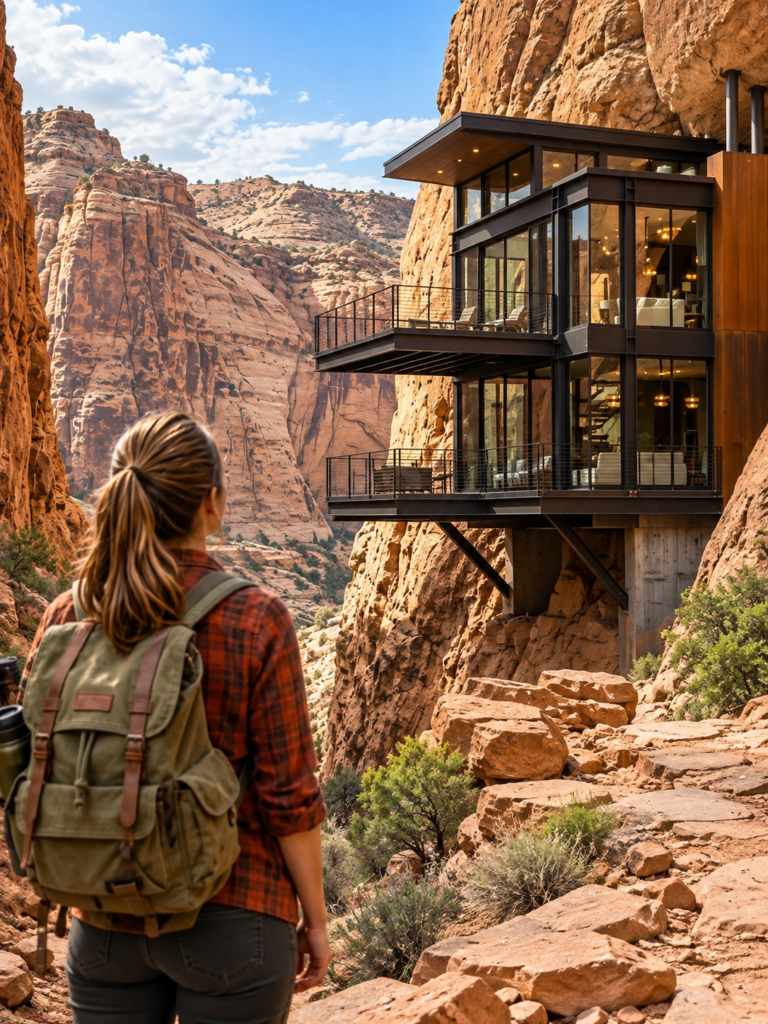
Before her lay an enormous natural alcove carved into the mountain.
Inside it stood a house.
Not a cabin.
Not an abandoned miner’s shelter.
A breathtaking three-story residence suspended against the sandstone wall.
Black glass stretched between weathered steel beams. Broad terraces projected over the rock floor. Concrete stairways climbed between different levels, supported by columns anchored into the cliff.
The structure blended into the surrounding shadows so completely that it would have been nearly invisible from above.
Warm lights glowed behind the windows.
Clara stared.
“What in the world?”
She took several careful steps forward.
The house was real.
There were drainage channels along the floor of the alcove.
Steel supports disappeared deep into the rock.
A narrow service path ran beneath the main terrace.
Every detail suggested enormous planning and extraordinary expense.
Her father had built bridges across mountain valleys.
He had designed dams, commercial towers, and complicated foundations in unstable ground.
But this was unlike anything she had ever seen.
An entire home concealed inside a mountain.
She approached the entrance.
Broad concrete steps led to a massive steel door.
Beside it was a small digital keypad.
Clara pressed a button.
The screen illuminated.
ENTER ACCESS CODE.
She tried her birthday.
Rejected.
She tried her mother’s birthday.
Rejected.
Then their wedding anniversary.
Rejected.
Clara leaned against the wall.
“Come on, Dad.”
She studied the compass.
The coordinates had been engraved with extraordinary precision.
Perhaps the numbers were more than directions.
She entered a sequence derived from them.
A red light flashed.
She tried another grouping.
Nothing.
Then she remembered something Arthur had once told her about engineering drawings.
“Numbers only mean something when you know where one measurement ends and the next begins.”
Clara separated the coordinates according to the engraved spacing and entered the resulting code.
For one terrible second, nothing happened.
Then a heavy mechanical lock clicked.
The steel door released.
Clara stood motionless as it swung inward.
A row of warm ceiling lights illuminated the entrance.
She stepped inside.
The air was cool.
The floor beneath her boots was smooth terrazzo.
A spacious living room opened toward an enormous glass wall overlooking the hidden canyon passage.
There were leather chairs, oak bookshelves, a long dining table, and framed photographs.
Everything was clean.
Everything appeared ready for someone to arrive.
Clara moved slowly through the room.
On a side table stood a photograph of her mother.
Evelyn Pendleton was laughing in the picture, holding a fishing rod beside a mountain lake.
Arthur had taken that photograph during their last family vacation.
Clara lifted the frame.
For seven years, she had imagined her father had locked every memory of their family away.
Yet here was her mother’s face, carefully placed beside his favorite chair.
She looked around again.
A faded red quilt lay folded across the back of a sofa.
Clara recognized it.
Her grandmother had sewn that quilt when Clara was born.
Arthur had refused to throw it away even after the fabric began fraying.
She touched the worn stitching.
Her throat tightened.
“Why did you bring this here?”
The house answered with silence.
She found a kitchen stocked with canned food, sealed dry goods, and basic supplies.
When she opened the faucet, cold water flowed freely.
The utility panel showed that the property operated on stored electrical power.
A maintenance display indicated groundwater filtration, solar generation, and battery reserves.
She opened a service cabinet and found carefully labeled replacement parts.
Arthur had built the place to survive without ordinary utilities.
Clara knew enough about his work to appreciate what that required.
The water system alone represented years of planning.
Beyond the kitchen, she found three bedrooms.
One contained books on civil engineering and geology.
Another had an enormous wardrobe and an untouched bed.
The third stopped her.
It was smaller than the others.
A quilt covered the bed.
On the dresser sat a picture of Clara at fourteen, smiling beside her father at a county science fair.
She had won second place for building a model suspension bridge.
Arthur had insisted they celebrate with ice cream.
Beside the photograph lay a box of colored pencils.
The same brand she used when she was young.
Clara sat on the edge of the bed.
She had spent years believing her father had forgotten her.
Yet he had built a room inside a hidden house and filled it with pieces of her childhood.
She pressed her hands over her eyes.
For the first time since his funeral, her grief felt larger than her anger.
After a while, she stood and continued exploring.
An upper-level room contained hydroponic equipment, grow lights, and empty planting trays.
A utility closet held emergency medical supplies.
A wall cabinet contained maps, weather equipment, and satellite communication instructions.
Her father had anticipated nearly every ordinary emergency.
But why?
Why would a successful engineer build a concealed house in a remote canyon?
And why leave it to his estranged daughter instead of using it himself?
At the end of the third-floor corridor, Clara found a heavy oak door.
A small brass plate beside it carried two words.
ARTHUR’S STUDY.
She turned the handle.
The smell of old paper and leather greeted her.
There was a drafting table covered in blueprints.
Tall filing cabinets lined the walls.
Geological maps were pinned beneath glass.
And sitting in the center of the desk was a thick leather journal.
Clara recognized her father’s handwriting on the cover.
She approached it cautiously.
An envelope lay beneath the journal.
On its front, written in Arthur’s unmistakable block letters, were five words.
FOR CLARA, WHEN SHE ARRIVES.
Her hands began shaking.
She opened the envelope.
Inside was a single sheet of paper.
“My dearest girl,” it began.
“If you are reading this, then the compass brought you home.
“I know you have every reason to hate me. Before you decide whether I deserve forgiveness, I need you to understand what I have been trying to protect.
“Read the journal.
“Trust the evidence.
“And whatever happens, do not let Mitchell Caldwell take this land.”
Clara read the letter twice.
Then she looked at the thick journal.
Outside, the last light of afternoon was fading from the canyon.
And somewhere inside those pages lay the truth her father had taken to his grave.
Part 3
Clara turned to the first marked page.
The entry was dated four years earlier.
August 12.
Caldwell is moving faster than I anticipated. He has been ordering geological tests under the company’s infrastructure research accounts. The samples came from Echo Ridge. He believes I do not examine the laboratory records.
He is wrong.
Clara frowned.
She turned the page.
Her father had written about underground mineral formations, geological sampling, shell companies, and unexplained transfers from the engineering firm.
At first, the details were difficult to follow.
Clara understood design plans and construction budgets, but she had never studied mineral exploration.
She returned to the maps spread across the drafting table.
Colored markings followed a formation beneath the canyon floor.
Several bore notes about lithium-bearing rock and cobalt mineralization.
Clara read another entry.
The deposit may be extraordinary. Independent verification is essential, but Caldwell has already begun moving money to acquire the property through nominees.
He does not want a mining company to find it. He wants to control the discovery before anyone knows what lies beneath the land.
Clara looked around the study.
Her father had not purchased a worthless canyon.
He had discovered something Mitchell wanted badly enough to hide.
A later entry described millions of dollars redirected through offshore companies.
Another mentioned falsified invoices.
Then she reached a page that made her grip the journal tightly.
September 4.
I have evidence that Mitchell is using company funds to finance the land acquisition. Some of those funds came from employee retirement accounts.
I confronted him privately.
He threatened Clara.
Her eyes stopped moving.
She read the sentence again.
He threatened Clara.
The journal continued.
He knew where she lived. He knew about her medical treatment. He knew her business was struggling. He implied that an unfortunate accident could happen to anyone.
Clara felt suddenly cold.
She remembered her final argument with her father.
He had begged her to move away from Denver.
She had accused him of trying to control her life.
He had refused to explain.
Now she understood why his voice had sounded so frightened.
She turned to the next page.
If Clara stays angry with me, she may stay away from the company. Caldwell will have fewer reasons to involve her.
It is a terrible bargain. I know that.
But I cannot protect her by bringing her into the middle of this.
Clara sat down.
She could almost hear Arthur speaking.
He had always been better at solving structural problems than human ones.
When her mother was alive, Evelyn had been the person who reminded him that people needed conversations, not plans.
After Evelyn’s death, he had tried to manage grief as if it were a damaged bridge.
Identify the weak point.
Reinforce the structure.
Keep moving.
He had never understood how lonely his daughter had become.
And in trying to protect her, he had left her believing she was unwanted.
Clara pressed the journal against her chest.
“You should have told me,” she whispered.
The room was silent.
“You should have trusted me.”
She wiped her face and continued reading.
The next pages described Arthur purchasing Echo Ridge through a separate holding company before Mitchell’s buyers could acquire it.
He had used personal funds, legal intermediaries, and independent contractors.
He had constructed the hidden house as a secure location for original documents, geological records, and evidence of financial fraud.
The project had consumed years of his life.
Clara looked at the walls surrounding her.
This extraordinary building had never been intended as a display of wealth.
It was a vault.
A refuge.
A place designed to protect information that powerful people wanted destroyed.
Her father’s handwriting grew more hurried toward the end of the journal.
The final dated entry was written three days before his death.
They know I have the ledger.
Someone entered my Denver house last night.
The drives are safe. The original mineral-rights documents are in the vault.
Caldwell believes he can use Clara’s financial difficulties to force her to sell Echo Ridge.
If anything happens to me, the compass will guide her.
The truth is in the wall.
Clara read those last words aloud.
“The truth is in the wall.”
She stood.
Her father had built the study against the solid sandstone cliff.
One wall was covered in walnut paneling.
The others held filing cabinets and bookshelves.
She searched for seams, hidden buttons, and unusual fixtures.
Nothing.
She tapped the western wall.
It sounded solid.
She returned to the blueprints.
The study’s dimensions were clearly marked.
Then she noticed something strange.
The wall thickness shown on one drawing did not match the finished room.
There should have been a concealed space behind the walnut paneling.
Clara ran her hands along the wood.
She pushed against each section.
Still nothing.
Her frustration grew.
The sun had disappeared behind the cliff.
She had been inside the house for hours.
She needed food, rest, and a practical plan for returning to Denver.
But she could not walk away now.
She scanned the room again.
Two heavy bronze bookends stood on a shelf near the drafting table.
Both were shaped like geometric sculptures.
One was a sphere.
The other was a triangle crossed by a vertical line.
Clara stared.
The symbol from the compass.
She approached the shelf.
The triangle did not move when she lifted it.
She tried sliding it.
Nothing.
Then she twisted it clockwise.
A mechanism clicked inside the wall.
A section of walnut paneling shifted outward and slid aside.
Behind it sat a steel safe embedded in the sandstone.
Clara exhaled.
“Of course, Dad.”
The safe had an electronic access panel and a large mechanical keyhole.
She examined the compass again.
The brass case felt heavier than it should.
Its winding knob was unusually long.
Clara pulled at it.
At first, nothing happened.
Then the knob detached.
Hidden inside the casing was a narrow iron key.
Her father had concealed the key in the compass she bought him when she was twelve.
Clara slipped it into the lock.
It turned with a heavy metallic sound.
The safe opened.
Inside were several encrypted hard drives, a thick binder, sealed geological reports, and a large envelope bearing her name.
She took out the envelope first.
The legal documents inside identified Apex Horizon Land LLC as the owner of the property and its associated mineral rights, subject to the recorded title conditions.
They also contained independent geological appraisals.
Clara read the estimates.
Then read them again.
The mineral resources beneath Echo Ridge had been assigned an estimated gross in-ground value of approximately $1.2 billion.
The figure was not cash she could spend. Developing a deposit would require approvals, financing, environmental review, and years of work.
But the land was far from worthless.
Mitchell had offered her twenty thousand dollars for property potentially connected to one of the region’s most valuable mineral discoveries.
She put a hand over her mouth.
“Oh, Dad.”
Her father had given Mitchell the company.
But he had left Clara the land Mitchell desperately wanted.
And he had hidden the documents needed to expose why.
She opened another folder.
Inside were financial records showing transfers among Pendleton Caldwell Infrastructure, several consulting entities, and a company called Apex Meridian Holdings.
There were invoices, bank records, and annotated transaction logs.
Clara turned a page.
The documents included payments to a private security contractor.
Then another.
And another.
The last payment was made shortly before Arthur’s fatal crash.
She stared at the dates.
A cold suspicion began forming.
Had her father really lost control of his car?
Or had someone arranged for him never to reach a courtroom?
Clara carried the binder to the desk and looked for a phone.
Her own mobile still had no signal.
She found a satellite communication console beside the study’s filing cabinets, but it required authentication she did not yet know.
She searched the office for the instructions.
Before she found them, a faint vibration moved through the floor.
Clara stopped.
At first, she thought it was machinery switching on.
Then the sound grew louder.
A distant, rhythmic beating.
Helicopter blades.
She rushed to the glass wall overlooking the canyon entrance.
Above the narrow opening, a black helicopter descended toward the valley floor.
Dust spun beneath it.
Three men in dark tactical clothing climbed down.
A fourth figure emerged wearing a pale shirt beneath a dust-covered suit jacket.
Clara pressed closer to the glass.
Silver hair.
Straight shoulders.
An unmistakable way of walking.
Mitchell Caldwell.
He looked toward the hidden opening beneath the boulders.
Then he pointed directly at it.
Clara backed away.
He knew.
Somehow, Mitchell knew she had found the house.
The helicopter settled onto the canyon floor.
One of the men lifted a heavy equipment bag from the aircraft.
Another carried a rifle.
Clara ran back to the study.
She shoved the drives, journal, binder, and original documents into her backpack.
Her hands shook so badly that she dropped one of the drives.
She knelt to retrieve it.
Then she heard Mitchell’s voice echoing faintly from the passage outside.
“Find the entrance.”
A man answered.
“And the woman?”
Clara froze.
Mitchell replied without hesitation.
“She doesn’t leave with those documents.”
For seven years, Clara had believed her father abandoned her.
Now she understood that he had been fighting a dangerous battle alone.
And the man who had killed his peace had come to take hers.
She tightened the straps of her backpack.
Then she looked at the architectural plans on the desk.
Her father had built a fortress.
Surely he had also built a way out.
Part 4
The first strike against the front door sounded like a hammer hitting a church bell.
Clara flinched.
A second impact followed.
Then came the grinding whine of an industrial drill.
The men outside were forcing their way through the locking system.
She spread the blueprints across the desk.
Her father had designed the house with multiple independent utility systems.
The water supply entered from a protected underground source.
The ventilation equipment connected to shafts extending through the sandstone.
Emergency power sat in a secured mechanical room on the lowest level.
And there, beside a dashed line almost hidden beneath Arthur’s handwritten measurements, was an auxiliary access shaft.
It rose through the cliff and opened onto the plateau nearly two hundred feet above.
Clara followed the line with one finger.
An escape route.
She memorized the corridor leading to it, stuffed the blueprints into her bag, and ran.
The spiral stairs rang beneath her boots.
She reached the main floor just as another violent blow shook the entrance.
Dust drifted from the ceiling.
She hurried past the kitchen and through a narrow service corridor.
At its end stood a heavy fire door.
She pushed it open.
The mechanical room was cold and filled with the steady hum of equipment.
Battery cabinets lined one wall.
Filtration tanks stood behind protective barriers.
Large pipes disappeared into the stone.
At the far end of the room was a steel grate covering an opening in the rock.
Clara ran toward it.
Four heavy latches held the grate shut.
She released the first.
Then the second.
The third snapped open with a sharp metallic crack.
The fourth would not move.
She pulled harder.
Nothing.
A distant explosion shook the house.
Clara screamed and ducked.
Dust fell from overhead.
The men had breached the front entrance.
She heard shouting.
Boots.
A voice ordering someone to search the upper floors.
Clara grabbed a steel wrench from a maintenance cart.
She struck the stuck latch.
Once.
Twice.
On the third blow, it moved.
She pulled it free and opened the grate.
A narrow vertical shaft disappeared into darkness.
Steel ladder rungs were anchored into the sandstone.
Far above, she could see a faint patch of daylight.
Clara climbed inside.
Her backpack scraped against the rock.
She pulled the grate shut beneath her.
Then she began climbing.
Twenty feet.
Forty.
Her arms burned.
She stopped on a small maintenance platform and pressed her forehead against the cold stone.
The autoimmune illness that had disrupted her life had taught her how quickly strength could disappear.
She could not rely on sheer determination alone.
She needed to conserve energy.
She adjusted her backpack, drank a small mouthful of water, and slowed her pace.
One rung at a time.
Then she heard a door open beneath her.
A flashlight beam swept across the mechanical room.
Clara froze.
A man approached the grate.
She pressed herself against the shaft wall.
“Anything?” another voice called.
“Looks like ventilation.”
“Check it.”
The first man pulled at the grate.
For one terrible moment, Clara thought he would open it.
Then another voice shouted from somewhere upstairs.
“We found the study! Get up here!”
The man below hesitated.
His flashlight swept across the ladder.
Clara held her breath.
Then he walked away.
The mechanical room door slammed.
She waited until she could no longer hear footsteps.
Then she continued climbing.
Her shoulders scraped against sandstone.
Sweat ran into her eyes.
Her legs trembled.
The narrow ladder seemed endless.
At one point, she looked down and immediately regretted it.
The darkness beneath her was deep enough to swallow the light from her headlamp.
She pressed her cheek against the rock.
“Please, Dad.”
She was not sure whether she was asking him for help or blaming him for putting her there.
Maybe both.
At last, cool air moved across her face.
She looked up.
A round metal cover stood between her and the open sky.
She pushed.
It resisted.
She braced her shoulders and tried again.
The cover shifted.
Sunlight flooded the shaft.
Clara hauled herself onto the plateau and collapsed in the dirt.
For several minutes, she could only breathe.
Then the sound of shouting rose from the canyon below.
She crawled toward the rim.
Far beneath her, the black helicopter sat near the boulder field.
Mitchell was walking in angry circles, speaking into a satellite phone.
Two men stood beside him.
A third emerged from the concealed passage.
Clara could not hear their conversation.
But when Mitchell pointed toward the upper cliff, she understood.
They would find the escape shaft.
And once they discovered where it ended, the entire plateau would become a hunting ground.
She pulled back from the edge.
Her car was miles away.
There was no shelter.
No reliable phone signal.
And only a little water remained.
She checked the topographic map stored on her phone.
A deep formation of narrow ravines lay northwest of the plateau.
The map identified the feature as Devil’s Throat.
She remembered seeing it on Arthur’s geological surveys.
Its walls formed a labyrinth of shadows and branching passages.
The distance was less than a mile.
Clara stood.
Her legs protested.
She began walking.
For the first several minutes, she moved carefully between broken rocks and shallow depressions.
Then the helicopter rose above the canyon rim.
She heard it before she saw it.
The chopping sound grew rapidly louder.
Clara dropped behind a twisted juniper tree.
The aircraft passed overhead.
Dust rushed across the plateau.
She covered her mouth.
The helicopter turned east.
She waited until it disappeared beyond a ridge.
Then she ran.
Her boots slipped on the sandstone.
The backpack pounded against her shoulders.
Her breathing became ragged.
She crossed a shallow wash and climbed over a low ridge.
Ahead, the desert floor ended abruptly.
Devil’s Throat.
She approached the edge.
A steep slope of loose rock descended into a narrow ravine.
Clara sat and lowered herself carefully.
Halfway down, the gravel beneath her feet shifted.
She slipped.
Her hip struck the stone.
Pain shot through her side.
She slid several feet before catching herself against a projecting ledge.
For a moment, she sat completely still.
Then she checked her legs.
Nothing appeared broken.
Her palms were scraped and bleeding.
She pulled a small first-aid kit from her backpack, cleaned the worst cuts with precious water, and wrapped them.
The helicopter returned.
Its shadow passed across the ridge above.
Clara flattened herself against the ravine wall.
The aircraft hovered briefly over the plateau.
Then it moved away.
She waited until the sound faded.
Only then did she stand.
The ravine narrowed.
Its walls rose so high that the sky became a thin blue ribbon.
The air was cooler inside.
Clara followed the passage north, using her map whenever the canyon divided.
Several branches ended in cliffs or impassable rockfalls.
She retraced her steps.
Her remaining water dwindled.
Hours passed.
The sunlight above shifted from white to gold.
She thought about her townhouse.
The empty kitchen.
The unpaid bills.
The small life she had been struggling to preserve.
She had driven into the desert thinking she had nothing left to lose.
Now she carried documents that could change her entire future.
But none of it mattered if she died before reaching safety.
Eventually, the narrow rock walls gave way to a broader sandy wash.
Beyond it lay a distant strip of black pavement.
Highway 89.
Clara nearly cried.
She climbed a low rise and saw a white pickup parked beside the road.
A government emblem was painted on the door.
Bureau of Land Management.
A middle-aged man with a graying mustache sat on the tailgate drinking coffee from a thermos.
Clara stumbled toward him.
The man stood immediately.
“Ma’am? Are you hurt?”
“I need help.”
He set down the thermos.
“Sit down. I’ve got water.”
He handed her a bottle.
Clara drank carefully, forcing herself not to swallow too quickly.
“What happened to you?” he asked.
She looked at his name patch.
HARRISON.
“My name is Clara Pendleton. Men are hunting me in Echo Ridge Canyon.”
Harrison’s expression changed.
“Who?”
“Private security contractors. Armed men. There’s a black helicopter.”
He reached toward his radio.
Clara grabbed his wrist.
“Please don’t broadcast my location.”
The ranger paused.
“Ma’am, I need to know what kind of situation I’m dealing with.”
She opened her backpack.
She showed him the binder, the journal, and the legal documents.
“My father owned land out here. His business partner wanted it. I found evidence of financial fraud, and I think my father’s death may not have been an accident.”
Harrison examined her bloodied hands and exhausted face.
Then he looked toward the distant mesas.
“How long have you been walking?”
“Most of the day.”
“Are you alone?”
“Yes.”
He glanced at the sky.
“Get in the truck.”
Clara climbed into the passenger seat.
He handed her another bottle of water and a packet of crackers.
“I’m not going to announce where you are,” he said. “But I am going to call for law-enforcement assistance on a secure channel.”
She nodded.
He started the engine.
They had traveled several miles when Clara heard the helicopter again.
It appeared above a southern ridge.
The aircraft turned toward the road.
Harrison looked in the mirror.
“That yours?”
Clara’s stomach dropped.
“Yes.”
The ranger accelerated.
He contacted state dispatch and reported a possible armed threat involving an aircraft.
Within minutes, highway patrol units were moving to intercept them.
Clara watched the black helicopter follow at a distance.
Then the first patrol vehicle appeared ahead.
Its lights flashed.
Two more joined behind the BLM truck.
The helicopter banked east.
Within seconds, it was shrinking toward the horizon.
Harrison let out a long breath.
“Looks like they’ve changed their minds.”
Clara stared out the windshield.
She could not speak.
For the first time since entering the canyon, she was no longer alone.
They brought her to a secure office where she received medical attention, food, and a place to rest.
Federal investigators were notified after Harrison described the documents she had carried out of Echo Ridge.
That night, Clara sat beneath a fluorescent light with a blanket around her shoulders.
An investigator asked whether she felt well enough to make an initial statement.
Clara looked at the backpack sitting beside her.
The brass compass lay in her lap.
“Yes,” she said.
Then she told him everything.
The will.
The canyon.
The hidden house.
The journal.
Mitchell Caldwell.
And the helicopter.
When she finished, the investigator studied her for a long moment.
“Miss Pendleton,” he said, “we need to secure these records immediately.”
Clara nodded.
“Just promise me one thing.”
“What?”
“If my father was murdered, I want the truth.”
The investigator did not make a promise he could not keep.
“We’ll follow the evidence,” he said.
Clara lowered her eyes to the compass.
For the first time, that answer was enough.
Part 5
Two days later, Clara sat across from Special Agent Thomas Reynolds inside a federal field office in Salt Lake City.
There were three people at the table.
Reynolds, an experienced financial-crimes investigator, had spent years examining complex corporate fraud.
Beside him sat a forensic accountant.
A third investigator was reviewing the records recovered from Arthur’s drives.
Clara had barely slept.
She wore clean borrowed clothes, and a bandage covered her left palm.
Her backpack lay empty beside her chair.
The drives had been secured, copied under forensic procedures, and cataloged.
Every original document was now being preserved as evidence.
Reynolds opened a folder.
“Your father was a very careful man.”
Clara looked up.
“He was an engineer.”
“He was also a remarkably thorough record keeper.”
Reynolds placed several pages on the table.
The investigators had begun matching Arthur’s private records against banking information obtained through emergency legal process and existing regulatory records.
The financial trail showed that Mitchell Caldwell had used a network of companies to move millions of dollars away from Pendleton Caldwell Infrastructure.
Some transactions appeared to involve employee pension assets.
Others had paid consultants and intermediaries associated with the Echo Ridge acquisition effort.
The geological reports had also been examined.
They confirmed that Arthur had obtained significant evidence of potentially valuable mineral resources beneath his canyon property.
The billion-dollar estimate was preliminary and subject to considerable uncertainty.
But the discovery was real enough to explain why Caldwell had wanted the land.
“There’s more,” Reynolds said.
He turned another page.
One contractor paid through the network had provided security services.
Investigators had identified communications between that contractor and Mitchell’s office in the days before Arthur died.
They had also obtained information raising serious questions about the original accident investigation.
Clara leaned forward.
“Are you saying my father was murdered?”
Reynolds chose his words carefully.
“We’re saying we have evidence that his death may have been deliberately caused. A criminal investigation is underway.”
Clara felt the room tilt.
She had spent years angry at a man she believed had chosen his business over his daughter.
Now she was hearing that his final weeks had been spent trying to expose a criminal enterprise.
“Did he know?” she whispered.
Reynolds looked at her.
“Know what?”
“That they were going to kill him.”
The agent glanced at the journal.
“I think he knew he was in danger.”
Clara closed her eyes.
She imagined Arthur alone in the mountain house, surrounded by drawings and files, working late beneath the yellow light of his study.
Had he been frightened?
Had he thought about calling her?
Had he picked up the telephone and put it down again?
She would never know.
Reynolds waited until she opened her eyes.
“Your father tried to document what was happening. Without those records, much of this would have been extremely difficult to uncover.”
Clara looked down at her bandaged hand.
“He left everything for me to find.”
“He left you a way to bring the truth into the open.”
Before the meeting ended, Reynolds received a call.
He listened without interrupting.
His expression became very serious.
Then he looked at Clara.
“Mitchell Caldwell has been taken into federal custody.”
Clara did not move.
“Where?”
“Denver International Airport. Investigators say he was preparing to leave the country.”
She stared at him.
“Is he under arrest?”
“Yes.”
For several seconds, she heard nothing except the faint hum of the room’s ventilation.
Mitchell Caldwell.
The man who had smiled across the attorney’s table and offered her twenty thousand dollars.
The man who had tried to use her financial desperation to acquire the canyon.
The man whose voice she heard outside the hidden house ordering that she not be allowed to leave with the documents.
He was no longer untouchable.
Clara covered her mouth.
Tears spilled down her cheeks.
She had imagined this moment while climbing the dark ladder.
She had imagined it while hiding beneath the juniper tree.
She had imagined it while stumbling through Devil’s Throat, afraid the next sound she heard would be the helicopter finding her.
But now that it had happened, there was no rush of triumph.
Only exhaustion.
And grief.
She whispered, “Dad, they got him.”
The investigations did not end with Mitchell’s arrest.
Over the following months, prosecutors examined the financial records, the attempted seizure of Echo Ridge, and the circumstances surrounding Arthur Pendleton’s death.
Civil proceedings followed to address the company’s damaged finances and the ownership disputes created by Caldwell’s actions.
The engineering firm faced serious consequences.
Employees learned that money intended for their retirement had been diverted.
Some had worked for Pendleton Caldwell Infrastructure for decades.
There were men who had built bridges beside Arthur.
Women who had spent their entire careers in the accounting department.
Families who had trusted the company to honor its obligations.
Clara attended one meeting with the employees.
A gray-haired construction supervisor stood near the back of the room.
His name was Walter Briggs.
He had known Arthur for almost thirty years.
When the meeting ended, Walter approached her.
“Miss Pendleton?”
She turned.
“Yes?”
He removed his cap.
“I worked with your father on the Glenwood bridge project.”
Clara managed a small smile.
“I remember that project. He was away from home for most of the summer.”
Walter nodded.
“He was a hard man to understand sometimes.”
Clara looked down.
“That’s true.”
“But I want you to know something.”
She raised her eyes.
Walter held his cap between both hands.
“Your father found out something was wrong with our retirement money. He asked me whether the older crews were having trouble getting their statements.”
Clara listened silently.
“He seemed worried. I told him some of the men were planning to retire, and he said he’d make sure their years of work weren’t forgotten.”
Walter paused.
“I didn’t know what he was fighting. I wish I had.”
Clara felt tears rising again.
“He never told me either.”
Walter nodded.
“That sounds like Arthur.”
Then he placed one rough hand over hers.
“He was proud of you, you know.”
Clara looked at him sharply.
“What?”
“Used to keep your science fair picture in his office. The little bridge you built.”
Her throat closed.
Walter smiled faintly.
“He told everybody you were smarter than he was.”
Clara tried to speak.
Nothing came out.
For seven years, she had believed her father had stopped caring about her.
Now, standing before a retired construction worker who had nothing to gain by lying, she learned that Arthur had spoken about her with pride.
Walter put his cap back on.
“Whatever mistakes he made, I don’t think he ever stopped being your dad.”
Clara hugged him.
And for the first time since Arthur’s death, she allowed herself to grieve the man he had truly been, not just the man she remembered from their final argument.
The months that followed were difficult.
Clara’s ownership of Echo Ridge did not magically solve every financial problem.
The mineral discovery needed independent verification and careful legal management.
Her inherited company interests were tangled in litigation.
Her own debts still had to be addressed.
She hired an independent attorney and a team of geological advisers.
They helped establish the legal standing of the property, review the mineral-rights documentation, and negotiate financing that allowed her to avoid a desperate sale.
She paid the most urgent medical bills.
She brought her mortgage current.
And she kept the townhouse, at least long enough to decide what she wanted from her future.
But she refused to sell Echo Ridge to the first company offering a fortune.
Several mining corporations approached her.
One proposed a vast surface operation that would have transformed the quiet canyon into an industrial site.
Another offered a substantial upfront payment if she surrendered control.
Clara listened to the presentations.
Then she returned to Utah.
She stood alone outside the hidden house, looking up at the sandstone walls.
The canyon was beautiful in a severe, uncompromising way.
Morning sunlight turned the cliffs copper and gold.
A hawk circled above the rim.
Wind moved softly through the sagebrush near the entrance.
Her father had chosen this place because he understood what lay beneath it.
But he had also understood its fragility.
In his study, Clara found engineering concepts for lower-impact mineral recovery, including a closed-loop system intended to minimize surface disturbance.
The design was not a ready-made solution.
It would need testing, regulatory approval, independent environmental studies, and financial investment.
But it gave her another possibility.
She could develop the resource cautiously.
Or she could leave it untouched if responsible development proved impossible.
For the first time, she possessed the freedom to choose.
She established a new company dedicated to investigating environmentally responsible ways to use the resources while protecting the surrounding landscape.
She hired qualified engineers and environmental specialists.
She consulted local residents and officials.
She made clear that no extraction would begin without independent testing and appropriate safeguards.
The work would take years.
There would be setbacks.
There would be arguments over costs, permits, water, and the future of the land.
But Clara had inherited more than mineral rights.
She had inherited the responsibility of deciding what kind of legacy those rights would create.
Six months after her first visit, she returned to the cliff house for the beginning of spring.
This time, she did not arrive desperate and alone.
Her attorney had arranged secure access.
The damaged entrance had been repaired.
The utility systems had been inspected.
The evidence room had been cleared after investigators finished documenting its contents.
The house no longer felt like a trap.
It felt like a place where a long and painful chapter could finally close.
Clara spent the afternoon cleaning Arthur’s study.
She dusted the bookshelves.
She organized the drawings.
She placed the old journal in a protective case.
Then she opened a bottom drawer of the drafting table.
Inside she found a wooden box she had never noticed.
It contained family photographs.
Her mother laughing at a picnic.
Clara riding a pony at a county fair.
Arthur helping her assemble a model airplane at the kitchen table.
There were Christmas mornings and fishing trips, school concerts, and ordinary afternoons that had once seemed too small to remember.
At the bottom of the box lay a sealed letter.
Clara’s name was written across it.
Not in the hurried handwriting of the journal.
In the careful, patient script Arthur used when writing birthday cards.
She sat at the desk and opened it.
“My beautiful Clara,
“If this letter ever reaches you, I hope it reaches you when you are safe.
“I have spent much of my life believing I could build something strong enough to protect everyone I loved.
“I built bridges because I wanted people to cross dangerous places without fear.
“I designed foundations because I wanted houses to stand after storms.
“But when your mother died, I discovered there was one thing I did not know how to repair.
“Our family.
“I thought keeping you away from my troubles would keep you safe. I understand now that silence can hurt as deeply as danger.
“I should have trusted you with the truth.
“I should have told you that I was afraid.
“And I should have said I loved you every time you needed to hear it.
“I do not know whether you can forgive me.
“I would not blame you if you cannot.
“But there is something I hope you will understand.
“I did not build this house because I wanted to hide from the world.
“I built it because I wanted there to be somewhere you could go when the world became too hard.
“A place no one could take from you.
“A place with water, warmth, light, and a door you could lock.
“I remembered how frightened you were during thunderstorms when you were small.
“You used to climb into bed between your mother and me and ask whether the house would fall down.
“I always told you the same thing.
“Not tonight, sweetheart. I built it strong.
“I hope this house gives you a little of that feeling again.
“You do not owe me anything for it.
“Not gratitude. Not forgiveness. Not your future.
“It is yours.
“Live a good life, Clara.
“Find people who deserve your trust.
“Laugh more than I did.
“And never let money persuade you that a piece of land, or a human life, is worthless.
“With all the love I should have said aloud,
“Dad.”
Clara finished reading.
Then she read it again.
Her tears fell onto the paper.
For years, she had waited for an apology.
She had imagined what it would sound like.
She had rehearsed angry answers.
She had told herself it was too late.
But there, in the quiet study he had built inside a mountain, her father had finally said the words she needed to hear.
She held the letter against her chest.
“I forgive you, Dad.”
The words came softly.
She waited.
Then she added something she wished she had said seven years earlier.
“I love you, too.”
Outside, the last sunlight was slipping down the canyon walls.
Clara stood and walked onto the broad terrace.
The air was cool.
Somewhere in the distance, a bird called.
She could see the narrow stone passage through which she had first entered the hidden house.
She remembered the woman who had squeezed between those boulders six months earlier.
Exhausted.
Angry.
Nearly bankrupt.
Certain that her father had left her nothing of value.
That woman had come searching for money.
Instead, she found a secret that nearly cost her life.
She found proof of betrayal.
She found the courage to stand against a powerful man.
And, finally, she found the truth about a father whose love had been real but terribly imperfect.
Clara took the brass compass from her pocket.
Its surface was scratched and worn.
The glass had a tiny chip along one edge.
The needle still pointed north.
She smiled through her tears.
Arthur had built a house that might one day be worth millions.
He had protected land containing extraordinary resources.
He had preserved documents that helped expose a criminal empire.
But of everything he left behind, Clara understood now that the smallest object had mattered most.
An eleven-dollar compass given by a little girl to her father.
He had carried it for decades.
He had made it the key to the place he built for her.
And by doing so, he had led his daughter back through years of silence to the love she thought she had lost.
Clara closed the compass.
The canyon stretched before her, quiet beneath the evening sky.
For the first time in many years, she was no longer thinking about what had been taken from her.
She was thinking about what could still be built.
Not just a company.
Not just a fortune.
But a life filled with honesty, belonging, and peace.
She turned toward the warm lights of the house.
And as she stepped through the steel doorway, she whispered the same words her father had spoken to her during childhood thunderstorms.
“Not tonight, Dad. You built it strong.”
The door closed gently behind her.
And deep within the Utah mountains, the house that had been hidden for years finally became what Arthur Pendleton had always intended it to be.
A home.