
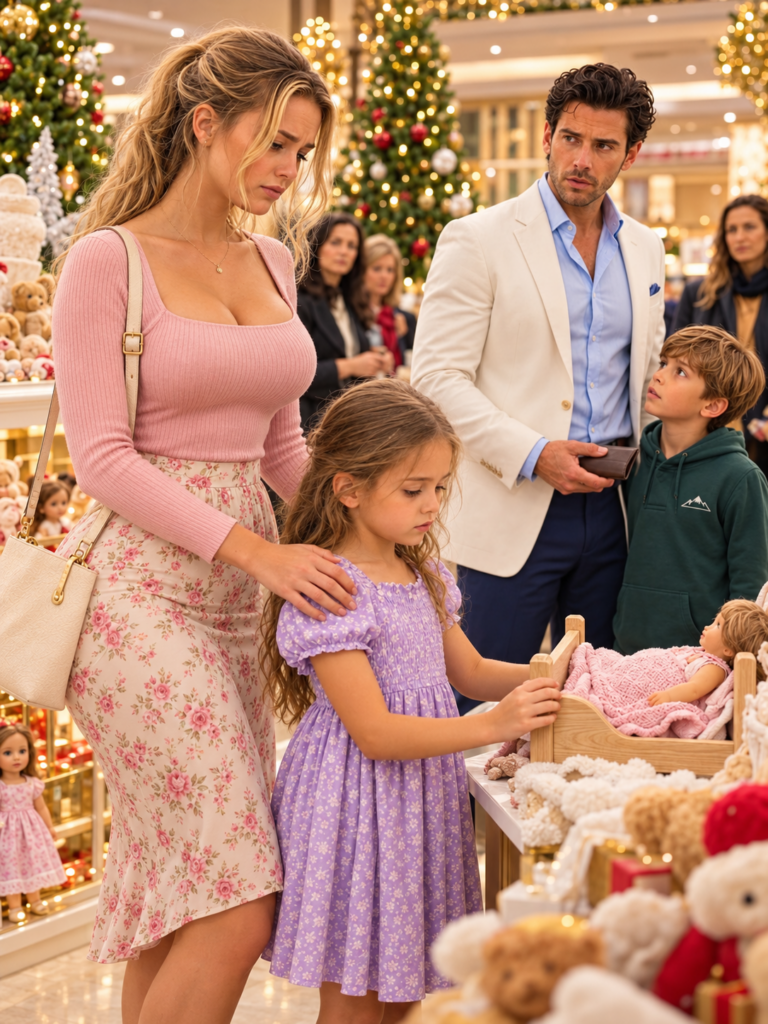
A struggling widow told her daughter they could only look at the Christmas dollhouse—then a boy whispered, “Can we buy it for her, Dad?” and the quiet man beside him made an unexpected decision…
Part 1
“Mom, I don’t need anything.”
Emma Bennett knew her daughter was lying.
Eight-year-old Lily had said the words while staring straight at a wooden dollhouse behind a sheet of polished department-store glass.
She said them too quickly.
Too brightly.
The way children sometimes lied when they had already learned too much about money.
Emma tightened her fingers around the handle of her worn leather purse and looked at the price tag.
$189.99.
For half a second, she actually laughed inside.
Not because it was funny.
Because $189.99 was so far beyond what remained in her checking account that the number felt almost imaginary.
That morning, after paying $742 in rent, $136 toward the electric bill, and $48 for the cheapest groceries she could stretch through the end of the week, Emma had checked her banking app.
$63.14.
She still needed gas.
Lily needed cough medicine.
And somewhere between Christmas and New Year’s, the front brake pads on Emma’s twelve-year-old Honda were going to have to become more than the grinding noise she kept pretending not to hear.
The dollhouse might as well have cost nineteen thousand dollars.
Still, Lily stood in front of it with her face glowing.
The display was beautiful.
Tiny warm lights had been strung around miniature windows. There was a little kitchen with painted cabinets, a bedroom with a wooden bed no longer than Emma’s hand, red curtains, two rocking chairs, and a miniature Christmas tree in the living room.
Someone in the store had even placed fake snow along the roof.
Lily pressed one palm lightly against the glass.
“Look, Mom. It has a fireplace.”
“I see it.”
“And the oven opens.”
“I see that too.”
“And there’s a little attic.”
Emma smiled.
“There is.”
Lily stared another few seconds.
Then her eyes moved down.
She saw the price tag.
Emma watched the change happen.
The excitement softened.
The little girl stepped away from the glass.
“I like looking better anyway.”
Emma’s throat tightened.
“You do?”
“Yeah.”
Lily nodded firmly.
“If you own stuff, you have to clean it.”
Emma almost smiled.
“That’s your argument?”
“Yes.”
“Interesting, considering the state of your bedroom.”
Lily grinned.
For three seconds, everything felt normal.
Then a family walked past them carrying four enormous shopping bags.
A boy Lily’s age was complaining because his parents had bought the wrong version of a video game console.
Emma looked away.
The Halston Department Store had been Lily’s idea.
Every Christmas Eve, when Emma’s husband Michael had been alive, the three of them had come downtown to see the decorations.
They rarely bought much.
Sometimes hot chocolate.
Once, when Lily was five, Michael had bought her a stuffed polar bear that was still propped against her pillow at home.
But mostly they came to look.
The giant tree.
The moving window displays.
The toy trains.
The mechanical reindeer.
The lights.
Michael used to say that looking was free.
Last Christmas, they had not come.
Last Christmas, Michael had been dead for twenty-three days.
A sudden aneurysm at thirty-five.
A headache on a Monday morning.
An ambulance before noon.
A funeral the following Saturday.
Emma remembered almost nothing from that December except casseroles people left at her door and Lily asking whether Daddy would know it was Christmas in heaven.
This year, Lily had asked if they could go back.
Emma had almost said no.
Then she realized she was tired of allowing grief to decide where they were permitted to go.
So they came.
They rode the bus downtown because Emma did not trust the Honda in holiday traffic.
They looked at the giant tree.
They shared one cup of hot chocolate.
They watched a pianist in the atrium play “Have Yourself a Merry Little Christmas.”
And now they had reached the toy department.
“Come on,” Emma said gently. “Let’s see the train.”
Lily nodded.
She took two steps.
Then looked back at the dollhouse.
Just once.
Emma pretended not to notice.
A few feet away, ten-year-old Noah Carter noticed everything.
He had been standing beside his father while a sales associate explained the difference between two expensive remote-controlled cars that Noah had already decided he did not want.
Noah had stopped listening the moment he saw Lily.
He saw her face when she first noticed the dollhouse.
He saw her mother look at the price.
He saw Lily step backward.
Most importantly, he heard her say, “I don’t need anything.”
Noah looked up at his father.
Daniel Carter was checking his phone.
Three unread emails.
One message from his chief financial officer.
Another from the head of legal.
A calendar reminder for a video conference on December 26.
Daniel was forty-one years old and had spent most of his adult life becoming extraordinarily successful.
He had also spent much of the last three years discovering that success was a poor substitute for a person you loved.
His wife, Rachel, had died from ovarian cancer when Noah was seven.
Afterward, Daniel had done what he understood best.
He worked.
He worked earlier.
He worked later.
He hired help.
He made sure Noah attended the right school.
He paid for piano lessons, soccer camp, tutors, vacations, therapy, and anything else experts recommended.
For a long time, Daniel believed that because he never missed a tuition payment, he was not failing his son.
Then, six months earlier, Noah’s teacher had asked the class to write about the place where they felt safest.
Most children wrote about home.
Noah wrote about his father’s car.
Because, he explained, it was the only place where Dad could not walk into another meeting.
Daniel had kept that essay in his desk ever since.
Tonight, his phone buzzed again.
Noah tugged on his sleeve.
“Dad.”
“One second.”
“Dad.”
Daniel looked down.
“What?”
Noah pointed subtly across the aisle.
“Can we buy it for her?”
Daniel followed his son’s gaze.
“The dollhouse?”
Noah nodded.
Daniel looked at Lily.
Then at Emma.
He saw a tired woman in an inexpensive black coat with a seam beginning to fray near one pocket. Her boots were clean but old. The leather bag on her shoulder had been repaired with a narrow strip of dark thread.
Nothing about her looked careless.
Everything looked maintained past the point at which most people with money would have replaced it.
“Noah—”
“She really wanted it.”
“You don’t know that.”
“Yes, I do.”
“How?”
“She looked at it the way I looked at the telescope at Grandma’s house.”
Daniel glanced at him.
That was annoyingly specific.
Noah continued.
“Her mom saw the price.”
Daniel looked back across the aisle.
Emma had one hand on Lily’s shoulder now.
They were beginning to leave.
Noah lowered his voice.
“They’re pretending she doesn’t want it.”
Daniel did not answer.
Noah looked at the remote-controlled cars behind them.
“I don’t need that.”
Daniel frowned.
“You asked for it.”
“I changed my mind.”
“You’ve been asking for it for three months.”
Noah shrugged.
“The one we have works.”
Daniel stared at his son.
Something uncomfortable moved through him.
That morning Daniel had spent eleven thousand dollars on watches for senior executives because his assistant reminded him it was customary.
He had spent less than seven minutes choosing them.
Now a $189 dollhouse had somehow become complicated.
“Please?” Noah asked.
Daniel slipped his phone into his coat pocket.
Before he could answer, they heard crying.
Not Lily.
Another child.
A little girl, perhaps five, stood near a shelf of stuffed animals.
Her mother and father were arguing quietly but urgently several feet away.
“I told you we’re already over.”
“It’s Christmas Eve.”
“And the rent is due.”
“She picked one thing.”
“We said thirty dollars. That’s fifty-two.”
The mother noticed people looking and immediately lowered her voice.
The little girl’s face crumpled.
She was holding nothing.
Lily stopped.
Emma whispered, “Lily.”
But Lily had already walked toward the smaller child.
She picked up a plush gray rabbit from a lower shelf.
It cost $14.99.
Emma saw the tag and nearly called her back.
Then Lily did not carry it to the register.
She simply held it out.
“This one’s really soft,” she said.
The younger girl sniffed.
“My daddy said maybe not.”
Lily looked at the rabbit.
“You can still hold him while you’re here.”
The girl hesitated.
Then took it.
Lily sat beside her on the little bench between displays.
“Rabbits are good at secrets.”
The girl looked skeptical.
“How do you know?”
“They have big ears.”
That earned a tiny smile.
“So if Christmas is bad,” Lily continued, “you can tell them, and they won’t tell anybody.”
Emma’s eyes stung.
Lily did not know Daniel and Noah were watching.
She did not know anybody was watching.
She was simply trying to make another child feel better.
Noah looked at his father.
Daniel exhaled.
“All right.”
Noah’s face changed instantly.
“Really?”
“Go find the sales associate.”
Noah took two steps, then stopped.
“What if her mom says no?”
Daniel looked at Emma.
“That,” he said quietly, “is very possible.”
Emma was waiting near the elevator when she heard a voice behind her.
“Excuse me.”
She turned.
A man in a dark wool coat stood several feet away.
Beside him was the boy she had seen earlier.
The man had a shopping bag in one hand but no visible entourage, no flashy jewelry, nothing suggesting anything beyond ordinary prosperity.
Emma assumed he was another customer.
“Yes?”
The boy looked at Lily.
Then seemed to lose some of his courage.
Daniel put one hand lightly on Noah’s shoulder.
“My son wanted to ask you something.”
Emma’s instincts rose immediately.
Years of parenting had taught her that unexpected sentences from strangers almost always required caution.
Noah cleared his throat.
“Would it be okay if we got the dollhouse for her?”
Lily’s eyes widened.
Emma froze.
“I’m sorry?”
“The wooden one.”
“I heard you.”
Noah looked at his father.
Daniel stepped in.
“He noticed your daughter looking at it. He has been saving Christmas money from his grandparents, and—”
“No.”
The answer came too quickly.
Emma immediately softened her tone.
“I’m sorry. That was rude.”
“It wasn’t.”
“That’s very kind, but no.”
Noah looked disappointed.
Daniel nodded.
“I understand.”
Emma glanced at Lily.
She could see the effort it was costing her daughter not to look back at the display.
“We’re okay,” Emma said.
Daniel did not argue.
That helped.
He did not reach for his wallet.
Did not tell her it was nothing.
Did not mention what he could afford.
He simply said, “Of course.”
Noah looked down.
Emma took Lily’s hand.
They started toward the elevator.
Then Lily stopped.
She turned back.
“Thank you anyway.”
Noah looked up.
“You’re welcome.”
“And I hope you get what you want for Christmas.”
Noah thought about that.
“I think I already have most of it.”
Emma saw Daniel’s expression change.
Something passed between father and son.
She almost walked away.
Then Lily squeezed her hand.
“Mom?”
Emma looked down.
Lily did not ask.
That made it worse.
If she had begged, Emma could have said no.
If she had whined, Emma could have explained.
But Lily had spent eleven months asking for almost nothing.
She wore secondhand snow boots from Emma’s coworker’s daughter.
She had told Emma she did not need a school picture package after seeing the order form on the kitchen table.
She had stopped asking for pizza on Fridays.
Last week, Emma had found three one-dollar bills beneath her coffee mug with a note written in purple marker.
FOR ELECTRIC.
Emma had cried in the bathroom where Lily could not hear.
Now her daughter was standing beside a stranger who wanted nothing from them.
Emma looked at Daniel.
“This isn’t something she asked you for?”
“No.”
“You’re not recording this?”
Daniel actually looked startled.
“No.”
“No social media?”
“No.”
“Nothing where my daughter becomes somebody’s Christmas charity video?”
Daniel’s face became serious.
“Absolutely not.”
Emma searched his expression.
She had worked enough service jobs to know the look of a man who enjoyed being thanked.
She did not see it.
She saw discomfort.
Almost embarrassment.
As if he wished the entire moment could happen without anyone seeing him either.
“It was his idea,” Daniel said.
He nodded toward Noah.
“I’m just the transportation and financing department.”
Noah frowned.
“I said I could use Grandma’s money.”
“And I told you Grandma’s money stays in your savings account.”
“So technically you stole my idea.”
Daniel sighed.
Emma laughed before she meant to.
It was a small laugh.
But it surprised her.
Lily looked up at her.
Daniel smiled.
“If you’re uncomfortable, we walk away. No hard feelings.”
Emma looked toward the dollhouse.
Then at her daughter.
Then at Noah.
She swallowed.
“All right.”
Lily’s mouth opened.
“But,” Emma said quickly, “only if Noah understands she cannot pay him back.”
Noah shrugged.
“She doesn’t have to.”
“And you’re sure?”
“Yes.”
Emma nodded.
“Then… okay.”
Lily threw both arms around her mother.
Not the dollhouse.
Her mother.
That nearly broke Emma.
“Thank you,” Lily whispered.
Emma closed her eyes and held her.
Over Lily’s shoulder, she saw Daniel quietly looking away.
The sales associate brought the box from the stockroom.
It was enormous.
Daniel laughed when he saw it.
“That’s not going on the bus.”
Emma looked horrified.
“How did you know we’re taking the bus?”
Daniel immediately realized he had crossed a line.
“I didn’t. I saw you checking the transit schedule on your phone.”
Emma glanced at her screen.
She had not realized anyone noticed.
“We can manage.”
Daniel looked at the box.
It was almost four feet long.
“No, you cannot.”
“I’ve managed worse.”
“I believe you.”
Something about the answer disarmed her.
He was not mocking her.
He probably did believe it.
Emma sighed.
Daniel offered to have the store deliver it.
The associate confirmed the department store offered same-day local delivery on Christmas Eve for oversized purchases.
Daniel paid.
Emma looked away from the total.
Noah helped Lily pick wrapping paper.
Red with snowflakes.
While the associate completed the paperwork, Lily wandered back toward the stuffed rabbits.
The smaller child was still there.
Her parents had apparently reached some decision.
The father held the rabbit now.
The little girl was smiling.
Lily smiled too.
Noah noticed.
“You know her?”
“No.”
“Then why did you help her?”
Lily shrugged.
“She was sad.”
Noah considered this as if it were a surprisingly complete answer.
Emma heard him.
So did Daniel.
The adults looked at one another.
Neither said anything.
At the exit, Emma held out her hand.
“I’m Emma.”
Daniel shook it.
“Daniel.”
“This is Lily.”
“Noah,” the boy said.
Lily smiled.
Emma looked at Daniel.
“I really don’t know what to say.”
“You don’t have to say anything.”
“I do.”
She hesitated.
“One day, when I can, I’m going to do this for somebody else.”
Daniel smiled.
“That sounds fair.”
Outside, snow had begun falling.
Not much.
Just thin white flakes drifting through the city lights.
Noah and Lily stood beneath the awning trying to catch them on their gloves.
Daniel watched.
His phone buzzed again.
He pulled it out.
Six missed messages now.
He turned it off.
Not silent.
Off.
Emma noticed.
For some reason, that stayed with her longer than the dollhouse.
They said goodbye near the bus stop.
Emma and Lily walked away.
Noah watched until they disappeared among the crowds.
Then he asked, “Dad?”
“Yes?”
“Do you think she was embarrassed?”
Daniel looked toward the corner where Emma had vanished.
“Yes.”
“Did we do something bad?”
“No.”
Daniel thought carefully.
“But that’s a good question.”
Noah frowned.
“How can helping be bad?”
“It can be, if you do it to make yourself feel important.”
Noah stared at the snow.
“I just wanted her to have the house.”
“I know.”
Daniel placed a hand on his son’s shoulder.
“That’s why I said yes.”
That evening, the dollhouse arrived at Emma’s apartment at 8:17.
Two delivery workers carried the box up three flights because the elevator had been broken since October.
Lily danced around them.
Emma tipped the men four dollars because that was all the cash she had.
Then she locked the door.
For a few minutes, she simply stared at the box.
The apartment was small.
The radiator clicked.
A string of Christmas lights around the living-room window had three dead bulbs.
Their tree was artificial and older than Lily.
There were five presents beneath it.
Two for Lily.
One pair of pajamas.
One used copy of a fantasy novel Lily had wanted.
The other three were inexpensive gifts Lily had made or bought for Emma.
And beside that little tree stood a dollhouse worth more than Emma’s weekly grocery budget.
Lily touched the box.
“Can we build it?”
Emma checked the instructions.
Estimated assembly time: 2.5 hours.
She looked at Lily.
“We have hot chocolate?”
“One packet.”
“Then I guess we have a construction project.”
They stayed awake until 11:46.
Lily held wooden walls in place while Emma tightened tiny screws.
They installed miniature curtains.
They arranged furniture.
The little Christmas tree went beside the fireplace.
When they finished, Lily ran to her bedroom.
She returned with something in her fist.
A tiny plastic rabbit from an old toy set.
She placed it beside the miniature tree.
Emma watched her.
“For the little girl?”
Lily nodded.
“So the house remembers.”
Emma looked away before her daughter could see her face.
Later, after Lily fell asleep, Emma sat alone at the kitchen table.
She opened her bank app.
$49.72.
The joy of the evening did not erase reality.
Rent would come again.
The brakes still needed repair.
Her evening cleaning supervisor had warned everyone that January hours might be cut.
Her grocery-store manager had already denied her request for more shifts.
Kindness had given Lily a beautiful Christmas.
But tomorrow morning, Emma would still wake up inside the same life.
She put the phone down.
For the first time in months, that thought did not feel quite as hopeless as usual.
Across the city, Daniel Carter stood alone in a penthouse kitchen large enough to contain Emma’s entire apartment.
Noah had gone to bed.
The housekeeper had left.
The Christmas tree lights reflected in windows overlooking downtown.
Daniel poured coffee and opened his laptop.
He intended to answer the emails he had ignored.
Instead, he stared at his inbox.
Then he thought about Emma’s question.
You’re not recording this?
He wondered how many times she had been made to feel that receiving help required surrendering dignity.
He thought about Lily giving the stuffed rabbit to the smaller child.
Then about Noah.
He opened his contacts.
Scrolled to a name.
Typed a message.
Then stopped.
He deleted it.
Emma had not asked him to fix her life.
He had no right to turn one brief encounter into an investigation.
Daniel closed the laptop.
But before he went upstairs, he wrote three words on the notepad beside it.
Notice people first.
Part 2
The brakes began screaming on December 29.
Emma was driving to work when the grinding sound became a metallic shriek every time she stopped.
She turned down the radio and whispered, “Not now.”
The car did not care.
At the grocery store, she parked near the back and called the mechanic on her lunch break.
He had inspected the car two months earlier.
“Pads are gone,” he told her. “If the rotors are damaged too, you’re looking at around four hundred.”
Emma stared at the vending machine across the employee break room.
“I don’t have four hundred.”
“Then don’t drive it until you do.”
“That’s not an option.”
“It needs to become one.”
She closed her eyes.
“Can you just do the front?”
“That is the front.”
Emma laughed once.
No humor.
“Right.”
Her manager, Carol, entered carrying a clipboard.
“Everything okay?”
Emma hung up.
“Car.”
Carol made the sympathetic face people made when they had no practical way to help.
“Sorry.”
“Me too.”
Carol hesitated.
“Actually, I was looking for you.”
Emma’s stomach tightened.
The January schedule had been posted that morning.
“What happened?”
“Corporate cut labor hours.”
There it was.
“How many?”
“For you?”
Carol looked uncomfortable.
“Six next week.”
Emma stared at her.
“You cut six hours?”
“I didn’t.”
“I know.”
“I fought it.”
Emma did the calculation automatically.
Six hours at $16.25.
Almost one hundred dollars before taxes.
Carol lowered her voice.
“Take any call-outs I get. I’ll put you first.”
“Okay.”
“I’m sorry.”
Emma nodded.
Then went back to work.
That night, she took two buses to the office tower where she cleaned from seven until eleven.
She arrived fourteen minutes late because the first bus stalled.
Her supervisor, Rick, was waiting near the service elevator.
“You’re late.”
“I know.”
“Third time this month.”
“Second.”
Rick checked his sheet.
“December ninth.”
“That was nine minutes. The bus—”
“And tonight.”
Emma stopped.
She knew the rules.
Excuses did not become more valuable because they were true.
“I’m sorry.”
Rick sighed.
“I like you, Emma. You work hard. But the client does not care about bus schedules.”
“I understand.”
“We’re reviewing the contract in January.”
Her heart sank.
“What does that mean?”
“It means I need everybody clean.”
“My work is clean.”
“I mean attendance.”
Emma bit back a response.
“Understood.”
She collected her supply cart.
The building belonged to Carter Global Systems.
Emma knew almost nothing about the company except that the employees threw away astonishing amounts of food.
On the executive floors, she often found catering trays barely touched after meetings.
Sandwiches.
Fruit.
Pastries.
Once, an entire box of individually wrapped lunches.
Company policy required everything to be discarded.
Emma hated it.
She never took any.
Not because she did not want to.
Because two years earlier a cleaner from another building had been fired for removing unopened food without permission.
Emma could not afford principles that resulted in unemployment.
That night, she was wiping fingerprints from a glass conference-room door when she noticed a leather wallet beneath the table.
She picked it up.
Opened it only far enough to find identification.
Thomas Reed.
Chief Operating Officer.
There was cash inside.
A lot.
Emma closed the wallet.
She took it immediately to security.
The guard, Marcus, looked inside.
His eyebrows rose.
“That’s several hundred dollars.”
“Then Mr. Reed will be happy.”
“You could’ve had a good New Year’s.”
Emma looked at him.
“So could he.”
Marcus grinned.
“I’ll log it.”
“Please do.”
Emma pushed her cart away.
She did not notice the man standing inside the darkened executive lounge down the hall.
Daniel Carter had returned to the office to retrieve a file.
He had heard the conversation.
He recognized Emma before she saw him.
For several seconds, he just stood there.
Christmas Eve felt suddenly less random.
Emma was not merely someone who had been kind in a toy department.
She worked in his building.
Not for Carter Global directly.
But close enough that their lives had apparently crossed before either of them realized it.
Daniel stepped into the corridor.
Then stopped.
If he spoke to her now, she would know immediately who he was.
The building’s lobby contained a twelve-foot photograph of Daniel at the company’s twentieth-anniversary celebration.
Emma had probably walked past his face hundreds of times.
He retreated into the lounge.
The next morning, Daniel called his facilities director.
“Who cleans floors thirty-two through thirty-eight?”
“BrightLine Facilities.”
“How long?”
“Four years.”
“How are they?”
A pause.
“Why?”
“I asked how they are.”
“Average. Maybe slightly below. We’ve had attendance issues.”
“With the company?”
“With staff.”
“What kind?”
“Normal turnover. Some lateness. We’re rebidding the contract.”
Daniel looked out his office window.
“What happens to their employees if we change vendors?”
“Depends. Some get reassigned.”
“And some?”
“Lose hours.”
Daniel thought of Emma’s shoes.
Her handbag.
The bus schedule on her phone.
“Don’t make any decision until I see the performance file.”
His facilities director sounded surprised.
“You’ve never reviewed a cleaning contract in twelve years.”
“Then this is a historic morning.”
Daniel hung up.
He did not ask about Emma.
Not yet.
At home, Noah had not forgotten Lily either.
He talked about her twice during the week after Christmas.
Once because he wondered whether the dollhouse had been difficult to assemble.
Once because he found a stuffed rabbit in a store and said it reminded him of her.
Daniel listened.
On January 3, Noah asked something else.
“Can we do that again?”
“Buy strangers dollhouses?”
“No.”
Noah rolled his eyes.
“Help people.”
Daniel smiled slightly.
“Maybe.”
“That means no.”
“It means helping random people without thinking can be complicated.”
“Why?”
“Because sometimes people need different things than you think they need.”
Noah frowned.
“Like what?”
Daniel thought about it.
“If somebody’s car is broken, maybe they don’t need a toy. Maybe they need a ride to work.”
Noah looked at him.
“Whose car is broken?”
Daniel realized his mistake.
“Nobody.”
“You said it weird.”
“I did not.”
“You did.”
Daniel changed the subject.
But the question stayed with him.
At the grocery store, Emma’s situation continued to tighten.
She picked up one call-out shift.
Then lost another when Lily developed a fever and the school nurse called.
Emma’s mother lived three states away.
Michael’s parents were elderly and could not drive at night.
There was no backup.
Emma left work.
Carol covered her register.
The next day, Emma returned to find a written attendance warning waiting.
Carol looked furious.
“Corporate system generated it.”
“My child was sick.”
“I know.”
“I gave you the doctor’s note.”
“I uploaded it.”
“Then why am I signing this?”
“Because they count unscheduled absence regardless of reason.”
Emma stared at the page.
For the first time in a long time, anger pushed through exhaustion.
“Do they think eight-year-olds schedule fevers?”
Carol leaned closer.
“You know I agree with you.”
Emma signed.
That evening, she rode the bus downtown in freezing rain.
Her second bus arrived twenty-two minutes late.
Rick said nothing when she entered the office tower.
That was worse.
Halfway through her shift, Emma found Marcus at the security desk.
“You okay?” he asked.
“Fantastic.”
“You have your murder face.”
“I have a murder face?”
“You have several faces. That one means somebody has tested your patience and survived only because there are cameras.”
Emma laughed.
Marcus handed her a cup of coffee.
“Cafeteria machine.”
“I can’t pay you.”
“It cost me eighty cents.”
“Still.”
“Emma.”
She took it.
“Thank you.”
Marcus nodded toward the executive elevators.
“Big people are still upstairs.”
“They always are.”
“Boss boss is here.”
Emma wiped a drip of coffee from the lid.
“Which boss boss?”
“Daniel Carter.”
She shrugged.
“Okay.”
Marcus stared at her.
“You don’t know who that is?”
“I know the building says Carter on it.”
“He owns most of the reason we have jobs.”
Emma glanced toward the giant framed portrait in the lobby.
For the first time, she actually looked carefully.
Daniel.
Christmas Eve.
Her stomach dropped.
Same eyes.
Same face.
Different clothes.
“Oh.”
Marcus saw her expression.
“What?”
“Nothing.”
“That was a very specific nothing.”
Emma looked again.
The stranger who bought Lily the dollhouse was the CEO whose offices she cleaned.
Of course he was.
She almost laughed.
Of course the man who could casually spend two hundred dollars on a stranger’s child was wealthy.
She had known he was comfortable.
She had not known he appeared on magazine covers.
Suddenly the memory felt different.
Not worse.
Just stranger.
Had he known she worked here?
No.
He could not have.
Unless he had somehow—
Emma shut that thought down.
She did not like where it led.
At 10:40, she reached the executive conference room.
The door opened.
Daniel stepped out.
They both froze.
Emma held a spray bottle in one hand.
Daniel held a folder.
For several seconds, the only sound was the vacuum running down the corridor.
“You,” Emma said.
Daniel gave a small, guilty smile.
“Hello, Emma.”
“You’re Daniel Carter.”
“I am.”
“You left out a word.”
“A few, technically.”
She stared at him.
He understood immediately.
“CEO?”
“That one.”
“You didn’t ask.”
“You said, ‘I’m Daniel.’”
“That is my name.”
Emma folded her arms.
“So is this funny?”
His expression changed.
“No.”
“Because I’ve been cleaning your office for nine months.”
“I learned that after Christmas.”
“When?”
“The twenty-ninth.”
“How?”
“I saw you return Thomas Reed’s wallet.”
Emma became still.
“You were watching me?”
“No. I was in the lounge.”
“That’s somehow not better.”
Daniel glanced toward the empty corridor.
“I wasn’t following you.”
“I didn’t say you were.”
“You were thinking it.”
“I was considering several possibilities.”
Despite herself, Emma almost smiled.
She stopped it.
Daniel continued.
“I recognized you. I didn’t know before then.”
Emma looked toward the conference room.
“Does Rick know?”
“Know what?”
“That you know me?”
“No.”
“Good.”
Daniel studied her.
“Why good?”
“Because I need this job.”
The answer was sharper than she intended.
Daniel’s face became serious.
“I’m not going to interfere with your job because of Christmas.”
Emma looked at him.
“Thank you.”
She turned back to her cart.
“Emma.”
She stopped.
“The dollhouse?”
She looked over her shoulder.
Daniel hesitated.
“Did it arrive okay?”
Her expression softened before she could prevent it.
“Yes.”
“And?”
“She slept beside it the first night.”
Daniel smiled.
“Noah will like that.”
“She put a little rabbit in the living room.”
“A rabbit?”
Emma told him why.
Daniel listened quietly.
Then said, “That sounds like Lily.”
“You met her for twelve minutes.”
“Apparently she makes a strong first impression.”
Emma nodded.
Then she remembered her own life.
The warning.
The buses.
The brakes.
The cleaning contract.
She picked up her cloth.
“Good night, Mr. Carter.”
“Daniel.”
“At work, you’re Mr. Carter.”
He understood.
“Good night, Emma.”
The following week, things worsened.
BrightLine announced that the Carter Global contract was likely going to another vendor.
Rick gathered the night crew in the supply room.
“No final decision yet,” he told them. “But I want everyone prepared.”
“For what?” one cleaner asked.
“Reassignment.”
“Where?”
“Depends.”
Emma asked the only question that mattered.
“Same hours?”
Rick hesitated.
Nobody needed the answer after that.
Emma went home that night and opened an envelope she had been avoiding.
FINAL NOTICE.
Her electric account was $218 past due.
She had made partial payments.
It was no longer enough.
Disconnect date: January 18.
Emma sat at the kitchen table with a pencil and a sheet of paper.
Checking: $104.82.
Cash: $17.
Electric: $218.
Brake repair estimate: $386.
Rent due February 1: $742.
She wrote every number carefully, as though neat handwriting might change them.
Lily entered wearing pajamas.
“What are you doing?”
“Math.”
“Can I help?”
“Nope.”
“I’m good at multiplication.”
“This is boring grown-up math.”
Lily climbed onto the chair opposite her.
“Is it money?”
Emma paused.
Children always knew more than parents wanted them to.
“A little.”
“Did the dollhouse cost us money?”
“No.”
“Are you sure?”
“Yes.”
Lily looked relieved.
Emma reached across the table.
“Hey. That was a gift. You never have to feel guilty about a gift.”
Lily nodded.
“Okay.”
Then she slid something across the table.
A folded five-dollar bill.
Emma stared at it.
“Where did you get this?”
“Grandpa.”
“Lily—”
“For the electric.”
Emma closed her eyes.
“No.”
“You said—”
“No.”
She pushed it back.
“But—”
“Your job is not to pay electric bills.”
“What if I want to help?”
Emma looked at her daughter.
She could have said children should not worry.
But Lily already did.
Pretending otherwise would not make her safer.
So Emma chose honesty.
“You help me by doing your homework, putting your dishes in the sink, telling me when you’re scared, and occasionally cleaning that disaster you call a bedroom.”
Lily smiled faintly.
“Money is my job.”
“Even if you don’t have enough?”
Emma swallowed.
“Even then.”
“What happens if there’s not enough?”
Emma reached for her hand.
“Then I figure it out.”
That night, after Lily slept, Emma cried quietly in the shower.
Not because she was weak.
Because she had been strong continuously for thirteen months, and sometimes strength developed leaks.
At Carter Global, Daniel was reading BrightLine’s performance files.
He had not planned to look for Emma.
Then he saw her name.
Bennett, Emma.
Attendance: two late arrivals, one dependent-care absence.
Performance ratings: excellent.
Client complaints: zero.
Supervisor comments:
Covers shifts when available.
Consistently completes assigned area ahead of schedule.
Assisted new employees without request.
Returned executive wallet containing $640 cash.
Reported water leak on 35th floor before damage spread.
Helped security employee during diabetic episode in September.
Daniel read that line twice.
He called facilities.
“What happened in September?”
“Security guard had low blood sugar. A cleaner noticed him acting confused. Called emergency services, got him juice.”
“Name?”
“Cleaner?”
“Yes.”
“Emma Bennett.”
Daniel leaned back.
One act could be sentiment.
A pattern was character.
He closed the file.
“What are we doing with the new cleaning contract?”
“Selecting MetroServe. Better automation, fewer staff, lower bid.”
“How much lower?”
“Eight percent.”
“How many current workers do they retain?”
“Not our problem contractually.”
Daniel looked at the file again.
“Make it our problem.”
There was silence.
“Daniel—”
“Add a transition requirement. Existing workers with satisfactory performance get first interview priority.”
“That will raise the bid.”
“Then it raises the bid.”
“How much?”
“Find out.”
Daniel hung up.
He did not carve out a job for Emma.
He refused to.
No special treatment.
But he was finished allowing spreadsheets to erase people he never bothered to see.
Three days later, Emma received an email from MetroServe inviting her to interview for a full-time daytime facilities coordinator position.
She assumed it was a mistake.
She called.
It was not.
Rick had recommended her.
So had Marcus.
The new vendor needed someone who understood the building, could train employees, manage supply inventory, handle shift coverage, and communicate with office staff.
The salary was $23.50 an hour.
Full-time.
Health insurance after sixty days.
Emma read the email five times.
Then she became suspicious.
She thought of Daniel.
No.
She told herself not to be ridiculous.
Still, when she arrived for the interview and saw Carter Global’s executive floor listed as the location, her stomach tightened.
The receptionist smiled.
“Ms. Bennett?”
“Yes.”
“They’re ready for you.”
“Who is they?”
The receptionist glanced at her screen.
“Facilities director, MetroServe regional manager, and Mr. Carter.”
Emma stopped breathing for a moment.
Of course.
She almost walked out.
Instead, she followed the receptionist down the corridor.
Daniel was standing at the far end of the conference room.
When he saw Emma, he immediately understood the expression on her face.
She thought he had arranged everything.
And judging by the way she set her purse down, she was not grateful.
She was furious.
Part 3
Emma waited until the receptionist closed the conference-room door.
Then she looked directly at Daniel.
“Can I speak to you privately?”
The MetroServe regional manager glanced between them.
Daniel nodded.
“Of course.”
They stepped into the corridor.
Emma kept her voice low.
“I told you I didn’t want charity.”
“This is not charity.”
“Then why are you in my interview?”
“Because the position works inside my company.”
“You attend facilities coordinator interviews?”
Daniel hesitated.
Emma’s eyes narrowed.
“That’s what I thought.”
“All right. No.”
“So you did this.”
“I changed a contract requirement.”
“For me.”
“For every employee working in this building.”
“Because of me.”
Daniel did not answer immediately.
That answer was complicated.
Emma shook her head.
“I knew this was going to happen.”
“Knew what?”
“The dollhouse.”
Daniel looked genuinely confused.
“What does the dollhouse have to do with this?”
“You did something nice. I accepted. Now suddenly I’m standing upstairs interviewing for a job that pays nearly fifty percent more.”
“Emma—”
“I don’t want Lily growing up thinking every good thing in our lives came because somebody wealthy felt sorry for us.”
Daniel’s expression tightened.
“I do not feel sorry for you.”
“Then what is this?”
He looked toward the conference room.
Then back at her.
“This is me realizing I run a company with six thousand employees and hundreds of contractors, and I knew almost nothing about the people cleaning the office after I went home.”
Emma stayed silent.
Daniel continued.
“I saw you return a wallet with six hundred forty dollars.”
Her face changed slightly.
“I read your work record.”
“I knew you were investigating me.”
“I reviewed the contractor’s performance file. You were in it.”
“Same thing.”
“No, it isn’t.”
He softened his voice.
“I learned that you helped Marcus in September.”
Emma shrugged.
“He needed help.”
“You found a water leak nobody else noticed.”
“I had eyes.”
“You’ve covered seventeen shifts in nine months.”
“People have kids.”
“You trained four new cleaners even though you’re not paid as a trainer.”
“They put people on a floor without showing them where anything is.”
Daniel almost smiled.
Emma did not.
He stopped.
“You’re proving my point.”
“What point?”
“That what happened at Christmas did not create this opportunity.”
Daniel nodded toward the conference room.
“You did.”
Emma looked away.
“Then why are you here?”
“Because I knew you would think exactly what you’re thinking.”
She looked at him.
“And?”
“And I wanted you to hear from me that I will leave before the interview begins if you want me to.”
That surprised her.
Daniel continued.
“I did not tell them to hire you. I did not tell them to interview you. Rick recommended you. Marcus submitted a statement. MetroServe reviewed your file.”
“You changed the contract.”
“Yes.”
“Why?”
Daniel looked through the glass wall toward the city.
“Because Christmas Eve embarrassed me.”
Emma blinked.
“What?”
“Not you. Me.”
He turned back.
“I saw Noah notice your daughter before I did. I saw Lily notice another child before any adult did. Then a few days later I saw you return money you probably could have used.”
Emma’s face stiffened.
Daniel immediately corrected himself.
“That came out wrong.”
“Yes, it did.”
“I don’t mean poor people deserve medals for not stealing.”
“Good recovery.”
“It’s terrible.”
“A little.”
Daniel sighed.
“What I mean is that I had built systems around me that reduced people to costs. Contracts. Headcount. Vendor efficiency.”
He paused.
“I had become very good at running numbers and very bad at noticing what those numbers meant.”
Emma listened.
“That contract was going to save my company eight percent by potentially cutting hours from people whose names nobody upstairs knew.”
“So you changed it.”
“I added protections.”
“For everyone?”
“For every current contractor with satisfactory performance.”
Emma studied him.
Daniel said, “If you want to leave, leave. The interview remains yours. If you want me gone, I’ll go.”
“And if I bomb the interview?”
“You don’t get the job.”
She searched his face.
“You’d let that happen?”
“Yes.”
Emma almost laughed.
“That’s a strange thing to say.”
“It’s the only answer that respects you.”
Silence stretched between them.
Finally Emma asked, “Will you leave?”
Daniel nodded immediately.
“Yes.”
He walked back into the conference room.
“Something came up. I won’t be participating.”
The facilities director looked confused.
Daniel ignored him.
As he passed Emma, he stopped briefly.
“For what it’s worth, I think you’re qualified.”
Emma raised an eyebrow.
“You’re leaving.”
“Right.”
He left.
Emma interviewed for fifty-two minutes.
Nobody asked about Christmas.
Nobody mentioned Lily.
They asked about supply budgets.
Conflict between employees.
Scheduling.
Safety.
Communication.
Emergency procedures.
Emma told them how she would redesign the supply closets to reduce wasted time between floors.
She explained that cleaners needed staggered breaks because service elevators bottlenecked at 9:00 p.m.
She described a recurring problem with mislabeled chemical bottles.
The regional manager took notes.
Then he asked, “You’ve thought about this a lot.”
Emma smiled.
“I’ve had nine months to think about it while fixing it.”
Three days later, they called.
She got the job.
Emma sat on the edge of her bed with the phone still in her hand.
For several seconds, she could not move.
Then she laughed.
Lily ran in.
“What?”
Emma looked at her.
“I got a new job.”
“Is that good?”
“Yes.”
“How good?”
Emma pulled her into a hug.
“The kind where I might stop yelling every time somebody leaves a light on.”
Lily gasped.
“We’re rich?”
Emma laughed so hard she cried.
“No. Definitely not.”
“Oh.”
“But we’re going to be okay.”
Lily hugged her tighter.
That was enough.
The new job did not magically fix everything.
Emma used her first larger paycheck to pay the electric balance.
Her second went partly to the brake repair.
She kept the Honda.
She did not move into a luxury apartment.
She did not suddenly buy new clothes.
She did not stop checking prices.
But for the first time since Michael died, her budget began ending with numbers above zero.
Sometimes only thirty dollars.
Sometimes seventy.
Once, one hundred and twelve.
Emma stared at that number for a long time.
Security was not glamorous.
It was deeply beautiful.
She could fill the gas tank instead of adding fifteen dollars.
She could buy Lily grapes when they were not on sale.
She could replace her winter boots before water came through the sole.
She could make an appointment at the dentist she had postponed for eleven months.
Small things.
Enormous things.
Daniel kept his distance.
Professionally, Emma saw him occasionally.
He said hello.
She said hello.
That was all.
No more gifts.
No surprise bonuses.
No invitations.
Emma appreciated that more than he knew.
Noah, however, was less patient.
In March, Daniel finally admitted his son had asked about Lily approximately twenty times.
Emma laughed.
“Lily asks about him too.”
“Really?”
“She calls him Dollhouse Boy.”
Daniel smiled.
“Noah will be devastated.”
“What does he call her?”
Daniel hesitated.
“Rabbit Girl.”
Emma shook her head.
“Children are terrible at names.”
They arranged to meet at a public park on a Saturday afternoon.
No grand event.
No expensive restaurant.
Daniel brought coffee.
Emma brought sandwiches.
Noah and Lily ran around the playground as though they had been friends for years instead of twelve minutes.
At one point, Daniel looked toward Emma.
“You know, Noah thinks I bought the dollhouse because he convinced me.”
“Didn’t he?”
“He did.”
Emma smiled.
“Then let him have the win.”
Daniel nodded.
They watched the children.
After a while Emma said, “Thank you.”
Daniel looked at her.
“For the contract change.”
“You earned the job.”
“I know.”
That made him smile.
Emma continued.
“But somebody had to change the door before I could walk through it.”
Daniel looked down at his coffee.
“That might be the nicest thing you’ve ever said to me.”
“Don’t get comfortable.”
“I won’t.”
By summer, Emma had become one of MetroServe’s strongest coordinators.
She was promoted to assistant site manager.
Not because Daniel ordered it.
Because the regional manager showed up unexpectedly one evening and found Emma helping a newly hired cleaner complete a floor after the woman received a call that her childcare had fallen through.
Emma had already finished her own work.
“You know you’re not getting overtime for this,” the manager said.
“I know.”
“Then why are you still here?”
Emma looked at the anxious young mother gathering her coat.
“Because she has to pick up her son.”
The manager remembered that.
Emma almost declined the promotion.
She worried it would pull her away from Lily.
Instead, she negotiated an earlier schedule.
That was another new thing.
Negotiating.
For years, Emma had accepted whatever employers offered because she believed needing a job meant forfeiting the right to ask for anything.
Now she asked.
Sometimes the answer was no.
Sometimes it was yes.
Either way, she stopped confusing gratitude with silence.
In October, Emma began volunteering twice a month at a neighborhood community center.
The first evening, she helped organize winter clothing donations.
The second, she helped families complete heating-assistance applications.
By November, the center director asked if she could help coordinate their Christmas toy program.
Emma agreed immediately.
She brought Lily.
They spent Saturday mornings sorting donated toys by age.
One afternoon Lily found a wooden dollhouse.
Not as large as hers.
Not as fancy.
But beautiful.
She ran her fingers along the roof.
“Mom?”
“Yes?”
“Can this one go to somebody who doesn’t have a dad?”
Emma stopped sorting books.
“Why?”
Lily shrugged.
“Because last Christmas felt worse because Dad was gone.”
Emma’s chest tightened.
Grief had changed over the year.
It no longer entered every room first.
But it had not left.
Emma sat beside her daughter.
“Do you still think about him?”
“Every day.”
“Me too.”
“Do you think Dad would like my dollhouse?”
Emma smiled.
“He would complain about the instructions.”
Lily giggled.
“He hated instructions.”
“He believed instructions were personal insults.”
Lily laughed harder.
Emma pulled her close.
They sat there on the community-center floor surrounded by donated toys.
For once, talking about Michael did not destroy the day.
It became part of it.
In early December, Emma wrote Daniel a letter.
Not an email.
A letter.
She told him the practical things.
The new apartment she and Lily had moved into.
Not luxurious.
Just safer, closer to school, with working laundry machines in the building.
She told him about the promotion.
The community center.
The Christmas toy program.
Then she wrote:
You told me I didn’t owe you anything.
You were right.
But Lily and I decided there is one debt we are happy to keep.
Every time someone helps us, we try to make the world owe a little kindness to somebody else.
I think that is the kind of debt nobody should finish paying.
Daniel read the letter twice.
Then he put it in the top drawer of his desk beside Noah’s school essay about feeling safest in the car.
On Christmas Eve, one year after they met, Daniel and Noah returned to Halston Department Store.
Noah was taller.
Daniel had more gray near his temples.
They did not come for a remote-controlled car.
They arrived with a truck from Carter Global’s employee holiday drive.
Dozens of toys had been donated.
Bicycles.
Books.
Board games.
Stuffed animals.
Art supplies.
And three wooden dollhouses.
The toys were going to local shelters and community centers.
Daniel carried one of the dollhouses toward the display area.
Noah taped a card to the box.
FOR THE CHILD WHO NEEDS A LITTLE HOPE.
Daniel looked at him.
“Your handwriting is terrible.”
“You wrote ‘quarterly’ wrong on the whiteboard last week.”
“I was speaking while writing.”
“That doesn’t make spelling stop existing.”
Daniel sighed.
“You’re becoming difficult.”
“I’m ten.”
“Exactly.”
A voice behind them said, “Actually, you’re eleven.”
Noah turned.
Lily stood several feet away.
Beside her was Emma.
Noah’s face lit up.
“Rabbit Girl.”
Lily looked offended.
“Dollhouse Boy.”
Emma laughed.
Daniel stared at her.
“What are you doing here?”
Emma lifted a clipboard.
“Community center pickup.”
Daniel looked at the truck of toys.
Then at her.
“Of course.”
“What?”
“Nothing.”
They spent the next hour loading donated toys.
No cameras.
No publicity team.
Daniel had rejected Carter Global’s communications department when they suggested photographs.
He remembered Emma’s question from the previous year.
You’re not recording this?
Some things did not need proof.
Near the end, a woman approached the distribution table with two children.
She looked nervous.
Emma recognized the expression immediately.
Embarrassment disguised as politeness.
“I’m sorry,” the woman said. “They told me families from the center could come here?”
Emma smiled.
“Yes.”
“I only registered yesterday. I wasn’t sure—”
“You’re on the list.”
The woman relaxed slightly.
Her son looked toward a stack of toys.
Her daughter stood near the dollhouses.
But she did not touch them.
Emma noticed.
So did Lily.
Lily walked to the table.
She picked up the card Noah had written.
Then she looked at her mother.
Emma nodded.
Lily carried it toward the little girl.
“Do you like dollhouses?”
The girl nodded cautiously.
“This one needs somebody.”
The mother immediately shook her head.
“Oh, sweetheart, we can’t—”
Emma stepped closer.
“It’s donated.”
The woman looked embarrassed.
“We didn’t come for anything expensive.”
“I know.”
“My kids are fine.”
“I know.”
Emma recognized every word.
She had said them herself.
So she did not argue.
She did not say, You need help.
She did not say, You deserve charity.
She simply looked at the mother and said, “Last year, somebody gave my daughter one.”
The woman glanced at Lily.
Emma continued.
“I almost said no.”
“Why?”
“Because I thought accepting kindness meant admitting I had failed.”
The woman looked down.
Emma smiled gently.
“It didn’t.”
For several seconds, neither spoke.
Then the woman whispered, “Thank you.”
Lily helped the girl choose wrapping paper.
Red with snowflakes.
Daniel stood several feet away.
Noah nudged him.
“Dad.”
“Yes?”
“That’s like last year.”
Daniel nodded.
“Yes.”
“Did you plan it?”
“No.”
Noah smiled.
“Better.”
Daniel looked at Emma.
She caught his eye.
Neither needed to say anything.
That night, Emma and Lily returned home to their apartment.
Their original dollhouse still stood beside the living-room wall.
The miniature lights still worked.
The tiny curtains were slightly crooked because Lily rearranged them constantly.
Inside the little Christmas room stood the plastic rabbit.
Lily picked it up.
“Should we give him away too?”
Emma considered it.
“No.”
“Why?”
Emma placed the rabbit back beside the tiny tree.
“Some things can stay.”
Lily nodded.
They turned off the living-room lights.
Only the Christmas tree and dollhouse glowed.
Emma stood in the doorway for a moment.
A year earlier, she had sat at a kitchen table with forty-nine dollars in the bank, a broken car, shrinking work hours, and no idea how she would keep carrying everything.
A stranger had not saved her.
That was not the story.
She had continued working.
She had endured.
She had interviewed.
She had learned.
She had argued for herself.
She had rebuilt.
But one small act of kindness had interrupted her certainty that she was alone.
That mattered.
Across the city, Daniel stood in his kitchen while Noah made hot chocolate.
His phone buzzed on the counter.
He looked at it.
An email.
He left it there.
Noah noticed.
“Aren’t you getting that?”
“Tomorrow.”
“You always say that now.”
“Is that bad?”
“No.”
Noah poured too many marshmallows into both mugs.
Daniel looked at him.
“You know, this entire thing is technically your fault.”
“What thing?”
“The toy drive.”
Noah smiled.
“So?”
“So it cost the company considerably more than one dollhouse.”
“Are we poor now?”
Daniel laughed.
“No.”
“Then you’re okay.”
Daniel shook his head.
“You sound like your grandmother.”
“Is that good?”
“Usually.”
They carried the mugs into the living room.
The house was still too large.
Rachel was still gone.
Daniel still missed her.
Grief, he had learned, was not a problem that success solved.
It was simply love that had nowhere obvious to go.
Maybe that was why kindness mattered.
It gave some of that love somewhere to travel.
On the other side of the city, Lily switched off the tiny lights inside her dollhouse.
Before going to bed, she touched the little plastic rabbit once.
“Good night,” she whispered.
Emma heard her from the hallway.
“What are you doing?”
“Nothing.”
“Bed.”
“I’m going.”
Lily ran past her, then stopped.
“Mom?”
“Yes?”
“Can we help with the toys again next Christmas?”
Emma smiled.
“Yes.”
“Even if we’re busy?”
“Yes.”
“Promise?”
Emma looked back at the little wooden house glowing beneath the Christmas tree.
At the tiny room.
The tiny tree.
The tiny rabbit that had somehow become a marker between two different lives.
She thought of Michael.
Of Daniel.
Of Noah.
Of strangers who noticed.
Of people who almost refused help because pride was sometimes the last possession hardship left untouched.
Then she looked at her daughter.
“I promise.”
Lily disappeared toward her bedroom.
Emma switched off the last light.
Outside, snow began falling over the city.
It landed on apartment rooftops and glass towers.
On crowded sidewalks and empty bus stops.
On expensive cars and rusted ones.
On people carrying gifts and people carrying worries nobody else could see.
And somewhere in that enormous city, another exhausted parent was probably counting dollars.
Another child was probably pretending not to want something.
Another person was probably wondering whether anyone noticed how hard they were trying.
Emma could not help all of them.
Neither could Daniel.
Neither could Lily or Noah.
But that was no longer the point.
The point was that once in a while, somebody did notice.
And when they did, they could stop.
They could listen.
They could protect another person’s dignity.
They could open a door without demanding that anyone kneel in gratitude before walking through it.
A year earlier, Noah Carter had looked at a little girl beside a Christmas display and asked his father one simple question.
“Can we buy it for her?”
The dollhouse had been wrapped in red paper.
The kindness had not.
It had passed quietly from one child to another, from a father to a widow, from a workplace to its workers, from Emma to families she had never met.
And inside one small apartment, beside a miniature Christmas tree, a plastic rabbit remained where Lily had placed it.
Not as proof that strangers sometimes rescued people.
But as a reminder that nobody truly knew how far one moment of noticing another human being might travel.


